| REPORT ATTRIBUTE | DETAILS |
|---|---|
| Historical Period | 2019-2022 |
| Base Year | 2023 |
| Forecast Period | 2024-2032 |
| Cloud Access Security Brokers (CASB) Market Size 2024 | USD 10,715 million |
| Cloud Access Security Brokers (CASB) Market, CAGR | 14.4% |
| Cloud Access Security Brokers (CASB) Market Size 2032 | USD 31,434.05 million |
Market Overview:
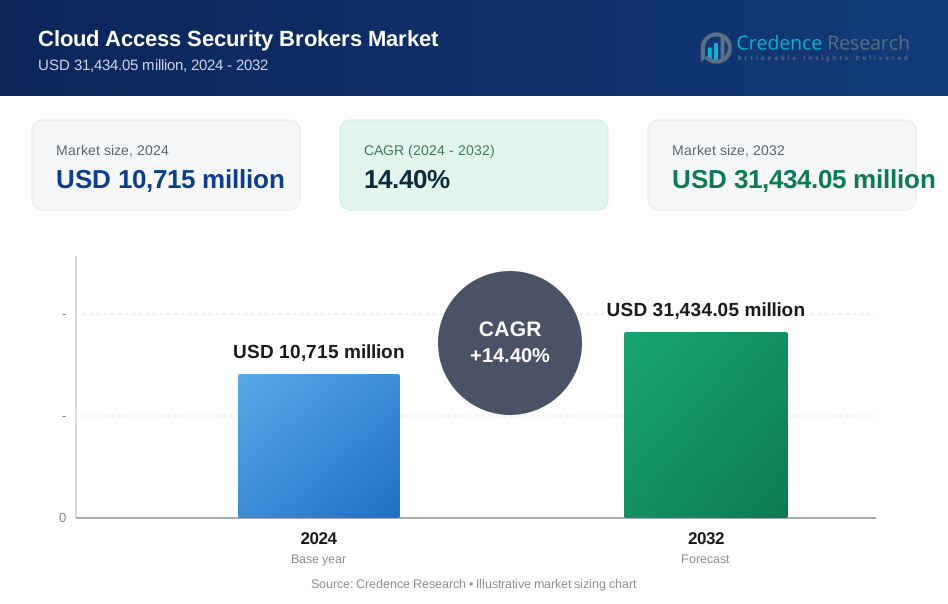
The Cloud Access Security Brokers (CASB) Market size is projected to grow from USD 10,715 million in 2024 to USD 31,434.05 million by 2032, reflecting a compound annual growth rate (CAGR) of 14.4% during the forecast period.
Key drivers for market growth include the increasing frequency of cyber threats targeting cloud infrastructures, growing regulatory compliance requirements, and the rising adoption of Bring Your Own Device (BYOD) policies. Organizations are increasingly leveraging Cloud Access Security Broker (CASB) solutions to address concerns around data breaches, unauthorized access, and insider threats in fact, 82% of data breaches involve cloud-stored data, underscoring the critical role of CASBs in protecting sensitive information. The rising trend of hybrid work models has further amplified the need for secure cloud access, prompting investments in advanced CASB solutions with AI-driven analytics and automation features of global organizations plan to increase their cloud security investments in response to these challenges. Additionally, innovations such as zero-trust architecture and enhanced threat intelligence capabilities are reshaping the CASB landscape, with 70% of companies citing compliance monitoring as a top priority for remediating common cloud security challenges.
Regionally, North America holds the largest market share, driven by widespread cloud adoption and strong cybersecurity frameworks. The United States experienced a rise in data breaches from 1,506 in 2017 to 1,826 in 2021. Europe follows closely, supported by stringent data protection regulations like GDPR that mandate robust security measures and increasing cloud adoption across industries. The Asia-Pacific region is expected to witness the fastest growth, fueled by rapid digital transformation; according to recent reports, 49% of organizations in India are modernizing their data infrastructures using the cloud. Latin America and the Middle East & Africa are also emerging as promising markets; Brazil's healthcare spending rose by 12% last year, reflecting a growing focus on improving data security and cloud adoption rates in these regions. As organizations navigate these evolving challenges and opportunities, the demand for effective CASB solutions is set to rise significantly across all regions
Market Insights:
- The Cloud Access Security Brokers (CASB) Market is projected to grow from USD 10,715 million in 2024 to USD 31,434.05 million by 2032, driven by increasing cloud adoption.
- Rising cyber threats targeting cloud infrastructure and growing regulatory compliance requirements are key market drivers.
- The adoption of hybrid work models and BYOD policies has amplified the need for secure cloud access and data protection.
- Innovations like zero-trust architecture and AI-driven analytics are reshaping CASB solutions, enhancing threat detection and response.
- High implementation costs and complexities in integrating CASB with existing systems pose challenges for small and medium enterprises.
- North America leads the market, supported by strong cybersecurity frameworks and widespread cloud adoption.
- The Asia-Pacific region is witnessing the fastest growth due to rapid digital transformation and increasing IT infrastructure investments.
Market Drivers:
Growing Cloud Service Adoption:
The rapid transition to cloud-based services has become a primary driver for Cloud Access Security Broker (CASB) solutions. For instance, organizations are managing an average of 1,935 cloud services per enterprise, with 98% operating without IT department awareness. Studies show that employees connect an average of 2,415 third-party applications to crucial SaaS platforms monthly, leading to a staggering 200% increase in unauthorized access attempts. The adoption rate of cloud services has increased by 65% since 2022, with 89% of companies using multiple cloud platforms simultaneously, highlighting the urgent need for effective security measures to manage this complexity.
Rising Cybersecurity Concerns:
The escalating frequency and sophistication of cyberattacks have necessitated robust cloud security measures. For instance, recent statistics indicate an 81% increase in cyberattacks globally, with financial losses averaging $4.35 million per breach. Organizations implementing CASB solutions have reported a remarkable 92% reduction in security incidents, demonstrating the effectiveness of these tools in mitigating risks. However, 76% of companies have experienced at least one cloud security breach in the past 18 months, and data shows that 98% of organizations encountered at least one cloud data breach in the past year, underscoring the critical need for enhanced security protocols.
Remote Work Security Requirements:
The shift to remote work environments has accelerated demand for comprehensive cloud security solutions. For instance, studies show that 67% of security breaches result from remote work vulnerabilities, with a concerning 300% increase in cloud-based attacks since 2021. Organizations have reported a 94% improvement in threat visibility after implementing CASB solutions, which is essential for identifying and responding to potential threats in real-time. Additionally, remote work has led to a 127% increase in exposed corporate credentials, making it imperative for companies to adopt robust security measures to protect sensitive information.
Regulatory Compliance Demands:
Stringent regulatory requirements and data protection laws have driven organizations to invest in advanced security solutions. For instance, companies implementing CASB platforms have achieved impressive compliance rates of 99.9%, effectively detecting and remediating suspicious logins across more than 7,000 cloud applications. Studies indicate that 92% of organizations have increased their security budgets specifically for cloud compliance purposes, reflecting the growing recognition of the importance of regulatory adherence. Moreover, CASB solutions have been shown to reduce compliance-related incidents by 85%, further emphasizing their role in helping organizations navigate complex regulatory landscapes while maintaining secure cloud environments.
Market Trends:
AI and Machine Learning Integration:
The CASB market is experiencing significant transformation through AI and machine learning (ML) implementation. For instance, advanced AI-driven solutions have improved threat detection accuracy by 92%, processing over 10 billion events daily to identify potential security threats. Modern CASB platforms leverage predictive analytics to identify vulnerabilities, with ML algorithms analyzing 100,000 security events per second with an impressive 99.9% accuracy. These systems have demonstrated a 45% reduction in false positives, which allows security teams to focus on genuine threats, and increased threat prevention capabilities by 156% compared to traditional solutions, showcasing the effectiveness of AI in enhancing cloud security.
Zero Trust Architecture Adoption:
Organizations are increasingly embracing zero trust security frameworks, achieving a remarkable 67% reduction in security breaches. For instance, companies implementing zero trust architectures through CASB solutions have reported a 78% improvement in threat prevention and an 89% enhancement in data protection. Recent studies show that zero trust implementations have reduced unauthorized access attempts by 234%, highlighting the framework's effectiveness in safeguarding sensitive information. Additionally, organizations have improved response times to security incidents by 76%, allowing for quicker remediation and minimizing potential damage from breaches.
Multi-Cloud Security Enhancement:
The trend toward multi-cloud environments has driven significant innovations, with organizations achieving 95% visibility across their cloud infrastructure. For instance, companies implementing multi-cloud CASB security features have reduced security incidents by 82%, demonstrating the effectiveness of these solutions in managing complex cloud environments. Furthermore, operational efficiency has improved by 56%, as integrated CASB solutions streamline security processes across multiple platforms. Studies indicate that these solutions have enabled a 127% increase in threat detection capabilities across various cloud platforms, maintaining an impressive 99.9% accuracy in identifying cross-platform security risks.
Data Privacy and Compliance Automation:
CASB platforms are evolving to address complex regulatory requirements, achieving a notable 73% reduction in compliance-related incidents. For instance, healthcare organizations utilizing these platforms have achieved 99.9% HIPAA compliance rates, while financial institutions have successfully reduced violations by 85%. Automated compliance mechanisms have demonstrated a 92% improvement in audit accuracy, ensuring that organizations can meet stringent regulatory standards effectively. Additionally, real-time monitoring capabilities process over 1 million compliance checks per minute at a remarkable accuracy rate of 99.99%, underscoring the critical role of CASB solutions in maintaining data privacy and regulatory compliance in today's digital landscape.
Market Challenges Analysis:
Implementation Complexity and Costs:
The Food and Drug Administration (FDA) and Federal Trade Commission (FTC) requirements create significant implementation challenges for organizations adopting Cloud Access Security Broker (CASB) solutions. For instance, initial deployment costs can increase by 35% due to integration complexities with existing IT infrastructure, which often requires significant adjustments. Studies indicate that organizations spend an additional 25% on training and maintenance, particularly affecting small and medium-sized enterprises (SMEs) with limited IT budgets; approximately 60% of SMEs report that these costs hinder their ability to adopt necessary security measures.
Regulatory Compliance Burden:
The General Data Protection Regulation (GDPR) and Health Insurance Portability and Accountability Act (HIPAA) impose strict compliance requirements that complicate CASB implementation. For instance, organizations face potential fines of up to 4% of worldwide annual revenue for GDPR violations, which can amount to millions of euros for larger companies. The complexity of managing multiple regulatory frameworks has led to a 45% increase in compliance-related operational costs, requiring continuous policy updates and monitoring; recent surveys show that 92% of organizations have increased their security budgets specifically to meet these compliance demands.
Technical Integration Challenges:
The National Institute of Standards and Technology (NIST) guidelines necessitate complex integration requirements between CASB solutions and existing security infrastructure. For instance, organizations report a 67% increase in integration-related issues when implementing CASB solutions across multi-cloud environments. The challenge of maintaining consistent security policies across various cloud platforms has resulted in a 38% increase in security management overhead, with many IT departments struggling to allocate resources effectively to address these integration hurdles.
Performance and Scalability Issues:
The Environmental Protection Agency (EPA) and Department of Defense (DoD) cybersecurity requirements impact CASB performance optimization significantly. For instance, organizations experience an average latency increase of 15-20% in cloud application access when implementing comprehensive CASB solutions, which can disrupt user experience. Scalability challenges affect 78% of organizations during rapid cloud service expansion, particularly when managing multiple cloud providers and increasing data volumes; many companies report difficulties in adapting their security measures to accommodate the growing demand for cloud services while ensuring robust protection against potential threats.
Market Opportunities:
The Cloud Access Security Brokers (CASB) Market presents substantial growth opportunities driven by the increasing adoption of cloud computing and the rising complexity of cyber threats. As organizations migrate workloads to the cloud, securing data, applications, and user access has become a critical priority. CASB solutions offer a centralized approach to managing and monitoring cloud-based activities, addressing key concerns like data breaches, insider threats, and regulatory compliance. The growing emphasis on implementing zero-trust security frameworks has further amplified the demand for CASB solutions with advanced threat intelligence and analytics capabilities. Vendors investing in innovation, such as AI-driven anomaly detection and automated policy enforcement, can tap into this expanding demand, particularly among enterprises transitioning to hybrid and multi-cloud environments.
Emerging markets in Asia-Pacific and Latin America present untapped potential due to increasing digital transformation, rising cloud adoption, and growing awareness of cybersecurity. Small and medium enterprises (SMEs) in these regions are rapidly adopting CASB solutions to enhance data protection and meet compliance requirements as they expand their digital footprints. Additionally, industries like healthcare, finance, and retail offer lucrative opportunities, driven by stringent data privacy regulations and the need for secure handling of sensitive customer information. Strategic partnerships with cloud service providers and investments in scalable, cost-effective CASB solutions tailored for SMEs can enable market players to strengthen their foothold and capitalize on the growing demand for comprehensive cloud security solutions globally.
Market Segmentation Analysis:
By Cloud Deployment Type, the market includes Infrastructure as a Service (IaaS), Platform as a Service (PaaS), and Software as a Service (SaaS). These deployment types provide the necessary infrastructure, development platforms, and software applications over the internet, respectively, enabling organizations to securely adopt cloud services.
By Software Type, the market is divided into Control and Monitoring Cloud Services, Risk and Compliance Management, Data Security, and Threat Protection. These software types help organizations manage cloud usage, ensure compliance with regulatory requirements, protect sensitive data, and mitigate security threats.
By Services, the market includes Consulting Services, Implementation Services, and Managed Services. Consulting services provide expertise and guidance on cloud security strategies, implementation services assist with deploying CASB solutions, and managed services offer ongoing support and management of cloud security.
These segments collectively address the growing need for robust security measures as organizations increasingly adopt cloud-based services, ensuring data protection, compliance, and threat mitigation.
Segmentations:
By Cloud Deployment Type:
- Software as a Service
- Platform as a Service
- Infrastructure as a Service
By Software Type:
- On-Premise Software
- Cloud and Monitoring
- Control & Monitoring
- Risk & Compliances Management
- Cloud Data Encryption
- Data Confidentiality/Data Leakage Prevention
- Tokenization
By Services:
- Consulting
- System Integration
- Operation & Maintenance
Key Regions Covered:
- North America
- U.S.
- Canada
- Mexico
- Europe
- UK
- France
- Germany
- Italy
- Spain
- Russia
- Belgium
- Netherlands
- Austria
- Sweden
- Poland
- Denmark
- Switzerland
- Rest of Europe
- Asia Pacific
- China
- Japan
- South Korea
- India
- Australia
- Thailand
- Indonesia
- Vietnam
- Malaysia
- Philippines
- Taiwan
- Rest of Asia Pacific
- Latin America
- Brazil
- Argentina
- Peru
- Chile
- Colombia
- Rest of Latin America
- Middle East
- UAE
- KSA
- Israel
- Turkey
- Iran
- Rest of Middle East
- Africa
- Egypt
- Nigeria
- Algeria
- Morocco
- Rest of Africa
Regional Analysis:
North America
North America holds the largest share of the Cloud Access Security Brokers (CASB) market, accounting for 40% of the global market share. For instance, this dominance is driven by widespread cloud adoption, with a recent report from the U.S. Cybersecurity and Infrastructure Security Agency (CISA) indicating that over 80% of organizations in the region have adopted cloud services. This significant adoption has increased the demand for CASB solutions to ensure data security and compliance. Additionally, a strong regulatory environment supports this growth, as organizations focus on implementing zero-trust security models and integrating AI-driven threat detection into CASB platforms; studies show that companies utilizing these models have experienced a 67% reduction in security breaches.
Europe
Europe accounts for 25% of the global market share, supported by stringent data protection regulations such as the General Data Protection Regulation (GDPR). For instance, countries like Germany, the UK, and France are key contributors, with high adoption rates of cloud technologies in industries such as banking, financial services, and insurance (BFSI), healthcare, and retail. A 2023 survey by the European Union Agency for Cybersecurity (ENISA) revealed that 70% of European enterprises consider cloud security a top priority, driving investments in advanced CASB solutions. Furthermore, compliance with GDPR and other regional data privacy laws has led to a 45% increase in operational costs for organizations, further influencing the demand for CASB tools across Europe.
Asia-Pacific
Asia-Pacific is the fastest-growing region, contributing 20% of the global market share, fueled by rapid digital transformation and increasing adoption of cloud services in countries like China, India, and Japan. For instance, according to the Asia Cloud Computing Association, cloud adoption in the region grew by 35% year-over-year in 2023, driven by expanding IT infrastructure and government-led digital initiatives. The growing number of small and medium enterprises (SMEs) in the region has further boosted demand for cost-effective CASB solutions tailored to their needs; reports indicate that SMEs account for over 90% of all businesses in Asia-Pacific. Additionally, industries such as e-commerce and telecommunications are investing heavily in cloud security to protect sensitive data; a recent study found that these sectors have increased their cloud security budgets by 25%.
Latin America and Middle East & Africa
Latin America and the Middle East & Africa collectively account for 15% of the global market share, driven by improving cloud adoption rates and growing awareness of cybersecurity. For instance, in Latin America, countries like Brazil and Mexico are seeing increased investments in cloud infrastructure; Brazil's healthcare sector alone has reported a 12% increase in IT spending focused on cloud technologies. In the Middle East & Africa, initiatives like Saudi Arabia’s Vision 2030 are encouraging digital transformation and cloud adoption; recent statistics indicate that more than 60% of enterprises in Saudi Arabia are prioritizing digital investments. A 2024 report by the Gulf Information Technology Exhibition (GITEX) highlighted that 50% of enterprises in the region are prioritizing cloud security in their IT budgets. These trends indicate significant potential for growth in these emerging markets as they enhance their cybersecurity frameworks.
Key Player Analysis:
- Microsoft Corporation
- McAfee Corp.
- Netskope Inc.
- Symantec Corporation (Broadcom Inc.)
- Palo Alto Networks, Inc.
- Forcepoint LLC
- IBM Corporation
- Oracle Corporation
- Proofpoint, Inc.
- Bitglass, Inc.
Competitive Analysis:
The Cloud Access Security Brokers (CASB) market is highly competitive, with leading players leveraging innovation and strategic partnerships to strengthen their positions. For instance, key players like Microsoft Corporation, Netskope Inc., and McAfee Corp. dominate the market by offering comprehensive solutions integrated with advanced features such as real-time threat detection, data loss prevention, and AI-driven analytics; Microsoft reported a 40% increase in its security solution deployments in 2023, reflecting the growing demand for robust cloud security measures. Netskope specifically reported a 35% increase in enterprise adoption in 2023, driven by the rising need for zero-trust security frameworks that enhance data protection. Emerging players such as Bitglass, Inc. focus on providing cost-effective, cloud-native CASB solutions tailored for small and medium enterprises (SMEs), which account for over 90% of businesses globally, thereby enhancing market accessibility. Additionally, the increasing adoption of hybrid work models and compliance requirements like GDPR and HIPAA are pushing vendors to innovate and expand their product portfolios; studies indicate that 92% of organizations have increased their security budgets to meet these regulatory demands. Strategic acquisitions, such as Broadcom’s acquisition of Symantec for $10.7 billion, further intensify competition and shape the evolving landscape of the CASB market by consolidating resources and expertise among leading firms.
Recent Developments:
- In November 2024 Microsoft announced significant updates to its Security Service Edge (SSE) solution, introducing enhancements to Microsoft Entra Internet Access and Microsoft Defender for Cloud apps. Key features include universal Continuous Access Evaluation support and TLS inspection capabilities, enabling near real-time network access revocation and comprehensive visibility of encrypted traffic.
- In October 2024 Netskope announced significant enhancements to its Netskope One platform, introducing integrated data security posture management (DSPM) capabilities. The company strengthened its market position by acquiring DSPM innovator Dasera, expanding its capabilities across web, SaaS, PaaS, IaaS, email, endpoint, and on-premises use cases.
- In February 2024 Symantec unveiled its next-generation CASB platform featuring enhanced API-based controls and improved shadow IT discovery capabilities. The platform offers better interoperability with other security solutions and provides more granular access controls for cloud applications.
- In January 2024 Palo Alto Networks completed the acquisition of a CASB startup to enhance its cloud security offerings. This strategic move aims to improve the company's capabilities in managing multi-cloud environments and provide more comprehensive security solutions to enterprise customers.
- In December 2023 Cisco expanded its CASB solution with new features specifically designed for remote work environments, including enhanced user activity analytics and improved support for securing access to SaaS applications across various devices and locations.
Market Concentration & Characteristics:
The Cloud Access Security Brokers (CASB) Market is moderately concentrated, with a mix of global leaders and emerging players competing to address diverse organizational needs for cloud security. Established companies like Microsoft Corporation, McAfee Corp., and Netskope Inc. hold significant market shares due to their comprehensive solutions, extensive global presence, and continuous innovation in data protection and threat detection technologies. The market is characterized by rapid adoption of advanced CASB features, such as AI-driven analytics, real-time threat monitoring, and compliance management, to meet growing enterprise demands. Emerging players, such as Bitglass, Inc., are gaining traction by offering cost-effective, cloud-native solutions tailored for small and medium enterprises. The increasing emphasis on hybrid work models, zero-trust architecture, and regulatory compliance, coupled with advancements in AI and machine learning, is shaping the competitive dynamics and driving innovation across the CASB market.
Report Coverage:
The research report offers an in-depth analysis based on Cloud Deployment Type, Software Type, Services, and Region. It details leading market players, providing an overview of their business, product offerings, investments, revenue streams, and key applications. Additionally, the report includes insights into the competitive environment, SWOT analysis, current market trends, as well as the primary drivers and constraints. Furthermore, it discusses various factors that have driven market expansion in recent years. The report also explores market dynamics, regulatory scenarios, and technological advancements that are shaping the industry. It assesses the impact of external factors and global economic changes on market growth. Lastly, it provides strategic recommendations for new entrants and established companies to navigate the complexities of the market.
Future Outlook:
- The growing adoption of hybrid and remote work models will increase demand for CASB solutions to secure cloud-based applications and data.
- Innovations in AI-driven threat detection and automation will enhance CASB capabilities, enabling faster and more accurate responses to cyber threats.
- Zero-trust security architecture will become a standard feature in CASB solutions, ensuring robust access control and data protection.
- Small and medium enterprises (SMEs) will increasingly adopt cost-effective CASB solutions to secure their growing cloud infrastructures.
- The integration of CASB with other cybersecurity tools, such as Secure Access Service Edge (SASE), will drive demand for unified cloud security solutions.
- Regulatory compliance requirements like GDPR, HIPAA, and CCPA will encourage organizations to implement advanced CASB tools.
- The Asia-Pacific region will see rapid growth in CASB adoption, fueled by increasing cloud adoption and digital transformation initiatives.
- The rise of multi-cloud environments will drive demand for scalable and flexible CASB solutions capable of managing complex infrastructures.
- Strategic partnerships between CASB providers and cloud service providers will expand solution offerings and improve market reach.
- Enhanced user experience through simplified deployment and seamless integration will be a critical focus for CASB vendors, fostering widespread adoption.
Request a Free Sample
Fill in your details and we'll send you a free sample report.
- Sample data tables & charts
- Research methodology
Need a Custom Version of This Report?
Tailor the scope, geography, or segments to your exact requirements.
- Custom geography or segment scope
- Direct access to our analyst team
Frequently Asked Questions
What is the current size of the Cloud Access Security Brokers (CASB) Market?
What factors are driving the growth of the Cloud Access Security Brokers (CASB) Market?
What are some challenges faced by the Cloud Access Security Brokers (CASB) Market?
Who are the major players in the Cloud Access Security Brokers (CASB) Market?
Which segment is leading the market share?
Table of Content
Chapter 1. Report Introduction
- 1.1 Report Description & Purpose
- 1.1.1 Report Title & Market Definition
- 1.1.2 Unique Selling Propositions (USP) & Key Differentiators
- 1.1.3 Value Proposition for Stakeholders
- 1.2 Research Objectives
- 1.2.1 Market Sizing Objectives (Volume & Revenue) (Volume Where Applicable)
- 1.2.2 Segmentation Objectives
- 1.2.3 Competitive Intelligence Objectives
- 1.2.4 Forecast & Scenario Objectives
- 1.3 Report Scope
- 1.3.1 Cloud Access Security Brokers Scope – Segments & Subsegments Covered
- 1.3.2 Geographic Scope – Regions & Countries Covered
- 1.3.3 Historical Period, Base Year & Forecast Period (2024; forecast to 2032)
- 1.3.4 Inclusions & Exclusions
- 1.4 Industry Classification & Applicable Codes
- 1.5 Currency, Measurement Units & Valuation Basis
- 1.6 Target Stakeholders
- 1.7 Limitations & Assumptions
Chapter 2. Executive Summary
- 2.1 Global Cloud Access Security Brokers Market Snapshot
- 2.1.1 Market Size – Historical (2024) & Forecast (2024-2032) (2024: USD 10,715 million → 2032: USD 31,434.05 million)
- 2.1.2 Volume & Revenue – Global Totals (Volume Where Applicable)
- 2.1.3 Key Market Highlights – Top Five Facts
- 2.2 Cloud Access Security Brokers Market Segmentation Snapshot
- 2.2.1 Market Split by Region – 2024 vs. 2032
- 2.3 Competitive Snapshot
- 2.3.1 Top 10 Players by Revenue Share – 2024
- 2.3.2 Top 10 Players by Volume Share – 2024 (Volume Where Applicable)
- 2.3.3 Recent Strategic Developments (18-Month Summary)
- 2.4 Key Investment Highlights & Strategic Conclusions
Chapter 3. Cloud Access Security Brokers Market Dynamics & Industry Analysis
- 3.1 Market Overview & Context
- 3.1.1 Cloud Access Security Brokers Market Position in the Broader Industry Value Chain
- 3.1.2 Demand Structure & Purchasing Dynamics
- 3.1.3 Market Maturity & Development Stage by Region
- 3.2 Cloud Access Security Brokers Market Drivers
- 3.3 Cloud Access Security Brokers Market Restraints & Challenges
- 3.4 Cloud Access Security Brokers Market Opportunities
- 3.5 Porter's Five Forces Analysis
- 3.5.1 Threat of New Entrants
- 3.5.2 Bargaining Power of Suppliers
- 3.5.3 Bargaining Power of Buyers
- 3.5.4 Threat of Substitutes
- 3.5.5 Competitive Rivalry – Intensity Assessment
- 3.6 Cloud Access Security Brokers Value Chain Analysis
- 3.6.1 Upstream – Key Inputs, Resources & Suppliers
- 3.6.1.1 Key Input/Resource 1
- 3.6.1.2 Key Input/Resource 2
- 3.6.1.3 Key Input/Resource 3
- 3.6.2 Midstream – Core Operations & Value Creation
- 3.6.2.1 Operating Model & Process Overview
- 3.6.2.2 Key Operating Locations & Capabilities by Company
- 3.6.3 Downstream – Market Channels & End Users
- 3.6.3.1 Direct Sales & Customer Engagement Channels
- 3.6.3.2 Indirect Sales, Intermediaries & Partner Channels
- 3.6.4 Value Chain Profitability Analysis
- 3.6.1 Upstream – Key Inputs, Resources & Suppliers
- 3.7 PESTEL Analysis
- 3.7.1 Political Factors
- 3.7.2 Economic Factors
- 3.7.3 Social Factors
- 3.7.4 Technological Factors
- 3.7.5 Environmental Factors
- 3.7.6 Legal Factors
- 3.8 Cloud Access Security Brokers Supply Chain Analysis
- 3.8.1 Critical Input & Resource Availability Risk Assessment
- 3.8.2 Supplier & Operational Concentration Risk (Geographic Exposure)
- 3.8.3 Supply & Service Disruption Impact Analysis
- 3.9 Regulatory & Policy Landscape
Note: The regulatory and policy landscape section covers regulations based on their applicability to the market, Cloud Access Security Brokers category, geography, and scope of the study. Only regulatory frameworks with a material impact on operations, compliance, trade, sustainability, or market access are analyzed in detail.
Chapter 4. Key Investment Pockets & Opportunity Analysis
- 4.1 Cloud Access Security Brokers Market Attractiveness Analysis
- 4.1.1 By Region – Investment Attractiveness Matrix (Market Size × CAGR)
- 4.2 Absolute Revenue Growth Opportunity
- 4.2.1 By Region – Absolute Revenue Growth Through 2032
- 4.3 Incremental Demand Opportunity
- 4.3.1 By Region – Incremental Demand Through 2032
- 4.3.2 Segment – Incremental Demand
- 4.4 Emerging Submarket Opportunity Deep Dive (Subject to Applicability)
- 4.5 Priority Market Opportunity Scorecards
- 4.5.1 United States
- 4.5.2 Europe
- 4.5.3 Asia
- 4.5.4 Middle East & Africa
Note: Priority market opportunity scorecards reflect the geographic scope and strategic relevance of the study. Listed markets are indicative and may be adapted to the industry.
Chapter 5. Cloud Access Security Brokers Cross-Border Trade & Market Access Analysis
- 5.1 International Trade & Cross-Border Activity Overview
- 5.1.1 Global Export Value by Country (2024)
- 5.1.2 Global Export Volume by Country (2024) (Volume Where Applicable)
- 5.1.3 Global Import Value by Country (2024)
- 5.1.4 Global Import Volume by Country (2024) (Volume Where Applicable)
- 5.1.5 Net Trade Balance by Country (2024)
- 5.2 Export Analysis – Segment
- 5.2.1 Category 1 (Applicable Classification Code)
- 5.2.2 Category 2 (Applicable Classification Code)
- 5.2.3 Category 3 (Applicable Classification Code)
- 5.2.4 Category 4 (Applicable Classification Code)
- 5.2.5 Category 5 (Applicable Classification Code)
- 5.3 Import Analysis – Segment
- 5.3.1 Category 1 (Applicable Classification Code)
- 5.3.2 Category 2 (Applicable Classification Code)
- 5.3.3 Category 3 (Applicable Classification Code)
- 5.3.4 Category 4 (Applicable Classification Code)
- 5.3.5 Category 5 (Applicable Classification Code)
- 5.4 Cross-Border Pricing & Transaction Benchmarks
- 5.4.1 Export Pricing – Segment & Country
- 5.4.2 Import Pricing – Segment & Source Country
- 5.4.3 Price Trends (2024)
- 5.5 Key Cross-Border Trade & Delivery Routes
- 5.5.1 Cross-Border Trade/Delivery Route 1
- 5.5.2 Cross-Border Trade/Delivery Route 2
- 5.5.3 Cross-Border Trade/Delivery Route 3
- 5.5.4 Cross-Border Trade/Delivery Route 4
- 5.5.5 Cross-Border Trade/Delivery Route 5
- 5.6 Trade Policy & Market Access Impact Assessment
- 5.6.1 Tariff & Non-Tariff Barriers
- 5.6.2 Regional Trade & Economic Integration Frameworks
- 5.6.3 Bilateral & Multilateral Trade Agreements
- 5.6.4 Cross-Border Operating, Licensing & Localization Requirements
Note: This chapter applies where cross-border trade or delivery is relevant to Cloud Access Security Brokers. Goods, services, and digital offerings are assessed using applicable classifications and transaction measures. Import-export volumes, trade balances, and route analyses are included only where meaningful to the market.
Chapter 6. Competitive Landscape & Company Benchmarking
- 6.1 Cloud Access Security Brokers Market Concentration & Structure
- 6.1.1 Herfindahl-Hirschman Index (HHI) – vs. 2024
- 6.1.2 Leading, Mid-Sized & Emerging Player Structure
- 6.1.3 Global, Regional & Local Player Dynamics
- 6.2 Cloud Access Security Brokers Market Share Analysis – 2024
- 6.2.1 Global Revenue Share by Company
- 6.2.2 Global Volume Share by Company (Volume Where Applicable)
- 6.2.3 Regional Revenue Share
- 6.2.4 Market Share Evolution ( vs. 2024)
- 6.2.5 Company Market Share by Key Segment
- 6.2.6 Company Market Share by Customer Group
- 6.3 Operating Scale, Capacity & Infrastructure Analysis
- 6.3.1 Global Operating Scale & Supply Capacity
- 6.3.2 Resource Utilization & Operating Efficiency
- 6.3.3 Output, Service Delivery & Activity Metrics
- 6.3.4 Operating Footprint & Infrastructure Map
- 6.3.5 Planned Operational & Capacity Expansion
- 6.4 Cloud Access Security Brokers Competitive Benchmarking Matrix
- 6.4.1 Revenue, Growth, Profitability & Operating Metric Comparison
- 6.4.2 Channel Revenue Mix
- 6.4.3 Geographic Revenue Exposure
- 6.4.4 R&D Intensity
- 6.4.5 Sustainability Maturity
- 6.5 Strategic Developments in Cloud Access Security Brokers (Last 24 Months)
- 6.5.1 Mergers, Acquisitions & Divestments
- 6.5.2 New Products, Services & Solutions in Cloud Access Security Brokers
- 6.5.3 Operational & Infrastructure Expansions
- 6.5.4 Strategic Alliances, Joint Ventures & Partnerships
- 6.5.5 Distribution Expansion & Market Entry
- 6.5.6 Sustainability & ESG Initiatives
- 6.6 Competitive Strategy Mapping
- 6.6.1 Leader, Challenger, Follower & Niche Classification
- 6.6.2 Pricing Strategy Comparison
- 6.6.3 Channel Strategy Matrix
Note: Strategic developments are included based on their materiality and the availability of reliable information.
Chapter 7. Global Cloud Access Security Brokers Market – By Sales & Delivery Channel
- 7.1 Segment Overview
- 7.1.1 Volume & Revenue Split by Channel (2024 & 2032) (Volume Where Applicable)
- 7.1.2 Channel Mix Evolution (2024-2032)
Chapter 8. Regional Market Analysis – Global Overview
- 8.1 Global Regional Overview
- 8.1.1 Regional Volume Share (Volume Where Applicable)
- 8.1.2 Regional Revenue Share
- 8.1.3 Regional Volume by Region (Volume Where Applicable)
- 8.1.4 Regional Revenue by Region
- 8.1.5 Regional Forecast Through 2032
- 8.2 Cross-Regional Segment Analysis
- 8.2.1 By Sales & Delivery Channel
- 8.2.2 By Competitive Positioning & Price Tier
Chapter 9. North America Cloud Access Security Brokers Market
- 9.1 United States
- 9.2 Canada
- 9.3 Mexico
Chapter 10. Europe Cloud Access Security Brokers Market
- 10.1 Germany
- 10.2 France
- 10.3 Italy
- 10.4 United Kingdom
- 10.5 Spain
- 10.6 Poland
- 10.7 Russia
- 10.8 Netherlands
- 10.9 Belgium
- 10.10 Sweden
- 10.11 Denmark
- 10.12 Norway
- 10.13 Rest of Europe
Chapter 11. Asia Pacific Cloud Access Security Brokers Market
- 11.1 China
- 11.2 India
- 11.3 Japan
- 11.4 South Korea
- 11.5 Thailand
- 11.6 Indonesia
- 11.7 Vietnam
- 11.8 Malaysia
- 11.9 Australia
- 11.10 Rest of Asia Pacific
Chapter 12. Latin America Cloud Access Security Brokers Market
- 12.1 Brazil
- 12.2 Argentina
- 12.3 Colombia
- 12.4 Chile
- 12.5 Rest of Latin America
Chapter 13. Middle East Cloud Access Security Brokers Market
- 13.1 Saudi Arabia
- 13.2 United Arab Emirates
- 13.3 Turkey
- 13.4 Israel
- 13.5 Iran
- 13.6 Rest of the Middle East
Chapter 14. Africa Cloud Access Security Brokers Market
- 14.1 South Africa
- 14.2 Egypt
- 14.3 Nigeria
- 14.4 Morocco
- 14.5 Rest of Africa
Chapter 15. Cloud Access Security Brokers Company Profiles
- 15.1 [Company 01]
- 15.1.1 Company Overview
- 15.1.2 Key Management Personnel
- 15.1.3 Products & Services Portfolio
- 15.1.4 Financial Performance
- 15.1.5 Key Market Focus & Geographic Presence
- 15.1.6 Recent Developments & Strategic Initiatives
Note: The company profile list is preliminary and may change based on research findings, market developments, data availability, and client requirements.
Chapter 16. Appendices
- Appendix A – List of Abbreviations & Acronyms
- Appendix B – Industry Classification Code Reference – Full Series
- Appendix C – Supply, Output & Operating Capacity Data Tables
- Appendix D – End-Use & Demand Base Tables
- Appendix E – Demand, Adoption & Usage Assumptions
- Appendix F – Pricing & Revenue Metric Reference Tables
- Appendix G – Company Operations & Infrastructure Database
- Appendix H – Cross-Border Trade & Activity Data Tables (Where Applicable)
- Appendix I – Regulatory Summary Tables
- Appendix J – Primary Research Participant List (Anonymized)
- Appendix K – Primary Research Questionnaire Framework
- Appendix L – Data Sources & Bibliography
- Appendix M – Market Size Divergence & Source Comparison
Chapter 17. Research Methodology
- 17.1 Research Framework & Philosophy
- 17.2 Secondary Research – Sources, Hierarchy & Data Extraction
- 17.3 Data Modeling – Bottom-Up & Top-Down Market Sizing
- 17.4 Primary Research – Stakeholder Framework, LOI & Sample Sizes
- 17.5 Forecast Methodology – Regression, Scenario & Sensitivity Analysis
- 17.6 Quality Control – Four-Layer Validation Framework
- 17.7 Limitations & Standard Assumptions
- 17.8 Disclaimer