
mRNA Synthesis And Manufacturing Market Overview:
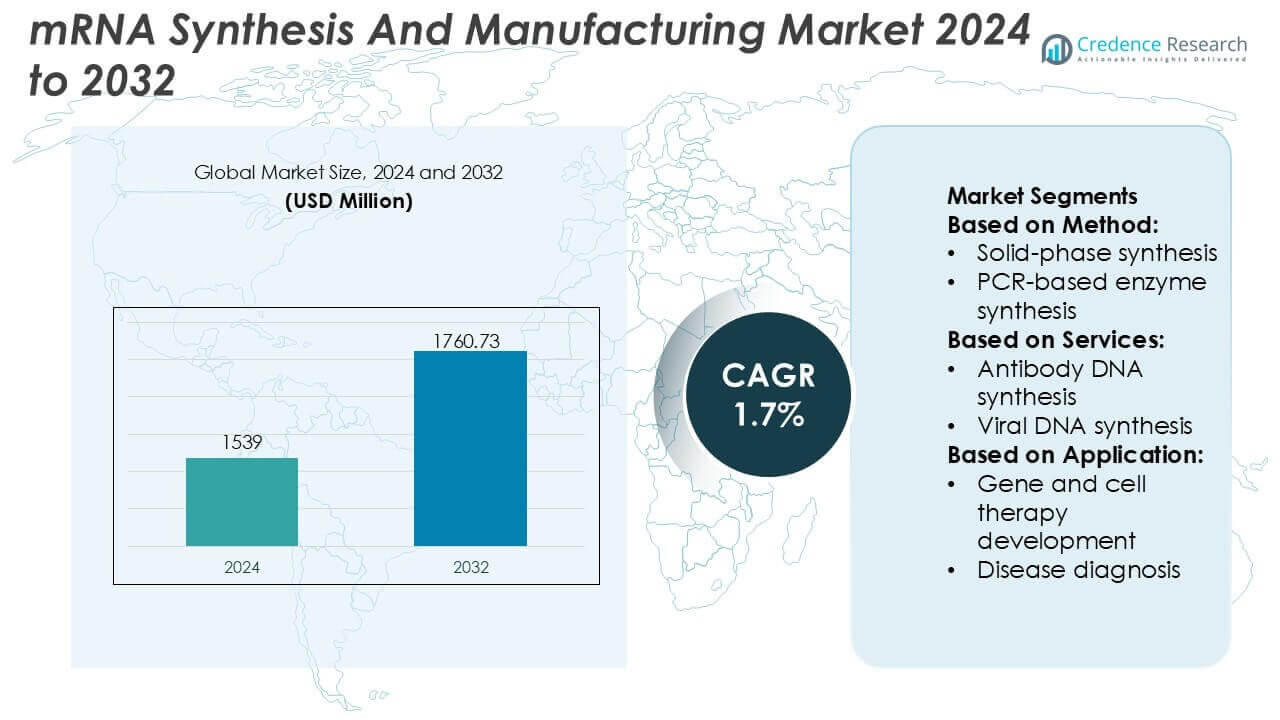
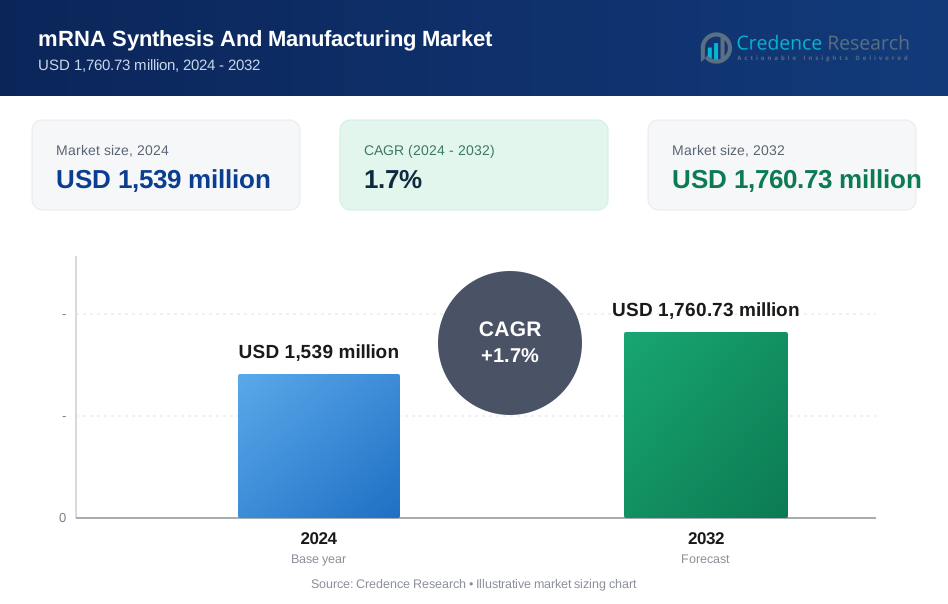
mRNA Synthesis And Manufacturing Market size was valued USD 1539 million in 2024 and is anticipated to reach USD 1760.73 million by 2032, at a CAGR of 1.7% during the forecast period.
| REPORT ATTRIBUTE | DETAILS |
|---|---|
| Historical Period | 2020-2023 |
| Base Year | 2024 |
| Forecast Period | 2025-2032 |
| mRNA Synthesis And Manufacturing Market Size 2024 | USD 1539 million |
| mRNA Synthesis And Manufacturing Market, CAGR | 1.7% |
| mRNA Synthesis And Manufacturing Market Size 2032 | USD 1760.73 million |
mRNA Synthesis And Manufacturing Market Insights
- Market growth is driven by expanding mRNA pipelines in vaccines and therapeutics, rising biopharmaceutical R&D investment, and increasing reliance on GMP-compliant, scalable manufacturing platforms that support faster development timelines.
- Key trends include wider adoption of automated and modular production systems, growing outsourcing to CDMOs, and process optimization across enzymatic synthesis and purification, with enzymatic in vitro transcription accounting for nearly 65% segment share due to high yield and scalability.
- Competitive dynamics focus on process efficiency, regulatory compliance, capacity expansion, and strategic partnerships that enable rapid scale-up and global supply continuity, while high capital requirements act as a key market restraint.
- Regionally, North America leads with an exact 41% market share, supported by strong R&D intensity and advanced infrastructure, followed by Europe and Asia-Pacific, where capacity expansion and localization strategies continue to gain momentum.
mRNA Synthesis And Manufacturing Market Segmentation Analysis:
By Method
By method, solid-phase synthesis dominates the mRNA synthesis and manufacturing market, accounting for an estimated 46% market share, supported by its high coupling efficiency, scalability, and suitability for producing long, sequence-defined RNA constructs. This method enables precise control over nucleotide addition and supports incorporation of modified nucleosides critical for mRNA stability and translation efficiency. PCR-based enzyme synthesis follows, driven by its rapid amplification capability and lower error rates for template generation in research and early-stage manufacturing. Chip-based synthesis holds a smaller but growing share, benefiting from miniaturization, parallelization, and reduced reagent consumption for high-throughput mRNA design workflows.
- For instance, Honeywell International Inc. provides a comprehensive suite of digital automation software and high-purity reagents to support high-fidelity nucleic acid production in GMP-aligned environments. Rather than manufacturing a specific synthesis and purification hardware platform with ±0.1 °C stability.
By Services
By services, antibody DNA synthesis represents the dominant sub-segment with approximately 41% market share, driven by expanding use of mRNA platforms in monoclonal antibody discovery, engineering, and expression optimization. Demand is reinforced by pharmaceutical and biotechnology companies outsourcing complex sequence design and high-fidelity synthesis to specialized providers. Viral DNA synthesis follows closely, supported by its essential role in vaccine vector development and viral gene expression studies. Other services, including custom gene libraries and optimized mRNA templates, maintain steady demand as research organizations seek flexible, end-to-end synthesis solutions to accelerate preclinical and translational programs.
- For instance, FANUC Corporation supplies high-precision industrial robots widely deployed in automated life-science manufacturing lines, with articulated robots achieving repeatability as tight as ±0.02 millimeters and continuous operation lifetimes exceeding 60,000 hours, enabling sterile, high-throughput handling of DNA synthesis reagents, microplates, and enzymatic processing steps under GMP-aligned conditions.
By Application
By application, vaccine development leads the market with an estimated 48% market share, reflecting the broad adoption of mRNA platforms for infectious disease prevention and rapid-response vaccine programs. Strong drivers include fast development timelines, scalable manufacturing, and adaptability to emerging pathogens. Gene and cell therapy development represents the next significant sub-segment, supported by growing pipelines targeting rare and genetic diseases using mRNA-based delivery approaches. Disease diagnosis and other applications hold smaller but stable shares, leveraging mRNA synthesis for molecular diagnostics, assay development, and functional genomics research across academic and clinical settings.
Key Growth Drivers
Expansion of mRNA-Based Therapeutics and Vaccines
The rapid expansion of mRNA-based therapeutics and vaccines remains a primary growth driver for the mRNA synthesis and manufacturing market. Success in infectious disease vaccines has validated mRNA as a versatile and scalable platform, accelerating its adoption across oncology, rare diseases, and personalized medicine. Pharmaceutical and biotechnology companies are increasingly advancing mRNA candidates through clinical pipelines, driving sustained demand for high-quality mRNA production, optimized synthesis workflows, and compliant manufacturing capacity that can support both clinical and commercial-scale requirements.
- For instance, ABB Ltd. has deployed its Ability™ System 800xA distributed control platform in biopharmaceutical manufacturing environments, enabling real-time control of more than 250,000 I/O signals with scan times as low as 10 milliseconds, while integrated analytical measurement solutions deliver temperature accuracy of ±0.05 °C and continuous process data logging at sub-second resolution, directly supporting reproducible mRNA synthesis and downstream manufacturing operations.
Rising Investment in Biopharmaceutical R&D and Capacity Building
Strong investment in biopharmaceutical research and development significantly supports market growth. Governments, private investors, and strategic partnerships are channeling funding toward mRNA innovation, including new therapeutic targets and delivery systems. This investment translates into the expansion of in-house and contract manufacturing capabilities, adoption of advanced synthesis technologies, and construction of GMP-compliant facilities. As companies seek to reduce development timelines and ensure supply security, demand for reliable, scalable mRNA synthesis platforms and specialized manufacturing services continues to increase.
- For instance, Mitsubishi Electric Corporation has enhanced its MELFA industrial robotics portfolio with articulated robots offering positional accuracy up to ±0.02 mm and payload options ranging from 2 kg to 80 kg for precision material handling, while its collaborative MELFA ASSISTA cobots deliver ±0.03 mm repeatability with a 910 mm reach and 5.5 kg payload capacity, supporting cleanroom-compatible tasks in pharmaceutical and biotech production cells.
Technological Advancements in mRNA Synthesis and Process Optimization
Continuous technological advancements in mRNA synthesis processes are driving efficiency and quality improvements across the market. Innovations in enzymatic synthesis, purification, and formulation have enhanced yield, stability, and reproducibility while reducing production time and costs. Automation and digital process controls further improve batch consistency and regulatory compliance. These advancements enable manufacturers to meet stringent quality requirements for clinical and commercial applications, supporting broader adoption of mRNA-based products and reinforcing long-term market growth.
Key Trends & Opportunities
Shift Toward Outsourced and Contract Manufacturing Models
A key trend shaping the market is the increasing reliance on outsourced and contract manufacturing organizations for mRNA synthesis and production. Many biopharmaceutical companies prefer to leverage specialized partners to access advanced infrastructure, regulatory expertise, and scalable capacity without heavy capital investment. This shift creates strong opportunities for contract manufacturers to expand service portfolios, invest in flexible production lines, and support clients across early development through commercialization, strengthening their role within the mRNA value chain.
- For instance, Cisco Systems, Inc. has advanced its secure, AI-enhanced networking and observability solutions that underpin modern outsourced manufacturing facilities, including Cisco Secure Networking stacks with AI-driven anomaly detection capable of analyzing billions of telemetry events per day and automated policy updates processed in under 500 milliseconds to protect connected production assets against evolving threats.
Growing Focus on Personalized and Precision Medicine
The growing focus on personalized and precision medicine presents a significant opportunity for the mRNA synthesis and manufacturing market. Personalized cancer vaccines and patient-specific therapies require rapid, small-batch, and highly controlled mRNA production. This trend is driving demand for modular manufacturing systems, fast turnaround times, and adaptable synthesis platforms. Companies that can efficiently support customized production while maintaining regulatory compliance are well positioned to capture emerging opportunities in this evolving therapeutic landscape.
- For instance, Thermo Fisher Scientific, Inc. has advanced its Applied Biosystems™ QuantStudio™ Absolute Q™ Digital PCR System, which integrates microfluidic array (MAP16) technology with digital PCR to analyze over 20,480 fixed microreaction chambers per panel, enabling theoretical detection sensitivity as low as approximately 0.1 copies per microliter of target nucleic acid and up to four optical channels for multiplex analysis with results in as little as 90 minutes with hands-on time under five minutes.
Integration of Automation and Digital Manufacturing Technologies
The integration of automation and digital technologies is emerging as an important trend and opportunity. Automated synthesis, purification, and filling systems reduce manual intervention, improve reproducibility, and support scale-up. Digital monitoring, data analytics, and process modeling enhance quality control and regulatory documentation. These capabilities not only improve operational efficiency but also help manufacturers meet stringent regulatory expectations, making advanced digital manufacturing solutions a key differentiator in the competitive mRNA manufacturing market.
Key Challenges
Complex Manufacturing Processes and Quality Control Requirements
The complexity of mRNA synthesis and manufacturing presents a major challenge for market participants. The process involves multiple sensitive steps, including transcription, capping, purification, and formulation, each requiring precise control to ensure product quality and stability. Maintaining consistency across batches while meeting strict regulatory standards can be difficult, particularly during scale-up. Any variability can impact efficacy or safety, increasing the burden on quality assurance systems and driving higher operational costs.
Supply Chain Constraints and Scalability Limitations
Supply chain constraints and scalability limitations also challenge the mRNA synthesis and manufacturing market. Dependence on specialized raw materials, enzymes, nucleotides, and single-use components can expose manufacturers to shortages and price volatility. Rapid demand surges further strain existing capacity and logistics networks. Scaling production without compromising quality or compliance requires significant planning, investment, and coordination, making supply chain resilience and capacity management critical but challenging priorities for industry stakeholders.
Regional Analysis
North America
North America dominates the mRNA synthesis and manufacturing market, accounting for an estimated 41% market share. The region benefits from a strong biopharmaceutical ecosystem, advanced research infrastructure, and early adoption of mRNA technologies across vaccines and therapeutics. High R&D spending, a dense concentration of biotechnology firms, and well-established contract development and manufacturing organizations support rapid scale-up from clinical to commercial production. Favorable regulatory frameworks and sustained public and private investment in next-generation biologics further reinforce North America’s leadership in high-quality, GMP-compliant mRNA manufacturing.
Europe
Europe represents approximately 28% of the global market share, supported by robust pharmaceutical manufacturing capabilities and strong academic–industry collaboration. Countries across Western and Northern Europe have invested heavily in mRNA research, pandemic preparedness, and domestic manufacturing capacity. The region emphasizes regulatory compliance, process standardization, and cross-border research initiatives, which drive consistent demand for advanced mRNA synthesis platforms. Growing focus on oncology, rare diseases, and therapeutic vaccines, combined with government funding programs, continues to expand Europe’s role as a major hub for mRNA development and manufacturing.
Asia-Pacific
Asia-Pacific holds an estimated 23% market share and is the fastest-growing regional market for mRNA synthesis and manufacturing. Rapid expansion of biotechnology sectors in countries such as China, Japan, South Korea, and India is driving demand for scalable and cost-efficient production. Governments are actively supporting local manufacturing to reduce reliance on imports and strengthen healthcare resilience. Increasing clinical trial activity, rising investment in biopharmaceutical infrastructure, and a growing pool of skilled talent position Asia-Pacific as a key growth engine for global mRNA manufacturing capacity.
Latin America
Latin America accounts for around 5% of the global market share, reflecting an emerging but gradually expanding role in mRNA synthesis and manufacturing. The region is strengthening its biopharmaceutical capabilities through public health initiatives, technology transfer programs, and partnerships with global manufacturers. Demand is primarily driven by vaccine production, infectious disease research, and regional preparedness strategies. While large-scale commercial capacity remains limited, increasing investment in research infrastructure and regulatory alignment is steadily improving the region’s participation in the mRNA manufacturing value chain.
Middle East & Africa
The Middle East & Africa region represents approximately 3% market share, with growth driven by strategic healthcare investments and national biotechnology initiatives. Several countries are focusing on building local vaccine and biologics manufacturing capabilities to enhance supply security. Although the market remains nascent, rising government funding, international collaborations, and improving regulatory frameworks are supporting gradual adoption of mRNA technologies. Long-term opportunities exist as regional healthcare systems prioritize advanced therapeutics, local production, and research capacity development to meet future public health needs.
mRNA Synthesis And Manufacturing Market Segmentations:
By Method:
- Solid-phase synthesis
- PCR-based enzyme synthesis
By Services:
- Antibody DNA synthesis
- Viral DNA synthesis
By Application:
- Gene and cell therapy development
- Disease diagnosis
By Geography
- North America
- U.S.
- Canada
- Mexico
- Europe
- Germany
- France
- U.K.
- Italy
- Spain
- Rest of Europe
- Asia Pacific
- China
- Japan
- India
- South Korea
- South-east Asia
- Rest of Asia Pacific
- Latin America
- Brazil
- Argentina
- Rest of Latin America
- Middle East & Africa
- GCC Countries
- South Africa
- Rest of the Middle East and Africa
Competitive Landscape
The competitive landscape of the mRNA synthesis and manufacturing market players such as Honeywell International Inc., FANUC Corporation, ABB Ltd., Schneider Electric, Mitsubishi Electric Corporation, Emerson Electric Co., Cisco Systems, Inc., Rockwell Automation Inc., Siemens AG. the mRNA synthesis and manufacturing market is defined by intense focus on process reliability, scalability, and regulatory compliance as developers move from clinical-stage programs to commercial production. Competition centers on the ability to deliver high-quality mRNA at consistent yields while supporting rapid scale-up and technology transfer. Manufacturers differentiate through advanced enzymatic synthesis workflows, robust purification platforms, and integrated quality control systems that ensure batch-to-batch reproducibility. Increasing adoption of automation, real-time process monitoring, and digital manufacturing tools strengthens operational efficiency and traceability. Strategic partnerships, capacity expansion, and investment in modular, flexible facilities further shape competition, enabling faster response to fluctuating demand and diverse therapeutic pipelines.
Key Player Analysis
- Honeywell International Inc.
- FANUC Corporation
- ABB Ltd.
- Schneider Electric
- Mitsubishi Electric Corporation
- Emerson Electric Co.
- Cisco Systems, Inc.
- Rockwell Automation Inc.
- Siemens AG
- General Electric
Recent Developments
- In May 2025, Azenta, Inc. (via its GENEWIZ division) partnered with Form Bio in May 2025 to integrate next-gen sequencing with Form Bio's AI for advanced AAV gene therapy development, aiming to speed up workflows and provide deeper insights into AAV capsid composition, a move announced at ASGCT and highlighted by companies like Yahoo Finance and BioSpace.
- In May 2025, Bachem confirmed major investments to expand its peptide and oligonucleotide manufacturing globally, focusing on new facilities like Building K in Bubendorf, Switzerland, increasing capacity at Vista, USA, and upgrading sites in St Helens, UK, all to meet soaring demand, especially for obesity drugs, with over CHFplanned.
- In March 2025, ABB Ltd. did expand significantly in the U.S. and China, investing heavily in new facilities for smart manufacturing, automation, and electrification to meet surging demand from data centers, grids, and advanced industries, boosting production and creating hundreds of jobs.
- In December 2024, Lonza launched its "One Lonza" strategy, a major CDMO overhaul grouping operations into three core platforms Integrated Biologics, Advanced Synthesis, and Specialized Modalities to simplify customer experience, boost scalability, and unify its market approach for future growth.
Report Coverage
The research report offers an in-depth analysis based on Method, Services, Application and Geography. It details leading market players, providing an overview of their business, product offerings, investments, revenue streams, and key applications. Additionally, the report includes insights into the competitive environment, SWOT analysis, current market trends, as well as the primary drivers and constraints. Furthermore, it discusses various factors that have driven market expansion in recent years. The report also explores market dynamics, regulatory scenarios, and technological advancements that are shaping the industry. It assesses the impact of external factors and global economic changes on market growth. Lastly, it provides strategic recommendations for new entrants and established companies to navigate the complexities of the market.
Future Outlook
- Expansion of mRNA pipelines beyond vaccines into oncology, rare diseases, and personalized therapeutics will sustain long-term manufacturing demand.
- Increasing adoption of modular and flexible manufacturing facilities will support rapid scale-up and technology transfer across regions.
- Continued process optimization in enzymatic synthesis, capping, and purification will improve yield, stability, and batch consistency.
- Growing reliance on contract development and manufacturing organizations will reshape capacity planning and global supply networks.
- Automation and digital manufacturing systems will become standard to enhance reproducibility, traceability, and regulatory compliance.
- Development of rapid, small-batch production models will support personalized and patient-specific mRNA therapies.
- Strengthening of raw material supply chains will reduce production risk and improve manufacturing resilience.
- Integration of advanced analytics and real-time quality monitoring will shorten release timelines and improve quality assurance.
- Regulatory frameworks will continue to evolve, driving higher standards for process control and documentation.
- Strategic investments in regional manufacturing capacity will improve supply security and reduce dependence on centralized production.
Request a Free Sample
Fill in your details and we'll send you a free sample report.
- Sample data tables & charts
- Research methodology
Need a Custom Version of This Report?
Tailor the scope, geography, or segments to your exact requirements.
- Custom geography or segment scope
- Direct access to our analyst team
Frequently Asked Questions
What is the current market size for the mRNA Synthesis and Manufacturing Market, and what is its projected size in 2032?
At what Compound Annual Growth Rate is the mRNA Synthesis and Manufacturing Market projected to grow between 2024 and 2032?
Which mRNA Synthesis and Manufacturing Market segment held the largest share in 2024?
What are the primary factors fueling the growth of the mRNA Synthesis and Manufacturing Market?
Who are the leading companies in the mRNA Synthesis and Manufacturing Market?
Which region commanded the largest share of the mRNA Synthesis and Manufacturing Market in 2024?
Table of Content
Chapter 1. Report Introduction
- 1.1 Report Description & Purpose
- 1.1.1 Report Title & Market Definition
- 1.1.2 Unique Selling Propositions (USP) & Key Differentiators
- 1.1.3 Value Proposition for Stakeholders
- 1.2 Research Objectives
- 1.2.1 Market Sizing Objectives (Volume & Revenue) (Volume Where Applicable)
- 1.2.2 Segmentation Objectives
- 1.2.3 Competitive Intelligence Objectives
- 1.2.4 Forecast & Scenario Objectives
- 1.3 Report Scope
- 1.3.1 mRNA Synthesis And Manufacturing Scope – Segments & Subsegments Covered
- 1.3.2 Geographic Scope – Regions & Countries Covered
- 1.3.3 Historical Period, Base Year & Forecast Period (2024; forecast to 2032)
- 1.3.4 Inclusions & Exclusions
- 1.4 Industry Classification & Applicable Codes
- 1.5 Currency, Measurement Units & Valuation Basis
- 1.6 Target Stakeholders
- 1.7 Limitations & Assumptions
Chapter 2. Executive Summary
- 2.1 Global mRNA Synthesis And Manufacturing Market Snapshot
- 2.1.1 Market Size – Historical (2024) & Forecast (2024-2032) (2024: USD 1,539 million → 2032: USD 1,760.73 million)
- 2.1.2 Volume & Revenue – Global Totals (Volume Where Applicable)
- 2.1.3 Key Market Highlights – Top Five Facts
- 2.2 mRNA Synthesis And Manufacturing Market Segmentation Snapshot
- 2.2.1 Market Split by Region – 2024 vs. 2032
- 2.3 Competitive Snapshot
- 2.3.1 Top 10 Players by Revenue Share – 2024
- 2.3.2 Top 10 Players by Volume Share – 2024 (Volume Where Applicable)
- 2.3.3 Recent Strategic Developments (18-Month Summary)
- 2.4 Key Investment Highlights & Strategic Conclusions
Chapter 3. mRNA Synthesis And Manufacturing Market Dynamics & Industry Analysis
- 3.1 Market Overview & Context
- 3.1.1 mRNA Synthesis And Manufacturing Market Position in the Broader Industry Value Chain
- 3.1.2 Demand Structure & Purchasing Dynamics
- 3.1.3 Market Maturity & Development Stage by Region
- 3.2 mRNA Synthesis And Manufacturing Market Drivers
- 3.3 mRNA Synthesis And Manufacturing Market Restraints & Challenges
- 3.4 mRNA Synthesis And Manufacturing Market Opportunities
- 3.5 Porter's Five Forces Analysis
- 3.5.1 Threat of New Entrants
- 3.5.2 Bargaining Power of Suppliers
- 3.5.3 Bargaining Power of Buyers
- 3.5.4 Threat of Substitutes
- 3.5.5 Competitive Rivalry – Intensity Assessment
- 3.6 mRNA Synthesis And Manufacturing Value Chain Analysis
- 3.6.1 Upstream – Key Inputs, Resources & Suppliers
- 3.6.1.1 Key Input/Resource 1
- 3.6.1.2 Key Input/Resource 2
- 3.6.1.3 Key Input/Resource 3
- 3.6.2 Midstream – Core Operations & Value Creation
- 3.6.2.1 Operating Model & Process Overview
- 3.6.2.2 Key Operating Locations & Capabilities by Company
- 3.6.3 Downstream – Market Channels & End Users
- 3.6.3.1 Direct Sales & Customer Engagement Channels
- 3.6.3.2 Indirect Sales, Intermediaries & Partner Channels
- 3.6.4 Value Chain Profitability Analysis
- 3.6.1 Upstream – Key Inputs, Resources & Suppliers
- 3.7 PESTEL Analysis
- 3.7.1 Political Factors
- 3.7.2 Economic Factors
- 3.7.3 Social Factors
- 3.7.4 Technological Factors
- 3.7.5 Environmental Factors
- 3.7.6 Legal Factors
- 3.8 mRNA Synthesis And Manufacturing Supply Chain Analysis
- 3.8.1 Critical Input & Resource Availability Risk Assessment
- 3.8.2 Supplier & Operational Concentration Risk (Geographic Exposure)
- 3.8.3 Supply & Service Disruption Impact Analysis
- 3.9 Regulatory & Policy Landscape
Note: The regulatory and policy landscape section covers regulations based on their applicability to the market, mRNA Synthesis And Manufacturing category, geography, and scope of the study. Only regulatory frameworks with a material impact on operations, compliance, trade, sustainability, or market access are analyzed in detail.
Chapter 4. Key Investment Pockets & Opportunity Analysis
- 4.1 mRNA Synthesis And Manufacturing Market Attractiveness Analysis
- 4.1.1 By Region – Investment Attractiveness Matrix (Market Size × CAGR)
- 4.2 Absolute Revenue Growth Opportunity
- 4.2.1 By Region – Absolute Revenue Growth Through 2032
- 4.3 Incremental Demand Opportunity
- 4.3.1 By Region – Incremental Demand Through 2032
- 4.3.2 Segment – Incremental Demand
- 4.4 Emerging Submarket Opportunity Deep Dive (Subject to Applicability)
- 4.5 Priority Market Opportunity Scorecards
- 4.5.1 United States
- 4.5.2 Europe
- 4.5.3 Asia
- 4.5.4 Middle East & Africa
Note: Priority market opportunity scorecards reflect the geographic scope and strategic relevance of the study. Listed markets are indicative and may be adapted to the industry.
Chapter 5. mRNA Synthesis And Manufacturing Cross-Border Trade & Market Access Analysis
- 5.1 International Trade & Cross-Border Activity Overview
- 5.1.1 Global Export Value by Country (2024)
- 5.1.2 Global Export Volume by Country (2024) (Volume Where Applicable)
- 5.1.3 Global Import Value by Country (2024)
- 5.1.4 Global Import Volume by Country (2024) (Volume Where Applicable)
- 5.1.5 Net Trade Balance by Country (2024)
- 5.2 Export Analysis – Segment
- 5.2.1 Category 1 (Applicable Classification Code)
- 5.2.2 Category 2 (Applicable Classification Code)
- 5.2.3 Category 3 (Applicable Classification Code)
- 5.2.4 Category 4 (Applicable Classification Code)
- 5.2.5 Category 5 (Applicable Classification Code)
- 5.3 Import Analysis – Segment
- 5.3.1 Category 1 (Applicable Classification Code)
- 5.3.2 Category 2 (Applicable Classification Code)
- 5.3.3 Category 3 (Applicable Classification Code)
- 5.3.4 Category 4 (Applicable Classification Code)
- 5.3.5 Category 5 (Applicable Classification Code)
- 5.4 Cross-Border Pricing & Transaction Benchmarks
- 5.4.1 Export Pricing – Segment & Country
- 5.4.2 Import Pricing – Segment & Source Country
- 5.4.3 Price Trends (2024)
- 5.5 Key Cross-Border Trade & Delivery Routes
- 5.5.1 Cross-Border Trade/Delivery Route 1
- 5.5.2 Cross-Border Trade/Delivery Route 2
- 5.5.3 Cross-Border Trade/Delivery Route 3
- 5.5.4 Cross-Border Trade/Delivery Route 4
- 5.5.5 Cross-Border Trade/Delivery Route 5
- 5.6 Trade Policy & Market Access Impact Assessment
- 5.6.1 Tariff & Non-Tariff Barriers
- 5.6.2 Regional Trade & Economic Integration Frameworks
- 5.6.3 Bilateral & Multilateral Trade Agreements
- 5.6.4 Cross-Border Operating, Licensing & Localization Requirements
Note: This chapter applies where cross-border trade or delivery is relevant to mRNA Synthesis And Manufacturing. Goods, services, and digital offerings are assessed using applicable classifications and transaction measures. Import-export volumes, trade balances, and route analyses are included only where meaningful to the market.
Chapter 6. Competitive Landscape & Company Benchmarking
- 6.1 mRNA Synthesis And Manufacturing Market Concentration & Structure
- 6.1.1 Herfindahl-Hirschman Index (HHI) – vs. 2024
- 6.1.2 Leading, Mid-Sized & Emerging Player Structure
- 6.1.3 Global, Regional & Local Player Dynamics
- 6.2 mRNA Synthesis And Manufacturing Market Share Analysis – 2024
- 6.2.1 Global Revenue Share by Company
- 6.2.2 Global Volume Share by Company (Volume Where Applicable)
- 6.2.3 Regional Revenue Share
- 6.2.4 Market Share Evolution ( vs. 2024)
- 6.2.5 Company Market Share by Key Segment
- 6.2.6 Company Market Share by Customer Group
- 6.3 Operating Scale, Capacity & Infrastructure Analysis
- 6.3.1 Global Operating Scale & Supply Capacity
- 6.3.2 Resource Utilization & Operating Efficiency
- 6.3.3 Output, Service Delivery & Activity Metrics
- 6.3.4 Operating Footprint & Infrastructure Map
- 6.3.5 Planned Operational & Capacity Expansion
- 6.4 mRNA Synthesis And Manufacturing Competitive Benchmarking Matrix
- 6.4.1 Revenue, Growth, Profitability & Operating Metric Comparison
- 6.4.2 Channel Revenue Mix
- 6.4.3 Geographic Revenue Exposure
- 6.4.4 R&D Intensity
- 6.4.5 Sustainability Maturity
- 6.5 Strategic Developments in mRNA Synthesis And Manufacturing (Last 24 Months)
- 6.5.1 Mergers, Acquisitions & Divestments
- 6.5.2 New Products, Services & Solutions in mRNA Synthesis And Manufacturing
- 6.5.3 Operational & Infrastructure Expansions
- 6.5.4 Strategic Alliances, Joint Ventures & Partnerships
- 6.5.5 Distribution Expansion & Market Entry
- 6.5.6 Sustainability & ESG Initiatives
- 6.6 Competitive Strategy Mapping
- 6.6.1 Leader, Challenger, Follower & Niche Classification
- 6.6.2 Pricing Strategy Comparison
- 6.6.3 Channel Strategy Matrix
Note: Strategic developments are included based on their materiality and the availability of reliable information.
Chapter 7. Global mRNA Synthesis And Manufacturing Market – By Sales & Delivery Channel
- 7.1 Segment Overview
- 7.1.1 Volume & Revenue Split by Channel (2024 & 2032) (Volume Where Applicable)
- 7.1.2 Channel Mix Evolution (2024-2032)
Chapter 8. Regional Market Analysis – Global Overview
- 8.1 Global Regional Overview
- 8.1.1 Regional Volume Share (Volume Where Applicable)
- 8.1.2 Regional Revenue Share
- 8.1.3 Regional Volume by Region (Volume Where Applicable)
- 8.1.4 Regional Revenue by Region
- 8.1.5 Regional Forecast Through 2032
- 8.2 Cross-Regional Segment Analysis
- 8.2.1 By Sales & Delivery Channel
- 8.2.2 By Competitive Positioning & Price Tier
Chapter 9. North America mRNA Synthesis And Manufacturing Market
- 9.1 United States
- 9.2 Canada
- 9.3 Mexico
Chapter 10. Europe mRNA Synthesis And Manufacturing Market
- 10.1 Germany
- 10.2 France
- 10.3 Italy
- 10.4 United Kingdom
- 10.5 Spain
- 10.6 Poland
- 10.7 Russia
- 10.8 Netherlands
- 10.9 Belgium
- 10.10 Sweden
- 10.11 Denmark
- 10.12 Norway
- 10.13 Rest of Europe
Chapter 11. Asia Pacific mRNA Synthesis And Manufacturing Market
- 11.1 China
- 11.2 India
- 11.3 Japan
- 11.4 South Korea
- 11.5 Thailand
- 11.6 Indonesia
- 11.7 Vietnam
- 11.8 Malaysia
- 11.9 Australia
- 11.10 Rest of Asia Pacific
Chapter 12. Latin America mRNA Synthesis And Manufacturing Market
- 12.1 Brazil
- 12.2 Argentina
- 12.3 Colombia
- 12.4 Chile
- 12.5 Rest of Latin America
Chapter 13. Middle East mRNA Synthesis And Manufacturing Market
- 13.1 Saudi Arabia
- 13.2 United Arab Emirates
- 13.3 Turkey
- 13.4 Israel
- 13.5 Iran
- 13.6 Rest of the Middle East
Chapter 14. Africa mRNA Synthesis And Manufacturing Market
- 14.1 South Africa
- 14.2 Egypt
- 14.3 Nigeria
- 14.4 Morocco
- 14.5 Rest of Africa
Chapter 15. mRNA Synthesis And Manufacturing Company Profiles
- 15.1 [Company 01]
- 15.1.1 Company Overview
- 15.1.2 Key Management Personnel
- 15.1.3 Products & Services Portfolio
- 15.1.4 Financial Performance
- 15.1.5 Key Market Focus & Geographic Presence
- 15.1.6 Recent Developments & Strategic Initiatives
Note: The company profile list is preliminary and may change based on research findings, market developments, data availability, and client requirements.
Chapter 16. Appendices
- Appendix A – List of Abbreviations & Acronyms
- Appendix B – Industry Classification Code Reference – Full Series
- Appendix C – Supply, Output & Operating Capacity Data Tables
- Appendix D – End-Use & Demand Base Tables
- Appendix E – Demand, Adoption & Usage Assumptions
- Appendix F – Pricing & Revenue Metric Reference Tables
- Appendix G – Company Operations & Infrastructure Database
- Appendix H – Cross-Border Trade & Activity Data Tables (Where Applicable)
- Appendix I – Regulatory Summary Tables
- Appendix J – Primary Research Participant List (Anonymized)
- Appendix K – Primary Research Questionnaire Framework
- Appendix L – Data Sources & Bibliography
- Appendix M – Market Size Divergence & Source Comparison
Chapter 17. Research Methodology
- 17.1 Research Framework & Philosophy
- 17.2 Secondary Research – Sources, Hierarchy & Data Extraction
- 17.3 Data Modeling – Bottom-Up & Top-Down Market Sizing
- 17.4 Primary Research – Stakeholder Framework, LOI & Sample Sizes
- 17.5 Forecast Methodology – Regression, Scenario & Sensitivity Analysis
- 17.6 Quality Control – Four-Layer Validation Framework
- 17.7 Limitations & Standard Assumptions
- 17.8 Disclaimer
