
| REPORT ATTRIBUTE | DETAILS |
|---|---|
| Historical Period | 2019-2022 |
| Base Year | 2023 |
| Forecast Period | 2024-2032 |
| Digital PCR Market Size 2023 | USD 8651.2 Million |
| Digital PCR Market, CAGR | 17.0% |
| Digital PCR Market Size 2032 | USD 35542.6 Million |
Market Insights
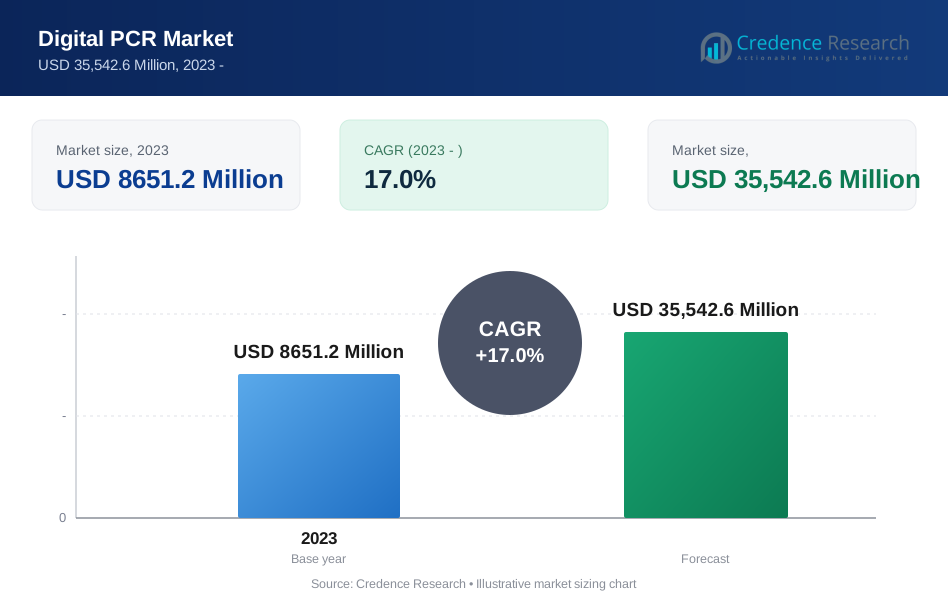
- The global Digital PCR Market reached a valuation of USD 8651.2 Million in 2023 and is anticipated to surge to USD 35542.6 Million by 2032, exhibiting a robust CAGR of 17.0% from 2024 to 2032.
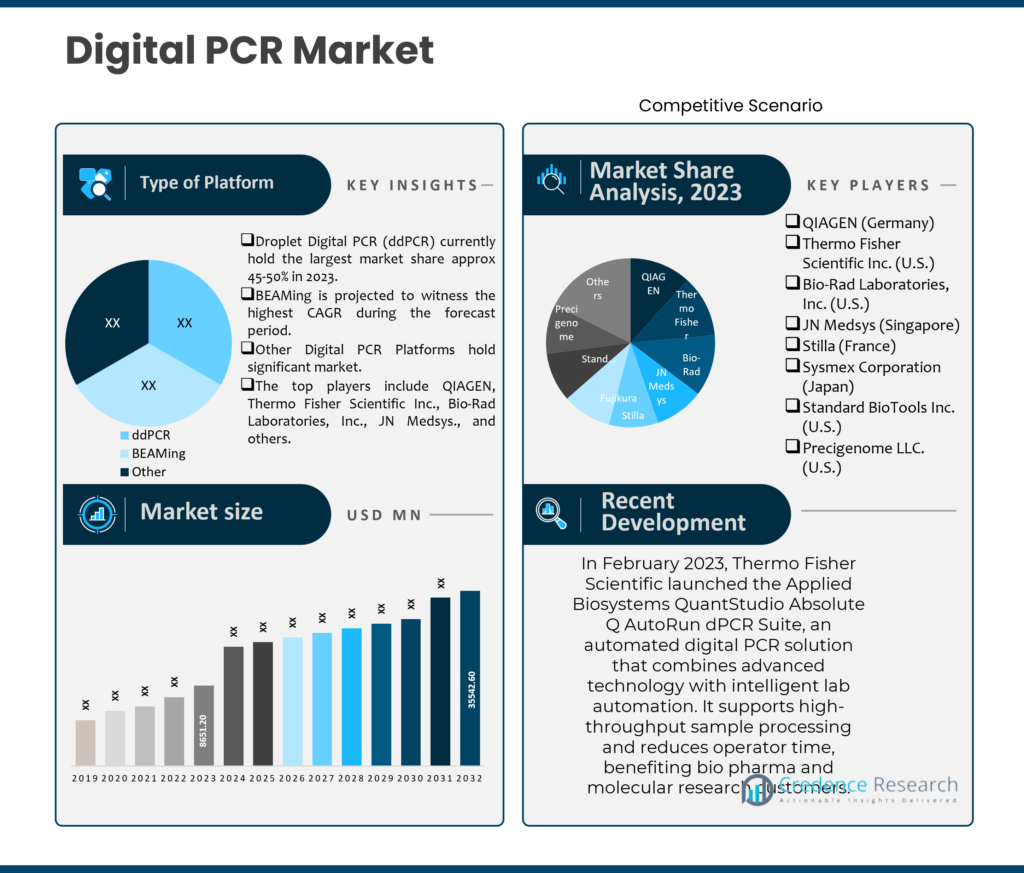
- Among the key segments, Droplet Digital PCR (ddPCR) emerged as the market leader by type of platform, holding approximately 45-50% of the total market share in 2023. However, BEAMing is projected to witness the highest growth rate during the forecast period.
- Droplet Digital PCR (ddPCR) segment holds the largest share of the market in 2023, constituting approximately 45-50% of the total market due to its widespread adoption in research and clinical settings.
- Master Mixes and PCR Kits currently hold the largest market share by reagents and consumables, accounting for approximately 35% in 2023, owing to their essential role in digital PCR experiments.
- Pathogen Detection and Infectious Disease Diagnostics dominate the market by application, holding around 35-37% of the market share in 2023, driven by the increasing prevalence of infectious diseases and the demand for accurate diagnostic tests.
- Clinical Diagnostic Laboratories hold the largest share of the market by end-user, accounting for approximately 35-40% in 2023, attributed to the widespread use of digital PCR in clinical settings for disease diagnosis and monitoring.
- North America accounts for the largest share of the market in 2023, followed by Asia Pacific and Europe with a collective share of just under 55%.
- The rise in demand for digital PCR, driven by technological advancements, increasing demand for precision genomic testing, and rising incidence of diseases, fuels the growth of the Digital PCR Market.
- Key opportunities in the market include significant growth potential in cancer biomarker analysis and liquid biopsy, increased adoption across various applications and end-users, and continuous advancements in technology, fostering market expansion.
Executive Summary
Market Definition
Digital PCR (Polymerase Chain Reaction) Market refers to the industry that develops, manufactures and markets equipment, reagents and software for digital PCR testing Digital PCR is a highly sensitive and accurate method for the detection and quantification of nucleic acid targets There is a range of products and services, such as specialized hardware, reagents, software and contract research services. The driving factors in digital PCR market are technological advancement, increasing demand for precision genomic testing, increasing growth in biotechnology and pharmaceutical industry, increasing incidence of diseases, high R&D funding costs for rapid accuracy for the detection and quantification of nucleic acids. The need for methods, as well as increasing focus on personalized medicine is driving the growth of the digital PCR market.
Market Overview
The Digital PCR Market has demonstrated consistent expansion and is projected to maintain a robust CAGR of 17.0% from 2024 to 2032. Valued at USD 8651.2 million in 2023, this market is expected to reach USD 35542.6 million by 2032.
Among the primary segments, Droplet Digital PCR (ddPCR) dominated the market landscape by type of platform, comprising approximately 45-50% of the total market share in 2023. However, BEAMing is anticipated to observe the highest CAGR over the forecast period.
The clinical diagnostic laboratories segment captured around 35-40% of the market share in 2023, driven by the widespread utilization of digital PCR in diagnosing and monitoring various diseases in clinical settings.
Multiple Digital PCR Platforms held the largest market share in 2023 by configuration, accounting for approximately 40-42% of the total market, attributed to their versatility and ability to cater to diverse research and diagnostic needs.
Pathogen Detection and Infectious Disease Diagnostics emerged as the leading application segment in 2023, with a market share of about 35-37%, primarily due to the increasing demand for accurate and rapid diagnostic tests for infectious diseases.
North America constituted a significant portion of the market in 2023, followed by Asia Pacific and Europe, collectively representing just under 55% of the market share.
The rise in demand for digital PCR is driven by factors such as technological advancements, increasing demand for precision genomic testing, and rising incidence of diseases, particularly in regions like North America and Europe.
Continuous advancements in technology, including improved sensitivity and specificity, are further driving the demand for digital PCR, especially in industries requiring accurate nucleic acid quantification and detection.
Segmentation by Type of Platform
- Droplet Digital PCR (ddPCR) currently hold the largest market share approx 45-50% in 2023. This dominance can be attributed to the fact that ddPCR is a relatively mature technology that has been widely adopted in research and clinical settings.
- BEAMing is projected to witness the highest CAGR during the forecast period due to the ability to perform multiple integrations, which enable multiple targets to be identified simultaneously in a single process.
- Other Digital PCR Platforms hold significant market share due to methods, use different technologies, and provide researchers with new ways to conduct their experiments.
Segmentation by Reagents and Consumables
- Master Mixes and PCR Kits currently hold the largest market share approx 35% in 2023. Master mixes and PCR kits are essential components of digital PCR experiments, as they provide enzymes, dNTPs, and other reagents necessary for amplification and detection.
- Droplet Generation Oil is projected to witness the highest CAGR during the forecast period. Droplet generation oil is used to create uniform droplets that contain the template DNA, primers, and probes, allowing for efficient and accurate amplification and detection.
Segmentation by Application
- Pathogen Detection and Infectious Disease Diagnostics hold the largest market share approx 35-37% in 2023. The large share of this segment can be attributed to the increasing prevalence of infectious diseases such as COVID-19, HIV, and tuberculosis, which have created a high demand for accurate and rapid diagnostic tests.
- Cancer Biomarker Analysis and Liquid Biopsy is projected to witness the highest CAGR during the forecast period. The growth of this segment can be attributed to the rising incidence of cancer in the world all, along with increasing demand for minimally invasive diagnostic techniques Liquid biopsy, which requires screening for circulating tumor DNA in blood or other body fluids, was gaining popularity as a non-invasive method for early cancer detection.
Segmentation by End-User
- Clinical Diagnostic Laboratories hold the largest market share approx 35-40% in 2023. Widespread use of digital PCR in clinical settings for the diagnosis and monitoring of various diseases such as cancer, viral infections and genetic disorders contributed in the market growth.
- Academic and Research Institutions is projected to witness the highest CAGR during the forecast period. he growth of this sector can be attributed to the widespread use of digital PCR in R&D activities, such as gene expression studies, discovery of new biomarkers, and new diagnostic tests.
Segmentation by Region
- North America held significant share around 35-40% of the market in 2023. This dominance is primarily due to availability of advanced healthcare facilities, increasing innovative technologies and rising healthcare costs in countries such as the United States and Canada.
- Asia Pacific and Europe collectively account for just under 55% share in 2023, with Europe holding over 20% share in the same year.
- The rest of the world, including Latin America, the Middle East, and Africa, supplies the remaining demand for Digital PCR.
Technological advancements within the Digital PCR, the increasing applications of digital PCR such as cancer diagnosis, genetic diseases and infectious diseases, as well as key players in the industry, are also contributing to market growth.
The North America region held the largest market share of the Digital PCR market. This dominance can be attributed to several factors such as improved health care, widespread use of cutting-edge technology and presence of key players in the region. Additionally, the increasing prevalence of infectious diseases and cancer in the region has led to a growing demand for accurate and precise diagnostic tools, further driving the growth of the digital PCR market. Furthermore, the US Food and Drug Administration's (FDA) approval of dPCR technology for various applications has also contributed in the market growth. For instance, in February 2019, Bio-Rad Laboratories has received FDA clearance for its QXDx AutoDG ddPCR system and QXDx BCR-ABL %IS kit, a digital PCR test for monitoring chronic myeloid leukemia treatment response. The test provides more accurate measurements than the current standard, reverse transcription quantitative PCR, especially at low disease levels. This marks Bio-Rad's first cleared liquid biopsy test in oncology. Another factor contributing to the large North American market share is the presence of leading companies such as Bio-Rad Laboratories, Thermo-Fisher Scientific, Roche Diagnostics etc. These companies invest heavily in R&D, leading to introduction of new products, improvements in dPCR technology and it happened. Additionally, collaboration between academics and industry also boosted the growth of the dPCR market in North America.
Europe is the prominent share in the Digital PCR market. This dominance can be attributed to several factors including the presence of leading biotechnology companies, favorable government policies, budgets and a strong research environment. For instance, in 2019, The European Commission, particularly through the European Network of GMO Laboratories (ENGL), has been actively involved in validating digital PCR (dPCR) methods for GMO detection and quantification in food and feed products. These efforts aim to ensure accurate and reliable measurement results, with dPCR offering advantages over traditional qPCR methods. The use of dPCR has shown precision, repeatability, and suitability for GMO analysis, aligning with EU regulations on GMO control and safety. Another factor contributing to Europe’s prominence in the dPCR market is a supportive regulatory environment. Across Europe, governments have implemented policies and programs aimed at fostering innovation and investment in the life sciences. For example, the EU's Horizon 2020 program provides funding opportunities for researchers and entrepreneurs working on breakthrough technologies such as dPCR In addition, many European countries offer tax breaks and other financial incentives to encourage businesses to they invest in R&D activities.
Key Highlights of the Report
The Digital PCR Market is segmented by Type of Platform, Reagents and Consumablesn, End-User, Application, and Region. The growing demand for digital PCR is driven by factors such as technological advancements, increasing demand for precision genomic testing, and the need for accurate nucleic acid quantification across various industries including healthcare, biotechnology, and research.
Droplet Digital PCR (ddPCR) dominates the segment, serving critical functions in genomic testing and disease diagnosis due to its high sensitivity and specificity. Multiple Digital PCR Platforms lead the configuration segment, offering researchers versatile options for conducting experiments and diagnostics.
Clinical Diagnostic Laboratories hold a significant market share in the end-user segment, utilizing digital PCR for disease diagnosis and monitoring. The cancer biomarker analysis and liquid biopsy application segment is witnessing rapid growth, driven by the rising incidence of cancer and the need for minimally invasive diagnostic techniques.
North America held the largest share of the digital PCR market, supported by advanced healthcare infrastructure and the presence of key players such as QIAGEN and Thermo Fisher Scientific Inc. These players focus on product innovation and strategic collaborations to maintain their market position and competitiveness.
What Are The Main Drivers Of The Global Digital PCR Market?
The global Digital PCR market is being propelled by various factors, including such as increasing demand for early diagnosis of diseases, advancements in molecular diagnostics, rise in infectious and genetic diseases, expanding applications in research activities. These drivers contribute to the market's expansion by enhancing accuracy, sensitivity, and reproducibility in nucleic acid quantification, thereby meeting diverse clinical and research needs efficiently. Adoption of various strategies among market players further boost the market.
What Are The Major Challenges Faced By The Global Digital PCR Market?
The global digital PCR market faces challenges such as increasing equipment costs, limited knowledge about digital PCR technology, complexity in data analysis, changes in testing operations concerning standardization, lack of skilled personnel skilled in digital PCR techniques, and regulatory barriers.
What Are The Growth Opportunities In The Global Digital PCR Market?
The global digital PCR market presents growth opportunities through development of multiple capabilities, integration with other molecular biology techniques, expansion in liquid biopsy and prenatal testing along with continuous growth in academic institutions and among pharmaceutical companies for biomarker discovery and drug development. Moreover, the growing trend towards precision medicine, and the increasing demand for diagnostic partners, enable digitization PCR will accompany personalized healthcare strategies, driving market growth and innovation.
Market Drivers
Adoption of Various Strategies among Market Players
The major companies serving the global Digital PCR Market are QIAGEN, Thermo Fisher Scientific Inc., Bio-Rad Laboratories, Inc., among others. The market players are considerably contributing to the market growth by the adoption of various strategies including mergers & acquisitions, collaborations, funding, and new product launches, to stay competitive in the market. For instance, in November 2023, QIAGEN launched three new QIAcuity digital PCR kits and an updated software version, QIAcuity Software 2.5, to broaden the use of digital PCR technology in biopharmaceutical research and food safety. The new kits enhance precision, sensitivity, and cost-effectiveness in various applications, while the software update streamlines analysis with improved temperature control and sample dilution information, catering to the needs of biotech and pharma customers. This cutting-edge technology is expected to revolutionize the market.
Market Restraints
Safety Concerns, Regulatory Compliance, Restraints the Market
The digital PCR market faces challenges related to safety concerns and regulatory compliance, primarily due to the need for stringent quality controls, complex approval processes for testing and certification , and regulatory barriers including different guidelines in different regions restrain the market growth. Furthermore, concerns about data accuracy, reproducibility, and standardization hamper adoption. ddressing these challenges requires investment in robust quality assurance systems, standardized processes, and cooperation with regulatory agencies to streamline approval processes. By safeguarding a to prioritize, ensure regulatory compliance, and priority restrictions, the digital PCR market can build stakeholder confidence and facilitate sustainable growth in molecular diagnostics and research applications.
Opportunities
Increasing Demand of Digital PCR for Cancer Biomarker Analysis and Liquid Biopsy
The increasing demand for digital PCR (dPCR) technology in cancer biomarker analysis and liquid biopsy has created significant opportunities for the market. dPCR has higher sensitivity, specificity, and accuracy than conventional PCR methods. This has led to widespread adoption in various fields such as cancer diagnosis, disease progression monitoring and genetic mutation detection. Furthermore, dPCR enables the detection of rare mutations in tissue biopsies, which is not possible with conventional PCR methods. As a result, there is growing interest in dPCR in both academia and industry, leading to new products and technologies that are in line with this expanding market.
Competitive Landscape
Key Players
The global Digital PCR market is highly competitive, with several key players. Some of the major players in the market and their market share are as follows:
- QIAGEN (Germany)
- Thermo Fisher Scientific Inc. (U.S.)
- Bio-Rad Laboratories, Inc. (U.S.)
- JN Medsys (Singapore)
- Stilla (France)
- Sysmex Corporation (Japan)
- Standard BioTools Inc. (U.S.)
- Precigenome LLC. (U.S.)
- Others
These organizations prioritize product innovation, distribution channel expansion, and mergers and acquisitions to stay competitive.
The global Digital PCR market's key players continually seek to stay ahead by offering new products and developments.
In April 2023, Bio-Rad launched the QX600 Droplet Digital PCR System, advancing measurable residual disease research. Collaborators include Biodesix, using it for rare variant detection and therapeutic response testing. The system offers six color detection, simple workflow, and powerful data analysis, building on Bio-Rad's established ddPCR technology.
In February 2023, Thermo Fisher Scientific launched the Applied Biosystems QuantStudio Absolute Q AutoRun dPCR Suite, an automated digital PCR solution that combines advanced technology with intelligent lab automation. It supports high-throughput sample processing and reduces operator time, benefiting bio pharma and molecular research customers.
Summary of Key Findings
- The Digital PCR Market is experiencing substantial growth, fueled by the rising demand for precise genomic testing solutions across various sectors such as healthcare, biotechnology, and pharmaceuticals. Key drivers contributing to this growth include technological advancements, increasing incidence of diseases, and the need for personalized medicine.
- Market segmentation within the Digital PCR Market encompasses various factors including platform type, reagents and consumables, application, end-user, and region, reflecting the diverse needs and applications within the industry.
- Droplet Digital PCR (ddPCR) stands out as the leading platform, holding the majority market share due to its maturity and widespread adoption in both research and clinical settings. Other platforms such as BEAMing and alternative digital PCR platforms also contribute significantly to the market, offering researchers diverse options for conducting experiments.
- Reagents and consumables play a crucial role in the Digital PCR process, with master mixes and PCR kits dominating the market share due to their essential role in amplification and detection. Droplet generation oil is witnessing rapid growth, driven by its ability to create uniform droplets for efficient amplification and detection.
- In terms of applications, pathogen detection and infectious disease diagnostics hold the largest market share, fueled by the increasing prevalence of diseases such as COVID-19, HIV, and tuberculosis. However, cancer biomarker analysis and liquid biopsy are projected to witness the highest growth rate, driven by the rising incidence of cancer and the demand for minimally invasive diagnostic techniques.
- Clinical diagnostic laboratories emerge as the leading end-user segment, owing to the widespread use of Digital PCR in diagnosing various diseases including cancer, viral infections, and genetic disorders. Academic and research institutions are projected to witness significant growth, driven by the increasing adoption of Digital PCR in gene expression studies, biomarker discovery, and diagnostic test development.
- Geographically, North America holds the largest market share, attributed to advanced healthcare facilities, high adoption rates of innovative technologies, and the presence of key industry players. Europe and Asia Pacific collectively account for a substantial share of the market, with Europe witnessing growth due to increasing demand for precision medicine and expanding research activities.
Future Outlook
- The future outlook for the Digital PCR Market indicates promising growth opportunities, especially within sectors such as healthcare, biotechnology, and pharmaceuticals, driven by the escalating demand for precise nucleic acid quantification techniques. However, anticipated challenges include intense market competition, adaptation to evolving technologies, and substantial initial investment requirements.
- To maintain competitiveness in the Digital PCR Market, industry players should adopt various strategies such as continuous product innovation, strategic collaborations, securing funding, and launching new products. It is crucial for companies to prioritize addressing customer needs, improving product efficiency, and exploring untapped opportunities in emerging markets to ensure sustained growth amidst the dynamic market environment.
How CXOs Can Benefit from the Credence Research Digital PCR Networks Market Report
The Credence Research Digital PCR Networks Market Report provides CXOs with a comprehensive overview of the market, including:
- Market size and growth forecast:The report provides detailed estimates of the global Digital PCR networks market size, segmented platform type, reagents and consumables, application, end-user, and region. It also includes forecasts for the market through 2032, based on key trends and drivers.
- Market segmentation:The report segments the Digital PCR networks market by platform type, reagents and consumables, application, end-user, and region. The increasing demand for advanced solutions is driven. This segmentation provides CXOs with a granular understanding of the market and the opportunities in each segment.
- Competitive landscape:The report profiles the key players in the Digital PCR networks market and provides insights into their strategies, product offerings, and financial performance. This information can help CXOs to identify and assess their competition.
- Key trends and drivers:The report identifies and analyzes the key trends and drivers that are shaping the Digital PCR networks market. This information can help CXOs to make informed decisions about their investments and strategies.
CXOs can use the insights from the Credence Research Digital PCR Networks Market Report to:
- Identify growth opportunities:The report can help CXOs to identify new growth opportunities in the Digital PCR networks market. For example, the report identifies the growing demand for Digital PCR networks from cloud computing providers and telecom companies as a key opportunity.
- Make informed investment decisions:The report can help CXOs to make informed investment decisions about Digital PCR networks. For example, the report provides insights into the key factors to consider when evaluating Digital PCR providers and selecting Digital PCR solutions.
- Develop competitive strategies:The report can help CXOs to develop competitive strategies for their Digital PCR networks businesses. For example, the report identifies the key strategies that Digital PCR providers are using to differentiate themselves from their competitors.
- Track market developments:The report can help CXOs to track market developments and stay ahead of the curve. For example, the report provides insights into the latest trends and innovations in the Digital PCR networks market.
Overall, the Credence Research Digital PCR Networks Market Report is a valuable resource for CXOs who are looking to gain a deeper understanding of the market and identify opportunities for growth.
Segmentation
- Type of Platform Segmentation:
- Droplet Digital PCR (ddPCR)
- BEAMing (Beads, Emulsification, Amplification, and Magnetics)
- Other Digital PCR Platforms
- Reagents and Consumables Segmentation:
- Master Mixes and PCR Kits
- Droplet Generation Oil
- Fluorescent Probes and Detection Reagents
- Control DNA/RNA Standards
- Disposable Consumables
- Application Segmentation:
- Pathogen Detection and Infectious Disease Diagnostics
- Cancer Biomarker Analysis and Liquid Biopsy
- Genetic Testing and Rare Mutation Detection
- Gene Expression Profiling and Transcriptomics
- Environmental Monitoring and Food Safety Testing
- End-User Segmentation:
- Clinical Diagnostic Laboratories
- Academic and Research Institutions
- Pharmaceutical and Biotechnology Companies
- Environmental Testing Laboratories
- Food and Beverage Industry
- By Region
- North America
- US
- Canada
- Mexico
- Europe
- Germany
- France
- UK.
- Italy
- Spain
- Rest of Europe
- Asia Pacific
- China
- Japan
- India
- South Korea
- South-east Asia
- Rest of Asia Pacific
- Latin America
- Brazil
- Argentina
- Rest of Latin America
- Middle East & Africa
- GCC Countries
- South Africa
- Rest of Middle East and Africa
- North America
Adjacent Markets
In the Digital PCR market, there are several adjacent markets which has high revenue growth opportunities. The key adjacent markets for Digital PCR market -|
Adjacent Markets |
||
| Next-Generation Sequencing (NGS) market | Biomarker Discovery market | Companion Diagnostics market |
| Single-Cell Analysis market | Precision Medicine market | Bioinformatics market |
| Liquid Biopsy market | Molecular Diagnostics market | Genomics market |
Request a Free Sample
Fill in your details and we'll send you a free sample report.
- Sample data tables & charts
- Research methodology
Need a Custom Version of This Report?
Tailor the scope, geography, or segments to your exact requirements.
- Custom geography or segment scope
- Direct access to our analyst team
Frequently Asked Questions
What is the current size of the global Digital PCR market?
What is the expected growth rate of the Digital PCR market between 2024 and 2032?
Which segment is leading the market share in terms of Type of Platform?
Which Reagents and Consumables Segments governs the demand for Digital PCRs in the world?
Which Application-Specific Digital PCR segment is expected to post the highest CAGR during the forecast period?
Which region is fueling the growth of the Digital PCR industry?
Who are the major players in the global Digital PCR market?
What are the major market drivers of the Digital PCR industry?
What are the major market restraints of the Digital PCR industry?
What are the major market opportunities of the Digital PCR industry?
Table of Content
Chapter 1. Report Introduction
- 1.1 Report Description & Purpose
- 1.1.1 Report Title & Market Definition
- 1.1.2 Unique Selling Propositions (USP) & Key Differentiators
- 1.1.3 Value Proposition for Stakeholders
- 1.2 Research Objectives
- 1.2.1 Market Sizing Objectives (Volume & Revenue)
- 1.2.2 Segmentation Objectives
- 1.2.3 Competitive Intelligence Objectives
- 1.2.4 Forecast & Scenario Objectives
- 1.3 Report Scope
- 1.3.1 Digital PCR Scope – Types & Subtypes Covered
- 1.3.2 Geographic Scope – Regions & Countries Covered
- 1.3.3 Historical Period, Base Year & Forecast Period (2023; forecast to the forecast period)
- 1.3.4 Inclusions & Exclusions
- 1.4 HS Code & Classification Framework
- 1.5 Currency, Units & Pricing Basis
- 1.6 Target Stakeholders
- 1.7 Limitations & Assumptions
Chapter 2. Executive Summary
- 2.1 Global Digital PCR Market Snapshot
- 2.1.1 Market Size – Historical (2023) & Forecast (the forecast period) (2023: USD 8651.2 Million → forecast year: USD 35,542.6 Million)
- 2.1.2 Volume & Revenue – Global Totals
- 2.1.3 Key Market Highlights – Top Five Facts
- 2.2 Digital PCR Market Segmentation Snapshot
- 2.2.1 Market Split by Region – 2023 vs.
- 2.3 Competitive Snapshot
- 2.3.1 Top 10 Players by Revenue Share – 2023
- 2.3.2 Top 10 Players by Volume Share – 2023
- 2.3.3 Recent Strategic Developments (18-Month Summary)
- 2.4 Key Investment Highlights & Strategic Conclusions
Chapter 3. Digital PCR Market Dynamics & Industry Analysis
- 3.1 Market Overview & Context
- 3.1.1 Digital PCR Market Position in the Broader Automotive Value Chain
- 3.1.2 OEM vs. Replacement Market Dynamics
- 3.1.3 Market Maturity & Development Stage by Region
- 3.2 Digital PCR Market Drivers
- 3.3 Digital PCR Market Restraints & Challenges
- 3.4 Digital PCR Market Opportunities
- 3.5 Porter's Five Forces Analysis
- 3.5.1 Threat of New Entrants
- 3.5.2 Bargaining Power of Suppliers
- 3.5.3 Bargaining Power of Buyers
- 3.5.4 Threat of Substitutes
- 3.5.5 Competitive Rivalry – Intensity Assessment
- 3.6 Digital PCR Value Chain Analysis
- 3.6.1 Upstream – Raw Material/Input Suppliers
- 3.6.1.1 Raw Material/Input 1
- 3.6.1.2 Raw Material/Input 2
- 3.6.1.3 Raw Material/Input 3
- 3.6.2 Midstream – Production/Manufacturing/Service Delivery
- 3.6.2.1 Production/Process Overview
- 3.6.2.2 Key Facility Locations & Capacity by Manufacturer
- 3.6.3 Downstream – Distribution & End Consumer
- 3.6.3.1 Primary Channel – B2B/OEM
- 3.6.3.2 Secondary Channels – Dealer, Retail, Online, Direct
- 3.6.4 Value Chain Profitability Analysis
- 3.6.1 Upstream – Raw Material/Input Suppliers
- 3.7 PESTEL Analysis
- 3.7.1 Political Factors
- 3.7.2 Economic Factors
- 3.7.3 Social Factors
- 3.7.4 Technological Factors
- 3.7.5 Environmental Factors
- 3.7.6 Legal Factors
- 3.8 Digital PCR Supply Chain Analysis
- 3.8.1 Raw Material/Input Supply Risk Assessment
- 3.8.2 Manufacturing Concentration Risk (Geographic Exposure)
- 3.8.3 Trade Disruption Impact Analysis
- 3.9 Regulatory & Policy Landscape
Note: The regulatory and policy landscape section covers regulations based on their applicability to the market, Digital PCR category, geography, and scope of the study. Only regulatory frameworks with a material impact on operations, compliance, trade, sustainability, or market access are analyzed in detail.
Chapter 4. Key Investment Pockets & Opportunity Analysis
- 4.1 Digital PCR Market Attractiveness Analysis
- 4.1.1 By Region – Investment Attractiveness Matrix (Volume × CAGR)
- 4.2 Absolute Revenue Growth Opportunity
- 4.2.1 By Region – Absolute USD Growth Through the forecast period
- 4.3 Incremental Volume Opportunity
- 4.3.1 By Region – Incremental Volume Through the forecast period
- 4.3.2 Segment – Incremental Volume
- 4.4 Emerging Submarket Opportunity Deep Dive (Subject to Applicability)
- 4.5 Emerging Market Opportunity Scorecards
- 4.5.1 United States
- 4.5.2 Europe
- 4.5.3 Asia
- 4.5.4 Middle East & Africa
Note: Emerging Market Opportunity Scorecards will be included based on relevance and strategic importance. Regions listed are indicative and may vary depending on data availability and market dynamics.
Chapter 5. Digital PCR Import-Export Analysis & Trade Flows
- 5.1 Global Trade Overview
- 5.1.1 Global Export Value by Country (2023)
- 5.1.2 Global Export Volume by Country (2023)
- 5.1.3 Global Import Value by Country (2023)
- 5.1.4 Global Import Volume by Country (2023)
- 5.1.5 Net Trade Balance by Country (2023)
- 5.2 Export Analysis – Segment
- 5.2.1 Type 1 (HS Code)
- 5.2.2 Type 2 (HS Code)
- 5.2.3 Type 3 (HS Code)
- 5.2.4 Type 4 (HS Code)
- 5.2.5 Type 5 (HS Code)
- 5.3 Import Analysis – Segment
- 5.3.1 Type 1 (HS Code)
- 5.3.2 Type 2 (HS Code)
- 5.3.3 Type 3 (HS Code)
- 5.3.4 Type 4 (HS Code)
- 5.3.5 Type 5 (HS Code)
- 5.4 Average Unit Trade Prices
- 5.4.1 Average Export Price – Segment & Country
- 5.4.2 Average Import Price – Segment & Source Country
- 5.4.3 Price Trends (2023)
- 5.5 Key Trade Route Analysis
- 5.5.1 Trade Route 1
- 5.5.2 Trade Route 2
- 5.5.3 Trade Route 3
- 5.5.4 Trade Route 4
- 5.5.5 Trade Route 5
- 5.6 Trade Policy Impact Assessment
- 5.6.1 US Anti-Dumping & Section 301 Tariffs
- 5.6.2 EU Customs Union Impact
- 5.6.3 Major Free Trade Agreements
- 5.6.4 USMCA Rules of Origin
Note: Trade policy analysis will be included only where relevant to the Digital PCR market.
Chapter 6. Competitive Landscape & Company Benchmarking
- 6.1 Digital PCR Market Concentration & Structure
- 6.1.1 Herfindahl-Hirschman Index (HHI) – vs. 2023
- 6.1.2 Tier 1, Tier 2 & Tier 3 Market Structure
- 6.1.3 Global, Regional & Local Player Dynamics
- 6.2 Digital PCR Market Share Analysis – 2023
- 6.2.1 Global Revenue Share by Company
- 6.2.2 Global Volume Share by Company
- 6.2.3 Regional Revenue Share
- 6.2.4 Market Share Evolution ( vs. 2023)
- 6.2.5 OEM Segment Share by Company
- 6.2.6 Replacement Segment Share by Company
- 6.3 Production/Delivery Capacity & Facility Analysis
- 6.3.1 Global Installed Capacity
- 6.3.2 Capacity Utilization Rates
- 6.3.3 Production/Output Volume
- 6.3.4 Facility Locations & Capacity Map
- 6.3.5 Planned Capacity Additions
- 6.4 Digital PCR Competitive Benchmarking Matrix
- 6.4.1 Revenue, Volume, CAGR & Profitability Comparison
- 6.4.2 Channel Revenue Mix
- 6.4.3 Geographic Revenue Exposure
- 6.4.4 R&D Intensity
- 6.4.5 Sustainability Maturity
- 6.5 Strategic Developments in Digital PCR (Last 24 Months)
- 6.5.1 Mergers, Acquisitions & Divestments
- 6.5.2 New Digital PCR Launches
- 6.5.3 Facility Expansions
- 6.5.4 Strategic Alliances, Joint Ventures & Partnerships
- 6.5.5 Distribution Expansion & Market Entry
- 6.5.6 Sustainability & ESG Initiatives
- 6.6 Competitive Strategy Mapping
- 6.6.1 Leader, Challenger, Follower & Niche Classification
- 6.6.2 Pricing Strategy Comparison
- 6.6.3 Channel Strategy Matrix
Note: Strategic developments are included based on their materiality and the availability of reliable information.
Chapter 7. Global Digital PCR Market – By Distribution Channel
- 7.1 Segment Overview
- 7.1.1 Volume & Revenue Split by Channel (2023 & )
- 7.1.2 Channel Mix Evolution (the forecast period)
Chapter 8. Regional Market Analysis – Global Overview
- 8.1 Global Regional Overview
- 8.1.1 Regional Volume Share
- 8.1.2 Regional Revenue Share
- 8.1.3 Regional Volume by Region
- 8.1.4 Regional Revenue by Region
- 8.1.5 Regional Forecast Through the forecast period
- 8.2 Cross-Regional Segment Analysis
- 8.2.1 By Distribution Channel
- 8.2.2 By Brand/Price Tier
Chapter 9. North America Digital PCR Market
- 9.1 United States
- 9.2 Canada
- 9.3 Mexico
Chapter 10. Europe Digital PCR Market
- 10.1 Germany
- 10.2 France
- 10.3 Italy
- 10.4 United Kingdom
- 10.5 Spain
- 10.6 Poland
- 10.7 Russia
- 10.8 Netherlands
- 10.9 Belgium
- 10.10 Sweden
- 10.11 Denmark
- 10.12 Norway
- 10.13 Rest of Europe
Chapter 11. Asia Pacific Digital PCR Market
- 11.1 China
- 11.2 India
- 11.3 Japan
- 11.4 South Korea
- 11.5 Thailand
- 11.6 Indonesia
- 11.7 Vietnam
- 11.8 Malaysia
- 11.9 Australia
- 11.10 Rest of Asia Pacific
Chapter 12. Latin America Digital PCR Market
- 12.1 Brazil
- 12.2 Argentina
- 12.3 Colombia
- 12.4 Chile
- 12.5 Rest of Latin America
Chapter 13. Middle East Digital PCR Market
- 13.1 Saudi Arabia
- 13.2 United Arab Emirates
- 13.3 Turkey
- 13.4 Israel
- 13.5 Iran
- 13.6 Rest of the Middle East
Chapter 14. Africa Digital PCR Market
- 14.1 South Africa
- 14.2 Egypt
- 14.3 Nigeria
- 14.4 Morocco
- 14.5 Rest of Africa
Chapter 15. Digital PCR Company Profiles
- 15.1 [Company 01]
- 15.1.1 Company Overview
- 15.1.2 Key Management Personnel
- 15.1.3 Products & Services Portfolio
- 15.1.4 Financial Performance
- 15.1.5 Key Market Focus & Geographic Presence
- 15.1.6 Recent Developments & Strategic Initiatives
Note: The company profile list is preliminary and may change based on research findings, market developments, data availability, and client requirements.
Chapter 16. Appendices
- Appendix A – List of Abbreviations & Acronyms
- Appendix B – Industry Classification Code Reference – Full Series
- Appendix C – Production & Capacity Data Tables
- Appendix D – End-Use & Demand Base Tables
- Appendix E – Consumption & Replacement Rate Assumptions
- Appendix F – ASP Reference Tables
- Appendix G – Manufacturing & Facility Database
- Appendix H – Import-Export Data Tables
- Appendix I – Regulatory Summary Tables
- Appendix J – Primary Research Participant List (Anonymized)
- Appendix K – Primary Research Questionnaire Framework
- Appendix L – Data Sources & Bibliography
- Appendix M – Market Size Divergence & Source Comparison
Chapter 17. Research Methodology
- 17.1 Research Framework & Philosophy
- 17.2 Secondary Research – Sources, Hierarchy & Data Extraction
- 17.3 Data Modeling – Bottom-Up & Top-Down Market Sizing
- 17.4 Primary Research – Stakeholder Framework, LOI & Sample Sizes
- 17.5 Forecast Methodology – Regression, Scenario & Sensitivity Analysis
- 17.6 Quality Control – Four-Layer Validation Framework
- 17.7 Limitations & Standard Assumptions
- 17.8 Disclaimer
