
Market Overview
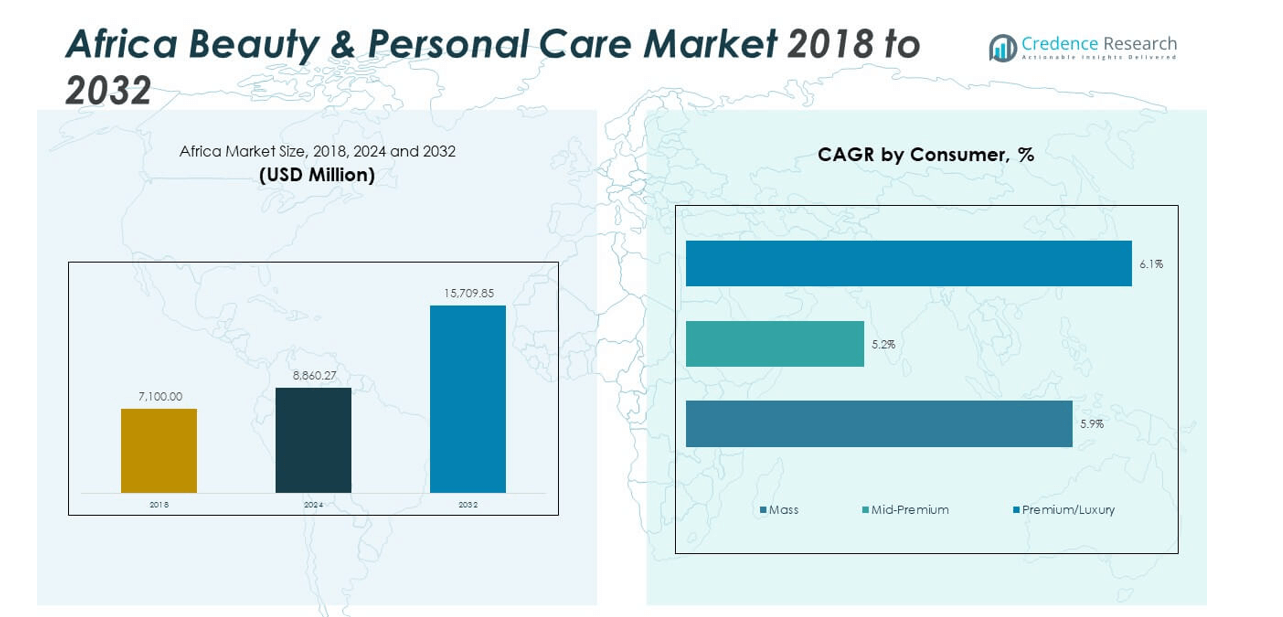
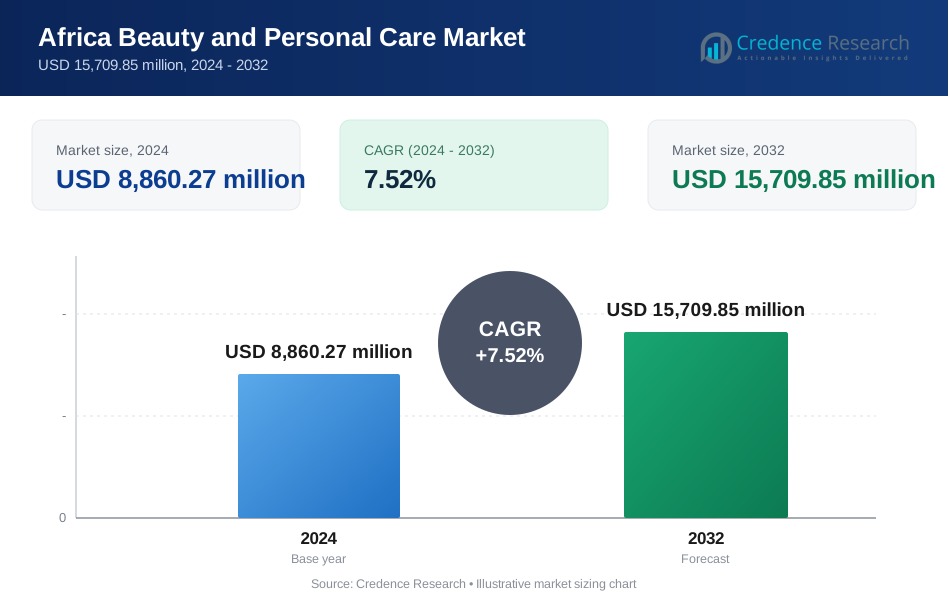
The Africa Beauty & Personal Care Market size was valued at USD 7,100.00 million in 2018 to USD 8,860.27 million in 2024 and is anticipated to reach USD 15,709.85 million by 2032, at a CAGR of 7.52% during the forecast period.
| REPORT ATTRIBUTE | DETAILS |
|---|---|
| Historical Period | 2020-2023 |
| Base Year | 2024 |
| Forecast Period | 2025-2032 |
| Africa Beauty & Personal Care Market Size 2024 | USD 8,860.27 million |
| Africa Beauty & Personal Care Market, CAGR | 7.52% |
| Africa Beauty & Personal Care Market Size 2032 | USD 15,709.85 million |
Urban growth raises demand for daily care products across African cities. Rising income improves spending on skin, hair, and hygiene items. Young consumers favor modern brands and new routines. Social media shapes beauty trends and brand trust. Local firms expand affordable product ranges. Global brands widen retail reach through pharmacies and supermarkets. Natural ingredients gain attention due to climate needs. Men’s grooming demand rises across cities. E-commerce improves access beyond urban centers. Product safety rules improve buyer confidence.
South Africa leads due to strong retail networks and brand presence. Nigeria follows with a large youth population and fast urban growth. Egypt shows steady demand from rising middle-class households. Kenya and Ghana emerge through expanding modern trade. Francophone West Africa gains traction via regional distribution hubs. North Africa benefits from established cosmetics use. East Africa sees growth from digital commerce adoption. Rural markets show gradual uptake through sachets and value packs. Regional diversity shapes tailored product strategies.
Market Insights:
- The Africa Beauty & Personal Care Market size was USD 7,100.00 million in 2018, reached USD 8,860.27 million in 2024, and is projected to reach USD 15,709.85 million by 2032, growing at a CAGR of 7.52% during the forecast period.
- North Africa leads with about 35% share due to strong retail networks and established grooming habits, followed by West Africa at nearly 30% driven by population scale and urban demand, while East Africa holds around 18% supported by expanding modern trade and digital access.
- East Africa is the fastest-growing region with nearly 18% share, supported by rising urbanization, growing youth population, expanding e-commerce, and improving product availability across Kenya and Tanzania.
- By ingredient, Functional and Clinical products hold the largest share at around 40%, supported by daily use needs, climate suitability, and trust in efficacy-focused formulations.
- Halal and Compliance ingredients account for nearly 25%, K-Beauty contributes about 20%, and Others hold the remaining share, reflecting rising influence of global trends and diverse consumer preferences.
Market Drivers:
Urban Lifestyle Expansion And Daily Personal Care Adoption
The Africa Beauty & Personal Care Market benefits from rapid urban lifestyle changes across major cities. Urban consumers adopt structured grooming and hygiene routines as part of daily life. It gains demand from convenient and time-efficient product formats. Working populations prefer ready-to-use skin, hair, and hygiene products. Personal appearance links closely with social confidence and professional identity. Organized retail improves product access in urban centers. Brand visibility strengthens through supermarkets and pharmacies. This driver supports steady and recurring product consumption.
- For instance, Unilever reported over 85% numeric distribution for its personal care brands across key urban retail outlets in South Africa and Nigeria, strengthening daily product uptake.
Rising Disposable Income And Middle Class Consumption Growth
Income growth improves consumer spending on beauty and personal care products. The Africa Beauty & Personal Care Market experiences higher spending per household. Middle-income groups shift from unbranded to branded offerings. It supports movement toward quality and performance-focused products. Personal care evolves from basic need to lifestyle choice. Consumers show interest in affordable premium ranges. Youth influence household purchase behavior. This income trend supports long-term market stability.
Youth Demographics And Expanding Grooming Awareness
Africa holds a large and youthful population base. The Africa Beauty & Personal Care Market gains momentum from young consumer demand. Youth follow global grooming habits and beauty standards. It benefits from strong social media exposure and peer influence. Male grooming gains cultural acceptance in urban regions. Skincare awareness rises among younger buyers. Brand experimentation remains high within this group. This demographic supports sustained category expansion.
Retail Expansion And Product Availability Improvement
Modern retail networks expand across African economies. The Africa Beauty & Personal Care Market gains wider shelf presence and visibility. Supermarkets ensure consistent product availability. It improves access for first-time buyers. Pharmacies strengthen trust in personal care categories. Local distributors expand last-mile reach. Retail partnerships support faster penetration. This expansion improves overall market accessibility.
Market Trends:
Rising Preference For Natural And Climate Suitable Formulations
Consumers prefer products suited to local climate conditions. The Africa Beauty & Personal Care Market reflects growing interest in natural ingredients. It supports demand for moisture-rich and protective formulations. Harsh weather increases focus on skin and hair nourishment. Brands highlight plant-based components and mild blends. Local sourcing gains relevance in product positioning. Ingredient clarity builds consumer trust. This trend reshapes formulation strategies.
- For instance, L’Oréal reported that in 2023, 65% of its ingredients globally were biobased, derived from abundant minerals, or from circular processes, a figure it aims to increase to 95% by 2030. Additionally, as part of its climate-adaptive strategy, the company has specifically designed products like anti-humidity hair solutions and sweat-proof foundations for consumers in sun-intense and humid regions, including parts of Africa, the Middle East, and India.
Growth Of Digital Influence And Beauty Content Consumption
Digital platforms shape beauty discovery and brand awareness. The Africa Beauty & Personal Care Market benefits from online engagement. It gains visibility through local creators and beauty educators. Tutorials guide product use and care routines. Mobile access widens content reach across regions. Brands invest in localized digital campaigns. Story-driven promotion strengthens consumer connection. This trend boosts engagement levels.
Shift Toward Affordable Premium And Value Plus Products
Consumers seek better quality within controlled budgets. The Africa Beauty & Personal Care Market shows strong value-plus demand. It supports mid-tier product development. Brands balance performance and price sensitivity. Smaller pack sizes improve affordability perception. Quality cues influence repeat purchase behavior. Packaging design supports premium appeal. This trend balances volume and margins.
Increasing Focus On Personal Hygiene And Wellness Awareness
Hygiene awareness rises across households and institutions. The Africa Beauty & Personal Care Market aligns with wellness priorities. It supports steady demand for bath and body products. Health education improves routine usage. Parents emphasize hygiene for family care. Public initiatives reinforce cleanliness habits. Brand trust strengthens through consistent use. This trend supports essential category growth.
Market Challenges Analysis:
Price Sensitivity And Income Inequality Across Regions
Income gaps affect purchase consistency across markets. The Africa Beauty & Personal Care Market faces uneven demand patterns. It must address wide affordability differences. Premium products struggle in low-income regions. Consumers favor sachets and low unit pricing. Brand loyalty remains price driven. Cost pressure limits frequent upgrades. This challenge affects revenue predictability.
Supply Chain Complexity And Regulatory Variability
Logistics remain uneven across African countries. The Africa Beauty & Personal Care Market faces distribution delays. It manages varied regulatory frameworks. Import rules differ across borders. Compliance raises operational costs. Local production requires capital investment. Quality control remains critical. These factors slow market scalability.
Market Opportunities:
Expansion Of Local Manufacturing And Regional Brand Development
Local manufacturing reduces import dependence. The Africa Beauty & Personal Care Market can improve cost efficiency through domestic production. It supports faster product customization. Regional brands gain stronger consumer trust. Local sourcing improves supply reliability. Employment creation aligns with policy goals. Shorter supply chains increase responsiveness. This opportunity strengthens competitiveness.
Untapped Rural Markets And Inclusive Distribution Models
Rural regions show rising awareness of personal care products. The Africa Beauty & Personal Care Market holds strong rural growth potential. It benefits from low current penetration. Mobile trade expands outreach. Affordable packs suit rural spending behavior. Education improves product understanding. Local retailers act as trusted channels. This opportunity supports volume-driven growth.
Market Segmentation Analysis:
By Category
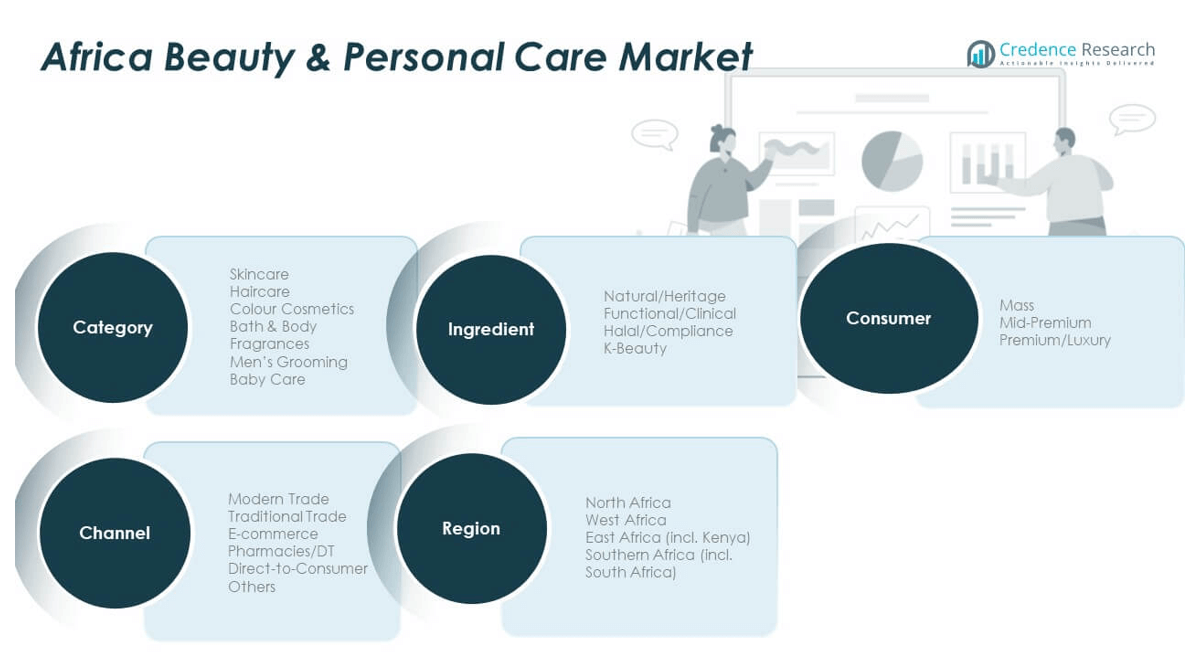
The Africa Beauty & Personal Care Market shows strong performance across diverse product categories. Skin care leads due to daily use and climate-driven needs. Hair care holds a large share because textured hair requires routine care. Oral care benefits from hygiene awareness and preventive health focus. Bath and shower products maintain stable demand across households. Cosmetics and makeup gain traction among urban youth. Fragrances see steady uptake through gifting and personal identity use.
- For instance, Beiersdorf reported that its NIVEA skin and body care portfolio recorded double-digit growth in key African markets, with Nigeria seeing a 60% sales increase and South Africa the world's largest market for NIVEA Body growing by over 20%, driven by high-frequency usage and products tailored for melanin-rich skin.
By Consumer
Women represent the largest consumer group due to higher product usage frequency. Men show rising demand for grooming and hygiene products. Children support demand through parental focus on safety and care. It reflects widening consumer participation across age groups. Brand messaging adapts to lifestyle and routine needs. Product formats vary by consumer preference. This structure supports balanced segment growth.
- For instance, Unilever noted that its men’s grooming brand Axe expanded penetration across Africa with grooming variants tailored for daily use, supporting strong repeat purchase behavior.
By Ingredient
Natural ingredients gain attention due to skin sensitivity concerns. Synthetic ingredients remain important for cost control and consistency. Organic ingredients attract premium buyers seeking clean labels. It balances performance, affordability, and trust. Brands manage sourcing to meet varied expectations. Ingredient choice shapes brand positioning. This segment reflects diverse consumer priorities.
By Channel
Supermarkets and hypermarkets lead through product variety and visibility. Pharmacies and drug stores support trust-driven purchases. Specialty stores focus on premium and targeted products. Online retail expands access and convenience. Traditional and local stores serve price-sensitive buyers. It ensures broad market reach across regions. Channel diversity strengthens overall distribution coverage.

Segmentation:
By Category- Skin Care
- Hair Care
- Oral Care
- Bath and Shower Products
- Cosmetics and Makeup
- Fragrances
- Men
- Women
- Children
- Natural Ingredients
- Synthetic Ingredients
- Organic Ingredients
- Supermarkets and Hypermarkets
- Pharmacies and Drug Stores
- Specialty Stores
- Online Retail
- Traditional and Local Stores
- North Africa
- West Africa
- East Africa
- Central Africa
- Southern Africa
Regional Analysis:
North Africa
North Africa holds the largest share of the Africa Beauty & Personal Care Market at around 35%. Egypt and Morocco lead due to established grooming habits and urban density. It benefits from strong cosmetics usage across daily routines. Modern retail penetration supports consistent product availability. International brands maintain strong presence in this region. Consumers show preference for skin care and fragrances. Stable demand supports predictable revenue flow.
West Africa
West Africa accounts for nearly 30% market share, driven mainly by Nigeria and Ghana. The Africa Beauty & Personal Care Market gains scale from large population size. It sees strong demand from youth and urban consumers. Hair care and bath products dominate product mix. Informal retail remains important across cities and towns. Social influence shapes brand awareness and trial. Rising income supports gradual premium adoption.
East, Southern, and Central Africa
East Africa holds close to 18% market share, led by Kenya and Tanzania. Southern Africa contributes around 12%, supported by South Africa’s retail maturity. Central Africa accounts for the remaining 5% with lower penetration. The Africa Beauty & Personal Care Market expands through digital commerce in these regions. It benefits from improving distribution networks. Affordable packs drive volume growth. These regions present long-term expansion potential.
Key Player Analysis:
Competitive Analysis:
The Africa Beauty & Personal Care Market shows strong competition between global and regional brands. Large multinationals leverage scale, distribution depth, and brand trust. It benefits from wide product portfolios across mass and premium tiers. Regional players compete through price access and local relevance. Innovation focuses on climate-suitable formulas and everyday essentials. Marketing relies on retail visibility and digital engagement. Supply reach remains a key advantage for leaders. Competitive pressure encourages frequent product refresh cycles. Brand loyalty stays moderate due to price sensitivity. The landscape supports steady rivalry across categories.
Recent Developments:
- Investment in Galderma - December 8, 2025: L'Oréal announced an additional 10% strategic investment in Galderma Group AG, acquired from a consortium led by EQT. This move demonstrates L'Oréal's commitment to the fast-growing aesthetics market and represents a continuation of their long-term partnership strategy. The company reaffirmed its support for Galderma's independence and strategic direction under current leadership.
- Strategic Partnership with Kering - October 19, 2025: In a landmark strategic alliance, L'Oréal announced the acquisition of the entire Kering beauty business, including the premium fragrance brand Creed, for EUR 4 billion (approximately USD 4.7 billion). This transaction represents L'Oréal's largest acquisition to date, surpassing its 2023 purchase of Australian brand Aesop. As part of this comprehensive agreement, L'Oréal will acquire the House of Creed and secure exclusive 50-year licenses for the creation, development, and distribution of fragrance and beauty products for Gucci, Bottega Veneta, and Balenciaga. The partnership extends beyond traditional beauty into a planned 50/50 joint venture focusing on wellness and longevity opportunities. The transaction is expected to close in the first half of 2026. This acquisition positions L'Oréal as a dominant player in the luxury beauty segment and strengthens its niche fragrance market presence.
- Sub-Saharan Africa Growth Performance - September 2025: L'Oréal reported high single-digit growth across Sub-Saharan Africa, driven by volume and product mix improvements. Growth was broad-based across all divisions, with Consumer Products and Dermatological Beauty serving as primary contributors. By product category, skincare, haircare, and makeup all delivered double-digit growth, led by flagship brands L'Oreal Paris, CeraVe, and La Roche-Posay. South Africa emerged as the key growth driver and continued to outperform its overall market.
Report Coverage:
The research report offers an in-depth analysis based on category, consumer, ingredient, channel, and region. It details leading market players, providing an overview of their business, product offerings, investments, revenue streams, and key applications. Additionally, the report includes insights into the competitive environment, SWOT analysis, current market trends, as well as the primary drivers and constraints. Furthermore, it discusses various factors that have driven market expansion in recent years. The report also explores market dynamics, regulatory scenarios, and technological advancements that are shaping the industry. It assesses the impact of external factors and global economic changes on market growth. Lastly, it provides strategic recommendations for new entrants and established companies to navigate the complexities of the market.
Future Outlook:
- Urban population growth continues to support daily personal care usage.
- Youth-driven demand shapes product design and brand communication.
- Affordable premium positioning gains importance across income groups.
- Natural and climate-adapted formulations attract wider acceptance.
- Digital commerce expands reach beyond major cities.
- Local manufacturing gains strategic relevance for cost control.
- Retail partnerships strengthen last-mile availability.
- Men’s grooming records steady adoption across urban centers.
- Rural penetration improves through smaller pack formats.
- Competitive intensity supports innovation and portfolio diversification.
Request a Free Sample
Fill in your details and we'll send you a free sample report.
- Sample data tables & charts
- Research methodology
Need a Custom Version of This Report?
Tailor the scope, geography, or segments to your exact requirements.
- Custom geography or segment scope
- Direct access to our analyst team
Frequently Asked Questions
What is the current market size for Africa Beauty & Personal Care Market, and what is its projected size in 2032?
At what Compound Annual Growth Rate is the Africa Beauty & Personal Care Market projected to grow between 2024 and 2032?
Which Africa Beauty & Personal Care Market segment held the largest share in 2024?
What are the primary factors fueling the growth of the Africa Beauty and Personal Care Market?
What are the primary factors fueling the growth of the Africa Beauty & Personal Care Market?
Who are the leading companies in the Africa Beauty & Personal Care Market?
Table of Content
Chapter 1. Report Introduction
- 1.1 Report Description & Purpose
- 1.1.1 Report Title & Market Definition
- 1.1.2 Unique Selling Propositions (USP) & Key Differentiators
- 1.1.3 Value Proposition for Stakeholders
- 1.2 Research Objectives
- 1.2.1 Market Sizing Objectives (Volume & Revenue) (Volume Where Applicable)
- 1.2.2 Segmentation Objectives
- 1.2.3 Competitive Intelligence Objectives
- 1.2.4 Forecast & Scenario Objectives
- 1.3 Report Scope
- 1.3.1 Africa Beauty and Personal Care Scope – Segments & Subsegments Covered
- 1.3.2 Geographic Scope – Selected Region & Countries Covered
- 1.3.3 Historical Period, Base Year & Forecast Period (2024; forecast to 2032)
- 1.3.4 Inclusions & Exclusions
- 1.4 Industry Classification & Applicable Codes
- 1.5 Currency, Measurement Units & Valuation Basis
- 1.6 Target Stakeholders
- 1.7 Limitations & Assumptions
Chapter 2. Executive Summary
- 2.1 Africa Beauty and Personal Care Snapshot
- 2.1.1 Market Size – Historical (2024) & Forecast (2024-2032) (2024: USD 8,860.27 million → 2032: USD 15,709.85 million)
- 2.1.2 Volume & Revenue – Regional Totals (Volume Where Applicable)
- 2.1.3 Key Market Highlights – Top Five Facts
- 2.2 Africa Beauty and Personal Care Segmentation Snapshot
- 2.2.1 Market Split by Country – 2024 vs. 2032
- 2.3 Competitive Snapshot
- 2.3.1 Top 10 Players by Revenue Share – 2024
- 2.3.2 Top 10 Players by Volume Share – 2024 (Volume Where Applicable)
- 2.3.3 Recent Strategic Developments (18-Month Summary)
- 2.4 Key Investment Highlights & Strategic Conclusions
Chapter 3. Africa Beauty and Personal Care Dynamics & Industry Analysis
- 3.1 Market Overview & Context
- 3.1.1 Africa Beauty and Personal Care Position in the Broader Industry Value Chain
- 3.1.2 Demand Structure & Purchasing Dynamics
- 3.1.3 Market Maturity & Development Stage by Country
- 3.2 Africa Beauty and Personal Care Drivers
- 3.3 Africa Beauty and Personal Care Restraints & Challenges
- 3.4 Africa Beauty and Personal Care Opportunities
- 3.5 Porter's Five Forces Analysis
- 3.5.1 Threat of New Entrants
- 3.5.2 Bargaining Power of Suppliers
- 3.5.3 Bargaining Power of Buyers
- 3.5.4 Threat of Substitutes
- 3.5.5 Competitive Rivalry – Intensity Assessment
- 3.6 Africa Beauty and Personal Care Value Chain Analysis
- 3.6.1 Upstream – Key Inputs, Resources & Suppliers
- 3.6.1.1 Key Input/Resource 1
- 3.6.1.2 Key Input/Resource 2
- 3.6.1.3 Key Input/Resource 3
- 3.6.2 Midstream – Core Operations & Value Creation
- 3.6.2.1 Operating Model & Process Overview
- 3.6.2.2 Key Operating Locations & Capabilities by Company
- 3.6.3 Downstream – Market Channels & End Users
- 3.6.3.1 Direct Sales & Customer Engagement Channels
- 3.6.3.2 Indirect Sales, Intermediaries & Partner Channels
- 3.6.4 Value Chain Profitability Analysis
- 3.6.1 Upstream – Key Inputs, Resources & Suppliers
- 3.7 PESTEL Analysis
- 3.7.1 Political Factors
- 3.7.2 Economic Factors
- 3.7.3 Social Factors
- 3.7.4 Technological Factors
- 3.7.5 Environmental Factors
- 3.7.6 Legal Factors
- 3.8 Africa Beauty and Personal Care Supply Chain Analysis
- 3.8.1 Critical Input & Resource Availability Risk Assessment
- 3.8.2 Supplier & Operational Concentration Risk (Geographic Exposure)
- 3.8.3 Supply & Service Disruption Impact Analysis
- 3.9 Regional & Country Regulatory Landscape
Note: The regulatory and policy landscape section covers regulations based on their applicability to the market, Africa Beauty and Personal Care category, geography, and scope of the study. Only regulatory frameworks with a material impact on operations, compliance, trade, sustainability, or market access are analyzed in detail.
Chapter 4. Key Investment Pockets & Opportunity Analysis
- 4.1 Africa Beauty and Personal Care Attractiveness Analysis
- 4.1.1 By Country – Investment Attractiveness Matrix (Market Size × CAGR)
- 4.2 Absolute Revenue Growth Opportunity
- 4.2.1 By Country – Absolute Revenue Growth Through 2032
- 4.3 Incremental Demand Opportunity
- 4.3.1 By Country – Incremental Demand Through 2032
- 4.3.2 Segment – Incremental Demand
- 4.4 Emerging Submarket Opportunity Deep Dive (Subject to Applicability)
- 4.5 Priority Country Opportunity Scorecards
- 4.5.1 Priority Country 1
- 4.5.2 Priority Country 2
- 4.5.3 Priority Country 3
- 4.5.4 Priority Country 4
Note: Priority countries are selected from within the region covered by the study. Numbered entries are indicative and are populated with relevant country names based on market size, growth potential, and strategic relevance.
Chapter 5. Africa Beauty and Personal Care Cross-Border Trade & Market Access Analysis
- 5.1 Intra-Regional & Extra-Regional Trade Overview
- 5.1.1 Regional Export Value by Country (2024)
- 5.1.2 Regional Export Volume by Country (2024) (Volume Where Applicable)
- 5.1.3 Regional Import Value by Country (2024)
- 5.1.4 Regional Import Volume by Country (2024) (Volume Where Applicable)
- 5.1.5 Net Trade Balance by Country (2024)
- 5.2 Export Analysis – Segment
- 5.2.1 Category 1 (Applicable Classification Code)
- 5.2.2 Category 2 (Applicable Classification Code)
- 5.2.3 Category 3 (Applicable Classification Code)
- 5.2.4 Category 4 (Applicable Classification Code)
- 5.2.5 Category 5 (Applicable Classification Code)
- 5.3 Import Analysis – Segment
- 5.3.1 Category 1 (Applicable Classification Code)
- 5.3.2 Category 2 (Applicable Classification Code)
- 5.3.3 Category 3 (Applicable Classification Code)
- 5.3.4 Category 4 (Applicable Classification Code)
- 5.3.5 Category 5 (Applicable Classification Code)
- 5.4 Cross-Border Pricing & Transaction Benchmarks
- 5.4.1 Export Pricing – Segment & Country
- 5.4.2 Import Pricing – Segment & Source Country
- 5.4.3 Price Trends (2024)
- 5.5 Key Cross-Border Trade & Delivery Routes
- 5.5.1 Cross-Border Trade/Delivery Route 1
- 5.5.2 Cross-Border Trade/Delivery Route 2
- 5.5.3 Cross-Border Trade/Delivery Route 3
- 5.5.4 Cross-Border Trade/Delivery Route 4
- 5.5.5 Cross-Border Trade/Delivery Route 5
- 5.6 Trade Policy & Market Access Impact Assessment
- 5.6.1 Tariff & Non-Tariff Barriers
- 5.6.2 Regional Trade & Economic Integration Frameworks
- 5.6.3 Bilateral & Multilateral Trade Agreements
- 5.6.4 Cross-Border Operating, Licensing & Localization Requirements
Note: Cross-border analysis applies where relevant to Africa Beauty and Personal Care. Country trade flows distinguish intra-regional activity from trade with markets outside the region. Regional external trade totals exclude intra-regional flows to avoid double counting. Classifications and transaction measures follow the market scope; volume and route analyses apply only where meaningful.
Chapter 6. Competitive Landscape & Company Benchmarking
- 6.1 Africa Beauty and Personal Care Concentration & Structure
- 6.1.1 Herfindahl-Hirschman Index (HHI) – vs. 2024
- 6.1.2 Leading, Mid-Sized & Emerging Player Structure
- 6.1.3 Global, Regional & Local Player Dynamics
- 6.2 Africa Beauty and Personal Care Share Analysis – 2024
- 6.2.1 Regional Revenue Share by Company
- 6.2.2 Regional Volume Share by Company (Volume Where Applicable)
- 6.2.3 Company Revenue Share by Country
- 6.2.4 Market Share Evolution ( vs. 2024)
- 6.2.5 Company Market Share by Key Segment
- 6.2.6 Company Market Share by Customer Group
- 6.3 Operating Scale, Capacity & Infrastructure Analysis
- 6.3.1 Regional Operating Scale & Supply Capacity
- 6.3.2 Resource Utilization & Operating Efficiency
- 6.3.3 Output, Service Delivery & Activity Metrics
- 6.3.4 Operating Footprint & Infrastructure Map
- 6.3.5 Planned Operational & Capacity Expansion
- 6.4 Africa Beauty and Personal Care Competitive Benchmarking Matrix
- 6.4.1 Revenue, Growth, Profitability & Operating Metric Comparison
- 6.4.2 Channel Revenue Mix
- 6.4.3 Revenue Exposure by Country Within the Region
- 6.4.4 R&D Intensity
- 6.4.5 Sustainability Maturity
- 6.5 Strategic Developments in Africa Beauty and Personal Care (Last 24 Months)
- 6.5.1 Mergers, Acquisitions & Divestments
- 6.5.2 New Products, Services & Solutions in Africa Beauty and Personal Care
- 6.5.3 Operational & Infrastructure Expansions
- 6.5.4 Strategic Alliances, Joint Ventures & Partnerships
- 6.5.5 Distribution Expansion & Market Entry
- 6.5.6 Sustainability & ESG Initiatives
- 6.6 Competitive Strategy Mapping
- 6.6.1 Leader, Challenger, Follower & Niche Classification
- 6.6.2 Pricing Strategy Comparison
- 6.6.3 Channel Strategy Matrix
Note: Strategic developments are included based on their materiality and the availability of reliable information.
Chapter 7. Africa Beauty and Personal Care – By Sales & Delivery Channel
- 7.1 Segment Overview
- 7.1.1 Volume & Revenue Split by Channel (2024 & 2032) (Volume Where Applicable)
- 7.1.2 Channel Mix Evolution (2024-2032)
Chapter 8. Country Market Analysis – Regional Overview
- 8.1 Country Market Overview Within the Region
- 8.1.1 Country Volume Share Within the Region (Where Applicable)
- 8.1.2 Country Revenue Share Within the Region
- 8.1.3 Market Volume by Country (Where Applicable)
- 8.1.4 Market Revenue by Country
- 8.1.5 Country Forecasts Through 2032
- 8.2 Cross-Country Segment Analysis
- 8.2.1 By Sales & Delivery Channel
- 8.2.2 By Competitive Positioning & Price Tier
Chapter 9. Africa Beauty and Personal Care – Priority Country 1
Chapter 10. Africa Beauty and Personal Care – Priority Country 2
Chapter 11. Africa Beauty and Personal Care – Priority Country 3
Chapter 12. Africa Beauty and Personal Care – Priority Country 4
Chapter 13. Africa Beauty and Personal Care Company Profiles
- 13.1 [Company 01]
- 13.1.1 Company Overview
- 13.1.2 Key Management Personnel
- 13.1.3 Products & Services Portfolio
- 13.1.4 Financial Performance
- 13.1.5 Regional Market Focus & Country Presence
- 13.1.6 Recent Developments & Strategic Initiatives
Note: The company profile list is preliminary and may change based on research findings, market developments, data availability, and client requirements.
Chapter 14. Appendices
- Appendix A – List of Abbreviations & Acronyms
- Appendix B – Industry Classification Code Reference – Full Series
- Appendix C – Supply, Output & Operating Capacity Data Tables
- Appendix D – End-Use & Demand Base Tables
- Appendix E – Demand, Adoption & Usage Assumptions
- Appendix F – Pricing & Revenue Metric Reference Tables
- Appendix G – Company Operations & Infrastructure Database
- Appendix H – Cross-Border Trade & Activity Data Tables (Where Applicable)
- Appendix I – Regulatory Summary Tables
- Appendix J – Primary Research Participant List (Anonymized)
- Appendix K – Primary Research Questionnaire Framework
- Appendix L – Data Sources & Bibliography
- Appendix M – Market Size Divergence & Source Comparison
Chapter 15. Research Methodology
- 15.1 Research Framework & Philosophy
- 15.2 Secondary Research – Sources, Hierarchy & Data Extraction
- 15.3 Data Modeling – Country-Level Estimates & Regional Aggregation
- 15.4 Primary Research – Stakeholder Framework, LOI & Sample Sizes
- 15.5 Forecast Methodology – Regression, Scenario & Sensitivity Analysis
- 15.6 Quality Control – Four-Layer Validation Framework
- 15.7 Limitations & Standard Assumptions
- 15.8 Disclaimer
