
Market Overview
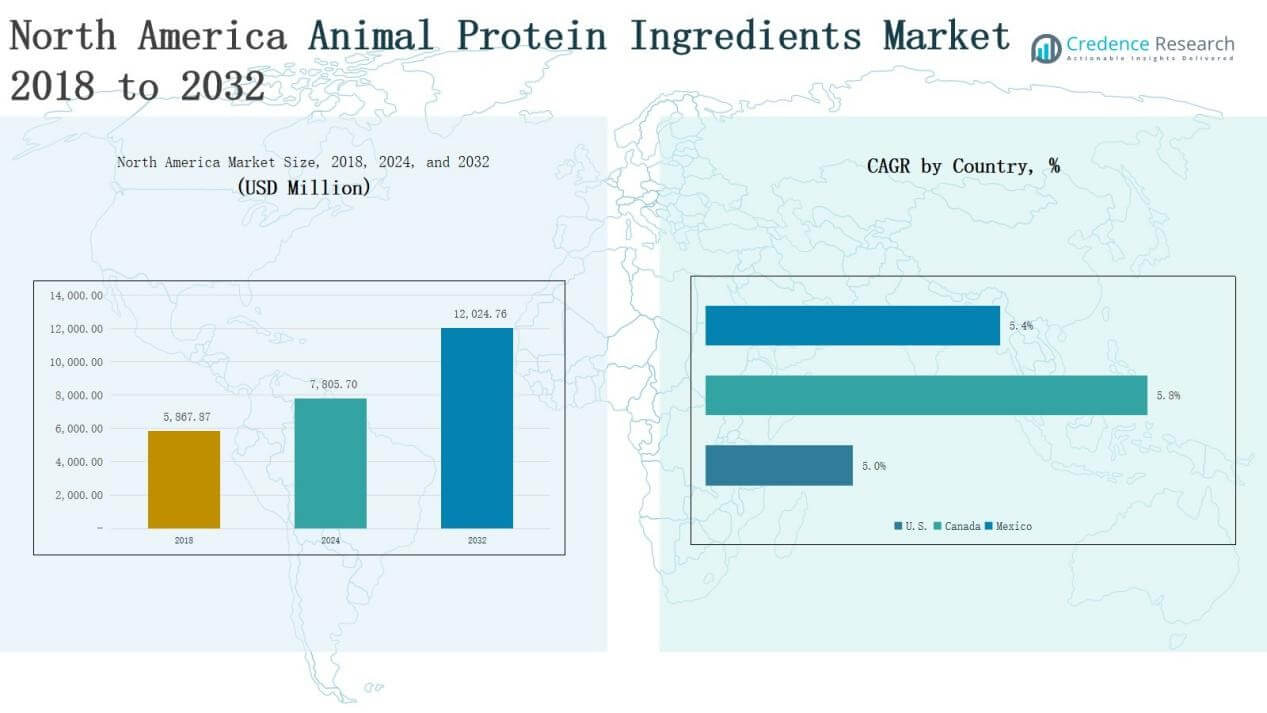
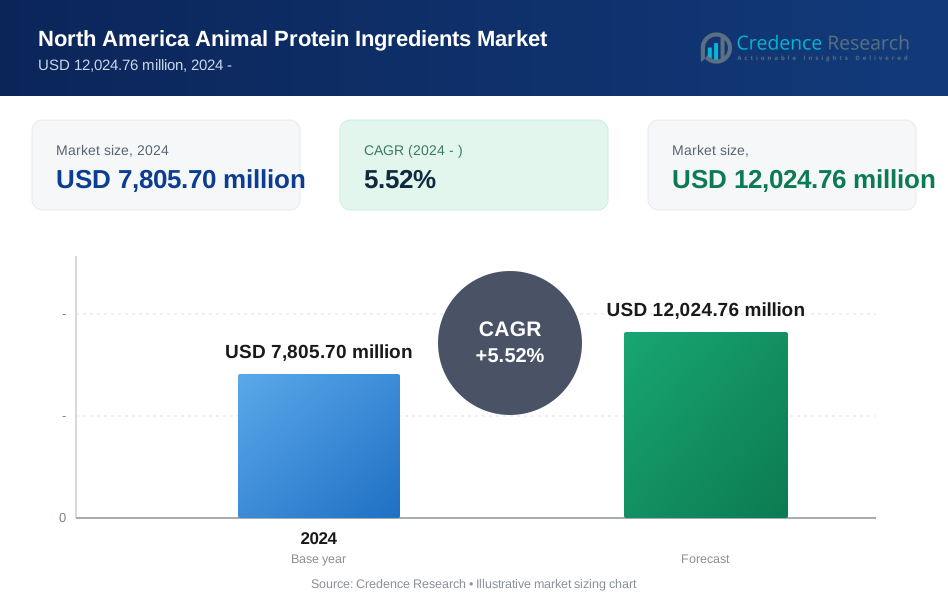
The North America Animal Protein Ingredients Market size was valued at USD 5,867.87 million in 2018, rising to USD 7,805.70 million in 2024, and is anticipated to reach USD 12,024.76 million by 2032, at a CAGR of 5.52% during the forecast period.
| REPORT ATTRIBUTE | DETAILS |
|---|---|
| Historical Period | 2020-2023 |
| Base Year | 2024 |
| Forecast Period | 2025-2032 |
| North America Animal Protein Ingredients Market Size 2024 | USD 7,805.70 Million |
| North America Animal Protein Ingredients Market, CAGR | 5.52% |
| North America Animal Protein Ingredients Market Size 2032 | USD 12,024.76 Million |
The North America Animal Protein Ingredients Market features strong competition led by global and regional companies. Major players include Cargill, Tyson Foods, ADM Animal Nutrition, Kemin Industries, Prinova, Nutraferma LLC, Green Labs LLC, GRF Ingredients, CJ Selecta, and NCC Food Ingredients. These companies strengthen their market positions through diverse protein portfolios, advanced processing technologies, and expanding applications in sports nutrition, clinical nutrition, pet food, and aquafeed. The United States emerges as the leading region, commanding a 65% market share, supported by high consumer demand for dairy proteins, strong presence of pet food manufacturers, and consistent investment in innovative protein solutions.
 Market Insights
- The North America Animal Protein Ingredients Market grew from USD 5,867.87 million in 2018 to USD 7,805.70 million in 2024 and will reach USD 12,024.76 million by 2032, expanding at 5.52%.
- Dairy leads by source with 40% share, followed by meat & poultry at 28%, fish & marine at 25%, and others at 7%, driven by diverse nutritional applications.
- Powders dominate by form with 55% share due to stability and versatility, while liquids/pastes hold 28% and granules/flakes account for 17%.
- Sports & active nutrition is the largest application with 35% share, followed by pet food at 25%, aquafeed & livestock feed at 20%, clinical nutrition at 15%, and others at 5%.
- The United States holds 65% share, Canada 20%, and Mexico 15%, with strong growth driven by sports nutrition demand, pet food expansion, and aquaculture feed solutions.
Market Segment Insights
By Source
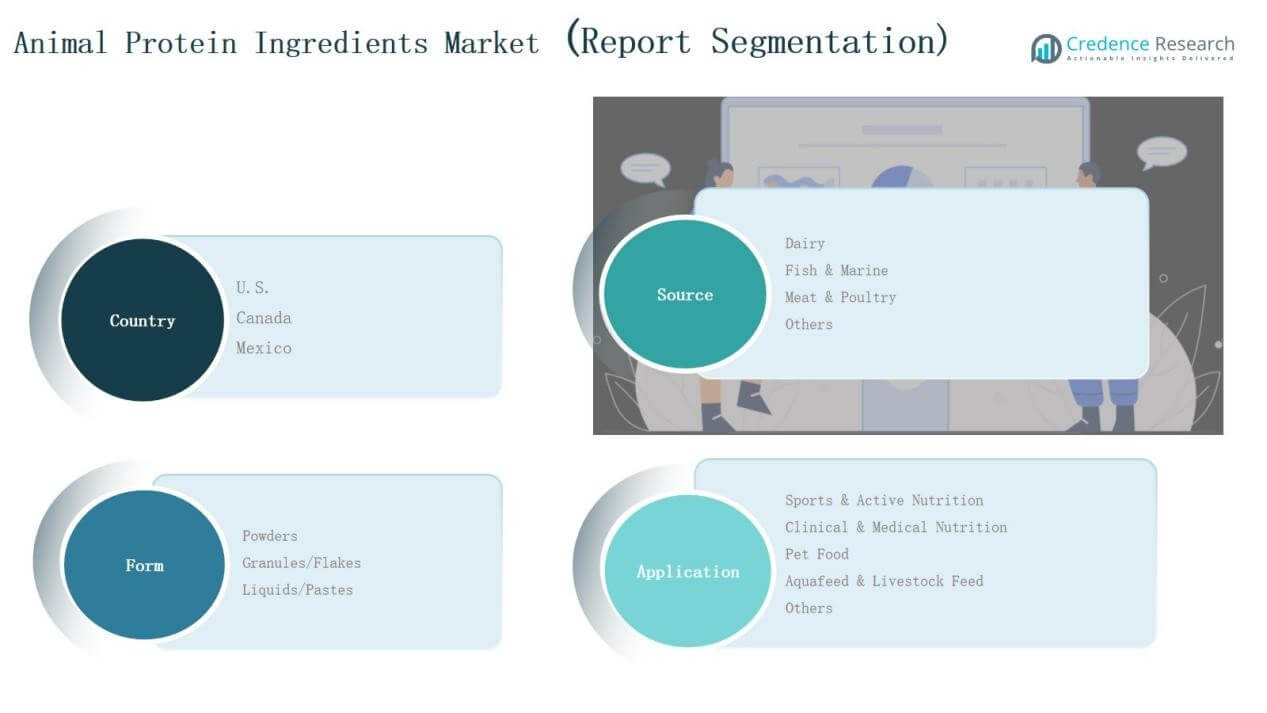
Dairy dominates the North America Animal Protein Ingredients Market with a share of 40%. Strong demand for whey and casein proteins in sports nutrition and medical applications drives this leadership. Fish & marine ingredients hold 25%, supported by omega-rich applications in aquafeed and clinical nutrition. Meat & poultry account for 28%, reflecting high use in pet food and dietary supplements. The remaining 7% share comes from other sources, including emerging specialty protein blends.
For instance, Omega Protein (Cooke Inc.) expanded production of fish oil concentrates in Virginia to meet rising aquafeed and clinical nutrition demand.
By Form
Powders lead the market with a share of 55%, driven by their stability, ease of formulation, and extensive use in supplements and clinical nutrition. Liquids/pastes represent 28%, favored for applications in medical nutrition and pet food. Granules/flakes capture 17%, with growth linked to convenience in feed formulations and ready-to-mix nutrition products. The dominance of powders is reinforced by rising demand for high-protein shakes and performance supplements.
For instance, FrieslandCampina Ingredients launched Nutri Whey Isolate Clear, a powder designed for clear protein drinks, highlighting the demand for stable, versatile whey formats.
By Application
Sports & active nutrition is the largest application segment with 35% share, fueled by strong consumer focus on fitness, bodybuilding, and protein-enriched diets. Pet food follows with 25%, supported by premiumization trends and rising adoption of companion animals. Aquafeed & livestock feed contributes 20%, reflecting demand for sustainable protein sources in aquaculture and animal farming. Clinical & medical nutrition holds 15%, driven by increasing use in therapeutic diets and elderly nutrition, while others account for 5%.
 Key Growth Drivers
Rising Demand for High-Protein Nutrition
The growing focus on health, fitness, and balanced diets is boosting demand for protein-rich foods in North America. Consumers increasingly incorporate whey, casein, and collagen proteins into sports supplements, functional beverages, and dietary products. This demand is reinforced by rising obesity rates and an emphasis on weight management. Sports nutrition brands and food manufacturers are expanding protein-fortified offerings, making dairy and meat-based ingredients key contributors to revenue growth in the regional animal protein ingredients market.
For instance, ADM partnered with Benson Hill to scale Ultra-High Protein soybeans, boosting plant-based protein supply for food ingredients in North America, meeting growing consumer preferences for high-protein nutrition.
Expansion of Pet Food and Animal Feed Industry
The region’s robust pet adoption rates and preference for premium pet foods are driving sustained demand for protein ingredients. Pet owners increasingly choose formulations rich in meat, fish, and poultry proteins to ensure animal health and wellness. Similarly, aquaculture and livestock farming depend on protein-rich feed formulations to enhance productivity. This dual demand from the pet food and feed industries supports steady growth for animal protein ingredient suppliers, with emphasis on consistent quality and traceability standards.
For instance, Hound & Gatos emphasized natural, high-quality animal protein as the main ingredient across their pet food products, avoiding fillers and meat by-products to ensure nutrient density and transparency.
Advancements in Processing and Functional Applications
Technological improvements in protein extraction and processing have enhanced ingredient functionality, solubility, and shelf life. These advancements enable manufacturers to tailor proteins for diverse applications, including clinical nutrition, performance supplements, and fortified foods. The ability to meet clean-label expectations and deliver high-performance formulations strengthens market penetration. Continuous investment in R&D for bioactive protein peptides and specialty blends further supports growth, allowing producers to cater to both health-conscious consumers and medical nutrition applications.
Key Trends & Opportunities
Shift Toward Functional and Specialty Proteins
Consumers in North America are seeking proteins with added health benefits, such as immune support, muscle recovery, and digestive wellness. This shift is opening opportunities for collagen, hydrolyzed whey, and marine-based proteins. Demand for multifunctional proteins in clinical nutrition and lifestyle-driven diets is accelerating innovation. Manufacturers are also launching fortified snacks and beverages, capitalizing on consumer willingness to pay premium prices for targeted health benefits.
For instance, BioCell Collagen launched hydrolyzed collagen supplements formulated for skin elasticity improvement and faster muscle recovery, backed by clinical trials showing reduction in wrinkles and enhanced hydration.
Growing Focus on Sustainable Sourcing and Transparency
Sustainability is emerging as a critical trend in the animal protein market. Companies are investing in responsible sourcing, improved waste management, and transparent supply chains. Marine protein producers, for example, are adopting certifications to ensure responsible fisheries. Consumer preference for traceable, ethically sourced animal proteins creates opportunities for brands that highlight sustainability credentials. This trend also supports long-term competitiveness by aligning with evolving regulatory standards and corporate ESG commitments in North America.
For instance, Mowi was ranked number 1 for sustainable animal protein production by the Coller FAIRR Protein Producer Index for the sixth consecutive year, driven by its robust policies on responsible sourcing, animal welfare, and environmental sustainability.
Key Challenges
Competition from Plant-Based and Alternative Proteins
The rise of plant-based protein options poses a significant challenge for animal protein suppliers. Growing consumer concerns about health, sustainability, and animal welfare are fueling plant-based adoption. This shift diverts market share, particularly in sports nutrition and functional foods. To counter competition, animal protein producers must emphasize superior amino acid profiles, functional properties, and clinical validation of benefits. However, overcoming consumer perception challenges remains a key hurdle in maintaining growth momentum.
Volatility in Raw Material Costs
Fluctuations in livestock, dairy, and marine raw material prices directly affect production costs of protein ingredients. Feed shortages, disease outbreaks, and climate-related risks add to supply instability. These cost pressures create pricing challenges for manufacturers and reduce profit margins. Companies must balance procurement strategies, supplier diversification, and process efficiencies to mitigate risks. The volatility further complicates long-term contracts with food and feed producers, limiting flexibility in pricing models.
Regulatory and Quality Compliance Pressure
The animal protein industry in North America operates under strict safety and quality regulations. Meeting evolving standards for food safety, labeling, and sustainability requires continuous investment in compliance systems. Manufacturers face risks of recalls, penalties, and reputational damage if standards are not met. Additionally, increasing scrutiny on antibiotics, allergens, and contaminants adds operational complexity. Smaller players, in particular, struggle with the financial and technical burden of adhering to stringent compliance requirements.
Regional Analysis
United States
The United States dominates the North America Animal Protein Ingredients Market with a 65% share. It benefits from strong demand for dairy-based proteins in sports nutrition and clinical nutrition, alongside rising popularity of collagen in dietary supplements and beauty products. The pet food industry in the country also supports high consumption of meat and poultry protein ingredients. Leading manufacturers invest in advanced processing technologies and product innovation to meet clean-label and functional food requirements. Growth is reinforced by established fitness trends, large healthcare spending, and rising demand for fortified foods. The market continues to expand as consumer awareness of high-protein diets strengthens.
Canada
Canada holds a 20% share of the North America Animal Protein Ingredients Market. Its growth is supported by increasing demand for premium pet food, clinical nutrition, and dairy protein supplements. Canadian consumers show high awareness of health and wellness, creating opportunities for fortified food and beverage launches. The country’s aquaculture sector contributes significantly to the use of marine-based proteins in feed formulations. Local producers and multinational players focus on sustainability certifications and transparent sourcing to align with consumer preferences. It demonstrates steady expansion across both human nutrition and animal feed applications.
Mexico
Mexico accounts for 15% share of the North America Animal Protein Ingredients Market. Rising disposable income and urbanization are driving demand for sports and active nutrition products, while livestock and aquafeed industries increase reliance on protein-rich formulations. Meat and poultry ingredients dominate consumption, supported by the country’s strong agricultural and farming base. Demand for affordable yet nutrient-rich food products is shaping growth in both functional and mass-market protein applications. Manufacturers are also expanding their presence in clinical and medical nutrition, supported by growing awareness of dietary health. The market is gaining momentum through both domestic demand and regional exports.
 Market Segmentations:
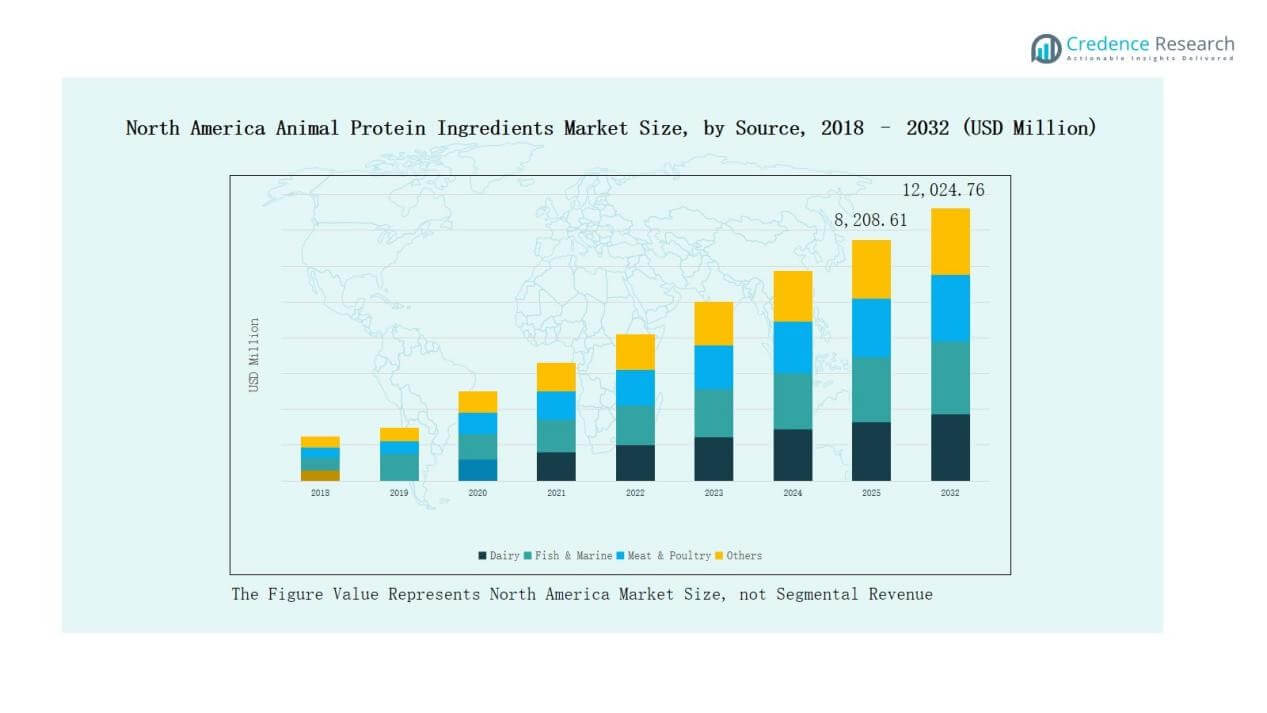
By Source
- Dairy
- Fish & Marine
- Meat & Poultry
- Others
By Form
- Powders
- Granules/Flakes
- Liquids/Pastes
By Application
- Sports & Active Nutrition
- Clinical & Medical Nutrition
- Pet Food
- Aquafeed & Livestock Feed
- Others
By Region
- U.S.
- Canada
- Mexico
Competitive Landscape
The North America Animal Protein Ingredients Market is moderately consolidated, with a mix of global corporations and regional suppliers competing for market share. Leading companies such as Cargill, Tyson Foods, ADM Animal Nutrition, and Kemin Industries dominate through diversified product portfolios, advanced processing capabilities, and extensive distribution networks. These players focus on innovation in dairy, meat, and marine-based proteins, responding to strong demand from sports nutrition, clinical applications, and pet food sectors. Mid-sized firms including Nutraferma LLC, Green Labs LLC, and GRF Ingredients strengthen competition by offering specialized and sustainable protein solutions tailored to evolving consumer needs. Strategic partnerships, acquisitions, and product launches remain key growth strategies, enabling companies to expand market reach and address shifting preferences for functional and clean-label protein products. Intense rivalry drives continuous investment in research, quality compliance, and sustainable sourcing practices, ensuring competitiveness across both human and animal nutrition segments in the region.
Key Players
- Nutraferma LLC
- CJ Selecta
- Green Labs LLC
- GRF Ingredients
- Cargill
- Kemin Industries
- Prinova
- ADM Animal Nutrition
- NCC Food Ingredients
- Tyson Foods
- Other Key Players
Recent Developments
- In April 2025, Actus Nutrition acquired the Foremost Farms whey protein facility in Sparta, Wisconsin, to expand whey production.
- In March 2025, Arla Foods Ingredients partnered with Valley Queen in South Dakota to manufacture its Nutrilac ProteinBoost whey line and signed a U.S. distribution deal for PB-8420.
- In March 2025, Burcon NutraScience’s alliance partner, RE ProMan, acquired a protein production facility in North America to strengthen plant-based protein operations.
- In March 2025, Vivici launched Vivitein™ BLG, a precision-fermented dairy protein ingredient in the U.S. with reduced carbon and water footprint.
Report Coverage
The research report offers an in-depth analysis based on Source, Form, Application and Region. It details leading market players, providing an overview of their business, product offerings, investments, revenue streams, and key applications. Additionally, the report includes insights into the competitive environment, SWOT analysis, current market trends, as well as the primary drivers and constraints. Furthermore, it discusses various factors that have driven market expansion in recent years. The report also explores market dynamics, regulatory scenarios, and technological advancements that are shaping the industry. It assesses the impact of external factors and global economic changes on market growth. Lastly, it provides strategic recommendations for new entrants and established companies to navigate the complexities of the market.
Future Outlook
- Demand for dairy proteins will remain strong due to sports and clinical nutrition growth.
- Collagen and specialty proteins will see wider adoption in beauty and wellness applications.
- Pet food will continue driving meat and poultry protein consumption across the region.
- Marine proteins will expand with rising focus on sustainable aquaculture feed solutions.
- Functional food and beverage launches will strengthen the role of animal proteins in daily diets.
- Clean-label and traceable sourcing will become a key purchasing factor for consumers.
- Investments in advanced processing technologies will improve efficiency and product quality.
- Strategic mergers and acquisitions will reshape competition and expand distribution networks.
- Regulatory focus on safety and sustainability will influence product innovation and compliance.
- Growth in Mexico and Canada will complement U.S. dominance, supporting regional balance.
Request a Free Sample
Fill in your details and we'll send you a free sample report.
- Sample data tables & charts
- Research methodology
Need a Custom Version of This Report?
Tailor the scope, geography, or segments to your exact requirements.
- Custom geography or segment scope
- Direct access to our analyst team
Frequently Asked Questions
What is the current market size for North America Animal Protein Ingredients Market, and what is its projected size in 2032?
At what Compound Annual Growth Rate is the North America Animal Protein Ingredients Market projected to grow between 2025 and 2032?
Which North America Animal Protein Ingredients Market segment held the largest share in 2024?
What are the primary factors fueling the growth of the North America Animal Protein Ingredients Market?
Who are the leading companies in the North America Animal Protein Ingredients Market?
Which region commanded the largest share of the North America Animal Protein Ingredients Market in 2024?
Table of Content
Chapter 1. Report Introduction
- 1.1 Report Description & Purpose
- 1.1.1 Report Title & Market Definition
- 1.1.2 Unique Selling Propositions (USP) & Key Differentiators
- 1.1.3 Value Proposition for Stakeholders
- 1.2 Research Objectives
- 1.2.1 Market Sizing Objectives (Volume & Revenue)
- 1.2.2 Segmentation Objectives
- 1.2.3 Competitive Intelligence Objectives
- 1.2.4 Forecast & Scenario Objectives
- 1.3 Report Scope
- 1.3.1 North America Animal Protein Ingredients Scope – Types & Subtypes Covered
- 1.3.2 Geographic Scope – Regions & Countries Covered
- 1.3.3 Historical Period, Base Year & Forecast Period (2024; forecast to the forecast period)
- 1.3.4 Inclusions & Exclusions
- 1.4 HS Code & Classification Framework
- 1.5 Currency, Units & Pricing Basis
- 1.6 Target Stakeholders
- 1.7 Limitations & Assumptions
Chapter 2. Executive Summary
- 2.1 Global North America Animal Protein Ingredients Market Snapshot
- 2.1.1 Market Size – Historical (2024) & Forecast (the forecast period) (2024: USD 7,805.70 million → forecast year: USD 12,024.76 million)
- 2.1.2 Volume & Revenue – Global Totals
- 2.1.3 Key Market Highlights – Top Five Facts
- 2.2 North America Animal Protein Ingredients Market Segmentation Snapshot
- 2.2.1 Market Split by Region – 2024 vs.
- 2.3 Competitive Snapshot
- 2.3.1 Top 10 Players by Revenue Share – 2024
- 2.3.2 Top 10 Players by Volume Share – 2024
- 2.3.3 Recent Strategic Developments (18-Month Summary)
- 2.4 Key Investment Highlights & Strategic Conclusions
Chapter 3. North America Animal Protein Ingredients Market Dynamics & Industry Analysis
- 3.1 Market Overview & Context
- 3.1.1 North America Animal Protein Ingredients Market Position in the Broader Automotive Value Chain
- 3.1.2 OEM vs. Replacement Market Dynamics
- 3.1.3 Market Maturity & Development Stage by Region
- 3.2 North America Animal Protein Ingredients Market Drivers
- 3.3 North America Animal Protein Ingredients Market Restraints & Challenges
- 3.4 North America Animal Protein Ingredients Market Opportunities
- 3.5 Porter's Five Forces Analysis
- 3.5.1 Threat of New Entrants
- 3.5.2 Bargaining Power of Suppliers
- 3.5.3 Bargaining Power of Buyers
- 3.5.4 Threat of Substitutes
- 3.5.5 Competitive Rivalry – Intensity Assessment
- 3.6 North America Animal Protein Ingredients Value Chain Analysis
- 3.6.1 Upstream – Raw Material/Input Suppliers
- 3.6.1.1 Raw Material/Input 1
- 3.6.1.2 Raw Material/Input 2
- 3.6.1.3 Raw Material/Input 3
- 3.6.2 Midstream – Production/Manufacturing/Service Delivery
- 3.6.2.1 Production/Process Overview
- 3.6.2.2 Key Facility Locations & Capacity by Manufacturer
- 3.6.3 Downstream – Distribution & End Consumer
- 3.6.3.1 Primary Channel – B2B/OEM
- 3.6.3.2 Secondary Channels – Dealer, Retail, Online, Direct
- 3.6.4 Value Chain Profitability Analysis
- 3.6.1 Upstream – Raw Material/Input Suppliers
- 3.7 PESTEL Analysis
- 3.7.1 Political Factors
- 3.7.2 Economic Factors
- 3.7.3 Social Factors
- 3.7.4 Technological Factors
- 3.7.5 Environmental Factors
- 3.7.6 Legal Factors
- 3.8 North America Animal Protein Ingredients Supply Chain Analysis
- 3.8.1 Raw Material/Input Supply Risk Assessment
- 3.8.2 Manufacturing Concentration Risk (Geographic Exposure)
- 3.8.3 Trade Disruption Impact Analysis
- 3.9 Regulatory & Policy Landscape
Note: The regulatory and policy landscape section covers regulations based on their applicability to the market, North America Animal Protein Ingredients category, geography, and scope of the study. Only regulatory frameworks with a material impact on operations, compliance, trade, sustainability, or market access are analyzed in detail.
Chapter 4. Key Investment Pockets & Opportunity Analysis
- 4.1 North America Animal Protein Ingredients Market Attractiveness Analysis
- 4.1.1 By Region – Investment Attractiveness Matrix (Volume × CAGR)
- 4.2 Absolute Revenue Growth Opportunity
- 4.2.1 By Region – Absolute USD Growth Through the forecast period
- 4.3 Incremental Volume Opportunity
- 4.3.1 By Region – Incremental Volume Through the forecast period
- 4.3.2 Segment – Incremental Volume
- 4.4 Emerging Submarket Opportunity Deep Dive (Subject to Applicability)
- 4.5 Emerging Market Opportunity Scorecards
- 4.5.1 United States
- 4.5.2 Europe
- 4.5.3 Asia
- 4.5.4 Middle East & Africa
Note: Emerging Market Opportunity Scorecards will be included based on relevance and strategic importance. Regions listed are indicative and may vary depending on data availability and market dynamics.
Chapter 5. North America Animal Protein Ingredients Import-Export Analysis & Trade Flows
- 5.1 Global Trade Overview
- 5.1.1 Global Export Value by Country (2024)
- 5.1.2 Global Export Volume by Country (2024)
- 5.1.3 Global Import Value by Country (2024)
- 5.1.4 Global Import Volume by Country (2024)
- 5.1.5 Net Trade Balance by Country (2024)
- 5.2 Export Analysis – Segment
- 5.2.1 Type 1 (HS Code)
- 5.2.2 Type 2 (HS Code)
- 5.2.3 Type 3 (HS Code)
- 5.2.4 Type 4 (HS Code)
- 5.2.5 Type 5 (HS Code)
- 5.3 Import Analysis – Segment
- 5.3.1 Type 1 (HS Code)
- 5.3.2 Type 2 (HS Code)
- 5.3.3 Type 3 (HS Code)
- 5.3.4 Type 4 (HS Code)
- 5.3.5 Type 5 (HS Code)
- 5.4 Average Unit Trade Prices
- 5.4.1 Average Export Price – Segment & Country
- 5.4.2 Average Import Price – Segment & Source Country
- 5.4.3 Price Trends (2024)
- 5.5 Key Trade Route Analysis
- 5.5.1 Trade Route 1
- 5.5.2 Trade Route 2
- 5.5.3 Trade Route 3
- 5.5.4 Trade Route 4
- 5.5.5 Trade Route 5
- 5.6 Trade Policy Impact Assessment
- 5.6.1 US Anti-Dumping & Section 301 Tariffs
- 5.6.2 EU Customs Union Impact
- 5.6.3 Major Free Trade Agreements
- 5.6.4 USMCA Rules of Origin
Note: Trade policy analysis will be included only where relevant to the North America Animal Protein Ingredients market.
Chapter 6. Competitive Landscape & Company Benchmarking
- 6.1 North America Animal Protein Ingredients Market Concentration & Structure
- 6.1.1 Herfindahl-Hirschman Index (HHI) – vs. 2024
- 6.1.2 Tier 1, Tier 2 & Tier 3 Market Structure
- 6.1.3 Global, Regional & Local Player Dynamics
- 6.2 North America Animal Protein Ingredients Market Share Analysis – 2024
- 6.2.1 Global Revenue Share by Company
- 6.2.2 Global Volume Share by Company
- 6.2.3 Regional Revenue Share
- 6.2.4 Market Share Evolution ( vs. 2024)
- 6.2.5 OEM Segment Share by Company
- 6.2.6 Replacement Segment Share by Company
- 6.3 Production/Delivery Capacity & Facility Analysis
- 6.3.1 Global Installed Capacity
- 6.3.2 Capacity Utilization Rates
- 6.3.3 Production/Output Volume
- 6.3.4 Facility Locations & Capacity Map
- 6.3.5 Planned Capacity Additions
- 6.4 North America Animal Protein Ingredients Competitive Benchmarking Matrix
- 6.4.1 Revenue, Volume, CAGR & Profitability Comparison
- 6.4.2 Channel Revenue Mix
- 6.4.3 Geographic Revenue Exposure
- 6.4.4 R&D Intensity
- 6.4.5 Sustainability Maturity
- 6.5 Strategic Developments in North America Animal Protein Ingredients (Last 24 Months)
- 6.5.1 Mergers, Acquisitions & Divestments
- 6.5.2 New North America Animal Protein Ingredients Launches
- 6.5.3 Facility Expansions
- 6.5.4 Strategic Alliances, Joint Ventures & Partnerships
- 6.5.5 Distribution Expansion & Market Entry
- 6.5.6 Sustainability & ESG Initiatives
- 6.6 Competitive Strategy Mapping
- 6.6.1 Leader, Challenger, Follower & Niche Classification
- 6.6.2 Pricing Strategy Comparison
- 6.6.3 Channel Strategy Matrix
Note: Strategic developments are included based on their materiality and the availability of reliable information.
Chapter 7. Global North America Animal Protein Ingredients Market – By Distribution Channel
- 7.1 Segment Overview
- 7.1.1 Volume & Revenue Split by Channel (2024 & )
- 7.1.2 Channel Mix Evolution (the forecast period)
Chapter 8. Regional Market Analysis – Global Overview
- 8.1 Global Regional Overview
- 8.1.1 Regional Volume Share
- 8.1.2 Regional Revenue Share
- 8.1.3 Regional Volume by Region
- 8.1.4 Regional Revenue by Region
- 8.1.5 Regional Forecast Through the forecast period
- 8.2 Cross-Regional Segment Analysis
- 8.2.1 By Distribution Channel
- 8.2.2 By Brand/Price Tier
Chapter 9. North America North America Animal Protein Ingredients Market
- 9.1 United States
- 9.2 Canada
- 9.3 Mexico
Chapter 10. Europe North America Animal Protein Ingredients Market
- 10.1 Germany
- 10.2 France
- 10.3 Italy
- 10.4 United Kingdom
- 10.5 Spain
- 10.6 Poland
- 10.7 Russia
- 10.8 Netherlands
- 10.9 Belgium
- 10.10 Sweden
- 10.11 Denmark
- 10.12 Norway
- 10.13 Rest of Europe
Chapter 11. Asia Pacific North America Animal Protein Ingredients Market
- 11.1 China
- 11.2 India
- 11.3 Japan
- 11.4 South Korea
- 11.5 Thailand
- 11.6 Indonesia
- 11.7 Vietnam
- 11.8 Malaysia
- 11.9 Australia
- 11.10 Rest of Asia Pacific
Chapter 12. Latin America North America Animal Protein Ingredients Market
- 12.1 Brazil
- 12.2 Argentina
- 12.3 Colombia
- 12.4 Chile
- 12.5 Rest of Latin America
Chapter 13. Middle East North America Animal Protein Ingredients Market
- 13.1 Saudi Arabia
- 13.2 United Arab Emirates
- 13.3 Turkey
- 13.4 Israel
- 13.5 Iran
- 13.6 Rest of the Middle East
Chapter 14. Africa North America Animal Protein Ingredients Market
- 14.1 South Africa
- 14.2 Egypt
- 14.3 Nigeria
- 14.4 Morocco
- 14.5 Rest of Africa
Chapter 15. North America Animal Protein Ingredients Company Profiles
- 15.1 [Company 01]
- 15.1.1 Company Overview
- 15.1.2 Key Management Personnel
- 15.1.3 Products & Services Portfolio
- 15.1.4 Financial Performance
- 15.1.5 Key Market Focus & Geographic Presence
- 15.1.6 Recent Developments & Strategic Initiatives
Note: The company profile list is preliminary and may change based on research findings, market developments, data availability, and client requirements.
Chapter 16. Appendices
- Appendix A – List of Abbreviations & Acronyms
- Appendix B – Industry Classification Code Reference – Full Series
- Appendix C – Production & Capacity Data Tables
- Appendix D – End-Use & Demand Base Tables
- Appendix E – Consumption & Replacement Rate Assumptions
- Appendix F – ASP Reference Tables
- Appendix G – Manufacturing & Facility Database
- Appendix H – Import-Export Data Tables
- Appendix I – Regulatory Summary Tables
- Appendix J – Primary Research Participant List (Anonymized)
- Appendix K – Primary Research Questionnaire Framework
- Appendix L – Data Sources & Bibliography
- Appendix M – Market Size Divergence & Source Comparison
Chapter 17. Research Methodology
- 17.1 Research Framework & Philosophy
- 17.2 Secondary Research – Sources, Hierarchy & Data Extraction
- 17.3 Data Modeling – Bottom-Up & Top-Down Market Sizing
- 17.4 Primary Research – Stakeholder Framework, LOI & Sample Sizes
- 17.5 Forecast Methodology – Regression, Scenario & Sensitivity Analysis
- 17.6 Quality Control – Four-Layer Validation Framework
- 17.7 Limitations & Standard Assumptions
- 17.8 Disclaimer
