Market Overview:
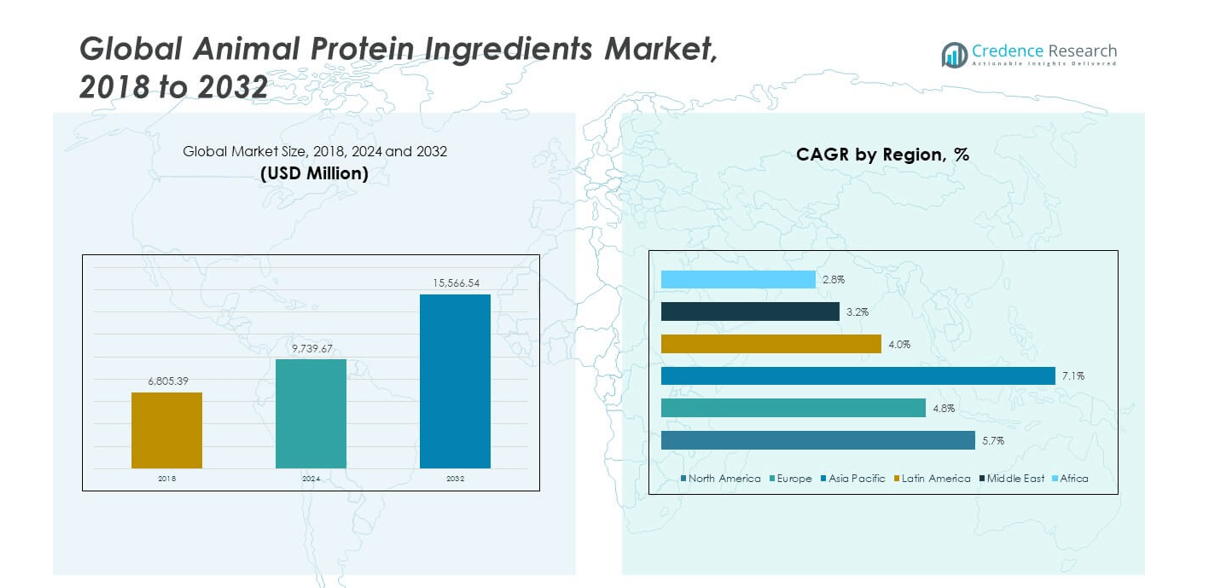
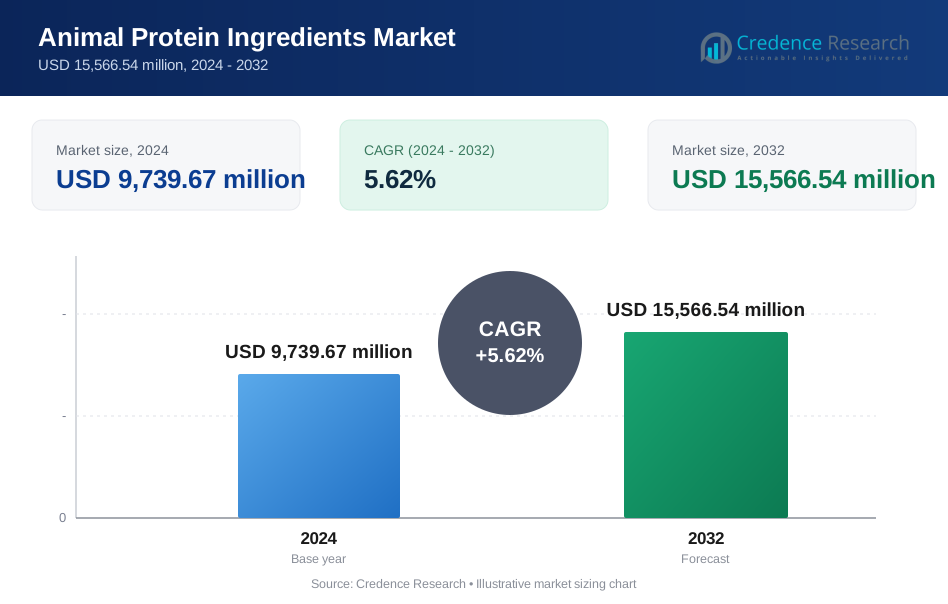
The Global Animal Protein Ingredients Market size was valued at USD 6,805.39 million in 2018 to USD 9,739.67 million in 2024 and is anticipated to reach USD 15,566.54 million by 2032, at a CAGR of 5.62% during the forecast period.
| REPORT ATTRIBUTE | DETAILS |
|---|---|
| Historical Period | 2020-2023 |
| Base Year | 2024 |
| Forecast Period | 2025-2032 |
| Animal Protein Ingredients Market Size 2024 | USD 9,739.67 million |
| Animal Protein Ingredients Market, CAGR | 5.62% |
| Animal Protein Ingredients Market Size 2032 | USD 15,566.54 million |
The Global Animal Protein Ingredients Market grows due to rising protein-rich diet demand. Food manufacturers use animal proteins for nutrition and texture improvement. Sports nutrition brands increase protein fortification across product lines. Pet food producers raise protein inclusion for premium formulations. Meat processing expansion supports by-product protein recovery. Functional benefits drive use in bakery and dairy applications. Pharmaceutical and feed sectors adopt proteins for bioavailability advantages. Clean-label trends favor recognizable animal protein sources.
North America leads due to strong processed food and nutrition industries. Europe follows with advanced meat processing and regulatory compliance. Asia Pacific emerges fast with growing population and protein consumption shifts. China and India expand food manufacturing capacity steadily. Latin America gains momentum through livestock sector growth. Brazil supports supply through large-scale meat production. Middle East and Africa show gradual adoption via food security initiatives. Regional growth reflects dietary shifts and industrial expansion.
Market Insights:
- The Global Animal Protein Ingredients Market size was valued at USD 6,805.39 million in 2018, reached USD 9,739.67 million in 2024, and is projected to attain USD 15,566.54 million by 2032, expanding at a CAGR of 5.62% due to sustained protein demand across food, nutrition, and feed sectors.
- North America leads with about 42% share, followed by Europe at nearly 26% and Asia Pacific at around 23%, driven by strong food processing capacity, regulatory maturity, and large-scale protein consumption.
- Asia Pacific is the fastest-growing region with nearly 23% share, supported by population growth, rising protein intake, expanding food manufacturing, and strong demand from China and India.
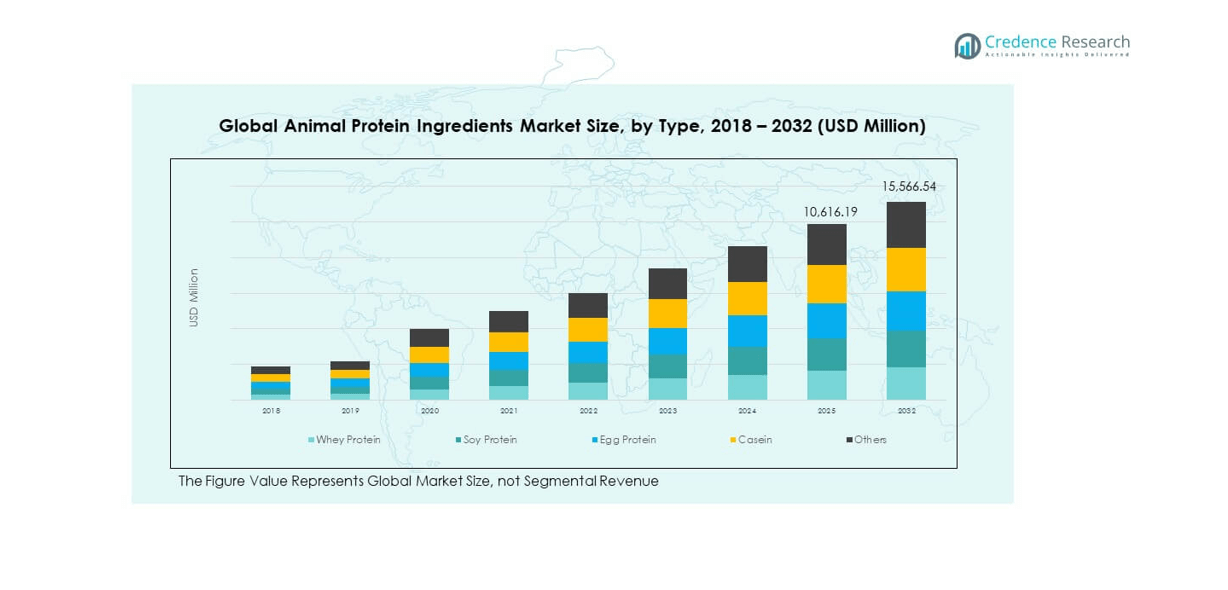
- By type, whey protein dominates with roughly 38% share, followed by soy protein at about 27%, supported by high bioavailability, cost efficiency, and wide application across food and nutrition products.
- Egg protein and casein together account for nearly 28% share, while others contribute the remaining portion, reflecting diversified use in bakery, dairy, supplements, and specialized formulations.
Market Drivers:
Rising Demand For High-Protein And Nutrient-Dense Food Products
The Global Animal Protein Ingredients Market benefits from strong demand for protein-rich diets. Consumers seek foods that support muscle health and satiety. Food brands use animal proteins to improve nutrition profiles. Dairy and bakery producers rely on them for texture and structure. Sports nutrition products favor complete amino acid profiles. Clinical nutrition uses them for digestibility benefits. Aging populations raise demand for functional protein intake. Urban lifestyles support packaged high-protein foods.
- For instance, Glanbia Nutritionals reports whey protein concentrates delivering over 80% protein content with high leucine levels, supporting muscle protein synthesis claims used in sports and medical nutrition products.
Expansion Of Industrial Meat Processing And By-Product Utilization
The Global Animal Protein Ingredients Market gains strength from meat processing scale. Slaughterhouse by-products supply raw protein materials. Rendering facilities convert waste into usable ingredients. This improves resource efficiency across value chains. Processors lower disposal costs through protein recovery. Feed producers depend on consistent protein inputs. Industrial automation improves output quality and volume. Supply stability supports long-term contracts.
- For instance, Darling Ingredients processes more than 10 million tons of animal by-products annually through its global rendering network, converting over 99% of raw material into proteins, fats, and specialty ingredients for feed and food use.
Growing Adoption Across Animal Feed And Pet Nutrition Segments
The Global Animal Protein Ingredients Market sees steady feed sector demand. Livestock producers prioritize growth and feed efficiency. Aquaculture relies on animal proteins for conversion rates. Pet food brands raise protein content for premium lines. Digestibility supports animal health outcomes. It enables better nutrient absorption. Rising pet ownership supports volume demand. Premiumization trends strengthen margins.
Functional Advantages In Food Formulation And Processing Performance
The Global Animal Protein Ingredients Market expands due to functional performance needs. Proteins improve emulsification and water binding. Meat blends use them for structure support. Processed foods depend on stability during heating. Shelf-life control supports packaged formats. It aids flavor retention and mouthfeel. Manufacturers value predictable performance. Product consistency drives repeat use.
Market Trends:
Shift Toward Specialized And Application-Specific Protein Fractions
The Global Animal Protein Ingredients Market trends toward tailored protein solutions. Suppliers develop fractions for targeted uses. Food processors seek precise functional outcomes. Nutritional brands demand defined amino profiles. This trend supports premium pricing strategies. It reduces formulation trial time. Customization strengthens supplier relationships. Innovation pipelines gain priority.
- For instance, Fonterra has commercialized whey protein isolates with protein purity exceeding 90%, engineered for fast solubility and neutral taste in ready-to-drink nutrition beverages.
Rising Focus On Traceability And Quality Certification Standards
The Global Animal Protein Ingredients Market reflects stronger quality focus. Buyers demand traceable sourcing records. Certification improves buyer confidence. It supports regulatory compliance in exports. Food safety audits increase supplier accountability. Transparent supply chains gain preference. Trust drives long-term procurement. Brand reputation influences sourcing decisions.
- For instance, Cargill operates animal protein facilities certified under ISO 22000 and FSSC 22000 standards, with digital traceability systems tracking raw material origin through finished ingredient batches across multiple regions.
Integration Of Advanced Processing And Drying Technologies
The Global Animal Protein Ingredients Market adopts modern processing systems. Spray drying improves solubility control. Enzyme treatment enhances bioavailability. Automation improves batch consistency. Energy-efficient systems reduce operational strain. It supports scalable production models. Technology investment raises entry barriers. Efficiency supports margin stability.
Premiumization Across Human Nutrition And Wellness Applications
The Global Animal Protein Ingredients Market aligns with wellness positioning. Brands market proteins for active lifestyles. Clean taste profiles support direct consumption. Fortified beverages use refined proteins. Clinical nutrition targets recovery needs. It enables premium product positioning. Branding links protein quality to health outcomes. Value-added products gain shelf space.
Market Challenges Analysis:
Volatility In Raw Material Availability And Cost Structure Pressure
The Global Animal Protein Ingredients Market faces instability in raw material supply. Livestock production cycles influence input consistency. Disease outbreaks disrupt sourcing networks. Price swings affect contract reliability. It complicates long-term procurement planning. Smaller processors face margin stress. Dependence on specific regions increases exposure. Supply risk management needs strategic diversification.
Regulatory Compliance Burden And Changing Consumer Perceptions
The Global Animal Protein Ingredients Market encounters complex regulatory demands. Food safety rules vary across regions. Compliance raises operational costs. Label transparency requirements increase scrutiny. Ethical sourcing concerns influence buyer decisions. Sustainability debates affect brand acceptance. It challenges communication strategies. Regulatory monitoring requires continuous investment.
Market Opportunities:
Expansion Of High-Value Nutrition And Functional Food Applications
The Global Animal Protein Ingredients Market finds opportunity in nutrition-focused products. Functional foods demand bioavailable protein sources. Medical nutrition uses proteins for recovery support. Sports brands seek clean and complete amino profiles. It supports premium product positioning. Innovation drives differentiated offerings. Urban consumers favor fortified foods. Value creation rises through formulation expertise.
Growth Potential Across Emerging Economies And Protein Access Programs
The Global Animal Protein Ingredients Market gains scope in emerging regions. Population growth raises protein demand. Urbanization supports packaged food adoption. Government nutrition programs expand protein access. It improves long-term volume growth. Local processing capacity increases steadily. Investment flows support supply chain expansion. Market penetration improves through affordability strategies.
Market Segmentation Analysis:
By Type
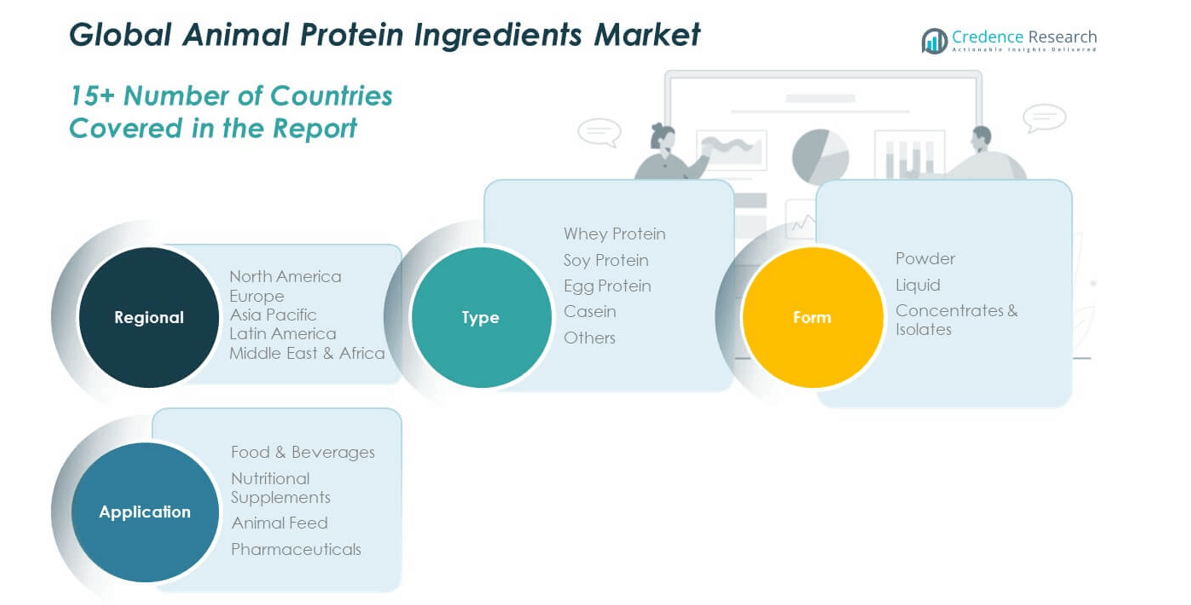
The Global Animal Protein Ingredients Market shows clear differentiation by protein type. Whey protein leads due to high bioavailability and broad use in nutrition products. Soy protein supports cost efficiency and functional balance in food formulations. Egg protein gains traction for emulsification and binding properties. Casein serves slow-release nutrition needs in supplements and dairy. Other proteins address niche applications and regional preferences. It supports portfolio diversity across end users.
- For instance, Arla Foods Ingredients supplies whey proteins with a Protein Digestibility Corrected Amino Acid Score of 1.0, meeting complete protein standards for clinical and sports nutrition.
By Form
Form-based segmentation highlights processing and application flexibility. Powder form dominates due to ease of storage and transport. Liquid proteins serve ready-to-use formulations in beverages and processed foods. Concentrates and isolates attract demand for high purity applications. It enables precise formulation control across nutrition and pharma uses. Manufacturers select form based on stability and performance needs.
By Application
Application analysis reflects broad demand coverage. Food and beverages hold the largest share due to functional and nutritional benefits. Nutritional supplements rely on complete amino acid profiles. Animal feed uses proteins to improve growth efficiency. Pharmaceuticals adopt them for digestibility and bioavailability advantages. It sustains balanced demand across consumption and industrial sectors.
Segmentation:
By Type
- Whey Protein
- Soy Protein
- Egg Protein
- Casein
- Others
- Powder
- Liquid
- Concentrates & Isolates
- Food & Beverages
- Nutritional Supplements
- Animal Feed
- Pharmaceuticals
- North America
- U.S.
- Canada
- Mexico
- Europe
- Germany
- France
- U.K.
- Italy
- Spain
- Rest of Europe
- Asia Pacific
- China
- Japan
- India
- South Korea
- South-east Asia
- Rest of Asia Pacific
- Latin America
- Brazil
- Argentina
- Rest of Latin America
- Middle East & Africa
- GCC Countries
- South Africa
- Rest of the Middle East and Africa
Regional Analysis:
North America
The North America Global Animal Protein Ingredients Market size was valued at USD 2,915.81 million in 2018 to USD 4,128.85 million in 2024 and is anticipated to reach USD 6,617.66 million by 2032, at a CAGR of 5.7% during the forecast period, accounting for nearly 42% market share in 2024. The Global Animal Protein Ingredients Market in North America benefits from a mature food and nutrition industry. High protein intake supports stable demand across applications. Food processors rely on animal proteins for texture and formulation control. Sports nutrition and clinical nutrition show consistent uptake. Pet food premiumization raises inclusion levels. Advanced processing infrastructure supports supply reliability. Regulatory clarity improves product standardization. Innovation investment strengthens regional competitiveness.
Europe
The Europe Global Animal Protein Ingredients Market size was valued at USD 1,805.03 million in 2018 to USD 2,483.69 million in 2024 and is anticipated to reach USD 3,720.51 million by 2032, at a CAGR of 4.8% during the forecast period, representing about 26% market share in 2024. The Global Animal Protein Ingredients Market in Europe reflects strong regulatory discipline. Food safety standards guide ingredient selection. Dairy and meat processing remain core demand sources. Functional food adoption supports protein enrichment. Sustainability focus influences sourcing decisions. Pet nutrition shows steady demand across countries. It benefits from advanced processing technologies. Export orientation supports scale and stability.
Asia Pacific
The Asia Pacific Global Animal Protein Ingredients Market size was valued at USD 1,479.12 million in 2018 to USD 2,274.02 million in 2024 and is anticipated to reach USD 4,064.74 million by 2032, at a CAGR of 7.1% during the forecast period, holding nearly 23% market share in 2024. The Global Animal Protein Ingredients Market in Asia Pacific expands due to rising protein consumption. Urbanization increases packaged food demand. China and India drive volume growth. Feed and aquaculture sectors use animal proteins extensively. Middle-income groups support nutrition product demand. Local processing capacity rises steadily. It attracts investment across value chains. Growth outpaces mature regions.
Latin America
The Latin America Global Animal Protein Ingredients Market size was valued at USD 314.64 million in 2018 to USD 444.59 million in 2024 and is anticipated to reach USD 627.13 million by 2032, at a CAGR of 4.0% during the forecast period, contributing about 5% market share in 2024. The Global Animal Protein Ingredients Market in Latin America benefits from strong livestock production. Brazil and Argentina support raw material availability. Meat exports increase by-product utilization. Feed applications dominate regional demand. Processing modernization improves efficiency. It supports cost-effective protein supply. Domestic food consumption rises gradually. Export focus enhances scale benefits.
Middle East
The Middle East Global Animal Protein Ingredients Market size was valued at USD 179.29 million in 2018 to USD 233.15 million in 2024 and is anticipated to reach USD 310.37 million by 2032, at a CAGR of 3.2% during the forecast period, accounting for nearly 2% market share in 2024. The Global Animal Protein Ingredients Market in the Middle East grows through food security initiatives. Protein fortification supports nutrition programs. Imports meet most ingredient needs. Processing capacity expands at a controlled pace. It supports demand from bakery and dairy sectors. Pet food adoption increases in urban areas. Regulatory systems evolve steadily. Market growth remains moderate.
Africa
The Africa Global Animal Protein Ingredients Market size was valued at USD 111.50 million in 2018 to USD 175.37 million in 2024 and is anticipated to reach USD 226.11 million by 2032, at a CAGR of 2.8% during the forecast period, representing around 2% market share in 2024. The Global Animal Protein Ingredients Market in Africa remains at an early stage. Population growth drives basic protein demand. Food affordability shapes purchasing patterns. Feed applications account for major consumption. Processing infrastructure stays limited. It depends on imports for specialty proteins. Gradual industrial development supports expansion. Long-term demand fundamentals remain favorable.
Key Player Analysis:
- Cargill, Inc.
- Archer Daniels Midland Company (ADM)
- Kerry Group
- Glanbia Nutritionals
- DuPont Nutrition & Biosciences
- Darling Ingredients Inc.
- Ingredion Incorporated
- Royal FrieslandCampina
- Tate & Lyle PLC
- Arla Foods Ingredients Group
Competitive Analysis:
The Global Animal Protein Ingredients Market features competition among multinational ingredient suppliers and specialized processors. Large players leverage integrated sourcing and advanced processing capabilities. Scale supports cost control and supply reliability. Portfolio breadth allows service across food, nutrition, and feed applications. Regional firms compete through localized sourcing and pricing flexibility. Product quality, traceability, and certification drive buyer preference. Strategic partnerships strengthen distribution reach. Innovation focus centers on functional performance and digestibility. Competitive intensity remains moderate due to high capital requirements and regulatory oversight.
Recent Developments:
- Tate & Lyle completed the acquisition of CP Kelco, a leading provider of pectin, specialty gums, and other nature-based ingredients, creating a leader in mouthfeel capabilities. This combination significantly enhances Tate & Lyle's solutions portfolio and global reach, resulting in more than 5,000 employees working across approximately 75 locations in 38 countries serving customers in more than 120 countries. The enlarged company strengthens its expertise in sweetening, mouthfeel, and fortification, enabling development of ingredients and solutions that reduce sugar, calories, and fat while adding fiber and protein for applications across beverages, dairy, bakery, snacks, soups, sauces, and dressings. On a pro forma basis assuming the combination took place April 1, 2024, the enlarged Tate & Lyle Group would have generated revenue of £2.12 billion for the year ended March 31, 2025.
- In November 2024, Kerry Group entered into an agreement to sell Kerry Dairy Holdings (Ireland) Limited to Kerry Co-Operative Creameries Limited for an expected €500 million, marking a pivotal shift toward becoming a pure-play taste and nutrition company. The Kerry Dairy division, which generated €1.28 billion in revenues in fiscal year 2023, encompasses dairy consumer products and popular brands including Dairygold and Cheestrings. This strategic divestment allows Kerry to concentrate resources on its burgeoning taste and nutrition segments, including proactive health, food protection, and preservation technologies while maintaining a 30% stake initially with the Co-Op acquiring full ownership in a phased manner.
- In September 2024, Cargill acquired two feed mills from Compana Pet Brands-one in Denver, Colorado, and another in Kansas City, Kansas-with the transaction finalizing on September 3, 2024. This strategic expansion strengthens Cargill's Animal Nutrition and Health business across the U.S. western and central regions, enabling the company to better serve customers ranging from large-scale farmers and ranchers to local retailers selling horse treats and pet food. The Kansas City mill's proximity to Cargill's existing Kansas City facility positions the company for continued regional growth and strengthened supplier capabilities.
Report Coverage:
The research report offers an in-depth analysis based on type, form, and application segments. It details leading market players, providing an overview of their business, product offerings, investments, revenue streams, and key applications. Additionally, the report includes insights into the competitive environment, SWOT analysis, current market trends, as well as the primary drivers and constraints. Furthermore, it discusses various factors that have driven market expansion in recent years. The report also explores market dynamics, regulatory scenarios, and technological advancements that are shaping the industry. It assesses the impact of external factors and global economic changes on market growth. Lastly, it provides strategic recommendations for new entrants and established companies to navigate the complexities of the market.
Future Outlook:
- The market will continue to benefit from steady growth in protein-rich dietary preferences worldwide.
- Food and beverage manufacturers will increase the use of animal proteins for functional and nutritional enhancement.
- Sports and clinical nutrition segments will drive demand for high-quality and bioavailable protein ingredients.
- Pet food producers will expand premium formulations with higher animal protein inclusion.
- Feed applications will remain a stable demand base due to livestock and aquaculture needs.
- Processing technology upgrades will improve yield consistency and product performance.
- Traceability and quality certification will gain importance in procurement decisions.
- Asia Pacific will remain a key growth engine due to population and dietary shifts.
- Sustainability focus will encourage efficient use of meat processing by-products.
- Strategic partnerships will support regional expansion and portfolio diversification.
Request a Free Sample
Fill in your details and we'll send you a free sample report.
- Sample data tables & charts
- Research methodology
Market Dynamics
Expansion of Industrial Meat Processing and By-Product Utilization
Growth in industrial meat processing has increased the availability of animal by-products, which are converted into high-value protein ingredients. This improves resource efficiency and supply stability, supporting the market’s expansion across food, feed, and nutrition sectors.
Functional Advantages in Food Formulation
Animal protein ingredients are increasingly used for their functional properties such as emulsification, water binding, and texture enhancement in processed foods, bakery, and dairy applications. These benefits drive adoption among manufacturers seeking product consistency and improved sensory profiles.
Premiumization and Protein Fortification in Nutrition and Pet Food
Rising consumer interest in premium, protein-rich diets has led to greater use of animal proteins in sports nutrition, clinical nutrition, and high-end pet food. Brands leverage the complete amino acid profiles and digestibility of animal proteins to differentiate products and meet evolving health and wellness trends.
Growth in Emerging Markets and Protein Access Programs
Rapid urbanization, population growth, and government nutrition initiatives in Asia Pacific and Latin America are boosting demand for animal protein ingredients. Local processing capacity and increased affordability are enabling broader market penetration in these regions.
Emphasis on Traceability and Quality Certification
Stricter regulatory requirements and consumer demand for transparent sourcing are driving adoption of traceable and certified animal protein ingredients. This trend enhances buyer confidence, supports export opportunities, and encourages investment in quality assurance systems.
Need a Custom Version of This Report?
Tailor the scope, geography, or segments to your exact requirements.
- Custom geography or segment scope
- Direct access to our analyst team
Frequently Asked Questions
What is the current market size for Animal Protein Ingredients Market, and what is its projected size in 2032?
At what Compound Annual Growth Rate is the Animal Protein Ingredients Market projected to grow between 2025 and 2032?
Which Animal Protein Ingredients Market segment held the largest share in 2024?
What are the primary factors fueling the growth of the Animal Protein Ingredients Market?
Who are the leading companies in the Animal Protein Ingredients Market?
Table of Content
Chapter 1 Market Segmentation
- 1.1 Segmentation Framework
- 1.1.1 Product and Service Classification
- 1.1.2 Application and End-Use Classification
- 1.1.3 Technology and Solution Classification
- 1.1.4 Customer and Distribution Channel Classification
- 1.1.5 Geographic Segmentation
- 1.1.6 Market Segment Definitions and Boundaries
- 1.2 By Form
- 1.2.1 Powder
- 1.2.2 Liquid
- 1.2.3 Concentrates & Isolates
- 1.3 By Type
- 1.3.1 Whey Protein
- 1.3.2 Soy Protein
- 1.3.3 Egg Protein
- 1.3.4 Casein
- 1.3.5 Others
- 1.4 By Application
- 1.4.1 Food & Beverages
- 1.4.2 Nutritional Supplements
- 1.4.3 Animal Feed
- 1.4.4 Pharmaceuticals
Chapter 2 Introduction
- 2.1 Report Objectives and Scope
- 2.2 Product Definition and Industry Terminology
- 2.3 Market Inclusions and Exclusions
- 2.4 Research Process
- 2.4.1 Primary Research and Expert Interviews
- 2.4.2 Secondary Research and Source Review
- 2.4.3 Top-Down and Bottom-Up Estimation
- 2.4.4 Data Triangulation and Verification
- 2.5 Market Size Measurement Basis
- 2.5.1 2024: USD 9,739.67 million → 2032: USD 15,566.54 million
- 2.6 Historical and Forecast Reference Periods
- 2.6.1 Base Year: 2024
- 2.6.2 Forecast Period: 2024-2032
- 2.7 Research Assumptions and Limitations
Chapter 3 Executive Summary
- 3.1 Market Snapshot and Key Findings
- 3.2 Base-Year Market Size, 2024
- 3.3 Forecast Market Size, 2032
- 3.4 Revenue and Volume Growth Outlook
- 3.5 Key Demand and Supply Indicators
- 3.6 Leading Market Segments
- 3.7 Fastest-Growing Market Opportunities
- 3.8 Regional Performance Highlights
- 3.9 Technology and Industry Transformation
- 3.10 Competitive Landscape Summary
- 3.11 Analyst View and Strategic Implications
Chapter 4 Global Animal Protein Ingredients Market Trends and Developments
- 4.1 Historical Industry Development
- 4.2 Recent Market Trends and Developments
- 4.3 Demand and Customer Behavior Trends
- 4.4 Technology and Product Innovation
- 4.5 Artificial Intelligence, Automation and Digitalization
- 4.6 Local Manufacturing and Supply Chain Realignment
- 4.7 Industry Partnerships, Mergers and Acquisitions
- 4.8 Sustainability and Circular Economy Developments
- 4.9 Government and Private Sector Investment Trends
- 4.10 Emerging Business Models and Commercialization
- 4.11 Industry Developments and Announcements
Chapter 5 Global Animal Protein Ingredients Market Production, Supply and Demand Analysis
- 5.1 Demand Trend and Consumption Analysis
- 5.2 Demand Forecast, 2024-2032
- 5.3 Production and Output Trend
- 5.4 Production and Output Forecast, 2024-2032
- 5.5 Installed Capacity and Capacity Utilization
- 5.6 Company-Wise Production Plants and Statistics
- 5.6.1 Installed Production Capacity
- 5.6.2 Actual Production
- 5.6.3 Planned Capacity and Expansion Targets
- 5.7 Supply Chain Structure and Procurement Trends
- 5.8 Supply-Demand Gap and Bottlenecks
- 5.9 Import Dependence and Sourcing Structure
- 5.10 Contract Manufacturing and Outsourcing
- 5.11 Regional Supply and Demand Concentration
Chapter 6 Global Animal Protein Ingredients Market Pricing Analysis
- 6.1 Pricing Structure and Measurement
- 6.2 Historical Pricing Trends
- 6.3 Pricing Outlook, 2024-2032
- 6.4 Average Selling Price and Unit Economics
- 6.5 Pricing by Product and Market Segment
- 6.6 Geographic Pricing Differences
- 6.7 Key Input, Energy, Labor and Logistics Costs
- 6.8 Contract Pricing and Purchasing Models
- 6.9 Pricing Sensitivity and Competitive Positioning
- 6.10 Price, Margin and Profitability Implications
Chapter 7 Global Animal Protein Ingredients Market Dynamics
- 7.1 Market Growth Drivers
- 7.1.1 Demand-Side Drivers
- 7.1.2 Technology and Innovation Drivers
- 7.1.3 Infrastructure and Investment Drivers
- 7.1.4 Regulatory and Policy Drivers
- 7.2 Market Restraints
- 7.2.1 Cost and Affordability Constraints
- 7.2.2 Technology and Adoption Barriers
- 7.2.3 Supply Chain and Operational Constraints
- 7.3 Market Challenges
- 7.3.1 Competitive Pressure and Margin Erosion
- 7.3.2 Skills, Infrastructure and Implementation Gaps
- 7.4 Emerging Market Opportunities
- 7.5 Market Dynamics Impact and Time-Horizon Assessment
Chapter 8 Global Animal Protein Ingredients Value Chain Analysis
- 8.1 Industry Value Chain Overview
- 8.2 Upstream Suppliers and Critical Inputs
- 8.3 Technology and Component Providers
- 8.4 Manufacturing or Service Delivery
- 8.5 Distribution, Channel Partners and Integrators
- 8.6 Downstream Applications and End Users
- 8.7 Value Addition and Profit Pools
- 8.8 Vertical Integration and Outsourcing
- 8.9 Supplier Concentration and Risk
- 8.10 Supply Chain Localization and Resilience
Chapter 9 Global Animal Protein Ingredients Market Regulations and Policies
- 9.1 Relevant Laws, Standards and Compliance Frameworks
- 9.2 Product, Service, Safety and Quality Requirements
- 9.3 Government Policies, Incentives and Subsidies
- 9.4 Imports, Exports and Trade Barriers
- 9.5 Public Procurement and Local Content Requirements
- 9.6 Environmental and Sustainability Compliance
- 9.7 Upcoming Policy Changes and Market Implications
Chapter 10 Global Animal Protein Ingredients Market Hotspots and Opportunities
- 10.1 Market Opportunity Mapping and Growth Hotspots
- 10.2 High-Growth Applications and Customer Groups
- 10.3 Underserved Markets and White-Space Opportunities
- 10.4 Emerging Technology and Product Opportunities
- 10.5 New Capacity and Investment Hotspots
- 10.6 Market Entry and Expansion Opportunities
- 10.7 Distribution and Partnership Opportunities
- 10.8 Near-Term and Long-Term Commercial Potential
- 10.9 Opportunity Attractiveness and Execution Risks
Chapter 11 Global Animal Protein Ingredients Market Outlook, 2024-2032
- 11.1 Market Size and Analysis
- 11.1.1 Revenue (Market Measurement: 2024: USD 9,739.67 million → 2032: USD 15,566.54 million)
- 11.1.2 Market Volume and Quantity Sold
- 11.1.3 Historical Market Size
- 11.1.4 Base-Year Market Size, 2024
- 11.2 Market Forecast, 2024-2032
- 11.2.1 Revenue Forecast to 2032
- 11.2.2 Volume Forecast to 2032
- 11.2.3 CAGR and Year-on-Year Growth
- 11.2.4 Incremental Revenue Opportunity
- 11.3 Forecast Assumptions and Scenario Analysis
- 11.3.1 Base-Case Forecast
- 11.3.2 Optimistic and Conservative Scenarios
- 11.3.3 Technology, Pricing and Policy Sensitivities
- 11.4 Market Attractiveness and Growth Outlook
Chapter 12 Global Animal Protein Ingredients Market Segmentation and Outlook
- 12.1 Segmentation Summary and Market Shares, 2024
- 12.2 Largest and Fastest-Growing Segments
- 12.3 By Form - Market Size and Forecast, 2024-2032
- 12.3.1 Segment Definition and Scope
- 12.3.2 Historical Market Size
- 12.3.3 Revenue Forecast, 2024-2032
- 12.3.4 Volume Forecast, 2024-2032
- 12.3.5 Base-Year Market Share, 2024
- 12.3.6 Segment CAGR and Growth Drivers
- 12.3.7 Subsegment Market Size and Forecast
- 12.3.7.1 Powder
- 12.3.7.2 Liquid
- 12.3.7.3 Concentrates & Isolates
- 12.3.8 Subsegment Pricing and Adoption Trends
- 12.3.9 Leading Suppliers and Competition
- 12.3.10 Regional Demand and Opportunities
- 12.4 By Type - Market Size and Forecast, 2024-2032
- 12.4.1 Segment Definition and Scope
- 12.4.2 Historical Market Size
- 12.4.3 Revenue Forecast, 2024-2032
- 12.4.4 Volume Forecast, 2024-2032
- 12.4.5 Base-Year Market Share, 2024
- 12.4.6 Segment CAGR and Growth Drivers
- 12.4.7 Subsegment Market Size and Forecast
- 12.4.7.1 Whey Protein
- 12.4.7.2 Soy Protein
- 12.4.7.3 Egg Protein
- 12.4.7.4 Casein
- 12.4.7.5 Others
- 12.4.8 Subsegment Pricing and Adoption Trends
- 12.4.9 Leading Suppliers and Competition
- 12.4.10 Regional Demand and Opportunities
- 12.5 By Application - Market Size and Forecast, 2024-2032
- 12.5.1 Segment Definition and Scope
- 12.5.2 Historical Market Size
- 12.5.3 Revenue Forecast, 2024-2032
- 12.5.4 Volume Forecast, 2024-2032
- 12.5.5 Base-Year Market Share, 2024
- 12.5.6 Segment CAGR and Growth Drivers
- 12.5.7 Subsegment Market Size and Forecast
- 12.5.7.1 Food & Beverages
- 12.5.7.2 Nutritional Supplements
- 12.5.7.3 Animal Feed
- 12.5.7.4 Pharmaceuticals
- 12.5.8 Subsegment Pricing and Adoption Trends
- 12.5.9 Leading Suppliers and Competition
- 12.5.10 Regional Demand and Opportunities
- 12.6 Segment Growth Comparison
- 12.7 Segment Attractiveness and Priority Matrix
Chapter 13 Global Animal Protein Ingredients End-Use and Application Market Outlook
- 13.1 End-Use Industry and Customer Demand Structure
- 13.2 Leading Applications and Customer Groups
- 13.3 End-Use Market Size, Share and Forecast
- 13.4 Major End-Use Industry Deep Dives
- 13.4.1 Customer Requirements and Use Cases
- 13.4.2 Demand and Replacement Cycles
- 13.4.3 Technical and Regulatory Considerations
- 13.4.4 Purchasing and Procurement Models
- 13.4.5 Leading Vendors and Distribution Channels
- 13.4.6 Forecast and Commercial Opportunities
- 13.5 Emerging Applications and Cross-Segment Demand
- 13.6 End-Use Industry Investment Priorities
Chapter 14 Global Animal Protein Ingredients Geographic Market Outlook, 2024-2032
- 14.1 Regional Market Size and Share, 2024
- 14.2 Regional Market Forecast, 2024-2032
- 14.3 Regional Pricing, Production and Demand Differences
- 14.4 North America
- 14.4.1 United States
- 14.4.2 Canada
- 14.4.3 Mexico
- 14.5 Europe
- 14.5.1 Germany
- 14.5.2 France
- 14.5.3 Italy
- 14.5.4 United Kingdom
- 14.5.5 Spain
- 14.5.6 Poland
- 14.5.7 Russia
- 14.5.8 Netherlands
- 14.5.9 Belgium
- 14.5.10 Sweden
- 14.5.11 Denmark
- 14.5.12 Norway
- 14.5.13 Rest of Europe
- 14.6 Asia Pacific
- 14.6.1 China
- 14.6.2 India
- 14.6.3 Japan
- 14.6.4 South Korea
- 14.6.5 Thailand
- 14.6.6 Indonesia
- 14.6.7 Vietnam
- 14.6.8 Malaysia
- 14.6.9 Australia
- 14.6.10 Rest of Asia Pacific
- 14.7 Latin America
- 14.7.1 Brazil
- 14.7.2 Argentina
- 14.7.3 Colombia
- 14.7.4 Chile
- 14.7.5 Rest of Latin America
- 14.8 Middle East
- 14.8.1 Saudi Arabia
- 14.8.2 United Arab Emirates
- 14.8.3 Turkey
- 14.8.4 Israel
- 14.8.5 Iran
- 14.8.6 Rest of the Middle East
- 14.9 Africa
- 14.9.1 South Africa
- 14.9.2 Egypt
- 14.9.3 Nigeria
- 14.9.4 Morocco
- 14.9.5 Rest of Africa
- 14.10 Regional Investment, Policy and Supply Chain Differences
- 14.11 Regional Competitive Landscape
- 14.12 Geographic Growth Hotspots
Chapter 15 Global Animal Protein Ingredients Technology, Innovation and Sustainability Outlook
- 15.1 Technology Landscape and Maturity
- 15.2 Product, Process and Service Innovation
- 15.3 AI, Automation and Digital Tools in the Industry
- 15.4 Technology Adoption and Performance Benchmarking
- 15.5 Innovation Pipeline and R&D Investment
- 15.6 Patent and Intellectual Property Trends
- 15.7 Energy Efficiency and Resource Management
- 15.8 Sustainability, Recycling and Circularity
- 15.9 Technology Roadmap, 2024-2032
- 15.10 Risks of Obsolescence and Technology Substitution
Chapter 16 Global Animal Protein Ingredients Market Key Strategic Imperatives
- 16.1 Growth and Market Entry Priorities
- 16.2 High-Return Products and Segments
- 16.3 Pricing, Profitability and Cost Optimization
- 16.4 Technology Investment and Product Differentiation
- 16.5 Supply Chain Localization and Resilience
- 16.6 Distribution and Customer Acquisition
- 16.7 Partnership, Acquisition and Capacity Strategy
- 16.8 Regional Expansion Priorities
- 16.9 Short-, Medium- and Long-Term Actions
Chapter 17 Competition Outlook
- 17.1 Industry Competition Characteristics
- 17.2 Market Structure and Concentration
- 17.3 Market Share and Competitive Positioning, 2024
- 17.4 Company-Wise Revenue and Product Benchmarking
- 17.5 Production and Service Capacity Benchmarking
- 17.6 Technology, Pricing and Differentiation
- 17.7 Regional Footprint and Distribution Strength
- 17.8 Mergers, Acquisitions and Strategic Alliances
- 17.9 New Entrants and Competitive Threats
- 17.10 Porter's Five Forces and Industry Attractiveness
- 17.11 Competitive Outlook, 2024-2032
Chapter 18 Company Profiles
- 18.1 Company Coverage and Selection Criteria
- 18.2 Cargill, Inc.
- 18.2.1 Business Description
- 18.2.2 Company Ownership and Geographic Presence
- 18.2.3 Product and Service Portfolio
- 18.2.4 Manufacturing and Operating Footprint
- 18.2.5 Production Capacity and Expansion Plans
- 18.2.6 Financial Performance and Investment
- 18.2.7 Market Share and Competitive Position
- 18.2.8 Technology and Innovation Capabilities
- 18.2.9 Strategic Alliances or Partnerships
- 18.2.10 Recent Developments
- 18.2.11 Growth Strategy and Outlook
- 18.3 Archer Daniels Midland Company (ADM)
- 18.4 Kerry Group
- 18.5 Glanbia Nutritionals
- 18.6 DuPont Nutrition & Biosciences
- 18.7 Darling Ingredients Inc.
- 18.8 Ingredion Incorporated
- 18.9 Royal FrieslandCampina
- 18.10 Tate & Lyle PLC
- 18.11 Arla Foods Ingredients Group
- 18.12 Other Relevant Market Participants
Note: Every listed company is profiled on the structure shown under the first company. The company list is preliminary and may change based on research findings, market developments, data availability and client requirements.
Chapter 19 Disclaimer
- 19.1 Research and Forecast Disclaimer
- 19.2 Data Source and Estimation Limitations
Note: The depth of individual sections depends on data availability for this market. Volume, capacity, trade and other unit-based metrics are included where applicable.