Hair and Scalp Care Market Overview:
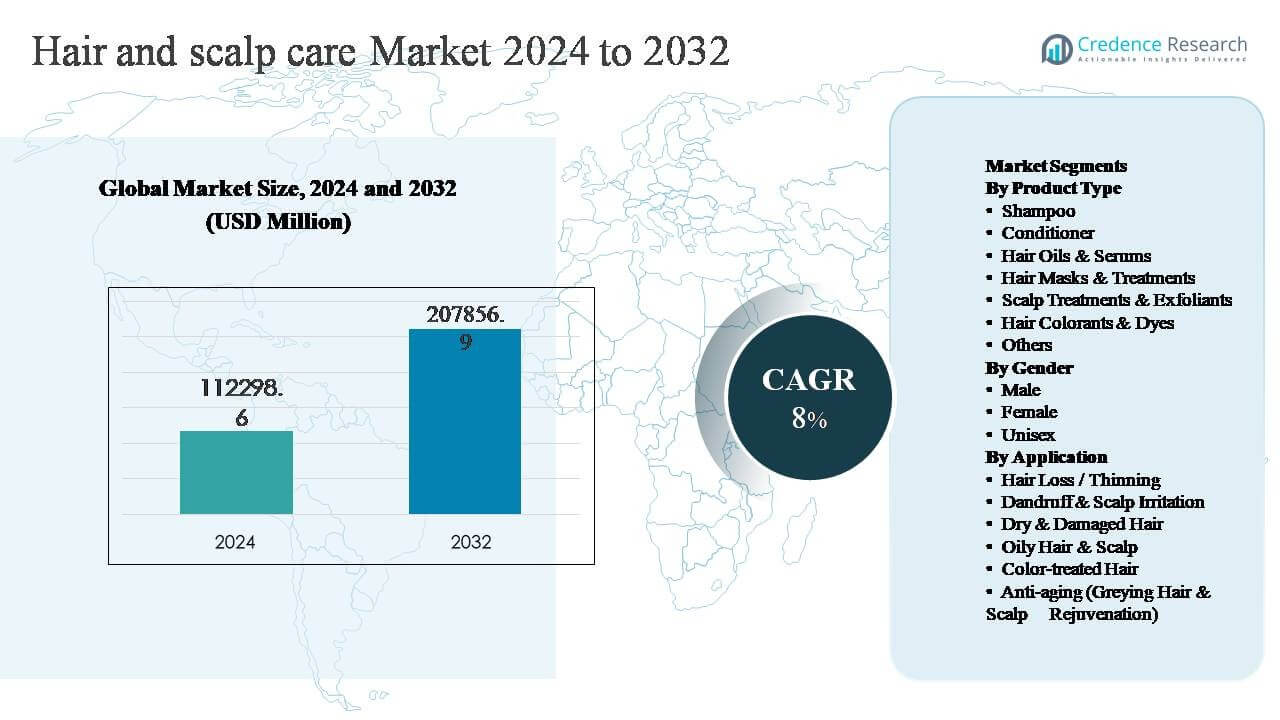
Hair and scalp care market size was valued at USD 112,298.6 million in 2024 and is anticipated to reach USD 207,856.9 million by 2032, expanding at a CAGR of approximately 8% during the forecast period (2025-2032).
| REPORT ATTRIBUTE | DETAILS |
|---|---|
| Historical Period | 2020-2023 |
| Base Year | 2024 |
| Forecast Period | 2025-2032 |
| Hair and Scalp Care Market Size 2024 | USD 112,298.6 million |
| Hair and Scalp Care Market, CAGR | 8% |
| Hair and Scalp Care Market Size 2032 | USD 207,856.9 million |
Hair and Scalp Care Market Insights
- Market growth is primarily driven by increasing consumer focus on scalp health, hair loss prevention, and treatment-based routines, with shampoo remaining the dominant product segment, accounting for over 35% share, due to its daily usage and expanding multifunctional formulations.
- Key trends include premiumization, clean-label products, and dermatology-aligned claims, while competition remains intense among global brands leveraging innovation, digital engagement, and broad distribution to defend market positions.
- Market restraints include product commoditization in core categories, high marketing costs, and regulatory scrutiny on ingredients and efficacy claims, which increase compliance complexity and pressure margins.
- Regionally, Asia Pacific leads with ~38% share, followed by North America (~26%) and Europe (~23%), while Latin America (~7%) and Middle East & Africa (~6%) show steady growth driven by rising grooming awareness and retail expansion.
Hair and Scalp Care Market Segmentation Analysis:
By Product Type
By product type, shampoo remains the dominant sub-segment in the hair and scalp care market, accounting for the largest share due to its essential, high-frequency usage across all consumer groups. Demand is driven by product innovation focused on sulfate-free formulations, scalp-balancing actives, and multifunctional benefits such as anti-dandruff and hair-fall control. Conditioners and hair oils & serums follow as strong secondary segments, supported by rising focus on hair nourishment and damage repair. Rapid growth in scalp treatments and exfoliants reflects increasing consumer awareness of scalp health as the foundation of hair care.
- For instance, L’Oréal Paris Research & Innovation developed the sulfate-free EverPure shampoo line using amino acid–based surfactants (such as sodium cocoyl isethionate) and gentle botanicals like rosemary and lotus flower.
By Gender
By gender, the female segment dominates market share, driven by higher product penetration, broader routines, and strong demand for treatment-oriented solutions addressing damage, coloring, and styling stress. Women-led demand supports premium shampoos, masks, serums, and color-protection products. The male segment is expanding steadily, supported by rising grooming awareness and targeted solutions for hair loss and dandruff. Meanwhile, the unisex category is gaining momentum as brands prioritize inclusive branding and simplified formulations, particularly in mass-market shampoos and scalp-care products designed for shared household use.
- For instance, Kao Corporation’s Goldwell Dualsenses Color Extra Rich line utilizes Luminescine technology, which transforms non-visible UV light into visible light to enhance color luminosity. The line features the microPROtec complex to distribute care ingredients quickly and evenly.
By Application By application, hair loss and thinning represents the dominant sub-segment, driven by increasing stress levels, lifestyle changes, aging populations, and greater acceptance of preventive hair care solutions. Products addressing hair fall combine scalp stimulation, strengthening actives, and dermatologically positioned claims, supporting strong consumer uptake. Dandruff and scalp irritation remains a core application due to widespread prevalence, while dry and damaged hair benefits from rising chemical treatments and heat styling. Growing interest in anti-aging and scalp rejuvenation further supports premiumization and innovation across application-focused formulations.
Key Growth Drivers
Rising Consumer Focus on Scalp Health and Preventive Care
Growing awareness that scalp health directly influences hair quality is a major driver of the hair and scalp care market. Consumers increasingly view scalp care as preventive wellness rather than corrective grooming, accelerating demand for exfoliating shampoos, scalp serums, tonics, and anti-dandruff treatments. Education through dermatologists, trichologists, and digital platforms has strengthened understanding of issues such as follicle blockage, inflammation, and microbiome imbalance. This shift supports regular, long-term product usage rather than occasional treatments, improving category value and volume growth. The trend is further reinforced by urban lifestyles marked by pollution, stress, and hard water exposure, which exacerbate scalp-related concerns. As a result, brands are prioritizing scalp-first positioning and functional benefits, driving sustained expansion across mass, premium, and professional channels.
- For instance, Unilever’s Clear Scalpceuticals Pro platform integrates a "skinification" approach using amino acid–based surfactants (such as glycine) and skincare-inspired actives like Niacinamide. These formulations are clinically proven to improve the scalp barrier and reduce hair fall within 30 days (approximately 12–15 wash cycles in standard trials).
Premiumization Driven by Ingredient Transparency and Performance Claims
Premiumization remains a strong growth driver as consumers seek high-efficacy products with visible results. Shoppers increasingly scrutinize ingredient labels, favoring formulations that highlight clinically recognized actives such as peptides, botanical extracts, ceramides, and scalp-soothing compounds. This behavior supports higher spending on targeted solutions for hair loss, damage repair, color protection, and scalp sensitivity. Clean-label positioning, sulfate-free and silicone-free formulations, and dermatologically tested claims further enhance brand credibility and pricing power. Premium growth is also fueled by salon-grade and dermatology-inspired products migrating into retail and online channels. As consumers associate higher price points with safety, efficacy, and long-term benefits, premium and masstige segments continue to outpace overall market growth.
- For instance,The Aveda Invati Advanced and newer Invati Ultra Advanced systems highlight ginseng and certified organic turmeric as part of an Ayurvedic herb blend designed to invigorate the scalp when massaged in. Their efficacy in reducing hair loss due to breakage is substantiated through instrumental repeat grooming tests on hair tresses.
Expanding Male Grooming and Gender-Neutral Product Adoption
The increasing acceptance of male grooming and self-care significantly contributes to market growth. Men are adopting specialized products for hair thinning, dandruff control, and scalp maintenance, moving beyond basic shampoos toward treatment-oriented solutions. Simultaneously, gender-neutral and unisex products are gaining traction, particularly among younger consumers seeking simplified routines and inclusive branding. These products appeal to shared household usage and align with evolving perceptions of personal care as non-gendered. Brands are responding with versatile formulations, neutral fragrances, and minimalist packaging. This expansion beyond traditional female-dominated demand broadens the consumer base, improves penetration in emerging markets, and supports steady long-term growth across demographic segments.
Key Trends & Opportunities
Growth of Natural, Clean, and Dermatology-Aligned Formulations
A strong trend toward natural and clean beauty continues to shape the hair and scalp care market. Consumers increasingly prefer products formulated with plant-based ingredients, minimal additives, and transparent sourcing practices. This creates opportunities for brands to combine natural positioning with dermatological credibility, addressing concerns around sensitivity, long-term use, and scalp health. The convergence of clean beauty and science-backed efficacy enables differentiation, particularly in anti-dandruff, hair loss, and scalp treatment categories. Products that balance safety, performance, and sustainability are well positioned to capture both premium and mass-market demand, especially among health-conscious and younger consumers.
- For instance, Pierre Fabre’s Ducray dermatological haircare line formulates scalp-soothing products tested under dermatologist supervision on over 500 sensitive-scalp subjects, with transepidermal water loss measured using closed-chamber evaporimeters recording 120 data points per assessment.
Digital Engagement and Direct-to-Consumer Expansion
E-commerce and digital platforms present significant growth opportunities by improving product accessibility and personalization. Online channels enable brands to educate consumers on scalp diagnostics, routine building, and targeted solutions through content, quizzes, and expert consultations. Direct-to-consumer strategies allow companies to gather consumer insights, launch niche products, and respond quickly to evolving preferences. Subscription models for shampoos, serums, and treatment kits further enhance customer retention. As digital-first brands gain credibility and established players strengthen omnichannel strategies, online engagement continues to reshape purchasing behavior and accelerate category innovation.
- For instance,Henkel’s SalonLab&Me (the first hyper-personalized "B2B2C" brand from Schwarzkopf Professional) integrates in-salon hair analysis with a digital fulfillment model for individualized regimens. While Henkel operates highly automated logistics centers such as the hub in Montornès del Vallès these facilities are designed for an annual throughput of approximately 7 million product units (averaging ~19,000 units per day) to meet the growing demand for personalized solutions.
Innovation in Application-Specific and Treatment-Based Solutions
Demand is shifting toward application-specific solutions that address distinct concerns such as hair fall, greying, irritation, and color damage. This creates opportunities for innovation in treatment-based formats, including leave-in serums, ampoules, exfoliants, and overnight scalp treatments. Consumers increasingly accept multi-step routines when benefits are clearly communicated and results are tangible. Brands that invest in targeted efficacy claims and routine-based product ecosystems can strengthen brand loyalty and increase average spend per user, particularly in premium and professional segments.
Key Challenges
Intense Competition and Brand Differentiation Pressure
The hair and scalp care market faces intense competition from global brands, regional players, and emerging digital-native companies. Product saturation in core categories such as shampoos and conditioners makes differentiation increasingly difficult. Frequent product launches, overlapping claims, and aggressive pricing strategies reduce brand loyalty and margin stability. Companies must continuously invest in innovation, marketing, and consumer education to maintain relevance. Smaller brands face scalability challenges, while established players must balance innovation with cost efficiency. This competitive intensity raises barriers to sustained differentiation and long-term profitability.
Regulatory Scrutiny and Ingredient Compliance Complexity
Regulatory requirements surrounding ingredient safety, labeling, and environmental impact pose a significant challenge for market participants. Restrictions on certain preservatives, fragrances, and active compounds vary across regions, increasing formulation complexity and compliance costs. Additionally, heightened scrutiny of marketing claims related to hair loss prevention and scalp treatment efficacy increases legal and reputational risk. Brands must invest in testing, documentation, and regulatory expertise to ensure compliance while maintaining innovation speed. These factors can delay product launches, increase operational costs, and limit flexibility, particularly for companies operating across multiple international markets.
Regional Analysis
North America:
North America accounts for approximately 26% of the global hair and scalp care market, driven by high consumer awareness, premium product penetration, and strong dermatology-backed brand adoption. The region shows robust demand for scalp health solutions, anti-hair loss products, and clean-label formulations, supported by advanced retail infrastructure and e-commerce dominance. Consumers actively seek performance-driven products addressing thinning, dandruff, and aging-related concerns, encouraging premiumization. Innovation in ingredient transparency, clinical claims, and personalized care routines further supports market maturity. The presence of leading multinational brands and strong marketing influence continues to sustain steady growth across both mass and premium segments.
Europe:
Europe holds an estimated 23% market share, supported by strong demand for natural, organic, and sustainability-focused hair and scalp care products. Regulatory emphasis on ingredient safety and environmental compliance shapes product development, favoring clean and eco-certified formulations. The region demonstrates balanced demand across shampoos, conditioners, and treatment-based products, particularly for sensitive scalp, anti-dandruff, and color-protection applications. High adoption of salon-quality products in retail channels supports premium growth. Western Europe leads consumption, while Eastern Europe shows rising penetration as disposable incomes and grooming awareness improve, contributing to consistent regional expansion.
Asia Pacific:
Asia Pacific dominates the global market with approximately 38% share, driven by large population base, increasing urbanization, and rising grooming awareness. High prevalence of hair fall, dandruff, and pollution-related scalp issues fuels strong demand for functional and preventive solutions. The region benefits from frequent product usage and strong penetration of hair oils, serums, and treatment shampoos. Rapid growth in middle-income consumers supports premium and masstige segments, while digital commerce accelerates product accessibility. Countries such as China, India, Japan, and South Korea play a central role, supported by innovation, traditional ingredient integration, and localized product development.
Latin America:
Latin America represents around 7% of the global market, supported by strong cultural emphasis on hair appearance and grooming. Demand is driven by conditioners, hair masks, and treatments targeting dryness, damage, and chemically treated hair. Rising awareness of scalp health and increasing availability of specialized products through retail and online channels support market development. Brazil and Mexico lead regional consumption due to large populations and established beauty industries. Although price sensitivity remains a challenge, growing interest in premium and salon-inspired products is gradually improving value growth across the region.
Middle East & Africa:
The Middle East & Africa region accounts for approximately 6% of the global hair and scalp care market, with growth supported by increasing urban populations and rising personal care expenditure. Demand is concentrated in shampoos, hair oils, and scalp treatments addressing dryness, hair fall, and scalp irritation linked to climatic conditions. The Middle East shows higher adoption of premium and imported brands, while Africa remains driven by mass-market and traditional formulations. Expanding retail infrastructure, social media influence, and improving grooming awareness continue to enhance long-term growth potential across the region.
Hair and Scalp Care Market Segmentations:
By Product Type
- Shampoo
- Conditioner
- Hair Oils & Serums
- Hair Masks & Treatments
- Scalp Treatments & Exfoliants
- Hair Colorants & Dyes
- Others
By Gender
- Male
- Female
- Unisex
By Application
- Hair Loss / Thinning
- Dandruff & Scalp Irritation
- Dry & Damaged Hair
- Oily Hair & Scalp
- Color-treated Hair
- Anti-aging (Greying Hair & Scalp Rejuvenation)
By Geography
- North America
- U.S.
- Canada
- Mexico
- Europe
- Germany
- France
- U.K.
- Italy
- Spain
- Rest of Europe
- Asia Pacific
- China
- Japan
- India
- South Korea
- South-east Asia
- Rest of Asia Pacific
- Latin America
- Brazil
- Argentina
- Rest of Latin America
- Middle East & Africa
- GCC Countries
- South Africa
- Rest of the Middle East and Africa
Competitive Landscape
The hair and scalp care market is highly competitive, characterized by the presence of multinational consumer goods companies, regional manufacturers, and emerging digital-first brands. Leading players compete through broad product portfolios spanning shampoos, conditioners, treatments, and scalp-focused solutions, supported by strong brand equity and extensive distribution networks. Innovation remains a key differentiator, with companies investing in ingredient science, dermatology-backed claims, and application-specific formulations targeting hair loss, dandruff, and scalp sensitivity. Strategic emphasis on premiumization, clean-label positioning, and sustainability strengthens market positioning. Digital marketing, influencer engagement, and direct-to-consumer channels enhance brand visibility and consumer reach. Meanwhile, regional players leverage localized formulations and pricing strategies to compete effectively. Ongoing product launches, portfolio expansion, and geographic penetration continue to intensify competition, reinforcing the importance of differentiation, trust, and consistent product performance in maintaining market share.
Key Player Analysis
- L'Oréal S.A.
- Procter & Gamble
- Unilever
- Kao Corporation
- Henkel AG & Co. KGaA
- Shiseido Company, Limited
- Marico Limited
- Johnson & Johnson Services, Inc.
- Amway Corp.
- Oriflame Cosmetics AG
Recent Developments
- In December 2025, Unilever announced expanded efforts in the “skinification of scalp care,” with Dove and Clear brands advancing targeted dandruff and scalp formulations that combine premium skincare ingredients with traditional haircare benefits to meet evolving consumer needs.
- June 2025, Kao released its Kao Integrated Report 2025, outlining strategic progress under its “Global Sharp Top” innovation framework signaling continued investment in R&D and long-term hair and scalp care science initiatives.
Report Coverage
The research report offers an in-depth analysis based on Product type, Gender, Application, and Geography. It details leading market players, providing an overview of their business, product offerings, investments, revenue streams, and key applications. Additionally, the report includes insights into the competitive environment, SWOT analysis, current market trends, as well as the primary drivers and constraints. Furthermore, it discusses various factors that have driven market expansion in recent years. The report also explores market dynamics, regulatory scenarios, and technological advancements that are shaping the industry. It assesses the impact of external factors and global economic changes on market growth. Lastly, it provides strategic recommendations for new entrants and established companies to navigate the complexities of the market.
Future Outlook
- Scalp-focused products will gain wider adoption as consumers increasingly link scalp health with long-term hair quality and growth.
- Demand for treatment-oriented solutions addressing hair loss, thinning, and scalp sensitivity will continue to expand across age groups.
- Premium and masstige segments will grow faster than mass products, supported by ingredient transparency and performance-driven claims.
- Clean, natural, and dermatology-aligned formulations will become standard expectations rather than niche offerings.
- Male grooming and unisex product lines will strengthen market penetration and broaden the consumer base.
- Digital platforms will play a larger role in education, personalization, and direct-to-consumer sales models.
- Application-specific routines will drive multi-product usage, increasing average consumer spend per household.
- Innovation in formats such as serums, exfoliants, and leave-in treatments will reshape traditional care routines.
- Emerging markets will contribute significantly to volume growth due to rising urbanization and grooming awareness.
- Sustainability in packaging and responsible sourcing will increasingly influence brand selection and loyalty.

Request a Free Sample
Fill in your details and we'll send you a free sample report.
- Sample data tables & charts
- Research methodology
Need a Custom Version of This Report?
Tailor the scope, geography, or segments to your exact requirements.
- Custom geography or segment scope
- Direct access to our analyst team
Frequently Asked Questions
What is the current market size for hair and scalp care, and what is its projected size in 2032?
At what Compound Annual Growth Rate is the hair and scalp care market projected to grow between 2024 and 2032?
Which hair and scalp care segment held the largest share in 2024?
What are the primary factors fueling the growth of the hair and scalp care market?
Who are the leading companies in the hair and scalp care market?
Which region commanded the largest share of the hair and scalp care market in 2024?
Table of Content
Chapter 1 Market Segmentation
- 1.1 Segmentation Framework
- 1.1.1 Product and Service Classification
- 1.1.2 Application and End-Use Classification
- 1.1.3 Technology and Solution Classification
- 1.1.4 Customer and Distribution Channel Classification
- 1.1.5 Geographic Segmentation
- 1.1.6 Market Segment Definitions and Boundaries
Chapter 2 Introduction
- 2.1 Report Objectives and Scope
- 2.2 Product Definition and Industry Terminology
- 2.3 Market Inclusions and Exclusions
- 2.4 Research Process
- 2.4.1 Primary Research and Expert Interviews
- 2.4.2 Secondary Research and Source Review
- 2.4.3 Top-Down and Bottom-Up Estimation
- 2.4.4 Data Triangulation and Verification
- 2.5 Market Size Measurement Basis
- 2.5.1 2024: USD 89,840.57 million → 2032: USD 180,641.62 million
- 2.6 Historical and Forecast Reference Periods
- 2.6.1 Base Year: 2024
- 2.6.2 Forecast Period: 2024-2032
- 2.7 Research Assumptions and Limitations
Chapter 3 Executive Summary
- 3.1 Market Snapshot and Key Findings
- 3.2 Base-Year Market Size, 2024
- 3.3 Forecast Market Size, 2032
- 3.4 Revenue and Volume Growth Outlook
- 3.5 Key Demand and Supply Indicators
- 3.6 Leading Market Segments
- 3.7 Fastest-Growing Market Opportunities
- 3.8 Regional Performance Highlights
- 3.9 Technology and Industry Transformation
- 3.10 Competitive Landscape Summary
- 3.11 Analyst View and Strategic Implications
Chapter 4 Global Hair and Scalp Care Market Trends and Developments
- 4.1 Historical Industry Development
- 4.2 Recent Market Trends and Developments
- 4.3 Demand and Customer Behavior Trends
- 4.4 Technology and Product Innovation
- 4.5 Artificial Intelligence, Automation and Digitalization
- 4.6 Local Manufacturing and Supply Chain Realignment
- 4.7 Industry Partnerships, Mergers and Acquisitions
- 4.8 Sustainability and Circular Economy Developments
- 4.9 Government and Private Sector Investment Trends
- 4.10 Emerging Business Models and Commercialization
- 4.11 Industry Developments and Announcements
Chapter 5 Global Hair and Scalp Care Market Production, Supply and Demand Analysis
- 5.1 Demand Trend and Consumption Analysis
- 5.2 Demand Forecast, 2024-2032
- 5.3 Production and Output Trend
- 5.4 Production and Output Forecast, 2024-2032
- 5.5 Installed Capacity and Capacity Utilization
- 5.6 Company-Wise Production Plants and Statistics
- 5.6.1 Installed Production Capacity
- 5.6.2 Actual Production
- 5.6.3 Planned Capacity and Expansion Targets
- 5.7 Supply Chain Structure and Procurement Trends
- 5.8 Supply-Demand Gap and Bottlenecks
- 5.9 Import Dependence and Sourcing Structure
- 5.10 Contract Manufacturing and Outsourcing
- 5.11 Regional Supply and Demand Concentration
Chapter 6 Global Hair and Scalp Care Market Pricing Analysis
- 6.1 Pricing Structure and Measurement
- 6.2 Historical Pricing Trends
- 6.3 Pricing Outlook, 2024-2032
- 6.4 Average Selling Price and Unit Economics
- 6.5 Pricing by Product and Market Segment
- 6.6 Geographic Pricing Differences
- 6.7 Key Input, Energy, Labor and Logistics Costs
- 6.8 Contract Pricing and Purchasing Models
- 6.9 Pricing Sensitivity and Competitive Positioning
- 6.10 Price, Margin and Profitability Implications
Chapter 7 Global Hair and Scalp Care Market Dynamics
- 7.1 Market Growth Drivers
- 7.1.1 Demand-Side Drivers
- 7.1.2 Technology and Innovation Drivers
- 7.1.3 Infrastructure and Investment Drivers
- 7.1.4 Regulatory and Policy Drivers
- 7.2 Market Restraints
- 7.2.1 Cost and Affordability Constraints
- 7.2.2 Technology and Adoption Barriers
- 7.2.3 Supply Chain and Operational Constraints
- 7.3 Market Challenges
- 7.3.1 Competitive Pressure and Margin Erosion
- 7.3.2 Skills, Infrastructure and Implementation Gaps
- 7.4 Emerging Market Opportunities
- 7.5 Market Dynamics Impact and Time-Horizon Assessment
Chapter 8 Global Hair and Scalp Care Value Chain Analysis
- 8.1 Industry Value Chain Overview
- 8.2 Upstream Suppliers and Critical Inputs
- 8.3 Technology and Component Providers
- 8.4 Manufacturing or Service Delivery
- 8.5 Distribution, Channel Partners and Integrators
- 8.6 Downstream Applications and End Users
- 8.7 Value Addition and Profit Pools
- 8.8 Vertical Integration and Outsourcing
- 8.9 Supplier Concentration and Risk
- 8.10 Supply Chain Localization and Resilience
Chapter 9 Global Hair and Scalp Care Market Regulations and Policies
- 9.1 Relevant Laws, Standards and Compliance Frameworks
- 9.2 Product, Service, Safety and Quality Requirements
- 9.3 Government Policies, Incentives and Subsidies
- 9.4 Imports, Exports and Trade Barriers
- 9.5 Public Procurement and Local Content Requirements
- 9.6 Environmental and Sustainability Compliance
- 9.7 Upcoming Policy Changes and Market Implications
Chapter 10 Global Hair and Scalp Care Market Hotspots and Opportunities
- 10.1 Market Opportunity Mapping and Growth Hotspots
- 10.2 High-Growth Applications and Customer Groups
- 10.3 Underserved Markets and White-Space Opportunities
- 10.4 Emerging Technology and Product Opportunities
- 10.5 New Capacity and Investment Hotspots
- 10.6 Market Entry and Expansion Opportunities
- 10.7 Distribution and Partnership Opportunities
- 10.8 Near-Term and Long-Term Commercial Potential
- 10.9 Opportunity Attractiveness and Execution Risks
Chapter 11 Global Hair and Scalp Care Market Outlook, 2024-2032
- 11.1 Market Size and Analysis
- 11.1.1 Revenue (Market Measurement: 2024: USD 89,840.57 million → 2032: USD 180,641.62 million)
- 11.1.2 Market Volume and Quantity Sold
- 11.1.3 Historical Market Size
- 11.1.4 Base-Year Market Size, 2024
- 11.2 Market Forecast, 2024-2032
- 11.2.1 Revenue Forecast to 2032
- 11.2.2 Volume Forecast to 2032
- 11.2.3 CAGR and Year-on-Year Growth
- 11.2.4 Incremental Revenue Opportunity
- 11.3 Forecast Assumptions and Scenario Analysis
- 11.3.1 Base-Case Forecast
- 11.3.2 Optimistic and Conservative Scenarios
- 11.3.3 Technology, Pricing and Policy Sensitivities
- 11.4 Market Attractiveness and Growth Outlook
Chapter 12 Global Hair and Scalp Care Market Segmentation and Outlook
- 12.1 Segmentation Summary and Market Shares, 2024
- 12.2 Largest and Fastest-Growing Segments
- 12.3 Segment Growth Comparison
- 12.4 Segment Attractiveness and Priority Matrix
Chapter 13 Global Hair and Scalp Care Geographic Market Outlook, 2024-2032
- 13.1 Regional Market Size and Share, 2024
- 13.2 Regional Market Forecast, 2024-2032
- 13.3 Regional Pricing, Production and Demand Differences
- 13.4 North America
- 13.4.1 United States
- 13.4.2 Canada
- 13.4.3 Mexico
- 13.5 Europe
- 13.5.1 Germany
- 13.5.2 France
- 13.5.3 Italy
- 13.5.4 United Kingdom
- 13.5.5 Spain
- 13.5.6 Poland
- 13.5.7 Russia
- 13.5.8 Netherlands
- 13.5.9 Belgium
- 13.5.10 Sweden
- 13.5.11 Denmark
- 13.5.12 Norway
- 13.5.13 Rest of Europe
- 13.6 Asia Pacific
- 13.6.1 China
- 13.6.2 India
- 13.6.3 Japan
- 13.6.4 South Korea
- 13.6.5 Thailand
- 13.6.6 Indonesia
- 13.6.7 Vietnam
- 13.6.8 Malaysia
- 13.6.9 Australia
- 13.6.10 Rest of Asia Pacific
- 13.7 Latin America
- 13.7.1 Brazil
- 13.7.2 Argentina
- 13.7.3 Colombia
- 13.7.4 Chile
- 13.7.5 Rest of Latin America
- 13.8 Middle East
- 13.8.1 Saudi Arabia
- 13.8.2 United Arab Emirates
- 13.8.3 Turkey
- 13.8.4 Israel
- 13.8.5 Iran
- 13.8.6 Rest of the Middle East
- 13.9 Africa
- 13.9.1 South Africa
- 13.9.2 Egypt
- 13.9.3 Nigeria
- 13.9.4 Morocco
- 13.9.5 Rest of Africa
- 13.10 Regional Investment, Policy and Supply Chain Differences
- 13.11 Regional Competitive Landscape
- 13.12 Geographic Growth Hotspots
Chapter 14 Global Hair and Scalp Care Technology, Innovation and Sustainability Outlook
- 14.1 Technology Landscape and Maturity
- 14.2 Product, Process and Service Innovation
- 14.3 AI, Automation and Digital Tools in the Industry
- 14.4 Technology Adoption and Performance Benchmarking
- 14.5 Innovation Pipeline and R&D Investment
- 14.6 Patent and Intellectual Property Trends
- 14.7 Energy Efficiency and Resource Management
- 14.8 Sustainability, Recycling and Circularity
- 14.9 Technology Roadmap, 2024-2032
- 14.10 Risks of Obsolescence and Technology Substitution
Chapter 15 Global Hair and Scalp Care Market Key Strategic Imperatives
- 15.1 Growth and Market Entry Priorities
- 15.2 High-Return Products and Segments
- 15.3 Pricing, Profitability and Cost Optimization
- 15.4 Technology Investment and Product Differentiation
- 15.5 Supply Chain Localization and Resilience
- 15.6 Distribution and Customer Acquisition
- 15.7 Partnership, Acquisition and Capacity Strategy
- 15.8 Regional Expansion Priorities
- 15.9 Short-, Medium- and Long-Term Actions
Chapter 16 Competition Outlook
- 16.1 Industry Competition Characteristics
- 16.2 Market Structure and Concentration
- 16.3 Market Share and Competitive Positioning, 2024
- 16.4 Company-Wise Revenue and Product Benchmarking
- 16.5 Production and Service Capacity Benchmarking
- 16.6 Technology, Pricing and Differentiation
- 16.7 Regional Footprint and Distribution Strength
- 16.8 Mergers, Acquisitions and Strategic Alliances
- 16.9 New Entrants and Competitive Threats
- 16.10 Porter's Five Forces and Industry Attractiveness
- 16.11 Competitive Outlook, 2024-2032
Chapter 17 Company Profiles
- 17.1 Company Coverage and Selection Criteria
- 17.2 Leading Market Participants – Standard Profile Structure
- 17.2.1 Business Description
- 17.2.2 Company Ownership and Geographic Presence
- 17.2.3 Product and Service Portfolio
- 17.2.4 Manufacturing and Operating Footprint
- 17.2.5 Production Capacity and Expansion Plans
- 17.2.6 Financial Performance and Investment
- 17.2.7 Market Share and Competitive Position
- 17.2.8 Technology and Innovation Capabilities
- 17.2.9 Strategic Alliances or Partnerships
- 17.2.10 Recent Developments
- 17.2.11 Growth Strategy and Outlook
- 17.3 Other Relevant Market Participants
Note: Every listed company is profiled on the structure shown under the first company. The company list is preliminary and may change based on research findings, market developments, data availability and client requirements.
Chapter 18 Disclaimer
- 18.1 Research and Forecast Disclaimer
- 18.2 Data Source and Estimation Limitations
Note: The depth of individual sections depends on data availability for this market. Volume, capacity, trade and other unit-based metrics are included where applicable.