Market Overview:
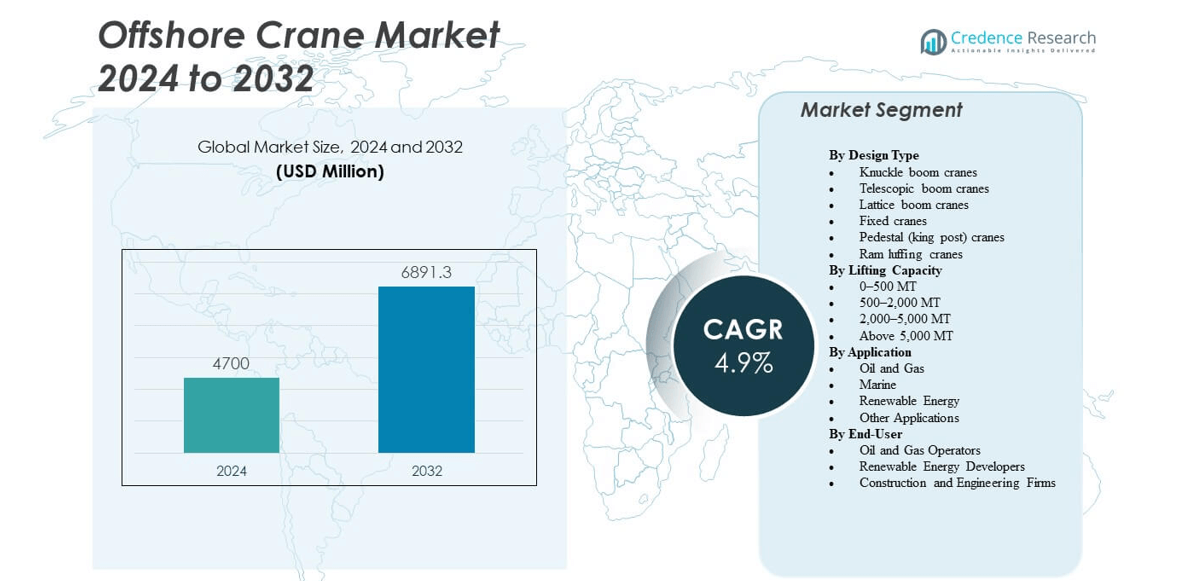
The Offshore Crane Market is projected to grow from USD 4700 million in 2024 to an estimated USD 6891.3 million by 2032, with a compound annual growth rate (CAGR) of 4.9% from 2024 to 2032.
| REPORT ATTRIBUTE | DETAILS |
|---|---|
| Historical Period | 2020-2023 |
| Base Year | 2024 |
| Forecast Period | 2025-2032 |
| Offshore Crane Market Size 2024 | USD 4700 million |
| Offshore Crane Market, CAGR | 4.9% |
| Offshore Crane Market Size 2032 | USD 6891.3 million |
The Offshore Crane Market is driven by rising offshore oil and gas exploration activities, which require advanced lifting equipment for deep-water operations. Increasing investments in offshore wind farms also boost demand for heavy-lift and subsea cranes. The need for reliable equipment that ensures operational efficiency and safety in harsh marine environments further strengthens adoption. Advancements in automation and digital monitoring systems enhance crane performance, reducing downtime and maintenance costs.
Regionally, Europe leads the market due to strong offshore wind energy development and established oil and gas infrastructure. North America shows steady growth with significant offshore projects in the Gulf of Mexico, while Asia-Pacific is emerging as a key growth hub, driven by expanding energy demand and renewable initiatives in China and Southeast Asia. The Middle East also plays a vital role, supported by ongoing offshore oil exploration and large-scale infrastructure projects in the region.
Market Insights:
- The Offshore Crane Market is projected to grow from USD 4700 million in 2024 to USD 6891.3 million by 2032, registering a CAGR of 4.9%.
- Rising offshore oil and gas exploration projects continue to drive strong demand for advanced lifting equipment.
- Offshore wind energy expansion fuels adoption of cranes with higher capacities and precision handling systems.
- High capital investment and maintenance costs remain major restraints for crane adoption across operators.
- Compliance with stringent international safety standards creates barriers for smaller manufacturers entering the market.
- Europe leads with a 32% share, supported by North Sea offshore wind projects and oilfield developments.
- Asia-Pacific is emerging as the fastest-growing region due to expanding exploration in China, India, and Southeast Asia.
Market Drivers:
Rising Demand for Offshore Energy Exploration and Expansion of Deepwater Projects
The Offshore Crane Market gains strong momentum from global demand for offshore oil and gas reserves. Companies invest heavily in deepwater projects requiring advanced lifting systems to support heavy subsea equipment. Exploration in ultra-deepwater zones fuels demand for high-capacity cranes capable of working in extreme conditions. The growing complexity of offshore fields necessitates reliable and safe crane solutions. Increased exploration drives higher utilization rates of advanced heavy-lift equipment across multiple regions. It provides operators with efficient methods for handling critical offshore operations. Offshore oil majors adopt advanced crane systems to maximize project efficiency. Rising global energy demand ensures continued offshore exploration and expansion.
- For instance, the Heerema Sleipnirvessel, equipped by Huisman, features two offshore revolving cranes each with a lifting capacity of 10,000 metric tonnes, enabling installation and decommissioning of some of the largest offshore platforms and deepwater subsea structures, with verified usage in extreme deepwater projects across the globe.
Accelerating Growth in Offshore Renewable Energy Development and Investments in Wind Farms
Rapid offshore wind farm installations create strong demand for specialized cranes. Offshore cranes play a key role in lifting large turbine components and subsea structures. The rise of clean energy goals pushes governments to fund wind energy infrastructure, expanding opportunities. It allows cranes with higher lifting capacity and precision controls to dominate this space. Growing turbine sizes require cranes with advanced stability and automation features. Offshore renewable growth enhances the importance of safe and efficient lifting solutions. Manufacturers innovate to meet the technical challenges of renewable installations in rough seas. The global shift to renewable power strengthens long-term demand for offshore cranes.
- For instance, Mammoet’s PTC 200 DS ring crane played an integral role in assembling wind turbines on spar buoys measuring 107 meters in length for the Hywind Tampen floating wind farm, with project documentation confirming its technical outreach and capacity for handling blades and tower components at unprecedented scale.
Growing Emphasis on Safety, Reliability, and Automation in Offshore Operations
The Offshore Crane Market benefits from rising focus on worker safety and operational reliability. Strict international standards regulate offshore lifting activities, creating demand for certified cranes. It encourages manufacturers to design systems that integrate advanced safety features. Automation and digital monitoring enhance efficiency while reducing risks during complex lifting tasks. Smart sensors and predictive maintenance extend crane lifespan and minimize downtime. The need to prevent accidents in harsh marine environments drives technology adoption. Crane operators seek digital assistance tools for higher precision and reduced human error. This safety-driven focus fuels adoption of advanced crane systems across offshore projects.
Infrastructure Expansion and Strategic Investments in Offshore Support Operations
Global investments in offshore platforms, rigs, and floating production units accelerate crane adoption. Offshore cranes remain vital for material handling, cargo transfers, and subsea construction support. Growing shipping and logistics needs in offshore zones strengthen reliance on heavy-lift cranes. It plays a central role in supporting long-term infrastructure growth for offshore industries. Governments and private players allocate large budgets for offshore project expansion. Infrastructure investments create opportunities for modern crane technologies with high durability. Oil and gas recovery projects rely on reliable lifting operations, expanding market demand. Strategic investments in global offshore infrastructure solidify the crane market outlook.
Market Trends:
Integration of Digitalization, IoT, and Remote Monitoring Technologies in Offshore Cranes
The Offshore Crane Market shows strong adoption of digital technologies and IoT-based monitoring. Advanced sensors enable predictive maintenance and real-time performance analysis. It improves efficiency by reducing operational downtime and extending equipment lifespan. Remote monitoring capabilities allow operators to control cranes with enhanced accuracy. Companies integrate smart technologies to improve safety and minimize operational risks. Rising digital transformation in offshore industries accelerates the adoption of intelligent lifting solutions. Cloud connectivity supports centralized fleet management of offshore cranes. Digitalization creates long-term cost savings and reliability for crane operators worldwide.
Rising Adoption of Hybrid Power Systems and Energy-Efficient Crane Designs
Energy-efficient solutions drive crane innovation, reducing fuel consumption and emissions. Hybrid systems combining electric and hydraulic mechanisms gain popularity in offshore environments. The Offshore Crane Market experiences a surge in demand for cranes with sustainable power sources. It aligns with the broader industry goal of lowering carbon footprints. Equipment with regenerative braking and optimized energy recovery reduces operational costs. Companies develop green-certified cranes to meet sustainability benchmarks. Energy efficiency also ensures compliance with tightening global environmental regulations. Hybrid and eco-friendly cranes represent a major trend shaping offshore operations.
Increasing Demand for Heavy-Lift Cranes Capable of Handling Mega Projects
The Offshore Crane Market observes rising demand for ultra-heavy lift capacity systems. Offshore megaprojects require cranes that can handle massive subsea modules and equipment. It leads to innovation in design, stability, and load-bearing capacity. Growth in subsea exploration drives investments in next-generation heavy cranes. Large floating platforms and offshore construction activities strengthen demand for cranes with enhanced capabilities. Operators prefer cranes with advanced hydraulics and motion compensation features. Expansion of deepwater oil and gas projects sustains this demand trend. Heavy-lift cranes set the standard for supporting future offshore projects.
- For instance, Huisman has engineered a wide range of offshore cranes, including Pedestal Mounted Cranes (PMCs) with capacities from 250 metric tons up to 1,200 metric tons, specifically designed for subsea installation work and harsh offshore environments. The company also manufactures Heavy Lift Mast Cranes with capacities up to 1,500 metric tons, and Tub Mounted Cranes capable of lifting up to 12,000 metric tons, ensuring reliable performance for deepwater projects.
Development of Specialized Cranes for Harsh Weather and Polar Offshore Operations
Offshore regions with harsh weather conditions create the need for specialized crane systems. The Offshore Crane Market witnesses rising innovations tailored for Arctic and extreme climates. It requires cranes with superior endurance, anti-corrosion materials, and advanced control systems. Polar offshore operations encourage the design of cranes capable of functioning in freezing environments. Engineering advances enhance structural resilience against storms and high seas. Operators demand cranes with high reliability for extreme-weather subsea lifting tasks. These specialized solutions open new growth opportunities in challenging geographies. Harsh-environment cranes represent a growing niche for offshore crane manufacturers.
- For instance, MacGregor developed advanced Arctic-ready offshore cranes with an enclosed operator cabin rated for temperatures as low as –40°C, ensuring reliable operation in polar exploration vessels.
Market Challenges Analysis:
High Operational Costs, Harsh Environments, and Stringent Compliance Requirements
The Offshore Crane Market faces challenges from high capital investment and maintenance expenses. Offshore cranes must withstand saltwater corrosion, high winds, and extreme weather, increasing upkeep costs. It requires constant monitoring and maintenance to ensure safety and reliability. Strict compliance with international standards creates barriers for smaller manufacturers. High training requirements for operators add complexity to adoption. Safety regulations require manufacturers to meet demanding certification processes. Harsh offshore conditions shorten crane lifespan compared to onshore equipment. Rising costs and compliance hurdles limit market entry for new players.
Supply Chain Disruptions, Technological Barriers, and Limited Skilled Workforce Availability
Global supply chain issues impact timely delivery of critical crane components. The Offshore Crane Market struggles with shortages of skilled technicians for complex operations. It slows down project execution and increases operational delays. Rapid technological advancements create pressure on companies to adapt quickly. Smaller players face barriers in adopting costly automation and IoT solutions. Workforce limitations reduce the overall efficiency of offshore crane operations. Dependence on global suppliers also exposes the market to price fluctuations. Supply chain instability and workforce gaps remain persistent challenges for long-term growth.
Market Opportunities:
Expansion of Offshore Renewable Installations and Emerging Green Energy Projects
The Offshore Crane Market benefits from global expansion of renewable energy projects. Offshore wind farms create long-term demand for cranes with heavy-lift and precise handling. It enables large-scale deployment of turbines and subsea infrastructure in multiple regions. Governments incentivize renewable projects, boosting crane demand for offshore installations. Manufacturers innovate cranes suited for green energy expansion. Rising commitments to sustainability drive continuous investment in renewable offshore infrastructure. The sector offers strong opportunities for crane providers in renewable-driven markets. Offshore renewable projects ensure steady future growth for crane technologies.
Technological Advancements, Emerging Regions, and Expansion of Offshore Infrastructure Development
Innovations in automation, IoT, and AI-powered crane systems create strong growth potential. The Offshore Crane Market benefits from demand in emerging economies investing in offshore infrastructure. It positions crane manufacturers to capture untapped opportunities in Asia-Pacific and Africa. Expanding exploration in deepwater regions strengthens opportunities for high-capacity cranes. Strategic partnerships enhance technology transfer and market expansion. Digitalized crane systems provide competitive advantages in harsh environments. Infrastructure growth and energy transition ensure demand expansion. Emerging regions and technology advancements provide robust opportunities for crane adoption.
Market Segmentation Analysis:
The Offshore Crane Market is segmented
By design type into knuckle boom cranes, telescopic boom cranes, lattice boom cranes, fixed cranes, pedestal (king post) cranes, and ram luffing cranes. Knuckle boom and telescopic models are widely used for flexibility and compact operations, while lattice boom cranes dominate heavy-lift projects. Fixed and pedestal cranes are standard for stable offshore platforms, and ram luffing cranes provide efficient lifting in space-constrained environments. This segmentation highlights the range of crane types serving diverse offshore needs.
- For instance, PALFINGER Marine’s DKF 1200 Knuckle Boom Crane is deployed offshore with a main lift capacity of 80 metric tonnes and an outreach of up to 43 meters, offering precise and flexible load handling for both vessel and rig platforms.
By lifting capacity, the market is categorized into 0–500 MT, 500–2,000 MT, 2,000–5,000 MT, and above 5,000 MT. It reflects varying offshore requirements, with low to mid-capacity cranes supporting vessel operations and platform maintenance. High-capacity cranes above 5,000 MT are essential for subsea installation and deepwater exploration projects. Demand across all capacity levels remains strong due to diverse operational needs in offshore environments.
By application includes oil and gas, marine, renewable energy, and other applications. Oil and gas continues to dominate due to extensive exploration and production projects. Renewable energy emerges as the fastest-growing segment, supported by global investments in offshore wind farms. Marine applications require versatile cranes for vessel operations and cargo handling, while other sectors adopt them for specialized offshore activities.
- For example, in Kodiak, Alaska, the Port installed a 2 MW electric crane to replace its diesel-powered predecessor. The crane posed a significant challenge for the island’s isolated renewable microgrid, which relies on wind and hydro power.
By end-user, the Offshore Crane Market serves oil and gas operators, renewable energy developers, and construction and engineering firms. Oil and gas operators represent the largest share, while renewable energy developers are driving rapid adoption. Construction and engineering firms also contribute significantly through offshore infrastructure projects.
Segmentation:
By Design Type
- Knuckle boom cranes
- Telescopic boom cranes
- Lattice boom cranes
- Fixed cranes
- Pedestal (king post) cranes
- Ram luffing cranes
By Lifting Capacity
- 0–500 MT
- 500–2,000 MT
- 2,000–5,000 MT
- Above 5,000 MT
By Application
- Oil and Gas
- Marine
- Renewable Energy
- Other Applications
By End-User
- Oil and Gas Operators
- Renewable Energy Developers
- Construction and Engineering Firms
By Region
- North America
- U.S.
- Canada
- Mexico
- Europe
- UK
- France
- Germany
- Italy
- Spain
- Russia
- Belgium
- Netherlands
- Austria
- Sweden
- Poland
- Denmark
- Switzerland
- Rest of Europe
- Asia Pacific
- China
- Japan
- South Korea
- India
- Australia
- Thailand
- Indonesia
- Vietnam
- Malaysia
- Philippines
- Taiwan
- Rest of Asia Pacific
- Latin America
- Brazil
- Argentina
- Peru
- Chile
- Colombia
- Rest of Latin America
- Middle East
- UAE
- KSA
- Israel
- Turkey
- Iran
- Rest of Middle East
- Africa
- Egypt
- Nigeria
- Algeria
- Morocco
- Rest of Africa
Regional Analysis
North America holds a 24% share of the Offshore Crane Market, driven by offshore projects in the Gulf of Mexico. Strong oil and gas exploration and advanced offshore infrastructure fuel demand for heavy-lift cranes. It benefits from ongoing investments in subsea developments and maintenance of existing platforms. The region’s focus on safety standards and digitalized equipment supports adoption of advanced systems. Growing renewable projects along coastal areas also create opportunities for specialized cranes. North America remains a steady market supported by large operators and technology providers.
Europe accounts for a 32% share, making it the leading region in the Offshore Crane Market. Offshore wind energy expansion in the North Sea drives strong demand for large-capacity cranes. It experiences further growth from oil and gas projects in Norway and the UK. European manufacturers emphasize sustainability and hybrid crane technologies to meet strict regulations. Investments in renewable energy projects fuel rapid crane deployment. Europe’s advanced offshore infrastructure and strong commitment to clean energy strengthen its leadership.
Asia-Pacific represents a 28% share and is the fastest-growing region in the market. Offshore activity in China, India, and Southeast Asia drives increasing demand for cranes. It benefits from expanding oil and gas exploration along with large-scale renewable projects. Rapid urbanization and rising energy demand strengthen offshore infrastructure development. Regional players collaborate with global firms to expand capabilities and adopt modern crane technologies. Asia-Pacific is emerging as a key hub for future growth in offshore crane operations. The Middle East and Africa hold a 10% share, while South America contributes 6%, both supported by oil exploration projects and expanding offshore development.
Key Player Analysis:
- Liebherr Group
- Kenz Figee Group
- Heila Cranes SpA
- Huisman Equipment B.V.
- Cargotec Corporation
- Konecranes
- National Oilwell Varco (NOV)
- The Manitowoc Company, Inc.
- Palfinger AG
- TEREX Corporation
- Sparrows Offshore Group Limited
- Seatrax, Inc.
- Zoomlion Heavy Industry Science and Technology Co., Ltd.
- MacGregor
- Melcal Marine
- Sormec Marine and Offshore Cranes
- Alatas Offshore
- Amco Veba Marine
- Dreggen
Competitive Analysis
The Offshore Crane Market is highly competitive with a mix of global and regional players. Leading companies include Liebherr, Konecranes, NOV Inc., Huisman, and Cargotec, offering diverse portfolios of heavy-lift and specialized offshore cranes. It is shaped by continuous investments in technology, automation, and hybrid power systems to improve efficiency and safety. European and Asian manufacturers focus on renewable energy projects, while North American players emphasize oil and gas solutions. Partnerships and joint ventures strengthen global market reach. Competitive pressure encourages innovations in digital monitoring, load safety systems, and eco-efficient designs. The competitive landscape remains dynamic, with established firms expanding their global presence while regional players capture niche opportunities.
Recent Developments:
- In July 2025, Triton, a European investment company, completed the acquisition of MacGregor a leading offshore crane and cargo handling specialist from Hiab (formerly Cargotec). This strategic transaction is expected to bolster MacGregor’s engineering capabilities and enhance its sustainable product offering, supporting further development of its merchant and offshore businesses.
- In April 2025, Huisman signed a contract with Greek shipowner Capital Offshore on April 22 to deliver four advanced knuckle boom cranes. Each crane features a 100 MT lifting capacity and can operate at depths up to 3,000 meters on new MMC-designed platform supply vessels destined for the Brazilian market
- In Jan 2025, Tadano solidified its presence in offshore crane capabilities when it acquired 100% of IUK Crane’s shares on July 1. The move created Tadano Infrastructure Solutions as it positioned itself as a wholly owned subsidiary offering enhanced crane solutions.
- In October 2023, Huisman Equipment B.V. launched a new series of subsea knuckle boom cranes designed for deepwater offshore operations. The product line includes models for water depths up to 3,000 meters and features remote motion reference units for effective vessel motion detection.
Report Coverage:
The research report offers an in-depth analysis based on Design Type, Lifting Capacity, Application and End-User. It details leading market players, providing an overview of their business, product offerings, investments, revenue streams, and key applications. Additionally, the report includes insights into the competitive environment, SWOT analysis, current market trends, as well as the primary drivers and constraints. Furthermore, it discusses various factors that have driven market expansion in recent years. The report also explores market dynamics, regulatory scenarios, and technological advancements that are shaping the industry. It assesses the impact of external factors and global economic changes on market growth. Lastly, it provides strategic recommendations for new entrants and established companies to navigate the complexities of the market.
Future Outlook:
- Offshore crane demand will grow with large-scale oil and gas exploration projects across global waters.
- Renewable energy expansion, particularly offshore wind installations, will strongly influence future crane adoption.
- Automation, remote control, and digital monitoring will shape operational efficiency and reduce downtime.
- Heavy-lift crane development will accelerate to support subsea construction and mega offshore projects.
- Hybrid and eco-efficient crane designs will gain adoption as sustainability targets intensify worldwide.
- Emerging markets in Asia-Pacific and Africa will attract new investments in offshore infrastructure.
- Regulatory standards will drive manufacturers toward certified and safety-driven offshore crane solutions.
- Strategic partnerships and joint ventures will foster innovation and strengthen global market presence.
- Specialized cranes for harsh weather and deepwater environments will witness rising demand.
- Offshore support facility expansion will remain a key factor sustaining long-term market growth.

Request a Free Sample
Fill in your details and we'll send you a free sample report.
- Sample data tables & charts
- Research methodology
Market Dynamics
Expansion of Offshore Oil & Gas Exploration
Growing global energy demand is driving increased investment in offshore oil and gas projects, particularly in deepwater and ultra-deepwater zones. These projects require advanced, high-capacity offshore cranes for safe and efficient handling of heavy subsea equipment and platform modules.
Rapid Growth in Offshore Renewable Energy
The surge in offshore wind farm installations, especially in Europe and Asia-Pacific, is fueling demand for specialized cranes capable of lifting large turbine components and subsea structures. Government incentives and clean energy targets are accelerating this trend, making renewable energy the fastest-growing application segment.
Advancements in Automation and Digital Monitoring
Technological innovations such as IoT integration, remote monitoring, and predictive maintenance are enhancing crane performance, reducing downtime, and improving operational safety. These advancements are making offshore cranes more reliable and cost-effective, encouraging wider adoption.
Emphasis on Safety and Regulatory Compliance
Stringent international safety standards and the need to minimize operational risks in harsh marine environments are pushing operators to invest in certified, technologically advanced crane systems. This focus on safety and compliance is driving demand for modern, feature-rich offshore cranes.
Infrastructure Expansion and Strategic Investments
Global investments in offshore platforms, floating production units, and support vessels are increasing the need for heavy-lift and specialized cranes. Both public and private sector funding for offshore infrastructure projects is creating sustained demand for advanced crane solutions.
Need a Custom Version of This Report?
Tailor the scope, geography, or segments to your exact requirements.
- Custom geography or segment scope
- Direct access to our analyst team
Frequently Asked Questions
What is the current market size for Offshore Crane Market, and what is its projected size in 2032?
At what Compound Annual Growth Rate is the Offshore Crane Market projected to grow between 2024 and 2032?
What are the primary factors fueling the growth of the Offshore Crane Market?
Who are the leading companies in the Offshore Crane Market?
Table of Content
Chapter 1 Market Segmentation
- 1.1 Segmentation Framework
- 1.1.1 Product and Service Classification
- 1.1.2 Application and End-Use Classification
- 1.1.3 Technology and Solution Classification
- 1.1.4 Customer and Distribution Channel Classification
- 1.1.5 Geographic Segmentation
- 1.1.6 Market Segment Definitions and Boundaries
- 1.2 By End-User
- 1.2.1 Oil and Gas Operators
- 1.2.2 Renewable Energy Developers
- 1.2.3 Construction and Engineering Firms
- 1.3 By Application
- 1.3.1 Oil and Gas
- 1.3.2 Marine
- 1.3.3 Renewable Energy
- 1.3.4 Other Applications
- 1.4 By Design Type
- 1.4.1 Knuckle boom cranes
- 1.4.2 Telescopic boom cranes
- 1.4.3 Lattice boom cranes
- 1.4.4 Fixed cranes
- 1.4.5 Pedestal (king post) cranes
- 1.4.6 Ram luffing cranes
- 1.5 By Lifting Capacity
- 1.5.1 0–500 MT
- 1.5.2 500–2,000 MT
- 1.5.3 2,000–5,000 MT
- 1.5.4 Above 5,000 MT
Chapter 2 Introduction
- 2.1 Report Objectives and Scope
- 2.2 Product Definition and Industry Terminology
- 2.3 Market Inclusions and Exclusions
- 2.4 Research Process
- 2.4.1 Primary Research and Expert Interviews
- 2.4.2 Secondary Research and Source Review
- 2.4.3 Top-Down and Bottom-Up Estimation
- 2.4.4 Data Triangulation and Verification
- 2.5 Market Size Measurement Basis
- 2.5.1 2024: USD 4700 million → 2032: USD 6891.3 million
- 2.6 Historical and Forecast Reference Periods
- 2.6.1 Base Year: 2024
- 2.6.2 Forecast Period: 2024-2032
- 2.7 Research Assumptions and Limitations
Chapter 3 Executive Summary
- 3.1 Market Snapshot and Key Findings
- 3.2 Base-Year Market Size, 2024
- 3.3 Forecast Market Size, 2032
- 3.4 Revenue and Volume Growth Outlook
- 3.5 Key Demand and Supply Indicators
- 3.6 Leading Market Segments
- 3.7 Fastest-Growing Market Opportunities
- 3.8 Regional Performance Highlights
- 3.9 Technology and Industry Transformation
- 3.10 Competitive Landscape Summary
- 3.11 Analyst View and Strategic Implications
Chapter 4 Global Offshore Crane Market Trends and Developments
- 4.1 Historical Industry Development
- 4.2 Recent Market Trends and Developments
- 4.3 Demand and Customer Behavior Trends
- 4.4 Technology and Product Innovation
- 4.5 Artificial Intelligence, Automation and Digitalization
- 4.6 Local Manufacturing and Supply Chain Realignment
- 4.7 Industry Partnerships, Mergers and Acquisitions
- 4.8 Sustainability and Circular Economy Developments
- 4.9 Government and Private Sector Investment Trends
- 4.10 Emerging Business Models and Commercialization
- 4.11 Industry Developments and Announcements
Chapter 5 Global Offshore Crane Market Production, Supply and Demand Analysis
- 5.1 Demand Trend and Consumption Analysis
- 5.2 Demand Forecast, 2024-2032
- 5.3 Production and Output Trend
- 5.4 Production and Output Forecast, 2024-2032
- 5.5 Installed Capacity and Capacity Utilization
- 5.6 Company-Wise Production Plants and Statistics
- 5.6.1 Installed Production Capacity
- 5.6.2 Actual Production
- 5.6.3 Planned Capacity and Expansion Targets
- 5.7 Supply Chain Structure and Procurement Trends
- 5.8 Supply-Demand Gap and Bottlenecks
- 5.9 Import Dependence and Sourcing Structure
- 5.10 Contract Manufacturing and Outsourcing
- 5.11 Regional Supply and Demand Concentration
Chapter 6 Global Offshore Crane Market Pricing Analysis
- 6.1 Pricing Structure and Measurement
- 6.2 Historical Pricing Trends
- 6.3 Pricing Outlook, 2024-2032
- 6.4 Average Selling Price and Unit Economics
- 6.5 Pricing by Product and Market Segment
- 6.6 Geographic Pricing Differences
- 6.7 Key Input, Energy, Labor and Logistics Costs
- 6.8 Contract Pricing and Purchasing Models
- 6.9 Pricing Sensitivity and Competitive Positioning
- 6.10 Price, Margin and Profitability Implications
Chapter 7 Global Offshore Crane Market Dynamics
- 7.1 Market Growth Drivers
- 7.1.1 Demand-Side Drivers
- 7.1.2 Technology and Innovation Drivers
- 7.1.3 Infrastructure and Investment Drivers
- 7.1.4 Regulatory and Policy Drivers
- 7.2 Market Restraints
- 7.2.1 Cost and Affordability Constraints
- 7.2.2 Technology and Adoption Barriers
- 7.2.3 Supply Chain and Operational Constraints
- 7.3 Market Challenges
- 7.3.1 Competitive Pressure and Margin Erosion
- 7.3.2 Skills, Infrastructure and Implementation Gaps
- 7.4 Emerging Market Opportunities
- 7.5 Market Dynamics Impact and Time-Horizon Assessment
Chapter 8 Global Offshore Crane Value Chain Analysis
- 8.1 Industry Value Chain Overview
- 8.2 Upstream Suppliers and Critical Inputs
- 8.3 Technology and Component Providers
- 8.4 Manufacturing or Service Delivery
- 8.5 Distribution, Channel Partners and Integrators
- 8.6 Downstream Applications and End Users
- 8.7 Value Addition and Profit Pools
- 8.8 Vertical Integration and Outsourcing
- 8.9 Supplier Concentration and Risk
- 8.10 Supply Chain Localization and Resilience
Chapter 9 Global Offshore Crane Market Regulations and Policies
- 9.1 Relevant Laws, Standards and Compliance Frameworks
- 9.2 Product, Service, Safety and Quality Requirements
- 9.3 Government Policies, Incentives and Subsidies
- 9.4 Imports, Exports and Trade Barriers
- 9.5 Public Procurement and Local Content Requirements
- 9.6 Environmental and Sustainability Compliance
- 9.7 Upcoming Policy Changes and Market Implications
Chapter 10 Global Offshore Crane Market Hotspots and Opportunities
- 10.1 Market Opportunity Mapping and Growth Hotspots
- 10.2 High-Growth Applications and Customer Groups
- 10.3 Underserved Markets and White-Space Opportunities
- 10.4 Emerging Technology and Product Opportunities
- 10.5 New Capacity and Investment Hotspots
- 10.6 Market Entry and Expansion Opportunities
- 10.7 Distribution and Partnership Opportunities
- 10.8 Near-Term and Long-Term Commercial Potential
- 10.9 Opportunity Attractiveness and Execution Risks
Chapter 11 Global Offshore Crane Market Outlook, 2024-2032
- 11.1 Market Size and Analysis
- 11.1.1 Revenue (Market Measurement: 2024: USD 4700 million → 2032: USD 6891.3 million)
- 11.1.2 Market Volume and Quantity Sold
- 11.1.3 Historical Market Size
- 11.1.4 Base-Year Market Size, 2024
- 11.2 Market Forecast, 2024-2032
- 11.2.1 Revenue Forecast to 2032
- 11.2.2 Volume Forecast to 2032
- 11.2.3 CAGR and Year-on-Year Growth
- 11.2.4 Incremental Revenue Opportunity
- 11.3 Forecast Assumptions and Scenario Analysis
- 11.3.1 Base-Case Forecast
- 11.3.2 Optimistic and Conservative Scenarios
- 11.3.3 Technology, Pricing and Policy Sensitivities
- 11.4 Market Attractiveness and Growth Outlook
Chapter 12 Global Offshore Crane Market Segmentation and Outlook
- 12.1 Segmentation Summary and Market Shares, 2024
- 12.2 Largest and Fastest-Growing Segments
- 12.3 By End-User - Market Size and Forecast, 2024-2032
- 12.3.1 Segment Definition and Scope
- 12.3.2 Historical Market Size
- 12.3.3 Revenue Forecast, 2024-2032
- 12.3.4 Volume Forecast, 2024-2032
- 12.3.5 Base-Year Market Share, 2024
- 12.3.6 Segment CAGR and Growth Drivers
- 12.3.7 Subsegment Market Size and Forecast
- 12.3.7.1 Oil and Gas Operators
- 12.3.7.2 Renewable Energy Developers
- 12.3.7.3 Construction and Engineering Firms
- 12.3.8 Subsegment Pricing and Adoption Trends
- 12.3.9 Leading Suppliers and Competition
- 12.3.10 Regional Demand and Opportunities
- 12.4 By Application - Market Size and Forecast, 2024-2032
- 12.4.1 Segment Definition and Scope
- 12.4.2 Historical Market Size
- 12.4.3 Revenue Forecast, 2024-2032
- 12.4.4 Volume Forecast, 2024-2032
- 12.4.5 Base-Year Market Share, 2024
- 12.4.6 Segment CAGR and Growth Drivers
- 12.4.7 Subsegment Market Size and Forecast
- 12.4.7.1 Oil and Gas
- 12.4.7.2 Marine
- 12.4.7.3 Renewable Energy
- 12.4.7.4 Other Applications
- 12.4.8 Subsegment Pricing and Adoption Trends
- 12.4.9 Leading Suppliers and Competition
- 12.4.10 Regional Demand and Opportunities
- 12.5 By Design Type - Market Size and Forecast, 2024-2032
- 12.5.1 Segment Definition and Scope
- 12.5.2 Historical Market Size
- 12.5.3 Revenue Forecast, 2024-2032
- 12.5.4 Volume Forecast, 2024-2032
- 12.5.5 Base-Year Market Share, 2024
- 12.5.6 Segment CAGR and Growth Drivers
- 12.5.7 Subsegment Market Size and Forecast
- 12.5.7.1 Knuckle boom cranes
- 12.5.7.2 Telescopic boom cranes
- 12.5.7.3 Lattice boom cranes
- 12.5.7.4 Fixed cranes
- 12.5.7.5 Pedestal (king post) cranes
- 12.5.7.6 Ram luffing cranes
- 12.5.8 Subsegment Pricing and Adoption Trends
- 12.5.9 Leading Suppliers and Competition
- 12.5.10 Regional Demand and Opportunities
- 12.6 By Lifting Capacity - Market Size and Forecast, 2024-2032
- 12.6.1 Segment Definition and Scope
- 12.6.2 Historical Market Size
- 12.6.3 Revenue Forecast, 2024-2032
- 12.6.4 Volume Forecast, 2024-2032
- 12.6.5 Base-Year Market Share, 2024
- 12.6.6 Segment CAGR and Growth Drivers
- 12.6.7 Subsegment Market Size and Forecast
- 12.6.7.1 0–500 MT
- 12.6.7.2 500–2,000 MT
- 12.6.7.3 2,000–5,000 MT
- 12.6.7.4 Above 5,000 MT
- 12.6.8 Subsegment Pricing and Adoption Trends
- 12.6.9 Leading Suppliers and Competition
- 12.6.10 Regional Demand and Opportunities
- 12.7 Segment Growth Comparison
- 12.8 Segment Attractiveness and Priority Matrix
Chapter 13 Global Offshore Crane End-Use and Application Market Outlook
- 13.1 End-Use Industry and Customer Demand Structure
- 13.2 Leading Applications and Customer Groups
- 13.3 End-Use Market Size, Share and Forecast
- 13.4 Major End-Use Industry Deep Dives
- 13.4.1 Customer Requirements and Use Cases
- 13.4.2 Demand and Replacement Cycles
- 13.4.3 Technical and Regulatory Considerations
- 13.4.4 Purchasing and Procurement Models
- 13.4.5 Leading Vendors and Distribution Channels
- 13.4.6 Forecast and Commercial Opportunities
- 13.5 Emerging Applications and Cross-Segment Demand
- 13.6 End-Use Industry Investment Priorities
Chapter 14 Global Offshore Crane Geographic Market Outlook, 2024-2032
- 14.1 Regional Market Size and Share, 2024
- 14.2 Regional Market Forecast, 2024-2032
- 14.3 Regional Pricing, Production and Demand Differences
- 14.4 North America
- 14.4.1 United States
- 14.4.2 Canada
- 14.4.3 Mexico
- 14.5 Europe
- 14.5.1 Germany
- 14.5.2 France
- 14.5.3 Italy
- 14.5.4 United Kingdom
- 14.5.5 Spain
- 14.5.6 Poland
- 14.5.7 Russia
- 14.5.8 Netherlands
- 14.5.9 Belgium
- 14.5.10 Sweden
- 14.5.11 Denmark
- 14.5.12 Norway
- 14.5.13 Rest of Europe
- 14.6 Asia Pacific
- 14.6.1 China
- 14.6.2 India
- 14.6.3 Japan
- 14.6.4 South Korea
- 14.6.5 Thailand
- 14.6.6 Indonesia
- 14.6.7 Vietnam
- 14.6.8 Malaysia
- 14.6.9 Australia
- 14.6.10 Rest of Asia Pacific
- 14.7 Latin America
- 14.7.1 Brazil
- 14.7.2 Argentina
- 14.7.3 Colombia
- 14.7.4 Chile
- 14.7.5 Rest of Latin America
- 14.8 Middle East
- 14.8.1 Saudi Arabia
- 14.8.2 United Arab Emirates
- 14.8.3 Turkey
- 14.8.4 Israel
- 14.8.5 Iran
- 14.8.6 Rest of the Middle East
- 14.9 Africa
- 14.9.1 South Africa
- 14.9.2 Egypt
- 14.9.3 Nigeria
- 14.9.4 Morocco
- 14.9.5 Rest of Africa
- 14.10 Regional Investment, Policy and Supply Chain Differences
- 14.11 Regional Competitive Landscape
- 14.12 Geographic Growth Hotspots
Chapter 15 Global Offshore Crane Technology, Innovation and Sustainability Outlook
- 15.1 Technology Landscape and Maturity
- 15.2 Product, Process and Service Innovation
- 15.3 AI, Automation and Digital Tools in the Industry
- 15.4 Technology Adoption and Performance Benchmarking
- 15.5 Innovation Pipeline and R&D Investment
- 15.6 Patent and Intellectual Property Trends
- 15.7 Energy Efficiency and Resource Management
- 15.8 Sustainability, Recycling and Circularity
- 15.9 Technology Roadmap, 2024-2032
- 15.10 Risks of Obsolescence and Technology Substitution
Chapter 16 Global Offshore Crane Market Key Strategic Imperatives
- 16.1 Growth and Market Entry Priorities
- 16.2 High-Return Products and Segments
- 16.3 Pricing, Profitability and Cost Optimization
- 16.4 Technology Investment and Product Differentiation
- 16.5 Supply Chain Localization and Resilience
- 16.6 Distribution and Customer Acquisition
- 16.7 Partnership, Acquisition and Capacity Strategy
- 16.8 Regional Expansion Priorities
- 16.9 Short-, Medium- and Long-Term Actions
Chapter 17 Competition Outlook
- 17.1 Industry Competition Characteristics
- 17.2 Market Structure and Concentration
- 17.3 Market Share and Competitive Positioning, 2024
- 17.4 Company-Wise Revenue and Product Benchmarking
- 17.5 Production and Service Capacity Benchmarking
- 17.6 Technology, Pricing and Differentiation
- 17.7 Regional Footprint and Distribution Strength
- 17.8 Mergers, Acquisitions and Strategic Alliances
- 17.9 New Entrants and Competitive Threats
- 17.10 Porter's Five Forces and Industry Attractiveness
- 17.11 Competitive Outlook, 2024-2032
Chapter 18 Company Profiles
- 18.1 Company Coverage and Selection Criteria
- 18.2 Liebherr Group
- 18.2.1 Business Description
- 18.2.2 Company Ownership and Geographic Presence
- 18.2.3 Product and Service Portfolio
- 18.2.4 Manufacturing and Operating Footprint
- 18.2.5 Production Capacity and Expansion Plans
- 18.2.6 Financial Performance and Investment
- 18.2.7 Market Share and Competitive Position
- 18.2.8 Technology and Innovation Capabilities
- 18.2.9 Strategic Alliances or Partnerships
- 18.2.10 Recent Developments
- 18.2.11 Growth Strategy and Outlook
- 18.3 Konecranes
- 18.4 Huisman Equipment B.V.
- 18.5 Cargotec Corporation
- 18.6 National Oilwell Varco (NOV)
- 18.7 Palfinger AG
- 18.8 TEREX Corporation
- 18.9 MacGregor
- 18.10 Kenz Figee Group
- 18.11 The Manitowoc Company, Inc.
- 18.12 Other Relevant Market Participants
Note: Every listed company is profiled on the structure shown under the first company. The company list is preliminary and may change based on research findings, market developments, data availability and client requirements.
Chapter 19 Disclaimer
- 19.1 Research and Forecast Disclaimer
- 19.2 Data Source and Estimation Limitations
Note: The depth of individual sections depends on data availability for this market. Volume, capacity, trade and other unit-based metrics are included where applicable.