
Market Insights
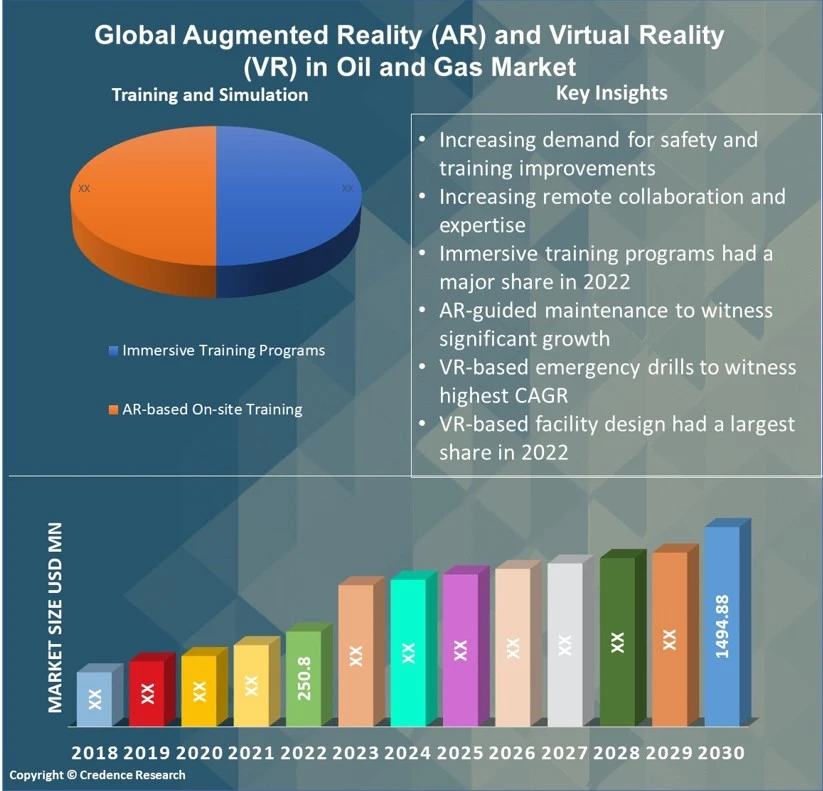
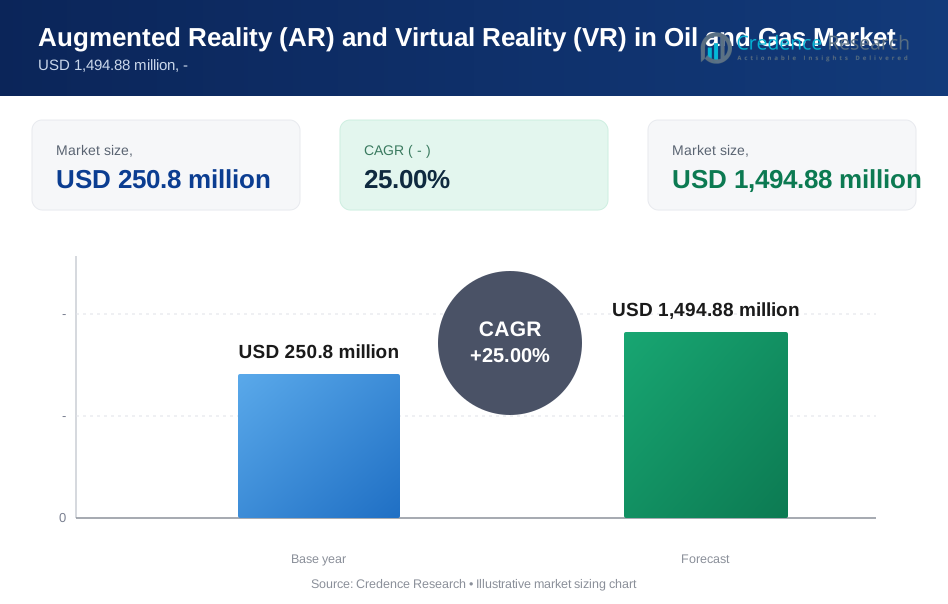
- The global demand for augmented reality (AR) and virtual reality (VR) in oil and gas was valued at USD 250.8 million in 2022 and is expected to reach USD 1494.88 million in 2030, growing at a CAGR of 25.00% between 2023 and 2030.
- The category of training and simulation with the highest is immersive training programs. AR-based on-site training, on the other hand, is expected to grow at a strong CAGR.
- The leading maintenance and inspection segment is virtual inspection.
- The CAGR for VR-based emergency drills is expected to be the highest during the projection period.
- During the forecast time frame, the VR-based facility design category will likely have the highest CAGR.
- VR data visualization is estimated to have the greatest CAGR during the forecast period.
- The AR-enhanced video conferencing segment will likely have the highest CAGR during the prediction period.
- The largest equipment operation and control category is AR-based equipment control.
- The VR-based well-planning segment's CAGR will be the top during the projected period.
- AR-enabled wearables are the best in the human-machine interface (HMI).
- Over the anticipated timeframe, the category with the largest compound annual growth rate (CAGR) is expected to be VR-based environmental simulations.
- Services is the segment with the highest CAGR during the projected timeframe.
- In the oil and gas market, North America is dominated by augmented reality (AR) and virtual reality (VR).
- The oil and gas industry's augmented reality (AR) and virtual reality (VR) markets are expected to grow to be the second-largest in Europe.
- In the oil and gas augmented reality and virtual reality businesses, Asia Pacific is expected to develop at the fastest rate.
- The ability to make better-informed decisions, bring in and keep citizens, and produce better environmental results are all contributing elements to the global market's growth.
- The oil and gas industry has a lot of opportunities to use augmented and virtual reality to improve customer satisfaction and service, drive innovation and automation, and boost the sustainability of the environment.
Executive Summary
Market Definition
The augmented reality in the oil and gas sector describes integrating digital and virtual elements into the actual world, enhancing user engagement and perception of their environment. Creating computer-generated, immersive experiences that allow users to experience locales and simulated scenarios important to oil and gas operations is known as virtual reality in the oil and gas business. The oil and gas sector's training, simulation, and decision-making processes can only function more effectively and safely with these technologies.
Market Overview
The augmented reality and virtual reality market in the oil and gas industry has been booming rapidly in recent years, and it is estimated to grow at a CAGR of 25.00% between 2023 and 2030. The market was estimated to be worth USD 250.8 million in 2022, and it is anticipated to be worth USD 1494.88 million in 2030.
Numerous gas and oil plants are situated in hard-to-reach places. Experts and personnel can work together and provide support from anywhere worldwide due to AR and VR technologies, eliminating the need to be physically present at remote locations. Field workers and distant experts can collaborate in real-time thanks to AR and VR. This capacity is essential for minimizing downtime, promptly identifying and fixing problems, and guaranteeing the seamless operation of vital machinery and procedures.
The requirement for specialists to travel to remote locations is significantly reduced by the potential of AR and VR technologies to deliver remote support. This reduces travel costs and downtime by having on-site specialists available for assistance. AR and VR enable efficient communication by superimposing virtual and augmented reality content in real-world settings. To guarantee that staff members have the knowledge and experience they need, even when working in remote areas, this feature is helpful for training and leadership.
Complex oil and gas assets may be visualized realistically and engagingly because of AR and VR technologies. This feature aids in better decision-making by allowing operators and maintenance staff to investigate and comprehend minute details of facilities, infrastructure, and equipment. VR technologies may create 3D models of oil and gas installations in detail. These models increase operating efficiency, which also helps with facility management, layout optimization, and maintenance planning.
Segmentation by Training and Simulation
- By training and simulation, immersive training programs are the market leader. Workers can experience and react to various simulated events through immersive training programs, which provide scenario-based learning. This kind of instruction aids in developing decision-making abilities and getting staff ready for changing work settings.
- The AR-based on-site training category will exhibit a sizable CAGR during the projected period. Due to AR-based on-site training, workers can develop and improve specialized skills right at the site where they will carry out duties. This guarantees that the training applies to the real work situation.
Segmentation by Maintenance and Inspection
- The main maintenance and inspection category is virtual inspection. AR and VR make remote inspection of oil and gas assets possible, allowing inspectors to digitally access and check facilities, pipelines, and equipment from a single location. This capacity lessens the requirement for physical presence in demanding or dangerous situations.
- The AR-guided maintenance category will likely register a significant CAGR during forecasting. AR-guided maintenance allows personnel to do activities without continuously consulting documentation or manuals. This hands-free function increases worker productivity and lowers the possibility of mistakes occurring during maintenance tasks.
Segmentation by Safety and Emergency Response
- During the projection period, the category for VR-based emergency exercises is expected to grow fastest. Evacuation procedure simulations can be included in VR-based emergency exercises. Personnel can study evacuation routes, practice leaving various locations, and better understand how important it is to stick to approved routes in case of an emergency.
- There is a growing need for AR and VR in the oil and gas industry due to various safety and emergency responses, including AR-enabled safety information.
Segmentation by Design and Planning
- During the projection period, the VR-based facility design category will likely have the highest CAGR. Stakeholders may visually explore and assess facility designs in a realistic setting due to virtual reality (VR), which makes immersive 3D design assessments possible. Better teamwork and more thoughtful design choices are made possible by this immersive experience.
- Other design and planning, such as AR-assisted construction, also contribute to the demand for augmented reality (AR) and virtual reality (VR) in oil and gas.
Segmentation by Data Visualization and Analytics
- VR data visualization will be expected to have the foremost CAGR during the prediction period. Virtual reality facilitates interactive data analytics, giving users real-time access to change and analyze data points. This interactive feature facilitates dynamic exploration and encourages a more practical method of analyzing data.
- Other data visualization and analytics, such as AR for data overlays, also contribute to the oil and gas industry's need for virtual reality (VR) and augmented reality (AR).
Segmentation by Remote Collaboration
- Throughout the forecast duration, the category for AR-enhanced video conferencing is anticipated to have the greatest CAGR. Participants in AR-enhanced video conferences can superimpose spatial data like 3D models, data visualizations, or annotations directly onto the live video stream. This enhances conversations by giving the information being communicated in a visual context.
- Other remote collaborations, such as VR-based remote meetings, also contribute to the demand for augmented reality (AR) and virtual reality (VR) in oil and gas.
Segmentation by Equipment Operation and Control
- The highest CAGR is anticipated for AR-based equipment control throughout estimation. Interactive interfaces can be superimposed on actual equipment through augmented reality-based equipment control. Operators can engage with equipment settings through touch-based controls or gestures, which makes control intuitive and hands-on.
- The need for AR and VR in the oil and gas industry is further supported by other equipment operations and control, such as VR-based equipment simulation.
Segmentation by Drilling and Well Planning
- Over the estimation period, VR-based well planning is expected to have the greatest CAGR. VR-based well planning and drilling allows team members in various places to participate in virtual planning and training sessions, facilitating remote collaboration. For teams that are dispersed across borders, this is very helpful.
- AR and VR are also needed in the oil and gas industry for other drilling and well-planning techniques, including AR-guided drilling operations.
Segmentation by Human-Machine Interface (HMI)
- Over the estimated timeframe, the AR-enabled wearables are anticipated to experience the highest CAGR. AR-enabled wearables facilitate wayfinding and navigation in intricate industrial environments. Employees can find equipment, move through big facilities more quickly, and follow visual overlays that provide the best route.
- Another human-machine interface (HMI), such as VR-based control rooms, also contributes to the demand for augmented reality (AR) and virtual reality (VR) in oil and gas.
Segmentation by Environmental Monitoring
- The VR-based environmental simulations category will probably have the greatest CAGR expected throughout the projection. Virtual reality simulations aid in evaluating the possible environmental consequences of exploration and drilling operations. This involves modeling how drilling operations affect local ecosystems, wildlife, and habitats.
- Other environmental monitoring, such as AR-enabled environmental data visualization, also contribute to the demand for augmented reality (AR) and virtual reality (VR) in oil and gas.
Segmentation by Component
- Services are predicted to have the most prominent CAGR during the estimation period. Creating specialized AR and VR apps that handle particular issues in the oil and gas sector, like training, simulation, and equipment maintenance, is driving a need for custom development services.
- Other components, such as hardware and software, also contribute to the demand for augmented reality (AR) and virtual reality (VR) in oil and gas.
Segmentation by Region
- North America dominated the AR and VR in the oil and gas market. North America's oil and gas industry is heavily focused on operational efficiency and safety. By providing solutions for improved training, remote help, and real-time data visualization, AR and VR technologies support these aims by promoting safer and more effective operations.
- The oil and gas industry's augmented reality (AR) and virtual reality (VR) markets are expected to be the second largest in Europe.
- Asia Pacific will witness the most rapid oil and gas market growth in augmented reality (AR) and virtual reality (VR).
- The remaining part of the globe, which includes Latin America, the Middle East, and Africa, meets the needs for virtual reality and augmented reality in the oil and gas industry.
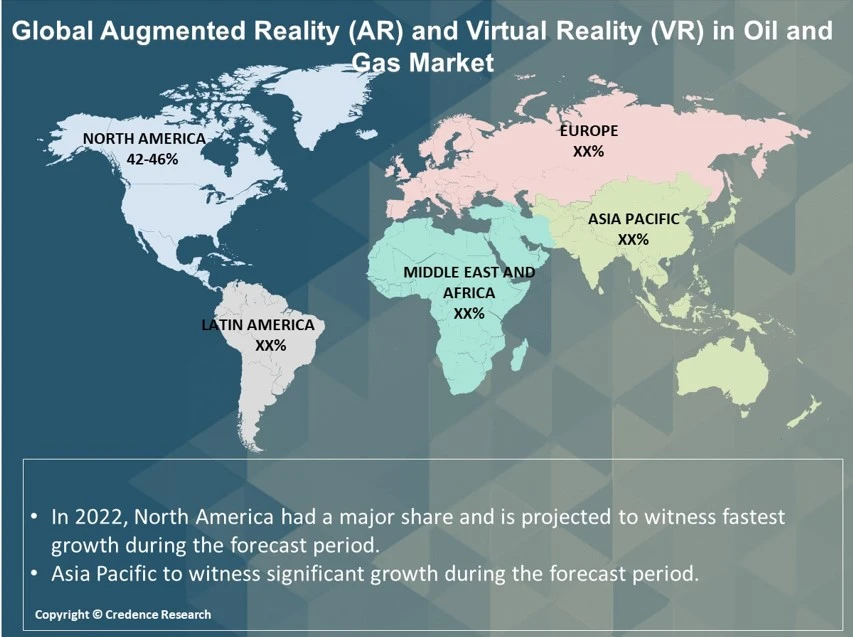
Increased regulatory compliance, asset management, enhanced exploration and production, and field communication contribute to the growing interest in virtual reality (VR) and augmented reality (AR) in the oil and gas industry.
Regarding forecasting, North America is likely to dominate the augmented and virtual reality markets for oil and gas. North America, especially the United States Silicon Valley, is a global technical innovation center. Leading IT companies and startups are present, which encourages the creation of innovative AR and VR solutions for the oil and gas industry. The area has notable investments in R&D, with both governmental and commercial sectors pushing the boundaries of AR and VR technologies. The current investment climate facilitates the development of novel solutions customized to meet the unique requirements of the oil and gas sector.
Additionally, North America has a sophisticated information technology infrastructure, including data centers and high-speed internet access. AR and VR technologies' smooth installation and functioning in oil and gas operations depend heavily on this strong infrastructure.
Throughout the forecast, the Asia Pacific region is anticipated to increase at the quickest rate. Energy demand is rising due to the Asia-Pacific region's fast industrialization and economic growth. To fulfill this increasing need, oil and gas exploration, production, and refining may all be optimized using AR and VR technologies. Asia's emerging markets, such as China and India, are investing in innovation and technology. These nations' governments and private businesses are investigating cutting-edge ways to boost productivity in the oil and gas industry, which creates a favorable environment for the adoption of AR and VR.
The Asia-Pacific region is home to several nations actively engaged in industry-wide digital transformation projects. The oil and gas industry includes integrating AR and VR technology to streamline procedures, save operating expenses, and boost worker safety. Asia-Pacific nations, including Australia, China, and India, have sizable oil and gas reserves. Because of these deposits, there are chances to use AR and VR technology to enhance the processes involved in exploration, extraction, and production.
Key Highlights of the Report
The global augmented reality (AR) and virtual reality (VR) in the oil and gas market are segmented by training and simulation, maintenance and inspection, safety and emergency response, design and planning, data visualization and analytics, remote collaboration, equipment operation, and control, drilling and well planning, human-machine interface (HMI), environmental monitoring, component, and region. As far as the training and simulation is concerned, immersive training programs are the market spearhead. Virtual inspection is the top segment. The category of VR-based emergency drills is anticipated to develop at the fastest CAGR during the forecast period. The VR-based facility design will experience the highest CAGR during the forecast period. The market for AR and VR in oil and gas is rapidly expanding in North America.
AR and VR can instantly deliver operational insights when integrated with real-time data streams. Quick and well-informed decision-making is facilitated by the real-time visualization of vital data by operators and decision-makers, including production rates, equipment performance, and environmental conditions. By overlaying pertinent data in the real world, augmented and virtual reality help improve situational awareness. In the oil and gas business, this function is essential for keeping an eye on things, seeing any problems, and reacting quickly to changing situations.
However, according to forecasts, North America will hold the largest market share for augmented reality (AR) and virtual reality (VR) in oil and gas globally. The region has led shale gas development with AR and VR technology, providing useful tools for visualizing geological formations, streamlining drilling procedures, and improving overall efficiency in unconventional resource extraction. The Asia Pacific region is also assumed to have the market's sharpest growth. The Asia-Pacific region's governments are encouraging innovation and the use of new technologies more and more. Through funding initiatives, policies, and incentives, companies are encouraged to investigate and apply AR and VR solutions in the oil and gas industry.
Which Key Factors Are Driving The Global Augmented Reality (AR) And Virtual Reality (VR) In the Oil And Gas Market?
The oil and gas industry is expanding due to AR and VR because they improve safety and understanding, increase operational efficiency and productivity, and facilitate remote cooperation and expertise sharing.
What Are The Key Challenges In The Global Market For Augmented Reality (AR) And Virtual Reality (VR) In Oil And Gas?
The development of AR and VR in the oil and gas industry is hampered by several issues, including substantial expenses for implementation, difficult integration with current systems, worries about data security, and a shortage of trained labor.
What Market Opportunities Exist For Augmented Reality (AR) And Virtual Reality (VR) In Oil And Gas Globally?
In the oil and gas sector, augmented reality and virtual reality offer abundant potential due to improved training and skill progress, emergency response modeling, and real-time data visualization.
Market Drivers
Several factors influence the global market for AR and VR in oil and gas. The main factors influencing the market for augmented reality and virtual reality in oil and gas globally are as follows:
Increasing Demand for Safety and Training Improvements
Complex oil and gas circumstances can be replicated through realistic and immersive training simulations made possible by AR and VR technologies. This lowers the dangers of in-person training exercises by allowing staff members to receive practical training in a secure virtual setting. Working in hazardous conditions is a common part of oil and gas operations. AR and VR offer a secure environment to train staff on handling emergencies, operating machinery, and reacting to possible threats without putting them in danger. Workers can practice and hone their response skills using VR simulations to create realistic emergency scenarios. This improves readiness for unanticipated circumstances and helps to create a more efficient and well-coordinated emergency response.
Market Restraints
Several challenges could prevent the global market expansion for AR and VR in oil and gas. Among them are the following:
High Implementation Costs
To deploy AR and VR solutions, an enormous initial investment in hardware is required, including headsets, sensors, and computer equipment. The creation or modification of software programs suited to the particular requirements of the oil and gas sector also adds to the total expense. The oil and gas business has certain requirements, and it can take a lot of resources to develop or modify AR and VR apps to satisfy industry-specific criteria and operational standards. The process of customization raises the overall cost of implementation. In addition to the initial investment, maintenance, and support expenditures for AR and VR systems exist. This covers doing routine maintenance on the equipment, updating the software, and offering technical assistance for issues that could arise while it's being used.
Opportunities
The global market for AR and VR in oil and gas presents significant potential opportunities. The following is an example of these:
Increasing Digital Twin Technology for Asset Management
With digital twin technology, physical assets are virtually recreated, offering a comprehensive and detailed perspective of the machinery, buildings, and infrastructure. Users can engage with these digital twins in a realistic and immersive way with AR and VR, which improves asset visualization. Digital Twin integration with AR and VR apps allows real-time asset performance monitoring. Offering information about the efficiency, health, and possible problems of the equipment problems promotes data-driven decision-making and improves asset management. AR/VR and Digital Twins work together to create predictive maintenance models. Organizations can optimize maintenance schedules and minimize unplanned downtime by predicting and preventing possible problems by analyzing real-time data from assets.
Competitive Landscape
Key Players
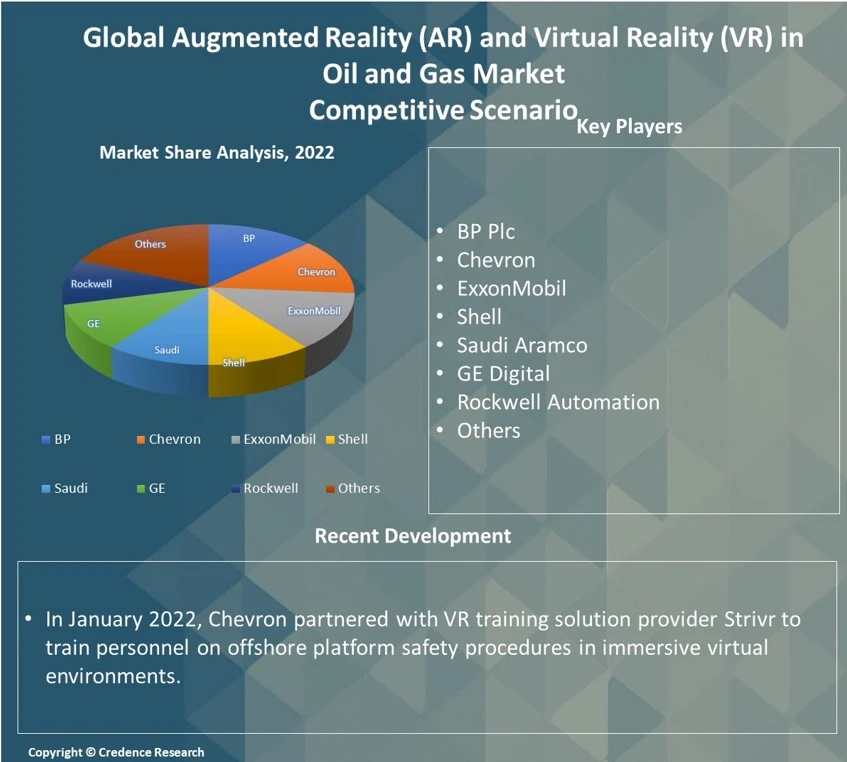
The global market for augmented reality (AR) and virtual reality (VR) in oil and gas is very competitive, with many powerful players. Some of the leading market participants and their corresponding market shares are listed below:
- BP Plc
- Chevron
- ExxonMobil
- Shell
- Saudi Aramco
- GE Digital
- Rockwell Automation
- Others
These companies prioritize mergers and acquisitions, expanding their distribution network, and developing new products to remain competitive.
The leading competitors in the global market for augmented reality (AR) and virtual reality (VR) in oil and gas are constantly looking for ways to get an advantage by releasing new items and advancements.
In June 2023, PTC and Rockwell Automation extended their collaboration, focusing on getting manufacturing companies to use augmented reality (AR) software and the Internet of Things (IoT). For as long as it exists, Rockwell Automation will continue to provide PTC's ThingWorx IoT software and Vuforia AR software to its present and potential discrete and process manufacturing clients.
In May 2023, Google launched new ARCore Geospatial capabilities, like Scene Semantics API, Geospatial Depth API, and Streetscape Geometry API, to let customers create inventive, global immersive experiences.
Summary of Key Findings
- Due to remote inspections and maintenance, augmented reality (AR) and virtual reality (VR) in the oil and gas industry keep expanding.
- The market is segmented by training and simulation, maintenance and inspection, safety and emergency response, design and planning, data visualization and analytics, remote collaboration, equipment operation, and control, drilling and well planning, human-machine interface (HMI), environmental monitoring, component, and region.
- The most popular training and simulation in the market is immersive training programs.
- The most ubiquitous maintenance and inspection fragment is virtual inspection.
- Regarding CAGR, VR-based emergency drills are expected to grow fastest during the forecast period.
- The VR-based facility design category will likely see the highest CAGR during the anticipated time frame.
- North America is leading market development; the market is highly competitive with key players including BP Plc, Chevron, ExxonMobil, Shell, Saudi Aramco, GE Digital, Rockwell Automation, and others.
Future Outlook
- Optimistic viewpoint for the global augmented reality (AR) and virtual reality (VR) in the oil and gas market with noteworthy growth potential in the North American region.
- The growing demand for safety and training improvements is one of the main drivers of the growth of AR and VR in the oil and gas market's growth.
- The high implementation costs could significantly challenge the market's growth throughout the anticipated term.
- Foremost companies must concentrate on product innovation, expanding their market reach, and maintaining competitive pricing to stay ahead.
How CXOs Can Benefit from the Credence Research Augmented Reality (AR) and Virtual Reality (VR) in Oil and Gas Market Report
The Credence Research Augmented Reality (AR) and Virtual Reality (VR) in Oil and Gas Market Report provides CXOs with a comprehensive overview of the market, including:
- Market size and growth forecast: The report provides detailed estimates of the global augmented reality (AR) and virtual reality (VR) in the oil and gas market size, segmented by training and simulation, maintenance and inspection, safety and emergency response, design and planning, data visualization and analytics, remote collaboration, equipment operation and control, drilling and well planning, human-machine interface (HMI), environmental monitoring, component, and region. It also includes forecasts for the market through 2032 based on key trends and drivers.
- Market segmentation: The report segments the augmented reality (AR) and virtual reality (VR) in the oil and gas market by training and simulation, maintenance and inspection, safety and emergency response, design and planning, data visualization and analytics, remote collaboration, equipment operation, and control, drilling and well planning, human-machine interface (HMI), environmental monitoring, component, and region. This segmentation provides CXOs with a granular understanding of the market and the opportunities in each segment.
- Competitive landscape: The report profiles the key players in augmented reality (AR) and virtual reality (VR) in the oil and gas market and provides insights into their strategies, product offerings, and financial performance. This information can help CXOs to identify and assess their competition.
- Key trends and drivers: The report identifies and analyzes the key trends and drivers shaping augmented reality (AR) and virtual reality (VR) in the oil and gas market. This information can help CXOs to make informed decisions about their investments and strategies.
CXOs can use the insights from the Credence Research Augmented Reality (AR) and Virtual Reality (VR) in Oil and Gas Market Report to:
- Identify growth opportunities: The report can help CXOs identify new growth opportunities in augmented reality (AR) and virtual reality (VR) in the oil and gas market. For example, the report identifies the growing demand for augmented reality (AR) and virtual reality (VR) in oil and gas from technical professionals, management, and decision-makers in the industry as a key opportunity.
- Make informed investment decisions: The report can help CXOs make informed investment decisions about augmented reality (AR) and virtual reality (VR) in oil and gas. For example, the report provides insights into the key factors to consider when evaluating augmented reality (AR) and virtual reality (VR) in oil and gas providers and selecting solutions.
- Develop competitive strategies: The report can help CXOs develop competitive strategies for their augmented reality (AR) and virtual reality (VR) in oil and gas businesses. For example, the report identifies the key strategies used by augmented reality (AR) and virtual reality (VR) in oil and gas providers to differentiate themselves from their competitors.
- Track market developments: The report can help CXOs track and stay ahead of the curve. For example, the report provides insights into the latest trends and innovations in augmented reality (AR) and virtual reality (VR) in the oil and gas market.
Overall, the Credence Research Augmented Reality (AR) and Virtual Reality (VR) in the Oil and Gas Market Report are valuable resources for CXOs looking to understand the market better and identify growth opportunities.
Segmentation
- By Training and Simulation
- Immersive Training Programs
- AR-based On-site Training
- By Maintenance and Inspection
- Virtual Inspection
- AR-guided Maintenance
- By Safety and Emergency Response
- VR-based Emergency Drills
- AR-enabled Safety Information
- By Design and Planning
- VR-based Facility Design
- AR-assisted Construction
- Data Visualization and Analytics
- AR for Data Overlays
- VR Data Visualization
- By Remote Collaboration
- VR-based Remote Meetings
- AR-enhanced Video Conferencing
- By Equipment Operation and Control
- AR-based Equipment Control
- VR-based Equipment Simulation
- By Drilling and Well Planning
- VR-based Well Planning
- AR-guided Drilling Operations
- By Human-Machine Interface (HMI)
- VR-based Control Rooms
- AR-enabled Wearables
- By Environmental Monitoring
- VR-based Environmental Simulations
- AR-enabled Environmental Data Visualization
- By Component
- Hardware
- Software
- Services
- By Region
- North America
- The U.S.
- Canada
- Mexico
- Europe
- Germany
- France
- The U.K.
- Italy
- Spain
- Rest of Europe
- Asia Pacific
- China
- Japan
- India
- South Korea
- South-east Asia
- Rest of Asia Pacific
- Latin America
- Brazil
- Argentina
- Rest of Latin America
- Middle East & Africa
- GCC Countries
- South Africa
- Rest of the Middle East and Africa
- North America
Request a Free Sample
Fill in your details and we'll send you a free sample report.
- Sample data tables & charts
- Research methodology
Need a Custom Version of This Report?
Tailor the scope, geography, or segments to your exact requirements.
- Custom geography or segment scope
- Direct access to our analyst team
Frequently Asked Questions
How big is the global market for augmented reality (AR) and virtual reality (VR) in oil and gas right now?
What are the augmented reality (AR) and virtual reality (VR) in the oil and gas market's anticipated growth rate from 2023 to 2030?
Which market category is in the lead in training and simulation?
Regarding maintenance and inspection, which market category is in the lead?
Which safety and emergency response segment is estimated to have the highest CAGR throughout the forecast period?
Table of Content
Chapter 1. Report Introduction
- 1.1 Report Description & Purpose
- 1.1.1 Report Title & Market Definition
- 1.1.2 Unique Selling Propositions (USP) & Key Differentiators
- 1.1.3 Value Proposition for Stakeholders
- 1.2 Research Objectives
- 1.2.1 Market Sizing Objectives (Volume & Revenue)
- 1.2.2 Segmentation Objectives
- 1.2.3 Competitive Intelligence Objectives
- 1.2.4 Forecast & Scenario Objectives
- 1.3 Report Scope
- 1.3.1 Augmented Reality (AR) and Virtual Reality (VR) in Oil and Gas Scope – Types & Subtypes Covered
- 1.3.2 Geographic Scope – Regions & Countries Covered
- 1.3.3 Historical Period, Base Year & Forecast Period (the historical period; forecast to the forecast period)
- 1.3.4 Inclusions & Exclusions
- 1.4 HS Code & Classification Framework
- 1.5 Currency, Units & Pricing Basis
- 1.6 Target Stakeholders
- 1.7 Limitations & Assumptions
Chapter 2. Executive Summary
- 2.1 Global Augmented Reality (AR) and Virtual Reality (VR) in Oil and Gas Market Snapshot
- 2.1.1 Market Size – Historical (the historical period) & Forecast (the forecast period) (base year: USD 250.8 million → forecast year: USD 1,494.88 million)
- 2.1.2 Volume & Revenue – Global Totals
- 2.1.3 Key Market Highlights – Top Five Facts
- 2.2 Augmented Reality (AR) and Virtual Reality (VR) in Oil and Gas Market Segmentation Snapshot
- 2.2.1 Market Split by Region – vs.
- 2.3 Competitive Snapshot
- 2.3.1 Top 10 Players by Revenue Share –
- 2.3.2 Top 10 Players by Volume Share –
- 2.3.3 Recent Strategic Developments (18-Month Summary)
- 2.4 Key Investment Highlights & Strategic Conclusions
Chapter 3. Augmented Reality (AR) and Virtual Reality (VR) in Oil and Gas Market Dynamics & Industry Analysis
- 3.1 Market Overview & Context
- 3.1.1 Augmented Reality (AR) and Virtual Reality (VR) in Oil and Gas Market Position in the Broader Automotive Value Chain
- 3.1.2 OEM vs. Replacement Market Dynamics
- 3.1.3 Market Maturity & Development Stage by Region
- 3.2 Augmented Reality (AR) and Virtual Reality (VR) in Oil and Gas Market Drivers
- 3.3 Augmented Reality (AR) and Virtual Reality (VR) in Oil and Gas Market Restraints & Challenges
- 3.4 Augmented Reality (AR) and Virtual Reality (VR) in Oil and Gas Market Opportunities
- 3.5 Porter's Five Forces Analysis
- 3.5.1 Threat of New Entrants
- 3.5.2 Bargaining Power of Suppliers
- 3.5.3 Bargaining Power of Buyers
- 3.5.4 Threat of Substitutes
- 3.5.5 Competitive Rivalry – Intensity Assessment
- 3.6 Augmented Reality (AR) and Virtual Reality (VR) in Oil and Gas Value Chain Analysis
- 3.6.1 Upstream – Raw Material/Input Suppliers
- 3.6.1.1 Raw Material/Input 1
- 3.6.1.2 Raw Material/Input 2
- 3.6.1.3 Raw Material/Input 3
- 3.6.2 Midstream – Production/Manufacturing/Service Delivery
- 3.6.2.1 Production/Process Overview
- 3.6.2.2 Key Facility Locations & Capacity by Manufacturer
- 3.6.3 Downstream – Distribution & End Consumer
- 3.6.3.1 Primary Channel – B2B/OEM
- 3.6.3.2 Secondary Channels – Dealer, Retail, Online, Direct
- 3.6.4 Value Chain Profitability Analysis
- 3.6.1 Upstream – Raw Material/Input Suppliers
- 3.7 PESTEL Analysis
- 3.7.1 Political Factors
- 3.7.2 Economic Factors
- 3.7.3 Social Factors
- 3.7.4 Technological Factors
- 3.7.5 Environmental Factors
- 3.7.6 Legal Factors
- 3.8 Augmented Reality (AR) and Virtual Reality (VR) in Oil and Gas Supply Chain Analysis
- 3.8.1 Raw Material/Input Supply Risk Assessment
- 3.8.2 Manufacturing Concentration Risk (Geographic Exposure)
- 3.8.3 Trade Disruption Impact Analysis
- 3.9 Regulatory & Policy Landscape
Note: The regulatory and policy landscape section covers regulations based on their applicability to the market, Augmented Reality (AR) and Virtual Reality (VR) in Oil and Gas category, geography, and scope of the study. Only regulatory frameworks with a material impact on operations, compliance, trade, sustainability, or market access are analyzed in detail.
Chapter 4. Key Investment Pockets & Opportunity Analysis
- 4.1 Augmented Reality (AR) and Virtual Reality (VR) in Oil and Gas Market Attractiveness Analysis
- 4.1.1 By Region – Investment Attractiveness Matrix (Volume × CAGR)
- 4.2 Absolute Revenue Growth Opportunity
- 4.2.1 By Region – Absolute USD Growth Through the forecast period
- 4.3 Incremental Volume Opportunity
- 4.3.1 By Region – Incremental Volume Through the forecast period
- 4.3.2 Segment – Incremental Volume
- 4.4 Emerging Submarket Opportunity Deep Dive (Subject to Applicability)
- 4.5 Emerging Market Opportunity Scorecards
- 4.5.1 United States
- 4.5.2 Europe
- 4.5.3 Asia
- 4.5.4 Middle East & Africa
Note: Emerging Market Opportunity Scorecards will be included based on relevance and strategic importance. Regions listed are indicative and may vary depending on data availability and market dynamics.
Chapter 5. Augmented Reality (AR) and Virtual Reality (VR) in Oil and Gas Import-Export Analysis & Trade Flows
- 5.1 Global Trade Overview
- 5.1.1 Global Export Value by Country (the historical period)
- 5.1.2 Global Export Volume by Country (the historical period)
- 5.1.3 Global Import Value by Country (the historical period)
- 5.1.4 Global Import Volume by Country (the historical period)
- 5.1.5 Net Trade Balance by Country (the historical period)
- 5.2 Export Analysis – Segment
- 5.2.1 Type 1 (HS Code)
- 5.2.2 Type 2 (HS Code)
- 5.2.3 Type 3 (HS Code)
- 5.2.4 Type 4 (HS Code)
- 5.2.5 Type 5 (HS Code)
- 5.3 Import Analysis – Segment
- 5.3.1 Type 1 (HS Code)
- 5.3.2 Type 2 (HS Code)
- 5.3.3 Type 3 (HS Code)
- 5.3.4 Type 4 (HS Code)
- 5.3.5 Type 5 (HS Code)
- 5.4 Average Unit Trade Prices
- 5.4.1 Average Export Price – Segment & Country
- 5.4.2 Average Import Price – Segment & Source Country
- 5.4.3 Price Trends (the historical period)
- 5.5 Key Trade Route Analysis
- 5.5.1 Trade Route 1
- 5.5.2 Trade Route 2
- 5.5.3 Trade Route 3
- 5.5.4 Trade Route 4
- 5.5.5 Trade Route 5
- 5.6 Trade Policy Impact Assessment
- 5.6.1 US Anti-Dumping & Section 301 Tariffs
- 5.6.2 EU Customs Union Impact
- 5.6.3 Major Free Trade Agreements
- 5.6.4 USMCA Rules of Origin
Note: Trade policy analysis will be included only where relevant to the Augmented Reality (AR) and Virtual Reality (VR) in Oil and Gas market.
Chapter 6. Competitive Landscape & Company Benchmarking
- 6.1 Augmented Reality (AR) and Virtual Reality (VR) in Oil and Gas Market Concentration & Structure
- 6.1.1 Herfindahl-Hirschman Index (HHI) – vs.
- 6.1.2 Tier 1, Tier 2 & Tier 3 Market Structure
- 6.1.3 Global, Regional & Local Player Dynamics
- 6.2 Augmented Reality (AR) and Virtual Reality (VR) in Oil and Gas Market Share Analysis –
- 6.2.1 Global Revenue Share by Company
- 6.2.2 Global Volume Share by Company
- 6.2.3 Regional Revenue Share
- 6.2.4 Market Share Evolution ( vs. )
- 6.2.5 OEM Segment Share by Company
- 6.2.6 Replacement Segment Share by Company
- 6.3 Production/Delivery Capacity & Facility Analysis
- 6.3.1 Global Installed Capacity
- 6.3.2 Capacity Utilization Rates
- 6.3.3 Production/Output Volume
- 6.3.4 Facility Locations & Capacity Map
- 6.3.5 Planned Capacity Additions
- 6.4 Augmented Reality (AR) and Virtual Reality (VR) in Oil and Gas Competitive Benchmarking Matrix
- 6.4.1 Revenue, Volume, CAGR & Profitability Comparison
- 6.4.2 Channel Revenue Mix
- 6.4.3 Geographic Revenue Exposure
- 6.4.4 R&D Intensity
- 6.4.5 Sustainability Maturity
- 6.5 Strategic Developments in Augmented Reality (AR) and Virtual Reality (VR) in Oil and Gas (Last 24 Months)
- 6.5.1 Mergers, Acquisitions & Divestments
- 6.5.2 New Augmented Reality (AR) and Virtual Reality (VR) in Oil and Gas Launches
- 6.5.3 Facility Expansions
- 6.5.4 Strategic Alliances, Joint Ventures & Partnerships
- 6.5.5 Distribution Expansion & Market Entry
- 6.5.6 Sustainability & ESG Initiatives
- 6.6 Competitive Strategy Mapping
- 6.6.1 Leader, Challenger, Follower & Niche Classification
- 6.6.2 Pricing Strategy Comparison
- 6.6.3 Channel Strategy Matrix
Note: Strategic developments are included based on their materiality and the availability of reliable information.
Chapter 7. Global Augmented Reality (AR) and Virtual Reality (VR) in Oil and Gas Market – By Distribution Channel
- 7.1 Segment Overview
- 7.1.1 Volume & Revenue Split by Channel ( & )
- 7.1.2 Channel Mix Evolution (the forecast period)
Chapter 8. Regional Market Analysis – Global Overview
- 8.1 Global Regional Overview
- 8.1.1 Regional Volume Share
- 8.1.2 Regional Revenue Share
- 8.1.3 Regional Volume by Region
- 8.1.4 Regional Revenue by Region
- 8.1.5 Regional Forecast Through the forecast period
- 8.2 Cross-Regional Segment Analysis
- 8.2.1 By Distribution Channel
- 8.2.2 By Brand/Price Tier
Chapter 9. North America Augmented Reality (AR) and Virtual Reality (VR) in Oil and Gas Market
- 9.1 United States
- 9.2 Canada
- 9.3 Mexico
Chapter 10. Europe Augmented Reality (AR) and Virtual Reality (VR) in Oil and Gas Market
- 10.1 Germany
- 10.2 France
- 10.3 Italy
- 10.4 United Kingdom
- 10.5 Spain
- 10.6 Poland
- 10.7 Russia
- 10.8 Netherlands
- 10.9 Belgium
- 10.10 Sweden
- 10.11 Denmark
- 10.12 Norway
- 10.13 Rest of Europe
Chapter 11. Asia Pacific Augmented Reality (AR) and Virtual Reality (VR) in Oil and Gas Market
- 11.1 China
- 11.2 India
- 11.3 Japan
- 11.4 South Korea
- 11.5 Thailand
- 11.6 Indonesia
- 11.7 Vietnam
- 11.8 Malaysia
- 11.9 Australia
- 11.10 Rest of Asia Pacific
Chapter 12. Latin America Augmented Reality (AR) and Virtual Reality (VR) in Oil and Gas Market
- 12.1 Brazil
- 12.2 Argentina
- 12.3 Colombia
- 12.4 Chile
- 12.5 Rest of Latin America
Chapter 13. Middle East Augmented Reality (AR) and Virtual Reality (VR) in Oil and Gas Market
- 13.1 Saudi Arabia
- 13.2 United Arab Emirates
- 13.3 Turkey
- 13.4 Israel
- 13.5 Iran
- 13.6 Rest of the Middle East
Chapter 14. Africa Augmented Reality (AR) and Virtual Reality (VR) in Oil and Gas Market
- 14.1 South Africa
- 14.2 Egypt
- 14.3 Nigeria
- 14.4 Morocco
- 14.5 Rest of Africa
Chapter 15. Augmented Reality (AR) and Virtual Reality (VR) in Oil and Gas Company Profiles
- 15.1 [Company 01]
- 15.1.1 Company Overview
- 15.1.2 Key Management Personnel
- 15.1.3 Products & Services Portfolio
- 15.1.4 Financial Performance
- 15.1.5 Key Market Focus & Geographic Presence
- 15.1.6 Recent Developments & Strategic Initiatives
Note: The company profile list is preliminary and may change based on research findings, market developments, data availability, and client requirements.
Chapter 16. Appendices
- Appendix A – List of Abbreviations & Acronyms
- Appendix B – Industry Classification Code Reference – Full Series
- Appendix C – Production & Capacity Data Tables
- Appendix D – End-Use & Demand Base Tables
- Appendix E – Consumption & Replacement Rate Assumptions
- Appendix F – ASP Reference Tables
- Appendix G – Manufacturing & Facility Database
- Appendix H – Import-Export Data Tables
- Appendix I – Regulatory Summary Tables
- Appendix J – Primary Research Participant List (Anonymized)
- Appendix K – Primary Research Questionnaire Framework
- Appendix L – Data Sources & Bibliography
- Appendix M – Market Size Divergence & Source Comparison
Chapter 17. Research Methodology
- 17.1 Research Framework & Philosophy
- 17.2 Secondary Research – Sources, Hierarchy & Data Extraction
- 17.3 Data Modeling – Bottom-Up & Top-Down Market Sizing
- 17.4 Primary Research – Stakeholder Framework, LOI & Sample Sizes
- 17.5 Forecast Methodology – Regression, Scenario & Sensitivity Analysis
- 17.6 Quality Control – Four-Layer Validation Framework
- 17.7 Limitations & Standard Assumptions
- 17.8 Disclaimer
