
Footwear and running pull Philippine sports spending
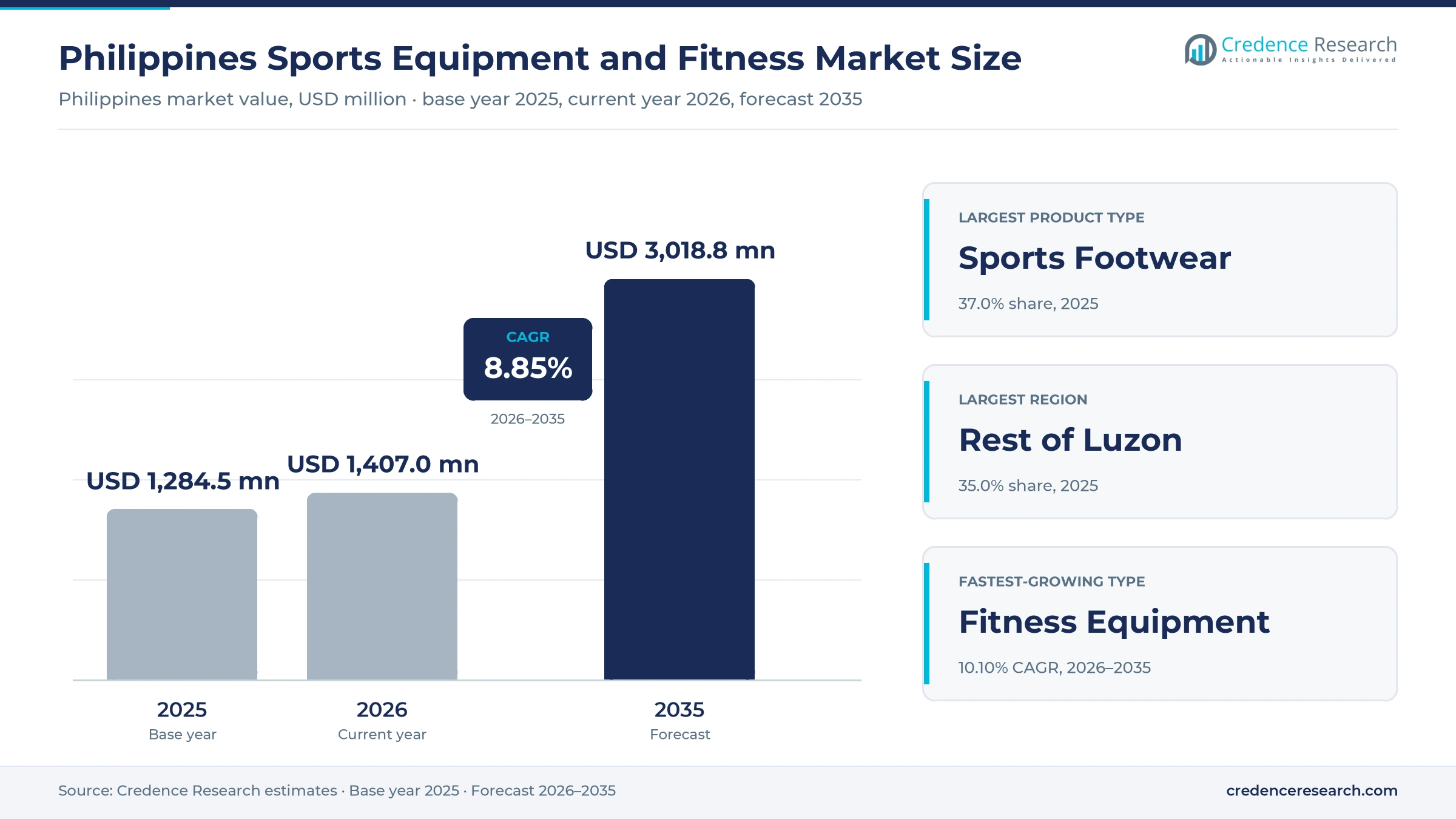
The Philippines sports equipment and fitness market was valued at USD 1.28 billion in 2025 and is projected to increase from USD 1.41 billion in 2026 to USD 3.02 billion by 2035, registering a CAGR of 8.85% during 2026–2035. Demand comes from running events, gym club rollouts, school sports and a mall-based retail network that is moving deeper into the provinces. Rest of Luzon held the largest regional share, 35.0% in 2025, because Calabarzon and Central Luzon together hold about 30 million residents. Visayas is the fastest-growing region at 9.32% a year, as Cebu and Iloilo receive larger store formats. Commercially, Decathlon set a target of 27 Philippine stores by the end of 2026 and 50 by 2030, while digital payments reached nearly two-thirds of retail payment volume in 2025.
What does the Philippines sports equipment and fitness market include?
The market counts retail and institutional spending on fitness machines, team and individual sports gear, performance apparel and sports footwear bought in the Philippines. Buyers range from households and recreational runners to gyms, school divisions, leagues and employers, and most purchases pass through mall stores, brand outlets or online marketplaces.
The estimate excludes gym membership fees, event entry fees, sports betting and broadcast rights, as well as casual fashion footwear without a sports use. The value chain runs from global brand owners and importers through local distributors, franchisees and retailers, because most performance products sold in the country are imported.
Philippines Sports Equipment and Fitness Market Insights
- The Philippines sports equipment and fitness market grows from USD 1.28 billion in 2025 to USD 3.02 billion by 2035, reflecting an 8.85% CAGR over 2026–2035.
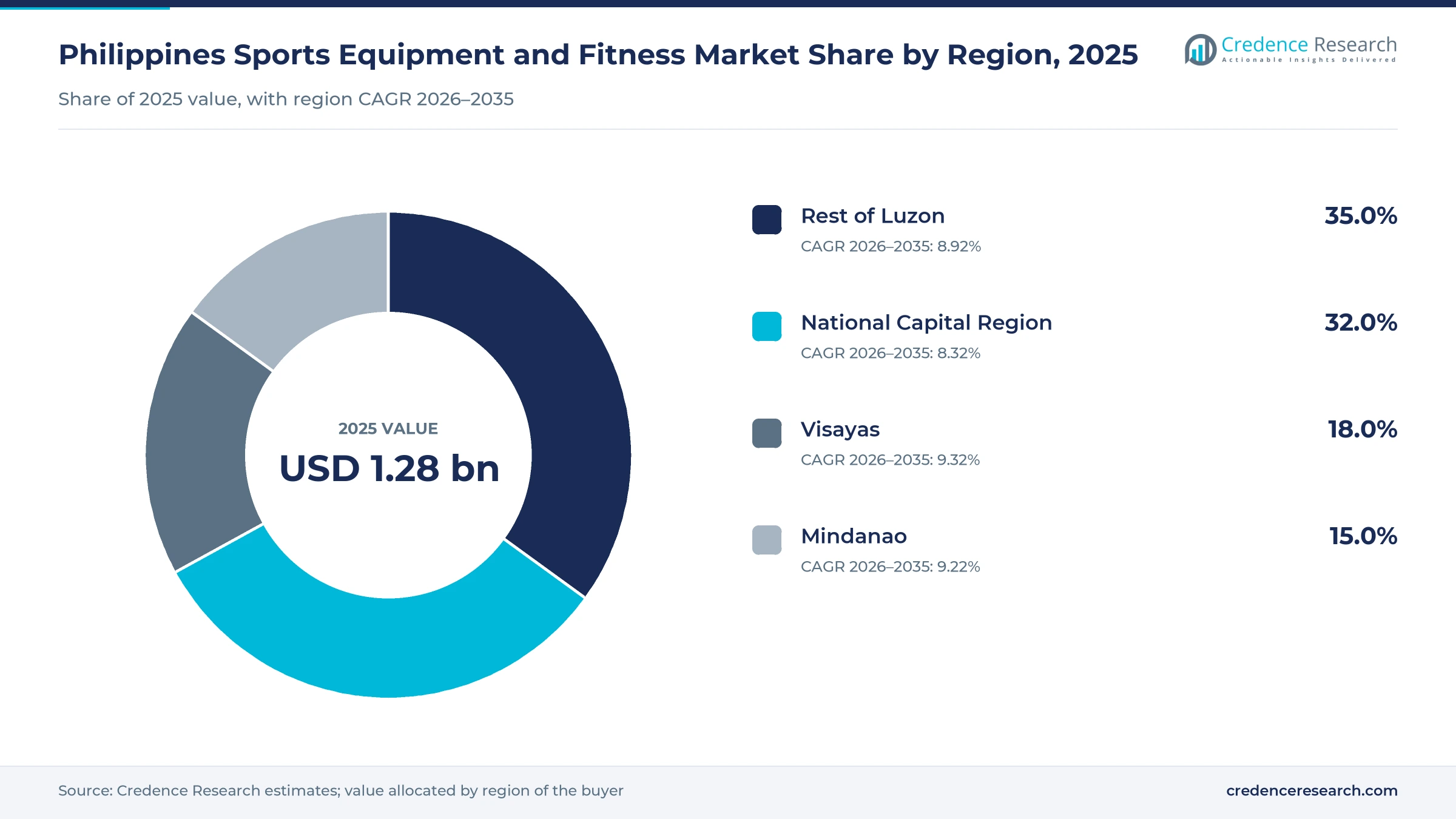
- Rest of Luzon held 35.0% of 2025 value, ahead of the National Capital Region at 32.0%, reflecting a larger population across Calabarzon and Central Luzon.
- Sports Footwear led product demand with 37.0% of 2025 value, supported by marathon fields such as the 12,275 runners at Cebu Marathon in January 2025.
- Retail is changing quickly, with Decathlon moving from 17 stores in 2025 toward a target of 27 by the end of 2026 and 50 by 2030.
- Competition centers on mall reach, as Quorum Holdings counted 75 stores in September 2025 and Garmin counted 25 nationwide stores by July 2026.
Footwear, outdoor use and specialty stores lead demand
Why does footwear lead Philippine sports product demand?
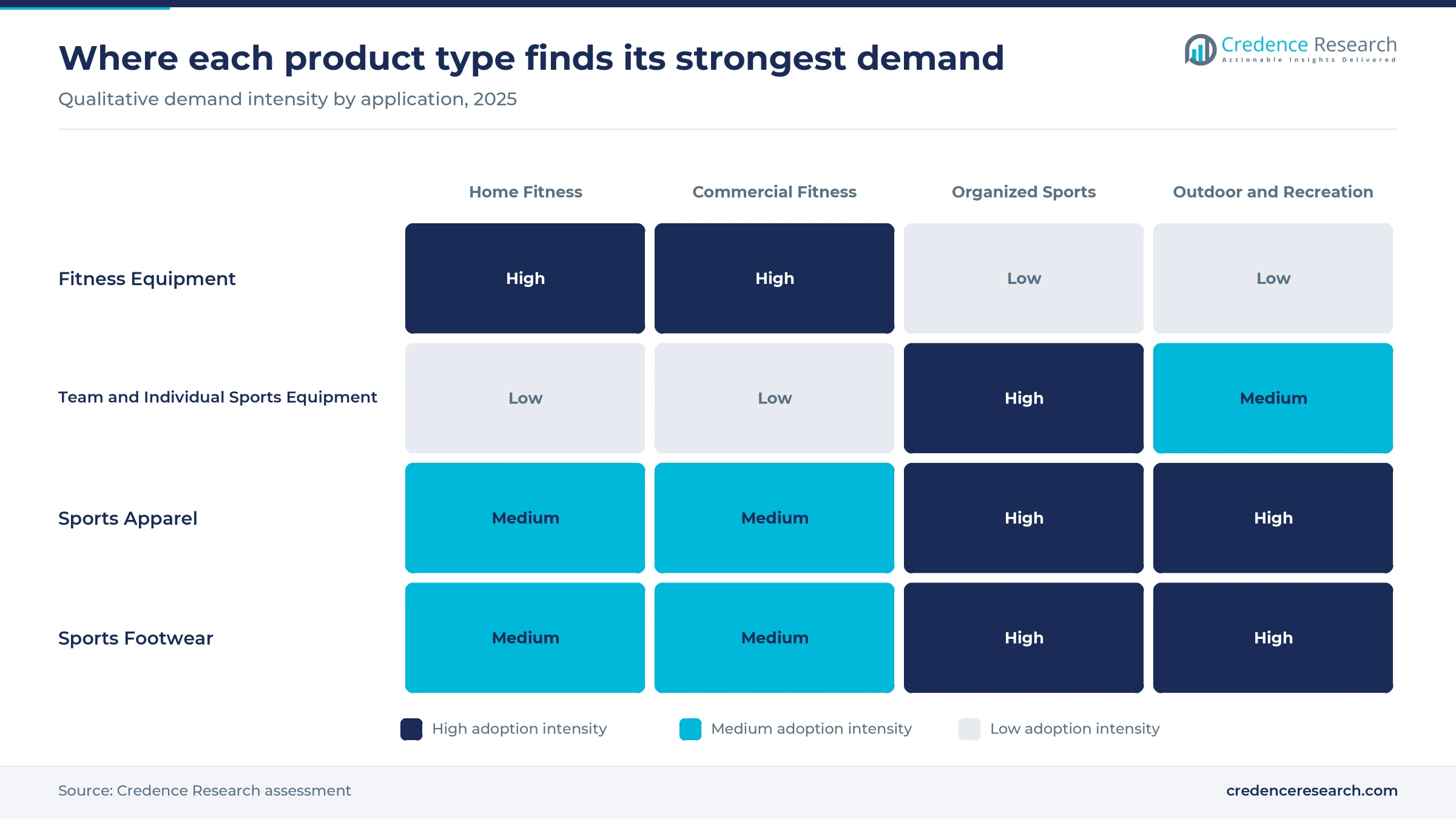
Based on product type, the market is categorized into fitness equipment, team and individual sports equipment, sports apparel and sports footwear. Sports Footwear led with 37.0% of 2025 value because repeat purchases of athletic footwear support dedicated mall space, shown by the 823-square-meter JD Sports store at SM Mall of Asia reported by Malaya in September 2025. Fitness Equipment grows fastest at 10.10% a year as club networks need machines, since Anytime Fitness rose from 50 Philippine gyms in February 2018, according to The Philippine Star, to its 150th club in Mactan in August 2024.
How do recreation and organized play shape product choice?
Based on application, the market is categorized into home fitness, commercial fitness, organized sports and outdoor and recreation. Outdoor and Recreation led with 39.0% of 2025 value because road running draws large paying fields, including 12,275 runners at Cebu Marathon in January 2025, according to The Philippine Star. Organized Sports grows fastest at 9.57% a year as public funding rises and school events scale up. GMA Regional TV reported a Philippine Sports Commission allocation of P2.21 billion for 2026 against P1.28 billion in 2025, while the May 2026 Palarong Pambansa gathered more than 13,000 student-athletes.
Who buys sports gear beyond the individual household?
Based on end user, the market is categorized into individual consumers, gyms and fitness centers, schools and universities, and sports clubs and corporate buyers. Individual Consumers led with 72.0% of 2025 value because household budgets expanded, with Philippine Statistics Authority data showing average family spending of PHP 321,850 in 2025, up 24.7% from 2023. Sports Clubs and Corporate Buyers grow fastest at 10.01% a year as organized groups buy in volume. Malaya reported that Toby's Sports serves corporate clients including GCash and PhilamLife, and the Daily Tribune counted more than 200 federation-registered pickleball clubs in 2025.
Why do specialty chains still outsell online marketplaces?
Based on distribution channel, the market is categorized into specialty sports retailers, brand-owned stores, e-commerce marketplaces and direct and institutional sales. Specialty Sports Retailers led with 38.0% of 2025 value because buyers still test fit and grip in person, and Quorum Holdings operated 75 Toby's Sports and Urban Athletics stores in September 2025, according to Malaya. E-Commerce Marketplaces grow fastest at 10.15% a year as digital payments remove checkout friction. Huawei offered vouchers on Shopee, Lazada and TikTok Shop for its April 2026 running watch, which shows where new sports devices now reach buyers first.
| Segment Group | Leading Sub-segment | Share, 2025 | Fastest-growing Sub-segment | CAGR, 2026–2035 |
|---|---|---|---|---|
| By Product Type | Sports Footwear | 37.0% | Fitness Equipment | 10.10% |
| By Application | Outdoor and Recreation | 39.0% | Organized Sports | 9.57% |
| By End User | Individual Consumers | 72.0% | Sports Clubs and Corporate Buyers | 10.01% |
| By Distribution Channel | Specialty Sports Retailers | 38.0% | E-Commerce Marketplaces | 10.15% |
Request a Free Sample
Fill in your details and we'll send you a free sample report.
- Sample data tables & charts
- Research methodology
Payments, sports funding and inactivity lift demand
Digital retail access and payment adoption
Digital payments reduce the friction of buying sports goods outside large cities, because a shopper in a provincial town can now pay for a brand-name shoe the same way as a Makati buyer. Bangko Sentral ng Pilipinas data show digital channels reached 64.7% of retail payment volume in 2025, up from 57.4% in 2024, according to the Daily Tribune. QR Ph alone handled 2.47 billion transactions worth P1.16 trillion during 2025, which brings small merchants into the same payment rail. This shift also supports brand promotions, as Huawei gave PHP 1,000 vouchers on Shopee, Lazada and TikTok Shop for its PHP 19,999 running watch in April 2026. As a result, E-Commerce Marketplaces rise at 10.15% a year, the fastest pace among channels.
Fitness and organized sports participation
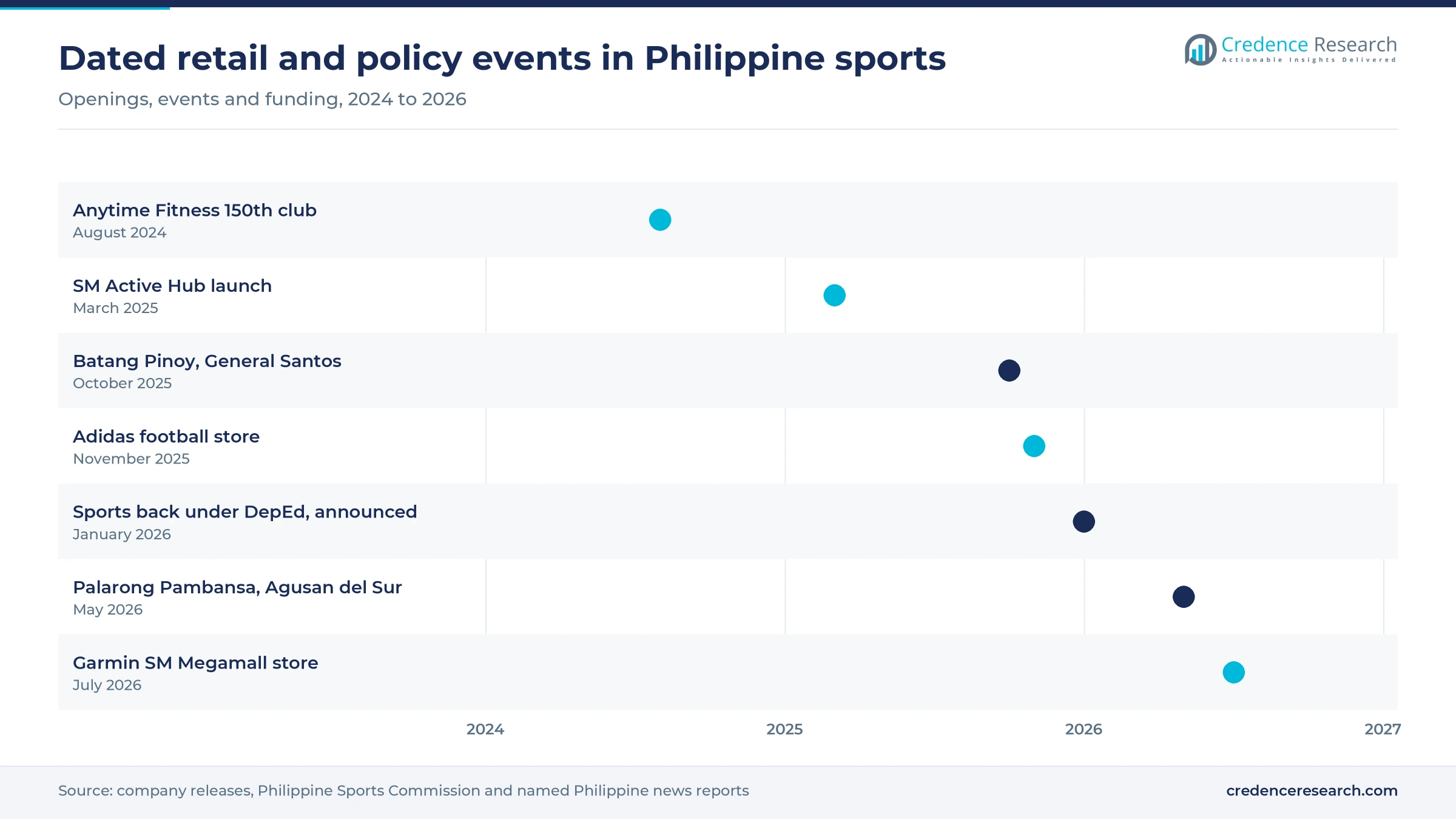
Participation has moved from occasional play to scheduled events and leagues, and each new event creates repeat demand for shoes, kits and training gear. The Philippine Sports Commission received P2.21 billion for 2026 against P1.28 billion in 2025, according to GMA Regional TV, which widens the funding base for athlete programs. The Philippine Sports Commission also planned Batang Pinoy 2025 in General Santos for about 15,000 young athletes across 27 sports. Crowds reinforce this interest, since the volleyball world championship final drew 16,429 spectators at SM Mall of Asia Arena in September 2025, tournament organizers reported. Consequently, Organized Sports grows at 9.57% a year, ahead of the other application groups in the market.
Demographic scale and the physical activity imperative
A large population with low activity levels gives policymakers and employers a clear reason to promote exercise, which supports long-term equipment demand. The 2024 census counted 112.73 million residents, according to the Philippine Statistics Authority, and that scale sustains broad retail networks. DOST-FNRI survey results reported by The Philippine Star showed 77.5% of adolescents aged 10 to 19 and 45.7% of adults were physically inactive in 2025, well short of the WHO reduction goal for 2030. Those gaps have prompted calls for funded recreation spaces, and they also create a large pool of potential first-time buyers. Family incomes are moving in the same direction, because average annual income reached PHP 411,350 in 2025, up 16.5% from 2023, according to Philippine Statistics Authority figures published by Metrobank.
Store rollouts that move supply beyond Metro Manila
Retailers are adding physical capacity faster than a few years ago, and new stores create demand in cities that previously relied on online orders or trips to Manila. Decathlon counted 17 Philippine stores in 2025 and plans 27 by the end of 2026 and 50 by 2030, according to a May 2026 Newswav report. Toby's Sports opened seven stores in two years, four of them franchised, Malaya reported in September 2025. Its parent also planned four more provincial stores for 2026, including outlets in Visayas and Mindanao. The World Bank said on Aug. 3, 2026, that the Philippines has reached upper-middle-income status, which supports this expansion, and Visayas stands to benefit most from the new stores.
Racket sports, wearables and provincial stores gain ground
Rise of pickleball and tennis lifts racket gear sales
Racket sports are widening the gear basket beyond running shoes and basketball, because they attract adult beginners who buy paddles, rackets, bags and court shoes. The Daily Tribune reported more than 13,000 Philippine Pickleball Federation members in 2025 and over 100,000 players on the Reclub app by June 2026. SM Supermalls added 44 pickleball courts in 21 malls and 14 running hubs under its Active Hub launched on March 9, 2025, which gives players public access inside malls. Tennis shows a parallel pattern after Alex Eala's results, as Decathlon beginner racket sales rose 66% over the year to August 2026, according to Khaleej Times. Together these signals point to a wider racket range within team and individual sports equipment, although growth depends on court access.
Shift toward connected watches and training data
Runners and cyclists are moving from basic trackers to devices that measure pace, power and recovery, which raises average spending per athlete. Garmin opened its largest Philippine store at SM Megamall on July 30, 2026, taking its network to 25 stores and adding a golf lab and cycling area for product trials. Huawei launched the WATCH GT Runner 2 in Manila on April 24, 2026, at PHP 19,999, with running power and heart rate variability analysis. ASICS earlier installed a 3D Foot ID Scanner at its 460-square-meter Glorietta 2 store in April 2023, which brought measurement into shoe fitting. This shift overlaps with global demand for smart wearables, and it favors premium brands.
Opportunity for suppliers to equip school and regional sports
School sports offer an opening for suppliers that can handle public procurement, since orders are recurring and tied to a national calendar. President Marcos said on Jan. 8, 2026, that sports administration is returning to the Department of Education, according to GMA News. The 66th Palarong Pambansa then gathered more than 13,000 student-athletes across 35 sports in Agusan del Sur in May 2026, the Manila Bulletin reported. Regional tenders show how this buying works, because DepEd Calabarzon advertised PHP 5,401,172.50 for Palaro uniforms, socks and umbrellas in April 2026. A supplier with team-kit capacity can therefore build recurring volume through school and regional orders.
Opportunity in football and team sports community venues
Branded venues create an opening to sell kits and coaching together, particularly in sports that have gained national teams with public followings. Adidas opened Southeast Asia's first football-only store beside the MOA Sky pitch on Nov. 27, 2025, and sold Filipinas kits at PHP 3,800, according to Spin.ph. The Manila Bulletin reported that the site would host clinics, leagues and women's football nights with the Philippine Football Federation. The Filipinas are also bound for the 2027 FIFA Women's World Cup, GMA Regional TV noted in July 2026, while tournament organizers confirm the Philippines will host the 2029 women's volleyball world championship. Suppliers that pair compression sportswear with team kits can extend these moments into recurring sales.
A weak peso and thin public facilities limit growth
How does peso weakness affect imported sports goods?
Most performance products are imported, so currency moves reach shelf prices quickly. GMA News reported that the peso closed at a record low of P63.615 to the dollar on Oct. 23, 2026, the 31st record that year. Distributors holding dollar costs must raise prices or accept thinner margins, and price-sensitive buyers in the value tier then delay replacement purchases. Retailers can reduce the effect through local sourcing of basic apparel, staged price changes and shorter import orders.
Why does the de minimis rule pressure local retailers?
Imports valued at P10,000 or less enter the Philippines free of duty and tax, which gives cross-border sellers a price edge over tax-paying stores. The Philippine Retailers Association estimates that about P57.4 billion in goods enter under this threshold each year, according to the Philippine Daily Inquirer. Specialty chains and local distributors feel this most on accessories and low-priced footwear. The association wants a lower threshold, while retailers respond with authenticity guarantees, fitting services and store pickup.
What limits participation outside commercial venues?
Public space remains thin, which restricts casual sport for households that cannot pay for clubs. The Philippine Star reported that only 1,100 kilometers of a planned 2,400-kilometer bike lane network had been delivered by mid-2026, while active transport capital fell to P105.38 million in 2026. Tennis faces similar limits, with fewer than 1,000 courts nationwide on a Philippine Tennis Association estimate cited by Khaleej Times. Mall operators and local governments are partly filling this gap with shared courts and running hubs.
How do uneven incomes limit premium equipment sales?
Premium gear remains out of reach for many households despite recent gains. The Philippine Statistics Authority put poverty at 9.7% in 2025, the Daily Tribune reported in August 2026, yet Khaleej Times noted that a good tennis racket can cost a month's wages for many Filipinos. Consequently, machines and branded performance footwear sell mainly in cities with higher incomes, and value brands take much of the provincial volume. Suppliers respond with entry-level ranges, installment offers and rental programs through clubs.
Rest of Luzon leads as Visayas gains the fastest
| Region | Value, 2025 (USD billion) | Share, 2025 | CAGR, 2026–2035 |
|---|---|---|---|
| Rest of Luzon | 0.45 | 35.0% | 8.92% |
| National Capital Region | 0.41 | 32.0% | 8.32% |
| Visayas | 0.23 | 18.0% | 9.32% |
| Mindanao | 0.19 | 15.0% | 9.22% |
Rest of Luzon holds the largest share through population
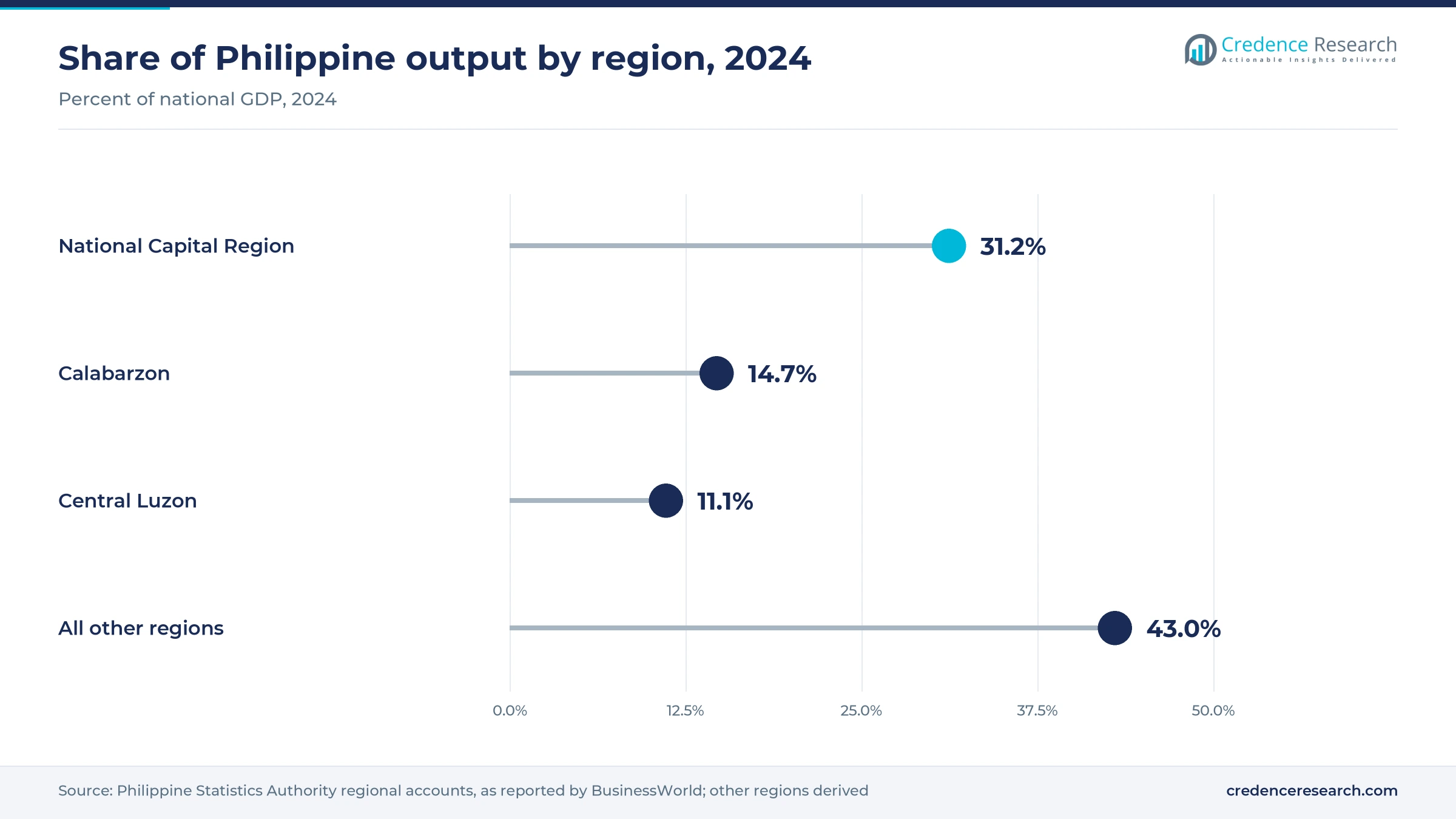
Rest of Luzon held 35.0% of 2025 value and grows at 8.92% a year. Calabarzon has 16.93 million residents and Central Luzon has 12.99 million, according to the 2024 census, and those regions produced 14.7% and 11.1% of national output in 2024, BusinessWorld reported. Toby's Sports has recently opened at SM Tuguegarao and SM San Pedro, and its parent planned two more North Luzon stores for 2026. Household buyers here favor footwear and value equipment sold in provincial malls.
National capital region leads on spending per resident
The National Capital Region held 32.0% of 2025 value and grows at 8.32% a year, slower than the provinces because its store base is already dense. Metro Manila produced 31.2% of national output in 2024, with output per person of P503,483, BusinessWorld reported. Quorum Holdings kept 51 of its 75 stores in the capital in September 2025. Flagship formats also concentrate here, including the JD Sports store at SM Mall of Asia and the largest Garmin store.
Visayas grows fastest as Cebu and Iloilo gain formats
Visayas held 18.0% of 2025 value and grows at 9.32% a year, the fastest rate among the four zones. Central Visayas output grew 7.3% in 2024, BusinessWorld reported, and Cebu received the first Decathlon Town store around January 2026, according to Context.ph. Nike opened a 677-square-meter store at SM City Iloilo on Oct. 18, 2025, its largest in Western Visayas, the Daily Guardian reported. Cebu Marathon also adds visible demand, having fielded 12,275 runners in January 2025.
Mindanao gains from national events and new stores
Mindanao held 15.0% of 2025 value and grows at 9.22% a year from a smaller retail base. National events are bringing attention and spending to the island, since General Santos was the Batang Pinoy host for October 2025 and Agusan del Sur hosted the Palarong Pambansa in May 2026. Caraga output grew 6.9% in 2024, BusinessWorld reported, and Quorum Holdings planned a Mindanao store for 2026. Team sports gear and footwear lead demand, while the store network remains thinner than in Luzon.
Retail openings and sports funding shaped 2025 and 2026
| Development | Status and market relevance |
|---|---|
| In October 2025, Nike opened a 677-square-meter store at SM City Iloilo, its largest in Western Visayas. | Open; extends brand-owned retail into a provincial city |
| In November 2025, Adidas opened a football-only store beside the MOA Sky pitch and released Filipinas kits priced at PHP 3,800. | Open; links team kits with a community venue |
| In February 2026, Decathlon opened its 19th Philippine store at SM Grand Central and restated a 27-store target for the end of 2026. | Rollout continuing; store target runs to 50 by 2030 |
| In April 2026, Huawei launched the WATCH GT Runner 2 in Manila at PHP 19,999 with marketplace vouchers. | On sale; raises the connected running offer online |
| In July 2026, Garmin opened its largest Philippine store at SM Megamall, taking its network to 25 stores. | Open; adds golf and cycling trial areas |
Connected gear moves into mainstream Filipino training
- Conventional equipment remains the base of gym and school purchasing, because barbells, balls and nets need little service support across the country.
- Connected fitness equipment remains a niche in store settings, shown by Garmin Golf Lab simulators that display real-time performance data at SM Megamall.
- Wearable-integrated gear is moving into mainstream retail, shown by the 25-store Garmin network and the PHP 19,999 Huawei running watch launched in April 2026.
- Smart training accessories include fitting tools, such as the ASICS 3D Foot ID Scanner in Glorietta 2, which guides shoe selection for runners and walkers.
Need a Custom Version of This Report?
Tailor the scope, geography, or segments to your exact requirements.
- Custom geography or segment scope
- Direct access to our analyst team
Global brands and local chains compete on mall reach
Competition runs across global brands, multi-brand chains and a growing group of experience stores, and mall access is the main contest. Decathlon uses larger formats averaging about 1,500 square meters in its City stores, which pressures older chains on range and floor space. Toby's Sports, founded 45 years ago, and Chris Sports, which opened its first store in 1985 and reports over 37 stores, compete through broad assortments and team-sport knowledge. Sports Central, an SM Group retail affiliate, runs brand locations inside SM department stores, which gives Nike, Adidas and Under Armour reach without separate leases. PUMA moved to a full subsidiary and opened its largest local store at SM City North EDSA in December 2022. ASICS and Garmin compete on fitting and data services rather than on price alone.
Companies profiled and their roles in this market
| Company | Type | Role in the market |
|---|---|---|
| Decathlon Philippines | Multi-sport retailer | Rollout from 17 stores in 2025 toward 27 by the end of 2026 and 50 by 2030 |
| Toby's Sports | Specialty chain | 63 branches and corporate programs for clients including GCash and PhilamLife, reported in September 2025 |
| Chris Sports | Specialty chain | Equipment-focused retailer reporting over 37 stores, first opened in 1985 at SM City North EDSA |
| Nike Philippines | Global brand | Brand stores including the 677-square-meter SM City Iloilo outlet opened in October 2025 |
| Adidas Philippines | Global brand | Football-only store at MOA Sky with Philippine Football Federation programs, opened November 2025 |
| ASICS Philippines | Global brand | Running focus, with a 460-square-meter Glorietta 2 store and 3D Foot ID Scanner since April 2023 |
| PUMA Philippines | Global brand | Full subsidiary with its largest local store at SM City North EDSA since December 2022 |
| Sports Central | Retail affiliate of the SM Group | Runs Under Armour, Nike and Adidas locations in SM department stores |
| Under Armour Philippines | Global brand | Sold through brand locations in SM department stores operated by Sports Central |
Provincial reach will separate the next market leaders
Credence Research's view is that the next phase of this market will be decided outside Metro Manila. Store counts already show the direction, with Decathlon targeting 50 stores by 2030 and Quorum Holdings steering new openings toward provinces. The risk is the currency, because a peso near P63.6 to the dollar pushes imported prices up just as first-time buyers enter the market. Retailers that combine local sourcing, marketplace reach and club partnerships should hold margins better than those relying on flagship traffic. The growth rate of 8.85% assumes that store rollouts continue at their announced pace.
How the Philippine market estimate was built
The report uses 2025 as the base year and 2026 to 2035 as the forecast period. Market values come from the Credence Research model and were checked against household consumption data from the World Bank and census population from the Philippine Statistics Authority. Regional, segment and company splits are Credence Research estimates informed by population, regional output and announced store networks. Sources include government statistics, agency announcements, company press releases and named Philippine news reports. No interviews or surveys were conducted for this report, so sub-segment shares carry more uncertainty than the total value.
Spending more than doubles as access widens to 2035
Spending on sports equipment and fitness in the Philippines is expected to climb from USD 1.41 billion in 2026 to USD 3.02 billion by 2035. Growth should come from provincial stores, online buying and rising participation in running, racket sports and football rather than from higher prices alone. The 2029 women's volleyball world championship and school sports reforms provide visible demand markers along the way. Currency weakness and limited public courts remain the main downside factors, so suppliers with local sourcing and venue partnerships should be better placed to convert interest into repeat purchases through the forecast period.
Frequently Asked Questions
How big is the Philippines sports equipment and fitness market?
Which region leads the market?
Which product type is the largest?
Which channel grows the fastest?
Who are the main companies in this market?
How is public funding affecting the market?
What are the main challenges for sellers?
Which region grows the fastest?
Table of Content
Chapter 1 Market Segmentation
- 1.1 Segmentation Framework
- 1.1.1 Product and Service Classification
- 1.1.2 Application and End-Use Classification
- 1.1.3 Technology and Solution Classification
- 1.1.4 Customer and Distribution Channel Classification
- 1.1.5 Geographic Segmentation
- 1.1.6 Market Segment Definitions and Boundaries
- 1.2 By Product Type
- 1.2.1 Sports Footwear
- 1.2.2 Sports Apparel
- 1.2.3 Fitness Equipment
- 1.2.4 Team and Individual Sports Equipment
- 1.3 By Application
- 1.3.1 Outdoor and Recreation
- 1.3.2 Organized Sports
- 1.3.3 Commercial Fitness
- 1.3.4 Home Fitness
- 1.4 By End User
- 1.4.1 Individual Consumers
- 1.4.2 Gyms and Fitness Centers
- 1.4.3 Schools and Universities
- 1.4.4 Sports Clubs and Corporate Buyers
Chapter 2 Introduction
- 2.1 Report Objectives and Scope
- 2.2 Product Definition and Industry Terminology
- 2.3 Market Inclusions and Exclusions
- 2.4 Research Process
- 2.4.1 Primary Research and Expert Interviews
- 2.4.2 Secondary Research and Source Review
- 2.4.3 Top-Down and Bottom-Up Estimation
- 2.4.4 Data Triangulation and Verification
- 2.5 Market Size Measurement Basis
- 2.5.1 2025: USD 1.28 billion → 2035: USD 3.02 billion
- 2.6 Historical and Forecast Reference Periods
- 2.6.1 Historical Period: 2018-2025
- 2.6.2 Base Year: 2025
- 2.6.3 Forecast Period: 2025-2035
- 2.7 Research Assumptions and Limitations
Chapter 3 Executive Summary
- 3.1 Market Snapshot and Key Findings
- 3.2 Base-Year Market Size, 2025
- 3.3 Forecast Market Size, 2035
- 3.4 Revenue and Volume Growth Outlook
- 3.5 Key Demand and Supply Indicators
- 3.6 Leading Market Segments
- 3.7 Fastest-Growing Market Opportunities
- 3.8 Regional Performance Highlights
- 3.9 Technology and Industry Transformation
- 3.10 Competitive Landscape Summary
- 3.11 Analyst View and Strategic Implications
Chapter 4 Philippines Sports Equipment and Fitness Market Trends and Developments
- 4.1 Historical Industry Development, 2018-2025
- 4.2 Recent Market Trends and Developments
- 4.3 Demand and Customer Behavior Trends
- 4.4 Technology and Product Innovation
- 4.5 Artificial Intelligence, Automation and Digitalization
- 4.6 Local Manufacturing and Supply Chain Realignment
- 4.7 Industry Partnerships, Mergers and Acquisitions
- 4.8 Sustainability and Circular Economy Developments
- 4.9 Government and Private Sector Investment Trends
- 4.10 Emerging Business Models and Commercialization
- 4.11 Industry Developments and Announcements
Chapter 5 Philippines Sports Equipment and Fitness Market Production, Supply and Demand Analysis
- 5.1 Demand Trend and Consumption Analysis, 2018-2025
- 5.2 Demand Forecast, 2025-2035
- 5.3 Production and Output Trend, 2018-2025
- 5.4 Production and Output Forecast, 2025-2035
- 5.5 Installed Capacity and Capacity Utilization
- 5.6 Company-Wise Production Plants and Statistics
- 5.6.1 Installed Production Capacity
- 5.6.2 Actual Production
- 5.6.3 Planned Capacity and Expansion Targets
- 5.7 Supply Chain Structure and Procurement Trends
- 5.8 Supply-Demand Gap and Bottlenecks
- 5.9 Import Dependence and Sourcing Structure
- 5.10 Contract Manufacturing and Outsourcing
- 5.11 Regional Supply and Demand Concentration
Chapter 6 Philippines Sports Equipment and Fitness Market Pricing Analysis
- 6.1 Pricing Structure and Measurement
- 6.2 Historical Pricing Trends, 2018-2025
- 6.3 Pricing Outlook, 2025-2035
- 6.4 Average Selling Price and Unit Economics
- 6.5 Pricing by Product and Market Segment
- 6.6 Geographic Pricing Differences
- 6.7 Key Input, Energy, Labor and Logistics Costs
- 6.8 Contract Pricing and Purchasing Models
- 6.9 Pricing Sensitivity and Competitive Positioning
- 6.10 Price, Margin and Profitability Implications
Chapter 7 Philippines Sports Equipment and Fitness Market Dynamics
- 7.1 Market Growth Drivers
- 7.1.1 Demand-Side Drivers
- 7.1.2 Technology and Innovation Drivers
- 7.1.3 Infrastructure and Investment Drivers
- 7.1.4 Regulatory and Policy Drivers
- 7.2 Market Restraints
- 7.2.1 Cost and Affordability Constraints
- 7.2.2 Technology and Adoption Barriers
- 7.2.3 Supply Chain and Operational Constraints
- 7.3 Market Challenges
- 7.3.1 Competitive Pressure and Margin Erosion
- 7.3.2 Skills, Infrastructure and Implementation Gaps
- 7.4 Emerging Market Opportunities
- 7.5 Market Dynamics Impact and Time-Horizon Assessment
Chapter 8 Philippines Sports Equipment and Fitness Value Chain Analysis
- 8.1 Industry Value Chain Overview
- 8.2 Upstream Suppliers and Critical Inputs
- 8.3 Technology and Component Providers
- 8.4 Manufacturing or Service Delivery
- 8.5 Distribution, Channel Partners and Integrators
- 8.6 Downstream Applications and End Users
- 8.7 Value Addition and Profit Pools
- 8.8 Vertical Integration and Outsourcing
- 8.9 Supplier Concentration and Risk
- 8.10 Supply Chain Localization and Resilience
Chapter 9 Philippines Sports Equipment and Fitness Market Regulations and Policies
- 9.1 Relevant Laws, Standards and Compliance Frameworks
- 9.2 Product, Service, Safety and Quality Requirements
- 9.3 Government Policies, Incentives and Subsidies
- 9.4 Imports, Exports and Trade Barriers
- 9.5 Public Procurement and Local Content Requirements
- 9.6 Environmental and Sustainability Compliance
- 9.7 Upcoming Policy Changes and Market Implications
Chapter 10 Philippines Sports Equipment and Fitness Market Hotspots and Opportunities
- 10.1 Market Opportunity Mapping and Growth Hotspots
- 10.2 High-Growth Applications and Customer Groups
- 10.3 Underserved Markets and White-Space Opportunities
- 10.4 Emerging Technology and Product Opportunities
- 10.5 New Capacity and Investment Hotspots
- 10.6 Market Entry and Expansion Opportunities
- 10.7 Distribution and Partnership Opportunities
- 10.8 Near-Term and Long-Term Commercial Potential
- 10.9 Opportunity Attractiveness and Execution Risks
Chapter 11 Philippines Sports Equipment and Fitness Market Outlook, 2025-2035
- 11.1 Market Size and Analysis
- 11.1.1 Revenue (Market Measurement: 2025: USD 1.28 billion → 2035: USD 3.02 billion)
- 11.1.2 Market Volume and Quantity Sold
- 11.1.3 Historical Market Size, 2018-2025
- 11.1.4 Base-Year Market Size, 2025
- 11.2 Market Forecast, 2025-2035
- 11.2.1 Revenue Forecast to 2035
- 11.2.2 Volume Forecast to 2035
- 11.2.3 CAGR and Year-on-Year Growth
- 11.2.4 Incremental Revenue Opportunity
- 11.3 Forecast Assumptions and Scenario Analysis
- 11.3.1 Base-Case Forecast
- 11.3.2 Optimistic and Conservative Scenarios
- 11.3.3 Technology, Pricing and Policy Sensitivities
- 11.4 Market Attractiveness and Growth Outlook
Chapter 12 Philippines Sports Equipment and Fitness Market Segmentation and Outlook
- 12.1 Segmentation Summary and Market Shares, 2025
- 12.2 Largest and Fastest-Growing Segments
- 12.3 By Product Type - Market Size and Forecast, 2025-2035
- 12.3.1 Segment Definition and Scope
- 12.3.2 Historical Market Size, 2018-2025
- 12.3.3 Revenue Forecast, 2025-2035
- 12.3.4 Volume Forecast, 2025-2035
- 12.3.5 Base-Year Market Share, 2025
- 12.3.6 Segment CAGR and Growth Drivers
- 12.3.7 Subsegment Market Size and Forecast
- 12.3.7.1 Sports Footwear
- 12.3.7.2 Sports Apparel
- 12.3.7.3 Fitness Equipment
- 12.3.7.4 Team and Individual Sports Equipment
- 12.3.8 Subsegment Pricing and Adoption Trends
- 12.3.9 Leading Suppliers and Competition
- 12.3.10 Regional Demand and Opportunities
- 12.4 By Application - Market Size and Forecast, 2025-2035
- 12.4.1 Segment Definition and Scope
- 12.4.2 Historical Market Size, 2018-2025
- 12.4.3 Revenue Forecast, 2025-2035
- 12.4.4 Volume Forecast, 2025-2035
- 12.4.5 Base-Year Market Share, 2025
- 12.4.6 Segment CAGR and Growth Drivers
- 12.4.7 Subsegment Market Size and Forecast
- 12.4.7.1 Outdoor and Recreation
- 12.4.7.2 Organized Sports
- 12.4.7.3 Commercial Fitness
- 12.4.7.4 Home Fitness
- 12.4.8 Subsegment Pricing and Adoption Trends
- 12.4.9 Leading Suppliers and Competition
- 12.4.10 Regional Demand and Opportunities
- 12.5 By End User - Market Size and Forecast, 2025-2035
- 12.5.1 Segment Definition and Scope
- 12.5.2 Historical Market Size, 2018-2025
- 12.5.3 Revenue Forecast, 2025-2035
- 12.5.4 Volume Forecast, 2025-2035
- 12.5.5 Base-Year Market Share, 2025
- 12.5.6 Segment CAGR and Growth Drivers
- 12.5.7 Subsegment Market Size and Forecast
- 12.5.7.1 Individual Consumers
- 12.5.7.2 Gyms and Fitness Centers
- 12.5.7.3 Schools and Universities
- 12.5.7.4 Sports Clubs and Corporate Buyers
- 12.5.8 Subsegment Pricing and Adoption Trends
- 12.5.9 Leading Suppliers and Competition
- 12.5.10 Regional Demand and Opportunities
- 12.6 Segment Growth Comparison
- 12.7 Segment Attractiveness and Priority Matrix
Chapter 13 Philippines Sports Equipment and Fitness End-Use and Application Market Outlook
- 13.1 End-Use Industry and Customer Demand Structure
- 13.2 Leading Applications and Customer Groups
- 13.3 End-Use Market Size, Share and Forecast
- 13.4 Major End-Use Industry Deep Dives
- 13.4.1 Customer Requirements and Use Cases
- 13.4.2 Demand and Replacement Cycles
- 13.4.3 Technical and Regulatory Considerations
- 13.4.4 Purchasing and Procurement Models
- 13.4.5 Leading Vendors and Distribution Channels
- 13.4.6 Forecast and Commercial Opportunities
- 13.5 Emerging Applications and Cross-Segment Demand
- 13.6 End-Use Industry Investment Priorities
Chapter 14 Philippines Sports Equipment and Fitness Geographic Market Outlook, 2025-2035
- 14.1 Domestic Market Distribution and Demand Clusters
- 14.2 State- or Province-Wise Market Size and Forecast, 2025-2035
- 14.3 City and Metropolitan Market Outlook
- 14.4 Industrial, Manufacturing and Commercial Clusters
- 14.5 Geographic Concentration of Key End Users
- 14.6 Local Pricing and Purchasing Differences
- 14.7 Domestic Production Facilities and Capacity Map
- 14.8 Local Infrastructure and Project Pipeline
- 14.9 State-Level Policy and Incentive Differences
- 14.10 Subnational Investment Hotspots and Opportunities
- 14.11 Distribution and Logistics Networks
- 14.12 Domestic Competitive Footprint
Chapter 15 Philippines Sports Equipment and Fitness Technology, Innovation and Sustainability Outlook
- 15.1 Technology Landscape and Maturity
- 15.2 Product, Process and Service Innovation
- 15.3 AI, Automation and Digital Tools in the Industry
- 15.4 Technology Adoption and Performance Benchmarking
- 15.5 Innovation Pipeline and R&D Investment
- 15.6 Patent and Intellectual Property Trends
- 15.7 Energy Efficiency and Resource Management
- 15.8 Sustainability, Recycling and Circularity
- 15.9 Technology Roadmap, 2025-2035
- 15.10 Risks of Obsolescence and Technology Substitution
Chapter 16 Philippines Sports Equipment and Fitness Market Key Strategic Imperatives
- 16.1 Growth and Market Entry Priorities
- 16.2 High-Return Products and Segments
- 16.3 Pricing, Profitability and Cost Optimization
- 16.4 Technology Investment and Product Differentiation
- 16.5 Supply Chain Localization and Resilience
- 16.6 Distribution and Customer Acquisition
- 16.7 Partnership, Acquisition and Capacity Strategy
- 16.8 Regional Expansion Priorities
- 16.9 Short-, Medium- and Long-Term Actions
Chapter 17 Competition Outlook
- 17.1 Industry Competition Characteristics
- 17.2 Market Structure and Concentration
- 17.3 Market Share and Competitive Positioning, 2025
- 17.4 Company-Wise Revenue and Product Benchmarking
- 17.5 Production and Service Capacity Benchmarking
- 17.6 Technology, Pricing and Differentiation
- 17.7 Regional Footprint and Distribution Strength
- 17.8 Mergers, Acquisitions and Strategic Alliances
- 17.9 New Entrants and Competitive Threats
- 17.10 Porter's Five Forces and Industry Attractiveness
- 17.11 Competitive Outlook, 2025-2035
Chapter 18 Company Profiles
- 18.1 Company Coverage and Selection Criteria
- 18.2 Nike Philippines
- 18.2.1 Business Description
- 18.2.2 Company Ownership and Geographic Presence
- 18.2.3 Product and Service Portfolio
- 18.2.4 Manufacturing and Operating Footprint
- 18.2.5 Production Capacity and Expansion Plans
- 18.2.6 Financial Performance and Investment
- 18.2.7 Market Share and Competitive Position
- 18.2.8 Technology and Innovation Capabilities
- 18.2.9 Strategic Alliances or Partnerships
- 18.2.10 Recent Developments
- 18.2.11 Growth Strategy and Outlook
- 18.3 Adidas Philippines
- 18.4 Decathlon Philippines
- 18.5 Toby's Sports
- 18.6 Chris Sports
- 18.7 Under Armour Philippines
- 18.8 PUMA Philippines
- 18.9 ASICS Philippines
- 18.10 Sports Central
- 18.11 Other Relevant Market Participants
Note: Every listed company is profiled on the structure shown under the first company. The company list is preliminary and may change based on research findings, market developments, data availability and client requirements.
Chapter 19 Disclaimer
- 19.1 Research and Forecast Disclaimer
- 19.2 Data Source and Estimation Limitations
Note: The depth of individual sections depends on data availability for this market. Volume, capacity, trade and other unit-based metrics are included where applicable.

