
Market Overview
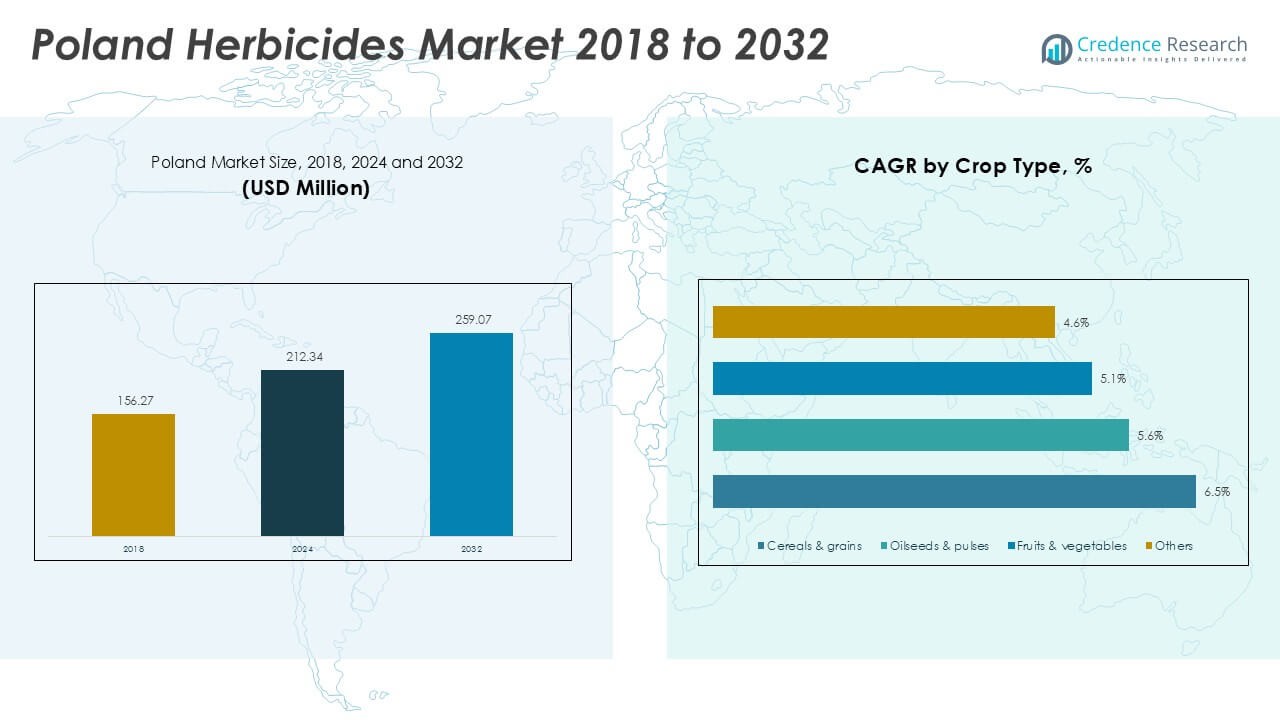
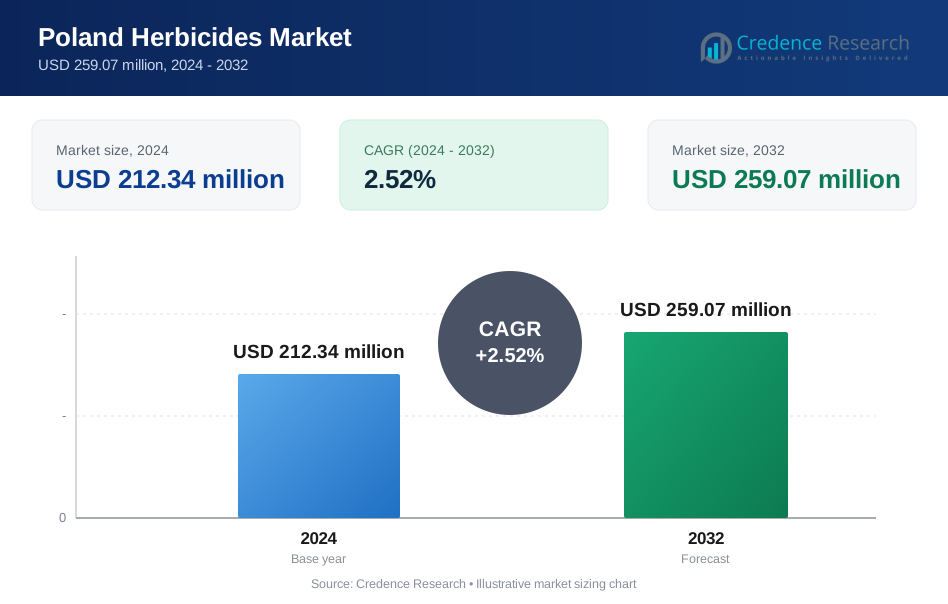
Poland Herbicides market size was valued at USD 156.27 million in 2018, reached USD 212.34 million in 2024, and is anticipated to reach USD 259.07 million by 2032, at a CAGR of 2.52% during the forecast period.
| REPORT ATTRIBUTE | DETAILS |
|---|---|
| Historical Period | 2020-2023 |
| Base Year | 2024 |
| Forecast Period | 2025-2032 |
| Poland Herbicides Market Size 2024 | USD 212.34 Million |
| Poland Herbicides Market, CAGR | 2.52% |
| Poland Herbicides Market Size 2032 | USD 259.07 Million |
The Poland herbicides market is led by major players such as BASF SE, Bayer AG, ADAMA Agricultural Solutions Ltd., FMC Corporation, UPL Limited, Sumitomo Chemical Co. Ltd., Syngenta Group, Corteva Agriscience, and Nufarm Ltd. These companies dominate through strong product portfolios, advanced formulations, and robust distribution networks. Central Poland is the leading region, holding 28% market share in 2024, driven by extensive maize, rapeseed, and sugar beet cultivation. North and South Poland follow with significant shares due to large cereal and horticulture production. Continuous R&D investment, precision farming adoption, and compliance with EU sustainability standards enable key players to strengthen market presence and meet rising demand for efficient, low-residue herbicides.
Market Insights
- The Poland herbicides market was valued at USD 212.34 million in 2024 and is projected to reach USD 259.07 million by 2032, growing at a CAGR of 2.52% during the forecast period.
- Demand is driven by rising cereal and grain production, adoption of modern farming practices, and the need for efficient weed control to improve crop yield and quality.
- Key trends include the shift toward bio-based, low-residue herbicides and the integration of digital agriculture tools such as GPS-guided sprayers and precision spraying systems.
- The market is moderately consolidated with major players including BASF SE, Bayer AG, Syngenta Group, Corteva Agriscience, and FMC Corporation focusing on innovative formulations and regulatory compliance.
- Central Poland leads with 28% share, followed by North Poland at 22% and South Poland at 20%, while cereals and grains dominate crop-type demand with nearly 50% share in 2024.
Market Segmentation Analysis:
By Type
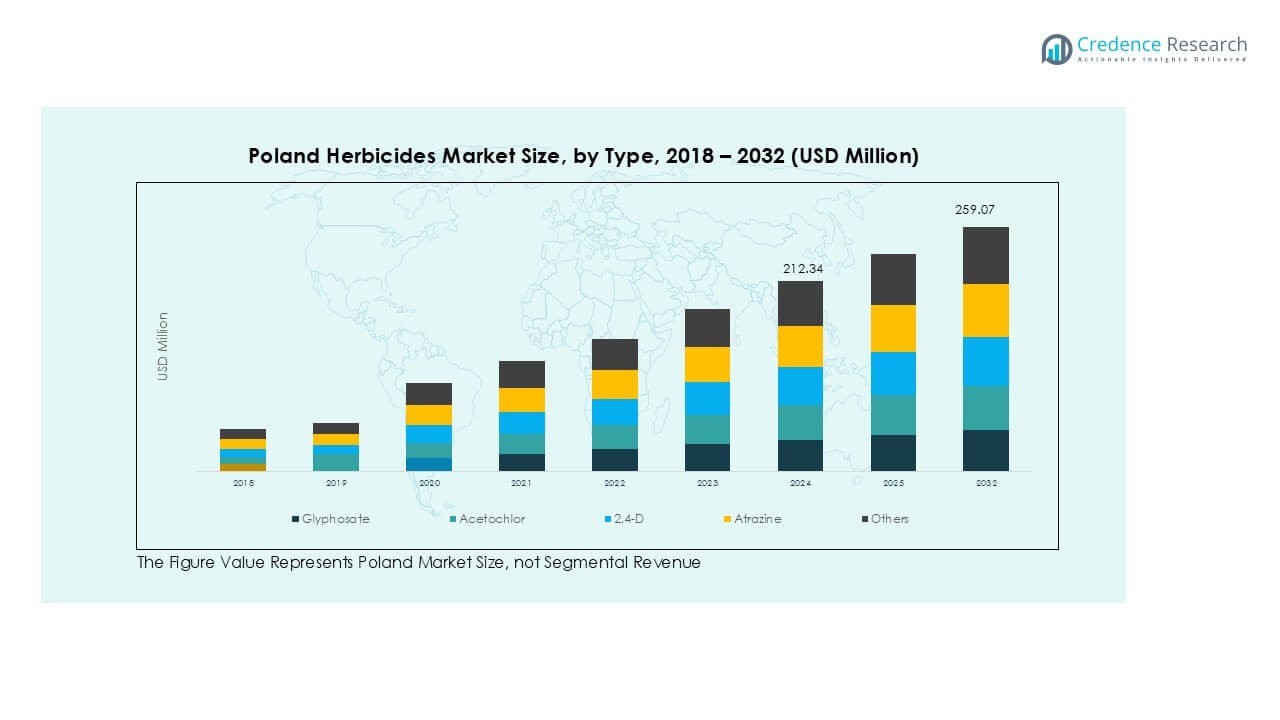
Glyphosate dominated the Poland herbicides market in 2024, capturing over 40% of the market share. Its broad-spectrum weed control, cost-effectiveness, and compatibility with multiple crop types make it the preferred choice among farmers. Rising adoption of conservation tillage and no-till farming practices further strengthens glyphosate demand. Acetochlor and 2,4-D follow as important segments, catering to selective weed control needs in maize and cereal production. Atrazine continues to hold a steady share, particularly in corn fields, supported by its residual weed suppression properties. Growing emphasis on efficient weed management sustains demand across all herbicide types.
- For instance, Bayer reported that glyphosate applications prevented soil disturbance over 20.5 million hectares in the EU, by enabling no-till and reduced tillage practices.
By Application
Foliar application accounted for more than 45% of the market share in 2024, making it the leading application segment. This dominance stems from its ability to deliver quick and uniform weed control, improving crop yields and reducing labor costs. Farmers favor foliar spraying for its ease of use and compatibility with modern spraying equipment. Fertigation-based herbicide use is growing, supported by rising adoption of precision agriculture techniques. Soil applications remain important for pre-emergence weed control, particularly in cereals and grains. Demand for targeted and cost-efficient herbicide application methods continues to expand across the country.
- For instance, the Bosch-BASF Smart Farming “ONE SMART SPRAY” system’s trials in Germany and Hungary showed that its camera-based sprayer could detect weeds in milliseconds and activate individual nozzles, reducing unnecessary spray over non-weed areas during green-on-green application.
By Crop Type
Cereals and grains led the market with nearly 50% share in 2024, supported by Poland’s large-scale wheat, barley, and maize production. The segment benefits from high herbicide demand to control broadleaf and grassy weeds that threaten yield. Oilseeds and pulses form the second-largest category, with rapeseed cultivation driving herbicide usage for pre- and post-emergence weed management. Fruits and vegetables also contribute steadily, supported by rising horticultural activities and demand for high-quality produce. Growing focus on food security and farm productivity ensures consistent herbicide adoption across crop categories, with cereals remaining the key growth driver.
Key Growth Drivers
Expansion of Cereal and Grain Production
Poland’s strong cereal and grain sector drives herbicide demand, accounting for nearly half of total use. Rising wheat, maize, and barley cultivation increases the need for efficient weed management solutions to protect yields. Government support for agricultural productivity and mechanization further boosts herbicide adoption. Farmers are shifting to advanced formulations that offer residual weed control and reduce application frequency. Increasing focus on food security and meeting export demand also contributes to consistent growth in herbicide consumption across major grain-producing regions.
- For instance, Poland harvested about 12.6 million metric tons of wheat in marketing year 2024/25 from 2.5 million hectares.
Adoption of Modern Farming Practices
The adoption of precision farming, conservation tillage, and integrated pest management is accelerating herbicide demand in Poland. Farmers increasingly prefer glyphosate and other broad-spectrum solutions for pre- and post-emergence weed control. Investments in advanced spraying technologies improve coverage efficiency, reducing input costs and boosting yield potential. This transition supports the use of systemic and selective herbicides that offer targeted action. Rising awareness about sustainable farming methods encourages use of regulated herbicide programs, aligning with EU agricultural guidelines and boosting market penetration.
- For example, a recent study on spring barley in Poland reported that under conservation rotation with high weed and pest protection, yields exceeded 7 tonnes per hectare.
Rising Demand for High-Quality Food Output
Growing consumer demand for uniform, high-quality produce is encouraging farmers to invest in effective weed control. Herbicides help minimize crop competition, improving nutrient uptake and boosting yield quality. The trend toward higher-value crops like rapeseed, vegetables, and maize drives demand for both pre- and post-emergence products. Agricultural cooperatives and government programs are promoting improved crop protection measures to enhance farm profitability. This growing emphasis on consistent, high-quality agricultural output strengthens herbicide market growth, particularly in regions focusing on export-oriented farming operations.
Key Trends & Opportunities
Growth of Bio-Based and Low-Residue Herbicides
There is a notable shift toward bio-based and low-residue herbicides in Poland, driven by EU regulatory pressure and consumer preference for safer agrochemicals. Manufacturers are investing in greener formulations that comply with stringent residue limits and reduce environmental impact. This trend creates opportunities for companies developing innovative, eco-friendly products. Demand for organic farming solutions is also rising, encouraging adoption of biological herbicide alternatives. As sustainability becomes a key market differentiator, suppliers offering certified, low-toxicity formulations are positioned to capture significant market share in the coming years.
- For instance, Borregaard’s Exilva, a bio-based adjuvant derived from microfibrillated cellulose, was shown in greenhouse trials to increase uptake of glyphosate and glufosinate in cornfields by measurable amounts, and it improved rainfastness by several hours in field tests.
Integration of Digital Agriculture Solutions
Digital agriculture tools, such as GPS-guided sprayers and AI-driven weed mapping, are gaining traction in Poland. These technologies allow farmers to optimize herbicide application, reduce waste, and improve efficiency. The adoption of variable rate spraying systems lowers overall input costs and supports compliance with environmental regulations. Opportunities exist for herbicide manufacturers to collaborate with agri-tech companies, offering integrated solutions tailored for precision farming. The growing focus on data-driven farming practices will enhance demand for compatible herbicide formulations and smart application systems.
- For instance, a study of precision agriculture in Central Europe found that in Poland, use of GNSS guidance systems and boom section control on sprayers is now established in many service providers, with dozens of spraying units per voivodeship performing auto section shut-off to prevent overlap.
Key Challenges
Stringent EU Regulatory Frameworks
Strict EU regulations governing herbicide use, residue levels, and environmental safety pose challenges for market growth. Several active ingredients, including certain atrazine formulations, face restrictions or bans due to groundwater contamination risks. Compliance with evolving policies increases production and registration costs for manufacturers. Farmers may face reduced access to popular herbicides, pushing them toward alternative weed management practices. These regulatory pressures can slow adoption rates and create uncertainty, particularly for smaller suppliers struggling to meet updated safety and environmental requirements.
Rising Herbicide Resistance in Weeds
Herbicide-resistant weed species are becoming a major concern in Poland’s farmlands, threatening crop productivity. Overreliance on glyphosate and other single-mode-of-action products accelerates resistance development. This challenge forces farmers to adopt more expensive integrated weed management practices, including crop rotation and herbicide mixtures. Rising resistance increases operational complexity and cost for growers, impacting profit margins. Manufacturers must innovate with new active ingredients and formulations to stay ahead of resistance issues, but R&D investment and regulatory approval timelines remain lengthy and costly.
Regional Analysis
North PolandNorth Poland held around 22% market share of the herbicides market in 2024, supported by its large-scale cereal and rapeseed cultivation. The region’s fertile soils and favorable climate conditions make it a key contributor to wheat and maize production, driving high herbicide consumption. Farmers in this region increasingly adopt glyphosate and foliar application methods to achieve effective weed control. Government-backed farm modernization programs encourage the use of advanced spraying equipment, further boosting demand. The presence of agricultural cooperatives also supports collective purchasing and training initiatives, helping growers optimize herbicide usage and improve overall crop productivity in the region.
Central Poland
Central Poland dominated the market with nearly share in 2024, making it the largest regional contributor. The area is known for intensive cultivation of cereals, oilseeds, and vegetables, requiring reliable herbicide programs for yield protection. Modern irrigation systems and mechanized farming practices drive demand for precision herbicide applications. Farmers favor pre- and post-emergence solutions that provide residual control to reduce multiple field visits. The region’s proximity to major agrochemical distributors ensures easy access to advanced formulations. Rising focus on export-quality grain production continues to fuel herbicide adoption, consolidating Central Poland’s position as a key agricultural hub.
South Poland
South Poland accounted for about 20% market share in 2024, supported by its mixed agricultural profile including cereals, potatoes, and vegetables. The hilly terrain and fragmented farm structures create strong demand for selective herbicides suitable for smaller plots. Adoption of integrated weed management practices is increasing, driven by EU-funded rural development programs. Foliar applications are widely used due to their ease and cost-effectiveness. The region also witnesses growing interest in bio-based herbicides as farmers seek to comply with environmental guidelines. Continuous improvement in farm mechanization is expected to enhance herbicide penetration and boost yield performance in the coming years.
East Poland
East Poland captured around 15% of the market share in 2024, characterized by extensive grain and pulse cultivation. The region has traditionally relied on conventional weed control, but adoption of modern herbicide solutions is steadily rising. Fertigation-based applications are gaining popularity as irrigation infrastructure improves. Government support for rural development projects is encouraging farmers to shift to regulated herbicide programs, enhancing efficiency and reducing manual labor. The relatively lower mechanization rate offers significant growth potential for agrochemical suppliers. Increasing awareness of the economic benefits of effective weed control will continue to drive herbicide demand across East Poland’s farmlands.
West Poland
West Poland represented close to 15% market share in 2024, driven by maize, sugar beet, and cereal production. Large-scale farms dominate this region, enabling higher adoption of systemic herbicides and precision spraying technologies. Farmers prioritize pre-emergence herbicides to ensure early-season weed suppression and improved yield outcomes. The region benefits from strong logistics infrastructure and proximity to chemical manufacturing hubs, ensuring timely product availability. Collaborations between input suppliers and farmer associations promote the use of integrated weed management solutions. Continued focus on high-yield, export-oriented crops is likely to keep herbicide demand strong in West Poland over the forecast period.
Market Segmentations:
By Type
- Glyphosate
- Acetochlor
- 2,4-D
- Atrazine
- Others
By Application
- Fertigation
- Foliar
- Soil
- Others
By Crop Type
- Cereals & Grains
- Oilseeds & Pulses
- Fruits & Vegetables
- Others
By Geography
- North Poland
- Central Poland
- South Poland
- East Poland
- West Poland
Competitive Landscape
The Poland herbicides market is moderately consolidated, with key players including BASF SE, Bayer AG, ADAMA Agricultural Solutions Ltd., FMC Corporation, UPL Limited, Sumitomo Chemical Co. Ltd., Syngenta Group, Corteva Agriscience, and Nufarm Ltd. These companies focus on expanding their product portfolios with selective and non-selective herbicides tailored to Poland’s major crops, including cereals, rapeseed, and maize. Strategic partnerships with local distributors and investments in R&D for low-residue and bio-based herbicides are key competitive priorities. Players are also adopting digital farming platforms to offer integrated weed management solutions and precision application support. Mergers and acquisitions strengthen market positions, while new product launches address herbicide resistance challenges and regulatory compliance. Competitive intensity is driven by price competitiveness, after-sales support, and product innovation, with multinational players leveraging strong supply chains and technical expertise to capture larger market shares and meet evolving EU sustainability and residue regulations.
Key Player Analysis
- BASF SE
- Bayer AG
- ADAMA Agricultural Solutions Ltd.
- FMC Corporation
- UPL Limited
- Sumitomo Chemical Co. Ltd
- Syngenta Group
- Corteva Agriscience
-
Nufarm Ltd
Recent Developments
- In December 2023, ADAMA introduced its most advanced cross-spectrum herbicide called Kampai for the grain business. The new product provides the broadest application window for broadleaf and narrow-leaf weed control for cereal crops.
- In September 2023, American Water Chemicals (AWC) announced the launch of its European division, named Amaya Solutions Europe, SL. This strategic move marks a significant milestone in AWC's global expansion efforts, aimed at enhancing its presence in the European market.
- In July 2023, ADAMA introduced new products, Davai A Plus and Clearfield Broad-Spectrum Herbicide Solutions, for imidazolinone-tolerant legumes like lentils, peas, and soybeans.
- In March 2023, BASF announced the launch of a novel corn herbicide named Surtain, which is set to be available for use in the United States in 2024. This innovative herbicide features solid encapsulation technology, marking it as the first of its kind in the industry.
- In January 2023, Bayer formed a new partnership with Oerth Bio to enhance crop protection technology and create more eco-friendly crop protection solutions.
Report Coverage
The research report offers an in-depth analysis based on Type, Application, Crop Type and Geography. It details leading market players, providing an overview of their business, product offerings, investments, revenue streams, and key applications. Additionally, the report includes insights into the competitive environment, SWOT analysis, current market trends, as well as the primary drivers and constraints. Furthermore, it discusses various factors that have driven market expansion in recent years. The report also explores market dynamics, regulatory scenarios, and technological advancements that are shaping the industry. It assesses the impact of external factors and global economic changes on market growth. Lastly, it provides strategic recommendations for new entrants and established companies to navigate the complexities of the market.
Future Outlook
- The Poland herbicides market will see steady growth driven by expanding cereal and maize cultivation.
- Adoption of precision farming will boost demand for selective and systemic herbicide solutions.
- Bio-based and low-residue herbicides will gain traction due to stricter EU regulations.
- Digital tools like GPS-guided spraying will improve application efficiency and reduce wastage.
- Rising herbicide resistance will drive innovation in new active ingredients and combinations.
- Demand for foliar applications will remain strong for quick and effective weed control.
- Integrated weed management practices will grow as farmers aim to reduce chemical reliance.
- Consolidation among major players will strengthen distribution and expand product portfolios.
- Government support for mechanization will encourage higher adoption of modern herbicides.
- Regional growth will be led by Central Poland, with rising opportunities in East and West Poland.
Request a Free Sample
Fill in your details and we'll send you a free sample report.
- Sample data tables & charts
- Research methodology
Need a Custom Version of This Report?
Tailor the scope, geography, or segments to your exact requirements.
- Custom geography or segment scope
- Direct access to our analyst team
Frequently Asked Questions
What is the current market size for Poland Herbicides market, and what is its projected size in 2032?
At what Compound Annual Growth Rate is the Poland Herbicides market projected to grow between 2025 and 2032?
Which Poland Herbicides market segment held the largest share in 2024?
What are the primary factors fueling the growth of the Poland Herbicides market?
Who are the leading companies in the Poland Herbicides market?
Which region commanded the largest share of the Poland Herbicides market in 2024?
Table of Content
Chapter 1. Report Introduction
- 1.1 Report Description & Purpose
- 1.1.1 Report Title & Market Definition
- 1.1.2 Unique Selling Propositions (USP) & Key Differentiators
- 1.1.3 Value Proposition for Stakeholders
- 1.2 Research Objectives
- 1.2.1 Market Sizing Objectives (Volume & Revenue)
- 1.2.2 Segmentation Objectives
- 1.2.3 Competitive Intelligence Objectives
- 1.2.4 Forecast & Scenario Objectives
- 1.3 Report Scope
- 1.3.1 Poland Herbicides Scope – Types & Subtypes Covered
- 1.3.2 Geographic Scope – Regions & Countries Covered
- 1.3.3 Historical Period, Base Year & Forecast Period (2024; forecast to 2032)
- 1.3.4 Inclusions & Exclusions
- 1.4 HS Code & Classification Framework
- 1.5 Currency, Units & Pricing Basis
- 1.6 Target Stakeholders
- 1.7 Limitations & Assumptions
Chapter 2. Executive Summary
- 2.1 Global Poland Herbicides Market Snapshot
- 2.1.1 Market Size – Historical (2024) & Forecast (2024-2032) (2024: USD 212.34 million → 2032: USD 259.07 million)
- 2.1.2 Volume & Revenue – Global Totals
- 2.1.3 Key Market Highlights – Top Five Facts
- 2.2 Poland Herbicides Market Segmentation Snapshot
- 2.2.1 Market Split by Region – 2024 vs. 2032
- 2.3 Competitive Snapshot
- 2.3.1 Top 10 Players by Revenue Share – 2024
- 2.3.2 Top 10 Players by Volume Share – 2024
- 2.3.3 Recent Strategic Developments (18-Month Summary)
- 2.4 Key Investment Highlights & Strategic Conclusions
Chapter 3. Poland Herbicides Market Dynamics & Industry Analysis
- 3.1 Market Overview & Context
- 3.1.1 Poland Herbicides Market Position in the Broader Automotive Value Chain
- 3.1.2 OEM vs. Replacement Market Dynamics
- 3.1.3 Market Maturity & Development Stage by Region
- 3.2 Poland Herbicides Market Drivers
- 3.3 Poland Herbicides Market Restraints & Challenges
- 3.4 Poland Herbicides Market Opportunities
- 3.5 Porter's Five Forces Analysis
- 3.5.1 Threat of New Entrants
- 3.5.2 Bargaining Power of Suppliers
- 3.5.3 Bargaining Power of Buyers
- 3.5.4 Threat of Substitutes
- 3.5.5 Competitive Rivalry – Intensity Assessment
- 3.6 Poland Herbicides Value Chain Analysis
- 3.6.1 Upstream – Raw Material/Input Suppliers
- 3.6.1.1 Raw Material/Input 1
- 3.6.1.2 Raw Material/Input 2
- 3.6.1.3 Raw Material/Input 3
- 3.6.2 Midstream – Production/Manufacturing/Service Delivery
- 3.6.2.1 Production/Process Overview
- 3.6.2.2 Key Facility Locations & Capacity by Manufacturer
- 3.6.3 Downstream – Distribution & End Consumer
- 3.6.3.1 Primary Channel – B2B/OEM
- 3.6.3.2 Secondary Channels – Dealer, Retail, Online, Direct
- 3.6.4 Value Chain Profitability Analysis
- 3.6.1 Upstream – Raw Material/Input Suppliers
- 3.7 PESTEL Analysis
- 3.7.1 Political Factors
- 3.7.2 Economic Factors
- 3.7.3 Social Factors
- 3.7.4 Technological Factors
- 3.7.5 Environmental Factors
- 3.7.6 Legal Factors
- 3.8 Poland Herbicides Supply Chain Analysis
- 3.8.1 Raw Material/Input Supply Risk Assessment
- 3.8.2 Manufacturing Concentration Risk (Geographic Exposure)
- 3.8.3 Trade Disruption Impact Analysis
- 3.9 Regulatory & Policy Landscape
Note: The regulatory and policy landscape section covers regulations based on their applicability to the market, Poland Herbicides category, geography, and scope of the study. Only regulatory frameworks with a material impact on operations, compliance, trade, sustainability, or market access are analyzed in detail.
Chapter 4. Key Investment Pockets & Opportunity Analysis
- 4.1 Poland Herbicides Market Attractiveness Analysis
- 4.1.1 By Region – Investment Attractiveness Matrix (Volume × CAGR)
- 4.2 Absolute Revenue Growth Opportunity
- 4.2.1 By Region – Absolute USD Growth Through 2032
- 4.3 Incremental Volume Opportunity
- 4.3.1 By Region – Incremental Volume Through 2032
- 4.3.2 Segment – Incremental Volume
- 4.4 Emerging Submarket Opportunity Deep Dive (Subject to Applicability)
- 4.5 Emerging Market Opportunity Scorecards
- 4.5.1 United States
- 4.5.2 Europe
- 4.5.3 Asia
- 4.5.4 Middle East & Africa
Note: Emerging Market Opportunity Scorecards will be included based on relevance and strategic importance. Regions listed are indicative and may vary depending on data availability and market dynamics.
Chapter 5. Poland Herbicides Import-Export Analysis & Trade Flows
- 5.1 Global Trade Overview
- 5.1.1 Global Export Value by Country (2024)
- 5.1.2 Global Export Volume by Country (2024)
- 5.1.3 Global Import Value by Country (2024)
- 5.1.4 Global Import Volume by Country (2024)
- 5.1.5 Net Trade Balance by Country (2024)
- 5.2 Export Analysis – Segment
- 5.2.1 Type 1 (HS Code)
- 5.2.2 Type 2 (HS Code)
- 5.2.3 Type 3 (HS Code)
- 5.2.4 Type 4 (HS Code)
- 5.2.5 Type 5 (HS Code)
- 5.3 Import Analysis – Segment
- 5.3.1 Type 1 (HS Code)
- 5.3.2 Type 2 (HS Code)
- 5.3.3 Type 3 (HS Code)
- 5.3.4 Type 4 (HS Code)
- 5.3.5 Type 5 (HS Code)
- 5.4 Average Unit Trade Prices
- 5.4.1 Average Export Price – Segment & Country
- 5.4.2 Average Import Price – Segment & Source Country
- 5.4.3 Price Trends (2024)
- 5.5 Key Trade Route Analysis
- 5.5.1 Trade Route 1
- 5.5.2 Trade Route 2
- 5.5.3 Trade Route 3
- 5.5.4 Trade Route 4
- 5.5.5 Trade Route 5
- 5.6 Trade Policy Impact Assessment
- 5.6.1 US Anti-Dumping & Section 301 Tariffs
- 5.6.2 EU Customs Union Impact
- 5.6.3 Major Free Trade Agreements
- 5.6.4 USMCA Rules of Origin
Note: Trade policy analysis will be included only where relevant to the Poland Herbicides market.
Chapter 6. Competitive Landscape & Company Benchmarking
- 6.1 Poland Herbicides Market Concentration & Structure
- 6.1.1 Herfindahl-Hirschman Index (HHI) – vs. 2024
- 6.1.2 Tier 1, Tier 2 & Tier 3 Market Structure
- 6.1.3 Global, Regional & Local Player Dynamics
- 6.2 Poland Herbicides Market Share Analysis – 2024
- 6.2.1 Global Revenue Share by Company
- 6.2.2 Global Volume Share by Company
- 6.2.3 Regional Revenue Share
- 6.2.4 Market Share Evolution ( vs. 2024)
- 6.2.5 OEM Segment Share by Company
- 6.2.6 Replacement Segment Share by Company
- 6.3 Production/Delivery Capacity & Facility Analysis
- 6.3.1 Global Installed Capacity
- 6.3.2 Capacity Utilization Rates
- 6.3.3 Production/Output Volume
- 6.3.4 Facility Locations & Capacity Map
- 6.3.5 Planned Capacity Additions
- 6.4 Poland Herbicides Competitive Benchmarking Matrix
- 6.4.1 Revenue, Volume, CAGR & Profitability Comparison
- 6.4.2 Channel Revenue Mix
- 6.4.3 Geographic Revenue Exposure
- 6.4.4 R&D Intensity
- 6.4.5 Sustainability Maturity
- 6.5 Strategic Developments in Poland Herbicides (Last 24 Months)
- 6.5.1 Mergers, Acquisitions & Divestments
- 6.5.2 New Poland Herbicides Launches
- 6.5.3 Facility Expansions
- 6.5.4 Strategic Alliances, Joint Ventures & Partnerships
- 6.5.5 Distribution Expansion & Market Entry
- 6.5.6 Sustainability & ESG Initiatives
- 6.6 Competitive Strategy Mapping
- 6.6.1 Leader, Challenger, Follower & Niche Classification
- 6.6.2 Pricing Strategy Comparison
- 6.6.3 Channel Strategy Matrix
Note: Strategic developments are included based on their materiality and the availability of reliable information.
Chapter 7. Global Poland Herbicides Market – By Distribution Channel
- 7.1 Segment Overview
- 7.1.1 Volume & Revenue Split by Channel (2024 & 2032)
- 7.1.2 Channel Mix Evolution (2024-2032)
Chapter 8. Regional Market Analysis – Global Overview
- 8.1 Global Regional Overview
- 8.1.1 Regional Volume Share
- 8.1.2 Regional Revenue Share
- 8.1.3 Regional Volume by Region
- 8.1.4 Regional Revenue by Region
- 8.1.5 Regional Forecast Through 2032
- 8.2 Cross-Regional Segment Analysis
- 8.2.1 By Distribution Channel
- 8.2.2 By Brand/Price Tier
Chapter 9. North America Poland Herbicides Market
- 9.1 United States
- 9.2 Canada
- 9.3 Mexico
Chapter 10. Europe Poland Herbicides Market
- 10.1 Germany
- 10.2 France
- 10.3 Italy
- 10.4 United Kingdom
- 10.5 Spain
- 10.6 Poland
- 10.7 Russia
- 10.8 Netherlands
- 10.9 Belgium
- 10.10 Sweden
- 10.11 Denmark
- 10.12 Norway
- 10.13 Rest of Europe
Chapter 11. Asia Pacific Poland Herbicides Market
- 11.1 China
- 11.2 India
- 11.3 Japan
- 11.4 South Korea
- 11.5 Thailand
- 11.6 Indonesia
- 11.7 Vietnam
- 11.8 Malaysia
- 11.9 Australia
- 11.10 Rest of Asia Pacific
Chapter 12. Latin America Poland Herbicides Market
- 12.1 Brazil
- 12.2 Argentina
- 12.3 Colombia
- 12.4 Chile
- 12.5 Rest of Latin America
Chapter 13. Middle East Poland Herbicides Market
- 13.1 Saudi Arabia
- 13.2 United Arab Emirates
- 13.3 Turkey
- 13.4 Israel
- 13.5 Iran
- 13.6 Rest of the Middle East
Chapter 14. Africa Poland Herbicides Market
- 14.1 South Africa
- 14.2 Egypt
- 14.3 Nigeria
- 14.4 Morocco
- 14.5 Rest of Africa
Chapter 15. Poland Herbicides Company Profiles
- 15.1 [Company 01]
- 15.1.1 Company Overview
- 15.1.2 Key Management Personnel
- 15.1.3 Products & Services Portfolio
- 15.1.4 Financial Performance
- 15.1.5 Key Market Focus & Geographic Presence
- 15.1.6 Recent Developments & Strategic Initiatives
Note: The company profile list is preliminary and may change based on research findings, market developments, data availability, and client requirements.
Chapter 16. Appendices
- Appendix A – List of Abbreviations & Acronyms
- Appendix B – Industry Classification Code Reference – Full Series
- Appendix C – Production & Capacity Data Tables
- Appendix D – End-Use & Demand Base Tables
- Appendix E – Consumption & Replacement Rate Assumptions
- Appendix F – ASP Reference Tables
- Appendix G – Manufacturing & Facility Database
- Appendix H – Import-Export Data Tables
- Appendix I – Regulatory Summary Tables
- Appendix J – Primary Research Participant List (Anonymized)
- Appendix K – Primary Research Questionnaire Framework
- Appendix L – Data Sources & Bibliography
- Appendix M – Market Size Divergence & Source Comparison
Chapter 17. Research Methodology
- 17.1 Research Framework & Philosophy
- 17.2 Secondary Research – Sources, Hierarchy & Data Extraction
- 17.3 Data Modeling – Bottom-Up & Top-Down Market Sizing
- 17.4 Primary Research – Stakeholder Framework, LOI & Sample Sizes
- 17.5 Forecast Methodology – Regression, Scenario & Sensitivity Analysis
- 17.6 Quality Control – Four-Layer Validation Framework
- 17.7 Limitations & Standard Assumptions
- 17.8 Disclaimer
