
Market overview
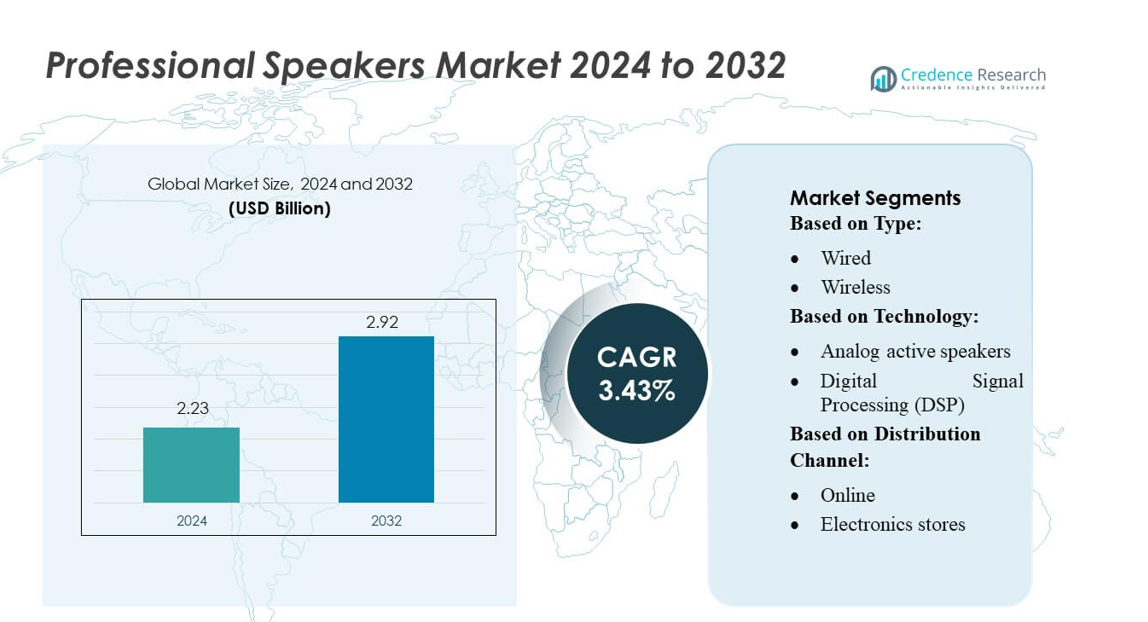
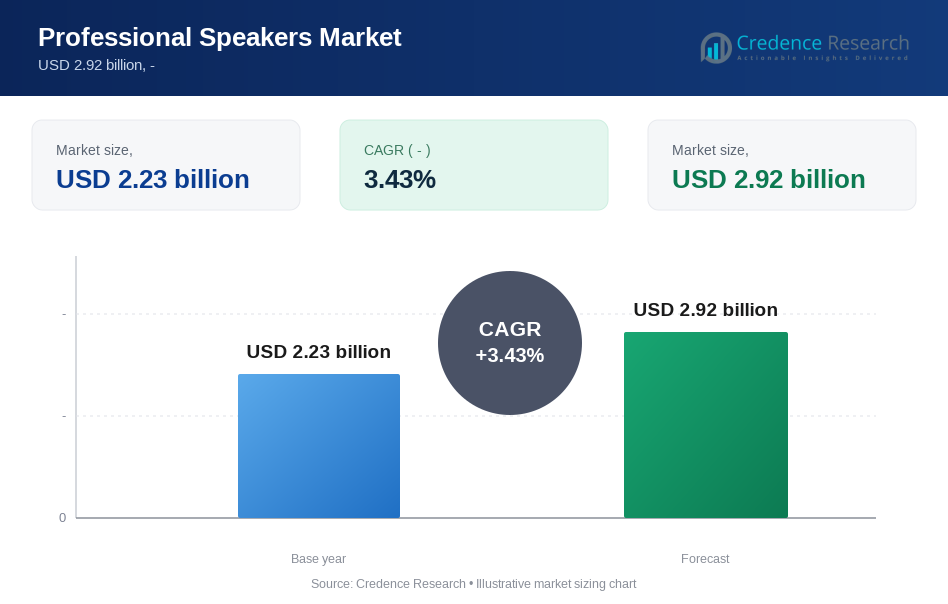
Professional Speakers Market size was valued USD 2.23 billion in 2024 and is anticipated to reach USD 2.92 billion by 2032, at a CAGR of 3.43% during the forecast period.
| REPORT ATTRIBUTE | DETAILS |
|---|---|
| Historical Period | 2020-2023 |
| Base Year | 2024 |
| Forecast Period | 2025-2032 |
| Professional Speakers Market Size 2024 | USD 2.23 billion |
| Professional Speakers Market, CAGR | 3.43% |
| Professional Speakers Market Size 2032 | USD 2.92 billion |
The Professional Speakers Market is shaped by a diverse group of global audio manufacturers that compete through advanced acoustic engineering, DSP-enabled systems, and expanding wireless ecosystems tailored for live events, corporate installations, and commercial venues. Companies strengthen their portfolios with high-efficiency amplifiers, lightweight enclosures, AI-based tuning features, and IP-compatible platforms that support multi-zone audio distribution. Product differentiation centers on sound precision, durability, and seamless integration with professional AV networks. North America leads the global market with approximately 34% share, driven by strong adoption across entertainment venues, enterprise environments, and large-scale event production.
Market Insights
- The Professional Speakers Market was valued at USD 2.23 billion in 2024 and is expected to reach USD 2.92 billion by 2032, registering a CAGR of 3.43% over the forecast period.
- Growth is driven by rising demand for high-output speakers in live events, corporate AV systems, and commercial installations, supported by expanding adoption of DSP-enabled and wireless audio technologies.
- Market trends highlight increasing use of AI-based tuning, lightweight composite enclosures, and IP-compatible multi-zone audio systems, enhancing performance and ease of integration.
- Competitive activity intensifies as manufacturers focus on acoustic precision, durability, and advanced amplification, while restraints include high installation costs and technical complexity for networked audio setups.
- Regionally, North America leads with 34% share, followed by Europe and Asia-Pacific, while wireless speakers dominate the type segment with over 60% share, reflecting strong demand for flexible, scalable audio solutions.
Market Segmentation Analysis:
By Type
Wireless speakers dominate the Professional Speakers Market with an estimated 62% share, driven by strong adoption across live events, corporate installations, and portable sound applications. Their appeal stems from flexible placement, reduced cabling requirements, and improved transmission stability enabled by Bluetooth 5.x and advanced RF protocols. Manufacturers increasingly integrate long-range wireless modules, multi-speaker synchronization, and adaptive frequency hopping to enhance reliability in crowded venues. Demand accelerates further as event organizers prioritize faster setup times and scalable audio systems suitable for touring events, conferences, and hybrid digital-physical environments.
- For instance, Klipsch offers powerful powered speakers, such as The Nines powered monitors, which deliver significant power (100 W RMS per woofer) to achieve high output and robust sound.
By Technology
Digital Signal Processing (DSP) leads the technology segment with nearly 68% market share, supported by rising demand for precision-controlled audio output across professional entertainment, broadcast, and auditorium applications. DSP-enabled speakers benefit from built-in equalization, dynamic range optimization, FIR filtering, and real-time room correction that elevate sound clarity and system tuning efficiency. Growing deployment of networked audio infrastructures encourages integration of DSP-based loudspeakers with Dante, AVB, and AES67 platforms. The ability to remotely manage presets and automate performance adjustments drives widespread adoption, particularly in large venues requiring consistent, distortion-free audio.
- For instance, Sony Corporation’s SLS-1A spatial sound speaker module incorporates eight individually amplified drivers per unit (each with its own 10 W amplifier) and operates with a DSP engine capable of up to 96 kHz / 24-bit processing, enabling features like beam steering to control the direction of the sound with precision.
By Distribution Channel
Online channels hold the dominant position with approximately 45% share, fueled by rapid expansion of e-commerce platforms, brand-owned digital stores, and B2B procurement portals. Professional buyers increasingly prefer online purchasing due to transparent pricing, product comparison tools, and access to wider inventories, including high-power column arrays, line-array systems, and portable PA speakers. Enhanced virtual demos, customer reviews, and detailed technical documentation further support purchasing decisions. Growth continues as manufacturers strengthen direct-to-customer strategies and offer exclusive online bundles, faster delivery options, and remote configuration support for institutional and event-management clients.
Key Growth Drivers
Rising Demand for Live Events and Large-Scale Venues
Growth accelerates as concerts, festivals, corporate events, and sports ceremonies increasingly rely on high-output, acoustically optimized professional speakers. Demand for scalable line-array systems and advanced PA solutions rises as venues require consistent sound distribution, higher SPL capabilities, and improved speech intelligibility. Event management companies upgrade to efficient, portable, and weather-resistant speaker systems to support frequent outdoor performances. The expansion of global music tours and cultural festivals further strengthens adoption, positioning performance-critical audio systems as core infrastructure in live entertainment and public gatherings.
- For instance, Bose Corporation’s ShowMatch DeltaQ array modules use a multi-emitter design with four EMB2S compression drivers and two 8-inch neodymium LF drivers per unit.
Rapid Expansion of Digital and Hybrid Corporate Environments
Corporate digitization fuels demand for professional speakers across boardrooms, auditoriums, training centers, and hybrid meeting environments. Organizations adopt advanced audio systems to support video conferencing, multi-room presentations, and interactive collaboration platforms. Integrated speakers with DSP tuning, beamforming capabilities, and networked audio compatibility enhance clarity for large-scale communication. Growth in enterprise AV investments, driven by global remote-working trends and rising employee engagement initiatives, accelerates equipment modernization. Companies emphasize high-fidelity sound and reliable acoustic performance to improve productivity and deliver seamless communication experiences across distributed teams.
- For instance, Masimo’s Bowers & Wilkins CWM8.3 D custom installation loudspeaker (part of the CI800 Series Diamond range) integrates a 25 mm diamond-dome tweeter paired with a 130 mm (5-inch) Continuum midrange driver engineered for low-distortion dialogue reproduction.
Technological Advancements and Smart Audio Integration
Breakthroughs in DSP, Bluetooth 5.x connectivity, IP-based audio systems, and wireless synchronization drive performance improvements in modern professional speakers. Manufacturers introduce smarter, self-optimizing loudspeakers featuring real-time room calibration, FIR filtering, and cloud-enabled monitoring. Integration with AV-over-IP ecosystems such as Dante and AES67 supports remote control, multi-zone management, and plug-and-play scalability. Lightweight composite enclosures and energy-efficient amplifiers enhance portability and durability. These innovations reduce setup complexity and support precision tuning, making advanced sound reinforcement accessible to event organizers, rental companies, and fixed-installation projects.
Key Trends & Opportunities
Growing Adoption of Networked and IP-Based Audio Systems
The shift toward IP-driven audio infrastructures presents major opportunities as venues migrate from analog setups to centralized, software-defined audio management. Networked speakers enable multi-room synchronization, remote firmware updates, and streamlined routing through protocols like AVB, Dante, and AES67. Demand rises across hospitality, education, and enterprise sectors seeking unified control of distributed audio environments. As smart buildings expand globally, professional speakers integrated into IoT ecosystems offer automation benefits, predictive maintenance, and scalable installation options that reduce long-term operating costs while enhancing acoustic consistency.
- For instance, Bang & Olufsen’s BeoSound Core streaming engine supports high-resolution audio processing up to 192 kHz / 24-bit (via optical connection, rendered at 96kHz/24-bit).
Increasing Popularity of Portable and Battery-Powered Professional Speakers
Rising adoption of mobile entertainment, outdoor events, and pop-up venues elevates demand for portable professional speakers with high-output performance and long battery life. Manufacturers capitalize on this opportunity by introducing rugged, lightweight enclosures, efficient Class-D amplifiers, and swappable lithium-ion battery systems designed for all-day operation. Enhanced wireless range, faster pairing, and multi-speaker linking enable flexible deployment without complex cabling. Growth in recreational audio use, educational outreach events, and community gatherings continues to create new segments where portability, durability, and ease of setup are critical advantages.
- For instance, Harman’s Crown ComTech D Series amplifiers deliver 125 W per channel when all channels are driven equally, while also supporting power sharing of up to 250 W on the 2-channel version and 500 W across any four channels in the 4- or 8-channel versions.
Expanding Use of Smart Features and AI-Enhanced Audio Optimization
AI-enabled audio processing emerges as a key opportunity as manufacturers incorporate auto-tuning, ambient noise adaptation, and intelligent feedback suppression into professional speakers. These features support consistent sound performance across dynamic environments, reducing dependency on skilled sound engineers. Cloud-connected monitoring platforms allow predictive diagnostics and remote troubleshooting, improving operational uptime for rental fleets and fixed installations. Advancements in sensor-based acoustic mapping create new value for large venues seeking to automate system calibration and optimize sound coverage, enhancing user experience and reducing setup times.
Key Challenges
High Initial Investment and Maintenance Costs
Professional-grade speakers, especially line-array systems and DSP-equipped models, involve significant upfront expenditure and ongoing maintenance requirements. Smaller event companies, educational institutions, and community venues often face budget constraints that delay upgrades or system expansion. Costs rise further with the need for compatible amplifiers, mixers, network hardware, and skilled installation services. Frequent outdoor usage also increases wear and necessitates weatherproofing, component replacements, and tuning adjustments. These financial barriers limit adoption among price-sensitive segments and push buyers toward rental models instead of ownership.
Technical Complexity and Skilled Labor Shortage
Deploying advanced professional audio systems requires trained technicians capable of managing DSP configurations, acoustic modeling, network routing, and multi-zone system calibration. Many regions face shortages of certified audio engineers, leading to inconsistent sound performance and increased reliance on automated tools. Integrating IP-based audio ecosystems further adds complexity, requiring expertise in networking, firmware management, and digital signal workflows. For event organizers and small venues, the lack of skilled labor can result in operational delays, suboptimal sound quality, and increased risk of system errors during live events.
Regional Analysis
North America
North America leads the Professional Speakers Market with roughly 34% share, supported by high adoption across live entertainment, corporate AV systems, and large-scale sports venues. Strong investments in touring-grade line-array systems, hybrid-event infrastructure, and networked audio solutions drive continuous upgrades. The U.S. dominates regional demand due to extensive music festivals, broadcast studios, and commercial installations requiring advanced DSP-enabled speakers. Growth accelerates as enterprises modernize conference environments with IP-based audio and integrated communication platforms. Expansion in rental and staging services further contributes to steady demand for durable, portable, and high-output speaker systems.
Europe
Europe holds nearly 28% market share, driven by strong demand from cultural venues, stadiums, performing arts centers, and corporate meeting environments. Countries such as Germany, the U.K., France, and Italy invest in advanced sound reinforcement technologies to support theatrical productions, sports events, and large-scale exhibitions. The region benefits from established professional audio manufacturing hubs and stringent acoustic performance standards that encourage adoption of premium DSP-driven speakers. Growth is reinforced by expanding tourism-related events and increasing government investment in modernizing public infrastructure, including convention centers, educational institutions, and municipal auditoriums requiring high-quality audio.
Asia-Pacific
Asia-Pacific accounts for approximately 30% share, making it one of the fastest-growing regions due to rapid urbanization, expanding entertainment industries, and rising investments in commercial infrastructure. China, Japan, India, and South Korea drive large-scale deployments of professional speakers across malls, stadiums, banquet halls, broadcast studios, and educational campuses. Growth strengthens as regional event-management industries expand and demand rises for portable speakers supporting weddings, corporate gatherings, and community events. Increasing adoption of networked audio systems and the expansion of smart cities accelerate installation of multi-zone speaker systems across transportation hubs and public venues.
Latin America
Latin America holds close to 5% market share, influenced by growing entertainment activities, music festivals, and sports events across Brazil, Mexico, Argentina, and Chile. Rising investments in hospitality, tourism, and corporate facilities support demand for compact PA systems and cost-effective DSP-enabled speakers. Local event-production companies increasingly adopt portable and weather-resistant models for outdoor use. Economic constraints slow large-scale upgrades, but adoption grows steadily within auditoriums, worship venues, and educational institutions. Expansion of regional e-commerce platforms also improves product accessibility, enabling broader penetration of mid-range professional speaker brands.
Middle East & Africa
The Middle East & Africa region represents around 3% market share, with demand driven by rising construction of hotels, convention centers, mosques, and entertainment complexes. The UAE, Saudi Arabia, and South Africa lead adoption as large-scale events, exhibitions, and cultural festivals expand. Premium professional speakers gain traction in luxury hospitality venues and upscale retail environments requiring enhanced audio experiences. Growth remains gradual due to budget limitations in several African nations, but infrastructural development and increased investment in tourism, sports, and public gatherings support steady long-term demand for durable, high-output speaker systems.
Market Segmentations:
By Type:
- Wired
- Wireless
By Technology:
- Analog active speakers
- Digital Signal Processing (DSP)
By Distribution Channel:
- Online
- Electronics stores
By Geography
- North America
- U.S.
- Canada
- Mexico
- Europe
- Germany
- France
- U.K.
- Italy
- Spain
- Rest of Europe
- Asia Pacific
- China
- Japan
- India
- South Korea
- South-east Asia
- Rest of Asia Pacific
- Latin America
- Brazil
- Argentina
- Rest of Latin America
- Middle East & Africa
- GCC Countries
- South Africa
- Rest of the Middle East and Africa
Competitive Landscape
The competitive landscape of the Professional Speakers Market features a strong mix of global audio leaders such as Klipsch Audio Technologies, Sony Corporation, Bose Corporation, Masimo (Bowers & Wilkins), Bang & Olufsen, Harman International, KEF International, Yamaha Corporation, Pioneer Corporation, and Sennheiser electronic SE & Co. KG. The Professional Speakers Market is defined by rapid technological evolution, strong product differentiation, and a growing focus on high-performance audio solutions tailored for diverse applications. Manufacturers compete by enhancing acoustic precision, expanding DSP capabilities, and introducing wireless multi-speaker ecosystems that simplify setup and improve scalability for live events, corporate environments, and commercial installations. The shift toward IP-based audio infrastructure intensifies innovation around network compatibility, remote monitoring, and automated room calibration. Companies also emphasize lightweight materials, energy-efficient amplifiers, and rugged enclosures to meet portability and durability needs. Design aesthetics, smart features, and seamless ecosystem integration further shape competitive positioning as brands target both professional and premium consumer segments.
Key Player Analysis
- Klipsch Audio Technologies
- Sony Corporation
- Bose Corporation
- Masimo (Bowers & Wilkins)
- Bang & Olufsen
- Harman International
- KEF International
- Yamaha Corporation
- Pioneer Corporation
- Sennheiser electronic SE & Co. KG
Recent Developments
- In May 2024, Bose Corporation released a new product in the Bluetooth speaker category. The SoundLink Max has an excellent old aux input and is a technologically advanced Bluetooth speaker with a 20-hour long battery life and AptX Adaptive codec support for higher-bitrate streaming.
- In April 2024, Sony Corporation announced the launch of a new series of Bluetooth headphones and speakers, the ULT POWER SOUND series-designed for young customers. These speakers and headphones offer powerful bass and an enhanced audio experience.
- In February 2024, Skyhigh Security announced the addition of managed & professional IT services to its Altitude Partner Program. With these professional services offered, companies can complete their product development and resell SkyHigh Security solutions.
- In August 2023, Creative Technology announced a strategic partnership with xMEMS Labs, bringing in a new era of audio excellence for users worldwide by incorporating xMEMS' cutting-edge Micro-electro-mechanical System (MEMS) solid-state speaker technology into Creative's True Wireless Stereo (TWS) products
Report Coverage
The research report offers an in-depth analysis based on Type, Technology, Distribution Channel and Geography. It details leading market players, providing an overview of their business, product offerings, investments, revenue streams, and key applications. Additionally, the report includes insights into the competitive environment, SWOT analysis, current market trends, as well as the primary drivers and constraints. Furthermore, it discusses various factors that have driven market expansion in recent years. The report also explores market dynamics, regulatory scenarios, and technological advancements that are shaping the industry. It assesses the impact of external factors and global economic changes on market growth. Lastly, it provides strategic recommendations for new entrants and established companies to navigate the complexities of the market.
Future Outlook
- The market will experience steady growth as live events, concerts, and large venues continue expanding worldwide.
- Demand for DSP-enabled speakers will rise due to the need for precise audio control and automated sound optimization.
- Wireless and networked audio systems will see stronger adoption across professional and commercial installations.
- Portable, battery-powered professional speakers will gain popularity for outdoor and mobile event applications.
- Smart speakers with AI-driven tuning and remote diagnostics will become more common in large-scale deployments.
- Integration with AV-over-IP platforms will accelerate, enabling seamless multi-zone audio management.
- Premium design-focused speakers will grow in demand across luxury hospitality and commercial spaces.
- Rental and staging companies will increasingly upgrade to lightweight, durable, and weather-resistant models.
- Corporate digitization will drive expansion of advanced audio systems in boardrooms and hybrid meeting environments.
- Emerging markets will contribute more significantly as entertainment infrastructure and event ecosystems expand.
Request a Free Sample
Fill in your details and we'll send you a free sample report.
- Sample data tables & charts
- Research methodology
Market Dynamics
Expansion of Live Events and Large-Scale Venues
The increasing number of concerts, festivals, sports ceremonies, and corporate events worldwide is driving demand for high-output, scalable professional speakers that deliver consistent sound quality across large spaces. Event organizers are investing in advanced PA and line-array systems to ensure optimal audio performance in both indoor and outdoor venues.
Rapid Corporate Digitization and Hybrid Work Environments
Organizations are modernizing boardrooms, auditoriums, and training centers with advanced audio systems to support video conferencing, multi-room presentations, and hybrid meetings. This trend is boosting demand for professional speakers with DSP tuning, networked audio compatibility, and enhanced clarity for large-scale communication.
Technological Advancements in DSP and Wireless Audio
Breakthroughs in digital signal processing, Bluetooth 5.x, and IP-based audio systems are enabling smarter, self-optimizing speakers with real-time room calibration, remote management, and seamless integration into AV-over-IP ecosystems. These innovations simplify setup, improve sound precision, and support flexible, scalable deployments.
Growth in Portable and Battery-Powered Professional Speakers
The rise of mobile entertainment, outdoor events, and pop-up venues is fueling demand for portable, battery-powered professional speakers that offer high output, long battery life, and rugged durability. Manufacturers are responding with lightweight designs and efficient amplifiers to meet the needs of event organizers and rental companies.
Adoption of Networked and AI-Enhanced Audio Systems
Venues and enterprises are increasingly shifting to networked, IP-based audio infrastructures that allow centralized control, multi-room synchronization, and automated system calibration. AI-driven features such as auto-tuning and ambient noise adaptation are further enhancing sound quality and reducing reliance on skilled technicians.
Need a Custom Version of This Report?
Tailor the scope, geography, or segments to your exact requirements.
- Custom geography or segment scope
- Direct access to our analyst team
Frequently Asked Questions
At what Compound Annual Growth Rate is the Professional Speakers Market projected to grow between 2025 and 2032?
Which is the leading region of the market for professional speakers?
What are the key drivers for the growth of the professional speakers market?
Which is the major segment in the professional speakers market by product type?
Which is the major segment in the professional speakers market by distribution channel?
Who are the leading companies in the Professional Speakers Market?
Table of Content
Chapter 1 Market Segmentation
- 1.1 Segmentation Framework
- 1.1.1 Product and Service Classification
- 1.1.2 Application and End-Use Classification
- 1.1.3 Technology and Solution Classification
- 1.1.4 Customer and Distribution Channel Classification
- 1.1.5 Geographic Segmentation
- 1.1.6 Market Segment Definitions and Boundaries
- 1.2 By Type
- 1.2.1 Wired
- 1.2.2 Wireless
- 1.3 By Technology
- 1.3.1 Analog active speakers
- 1.3.2 Digital Signal Processing (DSP)
Chapter 2 Introduction
- 2.1 Report Objectives and Scope
- 2.2 Product Definition and Industry Terminology
- 2.3 Market Inclusions and Exclusions
- 2.4 Research Process
- 2.4.1 Primary Research and Expert Interviews
- 2.4.2 Secondary Research and Source Review
- 2.4.3 Top-Down and Bottom-Up Estimation
- 2.4.4 Data Triangulation and Verification
- 2.5 Market Size Measurement Basis
- 2.5.1 2024: USD 2.23 billion → 2032: USD 2.92 billion
- 2.6 Historical and Forecast Reference Periods
- 2.6.1 Base Year: 2024
- 2.6.2 Forecast Period: 2024-2032
- 2.7 Research Assumptions and Limitations
Chapter 3 Executive Summary
- 3.1 Market Snapshot and Key Findings
- 3.2 Base-Year Market Size, 2024
- 3.3 Forecast Market Size, 2032
- 3.4 Revenue and Volume Growth Outlook
- 3.5 Key Demand and Supply Indicators
- 3.6 Leading Market Segments
- 3.7 Fastest-Growing Market Opportunities
- 3.8 Regional Performance Highlights
- 3.9 Technology and Industry Transformation
- 3.10 Competitive Landscape Summary
- 3.11 Analyst View and Strategic Implications
Chapter 4 Global Professional Speakers Market Trends and Developments
- 4.1 Historical Industry Development
- 4.2 Recent Market Trends and Developments
- 4.3 Demand and Customer Behavior Trends
- 4.4 Technology and Product Innovation
- 4.5 Artificial Intelligence, Automation and Digitalization
- 4.6 Local Manufacturing and Supply Chain Realignment
- 4.7 Industry Partnerships, Mergers and Acquisitions
- 4.8 Sustainability and Circular Economy Developments
- 4.9 Government and Private Sector Investment Trends
- 4.10 Emerging Business Models and Commercialization
- 4.11 Industry Developments and Announcements
Chapter 5 Global Professional Speakers Market Production, Supply and Demand Analysis
- 5.1 Demand Trend and Consumption Analysis
- 5.2 Demand Forecast, 2024-2032
- 5.3 Production and Output Trend
- 5.4 Production and Output Forecast, 2024-2032
- 5.5 Installed Capacity and Capacity Utilization
- 5.6 Company-Wise Production Plants and Statistics
- 5.6.1 Installed Production Capacity
- 5.6.2 Actual Production
- 5.6.3 Planned Capacity and Expansion Targets
- 5.7 Supply Chain Structure and Procurement Trends
- 5.8 Supply-Demand Gap and Bottlenecks
- 5.9 Import Dependence and Sourcing Structure
- 5.10 Contract Manufacturing and Outsourcing
- 5.11 Regional Supply and Demand Concentration
Chapter 6 Global Professional Speakers Market Pricing Analysis
- 6.1 Pricing Structure and Measurement
- 6.2 Historical Pricing Trends
- 6.3 Pricing Outlook, 2024-2032
- 6.4 Average Selling Price and Unit Economics
- 6.5 Pricing by Product and Market Segment
- 6.6 Geographic Pricing Differences
- 6.7 Key Input, Energy, Labor and Logistics Costs
- 6.8 Contract Pricing and Purchasing Models
- 6.9 Pricing Sensitivity and Competitive Positioning
- 6.10 Price, Margin and Profitability Implications
Chapter 7 Global Professional Speakers Market Dynamics
- 7.1 Market Growth Drivers
- 7.1.1 Demand-Side Drivers
- 7.1.2 Technology and Innovation Drivers
- 7.1.3 Infrastructure and Investment Drivers
- 7.1.4 Regulatory and Policy Drivers
- 7.2 Market Restraints
- 7.2.1 Cost and Affordability Constraints
- 7.2.2 Technology and Adoption Barriers
- 7.2.3 Supply Chain and Operational Constraints
- 7.3 Market Challenges
- 7.3.1 Competitive Pressure and Margin Erosion
- 7.3.2 Skills, Infrastructure and Implementation Gaps
- 7.4 Emerging Market Opportunities
- 7.5 Market Dynamics Impact and Time-Horizon Assessment
Chapter 8 Global Professional Speakers Value Chain Analysis
- 8.1 Industry Value Chain Overview
- 8.2 Upstream Suppliers and Critical Inputs
- 8.3 Technology and Component Providers
- 8.4 Manufacturing or Service Delivery
- 8.5 Distribution, Channel Partners and Integrators
- 8.6 Downstream Applications and End Users
- 8.7 Value Addition and Profit Pools
- 8.8 Vertical Integration and Outsourcing
- 8.9 Supplier Concentration and Risk
- 8.10 Supply Chain Localization and Resilience
Chapter 9 Global Professional Speakers Market Regulations and Policies
- 9.1 Relevant Laws, Standards and Compliance Frameworks
- 9.2 Product, Service, Safety and Quality Requirements
- 9.3 Government Policies, Incentives and Subsidies
- 9.4 Imports, Exports and Trade Barriers
- 9.5 Public Procurement and Local Content Requirements
- 9.6 Environmental and Sustainability Compliance
- 9.7 Data Protection, AI and Cybersecurity Compliance
- 9.8 Upcoming Policy Changes and Market Implications
Chapter 10 Global Professional Speakers Market Hotspots and Opportunities
- 10.1 Market Opportunity Mapping and Growth Hotspots
- 10.2 High-Growth Applications and Customer Groups
- 10.3 Underserved Markets and White-Space Opportunities
- 10.4 Emerging Technology and Product Opportunities
- 10.5 New Capacity and Investment Hotspots
- 10.6 Market Entry and Expansion Opportunities
- 10.7 Distribution and Partnership Opportunities
- 10.8 Near-Term and Long-Term Commercial Potential
- 10.9 Opportunity Attractiveness and Execution Risks
Chapter 11 Global Professional Speakers Market Outlook, 2024-2032
- 11.1 Market Size and Analysis
- 11.1.1 Revenue (Market Measurement: 2024: USD 2.23 billion → 2032: USD 2.92 billion)
- 11.1.2 Market Volume and Quantity Sold
- 11.1.3 Historical Market Size
- 11.1.4 Base-Year Market Size, 2024
- 11.2 Market Forecast, 2024-2032
- 11.2.1 Revenue Forecast to 2032
- 11.2.2 Volume Forecast to 2032
- 11.2.3 CAGR and Year-on-Year Growth
- 11.2.4 Incremental Revenue Opportunity
- 11.3 Forecast Assumptions and Scenario Analysis
- 11.3.1 Base-Case Forecast
- 11.3.2 Optimistic and Conservative Scenarios
- 11.3.3 Technology, Pricing and Policy Sensitivities
- 11.4 Market Attractiveness and Growth Outlook
Chapter 12 Global Professional Speakers Market Segmentation and Outlook
- 12.1 Segmentation Summary and Market Shares, 2024
- 12.2 Largest and Fastest-Growing Segments
- 12.3 By Type - Market Size and Forecast, 2024-2032
- 12.3.1 Segment Definition and Scope
- 12.3.2 Historical Market Size
- 12.3.3 Revenue Forecast, 2024-2032
- 12.3.4 Volume Forecast, 2024-2032
- 12.3.5 Base-Year Market Share, 2024
- 12.3.6 Segment CAGR and Growth Drivers
- 12.3.7 Subsegment Market Size and Forecast
- 12.3.7.1 Wired
- 12.3.7.2 Wireless
- 12.3.8 Subsegment Pricing and Adoption Trends
- 12.3.9 Leading Suppliers and Competition
- 12.3.10 Regional Demand and Opportunities
- 12.4 By Technology - Market Size and Forecast, 2024-2032
- 12.4.1 Segment Definition and Scope
- 12.4.2 Historical Market Size
- 12.4.3 Revenue Forecast, 2024-2032
- 12.4.4 Volume Forecast, 2024-2032
- 12.4.5 Base-Year Market Share, 2024
- 12.4.6 Segment CAGR and Growth Drivers
- 12.4.7 Subsegment Market Size and Forecast
- 12.4.7.1 Analog active speakers
- 12.4.7.2 Digital Signal Processing (DSP)
- 12.4.8 Subsegment Pricing and Adoption Trends
- 12.4.9 Leading Suppliers and Competition
- 12.4.10 Regional Demand and Opportunities
- 12.5 Segment Growth Comparison
- 12.6 Segment Attractiveness and Priority Matrix
Chapter 13 Global Professional Speakers Geographic Market Outlook, 2024-2032
- 13.1 Regional Market Size and Share, 2024
- 13.2 Regional Market Forecast, 2024-2032
- 13.3 Regional Pricing, Production and Demand Differences
- 13.4 North America
- 13.4.1 United States
- 13.4.2 Canada
- 13.4.3 Mexico
- 13.5 Europe
- 13.5.1 Germany
- 13.5.2 France
- 13.5.3 Italy
- 13.5.4 United Kingdom
- 13.5.5 Spain
- 13.5.6 Poland
- 13.5.7 Russia
- 13.5.8 Netherlands
- 13.5.9 Belgium
- 13.5.10 Sweden
- 13.5.11 Denmark
- 13.5.12 Norway
- 13.5.13 Rest of Europe
- 13.6 Asia Pacific
- 13.6.1 China
- 13.6.2 India
- 13.6.3 Japan
- 13.6.4 South Korea
- 13.6.5 Thailand
- 13.6.6 Indonesia
- 13.6.7 Vietnam
- 13.6.8 Malaysia
- 13.6.9 Australia
- 13.6.10 Rest of Asia Pacific
- 13.7 Latin America
- 13.7.1 Brazil
- 13.7.2 Argentina
- 13.7.3 Colombia
- 13.7.4 Chile
- 13.7.5 Rest of Latin America
- 13.8 Middle East
- 13.8.1 Saudi Arabia
- 13.8.2 United Arab Emirates
- 13.8.3 Turkey
- 13.8.4 Israel
- 13.8.5 Iran
- 13.8.6 Rest of the Middle East
- 13.9 Africa
- 13.9.1 South Africa
- 13.9.2 Egypt
- 13.9.3 Nigeria
- 13.9.4 Morocco
- 13.9.5 Rest of Africa
- 13.10 Regional Investment, Policy and Supply Chain Differences
- 13.11 Regional Competitive Landscape
- 13.12 Geographic Growth Hotspots
Chapter 14 Global Professional Speakers Technology, Innovation and Sustainability Outlook
- 14.1 Technology Landscape and Maturity
- 14.2 Product, Process and Service Innovation
- 14.3 AI, Automation and Digital Tools in the Industry
- 14.4 Technology Adoption and Performance Benchmarking
- 14.5 Innovation Pipeline and R&D Investment
- 14.6 Patent and Intellectual Property Trends
- 14.7 Energy Efficiency and Resource Management
- 14.8 Sustainability, Recycling and Circularity
- 14.9 Technology Roadmap, 2024-2032
- 14.10 Risks of Obsolescence and Technology Substitution
Chapter 15 Global Professional Speakers Market Key Strategic Imperatives
- 15.1 Growth and Market Entry Priorities
- 15.2 High-Return Products and Segments
- 15.3 Pricing, Profitability and Cost Optimization
- 15.4 Technology Investment and Product Differentiation
- 15.5 Supply Chain Localization and Resilience
- 15.6 Distribution and Customer Acquisition
- 15.7 Partnership, Acquisition and Capacity Strategy
- 15.8 Regional Expansion Priorities
- 15.9 Short-, Medium- and Long-Term Actions
Chapter 16 Competition Outlook
- 16.1 Industry Competition Characteristics
- 16.2 Market Structure and Concentration
- 16.3 Market Share and Competitive Positioning, 2024
- 16.4 Company-Wise Revenue and Product Benchmarking
- 16.5 Production and Service Capacity Benchmarking
- 16.6 Technology, Pricing and Differentiation
- 16.7 Regional Footprint and Distribution Strength
- 16.8 Mergers, Acquisitions and Strategic Alliances
- 16.9 New Entrants and Competitive Threats
- 16.10 Porter's Five Forces and Industry Attractiveness
- 16.11 Competitive Outlook, 2024-2032
Chapter 17 Company Profiles
- 17.1 Company Coverage and Selection Criteria
- 17.2 Klipsch Audio Technologies
- 17.2.1 Business Description
- 17.2.2 Company Ownership and Geographic Presence
- 17.2.3 Product and Service Portfolio
- 17.2.4 Manufacturing and Operating Footprint
- 17.2.5 Production Capacity and Expansion Plans
- 17.2.6 Financial Performance and Investment
- 17.2.7 Market Share and Competitive Position
- 17.2.8 Technology and Innovation Capabilities
- 17.2.9 Strategic Alliances or Partnerships
- 17.2.10 Recent Developments
- 17.2.11 Growth Strategy and Outlook
- 17.3 Sony Corporation
- 17.4 Bose Corporation
- 17.5 Masimo (Bowers & Wilkins)
- 17.6 Bang & Olufsen
- 17.7 Harman International
- 17.8 KEF International
- 17.9 Yamaha Corporation
- 17.10 Pioneer Corporation
- 17.11 Sennheiser electronic SE & Co. KG
- 17.12 Other Relevant Market Participants
Note: Every listed company is profiled on the structure shown under the first company. The company list is preliminary and may change based on research findings, market developments, data availability and client requirements.
Chapter 18 Disclaimer
- 18.1 Research and Forecast Disclaimer
- 18.2 Data Source and Estimation Limitations
Note: The depth of individual sections depends on data availability for this market. Volume, capacity, trade and other unit-based metrics are included where applicable.

