Market Overview
The Quartz Distillation Tower Market size was valued at USD 980.00 million in 2018, increased to USD 1,217.23 million in 2024, and is anticipated to reach USD 2,088.43 million by 2032, growing at a CAGR of 7.06% during the forecast period.
| REPORT ATTRIBUTE | DETAILS |
|---|---|
| Historical Period | 2020-2023 |
| Base Year | 2024 |
| Forecast Period | 2025-2032 |
| Quartz Distillation Tower Market Size 2024 | USD 1,217.23 million |
| Quartz Distillation Tower Market, CAGR | 7.06% |
| Quartz Distillation Tower Market Size 2032 | USD 2,088.43 million |
The Quartz Distillation Tower Market is led by major players such as Saint-Gobain, Heraeus, Tosoh Quartz, Inc., Pall Corporation, Sulzer Ltd., Koch-Glitsch, Raschig GmbH, Fenix Process Technologies, HAT International Ltd., and Hubei Feilihua Quartz Glass Co., Ltd. These companies focus on precision engineering, high-purity quartz fabrication, and advanced automation to enhance distillation performance and process reliability. Continuous investments in R&D and sustainability-focused designs strengthen their competitive edge across semiconductor, chemical, and pharmaceutical applications. Asia Pacific emerged as the leading region in 2024, commanding a 37% share of the global market, driven by strong semiconductor manufacturing, rapid industrialization, and expanding infrastructure for advanced materials production.
[caption id="attachment_147005" align="alignnone" width="1267"]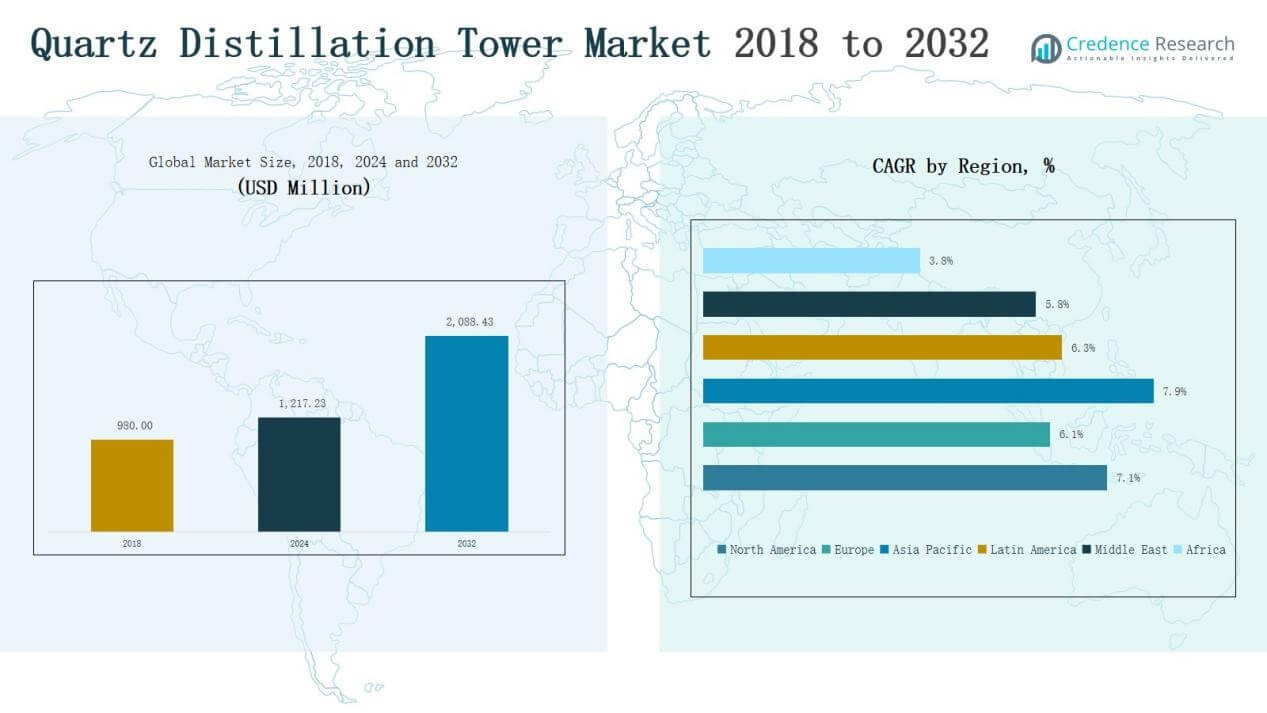 Quartz Distillation Tower Market Size[/caption]
Market Insights
- The Quartz Distillation Tower Market grew from USD 980.00 million in 2018 to USD 1,217.23 million in 2024 and is projected to reach USD 2,088.43 million by 2032, expanding at a CAGR of 7.06%.
- The Packed Towers segment dominated with a 38% share in 2024 due to superior efficiency, corrosion resistance, and suitability for semiconductor and chemical processing applications.
- The Vacuum Distillation segment led by 42% share in 2024, favored for processing high-purity and heat-sensitive materials in semiconductor and pharmaceutical industries.
- The Stainless Steel segment held the highest 46% share in 2024, supported by strong durability, corrosion resistance, and compatibility with quartz components across industrial applications.
- Asia Pacific led the global market with a 37% share in 2024, followed by North America at 31% and Europe at 26%, driven by rapid industrialization, technological advancement, and strong semiconductor manufacturing.
Market Segment Insights
By Tower Type
The Packed Towers segment dominated the Quartz Distillation Tower Market with a 38% share in 2024. Their efficiency in achieving high mass transfer rates and reduced pressure drop drives adoption in semiconductor and chemical sectors. The use of advanced quartz packing materials enhances corrosion resistance and purity levels. Increasing demand for energy-efficient distillation systems and the ability to handle diverse operating conditions further strengthen the segment’s growth across high-precision industrial applications.
- For instance, AdValue Tech supplied custom quartz-packed tower systems to a U.S. chemical producer, enabling continuous operation under varying temperature and corrosive conditions.
By Distillation Type
The Vacuum Distillation segment led the market with a 42% share in 2024, supported by its capability to process high-purity and heat-sensitive materials. It enables low-temperature separation, minimizing thermal degradation in semiconductor and pharmaceutical applications. Growing adoption in advanced chemical synthesis and cleanroom production boosts demand. Its superior efficiency in maintaining product integrity under controlled pressure environments continues to position it as the preferred distillation method in precision manufacturing.
- For instance, Merck KGaA implemented vacuum distillation units in its Darmstadt facility to enhance the purity of specialty solvents used in OLED material production.
By Material
The Stainless Steel segment held the largest share of 46% in 2024, driven by its excellent corrosion resistance, durability, and compatibility with quartz components. Its strength under varying thermal conditions makes it ideal for semiconductor and pharmaceutical distillation systems. The segment benefits from advancements in surface finishing technologies and increasing preference for long-life, low-maintenance materials. Rising demand for high-purity distillation equipment in controlled environments reinforces the prominence of stainless steel across global manufacturing facilities.
Key Growth Drivers
Rising Demand from Semiconductor and Electronics Manufacturing
The growing semiconductor industry fuels strong demand for high-purity quartz distillation towers. These systems ensure contaminant-free processing environments critical for chip fabrication. Increasing production of microprocessors, sensors, and photovoltaic cells drives adoption of advanced quartz-based systems. Manufacturers invest in automated and high-efficiency towers to meet purity and performance standards. Expanding cleanroom infrastructure across Asia Pacific and North America further strengthens the market’s growth momentum in semiconductor manufacturing applications.
- For instance, Sibelco's IOTA high-purity quartz sands are used to produce fused quartz crucibles vital for single crystal silicon growth in photovoltaic cells and semiconductor wafers.
Expansion of Chemical and Pharmaceutical Processing Applications
Quartz distillation towers are gaining importance in chemical and pharmaceutical industries due to their superior heat resistance and corrosion control. They enable precise separation and purification of sensitive compounds under extreme conditions. Continuous R&D in process optimization enhances product performance and operational safety. Growing emphasis on purity in chemical synthesis and pharmaceutical production promotes the replacement of conventional metal systems with high-quality quartz equipment, strengthening market penetration across advanced processing facilities.
- For instance, VTA provides modular skid-mounted quartz distillation units for fractional distillation used in vitamins and omega-3 fatty acid purification, combining low operating pressures and short residence times to avoid thermal degradation.
Advancements in Material Technology and Automation
Ongoing innovation in quartz processing and automation technologies supports market expansion. Enhanced fabrication methods allow greater structural integrity and efficiency, improving thermal management and distillation output. Integration of smart sensors and automated control systems ensures real-time process monitoring and consistency. These advancements reduce energy consumption, operational costs, and human error. Industrial digitization and Industry 4.0 trends encourage wider use of intelligent, high-precision distillation towers in critical applications across semiconductor, aerospace, and chemical industries.
Key Trends & Opportunities
Integration of Energy-Efficient and Sustainable Distillation Systems
Manufacturers are focusing on energy-efficient and environmentally sustainable distillation systems. The shift toward lower carbon footprints promotes the use of quartz materials that require minimal maintenance and offer long service life. Integration of modular designs and heat recovery systems improves energy efficiency. Sustainability-driven regulations and incentives encourage industries to adopt cleaner and recyclable materials. This trend creates opportunities for quartz tower manufacturers offering eco-friendly, high-performance, and recyclable system solutions.
- For instance, Supertek Glassware offers mono quartz distillation units made of high-purity quartz that ensure pyrogen-free, metal ion-free distilled water with low power consumption, enhancing operational sustainability.
Rising Adoption in Aerospace and Optical Component Manufacturing
Expanding use of quartz distillation towers in aerospace and optical industries presents new opportunities. Their ability to produce ultra-pure materials supports optical coatings, satellite systems, and precision instrumentation. Increasing investments in satellite deployment and optical component fabrication drive demand. Manufacturers leverage advanced design and process control to meet stringent purity and reliability standards. This trend expands the market’s reach into high-technology sectors requiring precise distillation and material refinement.
- For instance, SCHOTT AG revealed quartz tower integration into its European optical coating facility, resulting in documented improvements in purity for satellite instrumentation components.
Key Challenges
High Manufacturing and Installation Costs
Quartz distillation towers involve complex fabrication and precision assembly, resulting in high initial investment. The cost of raw materials and specialized equipment limits adoption among small and mid-scale producers. Custom engineering requirements and strict purity standards further elevate expenses. Limited economies of scale in production make cost optimization difficult. These financial constraints slow market penetration in price-sensitive regions and hinder widespread adoption in emerging industries.
Technical Complexity and Maintenance Requirements
Operating quartz distillation systems demands specialized technical expertise and careful maintenance. High sensitivity to thermal stress and mechanical shock increases the risk of operational disruption. Periodic inspection and controlled temperature management are necessary to maintain performance. Lack of skilled operators and limited training infrastructure create barriers in developing markets. The need for precise calibration and maintenance schedules adds operational burden, affecting efficiency and system lifespan.
Supply Chain Disruptions and Material Availability
Global supply chain challenges affect quartz raw material sourcing and component availability. Dependence on limited suppliers for high-purity quartz impacts production timelines and costs. Trade restrictions and logistical bottlenecks disrupt steady supply to manufacturers. Variability in quartz quality across regions influences performance consistency and pricing. These supply risks compel companies to diversify sourcing strategies and invest in regional production facilities to stabilize manufacturing operations and ensure long-term reliability.
Regional Analysis
North America
The North America Quartz Distillation Tower Market was valued at USD 249.70 million in 2018, increased to USD 304.79 million in 2024, and is projected to reach USD 521.90 million by 2032, growing at a CAGR of 7.1%. The region accounted for the 31% share of the global market in 2024. Growth is supported by strong semiconductor manufacturing, advanced process industries, and high adoption of automation technologies. The United States leads the market due to its robust R&D ecosystem, investment in clean energy infrastructure, and rising demand for precision distillation in electronic and pharmaceutical applications.
Europe
The Europe Quartz Distillation Tower Market was valued at USD 199.14 million in 2018, increased to USD 234.89 million in 2024, and is expected to reach USD 373.73 million by 2032, registering a CAGR of 6.1%. The region held a 26% share of the global market in 2024. Market growth is driven by expanding chemical and optical component manufacturing sectors across Germany, France, and Italy. Europe’s focus on sustainability, high-purity processing, and advanced material engineering supports increasing adoption of quartz-based systems in regulated and precision-oriented industries.
Asia Pacific
The Asia Pacific Quartz Distillation Tower Market reached USD 335.00 million in 2018, rose to USD 455.00 million in 2024, and is forecasted to attain USD 855.00 million by 2032, expanding at a CAGR of 7.9%. The region dominated the global market with a 37% share in 2024. Rapid industrialization, strong electronics production in China, Japan, and South Korea, and expanding semiconductor investments drive regional demand. Supportive government policies for advanced manufacturing and technological modernization further accelerate growth, making Asia Pacific the fastest-growing regional market for quartz distillation systems.
Latin America
The Latin America Quartz Distillation Tower Market was valued at USD 68.00 million in 2018, increased to USD 83.00 million in 2024, and is anticipated to reach USD 136.00 million by 2032, growing at a CAGR of 6.3%. The region captured 7% of the global market share in 2024. Growth is supported by rising adoption of high-purity processing systems in chemical and pharmaceutical industries across Brazil and Mexico. Government initiatives promoting industrial modernization and import substitution are fostering demand for efficient quartz-based distillation technologies in the region.
Middle East
The Middle East Quartz Distillation Tower Market stood at USD 56.00 million in 2018, grew to USD 67.00 million in 2024, and is projected to reach USD 105.00 million by 2032, advancing at a CAGR of 5.8%. The region accounted for a 5% market share in 2024. Increasing investments in chemical and energy sectors, particularly across GCC countries, drive the demand for durable quartz distillation systems. Expansion of industrial infrastructure and focus on material purity in specialty chemical production further contribute to regional market development.
Africa
The Africa Quartz Distillation Tower Market was valued at USD 22.00 million in 2018, increased to USD 28.00 million in 2024, and is expected to reach USD 41.00 million by 2032, growing at a CAGR of 3.8%. The region represented 4% of the global share in 2024. South Africa leads regional adoption due to growing industrial chemical and laboratory research sectors. However, limited technical expertise and infrastructure investment constrain rapid expansion. Increasing public–private partnerships and import of high-purity equipment from Europe and Asia are gradually improving market accessibility and growth prospects.
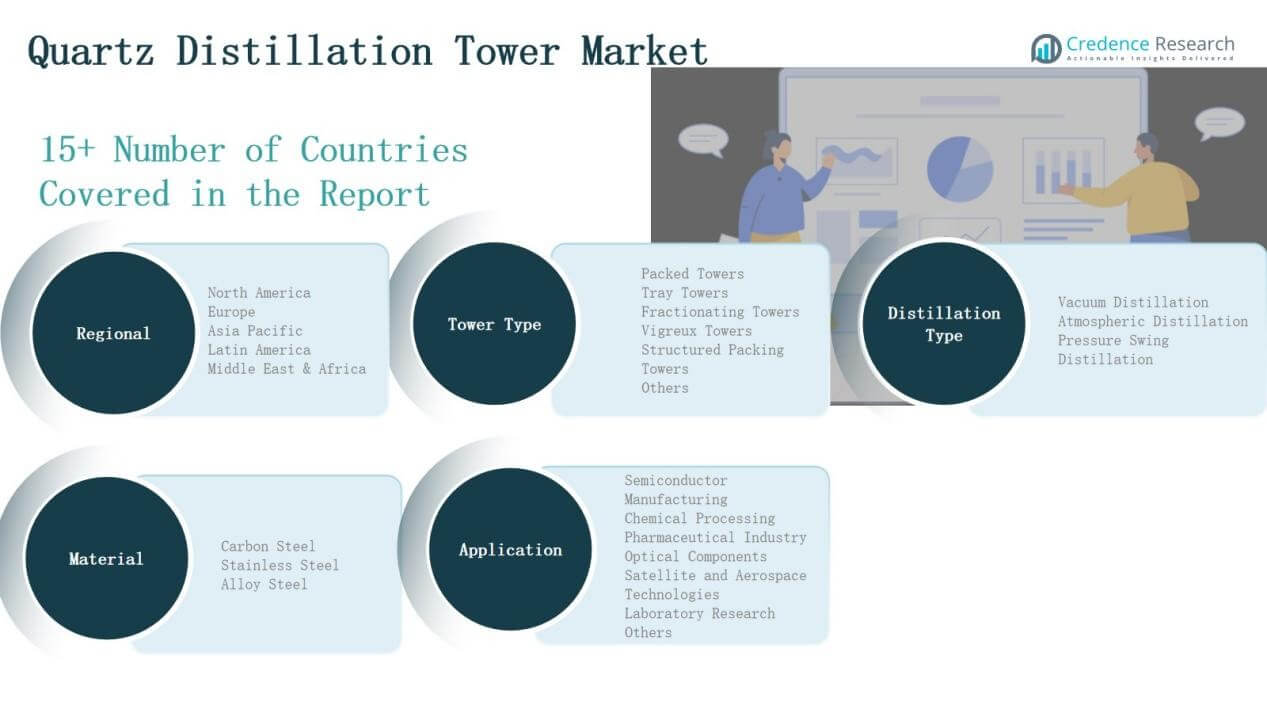
Market Segmentations:
By Tower Type
- Packed Towers
- Tray Towers
- Fractionating Towers
- Vigreux Towers
- Structured Packing Towers
- Others
By Distillation Type
- Vacuum Distillation
- Atmospheric Distillation
- Pressure Swing Distillation
By Material
- Carbon Steel
- Stainless Steel
- Alloy Steel
By Application
- Semiconductor Manufacturing
- Chemical Processing
- Pharmaceutical Industry
- Optical Components
- Satellite and Aerospace Technologies
- Laboratory Research
- Others
By Region
- North America
- Europe
- Asia Pacific
- Latin America
- Middle East
- Africa
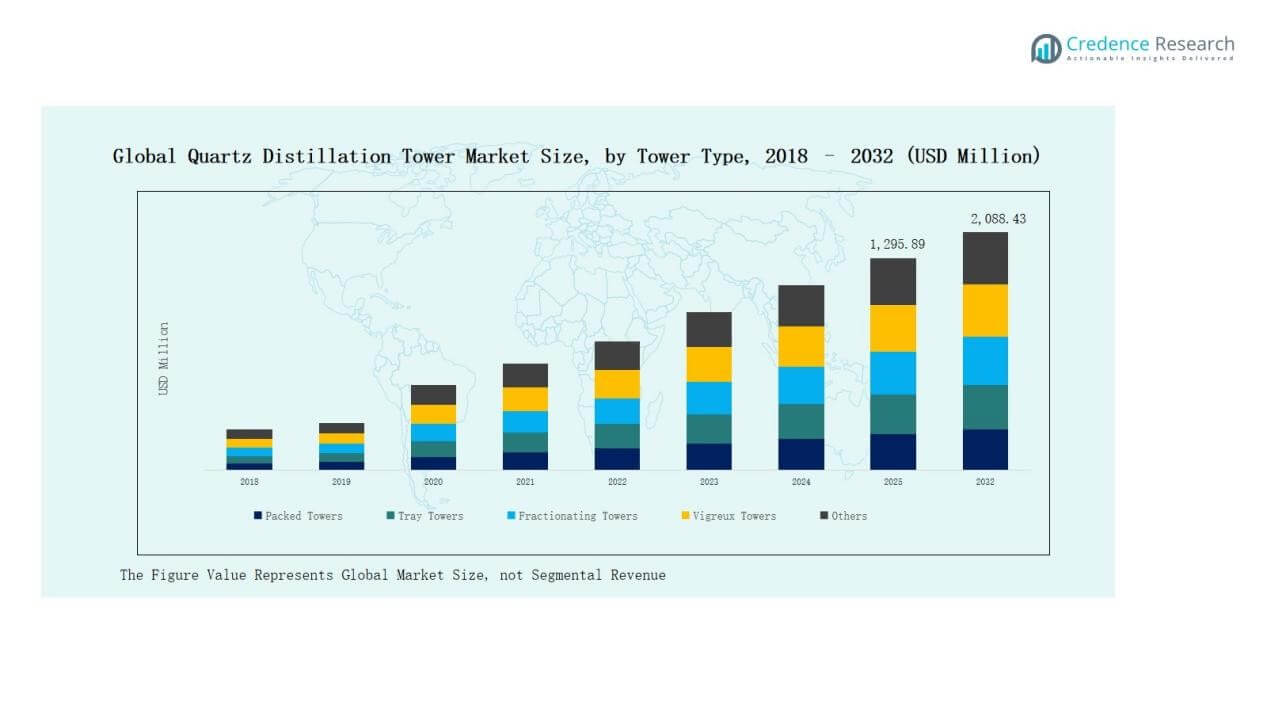 Quartz Distillation Tower Market Segmentation[/caption]
Competitive Landscape
The Quartz Distillation Tower Market features a moderately consolidated competitive landscape, dominated by global and regional manufacturers focusing on precision engineering and advanced material innovation. Key players such as Saint-Gobain, Heraeus, Tosoh Quartz, Inc., Pall Corporation, Koch-Glitsch, Sulzer Ltd., and Raschig GmbH emphasize high-purity quartz fabrication, automation, and corrosion-resistant tower design to serve semiconductor, pharmaceutical, and chemical industries. Continuous R&D investments strengthen process efficiency and product performance. Companies are expanding through strategic partnerships, acquisitions, and technological upgrades to enhance global supply capabilities. Emerging manufacturers in Asia Pacific, such as Hubei Feilihua Quartz Glass Co., Ltd. and Beijing Kaide Quartz Co., Ltd., are improving production scale and cost competitiveness. Meanwhile, established European and U.S. firms focus on sustainability and digital process control integration. This dynamic competition drives innovation, quality improvement, and market diversification, positioning high-precision quartz distillation systems as essential components in advanced industrial and scientific applications.\
Key Player
- Saint-Gobain
- Heraeus
- Shin-Etsu Quartz Products Co., Ltd.
- Wacom Quartz Corporation
- Beijing Kaide Quartz Co., Ltd.
- Hubei Feilihua Quartz Glass Co., Ltd.
- Huzhou Dong Ke Electron Quartz Co., Ltd.
- Glassco
- Koch-Glitsch
- Sulzer Ltd.
- Structured Packings Inc.
- Pall Corporation
- Raschig GmbH
- Montz GmbH
- Fenix Process Technologies
- HAT International Ltd.
- Ferrotec
- Hoya Corporation
- Tosoh Quartz, Inc.
- Nikon Corporation
Recent Developments
- In May 2024, Tosoh Corporation expanded its separation and purification media production capacity to strengthen its advanced materials portfolio and meet rising global demand.
- In 2025, Tosoh Quartz received the Intel EPIC Supplier Award for its excellence in high-purity quartz components used in semiconductor manufacturing.
- In December 2023, Nikon Corporation launched the NSR-S636E ArF immersion scanner, a high-productivity lithography system that incorporates advanced quartz-based technology for superior precision and performance.
Report Coverage
The research report offers an in-depth analysis based on Tower Type, Distillation Type, Material, Application and Region. It details leading market players, providing an overview of their business, product offerings, investments, revenue streams, and key applications. Additionally, the report includes insights into the competitive environment, SWOT analysis, current market trends, as well as the primary drivers and constraints. Furthermore, it discusses various factors that have driven market expansion in recent years. The report also explores market dynamics, regulatory scenarios, and technological advancements that are shaping the industry. It assesses the impact of external factors and global economic changes on market growth. Lastly, it provides strategic recommendations for new entrants and established companies to navigate the complexities of the market.
Future Outlook
- Demand for high-purity distillation systems will increase across semiconductor and pharmaceutical industries.
- Advancements in automation and process monitoring will enhance production efficiency.
- Asia Pacific will continue to expand as the leading manufacturing hub for quartz towers.
- Integration of smart control systems will improve precision and energy management.
- Adoption of sustainable and recyclable materials will gain strong industry traction.
- Rising investments in optical and aerospace applications will drive product innovation.
- Strategic mergers and technology partnerships will strengthen global market presence.
- Custom-designed towers will see higher adoption in research and specialized chemical processing.
- Digital manufacturing and Industry 4.0 practices will streamline fabrication and quality control.
- Continuous R&D in quartz engineering will boost durability, thermal stability, and system lifespan.

Request a Free Sample
Fill in your details and we'll send you a free sample report.
- Sample data tables & charts
- Research methodology
Need a Custom Version of This Report?
Tailor the scope, geography, or segments to your exact requirements.
- Custom geography or segment scope
- Direct access to our analyst team
Frequently Asked Questions
What is the current market size for the Quartz Distillation Tower Market, and what is its projected size in 2032?
At what Compound Annual Growth Rate is the Quartz Distillation Tower Market projected to grow between 2025 and 2032?
Which Quartz Distillation Tower Market segment held the largest share in 2024?
What are the primary factors fueling the growth of the Quartz Distillation Tower Market?
Who are the leading companies in the Quartz Distillation Tower Market?
Table of Content
Chapter 1 Market Segmentation
- 1.1 Segmentation Framework
- 1.1.1 Product and Service Classification
- 1.1.2 Application and End-Use Classification
- 1.1.3 Technology and Solution Classification
- 1.1.4 Customer and Distribution Channel Classification
- 1.1.5 Geographic Segmentation
- 1.1.6 Market Segment Definitions and Boundaries
Chapter 2 Introduction
- 2.1 Report Objectives and Scope
- 2.2 Product Definition and Industry Terminology
- 2.3 Market Inclusions and Exclusions
- 2.4 Research Process
- 2.4.1 Primary Research and Expert Interviews
- 2.4.2 Secondary Research and Source Review
- 2.4.3 Top-Down and Bottom-Up Estimation
- 2.4.4 Data Triangulation and Verification
- 2.5 Market Size Measurement Basis
- 2.5.1 2024: USD 1,217.23 million → 2032: USD 2,088.43 million
- 2.6 Historical and Forecast Reference Periods
- 2.6.1 Base Year: 2024
- 2.6.2 Forecast Period: 2024-2032
- 2.7 Research Assumptions and Limitations
Chapter 3 Executive Summary
- 3.1 Market Snapshot and Key Findings
- 3.2 Base-Year Market Size, 2024
- 3.3 Forecast Market Size, 2032
- 3.4 Revenue and Volume Growth Outlook
- 3.5 Key Demand and Supply Indicators
- 3.6 Leading Market Segments
- 3.7 Fastest-Growing Market Opportunities
- 3.8 Regional Performance Highlights
- 3.9 Technology and Industry Transformation
- 3.10 Competitive Landscape Summary
- 3.11 Analyst View and Strategic Implications
Chapter 4 Global Quartz Distillation Tower Market Trends and Developments
- 4.1 Historical Industry Development
- 4.2 Recent Market Trends and Developments
- 4.3 Demand and Customer Behavior Trends
- 4.4 Technology and Product Innovation
- 4.5 Artificial Intelligence, Automation and Digitalization
- 4.6 Local Manufacturing and Supply Chain Realignment
- 4.7 Industry Partnerships, Mergers and Acquisitions
- 4.8 Sustainability and Circular Economy Developments
- 4.9 Government and Private Sector Investment Trends
- 4.10 Emerging Business Models and Commercialization
- 4.11 Industry Developments and Announcements
Chapter 5 Global Quartz Distillation Tower Market Production, Supply and Demand Analysis
- 5.1 Demand Trend and Consumption Analysis
- 5.2 Demand Forecast, 2024-2032
- 5.3 Production and Output Trend
- 5.4 Production and Output Forecast, 2024-2032
- 5.5 Installed Capacity and Capacity Utilization
- 5.6 Company-Wise Production Plants and Statistics
- 5.6.1 Installed Production Capacity
- 5.6.2 Actual Production
- 5.6.3 Planned Capacity and Expansion Targets
- 5.7 Supply Chain Structure and Procurement Trends
- 5.8 Supply-Demand Gap and Bottlenecks
- 5.9 Import Dependence and Sourcing Structure
- 5.10 Contract Manufacturing and Outsourcing
- 5.11 Regional Supply and Demand Concentration
Chapter 6 Global Quartz Distillation Tower Market Pricing Analysis
- 6.1 Pricing Structure and Measurement
- 6.2 Historical Pricing Trends
- 6.3 Pricing Outlook, 2024-2032
- 6.4 Average Selling Price and Unit Economics
- 6.5 Pricing by Product and Market Segment
- 6.6 Geographic Pricing Differences
- 6.7 Key Input, Energy, Labor and Logistics Costs
- 6.8 Contract Pricing and Purchasing Models
- 6.9 Pricing Sensitivity and Competitive Positioning
- 6.10 Price, Margin and Profitability Implications
Chapter 7 Global Quartz Distillation Tower Market Dynamics
- 7.1 Market Growth Drivers
- 7.1.1 Demand-Side Drivers
- 7.1.2 Technology and Innovation Drivers
- 7.1.3 Infrastructure and Investment Drivers
- 7.1.4 Regulatory and Policy Drivers
- 7.2 Market Restraints
- 7.2.1 Cost and Affordability Constraints
- 7.2.2 Technology and Adoption Barriers
- 7.2.3 Supply Chain and Operational Constraints
- 7.3 Market Challenges
- 7.3.1 Competitive Pressure and Margin Erosion
- 7.3.2 Skills, Infrastructure and Implementation Gaps
- 7.4 Emerging Market Opportunities
- 7.5 Market Dynamics Impact and Time-Horizon Assessment
Chapter 8 Global Quartz Distillation Tower Value Chain Analysis
- 8.1 Industry Value Chain Overview
- 8.2 Upstream Suppliers and Critical Inputs
- 8.3 Technology and Component Providers
- 8.4 Manufacturing or Service Delivery
- 8.5 Distribution, Channel Partners and Integrators
- 8.6 Downstream Applications and End Users
- 8.7 Value Addition and Profit Pools
- 8.8 Vertical Integration and Outsourcing
- 8.9 Supplier Concentration and Risk
- 8.10 Supply Chain Localization and Resilience
Chapter 9 Global Quartz Distillation Tower Market Regulations and Policies
- 9.1 Relevant Laws, Standards and Compliance Frameworks
- 9.2 Product, Service, Safety and Quality Requirements
- 9.3 Government Policies, Incentives and Subsidies
- 9.4 Imports, Exports and Trade Barriers
- 9.5 Public Procurement and Local Content Requirements
- 9.6 Environmental and Sustainability Compliance
- 9.7 Upcoming Policy Changes and Market Implications
Chapter 10 Global Quartz Distillation Tower Market Hotspots and Opportunities
- 10.1 Market Opportunity Mapping and Growth Hotspots
- 10.2 High-Growth Applications and Customer Groups
- 10.3 Underserved Markets and White-Space Opportunities
- 10.4 Emerging Technology and Product Opportunities
- 10.5 New Capacity and Investment Hotspots
- 10.6 Market Entry and Expansion Opportunities
- 10.7 Distribution and Partnership Opportunities
- 10.8 Near-Term and Long-Term Commercial Potential
- 10.9 Opportunity Attractiveness and Execution Risks
Chapter 11 Global Quartz Distillation Tower Market Outlook, 2024-2032
- 11.1 Market Size and Analysis
- 11.1.1 Revenue (Market Measurement: 2024: USD 1,217.23 million → 2032: USD 2,088.43 million)
- 11.1.2 Market Volume and Quantity Sold
- 11.1.3 Historical Market Size
- 11.1.4 Base-Year Market Size, 2024
- 11.2 Market Forecast, 2024-2032
- 11.2.1 Revenue Forecast to 2032
- 11.2.2 Volume Forecast to 2032
- 11.2.3 CAGR and Year-on-Year Growth
- 11.2.4 Incremental Revenue Opportunity
- 11.3 Forecast Assumptions and Scenario Analysis
- 11.3.1 Base-Case Forecast
- 11.3.2 Optimistic and Conservative Scenarios
- 11.3.3 Technology, Pricing and Policy Sensitivities
- 11.4 Market Attractiveness and Growth Outlook
Chapter 12 Global Quartz Distillation Tower Market Segmentation and Outlook
- 12.1 Segmentation Summary and Market Shares, 2024
- 12.2 Largest and Fastest-Growing Segments
- 12.3 Segment Growth Comparison
- 12.4 Segment Attractiveness and Priority Matrix
Chapter 13 Global Quartz Distillation Tower Geographic Market Outlook, 2024-2032
- 13.1 Regional Market Size and Share, 2024
- 13.2 Regional Market Forecast, 2024-2032
- 13.3 Regional Pricing, Production and Demand Differences
- 13.4 North America
- 13.4.1 United States
- 13.4.2 Canada
- 13.4.3 Mexico
- 13.5 Europe
- 13.5.1 Germany
- 13.5.2 France
- 13.5.3 Italy
- 13.5.4 United Kingdom
- 13.5.5 Spain
- 13.5.6 Poland
- 13.5.7 Russia
- 13.5.8 Netherlands
- 13.5.9 Belgium
- 13.5.10 Sweden
- 13.5.11 Denmark
- 13.5.12 Norway
- 13.5.13 Rest of Europe
- 13.6 Asia Pacific
- 13.6.1 China
- 13.6.2 India
- 13.6.3 Japan
- 13.6.4 South Korea
- 13.6.5 Thailand
- 13.6.6 Indonesia
- 13.6.7 Vietnam
- 13.6.8 Malaysia
- 13.6.9 Australia
- 13.6.10 Rest of Asia Pacific
- 13.7 Latin America
- 13.7.1 Brazil
- 13.7.2 Argentina
- 13.7.3 Colombia
- 13.7.4 Chile
- 13.7.5 Rest of Latin America
- 13.8 Middle East
- 13.8.1 Saudi Arabia
- 13.8.2 United Arab Emirates
- 13.8.3 Turkey
- 13.8.4 Israel
- 13.8.5 Iran
- 13.8.6 Rest of the Middle East
- 13.9 Africa
- 13.9.1 South Africa
- 13.9.2 Egypt
- 13.9.3 Nigeria
- 13.9.4 Morocco
- 13.9.5 Rest of Africa
- 13.10 Regional Investment, Policy and Supply Chain Differences
- 13.11 Regional Competitive Landscape
- 13.12 Geographic Growth Hotspots
Chapter 14 Global Quartz Distillation Tower Technology, Innovation and Sustainability Outlook
- 14.1 Technology Landscape and Maturity
- 14.2 Product, Process and Service Innovation
- 14.3 AI, Automation and Digital Tools in the Industry
- 14.4 Technology Adoption and Performance Benchmarking
- 14.5 Innovation Pipeline and R&D Investment
- 14.6 Patent and Intellectual Property Trends
- 14.7 Energy Efficiency and Resource Management
- 14.8 Sustainability, Recycling and Circularity
- 14.9 Technology Roadmap, 2024-2032
- 14.10 Risks of Obsolescence and Technology Substitution
Chapter 15 Global Quartz Distillation Tower Market Key Strategic Imperatives
- 15.1 Growth and Market Entry Priorities
- 15.2 High-Return Products and Segments
- 15.3 Pricing, Profitability and Cost Optimization
- 15.4 Technology Investment and Product Differentiation
- 15.5 Supply Chain Localization and Resilience
- 15.6 Distribution and Customer Acquisition
- 15.7 Partnership, Acquisition and Capacity Strategy
- 15.8 Regional Expansion Priorities
- 15.9 Short-, Medium- and Long-Term Actions
Chapter 16 Competition Outlook
- 16.1 Industry Competition Characteristics
- 16.2 Market Structure and Concentration
- 16.3 Market Share and Competitive Positioning, 2024
- 16.4 Company-Wise Revenue and Product Benchmarking
- 16.5 Production and Service Capacity Benchmarking
- 16.6 Technology, Pricing and Differentiation
- 16.7 Regional Footprint and Distribution Strength
- 16.8 Mergers, Acquisitions and Strategic Alliances
- 16.9 New Entrants and Competitive Threats
- 16.10 Porter's Five Forces and Industry Attractiveness
- 16.11 Competitive Outlook, 2024-2032
Chapter 17 Company Profiles
- 17.1 Company Coverage and Selection Criteria
- 17.2 Leading Market Participants – Standard Profile Structure
- 17.2.1 Business Description
- 17.2.2 Company Ownership and Geographic Presence
- 17.2.3 Product and Service Portfolio
- 17.2.4 Manufacturing and Operating Footprint
- 17.2.5 Production Capacity and Expansion Plans
- 17.2.6 Financial Performance and Investment
- 17.2.7 Market Share and Competitive Position
- 17.2.8 Technology and Innovation Capabilities
- 17.2.9 Strategic Alliances or Partnerships
- 17.2.10 Recent Developments
- 17.2.11 Growth Strategy and Outlook
- 17.3 Other Relevant Market Participants
Note: Every listed company is profiled on the structure shown under the first company. The company list is preliminary and may change based on research findings, market developments, data availability and client requirements.
Chapter 18 Disclaimer
- 18.1 Research and Forecast Disclaimer
- 18.2 Data Source and Estimation Limitations
Note: The depth of individual sections depends on data availability for this market. Volume, capacity, trade and other unit-based metrics are included where applicable.