Market Overview:
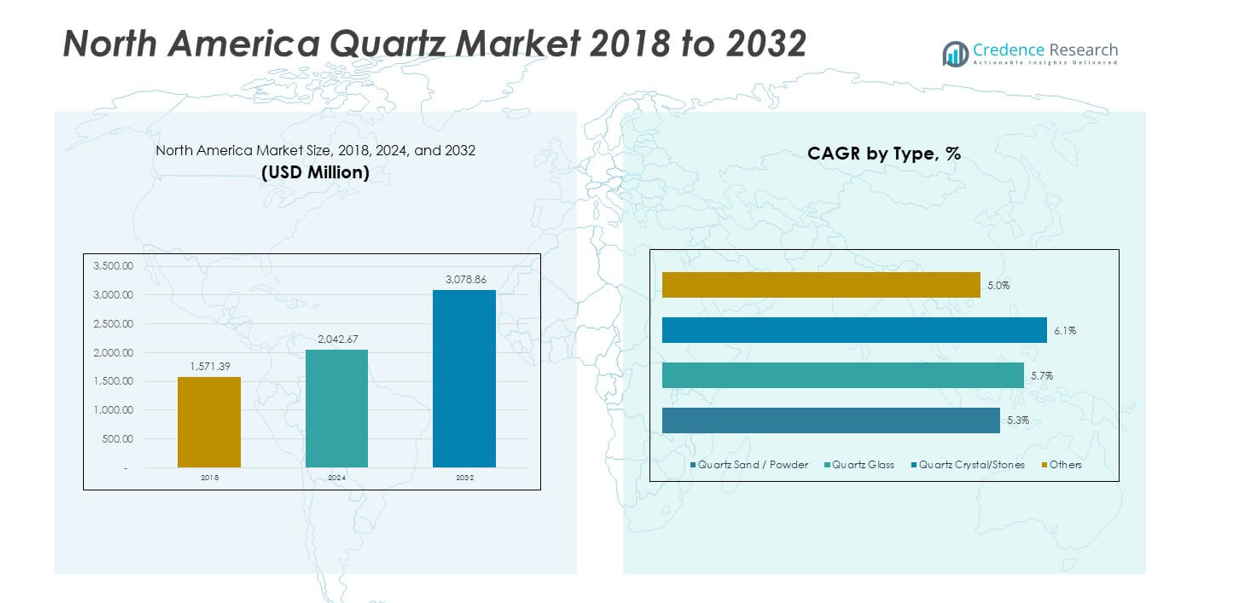
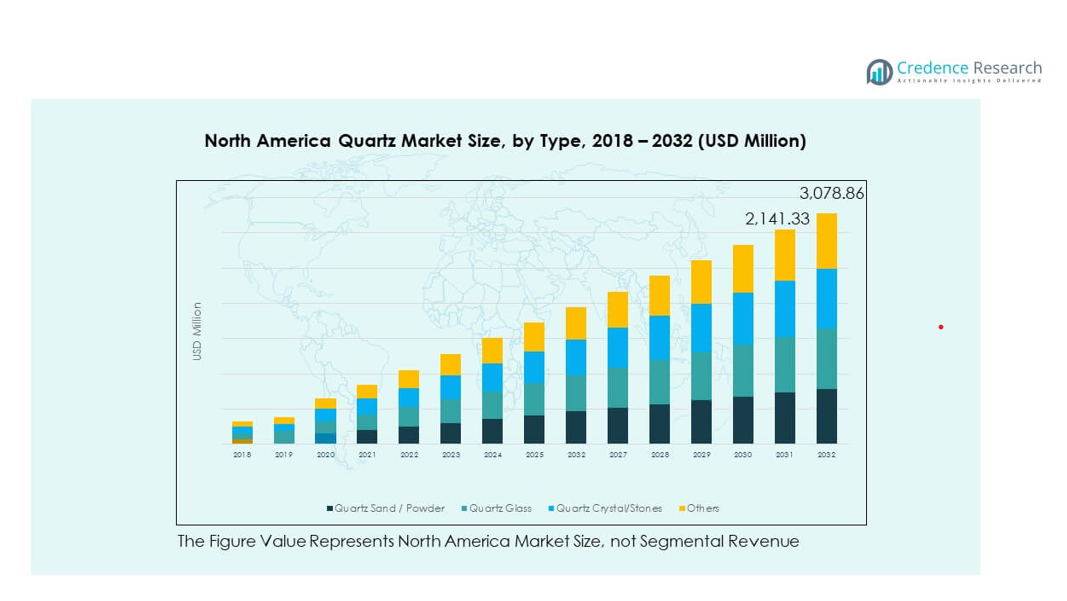
The North America Quartz Market size was valued at USD 1,571.39 million in 2018 to USD 2,042.67 million in 2024 and is anticipated to reach USD 3,078.86 million by 2032, at a CAGR of 5.24% during the forecast period.
| REPORT ATTRIBUTE | DETAILS |
|---|---|
| Historical Period | 2020-2023 |
| Base Year | 2024 |
| Forecast Period | 2025-2032 |
| North America Quartz Market Size 2024 | USD 2,042.67 million |
| North America Quartz Market, CAGR | 5.24% |
| North America Quartz Market Size 2032 | USD 3,078.86 million b |
The market is driven by steady demand from electronics, construction, and semiconductor industries. Quartz is increasingly used in high-performance applications due to its durability, purity, and thermal stability. Rising adoption in photovoltaic cells and advanced optics also supports growth. In addition, consumer electronics expansion, along with increased investments in semiconductor manufacturing, strengthens the market. Strong demand from industrial processing and architectural applications further positions quartz as a vital material across sectors.
Regionally, the U.S. leads the North America Quartz Market due to advanced semiconductor production, strong construction projects, and established electronics manufacturing hubs. Canada shows emerging potential driven by infrastructure development and growing use of quartz in architectural designs. Mexico is also witnessing steady growth supported by industrialization and increased demand from automotive and electronics sectors. Together, these countries create a balanced mix of mature and rising markets within the region.
Market Insights:
- The North America Quartz Market was valued at USD 1,571.39 million in 2018, reached USD 2,042.67 million in 2024, and is projected to reach USD 3,078.86 million by 2032, growing at a CAGR of 5.24%.
- The United States led with a 64% share in 2024 due to its advanced semiconductor base and strong construction activity, while Canada followed with 22% supported by infrastructure growth, and Mexico held 14% driven by industrialization.
- Mexico is the fastest-growing region with a 14% share, supported by rising manufacturing, renewable energy projects, and adoption of engineered quartz in construction.
- Quartz sand/powder dominated type segments with the largest share in 2024, supported by demand in glassmaking, foundry applications, and construction industries.
- Quartz glass followed with a significant share, driven by adoption in semiconductors, solar cells, and high-purity optical applications.
Market Drivers:
Rising Demand From Electronics And Semiconductor Manufacturing Driving Quartz Utilization
The electronics and semiconductor sector is one of the largest consumers of quartz, requiring high-purity grades for precision applications. Manufacturers in North America continue to increase investment in wafer fabrication and chip production, which supports long-term demand. Quartz’s superior thermal stability and purity make it critical in lithography and etching processes. The North America Quartz Market benefits directly from this reliance on advanced materials. It is witnessing consistent adoption across semiconductor equipment and device manufacturing. Expansion of consumer electronics, 5G infrastructure, and data centers strengthens quartz demand further. Regional production bases are also prioritizing localized supply chains to reduce import dependence.
- For instance, Heraeus Holding (specifically its Heraeus Covantics division) continues to deliver ultrapure quartz ware to semiconductor fabrication facilities, with its materials meeting stringent low contamination standards to support advanced chip lithography.
Growing Role Of Quartz In Construction And Architectural Applications Across Urban Centers
Quartz is widely used in engineered stone, countertops, and decorative surfaces across residential and commercial projects. North America’s construction sector has embraced quartz for its durability, scratch resistance, and aesthetic appeal. Urbanization and lifestyle changes continue to accelerate adoption in interior applications. The North America Quartz Market gains momentum from housing upgrades, remodeling trends, and rising investments in premium surfaces. Builders prefer quartz for long-term value and sustainability advantages over traditional materials. It is increasingly used in hospitals, airports, and offices due to hygiene and resilience benefits. Expanding commercial infrastructure projects are expected to sustain robust demand across the region.
- For instance, engineered quartz from brands like Cambria has been used in various healthcare and public projects because its nonporous surface is easy to clean and sanitize. This property helps installations meet stringent hygiene standards, which is crucial for infection control in these environments.
Adoption Of Quartz In Energy Sector Supporting Photovoltaic And Renewable Projects
The transition toward renewable energy continues to create opportunities for quartz in photovoltaic applications. High-purity quartz is essential for solar panel production, supporting efficiency and stability in energy generation. North America has prioritized renewable installations, driving higher quartz consumption. The North America Quartz Market benefits from the scale of solar investments in the U.S. and Canada. It is positioned as a critical raw material for sustainable energy infrastructure. Government incentives and policy frameworks encourage wider adoption of clean energy projects. Strong corporate commitments to carbon neutrality further strengthen demand for quartz-based materials in this segment.
Industrial Applications Expanding Across Diverse Manufacturing Segments Driving Market Growth
Quartz has established strong utility across industrial processes, ranging from foundries to chemical handling. It is valued for thermal stability, corrosion resistance, and high-performance characteristics. The North America Quartz Market experiences growth from its integration into industrial coatings, glassmaking, and processing equipment. Demand is reinforced by expanding automotive, aerospace, and metallurgy industries across the region. Quartz’s role in high-temperature and precision environments highlights its importance in production quality. It is also adopted in advanced optics and specialty glass solutions, adding new demand channels. Industrial diversification ensures quartz remains a key raw material in evolving North American industries.
Market Trends:
Increasing Popularity Of Engineered Quartz Surfaces In Residential And Commercial Interiors
Engineered quartz surfaces are experiencing strong adoption due to durability and modern design appeal. Homeowners and businesses choose quartz over natural stone for its resilience and maintenance benefits. The North America Quartz Market reflects this trend with higher consumption in kitchens, bathrooms, and office spaces. It is driven by customization options, color variety, and premium finishes. Architects and designers favor quartz for sustainable and hygienic features. The material supports long-term value and fits with contemporary interior design preferences. Rising real estate development continues to support this growing trend across North America.
Technological Advancements In Quartz Processing And Purification Methods
Technological improvements are enhancing the efficiency of quartz production and purification processes. Innovations in high-purity refining allow suppliers to meet semiconductor and optics requirements. The North America Quartz Market shows rising adoption of advanced processing methods for consistent quality. It is witnessing investments in automated systems and sustainable manufacturing practices. Companies are focusing on reducing impurities to meet stricter end-user specifications. This focus strengthens reliability in critical applications such as electronics and renewable energy. Ongoing R&D efforts contribute to strengthening the competitive landscape of quartz suppliers in the region.
- For instance, Elkem ASA has invested in digitalization and sustainability, developing innovative solutions like its carbon looping project (Sicalo) aimed at producing CO2-free silicon, and a new mechanical recycling process for silicone rubber in 2025.
Integration Of Quartz In Emerging High-Tech And Specialty Applications
Quartz is increasingly used in specialized industries such as aerospace, telecommunications, and medical devices. Its unique optical and mechanical properties make it ideal for advanced applications. The North America Quartz Market gains traction from its role in precision instruments and scientific research. It is finding use in advanced optics, resonators, and laboratory equipment. Growth of high-tech industries boosts demand for specialized quartz solutions. Research institutions and corporations are driving innovation in these niche applications. The integration into high-value sectors ensures stable, long-term growth opportunities.
Sustainability And Circular Economy Principles Transforming Quartz Supply Chain
Sustainability concerns are influencing procurement and production strategies in the quartz sector. Companies focus on energy-efficient processing and recycling practices. The North America Quartz Market reflects this trend as manufacturers adopt greener technologies. It is driven by regulatory compliance and rising consumer awareness of environmental impact. Sustainable sourcing practices are shaping procurement policies across industries. Recyclable quartz composites are gaining acceptance in construction and design markets. This trend strengthens the market’s alignment with broader sustainability goals across North America.
Market Challenges Analysis:
Supply Chain Volatility And Dependence On High-Purity Quartz Sources
The supply of high-purity quartz is limited, making it vulnerable to price fluctuations and availability issues. Producers in North America often depend on global imports for specific grades. The North America Quartz Market faces risks from geopolitical disruptions and trade barriers. It is challenged by cost escalations when supply chains tighten. Manufacturers must balance procurement strategies while securing reliable sources. This volatility impacts semiconductor and renewable sectors that need stable inputs. Industry stakeholders continue to explore local mining and refining to reduce dependence on imports.
High Production Costs And Intense Competition Across End-User Segments
Quartz production requires advanced processing, purification, and energy-intensive operations. The North America Quartz Market is challenged by rising production costs and competitive pressures. It is forced to manage profitability while meeting stringent purity and quality requirements. Competition between engineered stone suppliers and alternative materials further complicates market expansion. End users often compare cost-benefit ratios before committing to quartz adoption. Price-sensitive construction and industrial buyers limit opportunities for premium pricing. Companies must continually innovate and streamline operations to maintain competitiveness. Strategic investments in efficiency and technology are essential to address these challenges.
Market Opportunities:
Expanding Applications In Renewable Energy And Advanced Electronics Offering Long-Term Growth
Quartz has become vital in renewable energy and advanced electronic manufacturing. High-purity grades are critical for solar panels, semiconductors, and precision components. The North America Quartz Market benefits from strong renewable adoption and advanced manufacturing expansion. It is supported by policies that favor clean energy and digital transformation. Companies investing in quartz-based technologies stand to capture sustained demand. Market growth is also fueled by corporate shifts toward sustainability and innovation. These developments create scalable opportunities for quartz producers and technology suppliers alike.
Emerging Demand For Engineered Surfaces And Specialty Quartz Solutions In Regional Markets
Engineered quartz surfaces are gaining rapid preference in residential, commercial, and industrial settings. Consumers and builders seek durable, sustainable, and customizable design materials. The North America Quartz Market captures this opportunity through product innovation and design diversity. It is advancing into niche segments such as specialty optics, laboratory applications, and telecommunications. Strong demand across Canada and Mexico highlights emerging growth beyond the U.S. Manufacturers adopting localized strategies are better positioned to serve these expanding markets. This diversified demand landscape creates attractive opportunities for long-term profitability.
Market Segmentation Analysis:
By Type
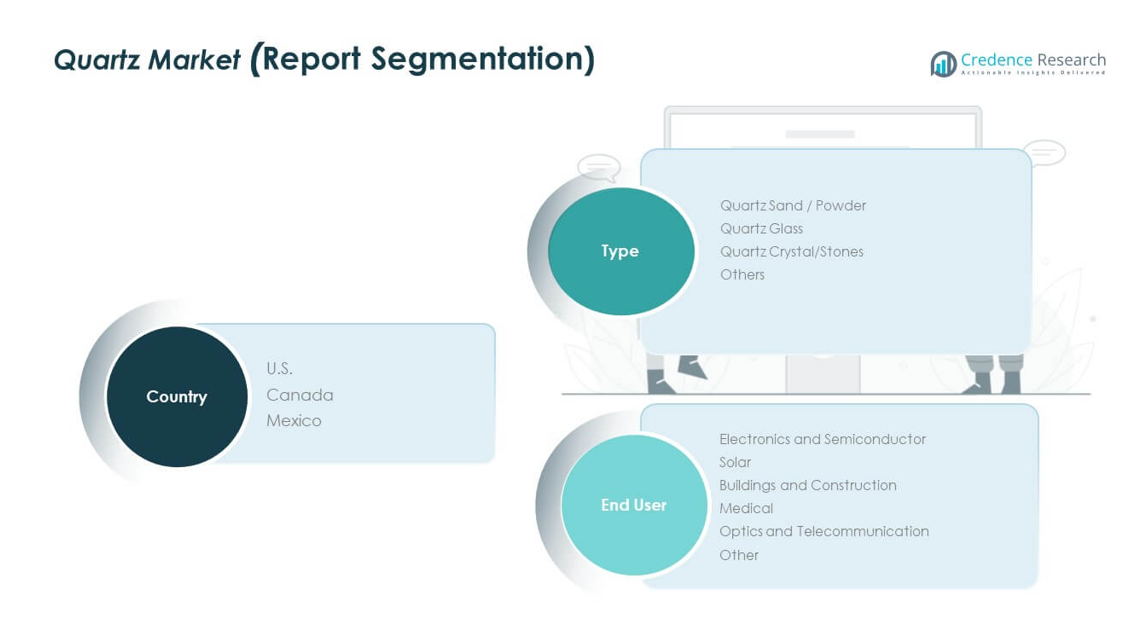
Quartz sand and powder account for a substantial share due to their extensive use in glassmaking, foundry applications, and construction materials. Quartz glass follows as a key segment, driven by demand in semiconductors, solar cells, and advanced optics where high purity is required. Quartz crystal and stone contribute strongly to electronics, watches, and communication devices due to their piezoelectric properties. Others include specialty and engineered forms that address niche applications in laboratories and industrial equipment. The North America Quartz Market continues to expand across all types due to diverse utility and industry adoption.
- For instance, Saint-Gobain S.A. operates extensively in North America, with its CerainTeed division inaugurating the region's first 100% renewable electricity plasterboard plant in Sainte-Catherine, Canada, in September 2025. The company is celebrating its 360th anniversary in 2025 and is expanding its construction solutions globally.
By End User
Electronics and semiconductor remain the largest consumers, relying on quartz for high-performance wafers, crucibles, and process equipment. Solar applications are expanding steadily, supported by renewable energy projects and government incentives. Buildings and construction demand quartz surfaces for durability, design appeal, and hygiene in residential and commercial projects. The medical sector uses quartz for precision instruments, diagnostic devices, and laboratory equipment. Optics and telecommunication gain momentum through applications in lenses, resonators, and high-frequency components. Others include industrial, aerospace, and specialty uses that contribute to market diversity. It sustains balanced demand across mature and emerging end-user industries.
- For instance, companies like The Quartz Corporation, Sibelco, and Jiangsu Pacific Quartz supply the hyper-high-purity quartz sand needed for semiconductor manufacturing. This sand is melted into highly specialized crucibles by other manufacturers and used to grow crystalline silicon ingots for wafers. In 2019, DuPont divested its compound semiconductor solutions business, including silicon carbide wafers, to SK Siltron, rather than providing specialized crucibles through 2025.
Segmentation:
By Type- Quartz Sand / Powder
- Quartz Glass
- Quartz Crystal/Stone
- Others
- Electronics and Semiconductor
- Solar
- Buildings and Construction
- Medical
- Optics and Telecommunication
- Others
- U.S.
- Canada
- Mexico
Regional Analysis:
United States Leading With Strong Industrial And Construction Demand
The United States dominates the North America Quartz Market with a share of nearly 64% in 2024. Growth is supported by advanced semiconductor production, extensive construction activity, and high consumer demand for engineered quartz surfaces. The country’s leadership in electronics and renewable energy adoption further boosts quartz utilization across multiple sectors. It also benefits from investments in clean energy projects, which strengthen quartz demand for photovoltaic applications. High urbanization levels encourage the use of quartz in architectural and decorative surfaces. Strong domestic production capacity and a mature industrial base position the U.S. as the primary revenue contributor in the regional market.
Canada Expanding With Infrastructure Growth And Renewable Energy Projects
Canada accounted for about 22% of the North America Quartz Market in 2024, supported by infrastructure development and renewable energy expansion. The country has seen growing use of quartz in both construction and solar applications. It benefits from increasing demand for high-performance materials in medical, laboratory, and industrial uses. Quartz adoption is rising in residential and commercial interiors, where sustainability and durability remain key priorities. Investments in research and development also support high-purity quartz for advanced applications. The combination of infrastructure spending and clean energy policies positions Canada as a steadily expanding market within the region.
Mexico Emerging As A Growth-Oriented Market In Quartz Applications
Mexico represented around 14% of the North America Quartz Market in 2024, reflecting its role as an emerging hub. Industrialization and growing automotive, electronics, and construction sectors drive quartz demand in the country. It is increasingly adopting engineered quartz surfaces for residential and commercial projects. Renewable energy initiatives also support growth in solar applications, particularly with government-backed projects. Expanding manufacturing capacity and rising consumer preference for durable materials enhance quartz market penetration. Mexico’s position as a growth-oriented economy allows it to contribute steadily to the overall regional expansion.
Key Player Analysis:
- Cambria
- MSI Q Quartz
- DuPont
- Elkem ASA
- LG Viatera
- Heraeus Holding
- HanStone Quartz
- Santa Margherita Quartz
- Saint Gobain S.A.
- Creswick Quartz
- Other Key Players
Competitive Analysis:
The North America Quartz Market is highly competitive, with both global and regional players strengthening their presence through innovation, product diversification, and expansion strategies. Companies focus on engineered quartz surfaces, high-purity quartz for semiconductors, and solar-grade quartz. It is characterized by strong rivalry among established brands such as Cambria, MSI Q Quartz, DuPont, LG Viatera, and Heraeus Holding. Market leaders invest in advanced processing technologies to ensure quality and reliability across applications. Partnerships and mergers are common strategies to enhance regional reach. Niche players contribute by offering tailored solutions for construction, electronics, and industrial use.
Recent Developments:
- In September 2025, MSI Q Quartz introduced seven innovative color options to its Q™ Premium Natural Quartz collection, featuring bold veins and fresh hues inspired by natural quartzite and dramatic selections designed for modern interiors. This expansion supports broader designer and homeowner needs, elevating MSI’s product presence in the North America Quartz Market.
- In September 2025, DuPont announced its plan to complete the spin-off of its electronics business, Qnity, by November 1, 2025, while finalizing the divestiture of its Aramids business, including the renowned Kevlar segment, as part of a strategic restructuring move to streamline operations in the North America Quartz Market.
- In August 2025, Cambria debuted four new quartz designs-Traymore Bay™, St. Isley™, Claremont™, and Kenwood™-highlighting textural innovation, organic depth, and emotional connection in surface aesthetics for both residential and commercial environments. This launch reinforced Cambria’s commitment to refinement and luxury within the North America Quartz Market.
Report Coverage:
The research report offers an in-depth analysis based on type and end-user segments. It details leading market players, providing an overview of their business, product offerings, investments, revenue streams, and key applications. Additionally, the report includes insights into the competitive environment, SWOT analysis, current market trends, as well as the primary drivers and constraints. Furthermore, it discusses various factors that have driven market expansion in recent years. The report also explores market dynamics, regulatory scenarios, and technological advancements that are shaping the industry. It assesses the impact of external factors and global economic changes on market growth. Lastly, it provides strategic recommendations for new entrants and established companies to navigate the complexities of the market.
Future Outlook:
- Demand for engineered quartz surfaces will rise in both residential and commercial spaces.
- Semiconductor and electronics industries will drive high-purity quartz consumption.
- Solar energy projects will expand quartz use in photovoltaic applications.
- Construction growth will support adoption of quartz in interior and architectural surfaces.
- Investments in advanced processing will improve quartz purity and reliability.
- Canada will gain steady share through infrastructure and renewable projects.
- Mexico will strengthen its role with industrialization and construction growth.
- Sustainable sourcing and recycling will influence production strategies.
- Partnerships and capacity expansions will shape competitive positioning.
- Diversified applications in optics, telecom, and medical fields will sustain long-term growth.

Request a Free Sample
Fill in your details and we'll send you a free sample report.
- Sample data tables & charts
- Research methodology
Market Dynamics
Electronics and Semiconductor Manufacturing Expansion
The rapid growth of semiconductor fabrication and electronics manufacturing in North America, especially in the U.S., is driving demand for high-purity quartz used in wafers, crucibles, and process equipment. Quartz’s thermal stability and purity are essential for advanced chip production and device reliability.
Rising Adoption in Construction and Architectural Applications
Quartz is increasingly favored in residential and commercial construction for engineered stone surfaces, countertops, and decorative elements due to its durability, hygiene, and aesthetic appeal. Urbanization and remodeling trends across North America are boosting quartz consumption in interior and architectural projects.
Growth of Renewable Energy and Photovoltaic Installations
The transition to renewable energy, particularly solar power, is fueling demand for high-purity quartz in photovoltaic cell manufacturing. Government incentives and corporate sustainability commitments in the U.S. and Canada are expanding the use of quartz in solar panels and related infrastructure.
Technological Advancements in Quartz Processing
Innovations in quartz purification and processing are enabling suppliers to meet the stringent requirements of the semiconductor, optics, and specialty glass industries. Investments in automation and sustainable manufacturing are improving product quality and expanding application possibilities.
Diversification into High-Tech and Specialty Applications
Quartz is finding new uses in advanced optics, telecommunications, medical devices, and laboratory equipment due to its unique optical and mechanical properties. The growth of high-tech industries and research sectors in North America is creating additional demand for specialized quartz solutions.
Need a Custom Version of This Report?
Tailor the scope, geography, or segments to your exact requirements.
- Custom geography or segment scope
- Direct access to our analyst team
Frequently Asked Questions
What is the current market size for North America Quartz Market, and what is its projected size in 2032?
At what Compound Annual Growth Rate is the North America Quartz Market projected to grow between 2024 and 2032?
Which North America Quartz Market segment held the largest share in 2024?
What are the primary factors fueling the growth of the North America Quartz Market?
Who are the leading companies in the North America Quartz Market?
Table of Content
Chapter 1 Market Segmentation
- 1.1 Segmentation Framework
- 1.1.1 Product and Service Classification
- 1.1.2 Application and End-Use Classification
- 1.1.3 Technology and Solution Classification
- 1.1.4 Customer and Distribution Channel Classification
- 1.1.5 Geographic Segmentation
- 1.1.6 Market Segment Definitions and Boundaries
- 1.2 By Type
- 1.2.1 Quartz Sand / Powder
- 1.2.2 Quartz Glass
- 1.2.3 Quartz Crystal/Stone
- 1.2.4 Others
- 1.3 By End User
- 1.3.1 Electronics and Semiconductor
- 1.3.2 Solar
- 1.3.3 Buildings and Construction
- 1.3.4 Medical
- 1.3.5 Optics and Telecommunication
- 1.3.6 Others
Chapter 2 Introduction
- 2.1 Report Objectives and Scope
- 2.2 Product Definition and Industry Terminology
- 2.3 Market Inclusions and Exclusions
- 2.4 Research Process
- 2.4.1 Primary Research and Expert Interviews
- 2.4.2 Secondary Research and Source Review
- 2.4.3 Top-Down and Bottom-Up Estimation
- 2.4.4 Data Triangulation and Verification
- 2.5 Market Size Measurement Basis
- 2.5.1 2024: USD 2,042.67 million → 2032: USD 3,078.86 million
- 2.6 Historical and Forecast Reference Periods
- 2.6.1 Base Year: 2024
- 2.6.2 Forecast Period: 2024-2032
- 2.7 Research Assumptions and Limitations
Chapter 3 Executive Summary
- 3.1 Market Snapshot and Key Findings
- 3.2 Base-Year Market Size, 2024
- 3.3 Forecast Market Size, 2032
- 3.4 Revenue and Volume Growth Outlook
- 3.5 Key Demand and Supply Indicators
- 3.6 Leading Market Segments
- 3.7 Fastest-Growing Market Opportunities
- 3.8 Regional Performance Highlights
- 3.9 Technology and Industry Transformation
- 3.10 Competitive Landscape Summary
- 3.11 Analyst View and Strategic Implications
Chapter 4 North America Quartz Market Trends and Developments
- 4.1 Historical Industry Development
- 4.2 Recent Market Trends and Developments
- 4.3 Demand and Customer Behavior Trends
- 4.4 Technology and Product Innovation
- 4.5 Artificial Intelligence, Automation and Digitalization
- 4.6 Local Manufacturing and Supply Chain Realignment
- 4.7 Industry Partnerships, Mergers and Acquisitions
- 4.8 Sustainability and Circular Economy Developments
- 4.9 Government and Private Sector Investment Trends
- 4.10 Emerging Business Models and Commercialization
- 4.11 Industry Developments and Announcements
Chapter 5 North America Quartz Market Production, Supply and Demand Analysis
- 5.1 Demand Trend and Consumption Analysis
- 5.2 Demand Forecast, 2024-2032
- 5.3 Production and Output Trend
- 5.4 Production and Output Forecast, 2024-2032
- 5.5 Installed Capacity and Capacity Utilization
- 5.6 Company-Wise Production Plants and Statistics
- 5.6.1 Installed Production Capacity
- 5.6.2 Actual Production
- 5.6.3 Planned Capacity and Expansion Targets
- 5.7 Supply Chain Structure and Procurement Trends
- 5.8 Supply-Demand Gap and Bottlenecks
- 5.9 Import Dependence and Sourcing Structure
- 5.10 Contract Manufacturing and Outsourcing
- 5.11 Regional Supply and Demand Concentration
Chapter 6 North America Quartz Market Pricing Analysis
- 6.1 Pricing Structure and Measurement
- 6.2 Historical Pricing Trends
- 6.3 Pricing Outlook, 2024-2032
- 6.4 Average Selling Price and Unit Economics
- 6.5 Pricing by Product and Market Segment
- 6.6 Geographic Pricing Differences
- 6.7 Key Input, Energy, Labor and Logistics Costs
- 6.8 Contract Pricing and Purchasing Models
- 6.9 Pricing Sensitivity and Competitive Positioning
- 6.10 Price, Margin and Profitability Implications
Chapter 7 North America Quartz Market Dynamics
- 7.1 Market Growth Drivers
- 7.1.1 Demand-Side Drivers
- 7.1.2 Technology and Innovation Drivers
- 7.1.3 Infrastructure and Investment Drivers
- 7.1.4 Regulatory and Policy Drivers
- 7.2 Market Restraints
- 7.2.1 Cost and Affordability Constraints
- 7.2.2 Technology and Adoption Barriers
- 7.2.3 Supply Chain and Operational Constraints
- 7.3 Market Challenges
- 7.3.1 Competitive Pressure and Margin Erosion
- 7.3.2 Skills, Infrastructure and Implementation Gaps
- 7.4 Emerging Market Opportunities
- 7.5 Market Dynamics Impact and Time-Horizon Assessment
Chapter 8 North America Quartz Value Chain Analysis
- 8.1 Industry Value Chain Overview
- 8.2 Upstream Suppliers and Critical Inputs
- 8.3 Technology and Component Providers
- 8.4 Manufacturing or Service Delivery
- 8.5 Distribution, Channel Partners and Integrators
- 8.6 Downstream Applications and End Users
- 8.7 Value Addition and Profit Pools
- 8.8 Vertical Integration and Outsourcing
- 8.9 Supplier Concentration and Risk
- 8.10 Supply Chain Localization and Resilience
Chapter 9 North America Quartz Market Regulations and Policies
- 9.1 Relevant Laws, Standards and Compliance Frameworks
- 9.2 Product, Service, Safety and Quality Requirements
- 9.3 Government Policies, Incentives and Subsidies
- 9.4 Imports, Exports and Trade Barriers
- 9.5 Public Procurement and Local Content Requirements
- 9.6 Environmental and Sustainability Compliance
- 9.7 Upcoming Policy Changes and Market Implications
Chapter 10 North America Quartz Market Hotspots and Opportunities
- 10.1 Market Opportunity Mapping and Growth Hotspots
- 10.2 High-Growth Applications and Customer Groups
- 10.3 Underserved Markets and White-Space Opportunities
- 10.4 Emerging Technology and Product Opportunities
- 10.5 New Capacity and Investment Hotspots
- 10.6 Market Entry and Expansion Opportunities
- 10.7 Distribution and Partnership Opportunities
- 10.8 Near-Term and Long-Term Commercial Potential
- 10.9 Opportunity Attractiveness and Execution Risks
Chapter 11 North America Quartz Market Outlook, 2024-2032
- 11.1 Market Size and Analysis
- 11.1.1 Revenue (Market Measurement: 2024: USD 2,042.67 million → 2032: USD 3,078.86 million)
- 11.1.2 Market Volume and Quantity Sold
- 11.1.3 Historical Market Size
- 11.1.4 Base-Year Market Size, 2024
- 11.2 Market Forecast, 2024-2032
- 11.2.1 Revenue Forecast to 2032
- 11.2.2 Volume Forecast to 2032
- 11.2.3 CAGR and Year-on-Year Growth
- 11.2.4 Incremental Revenue Opportunity
- 11.3 Forecast Assumptions and Scenario Analysis
- 11.3.1 Base-Case Forecast
- 11.3.2 Optimistic and Conservative Scenarios
- 11.3.3 Technology, Pricing and Policy Sensitivities
- 11.4 Market Attractiveness and Growth Outlook
Chapter 12 North America Quartz Market Segmentation and Outlook
- 12.1 Segmentation Summary and Market Shares, 2024
- 12.2 Largest and Fastest-Growing Segments
- 12.3 By Type - Market Size and Forecast, 2024-2032
- 12.3.1 Segment Definition and Scope
- 12.3.2 Historical Market Size
- 12.3.3 Revenue Forecast, 2024-2032
- 12.3.4 Volume Forecast, 2024-2032
- 12.3.5 Base-Year Market Share, 2024
- 12.3.6 Segment CAGR and Growth Drivers
- 12.3.7 Subsegment Market Size and Forecast
- 12.3.7.1 Quartz Sand / Powder
- 12.3.7.2 Quartz Glass
- 12.3.7.3 Quartz Crystal/Stone
- 12.3.7.4 Others
- 12.3.8 Subsegment Pricing and Adoption Trends
- 12.3.9 Leading Suppliers and Competition
- 12.3.10 Regional Demand and Opportunities
- 12.4 By End User - Market Size and Forecast, 2024-2032
- 12.4.1 Segment Definition and Scope
- 12.4.2 Historical Market Size
- 12.4.3 Revenue Forecast, 2024-2032
- 12.4.4 Volume Forecast, 2024-2032
- 12.4.5 Base-Year Market Share, 2024
- 12.4.6 Segment CAGR and Growth Drivers
- 12.4.7 Subsegment Market Size and Forecast
- 12.4.7.1 Electronics and Semiconductor
- 12.4.7.2 Solar
- 12.4.7.3 Buildings and Construction
- 12.4.7.4 Medical
- 12.4.7.5 Optics and Telecommunication
- 12.4.7.6 Others
- 12.4.8 Subsegment Pricing and Adoption Trends
- 12.4.9 Leading Suppliers and Competition
- 12.4.10 Regional Demand and Opportunities
- 12.5 Segment Growth Comparison
- 12.6 Segment Attractiveness and Priority Matrix
Chapter 13 North America Quartz End-Use and Application Market Outlook
- 13.1 End-Use Industry and Customer Demand Structure
- 13.2 Leading Applications and Customer Groups
- 13.3 End-Use Market Size, Share and Forecast
- 13.4 Major End-Use Industry Deep Dives
- 13.4.1 Customer Requirements and Use Cases
- 13.4.2 Demand and Replacement Cycles
- 13.4.3 Technical and Regulatory Considerations
- 13.4.4 Purchasing and Procurement Models
- 13.4.5 Leading Vendors and Distribution Channels
- 13.4.6 Forecast and Commercial Opportunities
- 13.5 Emerging Applications and Cross-Segment Demand
- 13.6 End-Use Industry Investment Priorities
Chapter 14 North America Quartz Geographic Market Outlook, 2024-2032
- 14.1 Regional Market Size and Country-Level Shares, 2024
- 14.2 Country Market Size Comparison, 2024
- 14.3 Country Market Forecasts, 2024-2032
- 14.4 Subregional Industrial and Demand Clusters
- 14.5 Intra-Regional Pricing and Cost Differences
- 14.6 Cross-Border Trade and Supply Networks
- 14.7 Regional Supply and Demand Balances
- 14.8 Country Opportunity Comparison and Prioritization
Note: Every listed country is covered on the structure shown under the first country.
Chapter 15 North America Quartz Technology, Innovation and Sustainability Outlook
- 15.1 Technology Landscape and Maturity
- 15.2 Product, Process and Service Innovation
- 15.3 AI, Automation and Digital Tools in the Industry
- 15.4 Technology Adoption and Performance Benchmarking
- 15.5 Innovation Pipeline and R&D Investment
- 15.6 Patent and Intellectual Property Trends
- 15.7 Energy Efficiency and Resource Management
- 15.8 Sustainability, Recycling and Circularity
- 15.9 Technology Roadmap, 2024-2032
- 15.10 Risks of Obsolescence and Technology Substitution
Chapter 16 North America Quartz Market Key Strategic Imperatives
- 16.1 Growth and Market Entry Priorities
- 16.2 High-Return Products and Segments
- 16.3 Pricing, Profitability and Cost Optimization
- 16.4 Technology Investment and Product Differentiation
- 16.5 Supply Chain Localization and Resilience
- 16.6 Distribution and Customer Acquisition
- 16.7 Partnership, Acquisition and Capacity Strategy
- 16.8 Regional Expansion Priorities
- 16.9 Short-, Medium- and Long-Term Actions
Chapter 17 Competition Outlook
- 17.1 Industry Competition Characteristics
- 17.2 Market Structure and Concentration
- 17.3 Market Share and Competitive Positioning, 2024
- 17.4 Company-Wise Revenue and Product Benchmarking
- 17.5 Production and Service Capacity Benchmarking
- 17.6 Technology, Pricing and Differentiation
- 17.7 Regional Footprint and Distribution Strength
- 17.8 Mergers, Acquisitions and Strategic Alliances
- 17.9 New Entrants and Competitive Threats
- 17.10 Porter's Five Forces and Industry Attractiveness
- 17.11 Competitive Outlook, 2024-2032
Chapter 18 Company Profiles
- 18.1 Company Coverage and Selection Criteria
- 18.2 Cambria
- 18.2.1 Business Description
- 18.2.2 Company Ownership and Geographic Presence
- 18.2.3 Product and Service Portfolio
- 18.2.4 Manufacturing and Operating Footprint
- 18.2.5 Production Capacity and Expansion Plans
- 18.2.6 Financial Performance and Investment
- 18.2.7 Market Share and Competitive Position
- 18.2.8 Technology and Innovation Capabilities
- 18.2.9 Strategic Alliances or Partnerships
- 18.2.10 Recent Developments
- 18.2.11 Growth Strategy and Outlook
- 18.3 MSI Q Quartz
- 18.4 DuPont
- 18.5 Elkem ASA
- 18.6 LG Viatera
- 18.7 Heraeus Holding
- 18.8 HanStone Quartz
- 18.9 Santa Margherita Quartz
- 18.10 Saint Gobain S.A.
- 18.11 Creswick Quartz
- 18.12 Other Relevant Market Participants
Note: Every listed company is profiled on the structure shown under the first company. The company list is preliminary and may change based on research findings, market developments, data availability and client requirements.
Chapter 19 Disclaimer
- 19.1 Research and Forecast Disclaimer
- 19.2 Data Source and Estimation Limitations
Note: The depth of individual sections depends on data availability for this market. Volume, capacity, trade and other unit-based metrics are included where applicable.