
Key Highlights of the report
How are the major segments performing in the Radiation Shielding Materials market?
- In 2022, the acoustic radiation segment accounted for the largest revenue share of the market due to the increasing demand for noise reduction and control in industries such as construction, automotive, and aerospace.
- In 2022, the lead material segment was anticipated to hold a prominent global radiation shielding materials market share. Due to its high density, lead is an effective absorber of gamma rays and x-rays. It is a common material for radiation shielding in different settings, such as medical facilities, industrial areas, and nuclear power plants.
- The diagnostic center end-user segment held a significant share in the global radiation shielding materials market in 2022, primarily due to the rising need for medical imaging techniques like X-rays, CT scans, and nuclear medicine.
What is the Market Size of Radiation Shielding Materials regarding value?
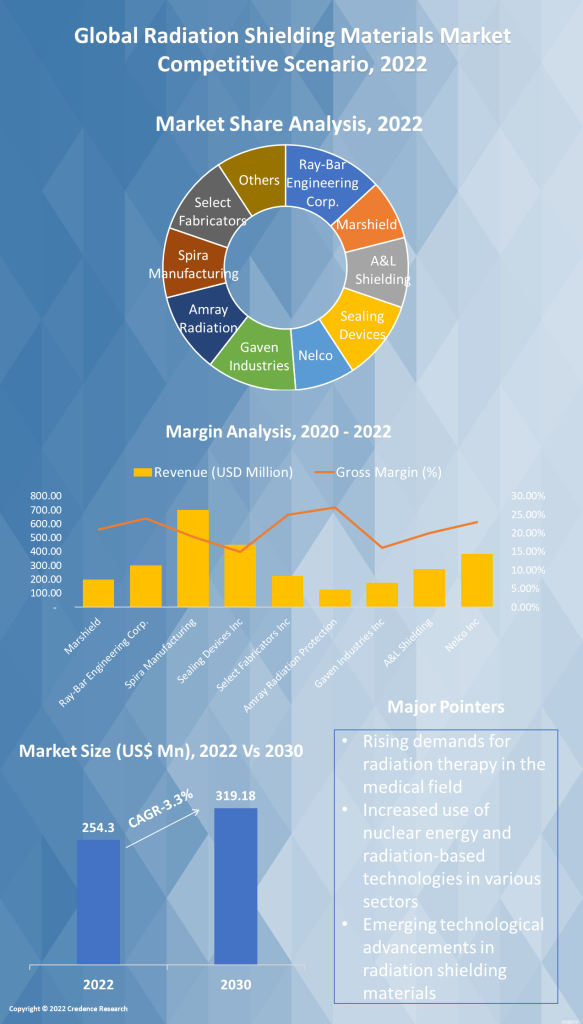
The global radiation shielding materials market is projected to grow at a substantial CAGR of 3.3% over the coming years. The global Radiation Shielding Materials industry was estimated to be worth USD 254.3 million in 2022 and was expected to be worth USD 319.18 million by 2028.
Which region dominated the radiation shielding materials market?
In 2022, North America was the dominant region in the global radiation shielding materials market, with a significant market revenue share. The increasing demand for medical imaging procedures is the primary driver of the growth of the North American market for radiation shielding materials. As imaging technologies such as X-rays, CT scans, and PET scans become more prevalent, the need for shielding materials to protect patients and healthcare workers from harmful radiation exposure also increases. In addition, the nuclear industry in the region is a significant driver of demand for radiation shielding materials. These materials are essential for ensuring the safety of workers and the environment in nuclear power plants, and large amounts of such materials are required for their construction and operation. The aerospace industry is also driving North America's radiation shielding materials market. These materials are necessary for spacecraft and satellites to protect electronic components and astronauts from cosmic radiation exposure.
How is US Market Performing in the radiation shielding materials market?
North America currently leads the global radiation shielding materials market, with the United States accounting for the largest revenue share. The radiation shielding materials market in the US is positively impacted by its well-established healthcare industry and the presence of prominent manufacturers of these materials. Additionally, developing innovative materials that provide equivalent or superior protection to lead-based options without the drawbacks of high costs and environmental concerns is driving growth in the market. As more businesses seek out eco-friendly and cost-efficient options, the demand for lead-free radiation shieldings materials like borated polyethylene and tungsten polymer composites is predicted to increase.
How is the economy impacting global radiation shielding materials growth?
Economic factors, such as recessions, inflation, and geopolitical tensions, can affect the global radiation shielding materials market. Economic recessions can reduce demand for radiation shielding materials as capital expenditure in medical imaging, nuclear power, and aerospace industries may decline. This can result in reduced investment in new technology and expansion, potentially slowing market growth. Inflation can raise production costs for raw materials, transportation, and labor, leading to higher prices for radiation shielding materials. Geopolitical tensions, such as the Russia-Ukraine War, can disrupt the global supply chain, making it harder for companies to obtain raw materials and transport finished products. Despite these challenges, the radiation shielding materials market is expected to grow due to increasing demand for medical imaging, nuclear power, and aerospace expansion and efforts to develop innovative and cost-effective materials.
What is the competitive environment of the radiation shielding materials market?
The market for radiation shielding materials is fiercely competitive, with numerous major players competing for a larger market share. Some prominent companies in the market include MarShield, Radiation Protection Products, Gaven Industries, E. I. DuPont de Nemours & Company, and Ametek Inc. These companies are investing heavily in research and development to develop innovative products and gain a competitive advantage in the market. Many new players have entered the market in recent years, further intensifying the competition. For instance, LEMO Maschinenbau GmbH, a Swiss company, introduced a new line of tungsten-based radiation shielding doors in 2020 that offer greater radiation attenuation properties than conventional doors. Furthermore, Lead2Fix BV, a Dutch company, launched a range of lead-free, lightweight radiation shielding panels in 2019. The competitive environment in the radiation shielding materials market is expected to remain fierce, with companies investing in research and development, strategic partnerships, mergers and acquisitions, and other measures to maintain a competitive edge.
Executive Summary
What are the key trends in the Radiation Shielding Materials market?
- Rising adoption of lightweight materials: The radiation shielding materials market trend is shifting towards using lightweight materials, as conventional materials tend to be heavy and unwieldy. The adoption of boron carbide and carbon fiber composites increased due to their comparable shielding properties and improved handling and transportation capabilities. These materials provide the necessary protection against radiation while being lighter in weight, making them easier to install and move. This trend towards lightweight radiation shielding materials is expected to continue to gain momentum in the market, driven by increasing demand from various end-user industries.
What are all the technical developments in the Radiation Shielding Materials Market?
The radiation shielding materials market has undergone several technical advancements recently. One of the latest improvements is using lightweight and highly effective borated polyethylene, which attenuates neutrons. Composite materials have also been developed to offer better-shielding properties than traditional materials like lead and concrete. Advanced computational methods and software have facilitated more precise modeling and simulation of radiation shielding materials, leading to their optimization in design and performance. 3D printing technology has also created intricate and customized radiation shielding structures with greater accuracy and efficiency. Moreover, machine learning and artificial intelligence are now being used to enhance the design and performance of radiation shielding materials. These innovations could enhance radiation shielding materials' effectiveness, cost-effectiveness, and safety.
Which are the key investments by the radiation shielding materials market players?
The major radiation shielding materials market players are investing substantially in research and development to create innovative products and increase their market share. To illustrate, in 2021, E. I. DuPont de Nemours and Company launched a new series of radiation shielding materials that provide elevated levels of protection against radiation exposure. Likewise, Radiation Protection Products recently introduced a new collection of radiation shielding materials free of lead for dental and medical applications. Apart from research and development, companies also focus on strategic partnerships and collaborations to extend their reach in the market. For instance, in 2020, MarShield partnered with Isotopia Molecular Imaging, a nuclear medicine company, to develop a new range of radiation shielding solutions for medical imaging applications.
Major global radiation shielding materials market players are Marshield, Nelco Inc, Ray-Bar Engineering Corp., Spira Manufacturing Corporation, Sealing Devices Inc, Select Fabricators Inc, Amray Radiation Protection, Gaven Industries Inc, and A&L Shielding.
What are the Major Driving Factors for the Radiation Shielding Materials Market?
Growth in the Medical Sector
The increasing prevalence of chronic diseases like cancer is indeed a significant driver for radiation shielding materials. For instance, globally, approximately one in three of all adults suffers from multiple chronic conditions. The global burden of non-communicable diseases (NCDs) contributes more in low- and middle-income countries, as well as among individuals with lower socioeconomic status in high-income countries, making NCDs a big hurdle to minimizing global and national health disparities. Among 55 million fatalities worldwide in 2019, NCDs accounted for about 41 million (71%) deaths.
The rising adoption of nuclear medicine and radiation therapy for diagnosis and treatment further fuels this demand. For example, it is estimated that 470,000 patients receive radiotherapy each year in the United States. According to the Center for Nuclear Science and Technology Information, about one-third of all procedures used in modern hospitals involve radiation or radioactivity.
Nuclear Energy Expansion
The potential resurgence of nuclear energy also presents a compelling driver for the radiation shielding materials market. As of June 2023, there were 57 nuclear reactors under construction worldwide. The global radiation shielding material market was estimated at USD 724.25 million in 2023. With increasing global efforts to transition towards sustainable energy sources, the construction of new nuclear power plants is gaining momentum. For instance, nuclear consumption increased by 4.8 percent worldwide in 2022 compared to the previous year. According to the new projections and assuming electricity generation will increase by 85% over the next three decades, nuclear energy could contribute about 14% of global electricity by 2050, up from its 10% share today.
Safety Awareness
Growing public awareness about the detrimental effects of radiation exposure has spurred the enactment of stricter regulations and safety standards across various industries. Heightened safety consciousness among regulatory bodies, employers, and the general populace has led to increased emphasis on radiation protection measures. Consequently, there is a rising demand for radiation shielding materials across diverse sectors, including healthcare, aerospace, nuclear, and industrial settings. This trend reflects a collective effort to mitigate the risks associated with radiation exposure and ensure compliance with evolving safety protocols.
Advancement in Materials
The continuous development of new and improved radiation shielding materials represents a significant catalyst for market growth. Innovations in material science have led to the creation of shielding materials with enhanced properties such as lighter weight, higher efficiency, and improved environmental sustainability. These advancements not only enhance the effectiveness of radiation protection but also offer cost-effective and eco-friendly solutions for end-users. The availability of such advanced materials opens up new avenues for market expansion, catering to the evolving needs of industries requiring radiation shielding solutions. As research and development efforts continue to drive innovation in this field, the market is poised to witness sustained growth fueled by the demand for cutting-edge shielding materials across various applications.
What are the Major Risks for the Radiation Shielding Materials Market?
The growth and profitability of the radiation shielding materials market are vulnerable to several risks. One of the significant constraints is the high cost of raw materials used in producing radiation shielding materials. Materials like lead and tungsten are expensive, resulting in an expensive final product that may not be accessible to small and medium-sized companies. Moreover, the market faces a challenge from the stringent regulatory framework that governs the use and disposal of radiation shielding materials. Compliance with various regulations and standards is necessary to ensure these materials' safe use and disposal, which can be time-consuming and costly. The slow adoption of new technologies in the industry also poses a risk to the market. Compared to competitors who have implemented advanced technologies, the radiation shielding materials market has needed to be faster to adopt new technologies, leading to a potential loss of market share.
Which is the key radiation type in the radiation shielding materials market?
The acoustic radiation segment will hold a major share of the global radiation shielding materials market over the forecasted period. The acoustic radiation sector of the radiation shielding materials market is experiencing growth due to the rising requirement for noise reduction and control in industries such as construction, automotive, and aerospace. Using acoustic radiation shielding materials can aid in lowering noise pollution, enhancing the safety and comfort of occupants. Moreover, the demand for acoustic radiation shielding materials is driven by the need to adhere to safety and environmental regulations. Additionally, developments in technology and materials science are creating advanced acoustic radiation shielding materials that offer better durability and performance.
How is the radiation shielding materials market performing in regions?
During the forecast period, the Asia Pacific region is projected to witness the fastest growth in the global radiation shielding materials market. Several factors are driving the Asia Pacific radiation shielding materials market. One of the significant drivers is the increasing use of nuclear energy and medical imaging technologies in the region. The growing demand for electricity in countries like China and India has led to a rise in nuclear power plants, which has resulted in an increased demand for radiation-shielding materials to ensure the safety of workers and the environment. Additionally, the rising incidence of cancer in the region has increased the demand for medical imaging procedures like CT and PET scans, which also require radiation-shielding materials. With the increasing demand for radiation shielding materials in the Asia Pacific region, major players in the market are expanding their operations and investing in research and development to meet the evolving needs of their customers. This includes expanding their production capacities and enhancing their distribution networks. For instance, in October 2021, MarShield, a leading radiation shielding materials manufacturer, announced the opening of a new production facility in Malaysia to cater to the increasing demand in the Asia Pacific region.
What is the regulatory landscape for the radiation shielding materials market?
The regulatory landscape for the radiation shielding materials market differs based on the region and industry. In the United States, the Nuclear Regulatory Commission (NRC) regulates the use of radiation shielding materials in the nuclear power industry to ensure safety for the public and workers. The NRC has established specific standards and requires testing to validate the effectiveness of radiation shielding materials. The US FDA oversees the use of radiation shielding materials in medical devices like X-ray machines and CT scanners, ensuring that they meet safety and effectiveness standards before being used in clinical settings. In the European Union, the use of radiation shielding materials is regulated by the European Commission and national regulatory bodies. The EU has set standards for radiation protection for different industries, including nuclear power and medical imaging. Overall, the use of radiation shielding materials is regulated to ensure the safety of workers, patients, and the environment. Companies must comply with regulatory standards to ensure the safety and effectiveness of their products.
What are the major players planning for the future of the radiation shielding materials market?
Major players in the radiation shielding materials market are actively pursuing new and innovative materials that offer better protection and are more cost-effective. For example, in January 2022, Ametek, a prominent radiation shielding material manufacturer, acquired Blore Edwards, a German company, to expand its product portfolio and strengthen its European presence. Ametek plans to utilize Blore Edwards' expertise in high-temperature and radiation-shielding materials to develop new solutions for its customers. Similarly, in November 2021, Radiation Protection Products (RPP), a major player in the market, announced the expansion of its manufacturing facility in New York to meet the increasing demand for its products. The expansion includes adding new equipment and increasing production capacity, resulting in quicker lead times and better customer service. Overall, key players in the radiation shielding materials market are committed to expanding their product offerings, enhancing production capabilities, and developing novel solutions to meet the ever-changing demands of their customers.
| REPORT ATTRIBUTE | DETAILS |
|---|---|
| Radiation Shielding Materials Market by Volume | Yes |
| Radiation Shielding Materials Market by Value | Yes |
| Radiation Shielding Materials Market, Tornado Analysis | Yes |
| Radiation Shielding Materials Market, STAR Analysis | Yes |
| Radiation Shielding Materials Market, SRC Analysis | Yes |
| Radiation Shielding Materials Market, Import-Export Data | Yes (On Demand) |
| Radiation Shielding Materials Market Pricing Analysis | Yes (On Demand) |
| Radiation Shielding Materials Market Segment Analysis | By Radiation Type (Electromagnetic Radiation, Particle Radiation, Acoustic Radiation, and Gravitational Radiation) By Material (Ceramicrete, Plexiglas, Depleted Uranium, Tin, Antimony, Tungsten, Lead, Rubber, and Others) By End-User (Diagnostic Centers, Hospitals, Oncology Department, Nuclear Energy Plant, and Others) |
| Radiation Shielding Materials Market, Regional Analysis | North America (US and Canada) Europe (Spain, Germany, UK, France, Italy, and the Rest of Europe) Asia Pacific (Japan, India, South Korea, China, South East Asia, and the Rest of Asia Pacific) Latin America (Brazil, Mexico, and the Rest of Latin America) Middle East and Africa (GCC Countries, South Africa, and the Rest of the Middle East and Africa) |
| Radiation Shielding Materials Market Key Companies | Marshield, Nelco Inc, Ray-Bar Engineering Corp., Spira Manufacturing Corporation, Sealing Devices Inc, Select Fabricators Inc, Amray Radiation Protection, Gaven Industries Inc, A&L Shielding |
| Radiation Shielding Materials Market Competitive Landscape | Market Share Analysis Competitive Benchmarking Key Players Market Positioning Geographical Presence Analysis Major Strategies Adopted |
Segmentation of Global Radiation Shielding Materials Market-
Global Radiation Shielding Materials Market – By Radiation Type
- Electromagnetic Radiation
- Particle Radiation
- Acoustic Radiation
- Gravitational Radiation
Global Radiation Shielding Materials Market – By Material
- Ceramicrete
- Plexiglas
- Depleted Uranium
- Tin
- Antimony
- Tungsten
- Lead
- Rubber
- Others
Global Radiation Shielding Materials Market – By End-User
- Diagnostic Centers
- Hospitals
- Oncology Department
- Nuclear Energy Plant
- Others
Global Radiation Shielding Materials Market – By Region
- North America
- U.S.
- Canada
- Europe
- Germany
- France
- U.K.
- Italy
- Spain
- Rest of Europe
- Asia Pacific
- China
- Japan
- India
- South Korea
- South-east Asia
- Rest of Asia Pacific
- Latin America
- Brazil
- Mexico
- Rest of Latin America
- Middle East & Africa
- GCC Countries
- South Africa
- Rest of the Middle East and Africa
Request a Free Sample
Fill in your details and we'll send you a free sample report.
- Sample data tables & charts
- Research methodology
Need a Custom Version of This Report?
Tailor the scope, geography, or segments to your exact requirements.
- Custom geography or segment scope
- Direct access to our analyst team
Frequently Asked Questions
How does COVID-19 impact the global radiation shielding materials market?
Which is the leading region of the market for radiation shielding materials?
What are the key drivers for the growth of the radiation shielding materials market?
Which is the major segment in the radiation shielding materials market by radiation type?
Which is the major segment in the radiation shielding materials market by material?
Table of Content
Chapter 1. Report Introduction
- 1.1 Report Description & Purpose
- 1.1.1 Report Title & Market Definition
- 1.1.2 Unique Selling Propositions (USP) & Key Differentiators
- 1.1.3 Value Proposition for Stakeholders
- 1.2 Research Objectives
- 1.2.1 Market Sizing Objectives (Volume & Revenue)
- 1.2.2 Segmentation Objectives
- 1.2.3 Competitive Intelligence Objectives
- 1.2.4 Forecast & Scenario Objectives
- 1.3 Report Scope
- 1.3.1 Radiation Shielding Materials Scope – Types & Subtypes Covered
- 1.3.2 Geographic Scope – Regions & Countries Covered
- 1.3.3 Historical Period, Base Year & Forecast Period (the historical period; forecast to the forecast period)
- 1.3.4 Inclusions & Exclusions
- 1.4 HS Code & Classification Framework
- 1.5 Currency, Units & Pricing Basis
- 1.6 Target Stakeholders
- 1.7 Limitations & Assumptions
Chapter 2. Executive Summary
- 2.1 Global Radiation Shielding Materials Market Snapshot
- 2.1.1 Market Size – Historical (the historical period) & Forecast (the forecast period) (base year: NULL → forecast year: NULL)
- 2.1.2 Volume & Revenue – Global Totals
- 2.1.3 Key Market Highlights – Top Five Facts
- 2.2 Radiation Shielding Materials Market Segmentation Snapshot
- 2.2.1 Market Split by Region – vs.
- 2.3 Competitive Snapshot
- 2.3.1 Top 10 Players by Revenue Share –
- 2.3.2 Top 10 Players by Volume Share –
- 2.3.3 Recent Strategic Developments (18-Month Summary)
- 2.4 Key Investment Highlights & Strategic Conclusions
Chapter 3. Radiation Shielding Materials Market Dynamics & Industry Analysis
- 3.1 Market Overview & Context
- 3.1.1 Radiation Shielding Materials Market Position in the Broader Automotive Value Chain
- 3.1.2 OEM vs. Replacement Market Dynamics
- 3.1.3 Market Maturity & Development Stage by Region
- 3.2 Radiation Shielding Materials Market Drivers
- 3.3 Radiation Shielding Materials Market Restraints & Challenges
- 3.4 Radiation Shielding Materials Market Opportunities
- 3.5 Porter's Five Forces Analysis
- 3.5.1 Threat of New Entrants
- 3.5.2 Bargaining Power of Suppliers
- 3.5.3 Bargaining Power of Buyers
- 3.5.4 Threat of Substitutes
- 3.5.5 Competitive Rivalry – Intensity Assessment
- 3.6 Radiation Shielding Materials Value Chain Analysis
- 3.6.1 Upstream – Raw Material/Input Suppliers
- 3.6.1.1 Raw Material/Input 1
- 3.6.1.2 Raw Material/Input 2
- 3.6.1.3 Raw Material/Input 3
- 3.6.2 Midstream – Production/Manufacturing/Service Delivery
- 3.6.2.1 Production/Process Overview
- 3.6.2.2 Key Facility Locations & Capacity by Manufacturer
- 3.6.3 Downstream – Distribution & End Consumer
- 3.6.3.1 Primary Channel – B2B/OEM
- 3.6.3.2 Secondary Channels – Dealer, Retail, Online, Direct
- 3.6.4 Value Chain Profitability Analysis
- 3.6.1 Upstream – Raw Material/Input Suppliers
- 3.7 PESTEL Analysis
- 3.7.1 Political Factors
- 3.7.2 Economic Factors
- 3.7.3 Social Factors
- 3.7.4 Technological Factors
- 3.7.5 Environmental Factors
- 3.7.6 Legal Factors
- 3.8 Radiation Shielding Materials Supply Chain Analysis
- 3.8.1 Raw Material/Input Supply Risk Assessment
- 3.8.2 Manufacturing Concentration Risk (Geographic Exposure)
- 3.8.3 Trade Disruption Impact Analysis
- 3.9 Regulatory & Policy Landscape
Note: The regulatory and policy landscape section covers regulations based on their applicability to the market, Radiation Shielding Materials category, geography, and scope of the study. Only regulatory frameworks with a material impact on operations, compliance, trade, sustainability, or market access are analyzed in detail.
Chapter 4. Key Investment Pockets & Opportunity Analysis
- 4.1 Radiation Shielding Materials Market Attractiveness Analysis
- 4.1.1 By Region – Investment Attractiveness Matrix (Volume × CAGR)
- 4.2 Absolute Revenue Growth Opportunity
- 4.2.1 By Region – Absolute USD Growth Through the forecast period
- 4.3 Incremental Volume Opportunity
- 4.3.1 By Region – Incremental Volume Through the forecast period
- 4.3.2 Segment – Incremental Volume
- 4.4 Emerging Submarket Opportunity Deep Dive (Subject to Applicability)
- 4.5 Emerging Market Opportunity Scorecards
- 4.5.1 United States
- 4.5.2 Europe
- 4.5.3 Asia
- 4.5.4 Middle East & Africa
Note: Emerging Market Opportunity Scorecards will be included based on relevance and strategic importance. Regions listed are indicative and may vary depending on data availability and market dynamics.
Chapter 5. Radiation Shielding Materials Import-Export Analysis & Trade Flows
- 5.1 Global Trade Overview
- 5.1.1 Global Export Value by Country (the historical period)
- 5.1.2 Global Export Volume by Country (the historical period)
- 5.1.3 Global Import Value by Country (the historical period)
- 5.1.4 Global Import Volume by Country (the historical period)
- 5.1.5 Net Trade Balance by Country (the historical period)
- 5.2 Export Analysis – Segment
- 5.2.1 Type 1 (HS Code)
- 5.2.2 Type 2 (HS Code)
- 5.2.3 Type 3 (HS Code)
- 5.2.4 Type 4 (HS Code)
- 5.2.5 Type 5 (HS Code)
- 5.3 Import Analysis – Segment
- 5.3.1 Type 1 (HS Code)
- 5.3.2 Type 2 (HS Code)
- 5.3.3 Type 3 (HS Code)
- 5.3.4 Type 4 (HS Code)
- 5.3.5 Type 5 (HS Code)
- 5.4 Average Unit Trade Prices
- 5.4.1 Average Export Price – Segment & Country
- 5.4.2 Average Import Price – Segment & Source Country
- 5.4.3 Price Trends (the historical period)
- 5.5 Key Trade Route Analysis
- 5.5.1 Trade Route 1
- 5.5.2 Trade Route 2
- 5.5.3 Trade Route 3
- 5.5.4 Trade Route 4
- 5.5.5 Trade Route 5
- 5.6 Trade Policy Impact Assessment
- 5.6.1 US Anti-Dumping & Section 301 Tariffs
- 5.6.2 EU Customs Union Impact
- 5.6.3 Major Free Trade Agreements
- 5.6.4 USMCA Rules of Origin
Note: Trade policy analysis will be included only where relevant to the Radiation Shielding Materials market.
Chapter 6. Competitive Landscape & Company Benchmarking
- 6.1 Radiation Shielding Materials Market Concentration & Structure
- 6.1.1 Herfindahl-Hirschman Index (HHI) – vs.
- 6.1.2 Tier 1, Tier 2 & Tier 3 Market Structure
- 6.1.3 Global, Regional & Local Player Dynamics
- 6.2 Radiation Shielding Materials Market Share Analysis –
- 6.2.1 Global Revenue Share by Company
- 6.2.2 Global Volume Share by Company
- 6.2.3 Regional Revenue Share
- 6.2.4 Market Share Evolution ( vs. )
- 6.2.5 OEM Segment Share by Company
- 6.2.6 Replacement Segment Share by Company
- 6.3 Production/Delivery Capacity & Facility Analysis
- 6.3.1 Global Installed Capacity
- 6.3.2 Capacity Utilization Rates
- 6.3.3 Production/Output Volume
- 6.3.4 Facility Locations & Capacity Map
- 6.3.5 Planned Capacity Additions
- 6.4 Radiation Shielding Materials Competitive Benchmarking Matrix
- 6.4.1 Revenue, Volume, CAGR & Profitability Comparison
- 6.4.2 Channel Revenue Mix
- 6.4.3 Geographic Revenue Exposure
- 6.4.4 R&D Intensity
- 6.4.5 Sustainability Maturity
- 6.5 Strategic Developments in Radiation Shielding Materials (Last 24 Months)
- 6.5.1 Mergers, Acquisitions & Divestments
- 6.5.2 New Radiation Shielding Materials Launches
- 6.5.3 Facility Expansions
- 6.5.4 Strategic Alliances, Joint Ventures & Partnerships
- 6.5.5 Distribution Expansion & Market Entry
- 6.5.6 Sustainability & ESG Initiatives
- 6.6 Competitive Strategy Mapping
- 6.6.1 Leader, Challenger, Follower & Niche Classification
- 6.6.2 Pricing Strategy Comparison
- 6.6.3 Channel Strategy Matrix
Note: Strategic developments are included based on their materiality and the availability of reliable information.
Chapter 7. Global Radiation Shielding Materials Market – By Distribution Channel
- 7.1 Segment Overview
- 7.1.1 Volume & Revenue Split by Channel ( & )
- 7.1.2 Channel Mix Evolution (the forecast period)
Chapter 8. Regional Market Analysis – Global Overview
- 8.1 Global Regional Overview
- 8.1.1 Regional Volume Share
- 8.1.2 Regional Revenue Share
- 8.1.3 Regional Volume by Region
- 8.1.4 Regional Revenue by Region
- 8.1.5 Regional Forecast Through the forecast period
- 8.2 Cross-Regional Segment Analysis
- 8.2.1 By Distribution Channel
- 8.2.2 By Brand/Price Tier
Chapter 9. North America Radiation Shielding Materials Market
- 9.1 United States
- 9.2 Canada
- 9.3 Mexico
Chapter 10. Europe Radiation Shielding Materials Market
- 10.1 Germany
- 10.2 France
- 10.3 Italy
- 10.4 United Kingdom
- 10.5 Spain
- 10.6 Poland
- 10.7 Russia
- 10.8 Netherlands
- 10.9 Belgium
- 10.10 Sweden
- 10.11 Denmark
- 10.12 Norway
- 10.13 Rest of Europe
Chapter 11. Asia Pacific Radiation Shielding Materials Market
- 11.1 China
- 11.2 India
- 11.3 Japan
- 11.4 South Korea
- 11.5 Thailand
- 11.6 Indonesia
- 11.7 Vietnam
- 11.8 Malaysia
- 11.9 Australia
- 11.10 Rest of Asia Pacific
Chapter 12. Latin America Radiation Shielding Materials Market
- 12.1 Brazil
- 12.2 Argentina
- 12.3 Colombia
- 12.4 Chile
- 12.5 Rest of Latin America
Chapter 13. Middle East Radiation Shielding Materials Market
- 13.1 Saudi Arabia
- 13.2 United Arab Emirates
- 13.3 Turkey
- 13.4 Israel
- 13.5 Iran
- 13.6 Rest of the Middle East
Chapter 14. Africa Radiation Shielding Materials Market
- 14.1 South Africa
- 14.2 Egypt
- 14.3 Nigeria
- 14.4 Morocco
- 14.5 Rest of Africa
Chapter 15. Radiation Shielding Materials Company Profiles
- 15.1 [Company 01]
- 15.1.1 Company Overview
- 15.1.2 Key Management Personnel
- 15.1.3 Products & Services Portfolio
- 15.1.4 Financial Performance
- 15.1.5 Key Market Focus & Geographic Presence
- 15.1.6 Recent Developments & Strategic Initiatives
Note: The company profile list is preliminary and may change based on research findings, market developments, data availability, and client requirements.
Chapter 16. Appendices
- Appendix A – List of Abbreviations & Acronyms
- Appendix B – Industry Classification Code Reference – Full Series
- Appendix C – Production & Capacity Data Tables
- Appendix D – End-Use & Demand Base Tables
- Appendix E – Consumption & Replacement Rate Assumptions
- Appendix F – ASP Reference Tables
- Appendix G – Manufacturing & Facility Database
- Appendix H – Import-Export Data Tables
- Appendix I – Regulatory Summary Tables
- Appendix J – Primary Research Participant List (Anonymized)
- Appendix K – Primary Research Questionnaire Framework
- Appendix L – Data Sources & Bibliography
- Appendix M – Market Size Divergence & Source Comparison
Chapter 17. Research Methodology
- 17.1 Research Framework & Philosophy
- 17.2 Secondary Research – Sources, Hierarchy & Data Extraction
- 17.3 Data Modeling – Bottom-Up & Top-Down Market Sizing
- 17.4 Primary Research – Stakeholder Framework, LOI & Sample Sizes
- 17.5 Forecast Methodology – Regression, Scenario & Sensitivity Analysis
- 17.6 Quality Control – Four-Layer Validation Framework
- 17.7 Limitations & Standard Assumptions
- 17.8 Disclaimer
