Executive Summary & Core Metrics
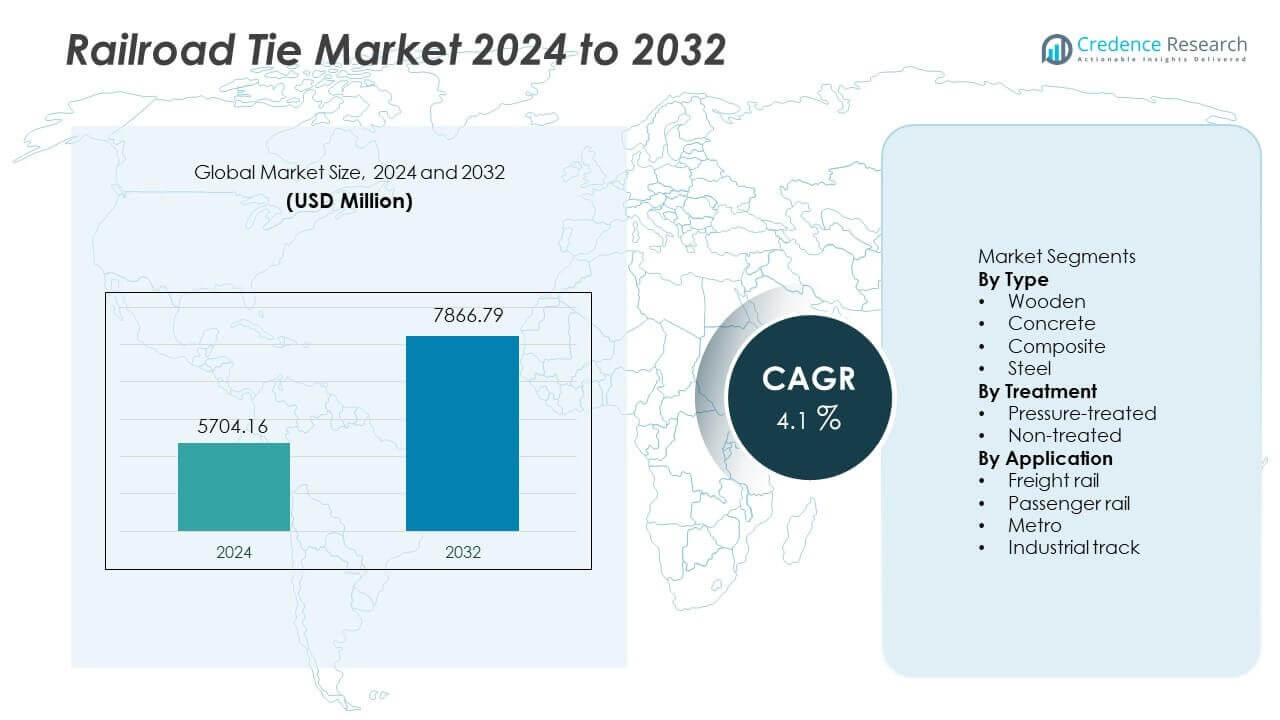
The global railroad tie market was valued at USD 5,704.16 million in 2024 and is projected to reach USD 7,866.79 million by 2032, expanding at a compound annual growth rate (CAGR) of 4.1% during the forecast period, according to Credence Research. This growth reflects steady demand for durable track support materials across freight rail, passenger rail, metro systems and industrial track networks, where railroad ties support load distribution, track stability, vibration control and long-term rail alignment.
| REPORT ATTRIBUTE | DETAILS |
|---|---|
| Historical Period | 2020-2023 |
| Base Year | 2024 |
| Forecast Period | 2025-2032 |
| Railroad Tie Market Size 2024 | USD 5,704.16 million |
| Railroad Tie Market, CAGR | 4.1% |
| Railroad Tie Market Size 2032 | USD 7,866.79 million |
The global railroad tie market is characterized by the presence of established rail infrastructure suppliers, wood treatment specialists, concrete tie manufacturers and composite material innovators competing on durability, lifecycle cost, load-bearing strength, environmental compliance and supply reliability. Leading players focus on wooden, concrete, composite and steel ties designed to withstand heavy axle loads, climatic stress, moisture exposure and high-frequency rail operations. Strategic priorities across the sector include advanced preservative treatment, recyclable composite development, concrete tie capacity expansion, lifecycle extension, automated installation support and long-term supply programs with rail operators and government transport agencies.
Strategic Market Insights
- Market growth is primarily driven by freight rail expansion, heavy-haul network modernization, metro development and sustained replacement demand across aging track infrastructure.
- Dominant industry trends highlight rising adoption of concrete and composite ties, especially in high-speed, metro and heavy-haul corridors where vibration control, moisture resistance, lower maintenance and longer service life are critical.
- The competitive landscape is shaped by product improvements in preservative treatment, higher load capacity, recycled composite technologies and concrete tie manufacturing, while material costs and environmental compliance rules restrain faster replacement in cost-sensitive markets.
- According to Credence Research regional mapping, Asia Pacific represents the largest market, accounting for a definitive 34% share due to rapid rail construction in China, India and Southeast Asia, supported by high-speed rail, metro expansion and industrial freight corridor development.
Railroad Tie Market Segmentation Analysis
By Type
- Wooden
- Concrete
- Composite
- Steel
Data compiled by Credence Research confirms that wooden railroad ties constitute the dominant type segment, holding an estimated 46% market share. Their leadership is supported by strong load-bearing properties, easy installation, established procurement networks and broad use across freight and regional rail infrastructure. Wooden ties remain preferred in many standard rail applications because they are relatively cost-effective, easy to replace and compatible with existing maintenance practices. Treated hardwood solutions are especially important for long-distance freight lines that require flexible, durable and proven track support materials.
Concrete and steel ties continue to expand in heavy-haul and high-speed rail networks due to their long service life, structural stability and resistance to high axle loads. Composite ties are gaining adoption in applications requiring moisture resistance, decay prevention and lower environmental exposure from chemical preservatives. However, wooden ties remain dominant due to established supply chains, lower upfront cost and wide acceptance among maintenance crews.
Stella-Jones operates a network of more than 40 treating and distribution facilities that handle hardwood and softwood products across North America, supporting large-volume wood tie supply for freight and passenger rail networks.
By Treatment
- Pressure-treated
- Non-treated
Credence Research identifies pressure-treated ties as the leading treatment segment, accounting for approximately 59% of global market share. Pressure-treated ties dominate because they offer improved durability, moisture resistance, insect protection and decay prevention in exposed outdoor rail environments. Treatment technologies extend the service life of wooden ties and reduce replacement frequency across high-traffic freight, passenger and industrial corridors. Rail operators increasingly specify treated ties for heavy-haul networks, regional track upgrades and exposed-weather installations where lifecycle performance is critical.
Non-treated ties continue to be used in light-load, temporary or low-cost track applications, but they provide shorter service life and lower protection against environmental damage. The long-term market trend favors treated products due to safety requirements, maintenance cost control and increasing demand for durable track infrastructure.
Koppers has supplied treated crossties using copper-naphthenate and creosote technologies across North American treating and recovery plants, supporting tie lifecycle services for rail operators.
By Application
- Freight rail
- Passenger rail
- Metro
- Industrial track
Freight rail dominates the application segment with an estimated 48% market share. This leadership is supported by heavy-haul operations, bulk commodity transport, mining logistics, agricultural exports and continuous rail movement across national corridors. Freight networks require ties that can withstand high axle loads, repeated vibration, long-distance movement and demanding weather exposure. Treated wooden ties and reinforced concrete ties are widely used to maintain track stability across freight corridors serving industrial and export markets.
Passenger rail follows as operators invest in track modernization, safety upgrades and comfort improvements. Metro systems increasingly adopt concrete and composite ties for vibration control, structural stability and lower maintenance in high-frequency urban operations. Industrial track remains smaller but uses steel and composite ties for specialized applications in plants, ports, logistics facilities and mining areas. Demand across applications reflects the need for durable, reliable and cost-efficient track support systems.
Key Market Dynamics
Primary Market Drivers
Expansion of Freight and Heavy-Haul Networks
Freight and bulk commodity transport continue to increase, raising demand for durable railroad ties that can support heavy axle loads and long-distance movement. Industrial supply chains rely on stable rail infrastructure for mining, agriculture, energy and export shipping. Rail operators invest in modernization and maintenance programs to improve axle-load performance, vibration control and operational reliability. Growing freight capacity encourages replacement of aging wooden ties with longer-lasting treated, concrete and composite alternatives. Credence Research identifies freight network expansion as a core driver of long-term tie installation across national rail corridors. Evertrak supplies its Evertrak 7000 composite ties, which are designed for heavy-haul freight lines and promoted with a service life of more than 50 years.
Modernization of Passenger and Metro Rail Projects
Passenger and metro rail programs are expanding across urban regions to reduce road congestion, improve mobility and support public transit adoption. These projects require track materials that provide vibration control, ride stability and lower maintenance frequency. Concrete and composite ties are gaining wider adoption in metro and passenger systems due to their structural stability, corrosion resistance and long-term performance. Governments continue investing in transit modernization to reduce emissions and improve transport efficiency. Vossloh AG manufactures prestressed concrete ties and synthetic composite sleepers tailored to high-speed and metro rail projects across North American and European transit networks.
Enhanced Treatment and Protection Technologies
Advanced wood treatment and material protection technologies are improving lifecycle performance in the railroad tie market. Pressure treatment, preservative chemicals and improved processing methods help wooden ties resist moisture, decay, insects and climatic stress. Composite and concrete products also benefit from material engineering that improves durability, moisture resistance and long-term structural performance. Rail operators need track materials that reduce replacement downtime, lower lifecycle costs and perform reliably under demanding rail conditions. Credence Research indicates that enhanced treatment and protection technologies will continue to support demand for durable railroad ties across freight and passenger systems.
Key Trends & Structural Opportunities
Growth of Composite and Concrete Adoption
Composite and concrete railroad ties are gaining adoption because they provide structural stability, long service life and resistance to harsh environments. Composite ties are especially useful in humid, coastal or environmentally sensitive areas where moisture resistance and decay prevention are important. Concrete ties meet heavy-haul, metro and high-speed rail requirements by improving vibration control and track reliability. These materials create strong opportunities for rail modernization programs, particularly across industrial corridors, metro lines and high-speed networks. Pandrol delivered composite bearers for the London Underground upgrade program, while composite sleepers are designed to combine timber-like handling benefits with extended service life.
Sustainability and Recyclable Material Development
Sustainability is becoming an important opportunity in the railroad tie market. Rail operators are focusing on environmentally balanced sourcing, recycled composite technologies and reduced reliance on chemically treated wood. Composite ties made from recycled plastic and reinforced fibers can reduce timber use, improve moisture resistance and support environmental compliance. Manufacturers are developing recyclable components that reduce lifecycle waste and align with green infrastructure standards. Sicut supplied recycled-plastic composite sleepers to Network Rail, helping address creosote restrictions while reducing embodied carbon compared with treated softwood or concrete ties over the track lifecycle.
Increasing Use of Digital Inspection for Predictive Tie Replacement
Digital inspection technologies are creating new opportunities for railroad tie suppliers and maintenance service providers. Rail operators increasingly use automated track inspection, sensor-based monitoring and predictive maintenance tools to identify tie degradation before failures occur. These systems help operators prioritize replacement programs, reduce service disruption and optimize maintenance budgets. Digital inspection also supports better lifecycle tracking for wooden, concrete and composite ties. Credence Research identifies predictive tie replacement as an emerging opportunity as rail networks seek higher safety standards and lower long-term maintenance costs.
Industry Challenges
High Cost of Concrete and Composite Production
Concrete and composite ties remain more expensive than standard wooden alternatives. High procurement costs restrict wide adoption in cost-sensitive rail networks, especially across developing regions where replacement budgets are limited. Advanced materials, production processes and transportation requirements can raise project costs. These cost barriers slow rapid transition away from traditional wood, even where concrete and composite ties offer longer service life and lower maintenance. Operators must balance lifecycle savings against immediate capital constraints.
Environmental Regulations for Chemical Treatment
Pressure-treated wooden ties rely on chemical preservatives that require strict environmental controls for installation, handling, disposal and recycling. Regulatory compliance increases costs and restricts certain treatment options in some markets. Environmental policy shifts are pushing rail operators to evaluate alternative materials, including composite and concrete ties. However, transitioning away from treated wood can create operational and budget challenges across large replacement programs. Manufacturers must continue improving preservative technologies and recycling practices to meet evolving environmental standards.
Detailed Regional Analysis
| Region | Market Share (%) | Strategic Regional Catalysts & Insights |
| Asia Pacific | 34.0% | Global leader. Driven by rapid rail construction in China, India and Southeast Asia, high-speed rail expansion, metro development and industrial freight corridor growth. |
| North America | 31.0% | Strong demand market. Supported by freight-oriented networks, heavy-haul corridors, replacement cycles and growing use of treated wood and composite ties. |
| Europe | 26.0% | Mature regional market. Driven by high-speed passenger corridors, metro modernization, environmental standards and adoption of sustainable composite materials. |
| Latin America | 5.0% | Developing regional market. Supported by mining logistics, agricultural exports, freight rail investment and selective metro expansion across Brazil, Argentina and Chile. |
| Middle East & Africa | 4.0% | Emerging territory. Supported by industrial rail expansion, mining logistics, Gulf metro projects and new freight corridor development. |
Asia Pacific leads the global railroad tie market with a 34% share, according to Credence Research. The region benefits from rapid rail construction across China, India and Southeast Asia. Concrete and composite ties are widely adopted across new freight, high-speed and metro networks due to durability, vibration control and long-term lifecycle performance. Expanding industrial corridors increase heavy-haul operations and drive continuous tie procurement. Major metro construction in large cities also strengthens demand for high-durability materials. Government-backed rail development and modern transit programs are expected to sustain the region’s leading position through the forecast period.
North America holds 31% of the global railroad tie market, supported by strong freight operations, extensive industrial rail networks and high replacement cycles across the United States and Canada. Wooden and concrete ties dominate long-haul lines that support bulk commodity shipping, mining and agricultural movements. The region continues investing in heavy-haul corridors and urban metro extensions, sustaining demand across freight and passenger systems. Regulatory focus on wood treatment and replacement of aging infrastructure drives purchases of pressure-treated and composite ties. Maintenance programs and selective high-speed development also support long-term market growth.
Europe accounts for 26% of the global market, driven by cross-country rail networks, metro modernization and high-speed passenger corridors across Germany, France and the United Kingdom. Concrete ties remain widely used because of their structural stability under high axle loads and long-distance operations. Rail agencies are increasingly adopting sustainable composite materials to meet environmental standards and reduce timber dependency. Replacement programs across aging freight lines support demand for durable materials. Investments in urban transit and inter-European passenger rail continue to enhance tie requirements across major industrial and metropolitan routes.
Competitive Landscape & Recent Developments
The railroad tie market is moderately competitive, with major suppliers focusing on wooden, concrete, composite and steel ties for freight, passenger, metro and industrial networks. Key players include Vossloh AG, Koppers Holdings Inc., L.B. Foster Company, Stella-Jones Inc., TieTek LLC, Lewis Bolt & Nut Company, CTR Manufacturing, KSA Limited, Gross & Janes Co. and Pandrol SAS. These companies compete through production capacity, treatment technologies, material innovation, long-term rail contracts and compliance with durability and environmental standards.
Market leaders continue investing in pressure-treated wood products to improve structural integrity and extend service life across heavy freight corridors. Composite tie development is gaining momentum with polymer-based materials that reduce maintenance needs and environmental impact. Concrete tie suppliers target high-speed, metro and heavy-haul rail applications because of superior load handling and vibration control. Global manufacturers also enter long-term supply programs with government rail agencies and private operators. Recycling methods, preservative upgrades and lifecycle cost reduction remain important differentiators across large rail networks.
Recent Industry Developments (2023–2025)
- In October 2025, Vossloh AG completed the acquisition of Sateba, adding European concrete-tie manufacturing capabilities to its portfolio.
- In July 2023, Pandrol announced a five-year extension to its agreement to act as Kansas-based Sicut North America Inc.’s sole distributor for Sicut’s glass-reinforced recycled plastic ties across North America.
- In July 2023, L.B. Foster Company announced that its CXT Inc. subsidiary completed the sale of substantially all operating assets of its prestressed concrete railroad tie business in Spokane, Washington, to voestalpine Railway Systems Nortrak LLC.

Request a Free Sample
Fill in your details and we'll send you a free sample report.
- Sample data tables & charts
- Research methodology
Need a Custom Version of This Report?
Tailor the scope, geography, or segments to your exact requirements.
- Custom geography or segment scope
- Direct access to our analyst team
Frequently Asked Questions
What is the current and projected size of the global railroad tie market?
What is the projected growth rate of the railroad tie industry over the forecast period?
Which type segment holds the maximum market share within the railroad tie industry?
Which treatment segment dominates the railroad tie market?
Which application segment leads the railroad tie market?
Table of Content
Chapter 1 Market Segmentation
- 1.1 Segmentation Framework
- 1.1.1 Product and Service Classification
- 1.1.2 Application and End-Use Classification
- 1.1.3 Technology and Solution Classification
- 1.1.4 Customer and Distribution Channel Classification
- 1.1.5 Geographic Segmentation
- 1.1.6 Market Segment Definitions and Boundaries
Chapter 2 Introduction
- 2.1 Report Objectives and Scope
- 2.2 Product Definition and Industry Terminology
- 2.3 Market Inclusions and Exclusions
- 2.4 Research Process
- 2.4.1 Primary Research and Expert Interviews
- 2.4.2 Secondary Research and Source Review
- 2.4.3 Top-Down and Bottom-Up Estimation
- 2.4.4 Data Triangulation and Verification
- 2.5 Market Size Measurement Basis
- 2.5.1 2024: USD 5,704.16 million → 2032: USD 7,866.79 million
- 2.6 Historical and Forecast Reference Periods
- 2.6.1 Base Year: 2024
- 2.6.2 Forecast Period: 2024-2032
- 2.7 Research Assumptions and Limitations
Chapter 3 Executive Summary
- 3.1 Market Snapshot and Key Findings
- 3.2 Base-Year Market Size, 2024
- 3.3 Forecast Market Size, 2032
- 3.4 Revenue and Volume Growth Outlook
- 3.5 Key Demand and Supply Indicators
- 3.6 Leading Market Segments
- 3.7 Fastest-Growing Market Opportunities
- 3.8 Regional Performance Highlights
- 3.9 Technology and Industry Transformation
- 3.10 Competitive Landscape Summary
- 3.11 Analyst View and Strategic Implications
Chapter 4 Global Railroad Tie Market Trends and Developments
- 4.1 Historical Industry Development
- 4.2 Recent Market Trends and Developments
- 4.3 Demand and Customer Behavior Trends
- 4.4 Technology and Product Innovation
- 4.5 Artificial Intelligence, Automation and Digitalization
- 4.6 Local Manufacturing and Supply Chain Realignment
- 4.7 Industry Partnerships, Mergers and Acquisitions
- 4.8 Sustainability and Circular Economy Developments
- 4.9 Government and Private Sector Investment Trends
- 4.10 Emerging Business Models and Commercialization
- 4.11 Industry Developments and Announcements
Chapter 5 Global Railroad Tie Market Production, Supply and Demand Analysis
- 5.1 Demand Trend and Consumption Analysis
- 5.2 Demand Forecast, 2024-2032
- 5.3 Production and Output Trend
- 5.4 Production and Output Forecast, 2024-2032
- 5.5 Installed Capacity and Capacity Utilization
- 5.6 Company-Wise Production Plants and Statistics
- 5.6.1 Installed Production Capacity
- 5.6.2 Actual Production
- 5.6.3 Planned Capacity and Expansion Targets
- 5.7 Supply Chain Structure and Procurement Trends
- 5.8 Supply-Demand Gap and Bottlenecks
- 5.9 Import Dependence and Sourcing Structure
- 5.10 Contract Manufacturing and Outsourcing
- 5.11 Regional Supply and Demand Concentration
Chapter 6 Global Railroad Tie Market Pricing Analysis
- 6.1 Pricing Structure and Measurement
- 6.2 Historical Pricing Trends
- 6.3 Pricing Outlook, 2024-2032
- 6.4 Average Selling Price and Unit Economics
- 6.5 Pricing by Product and Market Segment
- 6.6 Geographic Pricing Differences
- 6.7 Key Input, Energy, Labor and Logistics Costs
- 6.8 Contract Pricing and Purchasing Models
- 6.9 Pricing Sensitivity and Competitive Positioning
- 6.10 Price, Margin and Profitability Implications
Chapter 7 Global Railroad Tie Market Dynamics
- 7.1 Market Growth Drivers
- 7.1.1 Demand-Side Drivers
- 7.1.2 Technology and Innovation Drivers
- 7.1.3 Infrastructure and Investment Drivers
- 7.1.4 Regulatory and Policy Drivers
- 7.2 Market Restraints
- 7.2.1 Cost and Affordability Constraints
- 7.2.2 Technology and Adoption Barriers
- 7.2.3 Supply Chain and Operational Constraints
- 7.3 Market Challenges
- 7.3.1 Competitive Pressure and Margin Erosion
- 7.3.2 Skills, Infrastructure and Implementation Gaps
- 7.4 Emerging Market Opportunities
- 7.5 Market Dynamics Impact and Time-Horizon Assessment
Chapter 8 Global Railroad Tie Value Chain Analysis
- 8.1 Industry Value Chain Overview
- 8.2 Upstream Suppliers and Critical Inputs
- 8.3 Technology and Component Providers
- 8.4 Manufacturing or Service Delivery
- 8.5 Distribution, Channel Partners and Integrators
- 8.6 Downstream Applications and End Users
- 8.7 Value Addition and Profit Pools
- 8.8 Vertical Integration and Outsourcing
- 8.9 Supplier Concentration and Risk
- 8.10 Supply Chain Localization and Resilience
Chapter 9 Global Railroad Tie Market Regulations and Policies
- 9.1 Relevant Laws, Standards and Compliance Frameworks
- 9.2 Product, Service, Safety and Quality Requirements
- 9.3 Government Policies, Incentives and Subsidies
- 9.4 Imports, Exports and Trade Barriers
- 9.5 Public Procurement and Local Content Requirements
- 9.6 Environmental and Sustainability Compliance
- 9.7 Upcoming Policy Changes and Market Implications
Chapter 10 Global Railroad Tie Market Hotspots and Opportunities
- 10.1 Market Opportunity Mapping and Growth Hotspots
- 10.2 High-Growth Applications and Customer Groups
- 10.3 Underserved Markets and White-Space Opportunities
- 10.4 Emerging Technology and Product Opportunities
- 10.5 New Capacity and Investment Hotspots
- 10.6 Market Entry and Expansion Opportunities
- 10.7 Distribution and Partnership Opportunities
- 10.8 Near-Term and Long-Term Commercial Potential
- 10.9 Opportunity Attractiveness and Execution Risks
Chapter 11 Global Railroad Tie Market Outlook, 2024-2032
- 11.1 Market Size and Analysis
- 11.1.1 Revenue (Market Measurement: 2024: USD 5,704.16 million → 2032: USD 7,866.79 million)
- 11.1.2 Market Volume and Quantity Sold
- 11.1.3 Historical Market Size
- 11.1.4 Base-Year Market Size, 2024
- 11.2 Market Forecast, 2024-2032
- 11.2.1 Revenue Forecast to 2032
- 11.2.2 Volume Forecast to 2032
- 11.2.3 CAGR and Year-on-Year Growth
- 11.2.4 Incremental Revenue Opportunity
- 11.3 Forecast Assumptions and Scenario Analysis
- 11.3.1 Base-Case Forecast
- 11.3.2 Optimistic and Conservative Scenarios
- 11.3.3 Technology, Pricing and Policy Sensitivities
- 11.4 Market Attractiveness and Growth Outlook
Chapter 12 Global Railroad Tie Market Segmentation and Outlook
- 12.1 Segmentation Summary and Market Shares, 2024
- 12.2 Largest and Fastest-Growing Segments
- 12.3 Segment Growth Comparison
- 12.4 Segment Attractiveness and Priority Matrix
Chapter 13 Global Railroad Tie Geographic Market Outlook, 2024-2032
- 13.1 Regional Market Size and Share, 2024
- 13.2 Regional Market Forecast, 2024-2032
- 13.3 Regional Pricing, Production and Demand Differences
- 13.4 North America
- 13.4.1 United States
- 13.4.2 Canada
- 13.4.3 Mexico
- 13.5 Europe
- 13.5.1 Germany
- 13.5.2 France
- 13.5.3 Italy
- 13.5.4 United Kingdom
- 13.5.5 Spain
- 13.5.6 Poland
- 13.5.7 Russia
- 13.5.8 Netherlands
- 13.5.9 Belgium
- 13.5.10 Sweden
- 13.5.11 Denmark
- 13.5.12 Norway
- 13.5.13 Rest of Europe
- 13.6 Asia Pacific
- 13.6.1 China
- 13.6.2 India
- 13.6.3 Japan
- 13.6.4 South Korea
- 13.6.5 Thailand
- 13.6.6 Indonesia
- 13.6.7 Vietnam
- 13.6.8 Malaysia
- 13.6.9 Australia
- 13.6.10 Rest of Asia Pacific
- 13.7 Latin America
- 13.7.1 Brazil
- 13.7.2 Argentina
- 13.7.3 Colombia
- 13.7.4 Chile
- 13.7.5 Rest of Latin America
- 13.8 Middle East
- 13.8.1 Saudi Arabia
- 13.8.2 United Arab Emirates
- 13.8.3 Turkey
- 13.8.4 Israel
- 13.8.5 Iran
- 13.8.6 Rest of the Middle East
- 13.9 Africa
- 13.9.1 South Africa
- 13.9.2 Egypt
- 13.9.3 Nigeria
- 13.9.4 Morocco
- 13.9.5 Rest of Africa
- 13.10 Regional Investment, Policy and Supply Chain Differences
- 13.11 Regional Competitive Landscape
- 13.12 Geographic Growth Hotspots
Chapter 14 Global Railroad Tie Technology, Innovation and Sustainability Outlook
- 14.1 Technology Landscape and Maturity
- 14.2 Product, Process and Service Innovation
- 14.3 AI, Automation and Digital Tools in the Industry
- 14.4 Technology Adoption and Performance Benchmarking
- 14.5 Innovation Pipeline and R&D Investment
- 14.6 Patent and Intellectual Property Trends
- 14.7 Energy Efficiency and Resource Management
- 14.8 Sustainability, Recycling and Circularity
- 14.9 Technology Roadmap, 2024-2032
- 14.10 Risks of Obsolescence and Technology Substitution
Chapter 15 Global Railroad Tie Market Key Strategic Imperatives
- 15.1 Growth and Market Entry Priorities
- 15.2 High-Return Products and Segments
- 15.3 Pricing, Profitability and Cost Optimization
- 15.4 Technology Investment and Product Differentiation
- 15.5 Supply Chain Localization and Resilience
- 15.6 Distribution and Customer Acquisition
- 15.7 Partnership, Acquisition and Capacity Strategy
- 15.8 Regional Expansion Priorities
- 15.9 Short-, Medium- and Long-Term Actions
Chapter 16 Competition Outlook
- 16.1 Industry Competition Characteristics
- 16.2 Market Structure and Concentration
- 16.3 Market Share and Competitive Positioning, 2024
- 16.4 Company-Wise Revenue and Product Benchmarking
- 16.5 Production and Service Capacity Benchmarking
- 16.6 Technology, Pricing and Differentiation
- 16.7 Regional Footprint and Distribution Strength
- 16.8 Mergers, Acquisitions and Strategic Alliances
- 16.9 New Entrants and Competitive Threats
- 16.10 Porter's Five Forces and Industry Attractiveness
- 16.11 Competitive Outlook, 2024-2032
Chapter 17 Company Profiles
- 17.1 Company Coverage and Selection Criteria
- 17.2 Leading Market Participants – Standard Profile Structure
- 17.2.1 Business Description
- 17.2.2 Company Ownership and Geographic Presence
- 17.2.3 Product and Service Portfolio
- 17.2.4 Manufacturing and Operating Footprint
- 17.2.5 Production Capacity and Expansion Plans
- 17.2.6 Financial Performance and Investment
- 17.2.7 Market Share and Competitive Position
- 17.2.8 Technology and Innovation Capabilities
- 17.2.9 Strategic Alliances or Partnerships
- 17.2.10 Recent Developments
- 17.2.11 Growth Strategy and Outlook
- 17.3 Other Relevant Market Participants
Note: Every listed company is profiled on the structure shown under the first company. The company list is preliminary and may change based on research findings, market developments, data availability and client requirements.
Chapter 18 Disclaimer
- 18.1 Research and Forecast Disclaimer
- 18.2 Data Source and Estimation Limitations
Note: The depth of individual sections depends on data availability for this market. Volume, capacity, trade and other unit-based metrics are included where applicable.