
RT-AGT & RT-APM Market Overview:
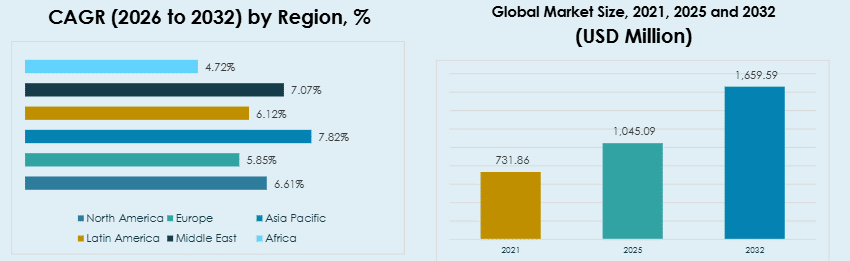
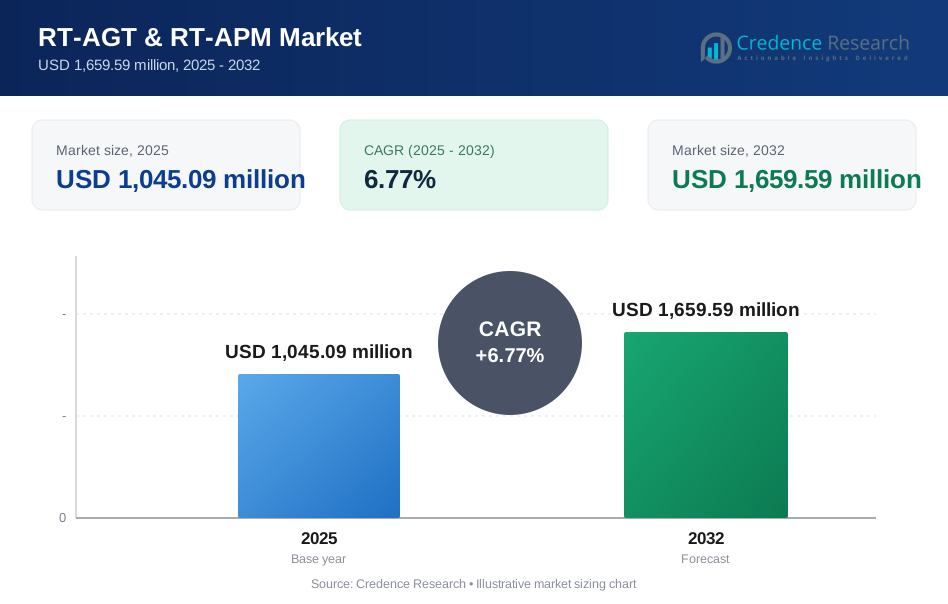
The global RT-AGT & RT-APM market size was valued at USD 731.86 million in 2021 and reached USD 1,045.09 million in 2025. It is anticipated to reach USD 1,659.59 million by 2032, growing at a CAGR of 6.77% during the forecast period.
| REPORT ATTRIBUTE | DETAILS |
|---|---|
| Historical Period | 2021-2024 |
| Base Year | 2025 |
| Forecast Period | 2026-2032 |
| RT-AGT & RT-APM Market Size 2025 | USD 1,045.09 million |
| RT-AGT & RT-APM Market , CAGR | 6.77% |
| RT-AGT & RT-APM Market Size 2032 | USD 1,659.59 million |
RT-AGT & RT-APM Market Insights
- Market growth is supported by airport modernization, terminal expansion, smart city mobility investment and the need for high-capacity automated transit systems that reduce passenger transfer time.
- Rubber-tired APM systems hold a strong position in the market due to widespread deployment across commercial airports, while rubber-tired AGT systems gain traction in urban and metropolitan transit applications.
- Commercial airports remain the leading application area, supported by rising passenger traffic, terminal connectivity projects, airport redevelopment programs and demand for seamless landside-to-airside mobility.
- Driverless / unattended operation leads the operation mode segment because fully automated systems improve service frequency, reduce labor dependency, support 24/7 operations and enable centralized monitoring.
RT-AGT & RT-APM Market Segment Insights
By type
By type, rubber-tired APM systems held the stronger commercial position in 2025, supported by extensive adoption across airport terminal transfer, concourse connection and landside passenger movement applications. These systems are preferred where airports require reliable, fully automated, high-frequency transit within controlled environments. Rubber-tired AGT systems also gained momentum in urban and metropolitan mobility projects, especially where cities seek medium-capacity transit solutions with lower noise, strong gradeability and flexible alignment. Demand across both types benefits from airport expansion, urban congestion management, smart mobility planning and the modernization of aging fixed-guideway transit assets.
By application
By application, commercial airports led the market in 2025, driven by terminal expansion, passenger flow optimization and the need to connect terminals, satellite concourses, parking areas, rental car centers and intermodal transit hubs. Airports use RT-AGT and RT-APM systems to reduce walking distances, improve transfer reliability and increase passenger handling efficiency during peak travel periods. Urban/metropolitan transit represents a growing application area as cities evaluate automated guideway systems for last-mile links, feeder corridors and medium-density mobility networks. Other applications include institutional campuses, entertainment districts and special-purpose mobility corridors where automated short-distance transit improves accessibility and operating efficiency.
By operation mode
By operation mode, driverless / unattended operation led the market in 2025, supported by airport and transit operator preference for centralized control, predictable service intervals and reduced staffing requirements. Fully automated operation enables continuous service, faster dispatching, improved system availability and real-time fleet monitoring. Semi-automated operation remains relevant in selected networks where operators require human oversight, phased automation or integration with legacy control systems. Demand for advanced driverless systems is expected to grow as operators prioritize safety redundancy, predictive maintenance, energy efficiency and operating cost optimization.
Key Market Drivers
Global airport expansion and modernization
Airport expansion and modernization remain the strongest growth driver for the RT-AGT and RT-APM market because major hubs need automated links that move passengers efficiently between terminals, concourses, satellite gates, parking assets, rental car centers, and rail interfaces without adding curbside congestion, while phased terminal programs also favor guideway systems that can connect legacy facilities with new capacity in a controlled operating environment. This need is becoming more urgent as airport traffic rises, with ACI World projecting global passenger volumes to reach 17.7 billion by 2043, which increases pressure on operators to improve transfer reliability, shorten walking distances, and protect on-time connections through high-frequency driverless systems rather than bus networks exposed to roadway bottlenecks. For Instance, Los Angeles International Airport raised the total cost of its Automated People Mover project to 3.34 billion dollars, and the electric system is being delivered with 44 train cars on a 2.25-mile guideway serving six stations, showing how large airports are committing multi-billion-dollar capital to automated internal mobility as part of broader modernization programs.
Urbanization and smart city infrastructure investments
Urbanization and smart city investment are strengthening demand for RT-AGT systems because dense metropolitan corridors require medium-capacity transit that can link residential clusters, business districts, campuses, airports, and major rail nodes on predictable headways while avoiding the road conflict, land take, and intersection delays that often constrain bus-based short-distance circulation in fast-growing urban environments. The structural pressure behind this demand is substantial, as the United Nations indicates that about 4.8 billion people lived in towns or cities in 2025 and that the global urban population is projected to reach roughly 6.5 billion by 2050, with the number of megacities rising to 37, reinforcing the case for automated feeder and distributor systems inside increasingly constrained urban footprints. For Instance, Toshiba states that its full turnkey rail business covers design, procurement, construction, and post-inauguration support across rolling stock, signaling, communication facilities, and electric facilities, underscoring why cities pursuing smart mobility programs increasingly prefer integrated suppliers that can deliver guideway transport together with digital control and long-term system support rather than isolated equipment packages.
Sustainability mandates and net-zero transition
Sustainability mandates are increasing the appeal of RT-AGT and RT-APM because airports and cities are under rising pressure to replace diesel shuttle circulation and private vehicle dependence with electric, automated transport that lowers local emissions, reduces noise, improves energy efficiency, and supports broader decarbonization strategies tied to infrastructure renewal, procurement standards, and long-life asset planning. This shift is now part of mainstream infrastructure policy, as ACI EUROPE reported that 314 airports across 36 countries had disclosed net-zero roadmaps by mid-2025, while Airport Carbon Accreditation showed that 15 airports had already achieved Level 5 net-zero status for emissions under their direct control, signaling that low-emission mobility systems are becoming embedded in airport transition plans rather than treated as optional upgrades. For Instance, the LAX Automated People Mover uses 44 electric cars, train shells made with 98 percent recyclable materials, regenerative braking, and a solar-powered command center, and project partners state that these design choices offset the carbon equivalent of 12 million vehicle miles driven, illustrating the practical sustainability value now attached to modern APM deployments.
Technological advancements in autonomous operations and AI
Technological progress in autonomous operations, condition monitoring, and AI-enabled maintenance is improving the competitiveness of RT-AGT and RT-APM by strengthening dispatch precision, fault detection, energy management, and service continuity, which is critical in airports and dense urban corridors where even brief disruptions can affect passenger transfers, station crowding, and overall network reliability. The market is also shifting toward broader solution scope, with suppliers that combine vehicles, signaling, centralized control, communications, infrastructure integration, and lifecycle services better positioned to win larger contracts because operators increasingly prefer single-accountability delivery models that reduce interface risk and support predictive maintenance instead of fragmented procurement across multiple vendors. For Instance, Alstom says its fully driverless Kuala Lumpur Innovia APM R can carry up to 270 passengers per trip with centralized train control and regenerative braking, while Indian Railways has deployed three Integrated Track Monitoring Systems and three AI-based Machine Vision Inspection Systems in pilot use, showing how automated supervision, predictive diagnostics, and higher-frequency operations are moving from concept to applied transport operations.
Key Trends and Opportunities
Emerging market airport development
Emerging markets offer strong growth potential as governments and airport operators invest in new terminals, satellite concourses and aviation hubs. Rapid passenger traffic growth in Asia Pacific, the Middle East, Latin America and parts of Africa creates demand for efficient terminal connectivity and passenger transfer systems. RT-AGT and RT-APM projects are particularly relevant for airports that seek to expand capacity without overloading road-based transport inside airport premises. Suppliers can capture opportunities by offering scalable systems, modular fleets and integrated operations support. Growth will be strongest where airports combine terminal expansion with long-term passenger experience goals.
Fleet replacement and system modernization
Fleet replacement and system modernization create major opportunities across mature markets. Many airport APM and AGT systems installed in earlier decades now require vehicle renewal, signaling upgrades, station improvements and lifecycle extension. Replacement demand is important because operators often prefer to upgrade existing guideways and control systems rather than rebuild complete networks. Modern fleets can improve capacity, passenger comfort, energy efficiency and operational reliability. Vendors that provide retrofit-compatible vehicles, control system upgrades and long-term maintenance services can benefit from this replacement cycle. This trend supports recurring revenue through operations, maintenance and system enhancement contracts.
System modernization and lifecycle extension
Lifecycle extension is becoming a strategic opportunity as operators seek to maximize asset value from existing guideway infrastructure. APM and AGT systems require periodic upgrades to signaling, power supply, communications, station systems and vehicle control platforms. Modernization projects can improve service reliability, reduce obsolete components and align older systems with current safety and cybersecurity requirements. This creates opportunities for OEMs and systems integrators with installed-base relationships and technical knowledge of legacy platforms. Long-term service contracts also strengthen customer retention and provide predictable revenue streams. Lifecycle extension will remain important in North America, Europe and mature Asian transit systems.
Key Market Challenges
High capital expenditure and long project lead times
High capital expenditure remains a major challenge for the RT-AGT & RT-APM market. Projects require guideway infrastructure, rolling stock, signaling systems, stations, control centers, power systems and extensive civil works. These requirements can lengthen planning, procurement, permitting and commissioning timelines. Airport and urban transit customers often evaluate projects over several years due to budget approvals, stakeholder coordination and public procurement procedures. Delays can affect supplier revenue recognition and increase project execution risk. Smaller cities and secondary airports may find upfront investment challenging unless projects are supported by public funding, concession models or long-term infrastructure plans.
Technology proprietary lock-in and limited OEM competition
Technology proprietary lock-in can limit customer flexibility and intensify procurement risk. APM and AGT systems often depend on supplier-specific rolling stock, signaling, control software and maintenance procedures. Operators may face limited vendor options when replacing fleets or upgrading existing systems, especially if guideway design and control architecture are tied to a specific OEM platform. This can increase lifecycle costs and reduce bargaining power during long-term service negotiations. Limited OEM competition also creates barriers for new entrants due to safety certification, reference project requirements and systems integration complexity. Customers increasingly seek open interfaces, performance guarantees and long-term support commitments to manage this risk.
Regulatory complexity and certification timelines
Regulatory complexity and certification timelines can slow adoption across airport and urban applications. Driverless systems must meet strict safety, reliability, cybersecurity and passenger evacuation requirements. Airport projects also require coordination with aviation authorities, airport operators, construction contractors and security stakeholders. Urban AGT projects often face local transit rules, environmental approvals, land-use constraints and public consultation requirements. These factors can extend development schedules and increase compliance costs. Suppliers must demonstrate proven safety performance, operational redundancy and system reliability before commercial operation. Companies with strong project references, local engineering support and certification experience have a competitive advantage.
Regional Analysis
North America
North America is projected to grow at a CAGR of 6.61% from 2026 to 2032, supported by large airport modernization programs, established APM networks and ongoing fleet replacement needs. Major airports in the U.S. rely on automated people movers to connect terminals, rental car centers, parking structures and satellite concourses. The region also presents steady demand for operations and maintenance contracts, signaling upgrades and lifecycle extension projects. Urban AGT adoption remains selective, but demand can grow in airport-city links, campus mobility and special-purpose transit corridors.
Europe
Europe is expected to grow at a CAGR of 5.85% from 2026 to 2032, supported by airport upgrades, urban mobility investment and sustainability-focused transport policy. Several European cities and airports use automated rubber-tired systems to improve connectivity and reduce congestion. Demand is shaped by strict safety standards, energy efficiency expectations and pressure to modernize older infrastructure. Growth will remain linked to airport expansion, metro feeder systems, system upgrades and investments in seamless multimodal transport.
Asia Pacific
Asia Pacific is projected to record the fastest growth, with a CAGR of 7.82% from 2026 to 2032. Growth is supported by airport expansion, urbanization and large-scale infrastructure development across China, India, Southeast Asia, Japan and South Korea. Airports in the region continue to invest in capacity expansion and passenger transfer efficiency. Urban transit authorities also evaluate AGT systems for dense corridors, new towns, airport links and smart city developments.
Latin America
Latin America is forecast to grow at a CAGR of 6.12% from 2026 to 2032, supported by airport redevelopment, tourism-driven infrastructure and urban transport modernization. Adoption remains selective due to funding constraints and longer procurement cycles, but major aviation hubs and metropolitan corridors may support future automated mobility projects. RT-AGT and RT-APM systems can help airports improve transfer efficiency and reduce congestion as passenger traffic grows.
Middle East
The Middle East is expected to grow at a CAGR of 7.07% from 2026 to 2032, supported by airport megaprojects, aviation hub development and smart city investment. Large airports in the region continue to prioritize premium passenger experience, fast terminal transfers and high-capacity automated movement. Gulf countries are also investing in smart infrastructure, urban development and tourism-linked mobility systems. Demand will be strongest in countries investing in aviation, transit-oriented development and next-generation city infrastructure.
Africa
Africa is projected to grow at a CAGR of 4.72% from 2026 to 2032, supported by airport modernization, urban development and long-term infrastructure planning. Adoption remains limited by project financing constraints, procurement complexity and competing transport priorities. Major airports and metropolitan regions could create selective demand where passenger volumes and land constraints justify automated systems. Future growth will depend on aviation infrastructure funding, public-private partnership models and broader urban mobility strategies.
Report Attribute Details
| Report Attribute | Details |
| Historical Period | 2021–2024 |
| Base Year | 2025 |
| Forecast Period | 2026–2032 |
| Market Size in 2021 | USD 731.86 million |
| Market Size in 2025 | USD 1,045.09 million |
| Market Size in 2026 | USD 1,120.23 million |
| Market Size in 2032 | USD 1,659.59 million |
| CAGR | 6.77% |
| Segments Covered | Type, Application, Operation Mode and Region |
| Key Companies Covered | Alstom SA, Mitsubishi Heavy Industries Ltd. (MHI), Siemens Mobility (VAL Division), CRRC, WOOJIN Industrial Systems and Others |
Company
- Alstom SA
- Mitsubishi Heavy Industries Ltd. (MHI)
- Siemens Mobility (VAL Division)
- CRRC
- WOOJIN Industrial Systems
- Others
RT-AGT & RT-APM Market Segmentations
By Type
- Rubber-Tired APM
- Rubber-Tired AGT
By Application
- Commercial Airports
- Urban/Metropolitan Transit
- Others
By Operation Mode
- Driverless / Unattended Operation
- Semi-Automated Operation
Key Players
- Alstom SA
- Mitsubishi Heavy Industries Ltd. (MHI)
- Siemens Mobility (VAL Division)
- CRRC
- WOOJIN Industrial Systems
- Others
Recent Developments
- In June 2025, Alstom delivered three Innovia APM R trainsets to Kuala Lumpur International Airport. The fully driverless system was scheduled to begin operation in July 2025 and was designed to strengthen terminal connectivity and passenger transfer efficiency.
- In September 2024, CRRC showcased its Autonomous Rail Rapid Transit technology using rubber wheels and virtual-track operation. The development reinforced CRRC’s positioning in intelligent urban mobility and rubber-wheel transit technologies.
- In June 2025, WOOJIN Industrial Systems delivered the first automated guideway transit vehicle for the Yangsan Line in Busan, supporting South Korea’s rubber-tired light metro development.
- In 2025, Siemens Mobility continued to position its VAL-based Cityval and Airval systems for city and airport people mover applications, supported by automation, monitoring technology and adaptable system design.
Report Coverage
The research report offers an in-depth analysis based on type, application, operation mode and geography. It details leading market players, providing an overview of their business positioning, product offerings, revenue share and strategic relevance in the RT-AGT and RT-APM ecosystem. The report includes insights into the competitive environment, market trends, growth drivers, restraints and opportunities. It also examines airport modernization, smart city investment, autonomous operation, lifecycle maintenance and fleet replacement as major factors shaping market development. The report assesses the impact of infrastructure investment, regulatory requirements, technology upgrades and regional demand patterns on market growth. It provides strategic recommendations for suppliers, airport operators, transit agencies, investors and new entrants seeking to navigate the market’s technical and procurement complexity.
Future Outlook
- Demand for driverless RT-AGT and RT-APM systems will continue to rise as airports and cities prioritize automated, high-frequency passenger movement.
- Commercial airports will remain the leading application area due to terminal expansion, satellite concourse development and intermodal connectivity needs.
- Rubber-tired APM systems will retain strong adoption in airport environments because they support efficient short-distance passenger transfer.
- Rubber-tired AGT systems will gain opportunities in urban/metropolitan transit, smart city corridors and feeder networks.
- Fleet replacement and system modernization will create recurring opportunities in mature markets with aging APM infrastructure.
- Suppliers will focus on predictive maintenance, advanced signaling, digital monitoring and energy-efficient vehicle design.
- Long-term operations and maintenance contracts will remain a key revenue source for leading OEMs and systems integrators.
- Asia Pacific and the Middle East will offer strong project opportunities due to airport expansion and urban infrastructure investment.
- North America and Europe will generate demand through upgrades, lifecycle extensions and replacement of existing people mover systems.
- Competitive intensity will increase as established OEMs compete on reliability, installed base, automation capability, service contracts and lifecycle cost.
Request a Free Sample
Fill in your details and we'll send you a free sample report.
- Sample data tables & charts
- Research methodology
Need a Custom Version of This Report?
Tailor the scope, geography, or segments to your exact requirements.
- Custom geography or segment scope
- Direct access to our analyst team
Frequently Asked Questions
What is the current market size for the global RT-AGT & RT-APM market and what is its projected size in 2032?
At what CAGR is the global RT-AGT & RT-APM market projected to grow?
Which type segment is expected to lead the global RT-AGT & RT-APM market?
Which application segment holds the strongest position in the market?
Which operation mode leads the market?
Who are the leading companies in the global RT-AGT & RT-APM market?
Which company held the largest revenue share in 2025?
Table of Content
Chapter 1. Report Introduction
- 1.1 Report Description & Purpose
- 1.1.1 Report Title & Market Definition
- 1.1.2 Unique Selling Propositions (USP) & Key Differentiators
- 1.1.3 Value Proposition for Stakeholders
- 1.2 Research Objectives
- 1.2.1 Market Sizing Objectives (Volume & Revenue)
- 1.2.2 Segmentation Objectives
- 1.2.3 Competitive Intelligence Objectives
- 1.2.4 Forecast & Scenario Objectives
- 1.3 Report Scope
- 1.3.1 RT-AGT & RT-APM Scope – Types & Subtypes Covered
- 1.3.2 Geographic Scope – Regions & Countries Covered
- 1.3.3 Historical Period, Base Year & Forecast Period (2025; forecast to 2032)
- 1.3.4 Inclusions & Exclusions
- 1.4 HS Code & Classification Framework
- 1.5 Currency, Units & Pricing Basis
- 1.6 Target Stakeholders
- 1.7 Limitations & Assumptions
Chapter 2. Executive Summary
- 2.1 Global RT-AGT & RT-APM Market Snapshot
- 2.1.1 Market Size – Historical (2025) & Forecast (2025-2032) (2025: USD 1,045.09 million → 2032: USD 1,659.59 million)
- 2.1.2 Volume & Revenue – Global Totals
- 2.1.3 Key Market Highlights – Top Five Facts
- 2.2 RT-AGT & RT-APM Market Segmentation Snapshot
- 2.2.1 Market Split by Region – 2025 vs. 2032
- 2.3 Competitive Snapshot
- 2.3.1 Top 10 Players by Revenue Share – 2025
- 2.3.2 Top 10 Players by Volume Share – 2025
- 2.3.3 Recent Strategic Developments (18-Month Summary)
- 2.4 Key Investment Highlights & Strategic Conclusions
Chapter 3. RT-AGT & RT-APM Market Dynamics & Industry Analysis
- 3.1 Market Overview & Context
- 3.1.1 RT-AGT & RT-APM Market Position in the Broader Automotive Value Chain
- 3.1.2 OEM vs. Replacement Market Dynamics
- 3.1.3 Market Maturity & Development Stage by Region
- 3.2 RT-AGT & RT-APM Market Drivers
- 3.3 RT-AGT & RT-APM Market Restraints & Challenges
- 3.4 RT-AGT & RT-APM Market Opportunities
- 3.5 Porter's Five Forces Analysis
- 3.5.1 Threat of New Entrants
- 3.5.2 Bargaining Power of Suppliers
- 3.5.3 Bargaining Power of Buyers
- 3.5.4 Threat of Substitutes
- 3.5.5 Competitive Rivalry – Intensity Assessment
- 3.6 RT-AGT & RT-APM Value Chain Analysis
- 3.6.1 Upstream – Raw Material/Input Suppliers
- 3.6.1.1 Raw Material/Input 1
- 3.6.1.2 Raw Material/Input 2
- 3.6.1.3 Raw Material/Input 3
- 3.6.2 Midstream – Production/Manufacturing/Service Delivery
- 3.6.2.1 Production/Process Overview
- 3.6.2.2 Key Facility Locations & Capacity by Manufacturer
- 3.6.3 Downstream – Distribution & End Consumer
- 3.6.3.1 Primary Channel – B2B/OEM
- 3.6.3.2 Secondary Channels – Dealer, Retail, Online, Direct
- 3.6.4 Value Chain Profitability Analysis
- 3.6.1 Upstream – Raw Material/Input Suppliers
- 3.7 PESTEL Analysis
- 3.7.1 Political Factors
- 3.7.2 Economic Factors
- 3.7.3 Social Factors
- 3.7.4 Technological Factors
- 3.7.5 Environmental Factors
- 3.7.6 Legal Factors
- 3.8 RT-AGT & RT-APM Supply Chain Analysis
- 3.8.1 Raw Material/Input Supply Risk Assessment
- 3.8.2 Manufacturing Concentration Risk (Geographic Exposure)
- 3.8.3 Trade Disruption Impact Analysis
- 3.9 Regulatory & Policy Landscape
Note: The regulatory and policy landscape section covers regulations based on their applicability to the market, RT-AGT & RT-APM category, geography, and scope of the study. Only regulatory frameworks with a material impact on operations, compliance, trade, sustainability, or market access are analyzed in detail.
Chapter 4. Key Investment Pockets & Opportunity Analysis
- 4.1 RT-AGT & RT-APM Market Attractiveness Analysis
- 4.1.1 By Region – Investment Attractiveness Matrix (Volume × CAGR)
- 4.2 Absolute Revenue Growth Opportunity
- 4.2.1 By Region – Absolute USD Growth Through 2032
- 4.3 Incremental Volume Opportunity
- 4.3.1 By Region – Incremental Volume Through 2032
- 4.3.2 Segment – Incremental Volume
- 4.4 Emerging Submarket Opportunity Deep Dive (Subject to Applicability)
- 4.5 Emerging Market Opportunity Scorecards
- 4.5.1 United States
- 4.5.2 Europe
- 4.5.3 Asia
- 4.5.4 Middle East & Africa
Note: Emerging Market Opportunity Scorecards will be included based on relevance and strategic importance. Regions listed are indicative and may vary depending on data availability and market dynamics.
Chapter 5. RT-AGT & RT-APM Import-Export Analysis & Trade Flows
- 5.1 Global Trade Overview
- 5.1.1 Global Export Value by Country (2025)
- 5.1.2 Global Export Volume by Country (2025)
- 5.1.3 Global Import Value by Country (2025)
- 5.1.4 Global Import Volume by Country (2025)
- 5.1.5 Net Trade Balance by Country (2025)
- 5.2 Export Analysis – Segment
- 5.2.1 Type 1 (HS Code)
- 5.2.2 Type 2 (HS Code)
- 5.2.3 Type 3 (HS Code)
- 5.2.4 Type 4 (HS Code)
- 5.2.5 Type 5 (HS Code)
- 5.3 Import Analysis – Segment
- 5.3.1 Type 1 (HS Code)
- 5.3.2 Type 2 (HS Code)
- 5.3.3 Type 3 (HS Code)
- 5.3.4 Type 4 (HS Code)
- 5.3.5 Type 5 (HS Code)
- 5.4 Average Unit Trade Prices
- 5.4.1 Average Export Price – Segment & Country
- 5.4.2 Average Import Price – Segment & Source Country
- 5.4.3 Price Trends (2025)
- 5.5 Key Trade Route Analysis
- 5.5.1 Trade Route 1
- 5.5.2 Trade Route 2
- 5.5.3 Trade Route 3
- 5.5.4 Trade Route 4
- 5.5.5 Trade Route 5
- 5.6 Trade Policy Impact Assessment
- 5.6.1 US Anti-Dumping & Section 301 Tariffs
- 5.6.2 EU Customs Union Impact
- 5.6.3 Major Free Trade Agreements
- 5.6.4 USMCA Rules of Origin
Note: Trade policy analysis will be included only where relevant to the RT-AGT & RT-APM market.
Chapter 6. Competitive Landscape & Company Benchmarking
- 6.1 RT-AGT & RT-APM Market Concentration & Structure
- 6.1.1 Herfindahl-Hirschman Index (HHI) – vs. 2025
- 6.1.2 Tier 1, Tier 2 & Tier 3 Market Structure
- 6.1.3 Global, Regional & Local Player Dynamics
- 6.2 RT-AGT & RT-APM Market Share Analysis – 2025
- 6.2.1 Global Revenue Share by Company
- 6.2.2 Global Volume Share by Company
- 6.2.3 Regional Revenue Share
- 6.2.4 Market Share Evolution ( vs. 2025)
- 6.2.5 OEM Segment Share by Company
- 6.2.6 Replacement Segment Share by Company
- 6.3 Production/Delivery Capacity & Facility Analysis
- 6.3.1 Global Installed Capacity
- 6.3.2 Capacity Utilization Rates
- 6.3.3 Production/Output Volume
- 6.3.4 Facility Locations & Capacity Map
- 6.3.5 Planned Capacity Additions
- 6.4 RT-AGT & RT-APM Competitive Benchmarking Matrix
- 6.4.1 Revenue, Volume, CAGR & Profitability Comparison
- 6.4.2 Channel Revenue Mix
- 6.4.3 Geographic Revenue Exposure
- 6.4.4 R&D Intensity
- 6.4.5 Sustainability Maturity
- 6.5 Strategic Developments in RT-AGT & RT-APM (Last 24 Months)
- 6.5.1 Mergers, Acquisitions & Divestments
- 6.5.2 New RT-AGT & RT-APM Launches
- 6.5.3 Facility Expansions
- 6.5.4 Strategic Alliances, Joint Ventures & Partnerships
- 6.5.5 Distribution Expansion & Market Entry
- 6.5.6 Sustainability & ESG Initiatives
- 6.6 Competitive Strategy Mapping
- 6.6.1 Leader, Challenger, Follower & Niche Classification
- 6.6.2 Pricing Strategy Comparison
- 6.6.3 Channel Strategy Matrix
Note: Strategic developments are included based on their materiality and the availability of reliable information.
Chapter 7. Global RT-AGT & RT-APM Market – By Distribution Channel
- 7.1 Segment Overview
- 7.1.1 Volume & Revenue Split by Channel (2025 & 2032)
- 7.1.2 Channel Mix Evolution (2025-2032)
Chapter 8. Regional Market Analysis – Global Overview
- 8.1 Global Regional Overview
- 8.1.1 Regional Volume Share
- 8.1.2 Regional Revenue Share
- 8.1.3 Regional Volume by Region
- 8.1.4 Regional Revenue by Region
- 8.1.5 Regional Forecast Through 2032
- 8.2 Cross-Regional Segment Analysis
- 8.2.1 By Distribution Channel
- 8.2.2 By Brand/Price Tier
Chapter 9. North America RT-AGT & RT-APM Market
- 9.1 United States
- 9.2 Canada
- 9.3 Mexico
Chapter 10. Europe RT-AGT & RT-APM Market
- 10.1 Germany
- 10.2 France
- 10.3 Italy
- 10.4 United Kingdom
- 10.5 Spain
- 10.6 Poland
- 10.7 Russia
- 10.8 Netherlands
- 10.9 Belgium
- 10.10 Sweden
- 10.11 Denmark
- 10.12 Norway
- 10.13 Rest of Europe
Chapter 11. Asia Pacific RT-AGT & RT-APM Market
- 11.1 China
- 11.2 India
- 11.3 Japan
- 11.4 South Korea
- 11.5 Thailand
- 11.6 Indonesia
- 11.7 Vietnam
- 11.8 Malaysia
- 11.9 Australia
- 11.10 Rest of Asia Pacific
Chapter 12. Latin America RT-AGT & RT-APM Market
- 12.1 Brazil
- 12.2 Argentina
- 12.3 Colombia
- 12.4 Chile
- 12.5 Rest of Latin America
Chapter 13. Middle East RT-AGT & RT-APM Market
- 13.1 Saudi Arabia
- 13.2 United Arab Emirates
- 13.3 Turkey
- 13.4 Israel
- 13.5 Iran
- 13.6 Rest of the Middle East
Chapter 14. Africa RT-AGT & RT-APM Market
- 14.1 South Africa
- 14.2 Egypt
- 14.3 Nigeria
- 14.4 Morocco
- 14.5 Rest of Africa
Chapter 15. RT-AGT & RT-APM Company Profiles
- 15.1 [Company 01]
- 15.1.1 Company Overview
- 15.1.2 Key Management Personnel
- 15.1.3 Products & Services Portfolio
- 15.1.4 Financial Performance
- 15.1.5 Key Market Focus & Geographic Presence
- 15.1.6 Recent Developments & Strategic Initiatives
Note: The company profile list is preliminary and may change based on research findings, market developments, data availability, and client requirements.
Chapter 16. Appendices
- Appendix A – List of Abbreviations & Acronyms
- Appendix B – Industry Classification Code Reference – Full Series
- Appendix C – Production & Capacity Data Tables
- Appendix D – End-Use & Demand Base Tables
- Appendix E – Consumption & Replacement Rate Assumptions
- Appendix F – ASP Reference Tables
- Appendix G – Manufacturing & Facility Database
- Appendix H – Import-Export Data Tables
- Appendix I – Regulatory Summary Tables
- Appendix J – Primary Research Participant List (Anonymized)
- Appendix K – Primary Research Questionnaire Framework
- Appendix L – Data Sources & Bibliography
- Appendix M – Market Size Divergence & Source Comparison
Chapter 17. Research Methodology
- 17.1 Research Framework & Philosophy
- 17.2 Secondary Research – Sources, Hierarchy & Data Extraction
- 17.3 Data Modeling – Bottom-Up & Top-Down Market Sizing
- 17.4 Primary Research – Stakeholder Framework, LOI & Sample Sizes
- 17.5 Forecast Methodology – Regression, Scenario & Sensitivity Analysis
- 17.6 Quality Control – Four-Layer Validation Framework
- 17.7 Limitations & Standard Assumptions
- 17.8 Disclaimer
