
Market Overview:
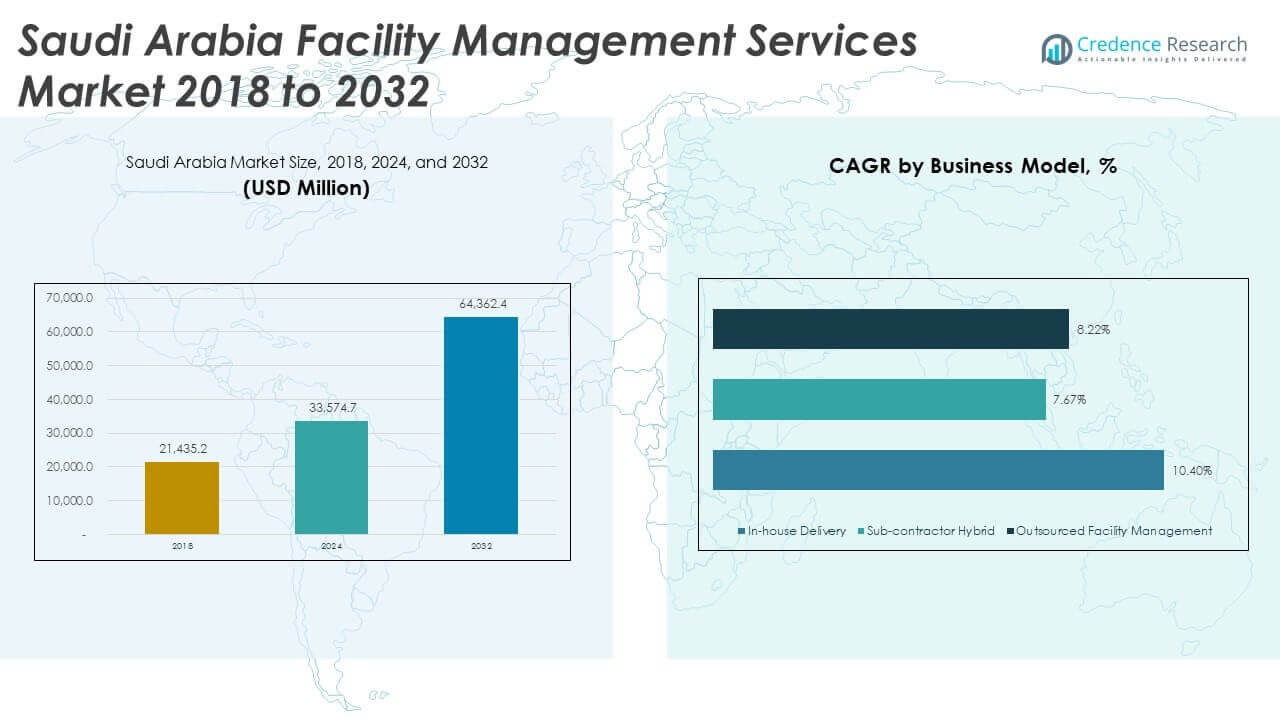
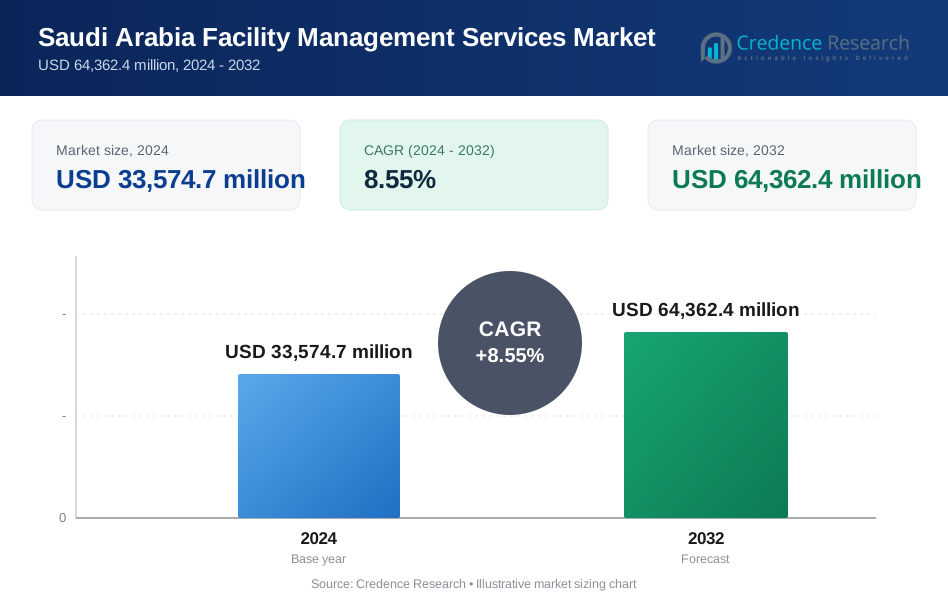
The Saudi Arabia Facility Management Services Market size was valued at USD 21,435.2 million in 2018 to USD 33,574.7 million in 2024 and is anticipated to reach USD 64,362.4 million by 2032, at a CAGR of 8.55% during the forecast period.
| REPORT ATTRIBUTE | DETAILS |
|---|---|
| Historical Period | 2020-2023 |
| Base Year | 2024 |
| Forecast Period | 2025-2032 |
| Saudi Arabia Facility Management Services Market Size 2024 | USD 33,574.7 million |
| Saudi Arabia Facility Management Services Market, CAGR | 8.55% |
| Saudi Arabia Facility Management Services Market Size 2032 | USD 64,362.4 million |
The market is expanding rapidly due to infrastructure growth, large-scale construction projects, and rising outsourcing in both public and private sectors. Giga-projects like NEOM, Vision 2030 initiatives, and commercial real estate growth have increased demand for integrated facility management. Clients seek cost efficiency, operational control, and performance-based service delivery. Growing emphasis on energy efficiency, digital tools, and sustainability further drives the need for advanced facility services across asset-heavy sectors like healthcare, transport, and education.
The Central Region dominates the market, led by Riyadh’s commercial, governmental, and institutional building stock. The Western Region follows, supported by hospitality and religious tourism hubs in Jeddah, Mecca, and Medina. The Eastern Region sees strong industrial demand, especially in oil and gas zones like Dammam and Jubail. Northern and Southern regions remain emerging markets, gaining traction through housing, healthcare, and smart city development. Urban expansion and regional diversification continue to reshape service demand across the kingdom.
Market Insights
- The Saudi Arabia Facility Management Services Market was valued at USD 21,435.2 million in 2018, USD 33,574.7 million in 2024, and is projected to reach USD 64,362.4 million by 2032, growing at a CAGR of 8.55% during the forecast period.
- The Central Region leads the market with 38% share due to Riyadh’s high-density commercial and governmental developments; the Western Region holds 32% driven by religious tourism hubs, and the Eastern Region captures 20% from industrial demand in oil and gas zones.
- The Southern Region is the fastest-growing area with a 10% share, supported by public infrastructure expansion, housing development, and smart city initiatives under Vision 2030.
- Outsourced Facility Management is the leading business model, recording the highest CAGR of 10.40%, compared to 8.22% for In-House Delivery and 7.67% for Sub-contractor Hybrid, reflecting a strong client preference for external expertise.
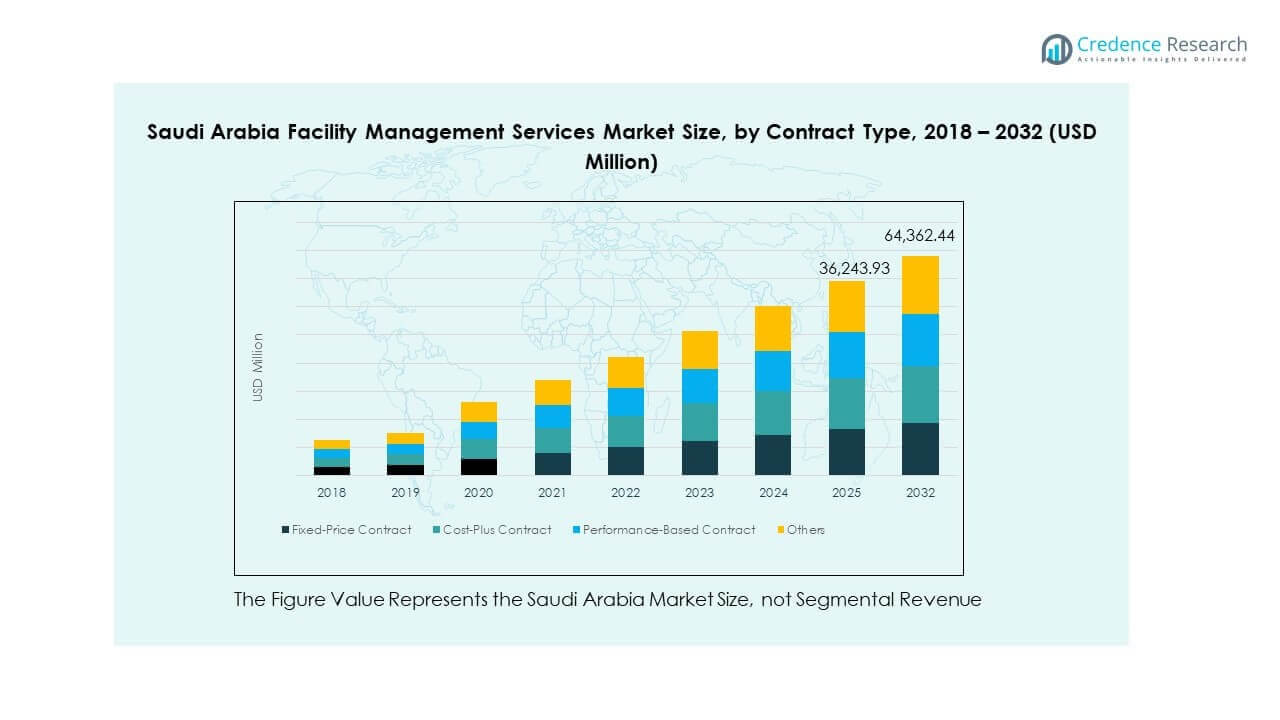
- Among contract types, Fixed-Price Contracts dominate the market, followed by Cost-Plus and Performance-Based Contracts, as observed in the segment distribution for 2032.
Market Drivers
Infrastructure Modernization Across Urban and Commercial Zones Drives Long-Term Service Contracts
Large-scale urban development and real estate expansion are key demand drivers across Saudi Arabia. The country is executing giga-projects like NEOM, Qiddiya, and the Red Sea Project, which integrate long-term facility management frameworks. These megaprojects require continuous maintenance, energy optimization, and asset lifecycle management. The Saudi Arabia Facility Management Services Market benefits from this structural transformation across cities. High-rise buildings, hotels, airports, and retail malls need integrated solutions covering cleaning, MEP, landscaping, and security. Clients expect round-the-clock support, which boosts recurring service models. Centralized procurement and digital monitoring systems increase efficiency and compliance. Demand for service reliability encourages long-term partnerships between clients and facility management vendors.
- For instance, Zahran Facility Management secured over SAR 4.7 billion in multi-year contracts in 2024, including projects for King Faisal Specialist Hospital and Dammam Airports Company, integrating digital CAFM tools across over 100 facilities.
Private Sector Adoption of Outsourcing Models Across Non-Core Building Functions
Corporations and private developers in Saudi Arabia increasingly outsource facility services to reduce costs and improve operational focus. Sectors including banking, manufacturing, and healthcare prefer outsourcing for functions like HVAC, electrical maintenance, and janitorial services. This approach enhances quality while lowering capital costs for in-house management. The Saudi Arabia Facility Management Services Market gains traction as service providers offer bundled contracts under performance-based SLAs. Integration of software tools improves service delivery, asset tracking, and maintenance scheduling. Growth in managed office spaces and commercial towers increases multi-tenant requirements. Clients prefer vendors with scalable manpower and digital systems for consistent delivery. Outsourcing continues expanding across medium and large enterprises in Tier-1 cities.
- For instance, EFSIM secured contracts worth over SAR 750 million in 2025 covering sectors like healthcare and education, deploying over 8,500 personnel and digital platforms to manage SLA compliance and workforce scheduling.
Regulatory Enforcement of Health, Safety, and Sustainability Standards in Public Buildings
Government mandates on health and safety drive demand for professional facility services across regulated sectors. Regulatory frameworks promote adherence to hygiene, fire safety, and energy efficiency across schools, hospitals, and transport hubs. These rules increase accountability and documentation, encouraging structured vendor engagement. The Saudi Arabia Facility Management Services Market aligns with national goals to enhance public service delivery. Institutions implement routine checks and digital audits to ensure indoor air quality, equipment safety, and waste handling. Service providers with domain certifications and trained staff win preference. Smart building compliance further supports predictive maintenance and real-time control. New building codes and certifications push owners to prioritize high-quality upkeep across large facilities.
Hospitality, Healthcare, and Retail Sectors Expanding Facilities and Upgrading Service Quality
The rapid growth of tourism, healthcare, and organized retail generates strong demand for facility services. Hotels, shopping malls, and hospitals require 24/7 service delivery across critical systems and guest areas. The Saudi Arabia Facility Management Services Market supports quality control, staff coordination, and energy savings in these high-traffic sites. Hospitality chains rely on branded experiences and cleanliness, where professional FM vendors add measurable value. Healthcare facilities need regulated infection control, waste disposal, and maintenance audits. Retail operators require coordinated lighting, HVAC, and security coverage across malls and supermarkets. These sectors often adopt KPIs to track vendor performance. Rising expectations among users boost demand for responsive, tech-integrated FM solutions.
Market Trends
Adoption of Smart Facility Management Tools for Real-Time Monitoring and Energy Optimization
Facility management vendors integrate digital platforms to optimize asset use, track performance, and cut energy costs. IoT-enabled sensors and CAFM systems help monitor HVAC, lighting, water, and elevator systems in real time. It supports predictive maintenance and remote diagnostics across sites. The Saudi Arabia Facility Management Services Market embraces energy management platforms that align with national sustainability goals. Clients prioritize tools that provide alerts, energy dashboards, and occupancy-based control. Vendors now bundle software with manpower services for competitive differentiation. Cloud-based dashboards improve transparency and response time. Adoption of AI tools for space analytics and workflow scheduling improves labor productivity and resource use.
Rising Use of Integrated Facility Management (IFM) Contracts Across Large Commercial Sites
IFM contracts are gaining preference among large developers, mall operators, and public institutions. Clients favor single-vendor models that streamline service delivery, reporting, and accountability. The Saudi Arabia Facility Management Services Market sees increasing demand for bundled services across cleaning, HVAC, pest control, and access systems. IFM improves vendor coordination and reduces management overhead. It also simplifies procurement and ensures faster incident resolution. Clients receive unified KPIs and customized dashboards. Contract durations are expanding as trust in outsourced delivery models rises. IFM adoption is especially visible across airports, government campuses, and hospital networks.
- For instance, Nesma Facility Management delivers integrated operations, maintenance, and technical services across commercial, residential, and industrial facilities in Saudi Arabia, emphasizing comprehensive solutions without segmenting individual bundled contract wins.
Growing Emphasis on Workforce Training, Localization, and Skills Development in FM Sector
The localization of FM jobs and workforce development are key priorities under national employment initiatives. Employers invest in structured training programs for technicians, engineers, and support staff. It supports service quality while complying with Saudization policies. The Saudi Arabia Facility Management Services Market sees vendors partnering with vocational institutions for technical certification. Clients prefer vendors with qualified and licensed personnel. Soft services such as hospitality cleaning and concierge roles are increasingly localized. Health and safety protocols require specialized knowledge, especially in healthcare and industrial sites. Workforce reliability, multi-skill capability, and language training improve client satisfaction and retention.
Technology-Led Differentiation Through Robotics, Drones, and Automated Equipment
Service providers deploy new technologies to improve efficiency and reduce reliance on manual processes. Cleaning robots, autonomous scrubbers, and drone-based inspection tools are emerging in premium sites. The Saudi Arabia Facility Management Services Market benefits from automation to handle large areas, high ceilings, and critical infrastructure. Drones support façade inspection, thermal imaging, and rooftop assessments. Robotic tools increase consistency, reduce costs, and minimize workplace risks. Automated tools also improve service speed and free up skilled workers for priority tasks. Adoption remains higher among corporate clients and large venues. Early movers are investing in technology to win long-term contracts.
- For instance, Interserve Rezayat, a joint venture between Mitie and Rezayat Group, continues to support large-scale industrial FM operations in Saudi Arabia’s Eastern Province, aligning with the national push toward digital and automated asset management technologies promoted by major clients like Saudi Aramco.
Market Challenges Analysis
Fragmented Vendor Landscape and Low Entry Barriers Impact Quality and Pricing Consistency
The Saudi Arabia Facility Management Services Market faces quality gaps due to a fragmented vendor base. Many small or mid-size firms lack standardized training, equipment, and digital tools. Low entry barriers allow unorganized players to compete on price without meeting service benchmarks. This undermines performance in sectors that require reliability, documentation, and specialized compliance. Clients in high-end commercial sites or critical infrastructure often face inconsistent delivery. The absence of unified certification systems affects vendor selection and quality assurance. Professional FM firms struggle to compete against low-cost operators in short-term contracts. This pricing pressure limits innovation, investment in staff training, and tech deployment.
Client Resistance to Long-Term Contracts and Limited Awareness of Lifecycle FM Benefits
Some clients prefer reactive maintenance or short-term arrangements rather than investing in lifecycle facility solutions. It limits the ability of FM vendors to plan, allocate, and optimize resources efficiently. The Saudi Arabia Facility Management Services Market faces barriers when promoting preventive or predictive maintenance models. Many property owners underestimate the long-term savings of proactive service contracts. Budget constraints or outdated procurement practices further restrict innovation. Public sector clients often emphasize upfront cost over long-term value. Lack of awareness around energy audits, asset tagging, and lifecycle costing delays digital FM adoption. Service providers face challenges in proving ROI without strong client engagement.
Market Opportunities
Expansion of Giga-Projects, Smart Cities, and Tourism Infrastructure Drives Premium FM Demand
Massive infrastructure projects such as NEOM, The Line, and Diriyah Gate create long-term demand for world-class FM services. These sites incorporate smart systems, energy-efficient buildings, and advanced security, requiring skilled FM providers. The Saudi Arabia Facility Management Services Market stands to benefit from this transformation. Clients seek integrated, tech-enabled vendors who can manage large and complex assets. The tourism sector’s rapid expansion under Vision 2030 offers growth for hospitality-centric FM solutions. Cultural sites, airports, and luxury resorts require 24/7 maintenance, security, and guest services.
Public Sector Digitization and Sustainability Goals Enable Strategic FM Engagement
Government institutions are digitizing infrastructure to improve service transparency, reliability, and sustainability. This creates demand for FM vendors that support green certifications, energy tracking, and lifecycle monitoring. It opens space for vendors offering CAFM, BMS, and ESG compliance tools. The Saudi Arabia Facility Management Services Market will benefit from the rising preference for professional, performance-linked services. Smart government buildings, e-health facilities, and learning centers present scalable opportunities for tech-enabled FM contracts.
Market Segmentation Analysis
By Service Type
Hard facility management dominates due to its relevance in asset-heavy environments such as industrial zones, government buildings, and healthcare institutions. Services like MEP, HVAC, electrical systems, plumbing, and fire safety require continuous oversight, technical skill, and compliance. Asset maintenance and energy sustainability solutions are gaining relevance across public infrastructure. It benefits from strong demand in cities with complex building stock. Vendors differentiate through technical certifications and predictive maintenance capabilities.
Soft facility management holds steady demand across commercial offices, hospitality, and education sectors. Cleaning and sanitation lead this segment due to hygiene regulations and customer experience priorities. Security services follow closely, supported by growing surveillance requirements. Waste management, catering, and concierge roles continue expanding in high-traffic facilities. The segment remains labor-intensive and price-sensitive. It relies on service quality, reliability, and workforce availability.
Bundled facility management services, combining hard and soft elements, are gaining momentum across large-scale contracts. Integrated service models reduce vendor fragmentation and improve service coordination. The Saudi Arabia Facility Management Services Market sees growing interest in bundled FM across malls, airports, and public campuses. Clients benefit from unified dashboards, single-point reporting, and performance-linked KPIs. The segment supports long-term contracts and digital system integration.
- For instance, Khidmah LLC and Initial Saudi Group are recognized among leading soft FM providers in Saudi Arabia, offering cleaning, security, and support services across office buildings, universities, and retail complexes.
By Contract Type
Fixed-price contracts dominate due to predictable service costs and clear deliverables. They are preferred in commercial real estate, hospitality, and public sector buildings. Cost-plus contracts are used in evolving project scopes where costs fluctuate. Performance-based contracts are growing as clients demand results tied to uptime, energy use, or response time. These contracts increase accountability and vendor engagement. Others include hybrid formats combining cost and performance elements.
- For instance, large integrated FM tenders in Saudi Arabia often feature performance metrics tied to energy targets and responsiveness benchmarks, reflecting the market’s shift toward performance‑linked delivery models.
By Business Model
Outsourced facility management holds the largest share, driven by cost-efficiency, flexibility, and access to expertise. Clients offload non-core functions to focus on operations. Sub-contractor hybrid models are common in large infrastructure contracts involving specialized trades. In-house delivery remains relevant in controlled environments or high-security facilities where direct supervision is preferred. It supports niche sectors but limits scalability and innovation.
By End-User Industry
Commercial real estate and offices lead demand, followed by healthcare, hospitality, and government ministries. High-occupancy buildings require daily support services and planned technical maintenance. Industrial and logistics zones prioritize hard FM for machinery and compliance. Retail facilities and residential compounds require a mix of cleaning, security, and energy services. Education institutions focus on sanitation, maintenance, and asset safety across campuses.
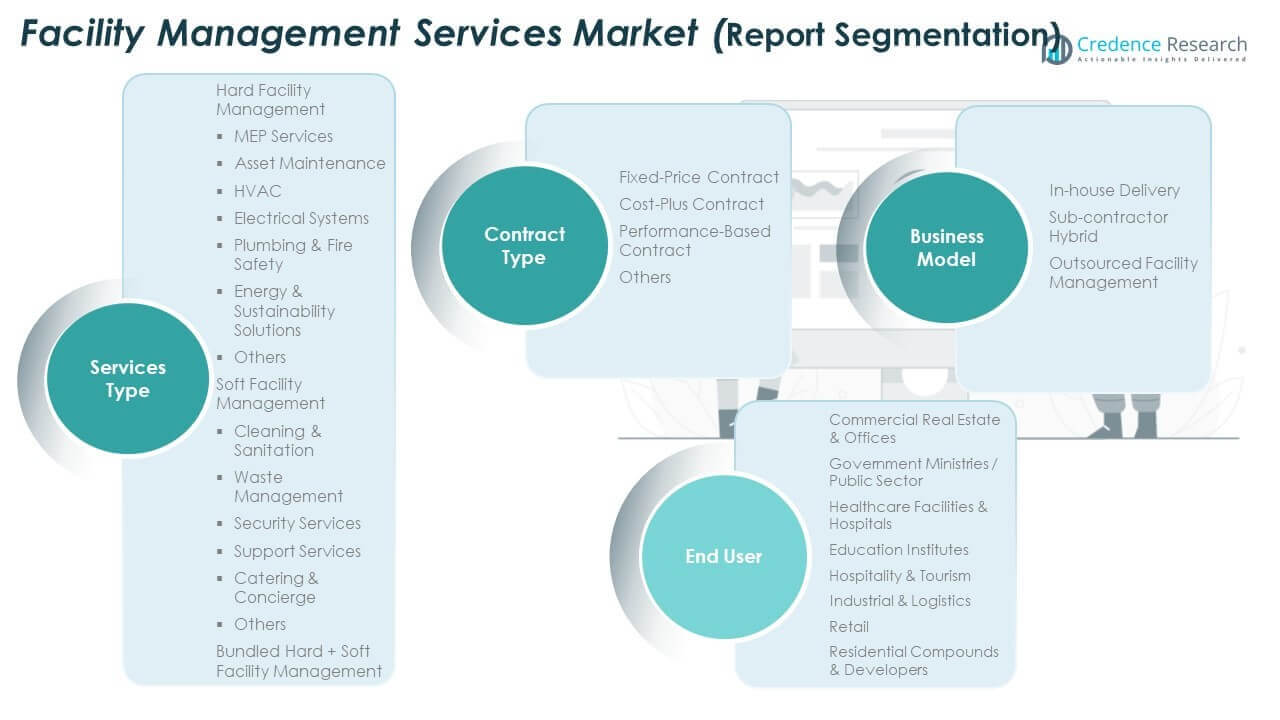
Segmentation
By Service Type
- Hard Facility Management
- MEP Services
- Asset Maintenance
- HVAC
- Electrical Systems
- Plumbing & Fire Safety
- Energy & Sustainability Solutions
- Others
- Soft Facility Management
- Cleaning & Sanitation
- Waste Management
- Security Services
- Support Services
- Catering & Concierge
- Others
- Bundled Facility Management
- Hard + Soft Services (Integrated)
By Contract Type
- Fixed-Price Contract
- Cost-Plus Contract
- Performance-Based Contract
- Others
By Business Model
- In-House Delivery
- Sub-Contractor Hybrid
- Outsourced Facility Management
By End-User Industry
- Commercial Real Estate & Offices
- Government Ministries / Public Sector
- Healthcare Facilities & Hospitals
- Education Institutes
- Hospitality & Tourism
- Industrial & Logistics
- Retail
- Residential Compounds & Developers
Regional Analysis
The Saudi Arabia Facility Management Services Market shows strong concentration in the Central Region, which holds around 38% market share. Riyadh anchors this dominance due to dense commercial offices, government ministries, and mixed-use developments. Large corporate campuses and public infrastructure projects sustain steady demand. It benefits from long-term outsourced contracts and integrated service models. Smart city initiatives and digital building adoption further support growth. Service providers prioritize this region for scale and contract stability.
The Western Region accounts for nearly 32% market share, led by Jeddah, Mecca, and Medina. Hospitality, religious tourism, airports, and retail assets drive service demand. High footfall facilities require continuous cleaning, security, and MEP services. The Saudi Arabia Facility Management Services Market gains momentum here from hotel expansions and transport upgrades. Seasonal demand peaks create opportunities for flexible service contracts. Facility operators focus on compliance, hygiene, and service quality due to global visitor exposure.
The Eastern Region contributes about 20% market share, supported by industrial zones in Dammam, Khobar, and Jubail. Oil, gas, logistics, and manufacturing assets require specialized hard facility services. It favors preventive maintenance and safety-driven service models. The remaining 10% comes from Northern and Southern Regions, which remain emerging markets. Government housing projects, regional hospitals, and educational facilities support gradual demand growth. Infrastructure expansion improves long-term service visibility across these areas.
Key Player Analysis
- Al Olayan Group
- Saudi Binladin Group
- Zahran Facility Management
- SETE Saudia
- Rezayat Group FM & Nesma Trading Facility Management
- Zamil Group
- Almajal G4S
- Other Key Players
Competitive Analysis
Competition in the Saudi Arabia Facility Management Services Market reflects a mix of large diversified groups and specialized domestic operators. Leading players compete on contract scale, technical depth, workforce size, and compliance capability. Firms such as Al Olayan Group, Zahran Facility Management, and Zamil Group leverage strong engineering backgrounds to secure hard FM contracts. Almajal G4S holds a strong position in security and integrated soft services, supported by brand trust and national coverage. Saudi Binladin Group and SETE Saudia benefit from public sector ties and large infrastructure exposure. It remains a relationship-driven market where long-term contracts favor established players. Vendors differentiate through integrated facility management offerings, digital reporting platforms, and KPI-based delivery. Workforce localization, training quality, and safety records influence contract awards. Mid-size players focus on niche segments such as healthcare or hospitality to defend margins. Price competition remains intense in commoditized soft services. Strategic partnerships, technology adoption, and bundled service models shape competitive positioning across regions.
Recent Developments
- In January 2025, Catrion(formerly Saudi Airlines Catering Company) diversified its soft services portfolio by securing a landmark SAR 2.3 billion, five-year catering and hospitality support contract with Riyadh Air.
- In February 2024, Oil Park Development Company (OPDC), a Public Investment Fund subsidiary behind THE RIG., partnered with Saudi Facility Management Company (FMTECH) through a Memorandum of Understanding. This collaboration, signed by OPDC CEO Raed Bakhrji and FMTECH CEO Adel Ibrahim Alroeshedy, focuses on strategies for facilities, property, and asset management at THE RIG. to boost operational efficiency, safety, and integration of advanced technologies.
Report Coverage
The research report offers an in-depth analysis based on Service Type, Contract Type, Business Model, and End-User Industry. It details leading market players, providing an overview of their business, product offerings, investments, revenue streams, and key applications. Additionally, the report includes insights into the competitive environment, SWOT analysis, current market trends, as well as the primary drivers and constraints. Furthermore, it discusses various factors that have driven market expansion in recent years. The report also explores market dynamics, regulatory scenarios, and technological advancements that are shaping the industry. It assesses the impact of external factors and global economic changes on market growth. Lastly, it provides strategic recommendations for new entrants and established companies to navigate the complexities of the market.
Future Outlook
- Infrastructure-driven service demand will grow steadily, supported by giga-projects and public-private investments.
- Government focus on Vision 2030 will accelerate FM outsourcing across ministries, schools, and healthcare facilities.
- Demand for energy-efficient buildings will increase the use of sustainability-linked FM contracts and audits.
- Adoption of IoT, CAFM, and AI-based predictive maintenance tools will reshape contract design and delivery models.
- Integrated Facility Management (IFM) models will gain preference across airports, malls, and mixed-use developments.
- Labor localization and skills development will shape vendor competitiveness and workforce scalability.
- Performance-based SLAs will become more common across commercial and institutional contracts.
- Private developers will prioritize bundled FM services to reduce vendor overlap and improve accountability.
- Growth in hospitality and tourism sectors will expand demand for 24/7 soft and concierge services.
- Smart cities and green building initiatives will drive long-term growth across regional and tier-2 locations.
Request a Free Sample
Fill in your details and we'll send you a free sample report.
- Sample data tables & charts
- Research methodology
Need a Custom Version of This Report?
Tailor the scope, geography, or segments to your exact requirements.
- Custom geography or segment scope
- Direct access to our analyst team
Frequently Asked Questions
What is the current market size for Saudi Arabia Facility Management Services Market, and what is its projected size in 2032?
At what Compound Annual Growth Rate is the Saudi Arabia Facility Management Services Market projected to grow between 2024 and 2032?
Which Saudi Arabia Facility Management Services Market segment held the largest share in 2024?
What are the primary factors fueling the growth of the Saudi Arabia Facility Management Services Market?
Who are the leading companies in the Saudi Arabia Facility Management Services Market?
Which region commanded the largest share of the Saudi Arabia Facility Management Services Market in 2024?
Table of Content
Chapter 1. Report Introduction
- 1.1 Report Description & Purpose
- 1.1.1 Report Title & Market Definition
- 1.1.2 Unique Selling Propositions (USP) & Key Differentiators
- 1.1.3 Value Proposition for Stakeholders
- 1.2 Research Objectives
- 1.2.1 Market Sizing Objectives (Volume & Revenue)
- 1.2.2 Segmentation Objectives
- 1.2.3 Competitive Intelligence Objectives
- 1.2.4 Forecast & Scenario Objectives
- 1.3 Report Scope
- 1.3.1 Saudi Arabia Facility Management Services Scope – Types & Subtypes Covered
- 1.3.2 Geographic Scope – Regions & Countries Covered
- 1.3.3 Historical Period, Base Year & Forecast Period (2024; forecast to 2032)
- 1.3.4 Inclusions & Exclusions
- 1.4 HS Code & Classification Framework
- 1.5 Currency, Units & Pricing Basis
- 1.6 Target Stakeholders
- 1.7 Limitations & Assumptions
Chapter 2. Executive Summary
- 2.1 Global Saudi Arabia Facility Management Services Market Snapshot
- 2.1.1 Market Size – Historical (2024) & Forecast (2024-2032) (2024: USD 33,574.7 million → 2032: USD 64,362.4 million)
- 2.1.2 Volume & Revenue – Global Totals
- 2.1.3 Key Market Highlights – Top Five Facts
- 2.2 Saudi Arabia Facility Management Services Market Segmentation Snapshot
- 2.2.1 Market Split by Region – 2024 vs. 2032
- 2.3 Competitive Snapshot
- 2.3.1 Top 10 Players by Revenue Share – 2024
- 2.3.2 Top 10 Players by Volume Share – 2024
- 2.3.3 Recent Strategic Developments (18-Month Summary)
- 2.4 Key Investment Highlights & Strategic Conclusions
Chapter 3. Saudi Arabia Facility Management Services Market Dynamics & Industry Analysis
- 3.1 Market Overview & Context
- 3.1.1 Saudi Arabia Facility Management Services Market Position in the Broader Automotive Value Chain
- 3.1.2 OEM vs. Replacement Market Dynamics
- 3.1.3 Market Maturity & Development Stage by Region
- 3.2 Saudi Arabia Facility Management Services Market Drivers
- 3.3 Saudi Arabia Facility Management Services Market Restraints & Challenges
- 3.4 Saudi Arabia Facility Management Services Market Opportunities
- 3.5 Porter's Five Forces Analysis
- 3.5.1 Threat of New Entrants
- 3.5.2 Bargaining Power of Suppliers
- 3.5.3 Bargaining Power of Buyers
- 3.5.4 Threat of Substitutes
- 3.5.5 Competitive Rivalry – Intensity Assessment
- 3.6 Saudi Arabia Facility Management Services Value Chain Analysis
- 3.6.1 Upstream – Raw Material/Input Suppliers
- 3.6.1.1 Raw Material/Input 1
- 3.6.1.2 Raw Material/Input 2
- 3.6.1.3 Raw Material/Input 3
- 3.6.2 Midstream – Production/Manufacturing/Service Delivery
- 3.6.2.1 Production/Process Overview
- 3.6.2.2 Key Facility Locations & Capacity by Manufacturer
- 3.6.3 Downstream – Distribution & End Consumer
- 3.6.3.1 Primary Channel – B2B/OEM
- 3.6.3.2 Secondary Channels – Dealer, Retail, Online, Direct
- 3.6.4 Value Chain Profitability Analysis
- 3.6.1 Upstream – Raw Material/Input Suppliers
- 3.7 PESTEL Analysis
- 3.7.1 Political Factors
- 3.7.2 Economic Factors
- 3.7.3 Social Factors
- 3.7.4 Technological Factors
- 3.7.5 Environmental Factors
- 3.7.6 Legal Factors
- 3.8 Saudi Arabia Facility Management Services Supply Chain Analysis
- 3.8.1 Raw Material/Input Supply Risk Assessment
- 3.8.2 Manufacturing Concentration Risk (Geographic Exposure)
- 3.8.3 Trade Disruption Impact Analysis
- 3.9 Regulatory & Policy Landscape
Note: The regulatory and policy landscape section covers regulations based on their applicability to the market, Saudi Arabia Facility Management Services category, geography, and scope of the study. Only regulatory frameworks with a material impact on operations, compliance, trade, sustainability, or market access are analyzed in detail.
Chapter 4. Key Investment Pockets & Opportunity Analysis
- 4.1 Saudi Arabia Facility Management Services Market Attractiveness Analysis
- 4.1.1 By Region – Investment Attractiveness Matrix (Volume × CAGR)
- 4.2 Absolute Revenue Growth Opportunity
- 4.2.1 By Region – Absolute USD Growth Through 2032
- 4.3 Incremental Volume Opportunity
- 4.3.1 By Region – Incremental Volume Through 2032
- 4.3.2 Segment – Incremental Volume
- 4.4 Emerging Submarket Opportunity Deep Dive (Subject to Applicability)
- 4.5 Emerging Market Opportunity Scorecards
- 4.5.1 United States
- 4.5.2 Europe
- 4.5.3 Asia
- 4.5.4 Middle East & Africa
Note: Emerging Market Opportunity Scorecards will be included based on relevance and strategic importance. Regions listed are indicative and may vary depending on data availability and market dynamics.
Chapter 5. Saudi Arabia Facility Management Services Import-Export Analysis & Trade Flows
- 5.1 Global Trade Overview
- 5.1.1 Global Export Value by Country (2024)
- 5.1.2 Global Export Volume by Country (2024)
- 5.1.3 Global Import Value by Country (2024)
- 5.1.4 Global Import Volume by Country (2024)
- 5.1.5 Net Trade Balance by Country (2024)
- 5.2 Export Analysis – Segment
- 5.2.1 Type 1 (HS Code)
- 5.2.2 Type 2 (HS Code)
- 5.2.3 Type 3 (HS Code)
- 5.2.4 Type 4 (HS Code)
- 5.2.5 Type 5 (HS Code)
- 5.3 Import Analysis – Segment
- 5.3.1 Type 1 (HS Code)
- 5.3.2 Type 2 (HS Code)
- 5.3.3 Type 3 (HS Code)
- 5.3.4 Type 4 (HS Code)
- 5.3.5 Type 5 (HS Code)
- 5.4 Average Unit Trade Prices
- 5.4.1 Average Export Price – Segment & Country
- 5.4.2 Average Import Price – Segment & Source Country
- 5.4.3 Price Trends (2024)
- 5.5 Key Trade Route Analysis
- 5.5.1 Trade Route 1
- 5.5.2 Trade Route 2
- 5.5.3 Trade Route 3
- 5.5.4 Trade Route 4
- 5.5.5 Trade Route 5
- 5.6 Trade Policy Impact Assessment
- 5.6.1 US Anti-Dumping & Section 301 Tariffs
- 5.6.2 EU Customs Union Impact
- 5.6.3 Major Free Trade Agreements
- 5.6.4 USMCA Rules of Origin
Note: Trade policy analysis will be included only where relevant to the Saudi Arabia Facility Management Services market.
Chapter 6. Competitive Landscape & Company Benchmarking
- 6.1 Saudi Arabia Facility Management Services Market Concentration & Structure
- 6.1.1 Herfindahl-Hirschman Index (HHI) – vs. 2024
- 6.1.2 Tier 1, Tier 2 & Tier 3 Market Structure
- 6.1.3 Global, Regional & Local Player Dynamics
- 6.2 Saudi Arabia Facility Management Services Market Share Analysis – 2024
- 6.2.1 Global Revenue Share by Company
- 6.2.2 Global Volume Share by Company
- 6.2.3 Regional Revenue Share
- 6.2.4 Market Share Evolution ( vs. 2024)
- 6.2.5 OEM Segment Share by Company
- 6.2.6 Replacement Segment Share by Company
- 6.3 Production/Delivery Capacity & Facility Analysis
- 6.3.1 Global Installed Capacity
- 6.3.2 Capacity Utilization Rates
- 6.3.3 Production/Output Volume
- 6.3.4 Facility Locations & Capacity Map
- 6.3.5 Planned Capacity Additions
- 6.4 Saudi Arabia Facility Management Services Competitive Benchmarking Matrix
- 6.4.1 Revenue, Volume, CAGR & Profitability Comparison
- 6.4.2 Channel Revenue Mix
- 6.4.3 Geographic Revenue Exposure
- 6.4.4 R&D Intensity
- 6.4.5 Sustainability Maturity
- 6.5 Strategic Developments in Saudi Arabia Facility Management Services (Last 24 Months)
- 6.5.1 Mergers, Acquisitions & Divestments
- 6.5.2 New Saudi Arabia Facility Management Services Launches
- 6.5.3 Facility Expansions
- 6.5.4 Strategic Alliances, Joint Ventures & Partnerships
- 6.5.5 Distribution Expansion & Market Entry
- 6.5.6 Sustainability & ESG Initiatives
- 6.6 Competitive Strategy Mapping
- 6.6.1 Leader, Challenger, Follower & Niche Classification
- 6.6.2 Pricing Strategy Comparison
- 6.6.3 Channel Strategy Matrix
Note: Strategic developments are included based on their materiality and the availability of reliable information.
Chapter 7. Global Saudi Arabia Facility Management Services Market – By Distribution Channel
- 7.1 Segment Overview
- 7.1.1 Volume & Revenue Split by Channel (2024 & 2032)
- 7.1.2 Channel Mix Evolution (2024-2032)
Chapter 8. Regional Market Analysis – Global Overview
- 8.1 Global Regional Overview
- 8.1.1 Regional Volume Share
- 8.1.2 Regional Revenue Share
- 8.1.3 Regional Volume by Region
- 8.1.4 Regional Revenue by Region
- 8.1.5 Regional Forecast Through 2032
- 8.2 Cross-Regional Segment Analysis
- 8.2.1 By Distribution Channel
- 8.2.2 By Brand/Price Tier
Chapter 9. North America Saudi Arabia Facility Management Services Market
- 9.1 United States
- 9.2 Canada
- 9.3 Mexico
Chapter 10. Europe Saudi Arabia Facility Management Services Market
- 10.1 Germany
- 10.2 France
- 10.3 Italy
- 10.4 United Kingdom
- 10.5 Spain
- 10.6 Poland
- 10.7 Russia
- 10.8 Netherlands
- 10.9 Belgium
- 10.10 Sweden
- 10.11 Denmark
- 10.12 Norway
- 10.13 Rest of Europe
Chapter 11. Asia Pacific Saudi Arabia Facility Management Services Market
- 11.1 China
- 11.2 India
- 11.3 Japan
- 11.4 South Korea
- 11.5 Thailand
- 11.6 Indonesia
- 11.7 Vietnam
- 11.8 Malaysia
- 11.9 Australia
- 11.10 Rest of Asia Pacific
Chapter 12. Latin America Saudi Arabia Facility Management Services Market
- 12.1 Brazil
- 12.2 Argentina
- 12.3 Colombia
- 12.4 Chile
- 12.5 Rest of Latin America
Chapter 13. Middle East Saudi Arabia Facility Management Services Market
- 13.1 Saudi Arabia
- 13.2 United Arab Emirates
- 13.3 Turkey
- 13.4 Israel
- 13.5 Iran
- 13.6 Rest of the Middle East
Chapter 14. Africa Saudi Arabia Facility Management Services Market
- 14.1 South Africa
- 14.2 Egypt
- 14.3 Nigeria
- 14.4 Morocco
- 14.5 Rest of Africa
Chapter 15. Saudi Arabia Facility Management Services Company Profiles
- 15.1 [Company 01]
- 15.1.1 Company Overview
- 15.1.2 Key Management Personnel
- 15.1.3 Products & Services Portfolio
- 15.1.4 Financial Performance
- 15.1.5 Key Market Focus & Geographic Presence
- 15.1.6 Recent Developments & Strategic Initiatives
Note: The company profile list is preliminary and may change based on research findings, market developments, data availability, and client requirements.
Chapter 16. Appendices
- Appendix A – List of Abbreviations & Acronyms
- Appendix B – Industry Classification Code Reference – Full Series
- Appendix C – Production & Capacity Data Tables
- Appendix D – End-Use & Demand Base Tables
- Appendix E – Consumption & Replacement Rate Assumptions
- Appendix F – ASP Reference Tables
- Appendix G – Manufacturing & Facility Database
- Appendix H – Import-Export Data Tables
- Appendix I – Regulatory Summary Tables
- Appendix J – Primary Research Participant List (Anonymized)
- Appendix K – Primary Research Questionnaire Framework
- Appendix L – Data Sources & Bibliography
- Appendix M – Market Size Divergence & Source Comparison
Chapter 17. Research Methodology
- 17.1 Research Framework & Philosophy
- 17.2 Secondary Research – Sources, Hierarchy & Data Extraction
- 17.3 Data Modeling – Bottom-Up & Top-Down Market Sizing
- 17.4 Primary Research – Stakeholder Framework, LOI & Sample Sizes
- 17.5 Forecast Methodology – Regression, Scenario & Sensitivity Analysis
- 17.6 Quality Control – Four-Layer Validation Framework
- 17.7 Limitations & Standard Assumptions
- 17.8 Disclaimer
