
Key Highlights of the Report
The Saudi Arabia data center market is segmented by types, IT infrastructure, and end users. The corporate data centers segment is the most popular, while web hosting data centers are the primary types segment. Servers are the IT Infrastructure segment, with BFSI as the end-use sector leading the market growth. The Saudi Arabia Data Center market has been driven by several factors, including the government in that region has been actively supporting the development of the data center industry & significant increase in internet penetration, with a large and growing number of internet users. However, the market also faces significant challenges, including availability of a skilled workforce specialized in data center operations and management & data centers are prime targets for cyber threats and attacks due to the sensitive nature of the data they store and process. Nonetheless, the Saudi Arabia Data Center market offers significant growth opportunities, such as the ongoing digitalization efforts in Saudi Arabia across various sectors & emergence of hybrid and edge computing models presents.Market Overview
The Saudi Arabia, Data Center market, has witnessed steady growth in recent years and is expected to grow at a CAGR of 8.30% between 2023 and 2030. The market was valued at USD 1.2 billion in 2022 and is expected to reach USD 2.096913146 billion in 2030.What Are the Main Drivers Of The Saudi Arabia Data Center Market?
The Saudi Arabia, Data Center market, is driven by several factors, including the government in this region has been actively supporting the development of the data center industry & significant increase in internet penetration, with a large and growing number of internet users.What Are the Major Challenges Faced by The Saudi Arabia Data Center Market?
The Saudi Arabia Data Center market also faces several challenges, including the availability of a skilled workforce specialized in data center operations and management & data centers are prime targets for cyber threats and attacks due to the sensitive nature of the data they store and process.What Are the Growth Opportunities in The Saudi Arabia Data Center Market?
The Saudi Arabia Data Center market offers significant growth opportunities, such as ongoing digitalization efforts in Saudi Arabia across various sectors & emergence of hybrid and edge computing models presents.Executive Summary
Overview of the Saudi Arabia Data Center Market
The Saudi Arabia Data Center market has been steadily growing in recent years due to the government in this region has been actively supporting the development of the data center industry & significant increase in internet penetration, with a large and growing number of internet users. The market is characterized by a wide range of equipment, designs, and sizes, catering to diverse consumer preferences.Market Definition
The Saudi Arabia data center market refers to the industry and ecosystem of facilities and services that provide data storage, processing, and management solutions within the country. It includes building, running, and managing actual data center buildings as well as offering services like colocation, cloud hosting, networking, and managed services. Due to digital transformation, increased data consumption, and the requirement for secure and dependable infrastructure to support various industries and organizations in Saudi Arabia, the market meets the growing demand for data storage and processing capabilities.Market Insights
- The demand for Saudi Arabia Data Center was valued at USD 1.2 Billion in 2022 and is expected to reach USD 2.096913146 Billion in 2030, growing at a CAGR of 8.30% between 2023 and 2030.
- Corporate data centers are the leading segment and held around two-thirds of the share in terms of value in 2022, while the web hosting data centers segment is likely to exhibit the fastest CAGR during the forecast period.
- Servers are expected to post the highest CAGR during the forecast period & leading the market share with more than 35% share in 2022.
- BFSI is the end-user segment fueling the growth of the Saudi Arabia Data Center industry with a nearly a two-fifths share in 2022, while the Servers & IT and E-Commerce industry collectively accounted for just nearly 60% share in 2022.
- The government in this region has been actively supporting the development of the data center industry & significant increase in internet penetration, with a large and growing number of internet users being the major drivers of the market.
- The availability of a skilled workforce specialized in data center operations, and management in & the data center industry in Saudi Arabia is still in the relatively early stages of development compared to more established markets, are the main restraint.
- Ongoing digitalization efforts in Saudi Arabia across various sectors & emergence of hybrid and edge computing models presents as the major opportunities in the market.
Segmentation by Types
- Corporate data centers are the leading segment and held around two-thirds of the share in value in 2022.
- Web Hosting Data Centers Segment will likely exhibit the fastest CAGR during the forecast period.
Segmentation by IT Infrastructure
- The servers segment governs the demand for the Saudi Arabia Data Center industry in the world, holding a massive share, and is also expected to grow at a rapid CAGR.
- The Enterprise Networking segment contributes to the rest of the demand for the IT staffing industry.
Segmentation by End User
- BFSI was fueling the growth of the Saudi Arabia Data Center industry with a nearly two-fifths share in 2022.
- Servers & IT and E-Commerce industry collectively account for nearly under 60% share in 2022.
Rising Digital Transformation
Saudi Arabia is undergoing a significant digital transformation across various sectors. This transformation requires robust data storage, processing, and management capabilities, which data centers provide. The increasing adoption of cloud computing, IoT, big data analytics, and artificial intelligence drives the demand for data centers. For instance, in February 2022, Saudi Aramco, the world's largest oil company, announced a partnership with Google Cloud to enhance its digital transformation and drive innovation through cloud solutions. This collaboration highlights the growing importance of cloud services and the need for data centers to support the storage and processing of data in the cloud.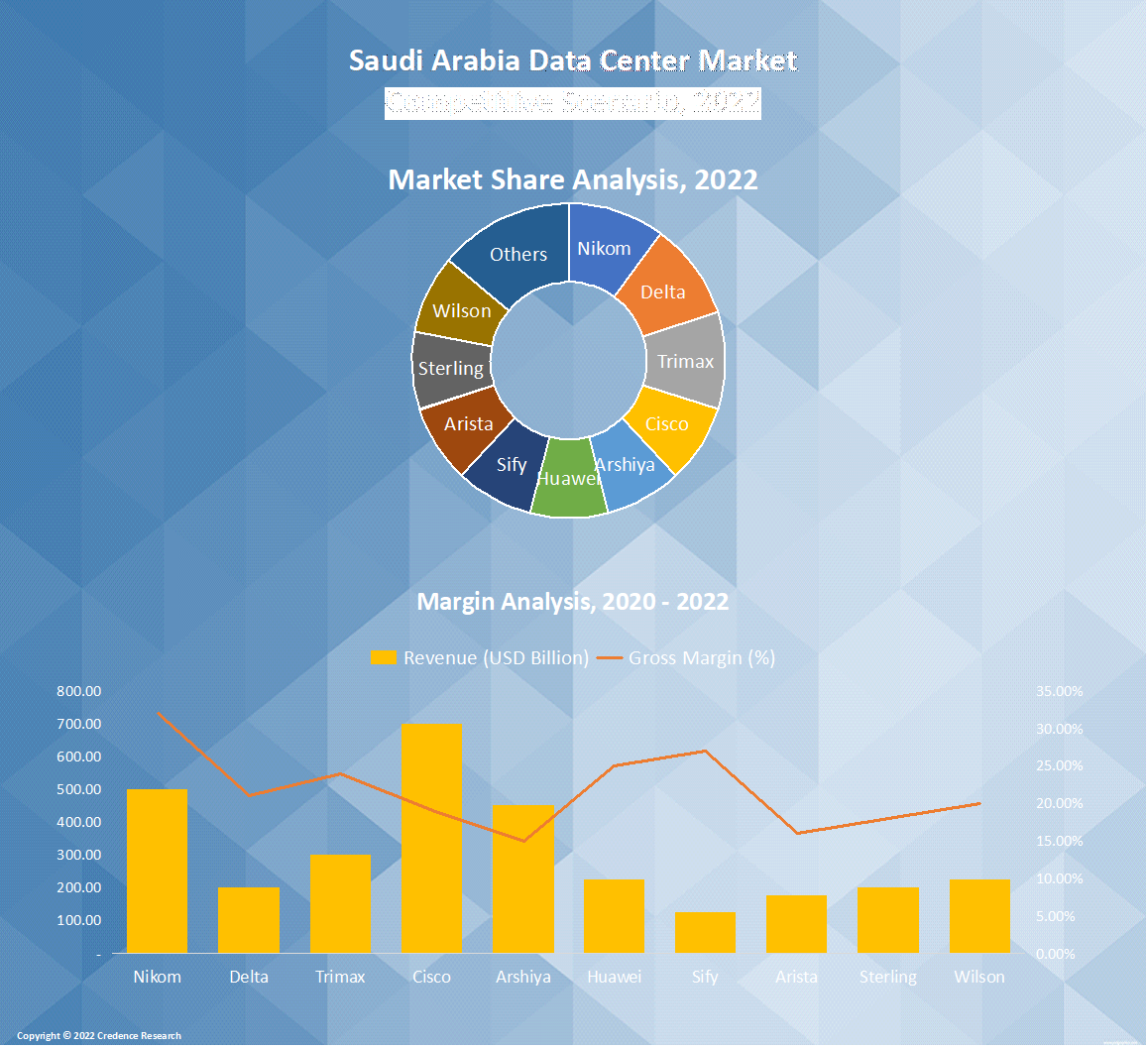
Energy Resources and Cost Efficiency
Saudi Arabia has been making significant investments in renewable energy sources, such as solar and wind power. These initiatives aim to diversify the country's energy mix and reduce reliance on fossil fuels. In January 2021, Saudi Arabia announced a plan to build the world's largest solar power project, generating 1.5 GW of electricity. The availability of renewable energy resources can contribute to lower energy costs for data centers, making them more cost-effective to operate. The low cost of energy makes it attractive for data center operators, as electricity consumption is a significant operational expense for data centers. The availability of low-cost energy can help attract investments and encourage the establishment of data centers, driving industry growth.Regulatory and Legal Framework
In Saudi Arabia, the legal and regulatory framework governing data security and privacy is currently developing. When it comes to data governance and handling sensitive information, organizations that run data centers must traverse a maze of complicated legislation and compliance requirements. Recently, Saudi Arabia introduced the Personal Data Protection Law (PDPL), which aims to regulate the processing of personal data and protect individuals' privacy rights. The PDPL establishes rules for data collection, processing, and storage, as well as the rights of data subjects. However, the specific implementing regulations and guidelines are still being developed, which creates some uncertainty for data center operators in terms of compliance requirements.Cloud Computing Adoption & International Connectivity
Cloud service providers have been expanding their presence in Saudi Arabia to meet the increasing demand for cloud services. In February 2021, Amazon Web Services (AWS) announced the opening of its first data center region in the Middle East, located in Bahrain. This region serves customers in Saudi Arabia and neighboring countries, offering cloud services such as computing, storage, database, and analytics. Data centers play a crucial role in supporting the infrastructure and services of cloud providers, enabling organizations to leverage cloud solutions locally.Competitive Landscape
Key Players
The Saudi Arabia, Data Center market, is highly competitive, with the presence of several key players. Some of the major players in the market and their market share are as follows:- Nikom IT Infrastructure Private Limited
- Delta Group
- Trimax IT Infrastructure & Services Limited
- Arshiya Limited
- Arista
- Sterling & Wilson and others
Summary of Key Findings
- Government in this region has been actively supporting the development of the data center industry & significant increase in internet penetration, with a large and growing number of internet users are the driving market growth
- Market segmented by types, IT Infrastructure, and End Use.
- Corporate data centers are the most popular, with web-hosting data centers as the primary types segment.
- Servers are the most common IT Infrastructure segment.
- BFSI is the end-user segment that is leading market growth; the market is highly competitive with key players including Nikom IT Infrastructure Private Limited, Delta Group, Trimax IT Infrastructure & Services Limited, and others.
Future Outlook
- Positive outlook for the Saudi Arabia Data Center market with significant growth potential in Saudi Arabia
- The government in this region has been actively supporting the development of the data center industry & significant increase in internet penetration, with a large and growing number of internet users driving the market growth.
- Challenges like availability of a skilled workforce specialized in data center operations and management & data centers are prime targets for cyber threats and attacks due to the sensitive nature of the data they store and process.
Segmentation
- By Types
-
- Corporate Data Centers
- Web Hosting Data Centers
- By IT Infrastructure
- Servers
- Storage
- Enterprise Networking
- Others
- By End User
- BFSI
- Telecom & IT
- Media & Entertainment
- E-Commerce
- Government
- Healthcare
- Others

Request a Free Sample
Fill in your details and we'll send you a free sample report.
- Sample data tables & charts
- Research methodology
Market Dynamics
Government Support and Vision 2030 Initiatives
The Saudi government has actively supported the development of the data center industry as part of its Vision 2030 digital transformation agenda, providing incentives, regulatory support, and infrastructure investments that encourage both local and international players to establish and expand data centers in the country.
Rising Internet Penetration and Digitalization
A significant increase in internet penetration and a rapidly growing number of internet users in Saudi Arabia are driving demand for robust data storage, processing, and management solutions, fueling the expansion of data center infrastructure.
Cloud Computing and International Connectivity
The adoption of cloud computing and the expansion of global cloud service providers into Saudi Arabia have increased the need for local data centers to support cloud services, data sovereignty, and low-latency connectivity for enterprises and consumers.
Energy Cost Efficiency and Renewable Investments
Saudi Arabia's investments in renewable energy sources, such as solar and wind, combined with generally low energy costs, make it attractive for data center operators by reducing operational expenses and supporting sustainable growth.
Need a Custom Version of This Report?
Tailor the scope, geography, or segments to your exact requirements.
- Custom geography or segment scope
- Direct access to our analyst team
Frequently Asked Questions
What is the current size of the Saudi Arabia Data Center market?
What is the expected growth rate of the Saudi Arabia Data Center market between 2023 and 2030?
Which types segment is leading the market share in terms of product types?
Which IT Infrastructure governs the demand for Saudi Arabia Data Centers in the world?
Which segment is expected to post the highest CAGR during the forecast period?
Which End User Segment is fueling the growth of the Saudi Arabia Data Center industry?
Who are the major players in the Saudi Arabia Data Center market?
What is the major market driver of the Saudi Arabia Data Center industry?
What are the major market restraints of the Saudi Arabia Data Center industry?
What are the major market opportunities of the Saudi Arabia Data Center industry?
Table of Content
Chapter 1 Market Segmentation
- 1.1 Segmentation Framework
- 1.1.1 Product and Service Classification
- 1.1.2 Application and End-Use Classification
- 1.1.3 Technology and Solution Classification
- 1.1.4 Customer and Distribution Channel Classification
- 1.1.5 Geographic Segmentation
- 1.1.6 Market Segment Definitions and Boundaries
- 1.2 By Type
- 1.2.1 Corporate Data Centers
- 1.2.2 Web Hosting Data Centers
- 1.3 By End User
- 1.3.1 BFSI
- 1.3.2 Telecom & IT
- 1.3.3 Media & Entertainment
- 1.3.4 E-Commerce
- 1.3.5 Government
- 1.3.6 Healthcare
- 1.3.7 Others
- 1.4 By IT Infrastructure
- 1.4.1 Servers
- 1.4.2 Storage
- 1.4.3 Enterprise Networking
- 1.4.4 Others
Chapter 2 Introduction
- 2.1 Report Objectives and Scope
- 2.2 Product Definition and Industry Terminology
- 2.3 Market Inclusions and Exclusions
- 2.4 Research Process
- 2.4.1 Primary Research and Expert Interviews
- 2.4.2 Secondary Research and Source Review
- 2.4.3 Top-Down and Bottom-Up Estimation
- 2.4.4 Data Triangulation and Verification
- 2.5 Market Size Measurement Basis
- 2.5.1 2022: USD 1.2 Billion → Forecast year: -
- 2.6 Historical and Forecast Reference Periods
- 2.6.1 Base Year: 2022
- 2.7 Research Assumptions and Limitations
Chapter 3 Executive Summary
- 3.1 Market Snapshot and Key Findings
- 3.2 Base-Year Market Size, 2022
- 3.3 Forecast Market Size
- 3.4 Revenue and Volume Growth Outlook
- 3.5 Key Demand and Supply Indicators
- 3.6 Leading Market Segments
- 3.7 Fastest-Growing Market Opportunities
- 3.8 Regional Performance Highlights
- 3.9 Technology and Industry Transformation
- 3.10 Competitive Landscape Summary
- 3.11 Analyst View and Strategic Implications
Chapter 4 Saudi Arabia Data Center Market Trends and Developments
- 4.1 Historical Industry Development
- 4.2 Recent Market Trends and Developments
- 4.3 Demand and Customer Behavior Trends
- 4.4 Technology and Product Innovation
- 4.5 Artificial Intelligence, Automation and Digitalization
- 4.6 Local Manufacturing and Supply Chain Realignment
- 4.7 Industry Partnerships, Mergers and Acquisitions
- 4.8 Sustainability and Circular Economy Developments
- 4.9 Government and Private Sector Investment Trends
- 4.10 Emerging Business Models and Commercialization
- 4.11 Industry Developments and Announcements
Chapter 5 Saudi Arabia Data Center Market Production, Supply and Demand Analysis
- 5.1 Demand Trend and Consumption Analysis
- 5.2 Demand Forecast
- 5.3 Production and Output Trend
- 5.4 Production and Output Forecast
- 5.5 Installed Capacity and Capacity Utilization
- 5.6 Company-Wise Production Plants and Statistics
- 5.6.1 Installed Production Capacity
- 5.6.2 Actual Production
- 5.6.3 Planned Capacity and Expansion Targets
- 5.7 Supply Chain Structure and Procurement Trends
- 5.8 Supply-Demand Gap and Bottlenecks
- 5.9 Import Dependence and Sourcing Structure
- 5.10 Contract Manufacturing and Outsourcing
- 5.11 Regional Supply and Demand Concentration
Chapter 6 Saudi Arabia Data Center Market Pricing Analysis
- 6.1 Pricing Structure and Measurement
- 6.2 Historical Pricing Trends
- 6.3 Pricing Outlook
- 6.4 Average Selling Price and Unit Economics
- 6.5 Pricing by Product and Market Segment
- 6.6 Geographic Pricing Differences
- 6.7 Key Input, Energy, Labor and Logistics Costs
- 6.8 Contract Pricing and Purchasing Models
- 6.9 Pricing Sensitivity and Competitive Positioning
- 6.10 Price, Margin and Profitability Implications
Chapter 7 Saudi Arabia Data Center Market Dynamics
- 7.1 Market Growth Drivers
- 7.1.1 Demand-Side Drivers
- 7.1.2 Technology and Innovation Drivers
- 7.1.3 Infrastructure and Investment Drivers
- 7.1.4 Regulatory and Policy Drivers
- 7.2 Market Restraints
- 7.2.1 Cost and Affordability Constraints
- 7.2.2 Technology and Adoption Barriers
- 7.2.3 Supply Chain and Operational Constraints
- 7.3 Market Challenges
- 7.3.1 Competitive Pressure and Margin Erosion
- 7.3.2 Skills, Infrastructure and Implementation Gaps
- 7.4 Emerging Market Opportunities
- 7.5 Market Dynamics Impact and Time-Horizon Assessment
Chapter 8 Saudi Arabia Data Center Value Chain Analysis
- 8.1 Industry Value Chain Overview
- 8.2 Upstream Suppliers and Critical Inputs
- 8.3 Technology and Component Providers
- 8.4 Manufacturing or Service Delivery
- 8.5 Distribution, Channel Partners and Integrators
- 8.6 Downstream Applications and End Users
- 8.7 Value Addition and Profit Pools
- 8.8 Vertical Integration and Outsourcing
- 8.9 Supplier Concentration and Risk
- 8.10 Supply Chain Localization and Resilience
Chapter 9 Saudi Arabia Data Center Market Regulations and Policies
- 9.1 Relevant Laws, Standards and Compliance Frameworks
- 9.2 Product, Service, Safety and Quality Requirements
- 9.3 Government Policies, Incentives and Subsidies
- 9.4 Imports, Exports and Trade Barriers
- 9.5 Public Procurement and Local Content Requirements
- 9.6 Environmental and Sustainability Compliance
- 9.7 Data Protection, AI and Cybersecurity Compliance
- 9.8 Upcoming Policy Changes and Market Implications
Chapter 10 Saudi Arabia Data Center Market Hotspots and Opportunities
- 10.1 Market Opportunity Mapping and Growth Hotspots
- 10.2 High-Growth Applications and Customer Groups
- 10.3 Underserved Markets and White-Space Opportunities
- 10.4 Emerging Technology and Product Opportunities
- 10.5 New Capacity and Investment Hotspots
- 10.6 Market Entry and Expansion Opportunities
- 10.7 Distribution and Partnership Opportunities
- 10.8 Near-Term and Long-Term Commercial Potential
- 10.9 Opportunity Attractiveness and Execution Risks
Chapter 11 Saudi Arabia Data Center Market Outlook
- 11.1 Market Size and Analysis
- 11.1.1 Revenue (Market Measurement: 2022: USD 1.2 Billion → Forecast year: - )
- 11.1.2 Market Volume and Quantity Sold
- 11.1.3 Historical Market Size
- 11.1.4 Base-Year Market Size, 2022
- 11.2 Market Forecast
- 11.2.1 Revenue Forecast
- 11.2.2 Volume Forecast
- 11.2.3 CAGR and Year-on-Year Growth
- 11.2.4 Incremental Revenue Opportunity
- 11.3 Forecast Assumptions and Scenario Analysis
- 11.3.1 Base-Case Forecast
- 11.3.2 Optimistic and Conservative Scenarios
- 11.3.3 Technology, Pricing and Policy Sensitivities
- 11.4 Market Attractiveness and Growth Outlook
Chapter 12 Saudi Arabia Data Center Market Segmentation and Outlook
- 12.1 Segmentation Summary and Market Shares, 2022
- 12.2 Largest and Fastest-Growing Segments
- 12.3 By Type - Market Size and Forecast
- 12.3.1 Segment Definition and Scope
- 12.3.2 Historical Market Size
- 12.3.3 Revenue Forecast
- 12.3.4 Volume Forecast
- 12.3.5 Base-Year Market Share, 2022
- 12.3.6 Segment CAGR and Growth Drivers
- 12.3.7 Subsegment Market Size and Forecast
- 12.3.7.1 Corporate Data Centers
- 12.3.7.2 Web Hosting Data Centers
- 12.3.8 Subsegment Pricing and Adoption Trends
- 12.3.9 Leading Suppliers and Competition
- 12.3.10 Regional Demand and Opportunities
- 12.4 By End User - Market Size and Forecast
- 12.4.1 Segment Definition and Scope
- 12.4.2 Historical Market Size
- 12.4.3 Revenue Forecast
- 12.4.4 Volume Forecast
- 12.4.5 Base-Year Market Share, 2022
- 12.4.6 Segment CAGR and Growth Drivers
- 12.4.7 Subsegment Market Size and Forecast
- 12.4.7.1 BFSI
- 12.4.7.2 Telecom & IT
- 12.4.7.3 Media & Entertainment
- 12.4.7.4 E-Commerce
- 12.4.7.5 Government
- 12.4.7.6 Healthcare
- 12.4.7.7 Others
- 12.4.8 Subsegment Pricing and Adoption Trends
- 12.4.9 Leading Suppliers and Competition
- 12.4.10 Regional Demand and Opportunities
- 12.5 By IT Infrastructure - Market Size and Forecast
- 12.5.1 Segment Definition and Scope
- 12.5.2 Historical Market Size
- 12.5.3 Revenue Forecast
- 12.5.4 Volume Forecast
- 12.5.5 Base-Year Market Share, 2022
- 12.5.6 Segment CAGR and Growth Drivers
- 12.5.7 Subsegment Market Size and Forecast
- 12.5.7.1 Servers
- 12.5.7.2 Storage
- 12.5.7.3 Enterprise Networking
- 12.5.7.4 Others
- 12.5.8 Subsegment Pricing and Adoption Trends
- 12.5.9 Leading Suppliers and Competition
- 12.5.10 Regional Demand and Opportunities
- 12.6 Segment Growth Comparison
- 12.7 Segment Attractiveness and Priority Matrix
Chapter 13 Saudi Arabia Data Center End-Use and Application Market Outlook
- 13.1 End-Use Industry and Customer Demand Structure
- 13.2 Leading Applications and Customer Groups
- 13.3 End-Use Market Size, Share and Forecast
- 13.4 Major End-Use Industry Deep Dives
- 13.4.1 Customer Requirements and Use Cases
- 13.4.2 Demand and Replacement Cycles
- 13.4.3 Technical and Regulatory Considerations
- 13.4.4 Purchasing and Procurement Models
- 13.4.5 Leading Vendors and Distribution Channels
- 13.4.6 Forecast and Commercial Opportunities
- 13.5 Emerging Applications and Cross-Segment Demand
- 13.6 End-Use Industry Investment Priorities
Chapter 14 Saudi Arabia Data Center Geographic Market Outlook
- 14.1 Domestic Market Distribution and Demand Clusters
- 14.2 State- or Province-Wise Market Size and Forecast
- 14.3 City and Metropolitan Market Outlook
- 14.4 Industrial, Manufacturing and Commercial Clusters
- 14.5 Geographic Concentration of Key End Users
- 14.6 Local Pricing and Purchasing Differences
- 14.7 Domestic Production Facilities and Capacity Map
- 14.8 Local Infrastructure and Project Pipeline
- 14.9 State-Level Policy and Incentive Differences
- 14.10 Subnational Investment Hotspots and Opportunities
- 14.11 Distribution and Logistics Networks
- 14.12 Domestic Competitive Footprint
Chapter 15 Saudi Arabia Data Center Technology, Innovation and Sustainability Outlook
- 15.1 Technology Landscape and Maturity
- 15.2 Product, Process and Service Innovation
- 15.3 AI, Automation and Digital Tools in the Industry
- 15.4 Technology Adoption and Performance Benchmarking
- 15.5 Innovation Pipeline and R&D Investment
- 15.6 Patent and Intellectual Property Trends
- 15.7 Energy Efficiency and Resource Management
- 15.8 Sustainability, Recycling and Circularity
- 15.9 Technology Roadmap
- 15.10 Risks of Obsolescence and Technology Substitution
Chapter 16 Saudi Arabia Data Center Market Key Strategic Imperatives
- 16.1 Growth and Market Entry Priorities
- 16.2 High-Return Products and Segments
- 16.3 Pricing, Profitability and Cost Optimization
- 16.4 Technology Investment and Product Differentiation
- 16.5 Supply Chain Localization and Resilience
- 16.6 Distribution and Customer Acquisition
- 16.7 Partnership, Acquisition and Capacity Strategy
- 16.8 Regional Expansion Priorities
- 16.9 Short-, Medium- and Long-Term Actions
Chapter 17 Competition Outlook
- 17.1 Industry Competition Characteristics
- 17.2 Market Structure and Concentration
- 17.3 Market Share and Competitive Positioning, 2022
- 17.4 Company-Wise Revenue and Product Benchmarking
- 17.5 Production and Service Capacity Benchmarking
- 17.6 Technology, Pricing and Differentiation
- 17.7 Regional Footprint and Distribution Strength
- 17.8 Mergers, Acquisitions and Strategic Alliances
- 17.9 New Entrants and Competitive Threats
- 17.10 Porter's Five Forces and Industry Attractiveness
- 17.11 Competitive Outlook
Chapter 18 Company Profiles
- 18.1 Company Coverage and Selection Criteria
- 18.2 Nikom IT Infrastructure Private Limited
- 18.2.1 Business Description
- 18.2.2 Company Ownership and Geographic Presence
- 18.2.3 Product and Service Portfolio
- 18.2.4 Manufacturing and Operating Footprint
- 18.2.5 Production Capacity and Expansion Plans
- 18.2.6 Financial Performance and Investment
- 18.2.7 Market Share and Competitive Position
- 18.2.8 Technology and Innovation Capabilities
- 18.2.9 Strategic Alliances or Partnerships
- 18.2.10 Recent Developments
- 18.2.11 Growth Strategy and Outlook
- 18.3 Delta Group
- 18.4 Trimax IT Infrastructure & Services Limited
- 18.5 Arshiya Limited
- 18.6 Arista
- 18.7 Sterling & Wilson
- 18.8 Saudi Telecom Company (STC)
- 18.9 Mobily
- 18.10 Zain KSA
- 18.11 Oracle
- 18.12 Other Relevant Market Participants
Note: Every listed company is profiled on the structure shown under the first company. The company list is preliminary and may change based on research findings, market developments, data availability and client requirements.
Chapter 19 Disclaimer
- 19.1 Research and Forecast Disclaimer
- 19.2 Data Source and Estimation Limitations
Note: The depth of individual sections depends on data availability for this market. Volume, capacity, trade and other unit-based metrics are included where applicable.

