
Market Overview:
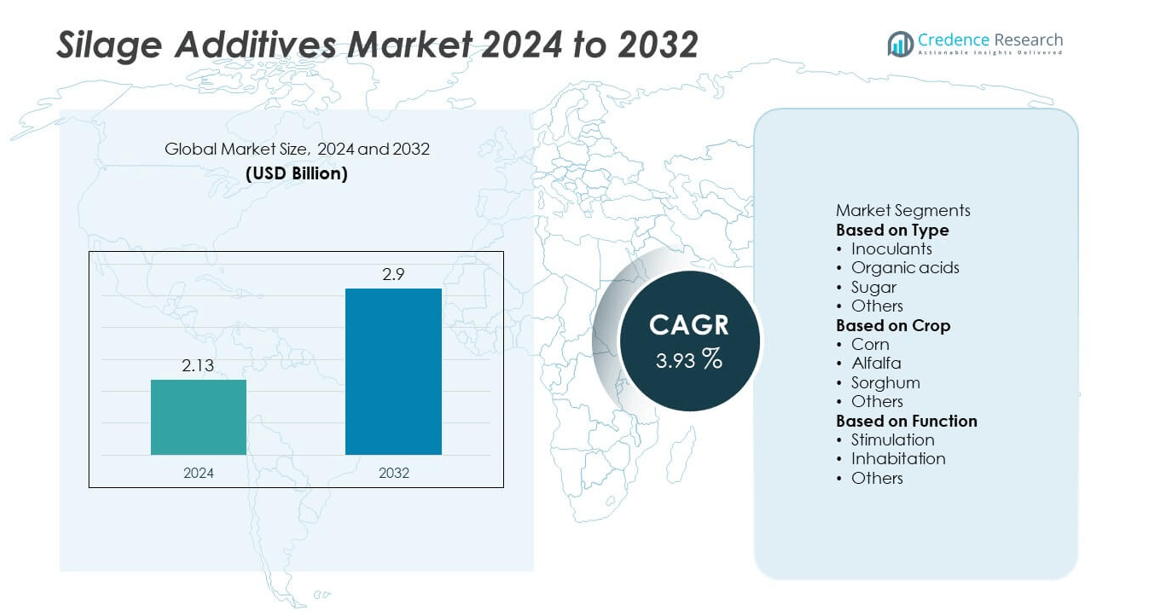
The Silage Additives Market was valued at USD 2.13 billion in 2024 and is projected to reach USD 2.9 billion by 2032, growing at a CAGR of 3.93% during the forecast period.
| REPORT ATTRIBUTE | DETAILS |
|---|---|
| Historical Period | 2020-2023 |
| Base Year | 2024 |
| Forecast Period | 2025-2032 |
| Silage Additives Market Size 2024 | USD 2.13 billion |
| Silage Additives Market, CAGR | 3.93% |
| Silage Additives Market Size 2032 | USD 2.9 billion |
The Silage Additives market is led by prominent companies such as Lallemand, Inc., ForFarmers N.V., BASF SE, Kemin Industries, Inc., American Farm Products, Inc., Dupont de Nemours, Inc. (DuPont), Biomin Holding GmbH, Cargill, Incorporated, ADM Animal Nutrition, and Chr. Hansen Holding A/S. These players emphasize microbial and enzyme-based innovations to enhance fermentation efficiency and feed preservation. Strategic investments in sustainable and high-performance additive solutions are strengthening their global reach. Asia-Pacific dominated the market with a 33.7% share in 2024, driven by livestock expansion and improved feed practices, followed by Europe with 31.5% and North America with 27.8%, supported by advanced dairy and beef industries.
Market Insights
- The Silage Additives market was valued at USD 2.13 billion in 2024 and is projected to reach USD 2.9 billion by 2032, growing at a CAGR of 3.93% during the forecast period.
- Rising demand for high-quality livestock feed and improved silage preservation is driving adoption across dairy and beef farming sectors worldwide.
- Key trends include increased use of microbial inoculants and enzyme-based additives that enhance fermentation, reduce spoilage, and align with sustainable farming practices.
- The market is competitive, with major players such as Lallemand, BASF, Cargill, DuPont, and ADM focusing on biological innovations, regional expansion, and partnerships with feed producers.
- Asia-Pacific held 33.7%, followed by Europe with 31.5% and North America with 27.8%, while the inoculants segment led with 46.7% share, reflecting growing preference for efficient, eco-friendly solutions in silage preservation and animal nutrition management.
Market Segmentation Analysis:
By Type
The inoculants segment dominated the Silage Additives market in 2024 with a 46.7% share. Its strong position is driven by its ability to enhance fermentation, improve nutrient retention, and prevent spoilage. Inoculants containing lactic acid bacteria accelerate pH reduction and increase feed digestibility, supporting livestock performance. Growing use in dairy and beef farming to maintain silage stability during long storage periods further boosts adoption. Organic acids are also gaining traction as chemical preservatives for moisture control, while sugars serve as fermentation enhancers in low-sugar crops.
- For instance, Chr. Hansen Holding A/S introduced its SiloSolve® FC inoculant combining Lactobacillus buchneri and Lactococcus lactis strains at a target application concentration of 1.5 × 10⁵ CFU per gram of fresh forage.
By Crop
The corn segment accounted for the largest 51.3% share of the market in 2024, reflecting its wide use in livestock feed production due to high starch and energy content. Silage additives improve fermentation efficiency and minimize nutrient loss in corn-based silage, which supports milk yield and animal growth. Rising demand for energy-dense feed in dairy and beef farms sustains corn’s dominance. Alfalfa and sorghum follow, as producers increasingly use additives to maintain protein levels and reduce spoilage under humid storage conditions.
- For instance, Lallemand, Inc. evaluated its Magniva® Platinum inoculant on corn silage in a 160-day storage trial, achieving a 5.4 percentage-point increase in Neutral Detergent Fibre digestibility (NDFd) and 1.23 kg higher daily milk yield per cow. The product’s multi-strain formula stabilized lactic acid concentration at 8.7 g/kg of dry matter, ensuring superior aerobic stability during long-term storage.
By Function
The stimulation segment led the market with a 54.2% share in 2024, supported by its role in promoting lactic acid fermentation and rapid pH stabilization. These additives help enhance microbial activity, ensuring better preservation and higher-quality silage. The use of enzyme-based and microbial stimulants is expanding, particularly in high-moisture crops, to boost feed conversion efficiency. The inhabitation segment, which includes preservatives and antifungal agents, continues to grow steadily as farms prioritize longer storage life and reduced mold contamination in silage.
Key Growth Drivers
Rising Demand for High-Quality Animal Feed
The growing focus on livestock productivity is driving demand for high-quality silage. Silage additives enhance fermentation efficiency, improve nutrient preservation, and extend storage stability. Farmers are adopting these products to maintain consistent feed quality throughout the year. Expanding dairy and beef industries, particularly in developing regions, are fueling wider additive use. With increasing awareness of feed efficiency and animal health, the adoption of inoculants and organic acids continues to strengthen across global livestock operations.
- For instance, Kemin Industries, Inc. introduced its Silage SAVOR® Plus Liquid additive formulated with 70% propionic and acetic acid. Applied at 2.0 lb per 10 ft² of silo surface, it achieved yeast reduction levels below 10³ CFU/g in maize silage, improving aerobic stability and preventing visible mold growth during 21 days of open storage.
Expansion of Livestock and Dairy Farming
The expansion of commercial livestock and dairy farms worldwide is a major growth driver. Rising meat and milk consumption in emerging economies is increasing the need for efficient feed preservation. Silage additives play a critical role in preventing spoilage, maintaining energy content, and ensuring balanced nutrition. Governments and private enterprises are investing in advanced silage management practices, supporting steady market growth. This trend is particularly strong in regions with expanding dairy production and intensive animal farming operations.
- For instance, research and field data on maize silage improvement programs in Brazil, some involving specific bacterial inoculants, have shown varied and sometimes significant results in improving forage quality. In studies evaluating the effects of different factors on maize silage quality, inoculation with Lactobacillus buchneri has been shown to increase aerobic stability.
Growing Awareness of Feed Efficiency and Sustainability
Farmers are increasingly focusing on reducing feed waste and improving sustainability in livestock systems. Silage additives help minimize nutrient losses, reduce methane emissions, and optimize fermentation processes. This aligns with environmental goals and cost-efficient farming practices. Adoption of eco-friendly microbial inoculants and biodegradable additives is growing as part of sustainable agriculture initiatives. The trend supports both productivity and environmental compliance, strengthening the market’s long-term growth prospects across the agriculture and livestock feed sectors.
Key Trends & Opportunities
Adoption of Biological and Enzyme-Based Additives
Biological and enzyme-based additives are gaining prominence due to their efficiency and eco-friendly nature. These additives enhance fiber breakdown, improve digestibility, and promote faster fermentation. Microbial inoculants containing lactic acid bacteria and enzymes are increasingly replacing chemical preservatives. Their natural composition supports clean-label livestock production and aligns with global sustainability standards. Ongoing research into multi-strain inoculants and enzyme blends is creating new opportunities for feed manufacturers targeting improved nutritional retention and higher animal performance.
- For instance, Biomin Holding GmbH developed its Biomin® BioStabil Plus inoculant containing Lactobacillus plantarum and Enterococcus faecium, a formulation of strategically selected Lactic Acid Bacteria for optimal forage preservation.
Integration of Precision Farming and Digital Monitoring
Technological advancements in precision farming are shaping the future of silage management. Digital sensors and monitoring systems now track fermentation quality, temperature, and moisture in real time. This allows farmers to optimize additive dosage and ensure consistent silage preservation. Integration of smart farming tools helps reduce feed spoilage and improve operational efficiency. The trend is supported by growing adoption of data-driven livestock management systems, especially among large-scale dairy and beef producers seeking improved productivity and cost control.
- For instance, trinamiX GmbH, a wholly-owned subsidiary of BASF SE, in collaboration with Eurofins Agro Testing, introduced the handheld NIR spectrometer trinamiX PAL Two, which can analyze various silage nutrient profiles on-farm.
Key Challenges
High Cost of Quality Additives and Equipment
The production and application of advanced silage additives involve significant costs, limiting adoption among small-scale farmers. High-quality microbial cultures, enzyme formulations, and specialized equipment increase operational expenses. Many farmers in developing regions still rely on traditional preservation methods due to budget constraints. Limited access to financial support or subsidies also restricts the use of premium additive products. Cost-effective formulations and local production could help address this challenge and expand the market’s reach among smallholder livestock producers.
Lack of Technical Knowledge and Training
Limited technical awareness among farmers remains a key barrier to wider adoption of silage additives. Many users lack understanding of optimal dosage, application timing, and crop-specific additive selection. Inadequate knowledge can lead to inconsistent results and poor fermentation outcomes. This challenge is more pronounced in developing markets with limited agricultural extension services. Training programs and awareness campaigns led by additive manufacturers and cooperatives are essential to improving user understanding and maximizing the benefits of modern silage management practices.
Regional Analysis
North America
North America held a 27.8% share of the Silage Additives market in 2024. The region’s dominance is driven by well-established dairy and beef industries in the United States and Canada. Farmers are increasingly adopting microbial inoculants and enzyme-based additives to enhance feed efficiency and reduce spoilage. Supportive government programs promoting sustainable livestock farming further encourage market growth. Growing awareness of feed preservation technologies and the presence of major feed manufacturers strengthen regional demand, while high mechanization levels in silage preparation ensure consistent adoption across large-scale farming operations.
Europe
Europe accounted for a 31.5% share of the global market in 2024, driven by the region’s advanced livestock farming systems and strict feed quality regulations. Countries such as Germany, France, and the Netherlands lead in the use of silage additives to maintain nutrient stability and fermentation quality. Farmers prioritize organic and eco-friendly additives to align with the European Union’s sustainability standards. The region’s strong dairy sector, high silage production volumes, and continuous research into biological inoculants further boost market expansion across major agricultural economies.
Asia-Pacific
Asia-Pacific dominated the Silage Additives market with a 33.7% share in 2024. The region’s growth is supported by rapid livestock expansion, increasing dairy consumption, and modernization of feed storage systems in China, India, and Japan. Rising awareness of silage preservation techniques and government efforts to improve animal nutrition practices are driving product adoption. Local manufacturers are investing in cost-effective additive formulations suited for tropical climates. Growing investments in dairy cooperatives and feed efficiency programs position Asia-Pacific as the fastest-growing region for silage additive consumption.
Latin America
Latin America captured a 4.2% share of the Silage Additives market in 2024. Brazil, Argentina, and Mexico are key contributors due to expanding beef and dairy production. Farmers are increasingly using inoculants and acid-based additives to improve silage quality under warm and humid conditions. Government-backed agricultural development programs are promoting better feed management practices. The region’s shift toward intensive livestock systems and rising export demand for meat products are encouraging wider adoption of silage additives to enhance feed preservation and animal productivity.
Middle East & Africa
The Middle East & Africa region held a 2.8% share of the global market in 2024. Growing livestock farming activities in South Africa, Saudi Arabia, and the United Arab Emirates are driving gradual adoption of silage additives. The region is witnessing rising demand for quality feed preservation solutions due to limited forage availability and harsh climatic conditions. Support from agricultural development programs and increasing focus on food security are encouraging farmers to use silage additives. The adoption of microbial inoculants is expanding as livestock producers aim to improve efficiency and reduce feed losses.
Market Segmentations:
By Type
- Inoculants
- Organic acids
- Sugar
- Others
By Crop
- Corn
- Alfalfa
- Sorghum
- Others
By Function
- Stimulation
- Inhabitation
- Others
By Geography
- North America
- U.S.
- Canada
- Mexico
- Europe
- Germany
- France
- U.K.
- Italy
- Spain
- Rest of Europe
- Asia Pacific
- China
- Japan
- India
- South Korea
- South-east Asia
- Rest of Asia Pacific
- Latin America
- Brazil
- Argentina
- Rest of Latin America
- Middle East & Africa
- GCC Countries
- South Africa
- Rest of the Middle East and Africa
Competitive Landscape
The competitive landscape of the Silage Additives market includes key players such as Lallemand, Inc., ForFarmers N.V., BASF SE, Kemin Industries, Inc., American Farm Products, Inc., Dupont de Nemours, Inc. (DuPont), Biomin Holding GmbH, Cargill, Incorporated, ADM Animal Nutrition, and Chr. Hansen Holding A/S. These companies are focusing on product innovation, microbial strain development, and enzymatic solutions to improve silage quality and feed efficiency. Strategic partnerships with feed producers and livestock farms are enhancing distribution networks and customer reach. Leading firms are investing in eco-friendly, biological inoculants and acid-based preservatives to align with sustainability goals. Technological advancements in microbial formulation and fermentation optimization are further strengthening their market positions. Continuous R&D and regional expansion across Asia-Pacific and Europe highlight efforts to meet rising demand for high-quality animal feed additives, ensuring competitiveness through product diversification and performance-driven solutions.
Key Player Analysis
- Lallemand, Inc.
- ForFarmers N.V.
- BASF SE
- Kemin Industries, Inc.
- American Farm Products, Inc.
- Dupont de Nemours, Inc. (DuPont)
- Biomin Holding GmbH
- Cargill, Incorporated
- ADM Animal Nutrition
- Hansen Holding A/S
Recent Developments
- In July 2025, BASF SE launched a handheld NIR spectrometer solution developed with trinamiX GmbH and Eurofins Agro Testing for on-farm nutritional analysis of silage; the device supports rapid measurement of maize, grass and haylage feed in-field.
- In March 2025, Lallemand, Inc. reported that use of its Magniva Platinum grass-silage inoculant increased Neutral Detergent Fibre digestibility (NDFd) by 5.4 percentage points in a 160-day trial, resulting in a daily milk yield improvement of 1.23 kg per cow.
- In January 2024, the primary focus for Chr. Hansen Holding A/S was the completion of its merger with Novozymes to form a new company named Novonesis
Report Coverage
The research report offers an in-depth analysis based on Type, Crop, Function and Geography. It details leading market players, providing an overview of their business, product offerings, investments, revenue streams, and key applications. Additionally, the report includes insights into the competitive environment, SWOT analysis, current market trends, as well as the primary drivers and constraints. Furthermore, it discusses various factors that have driven market expansion in recent years. The report also explores market dynamics, regulatory scenarios, and technological advancements that are shaping the industry. It assesses the impact of external factors and global economic changes on market growth. Lastly, it provides strategic recommendations for new entrants and established companies to navigate the complexities of the market.
Future Outlook
- Demand for silage additives will rise with growing livestock and dairy production worldwide.
- Adoption of microbial and enzyme-based additives will continue to expand for better fermentation control.
- Farmers will increasingly prefer eco-friendly and biodegradable additive formulations.
- Advancements in biological inoculants will improve feed quality and nutrient preservation.
- Asia-Pacific will remain the leading region due to rapid livestock expansion and modernization of farming systems.
- Europe will see steady growth driven by sustainability regulations and organic farming adoption.
- Manufacturers will invest more in R&D to develop multi-strain and crop-specific additive blends.
- Integration of digital monitoring tools will optimize silage management and additive application.
- Collaborations between feed companies and livestock producers will enhance product reach and awareness.
- Continuous focus on reducing feed losses and improving animal performance will sustain long-term market growth.

Request a Free Sample
Fill in your details and we'll send you a free sample report.
- Sample data tables & charts
- Research methodology
Need a Custom Version of This Report?
Tailor the scope, geography, or segments to your exact requirements.
- Custom geography or segment scope
- Direct access to our analyst team
Frequently Asked Questions
What is the current market size for the Silage Additives market, and what is its projected size in 2032?
At what Compound Annual Growth Rate is the Silage Additives market projected to grow between 2025 and 2032?
Which Silage Additives market segment held the largest share in 2024?
What are the primary factors fueling the growth of the Silage Additives market?
Who are the leading companies in the Silage Additives market?
Which region commanded the largest share of the Silage Additives market in 2024?
Table of Content
Chapter 1 Market Segmentation
- 1.1 Segmentation Framework
- 1.1.1 Product and Service Classification
- 1.1.2 Application and End-Use Classification
- 1.1.3 Technology and Solution Classification
- 1.1.4 Customer and Distribution Channel Classification
- 1.1.5 Geographic Segmentation
- 1.1.6 Market Segment Definitions and Boundaries
Chapter 2 Introduction
- 2.1 Report Objectives and Scope
- 2.2 Product Definition and Industry Terminology
- 2.3 Market Inclusions and Exclusions
- 2.4 Research Process
- 2.4.1 Primary Research and Expert Interviews
- 2.4.2 Secondary Research and Source Review
- 2.4.3 Top-Down and Bottom-Up Estimation
- 2.4.4 Data Triangulation and Verification
- 2.5 Market Size Measurement Basis
- 2.5.1 2024: USD 2.13 billion → 2032: USD 2.9 billion
- 2.6 Historical and Forecast Reference Periods
- 2.6.1 Base Year: 2024
- 2.6.2 Forecast Period: 2024-2032
- 2.7 Research Assumptions and Limitations
Chapter 3 Executive Summary
- 3.1 Market Snapshot and Key Findings
- 3.2 Base-Year Market Size, 2024
- 3.3 Forecast Market Size, 2032
- 3.4 Revenue and Volume Growth Outlook
- 3.5 Key Demand and Supply Indicators
- 3.6 Leading Market Segments
- 3.7 Fastest-Growing Market Opportunities
- 3.8 Regional Performance Highlights
- 3.9 Technology and Industry Transformation
- 3.10 Competitive Landscape Summary
- 3.11 Analyst View and Strategic Implications
Chapter 4 Global Silage Additives Market Trends and Developments
- 4.1 Historical Industry Development
- 4.2 Recent Market Trends and Developments
- 4.3 Demand and Customer Behavior Trends
- 4.4 Technology and Product Innovation
- 4.5 Artificial Intelligence, Automation and Digitalization
- 4.6 Local Manufacturing and Supply Chain Realignment
- 4.7 Industry Partnerships, Mergers and Acquisitions
- 4.8 Sustainability and Circular Economy Developments
- 4.9 Government and Private Sector Investment Trends
- 4.10 Emerging Business Models and Commercialization
- 4.11 Industry Developments and Announcements
Chapter 5 Global Silage Additives Market Production, Supply and Demand Analysis
- 5.1 Demand Trend and Consumption Analysis
- 5.2 Demand Forecast, 2024-2032
- 5.3 Production and Output Trend
- 5.4 Production and Output Forecast, 2024-2032
- 5.5 Installed Capacity and Capacity Utilization
- 5.6 Company-Wise Production Plants and Statistics
- 5.6.1 Installed Production Capacity
- 5.6.2 Actual Production
- 5.6.3 Planned Capacity and Expansion Targets
- 5.7 Supply Chain Structure and Procurement Trends
- 5.8 Supply-Demand Gap and Bottlenecks
- 5.9 Import Dependence and Sourcing Structure
- 5.10 Contract Manufacturing and Outsourcing
- 5.11 Regional Supply and Demand Concentration
Chapter 6 Global Silage Additives Market Pricing Analysis
- 6.1 Pricing Structure and Measurement
- 6.2 Historical Pricing Trends
- 6.3 Pricing Outlook, 2024-2032
- 6.4 Average Selling Price and Unit Economics
- 6.5 Pricing by Product and Market Segment
- 6.6 Geographic Pricing Differences
- 6.7 Key Input, Energy, Labor and Logistics Costs
- 6.8 Contract Pricing and Purchasing Models
- 6.9 Pricing Sensitivity and Competitive Positioning
- 6.10 Price, Margin and Profitability Implications
Chapter 7 Global Silage Additives Market Dynamics
- 7.1 Market Growth Drivers
- 7.1.1 Demand-Side Drivers
- 7.1.2 Technology and Innovation Drivers
- 7.1.3 Infrastructure and Investment Drivers
- 7.1.4 Regulatory and Policy Drivers
- 7.2 Market Restraints
- 7.2.1 Cost and Affordability Constraints
- 7.2.2 Technology and Adoption Barriers
- 7.2.3 Supply Chain and Operational Constraints
- 7.3 Market Challenges
- 7.3.1 Competitive Pressure and Margin Erosion
- 7.3.2 Skills, Infrastructure and Implementation Gaps
- 7.4 Emerging Market Opportunities
- 7.5 Market Dynamics Impact and Time-Horizon Assessment
Chapter 8 Global Silage Additives Value Chain Analysis
- 8.1 Industry Value Chain Overview
- 8.2 Upstream Suppliers and Critical Inputs
- 8.3 Technology and Component Providers
- 8.4 Manufacturing or Service Delivery
- 8.5 Distribution, Channel Partners and Integrators
- 8.6 Downstream Applications and End Users
- 8.7 Value Addition and Profit Pools
- 8.8 Vertical Integration and Outsourcing
- 8.9 Supplier Concentration and Risk
- 8.10 Supply Chain Localization and Resilience
Chapter 9 Global Silage Additives Market Regulations and Policies
- 9.1 Relevant Laws, Standards and Compliance Frameworks
- 9.2 Product, Service, Safety and Quality Requirements
- 9.3 Government Policies, Incentives and Subsidies
- 9.4 Imports, Exports and Trade Barriers
- 9.5 Public Procurement and Local Content Requirements
- 9.6 Environmental and Sustainability Compliance
- 9.7 Upcoming Policy Changes and Market Implications
Chapter 10 Global Silage Additives Market Hotspots and Opportunities
- 10.1 Market Opportunity Mapping and Growth Hotspots
- 10.2 High-Growth Applications and Customer Groups
- 10.3 Underserved Markets and White-Space Opportunities
- 10.4 Emerging Technology and Product Opportunities
- 10.5 New Capacity and Investment Hotspots
- 10.6 Market Entry and Expansion Opportunities
- 10.7 Distribution and Partnership Opportunities
- 10.8 Near-Term and Long-Term Commercial Potential
- 10.9 Opportunity Attractiveness and Execution Risks
Chapter 11 Global Silage Additives Market Outlook, 2024-2032
- 11.1 Market Size and Analysis
- 11.1.1 Revenue (Market Measurement: 2024: USD 2.13 billion → 2032: USD 2.9 billion)
- 11.1.2 Market Volume and Quantity Sold
- 11.1.3 Historical Market Size
- 11.1.4 Base-Year Market Size, 2024
- 11.2 Market Forecast, 2024-2032
- 11.2.1 Revenue Forecast to 2032
- 11.2.2 Volume Forecast to 2032
- 11.2.3 CAGR and Year-on-Year Growth
- 11.2.4 Incremental Revenue Opportunity
- 11.3 Forecast Assumptions and Scenario Analysis
- 11.3.1 Base-Case Forecast
- 11.3.2 Optimistic and Conservative Scenarios
- 11.3.3 Technology, Pricing and Policy Sensitivities
- 11.4 Market Attractiveness and Growth Outlook
Chapter 12 Global Silage Additives Market Segmentation and Outlook
- 12.1 Segmentation Summary and Market Shares, 2024
- 12.2 Largest and Fastest-Growing Segments
- 12.3 Segment Growth Comparison
- 12.4 Segment Attractiveness and Priority Matrix
Chapter 13 Global Silage Additives Geographic Market Outlook, 2024-2032
- 13.1 Regional Market Size and Share, 2024
- 13.2 Regional Market Forecast, 2024-2032
- 13.3 Regional Pricing, Production and Demand Differences
- 13.4 North America
- 13.4.1 United States
- 13.4.2 Canada
- 13.4.3 Mexico
- 13.5 Europe
- 13.5.1 Germany
- 13.5.2 France
- 13.5.3 Italy
- 13.5.4 United Kingdom
- 13.5.5 Spain
- 13.5.6 Poland
- 13.5.7 Russia
- 13.5.8 Netherlands
- 13.5.9 Belgium
- 13.5.10 Sweden
- 13.5.11 Denmark
- 13.5.12 Norway
- 13.5.13 Rest of Europe
- 13.6 Asia Pacific
- 13.6.1 China
- 13.6.2 India
- 13.6.3 Japan
- 13.6.4 South Korea
- 13.6.5 Thailand
- 13.6.6 Indonesia
- 13.6.7 Vietnam
- 13.6.8 Malaysia
- 13.6.9 Australia
- 13.6.10 Rest of Asia Pacific
- 13.7 Latin America
- 13.7.1 Brazil
- 13.7.2 Argentina
- 13.7.3 Colombia
- 13.7.4 Chile
- 13.7.5 Rest of Latin America
- 13.8 Middle East
- 13.8.1 Saudi Arabia
- 13.8.2 United Arab Emirates
- 13.8.3 Turkey
- 13.8.4 Israel
- 13.8.5 Iran
- 13.8.6 Rest of the Middle East
- 13.9 Africa
- 13.9.1 South Africa
- 13.9.2 Egypt
- 13.9.3 Nigeria
- 13.9.4 Morocco
- 13.9.5 Rest of Africa
- 13.10 Regional Investment, Policy and Supply Chain Differences
- 13.11 Regional Competitive Landscape
- 13.12 Geographic Growth Hotspots
Chapter 14 Global Silage Additives Technology, Innovation and Sustainability Outlook
- 14.1 Technology Landscape and Maturity
- 14.2 Product, Process and Service Innovation
- 14.3 AI, Automation and Digital Tools in the Industry
- 14.4 Technology Adoption and Performance Benchmarking
- 14.5 Innovation Pipeline and R&D Investment
- 14.6 Patent and Intellectual Property Trends
- 14.7 Energy Efficiency and Resource Management
- 14.8 Sustainability, Recycling and Circularity
- 14.9 Technology Roadmap, 2024-2032
- 14.10 Risks of Obsolescence and Technology Substitution
Chapter 15 Global Silage Additives Market Key Strategic Imperatives
- 15.1 Growth and Market Entry Priorities
- 15.2 High-Return Products and Segments
- 15.3 Pricing, Profitability and Cost Optimization
- 15.4 Technology Investment and Product Differentiation
- 15.5 Supply Chain Localization and Resilience
- 15.6 Distribution and Customer Acquisition
- 15.7 Partnership, Acquisition and Capacity Strategy
- 15.8 Regional Expansion Priorities
- 15.9 Short-, Medium- and Long-Term Actions
Chapter 16 Competition Outlook
- 16.1 Industry Competition Characteristics
- 16.2 Market Structure and Concentration
- 16.3 Market Share and Competitive Positioning, 2024
- 16.4 Company-Wise Revenue and Product Benchmarking
- 16.5 Production and Service Capacity Benchmarking
- 16.6 Technology, Pricing and Differentiation
- 16.7 Regional Footprint and Distribution Strength
- 16.8 Mergers, Acquisitions and Strategic Alliances
- 16.9 New Entrants and Competitive Threats
- 16.10 Porter's Five Forces and Industry Attractiveness
- 16.11 Competitive Outlook, 2024-2032
Chapter 17 Company Profiles
- 17.1 Company Coverage and Selection Criteria
- 17.2 Leading Market Participants – Standard Profile Structure
- 17.2.1 Business Description
- 17.2.2 Company Ownership and Geographic Presence
- 17.2.3 Product and Service Portfolio
- 17.2.4 Manufacturing and Operating Footprint
- 17.2.5 Production Capacity and Expansion Plans
- 17.2.6 Financial Performance and Investment
- 17.2.7 Market Share and Competitive Position
- 17.2.8 Technology and Innovation Capabilities
- 17.2.9 Strategic Alliances or Partnerships
- 17.2.10 Recent Developments
- 17.2.11 Growth Strategy and Outlook
- 17.3 Other Relevant Market Participants
Note: Every listed company is profiled on the structure shown under the first company. The company list is preliminary and may change based on research findings, market developments, data availability and client requirements.
Chapter 18 Disclaimer
- 18.1 Research and Forecast Disclaimer
- 18.2 Data Source and Estimation Limitations
Note: The depth of individual sections depends on data availability for this market. Volume, capacity, trade and other unit-based metrics are included where applicable.

