
Acetic Acid Market Overview:
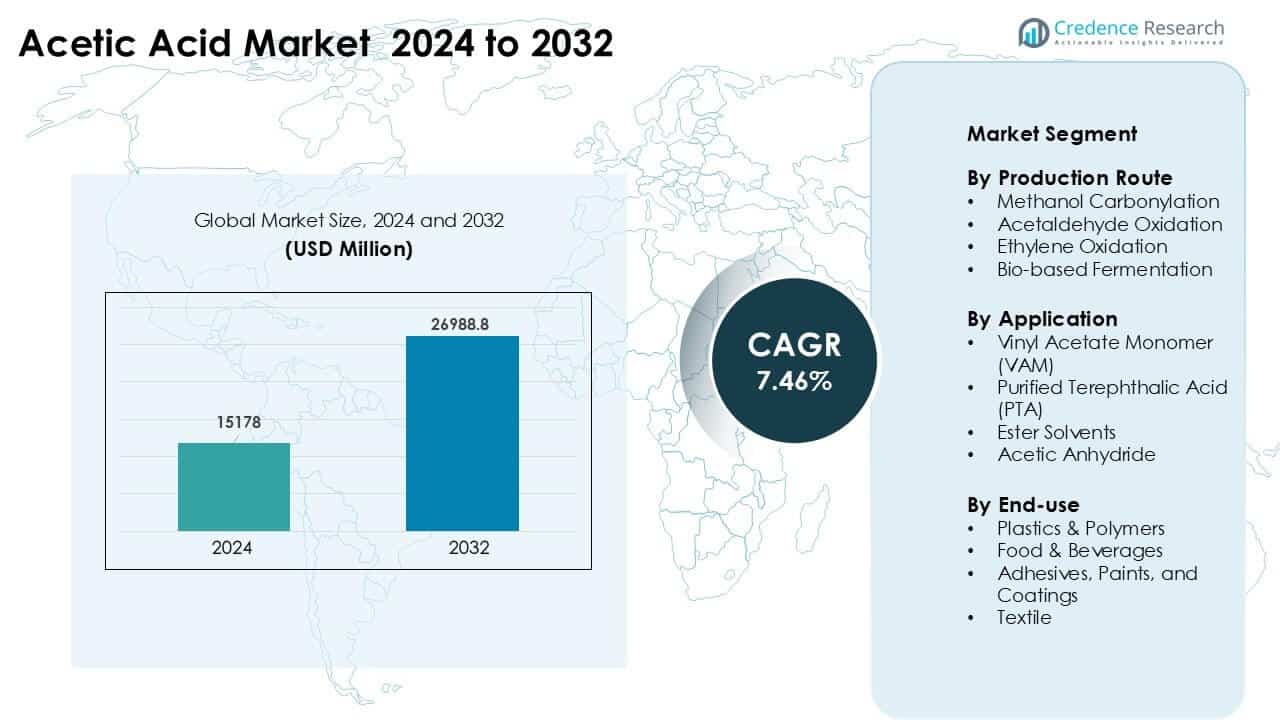
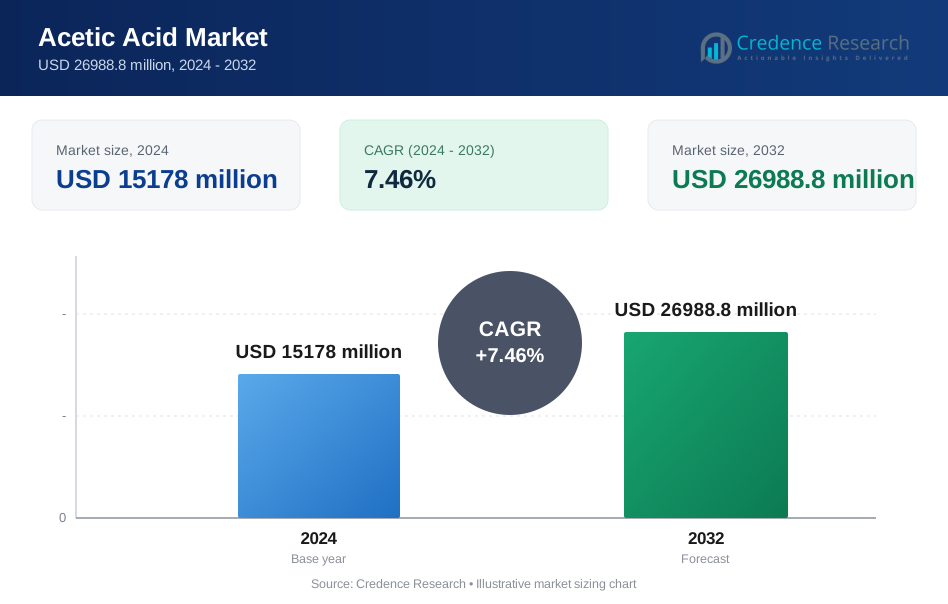
Acetic Acid Market was valued at USD 15178 million in 2024 and is anticipated to reach USD 26988.8 million by 2032, growing at a CAGR of 7.46 % during the forecast period.
| REPORT ATTRIBUTE | DETAILS |
|---|---|
| Historical Period | 2020-2023 |
| Base Year | 2024 |
| Forecast Period | 2025-2032 |
| Acetic Acid Market Size 2024 | USD 15178 million |
| Acetic Acid Market, CAGR | 7.46% |
| Acetic Acid Market Size 2032 | USD 26988.8 million |
Acetic Acid Market Insights
- Rising demand from VAM and PTA production drives market growth, supported by strong usage in packaging, textiles, adhesives, and coatings.
- Key trends include expansion of polyester and water-based coating applications, along with increasing interest in bio-based acetic acid and high-efficiency carbonylation technologies.
- The market is competitive, with major players expanding capacity and optimizing processes; methanol carbonylation leads production with a 63% share, while VAM dominates applications with 38% share.
- Asia-Pacific holds the largest regional share at 52%, followed by North America at 24% and Europe at 20%, reflecting strong industrial integration and high polymer consumption.
Acetic Acid Market Segmentation Analysis:
By Production Route
Methanol carbonylation dominates the Acetic Acid Market, holding about 63% share in 2024. Producers favor this route due to high yield, low cost, and strong process stability. Large petrochemical complexes adopt advanced catalysts to improve conversion efficiency and cut energy loss. Ethylene oxidation and acetaldehyde oxidation follow but remain limited due to higher operational expense. Bio-based fermentation continues to grow as sustainability targets rise, but scale remains lower. Demand from packaging, coatings, and polymer chains keeps methanol carbonylation in the leading position.
- For instance, BP licenses its Cativa carbonylation technology globally, which has been deployed across more than 15 commercial acetic acid plants worldwide. The process enables operation at lower water concentrations below 8 wt%, improving catalyst life and reducing corrosion-related shutdowns. These design advantages support long continuous operating cycles in large petrochemical complexes.
By Application
Vinyl acetate monomer (VAM) leads the application segment with nearly 38% share in 2024. Strong demand for adhesives, paints, and flexible packaging supports higher VAM use. Growth in construction and automotive industries also drives consumption of VAM-based emulsions. PTA and ester solvents follow due to rising polyester and resin production. Acetic anhydride supports pharmaceuticals and cellulose applications. VAM remains the dominant sub-segment because of its broad industrial use and steady expansion in polymer dispersions.
- For instance, Celanese is indeed recognized as the world's largest producer of both acetic acid (producing ~1.95 million tons per year, representing ~20% of global production) and vinyl acetate monomer (VAM).
By End-use
Plastics and polymers represent the dominant end-use segment, accounting for around 42% share in 2024. Rising PET, PVA, and acetate polymer production drives strong demand across packaging and textile chains. Adhesives, paints, and coatings also show steady growth due to construction and automotive needs. Food and beverages use acetic acid for preservation and processing, while textiles benefit from solvent and ester applications. The plastics and polymers segment leads due to large-scale consumption and continuous expansion of downstream manufacturing.
Key Growth Drivers
Rising Demand from VAM and PTA Production
Global growth in vinyl acetate monomer and purified terephthalic acid production acts as the strongest growth driver in the Acetic Acid Market. VAM supports adhesives, coatings, packaging films, and construction chemicals, while PTA remains essential for PET bottles and polyester fibers. Expanding packaging demand across food, beverage, and personal care sectors increases PTA consumption, pushing acetic acid requirements higher. Manufacturers expand output capacity to meet long-term growth in polymers and engineered materials. Rising urbanization and construction activity also boost VAM-based emulsions. This combined demand across multiple high-volume industries keeps acetic acid consumption on an upward path.
- For instance, Sinopec operates large integrated PTA and polyester complexes in China, including the Yizheng Chemical Fiber site with PTA production capacity exceeding 3 million metric tons per year. These facilities rely on acetic-acid-based solvent systems in oxidation and purification stages to support high-throughput PET resin output. Expansion of such integrated chains directly increases sustained acetic acid offtake.
Expansion of Polyester, Adhesives, and Coatings Industries
Growth in polyester fiber manufacturing and key adhesive and coating formulations strengthens market expansion. Polyester remains a core material in apparel, home furnishings, and industrial fabrics, while acetyl derivatives play vital roles in paints, sealants, and architectural finishes. Rapid construction activities in emerging economies fuel higher demand for water-based coatings, which rely on VAM chemistry. Rising automotive production also supports adhesive and composite material growth. Producers benefit from the steady rise in solvent, resin, and polymer applications. This strong connection between acetic acid and multiple downstream industries ensures consistent consumption across diverse manufacturing sectors.
- For instance, Wacker Chemie operates vinyl acetate–based dispersion production across Europe and Asia, supplying binders for paints and construction coatings. The company’s polymer sites run continuous reactors with individual line capacities exceeding 100,000 metric tons per year, requiring consistent VAM feedstock derived from acetic acid. Rising demand for water-based coatings directly reinforces upstream acetic acid consumption.
Shift Toward Low-Cost and High-Efficiency Production Routes
Methanol carbonylation encourages market growth due to its superior efficiency, low feedstock cost, and reduced energy use. Producers adopt advanced catalysts, optimized heat integration, and continuous systems to raise yield and cut operational losses. This supports competitive pricing, enabling wider adoption across industries with large-volume consumption needs. Many chemical producers also invest in process optimization to reduce emissions and improve conversion rates. These developments help stabilize global supply, prevent price volatility, and support long-term capacity planning. The improving economics of key production routes continue to reinforce acetic acid competitiveness compared with alternative chemical intermediates.
Key Trends & Opportunities
Growing Adoption of Bio-Based Acetic Acid
Rising sustainability commitments create a major trend toward bio-based production routes. Fermentation-based acetic acid gains attention as industries shift toward low-carbon feedstocks. Consumer brands demand greener packaging and textiles, driving interest in renewable PTA and VAM chains. Governments support bio-refineries through incentives, which strengthens R&D and pilot-scale deployment. Although production scale remains limited, improved microbial processes and enzyme engineering help lower costs. This shift toward renewable chemistry creates new opportunities for market expansion across environmentally conscious sectors.
- For instance, Jubilant Ingrevia produces food-grade acetic acid from "green ethanol" (bio-based feedstock) and has integrated facilities for various acetyl products.
Capacity Expansions in Asia-Pacific and Global Value Chain Integration
Asia-Pacific continues to attract new plant investments due to strong polymer, textile, and packaging demand. Integrated petrochemical hubs in China and Southeast Asia expand carbonylation units to secure local feedstock supply. These expansions reduce import reliance and improve global trade flows, creating competitive export opportunities. Multinational manufacturers also develop long-term contracts and regional partnerships to ensure stable raw material access. This integration of value chains improves reliability for downstream producers, supporting broader industrial growth across global markets.
- For instance, Celanese runs an integrated acetic acid and derivatives complex in Nanjing, China, with acetic acid capacity of 1.2 million metric tons per year. The site connects carbonylation units directly with VAM and acetate ester production, enabling efficient internal consumption and export supply. This integration strengthens regional value chains and improves delivery reliability for global customers.
Rising Use of Acetic Acid in High-Performance Materials
Advanced polymers, specialty coatings, and engineered composites drive fresh opportunities for acetic acid derivatives. Growing adoption of PVA films, water-based adhesives, and high-strength polyester supports material innovation across packaging, electronics, and automotive uses. Research into functional polymers with enhanced durability and improved thermal resistance increases long-term consumption potential. These emerging applications position acetic acid as a core building block in next-generation materials.
Key Challenges
Feedstock Price Volatility and Supply Disruptions
Fluctuating methanol prices create a major challenge for acetic acid producers. Feedstock costs depend on crude oil and natural gas trends, which introduce uncertainty to production margins. Supply chain disruptions, transportation bottlenecks, and geopolitical issues can restrict methanol availability, raising production costs. This affects downstream industries such as coatings, packaging, and textiles, which operate on tight margins. Producers must manage long-term contracts and diversify sourcing to stabilize supply. Persistent volatility complicates capacity planning and pricing strategies across global markets.
Environmental Regulations and Emission Control Requirements
Stricter environmental standards challenge acetic acid producers, especially those operating older plants with higher energy usage. Regulations demand significant investment in emission control, wastewater treatment, and process optimization systems. Carbonylation plants must reduce carbon intensity and meet regional compliance targets. Emerging rules on VOC emissions also affect downstream uses in coatings and adhesives. Compliance increases operational costs, slowing expansions and reducing competitiveness for smaller producers. The shift toward low-emission technologies requires capital investment and long-term modernization strategies to maintain regulatory alignment and operational efficiency.
Regional Analysis
North America
North America holds about 24% share of the Acetic Acid Market in 2024, supported by strong VAM and acetate solvent production. The region benefits from steady growth in adhesives, coatings, and packaging materials driven by construction and consumer goods. PET resin consumption stays robust due to beverage and personal care demand. Local producers rely on stable methanol supply and advanced carbonylation units to maintain competitiveness. Rising interest in sustainable materials also supports limited adoption of bio-based acetic acid. The region’s mature chemical sector and reliable infrastructure continue to ensure steady market performance.
Europe
Europe accounts for nearly 20% share of the Acetic Acid Market in 2024, driven by strong polymer, coatings, and textile industries. Demand remains steady due to strict quality standards for solvent and resin applications. The region focuses on energy-efficient production routes and advanced catalysts to cut emissions. Packaging and automotive sectors sustain PTA and VAM consumption. Regulations push producers toward cleaner processes, supporting long-term modernization. Import dependence from Asia influences pricing trends, but established downstream manufacturing keeps Europe a stable consumer market with balanced growth.
Asia-Pacific
Asia-Pacific dominates the Acetic Acid Market with about 52% share in 2024, driven by large-scale PTA, VAM, and polyester fiber production. China, India, and Southeast Asia host major petrochemical hubs and rapid capacity expansions. Strong demand from packaging, textiles, adhesives, and construction materials supports high-volume consumption. Regional producers continue to add methanol carbonylation capacity to reduce import reliance and stabilize supply. Growing e-commerce and urbanization further increase PET and polymer usage. Asia-Pacific’s integrated value chains and fast industrialization keep it the global leader in acetic acid demand.
Latin America
Latin America holds around 3% share of the Acetic Acid Market in 2024, with growth supported by packaging, paints, adhesives, and textile industries. Brazil and Mexico lead consumption due to expanding PET bottle use and rising construction activity. Industrialization in food and beverage processing also aids demand for PTA and solvent applications. Limited local production capacity increases dependence on imports, influencing cost structures. Despite scaling challenges, steady demand from consumer sectors supports moderate regional growth.
Middle East & Africa
Middle East & Africa account for nearly 1% share of the Acetic Acid Market in 2024, driven by developing petrochemical infrastructure and rising polymer production. Growth in packaging, textiles, and construction supports gradual increases in VAM and PTA consumption. Several countries invest in downstream integration to diversify beyond crude oil and strengthen chemical manufacturing. Limited industrial base and import reliance slow rapid expansion. However, long-term investments in industrial parks and export-oriented chemical projects provide opportunities for stable future demand.
Acetic Acid Market Segmentations:
By Production Route
- Methanol Carbonylation
- Acetaldehyde Oxidation
- Ethylene Oxidation
- Bio-based Fermentation
By Application
- Vinyl Acetate Monomer (VAM)
- Purified Terephthalic Acid (PTA)
- Ester Solvents
- Acetic Anhydride
By End-use
- Plastics & Polymers
- Food & Beverages
- Adhesives, Paints, and Coatings
- Textile
By Geography
- North America
- U.S.
- Canada
- Mexico
- Europe
- Germany
- France
- U.K.
- Italy
- Spain
- Rest of Europe
- Asia Pacific
- China
- Japan
- India
- South Korea
- South-east Asia
- Rest of Asia Pacific
- Latin America
- Brazil
- Argentina
- Rest of Latin America
- Middle East & Africa
- GCC Countries
- South Africa
- Rest of the Middle East and Africa
Competitive Landscape
The competitive landscape of the Acetic Acid Market features major companies such as Celanese Corporation, Daicel Corporation, Gujarat Narmada Valley Fertilizers & Chemicals Limited, Wacker Chemie AG, Shanghai Huayi, LyondellBasell Industries, Eastman Chemical Company, Jiangsu Sopo, Mitsubishi Chemical Group Corporation, and Airedale Group. These producers compete through capacity expansion, cost-efficient carbonylation routes, and strong integration with downstream VAM, PTA, and acetate solvent chains. Many invest in catalyst upgrades and process optimization to raise yield and lower energy use. Companies with large global supply networks secure steady demand from packaging, textiles, adhesives, and coatings. Asia-based producers expand aggressively to reduce import reliance and strengthen export capabilities. Sustainability initiatives drive interest in low-emission and bio-based technologies, prompting strategic partnerships and R&D efforts. Overall, the market remains highly consolidated at the top, with technology leadership and feedstock security defining long-term competitiveness.
Key Player Analysis
- Daicel Corporation (Japan)
- Celanese Corporation (U.S.)
- Gujarat Narmada Valley Fertilizers & Chemicals Limited (India)
- Wacker Chemie AG (Germany)
- Shanghai Huayi (Group) Company (China)
- LyondellBasell Industries (Netherlands)
- Eastman Chemical Company (U.S.)
- Jiangsu Sopo (Group) Co. Ltd. (China)
- Mitsubishi Chemical Group Corporation (Japan)
- Airedale Group (U.K.)
Recent Developments
- In September 2025, Shanghai Huayi Group permanently closed acetic acid and methanol units at its Wujing base in Shanghai. The move removed a designed acetic acid capacity of about 700,000 tonnes per year, reflecting pressure from overcapacity and weaker profitability in China’s acetic acid market.
- In September 2025, LyondellBasell started a two-month turnaround at its La Porte, Texas acetyls unit. The planned outage is intended to improve productivity and reliability at a site that produces glacial acetic acid and vinyl acetate monomer.
- In November 2024, Gujarat Narmada Valley Fertilizers & Chemicals Ltd (GNFC) India Signed an MOU with INEOS Acetyls to explore feasibility of building a new acetyls (acetic-acid/derivatives) facility / collaboration in India.
Report Coverage
The research report offers an in-depth analysis based on Production Route, Application, End-Use and Geography. It details leading market players, providing an overview of their business, product offerings, investments, revenue streams, and key applications. Additionally, the report includes insights into the competitive environment, SWOT analysis, current market trends, as well as the primary drivers and constraints. Furthermore, it discusses various factors that have driven market expansion in recent years. The report also explores market dynamics, regulatory scenarios, and technological advancements that are shaping the industry. It assesses the impact of external factors and global economic changes on market growth. Lastly, it provides strategic recommendations for new entrants and established companies to navigate the complexities of the market.
Future Outlook
- Global demand will rise as VAM and PTA production expands across packaging and textiles.
- Methanol carbonylation will remain the preferred route due to high efficiency and cost benefits.
- Bio-based acetic acid adoption will grow as industries shift toward low-carbon materials.
- Polyester fiber production will continue to support long-term consumption growth.
- Water-based coatings and adhesives will drive higher use of acetate derivatives.
- Asia-Pacific will strengthen its lead with new capacity additions and integrated value chains.
- Producers will invest in catalyst upgrades to improve yield and reduce emissions.
- Environmental regulations will push manufacturers to modernize plants and cut energy use.
- Supply chain partnerships will expand to secure feedstock stability and reduce volatility.
- New applications in specialty polymers and engineered materials will create fresh growth opportunities
Request a Free Sample
Fill in your details and we'll send you a free sample report.
- Sample data tables & charts
- Research methodology
Need a Custom Version of This Report?
Tailor the scope, geography, or segments to your exact requirements.
- Custom geography or segment scope
- Direct access to our analyst team
Frequently Asked Questions
What is the current market size for Acetic Acid Market, and what is its projected size in 2032?
At what Compound Annual Growth Rate is Acetic Acid Market projected to grow between 2024 and 2032?
Which Acetic Acid Market segment held the largest share in 2024?
What are the primary factors fueling the growth of Acetic Acid Market?
Who are the leading companies in Acetic Acid Market?
Which region commanded the largest share of Acetic Acid Market?
Table of Content
Chapter 1. Report Introduction
- 1.1 Report Description & Purpose
- 1.1.1 Report Title & Market Definition
- 1.1.2 Unique Selling Propositions (USP) & Key Differentiators
- 1.1.3 Value Proposition for Stakeholders
- 1.2 Research Objectives
- 1.2.1 Market Sizing Objectives (Volume & Revenue)
- 1.2.2 Segmentation Objectives
- 1.2.3 Competitive Intelligence Objectives
- 1.2.4 Forecast & Scenario Objectives
- 1.3 Report Scope
- 1.3.1 Acetic Acid Scope – Types & Subtypes Covered
- 1.3.2 Geographic Scope – Regions & Countries Covered
- 1.3.3 Historical Period, Base Year & Forecast Period (2024; forecast to 2032)
- 1.3.4 Inclusions & Exclusions
- 1.4 HS Code & Classification Framework
- 1.5 Currency, Units & Pricing Basis
- 1.6 Target Stakeholders
- 1.7 Limitations & Assumptions
Chapter 2. Executive Summary
- 2.1 Global Acetic Acid Market Snapshot
- 2.1.1 Market Size – Historical (2024) & Forecast (2024-2032) (2024: USD 15178 million → 2032: USD 26988.8 million)
- 2.1.2 Volume & Revenue – Global Totals
- 2.1.3 Key Market Highlights – Top Five Facts
- 2.2 Acetic Acid Market Segmentation Snapshot
- 2.2.1 Market Split by Region – 2024 vs. 2032
- 2.3 Competitive Snapshot
- 2.3.1 Top 10 Players by Revenue Share – 2024
- 2.3.2 Top 10 Players by Volume Share – 2024
- 2.3.3 Recent Strategic Developments (18-Month Summary)
- 2.4 Key Investment Highlights & Strategic Conclusions
Chapter 3. Acetic Acid Market Dynamics & Industry Analysis
- 3.1 Market Overview & Context
- 3.1.1 Acetic Acid Market Position in the Broader Automotive Value Chain
- 3.1.2 OEM vs. Replacement Market Dynamics
- 3.1.3 Market Maturity & Development Stage by Region
- 3.2 Acetic Acid Market Drivers
- 3.3 Acetic Acid Market Restraints & Challenges
- 3.4 Acetic Acid Market Opportunities
- 3.5 Porter's Five Forces Analysis
- 3.5.1 Threat of New Entrants
- 3.5.2 Bargaining Power of Suppliers
- 3.5.3 Bargaining Power of Buyers
- 3.5.4 Threat of Substitutes
- 3.5.5 Competitive Rivalry – Intensity Assessment
- 3.6 Acetic Acid Value Chain Analysis
- 3.6.1 Upstream – Raw Material/Input Suppliers
- 3.6.1.1 Raw Material/Input 1
- 3.6.1.2 Raw Material/Input 2
- 3.6.1.3 Raw Material/Input 3
- 3.6.2 Midstream – Production/Manufacturing/Service Delivery
- 3.6.2.1 Production/Process Overview
- 3.6.2.2 Key Facility Locations & Capacity by Manufacturer
- 3.6.3 Downstream – Distribution & End Consumer
- 3.6.3.1 Primary Channel – B2B/OEM
- 3.6.3.2 Secondary Channels – Dealer, Retail, Online, Direct
- 3.6.4 Value Chain Profitability Analysis
- 3.6.1 Upstream – Raw Material/Input Suppliers
- 3.7 PESTEL Analysis
- 3.7.1 Political Factors
- 3.7.2 Economic Factors
- 3.7.3 Social Factors
- 3.7.4 Technological Factors
- 3.7.5 Environmental Factors
- 3.7.6 Legal Factors
- 3.8 Acetic Acid Supply Chain Analysis
- 3.8.1 Raw Material/Input Supply Risk Assessment
- 3.8.2 Manufacturing Concentration Risk (Geographic Exposure)
- 3.8.3 Trade Disruption Impact Analysis
- 3.9 Regulatory & Policy Landscape
Note: The regulatory and policy landscape section covers regulations based on their applicability to the market, Acetic Acid category, geography, and scope of the study. Only regulatory frameworks with a material impact on operations, compliance, trade, sustainability, or market access are analyzed in detail.
Chapter 4. Key Investment Pockets & Opportunity Analysis
- 4.1 Acetic Acid Market Attractiveness Analysis
- 4.1.1 By Region – Investment Attractiveness Matrix (Volume × CAGR)
- 4.2 Absolute Revenue Growth Opportunity
- 4.2.1 By Region – Absolute USD Growth Through 2032
- 4.3 Incremental Volume Opportunity
- 4.3.1 By Region – Incremental Volume Through 2032
- 4.3.2 Segment – Incremental Volume
- 4.4 Emerging Submarket Opportunity Deep Dive (Subject to Applicability)
- 4.5 Emerging Market Opportunity Scorecards
- 4.5.1 United States
- 4.5.2 Europe
- 4.5.3 Asia
- 4.5.4 Middle East & Africa
Note: Emerging Market Opportunity Scorecards will be included based on relevance and strategic importance. Regions listed are indicative and may vary depending on data availability and market dynamics.
Chapter 5. Acetic Acid Import-Export Analysis & Trade Flows
- 5.1 Global Trade Overview
- 5.1.1 Global Export Value by Country (2024)
- 5.1.2 Global Export Volume by Country (2024)
- 5.1.3 Global Import Value by Country (2024)
- 5.1.4 Global Import Volume by Country (2024)
- 5.1.5 Net Trade Balance by Country (2024)
- 5.2 Export Analysis – Segment
- 5.2.1 Type 1 (HS Code)
- 5.2.2 Type 2 (HS Code)
- 5.2.3 Type 3 (HS Code)
- 5.2.4 Type 4 (HS Code)
- 5.2.5 Type 5 (HS Code)
- 5.3 Import Analysis – Segment
- 5.3.1 Type 1 (HS Code)
- 5.3.2 Type 2 (HS Code)
- 5.3.3 Type 3 (HS Code)
- 5.3.4 Type 4 (HS Code)
- 5.3.5 Type 5 (HS Code)
- 5.4 Average Unit Trade Prices
- 5.4.1 Average Export Price – Segment & Country
- 5.4.2 Average Import Price – Segment & Source Country
- 5.4.3 Price Trends (2024)
- 5.5 Key Trade Route Analysis
- 5.5.1 Trade Route 1
- 5.5.2 Trade Route 2
- 5.5.3 Trade Route 3
- 5.5.4 Trade Route 4
- 5.5.5 Trade Route 5
- 5.6 Trade Policy Impact Assessment
- 5.6.1 US Anti-Dumping & Section 301 Tariffs
- 5.6.2 EU Customs Union Impact
- 5.6.3 Major Free Trade Agreements
- 5.6.4 USMCA Rules of Origin
Note: Trade policy analysis will be included only where relevant to the Acetic Acid market.
Chapter 6. Competitive Landscape & Company Benchmarking
- 6.1 Acetic Acid Market Concentration & Structure
- 6.1.1 Herfindahl-Hirschman Index (HHI) – vs. 2024
- 6.1.2 Tier 1, Tier 2 & Tier 3 Market Structure
- 6.1.3 Global, Regional & Local Player Dynamics
- 6.2 Acetic Acid Market Share Analysis – 2024
- 6.2.1 Global Revenue Share by Company
- 6.2.2 Global Volume Share by Company
- 6.2.3 Regional Revenue Share
- 6.2.4 Market Share Evolution ( vs. 2024)
- 6.2.5 OEM Segment Share by Company
- 6.2.6 Replacement Segment Share by Company
- 6.3 Production/Delivery Capacity & Facility Analysis
- 6.3.1 Global Installed Capacity
- 6.3.2 Capacity Utilization Rates
- 6.3.3 Production/Output Volume
- 6.3.4 Facility Locations & Capacity Map
- 6.3.5 Planned Capacity Additions
- 6.4 Acetic Acid Competitive Benchmarking Matrix
- 6.4.1 Revenue, Volume, CAGR & Profitability Comparison
- 6.4.2 Channel Revenue Mix
- 6.4.3 Geographic Revenue Exposure
- 6.4.4 R&D Intensity
- 6.4.5 Sustainability Maturity
- 6.5 Strategic Developments in Acetic Acid (Last 24 Months)
- 6.5.1 Mergers, Acquisitions & Divestments
- 6.5.2 New Acetic Acid Launches
- 6.5.3 Facility Expansions
- 6.5.4 Strategic Alliances, Joint Ventures & Partnerships
- 6.5.5 Distribution Expansion & Market Entry
- 6.5.6 Sustainability & ESG Initiatives
- 6.6 Competitive Strategy Mapping
- 6.6.1 Leader, Challenger, Follower & Niche Classification
- 6.6.2 Pricing Strategy Comparison
- 6.6.3 Channel Strategy Matrix
Note: Strategic developments are included based on their materiality and the availability of reliable information.
Chapter 7. Global Acetic Acid Market – By Distribution Channel
- 7.1 Segment Overview
- 7.1.1 Volume & Revenue Split by Channel (2024 & 2032)
- 7.1.2 Channel Mix Evolution (2024-2032)
Chapter 8. Regional Market Analysis – Global Overview
- 8.1 Global Regional Overview
- 8.1.1 Regional Volume Share
- 8.1.2 Regional Revenue Share
- 8.1.3 Regional Volume by Region
- 8.1.4 Regional Revenue by Region
- 8.1.5 Regional Forecast Through 2032
- 8.2 Cross-Regional Segment Analysis
- 8.2.1 By Distribution Channel
- 8.2.2 By Brand/Price Tier
Chapter 9. North America Acetic Acid Market
- 9.1 United States
- 9.2 Canada
- 9.3 Mexico
Chapter 10. Europe Acetic Acid Market
- 10.1 Germany
- 10.2 France
- 10.3 Italy
- 10.4 United Kingdom
- 10.5 Spain
- 10.6 Poland
- 10.7 Russia
- 10.8 Netherlands
- 10.9 Belgium
- 10.10 Sweden
- 10.11 Denmark
- 10.12 Norway
- 10.13 Rest of Europe
Chapter 11. Asia Pacific Acetic Acid Market
- 11.1 China
- 11.2 India
- 11.3 Japan
- 11.4 South Korea
- 11.5 Thailand
- 11.6 Indonesia
- 11.7 Vietnam
- 11.8 Malaysia
- 11.9 Australia
- 11.10 Rest of Asia Pacific
Chapter 12. Latin America Acetic Acid Market
- 12.1 Brazil
- 12.2 Argentina
- 12.3 Colombia
- 12.4 Chile
- 12.5 Rest of Latin America
Chapter 13. Middle East Acetic Acid Market
- 13.1 Saudi Arabia
- 13.2 United Arab Emirates
- 13.3 Turkey
- 13.4 Israel
- 13.5 Iran
- 13.6 Rest of the Middle East
Chapter 14. Africa Acetic Acid Market
- 14.1 South Africa
- 14.2 Egypt
- 14.3 Nigeria
- 14.4 Morocco
- 14.5 Rest of Africa
Chapter 15. Acetic Acid Company Profiles
- 15.1 [Company 01]
- 15.1.1 Company Overview
- 15.1.2 Key Management Personnel
- 15.1.3 Products & Services Portfolio
- 15.1.4 Financial Performance
- 15.1.5 Key Market Focus & Geographic Presence
- 15.1.6 Recent Developments & Strategic Initiatives
Note: The company profile list is preliminary and may change based on research findings, market developments, data availability, and client requirements.
Chapter 16. Appendices
- Appendix A – List of Abbreviations & Acronyms
- Appendix B – Industry Classification Code Reference – Full Series
- Appendix C – Production & Capacity Data Tables
- Appendix D – End-Use & Demand Base Tables
- Appendix E – Consumption & Replacement Rate Assumptions
- Appendix F – ASP Reference Tables
- Appendix G – Manufacturing & Facility Database
- Appendix H – Import-Export Data Tables
- Appendix I – Regulatory Summary Tables
- Appendix J – Primary Research Participant List (Anonymized)
- Appendix K – Primary Research Questionnaire Framework
- Appendix L – Data Sources & Bibliography
- Appendix M – Market Size Divergence & Source Comparison
Chapter 17. Research Methodology
- 17.1 Research Framework & Philosophy
- 17.2 Secondary Research – Sources, Hierarchy & Data Extraction
- 17.3 Data Modeling – Bottom-Up & Top-Down Market Sizing
- 17.4 Primary Research – Stakeholder Framework, LOI & Sample Sizes
- 17.5 Forecast Methodology – Regression, Scenario & Sensitivity Analysis
- 17.6 Quality Control – Four-Layer Validation Framework
- 17.7 Limitations & Standard Assumptions
- 17.8 Disclaimer
