Market Overview
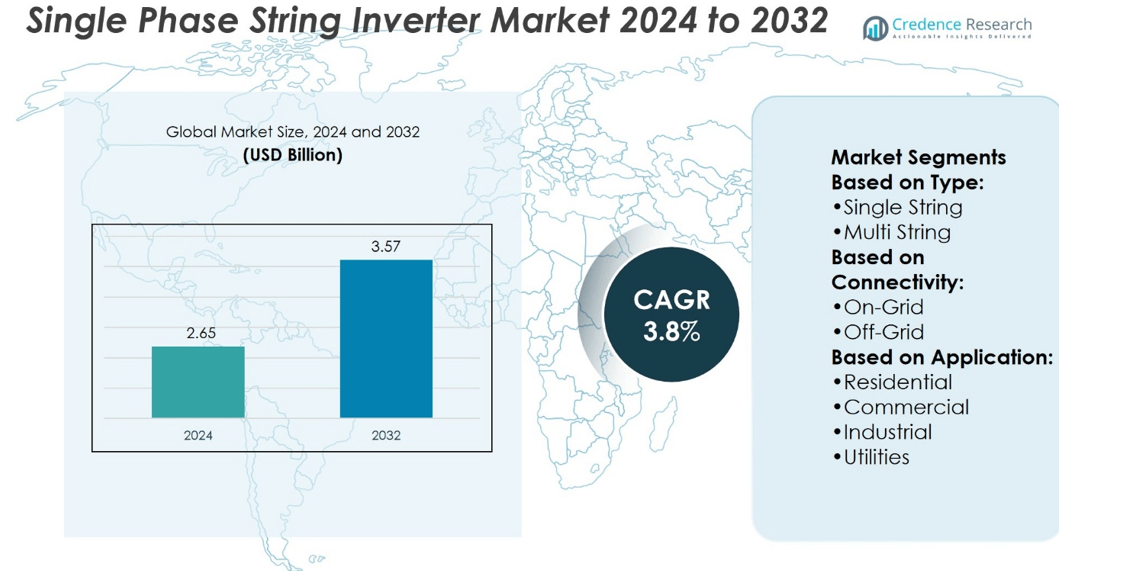
Single-Phase String Inverter Market size was valued at USD 2.65 billion in 2024 and is anticipated to reach USD 3.57 billion by 2032, at a CAGR of 3.8% during the forecast period.
| REPORT ATTRIBUTE | DETAILS |
|---|---|
| Historical Period | 2020-2023 |
| Base Year | 2024 |
| Forecast Period | 2025-2032 |
| Single-Phase String Inverter Market Size 2024 | USD 2.65 billion |
| Single-Phase String Inverter Market, CAGR | 3.8% |
| Single-Phase String Inverter Market Size 2032 | USD 3.57 billion |
The Single-Phase String Inverter Market grows through strong drivers such as rising residential solar adoption, supportive government incentives, and increasing consumer demand for energy independence. It benefits from technological advancements that deliver higher conversion efficiency, smart monitoring, and hybrid compatibility with storage systems. Trends highlight the shift toward compact designs, IoT-enabled diagnostics, and integration with digital platforms that enhance real-time performance insights. Expanding rural electrification programs and sustainability goals further strengthen adoption across diverse regions. Continuous innovation, policy alignment, and consumer preference for clean, efficient energy solutions shape the market’s evolution and ensure steady long-term growth.
The Single-Phase String Inverter Market shows strong geographical presence, with North America leading due to policy support and high rooftop solar adoption, while Asia-Pacific emerges as the fastest-growing region driven by China, India, and Japan. Europe maintains steady growth under strict renewable targets, and Latin America along with the Middle East & Africa display rising opportunities through rural electrification and solar programs. Key players include Fronius International, Huawei Technologies, SUNGROW, Canadian Solar, Solaredge Technologies, Enphase Energy, and APsystems.
Market Insights
- The Single-Phase String Inverter Market size was valued at USD 2.65 billion in 2024 and is projected to reach USD 3.57 billion by 2032, at a CAGR of 3.8%.
- Rising residential solar adoption, supportive incentives, and demand for energy independence drive steady growth.
- Advancements in efficiency, hybrid compatibility, and smart monitoring define key technological trends.
- Compact designs, IoT-enabled diagnostics, and integration with digital platforms shape evolving consumer preferences.
- Competitive landscape features strong global players focusing on innovation, partnerships, and cost-effective solutions.
- Market restraints include price sensitivity in emerging regions, technical challenges in grid integration, and higher compliance costs.
- North America leads with strong policy support, Asia-Pacific shows fastest growth led by China and India, Europe maintains stable adoption, while Latin America and Middle East & Africa expand through rural electrification and solar initiatives.
Market Drivers
Rising Residential Solar Adoption Driving Demand for Inverter Solutions
The Single-Phase String Inverter Market expands due to the rising integration of residential solar systems across developed and emerging economies. Households adopt these systems to reduce grid dependence and manage rising electricity costs. Governments provide tax credits, rebates, and net metering policies that create a favorable environment for installation. It enables panel-level performance optimization and supports greater energy efficiency. The convenience of decentralized energy generation further strengthens consumer confidence. The combination of economic and environmental benefits positions it as a key driver of inverter demand.
- For instance, SMA Solar Technology AG reported shipping more than 120,000 single-phase string inverters for residential rooftop solar installations in 2022, highlighting its contribution to expanding household-level solar adoption worldwide.
Technological Advancements Enhancing Energy Efficiency and Reliability
Continuous product innovation plays a pivotal role in shaping the Single-Phase String Inverter Market. Manufacturers focus on advanced maximum power point tracking (MPPT) algorithms and smart grid compatibility. These features optimize energy harvest and ensure resilience against voltage fluctuations. It enables higher efficiency levels, often exceeding 97%, while reducing operational losses. Compact designs, remote monitoring, and AI-based diagnostics further improve usability and lifecycle performance. The integration of IoT solutions enhances predictive maintenance and minimizes downtime. Strong emphasis on performance reliability drives adoption across both urban and semi-urban settings.
- For instance, Huawei Technologies integrated its advanced multi-MPPT technology into more than 2 million residential string inverters shipped globally by 2022, significantly improving efficiency and grid stability in household solar systems.
Government Policies and Renewable Energy Targets Supporting Growth
Policy frameworks remain a major growth engine for the Single-Phase String Inverter Market. Many nations set ambitious renewable energy targets that require large-scale residential solar adoption. Subsidies, feed-in tariffs, and zero-interest financing schemes create a positive ecosystem for deployment. It allows homeowners to contribute to decarbonization goals while reducing energy bills. Supportive initiatives in Europe, Asia-Pacific, and North America enhance market penetration. National solar programs encourage adoption in both rural electrification and urban modernization. Strong policy backing sustains long-term demand for efficient inverter technologies.
Expanding Urbanization and Rising Electricity Costs Influencing Consumer Choices
The pace of urban development and the associated rise in power demand accelerate the Single-Phase String Inverter Market. Consumers in high-density regions face increasing grid instability and tariff pressures. It offers an affordable and scalable alternative by enabling rooftop solar integration. Growing awareness of sustainable living and energy independence further fuels adoption. The combination of reliable performance and favorable payback periods strengthens consumer willingness to invest. Rising demand for clean energy solutions ensures sustained growth across residential and small-scale commercial segments.
Market Trends
Growing Integration of Smart Monitoring and Digital Platforms
The Single-Phase String Inverter Market shows a strong trend toward smart monitoring capabilities and digital platforms. Remote management tools and mobile applications allow users to track energy performance in real time. It supports proactive maintenance through alerts and diagnostic features that reduce system downtime. The adoption of cloud-based data solutions enables seamless integration with smart homes and energy management systems. Consumers prefer inverters that provide visibility into consumption patterns and grid interaction. This trend reflects a shift toward data-driven decision-making for maximizing energy savings.
- For instance, Sungrow reported in 2022 that it had shipped more than 340 GW of inverters globally, including millions of high-efficiency single-phase string inverters designed for residential applications, many of which feature compact footprints with conversion efficiencies above 98%.
Increasing Focus on Higher Conversion Efficiency and Compact Designs
Manufacturers in the Single-Phase String Inverter Market emphasize efficiency improvements and compact designs. Modern inverters often achieve peak efficiency levels above 97%, reducing conversion losses. It allows end-users to generate more power from limited rooftop space. The drive toward lighter and smaller units makes installation faster and reduces costs for installers. Compactness also benefits urban households with restricted installation areas. Continuous advancements in circuit design and cooling systems highlight the industry’s focus on reliability and convenience.
- For instance, UTL Solar, an Indian solar solutions provider, has installed more than 500,000 solar inverters, including hybrid single-phase models compatible with lithium-ion batteries, to enable residential customers to integrate storage and improve energy reliability.
Rising Adoption of Hybrid and Energy Storage Compatible Systems
The Single-Phase String Inverter Market experiences a growing preference for hybrid solutions and storage-ready systems. Inverters designed for compatibility with lithium-ion and other advanced batteries support greater energy independence. It allows consumers to store excess energy for use during peak demand or outages. This capability enhances self-consumption and reduces reliance on utility grids. The popularity of energy storage in residential applications creates new demand for flexible inverter designs. Hybrid systems align with evolving consumer preferences for sustainability and resilience.
Expanding Role of Policy Alignment and Sustainability Standards
Regulatory and sustainability standards significantly influence the Single-Phase String Inverter Market. Governments and international bodies promote eco-friendly equipment through efficiency benchmarks and certification programs. It encourages manufacturers to invest in technologies that meet stringent compliance requirements. Incentives linked to performance standards accelerate the adoption of certified inverters. Global emphasis on decarbonization strengthens the trend toward sustainable product development. Clear policy alignment ensures that inverter technologies remain central to renewable energy integration across residential and small-scale commercial segments.
Market Challenges Analysis
Technical Limitations and Reliability Concerns in Diverse Operating Conditions
The Single-Phase String Inverter Market faces challenges linked to technical limitations and reliability across varied environments. Performance often declines in regions with fluctuating temperatures, humidity, or dust accumulation. It requires regular maintenance and proper installation to ensure stable operation, which raises long-term costs for homeowners. Voltage fluctuations and grid instability in developing regions further test product durability. Complexities in integrating inverters with older grid infrastructure also create obstacles. These factors limit adoption in markets where infrastructure quality and maintenance capabilities remain weak.
Competitive Pressure and Cost Sensitivity Affecting Market Expansion
Strong competition and price sensitivity present significant hurdles for the Single-Phase String Inverter Market. Manufacturers face pressure to reduce costs while maintaining high efficiency and durability standards. It pushes companies to balance innovation with affordability, often squeezing profit margins. Low-cost imports from emerging economies intensify price wars and reduce differentiation among brands. Certification and compliance requirements add further expenses for producers. Consumers in cost-sensitive regions often prioritize upfront pricing over long-term efficiency, slowing broader adoption. This competitive dynamic creates volatility and constrains sustainable growth for industry players.
Market Opportunities
Expansion Potential in Emerging Economies and Residential Electrification
The Single-Phase String Inverter Market presents strong opportunities in emerging economies where solar adoption is gaining momentum. Rapid urbanization and rising electricity demand drive households to seek affordable renewable solutions. It enables efficient rooftop solar integration in regions with limited grid reliability. Supportive policies and financial incentives encourage widespread installations in Asia-Pacific, Latin America, and Africa. Growing interest in decentralized power generation strengthens demand for compact and cost-effective inverter systems. The ability to serve both rural electrification projects and urban households highlights untapped potential across diverse geographies.
Innovation in Storage Integration and Smart Energy Management Solutions
Technological innovation creates further opportunities for the Single-Phase String Inverter Market. Storage-ready and hybrid-compatible inverters allow homeowners to achieve greater energy independence. It enables seamless integration with lithium-ion batteries and smart grid platforms, improving flexibility and resilience. The growing demand for real-time monitoring and predictive analytics enhances the appeal of advanced inverter models. Partnerships between inverter manufacturers and smart home solution providers expand product utility. Rising consumer preference for sustainability and energy efficiency fosters continuous product upgrades. This alignment of technology and consumer demand positions the market for long-term growth.
Market Segmentation Analysis:
By Type
The Single-Phase String Inverter Market is segmented into single string and multi string types, each serving different operational requirements. Single string inverters dominate residential usage due to their simplicity, cost-effectiveness, and ease of installation. It supports smaller solar installations where scalability is not the primary concern. Multi string inverters, on the other hand, gain traction in larger residential and small commercial setups. They provide greater flexibility by connecting multiple strings of panels independently, allowing better optimization under varied shading conditions. This segment appeals to consumers who demand higher efficiency and system adaptability.
- For instance, NingBo Deye Inverter Technology reported shipping more than 10 GW of inverters globally in 2022, including a substantial share of single-phase single string models widely adopted in residential rooftop solar projects.
By Connectivity
In terms of connectivity, on-grid Single-Phase string inverters account for a major share due to strong adoption in urban and semi-urban areas. These inverters integrate seamlessly with utility grids, enabling energy exports and benefits through net metering policies. It helps households lower energy bills while contributing to grid stability. Off-grid systems, though smaller in share, create opportunities in regions with limited or unreliable electricity infrastructure. They are preferred in rural areas where grid expansion remains slow. Demand for off-grid solutions is expanding with the growth of rural electrification programs and sustainable energy initiatives.
- For instance, INVT Solar reported cumulative shipments exceeding 16 GW of solar inverters globally by 2022, with a significant portion consisting of on-grid Single-Phase string inverters deployed in residential and small commercial projects.
By Application (Residential, Commercial, Industrial, Utilities)
By application, residential use dominates the Single-Phase String Inverter Market, supported by rising rooftop solar installations. It offers homeowners a reliable, efficient, and affordable solution to reduce dependence on traditional energy sources. Commercial adoption is increasing as small businesses seek energy savings and compliance with sustainability targets. Industrial usage remains limited due to higher capacity requirements, where three-phase solutions are more common. Utility-scale projects use Single-Phase inverters primarily for distributed and pilot-scale solar installations. Expanding energy independence goals and consumer-driven sustainability efforts reinforce growth across all application segments.
Segments:
Based on Type:
- Single String
- Multi String
Based on Connectivity:
- On-Grid
- Off-Grid
Based on Application:
- Residential
- Commercial
- Industrial
- Utilities
Based on the Geography:
- North America
- U.S.
- Canada
- Mexico
- Europe
- UK
- France
- Germany
- Italy
- Spain
- Russia
- Belgium
- Netherlands
- Austria
- Sweden
- Poland
- Denmark
- Switzerland
- Rest of Europe
- Asia Pacific
- China
- Japan
- South Korea
- India
- Australia
- Thailand
- Indonesia
- Vietnam
- Malaysia
- Philippines
- Taiwan
- Rest of Asia Pacific
- Latin America
- Brazil
- Argentina
- Peru
- Chile
- Colombia
- Rest of Latin America
- Middle East
- UAE
- KSA
- Israel
- Turkey
- Iran
- Rest of Middle East
- Africa
- Egypt
- Nigeria
- Algeria
- Morocco
- Rest of Africa
Regional Analysis
North America
North America accounts for the largest share of 44.7% in the Single-Phase String Inverter Market in 2024. The United States leads the region, supported by tax credits, subsidies, and net metering policies that encourage residential solar adoption. It benefits from a mature grid structure and widespread rooftop solar installations across both urban and suburban households. Consumers prioritize energy independence, while federal initiatives like the Inflation Reduction Act strengthen demand for home solar systems. Canada contributes steadily with renewable energy programs and residential energy transition targets. This regional leadership reflects strong policy backing, reliable infrastructure, and a large installed base of residential solar projects.
Europe
Europe holds a notable share of about 22% in the Single-Phase String Inverter Market. Germany, Spain, and Italy remain the largest contributors due to established feed-in tariffs and progressive renewable targets. It supports steady deployment across both residential and small commercial applications. Households in the region adopt solar solutions not only for cost savings but also for compliance with ambitious decarbonization goals set by the European Union. The market grows further as governments tighten sustainability standards and promote energy-efficient technologies. The region benefits from a strong supply chain, established manufacturers, and an environmentally conscious consumer base.
Asia-Pacific
Asia-Pacific represents about 30% of the global market share in the Single-Phase String Inverter Market. China leads this region with large residential solar adoption and supportive subsidies, while India and Japan also register strong growth. It benefits from rapid urbanization, rising electricity demand, and government investments in renewable energy. Distributed solar installations across rural and semi-urban areas create opportunities for compact and affordable inverter solutions. Technological innovation, combined with policy frameworks like feed-in tariffs and competitive solar tenders, drives rapid expansion. Asia-Pacific remains the fastest-growing region due to its scale, favorable policies, and rising energy security needs.
Latin America
Latin America accounts for about 8% of the Single-Phase String Inverter Market. Brazil and Mexico lead the region, supported by declining solar costs and renewable energy auctions. It provides opportunities for both residential and small commercial segments, particularly in areas with rising electricity tariffs. Chile and Argentina also adopt rooftop solar systems for sustainability and energy independence. Limited grid reliability in rural zones strengthens the appeal of small, decentralized installations. The region’s potential lies in government support, abundant solar resources, and an increasing consumer preference for clean energy solutions.
Middle East & Africa
The Middle East & Africa hold about 5% of the market share in the Single-Phase String Inverter Market. Countries like the United Arab Emirates, Saudi Arabia, and South Africa spearhead adoption with solar pilot projects and national renewable energy programs. It supports both urban modernization and rural electrification efforts, where off-grid solutions remain critical. High solar irradiation levels across the region create favorable conditions for residential rooftop systems. However, challenges such as financing constraints and policy inconsistencies limit faster adoption. The region offers untapped opportunities that will strengthen over time with supportive frameworks and declining system costs.
Key Player Analysis
- Fronius International
- Huawei Technologies
- SUNGROW
- Canadian Solar
- UTL Solar
- Solaredge Technologies
- NingBo Deye Inverter Technology
- APsystems
- INVTSolar
- Enphase Energy
Competitive Analysis
The competitive landscape of the Single-Phase String Inverter Market players include Fronius International, Huawei Technologies, SUNGROW, Canadian Solar, UTL Solar, Solaredge Technologies, NingBo Deye Inverter Technology, APsystems, INVTSolar, and Enphase Energy. The Single-Phase String Inverter Market reflects a highly competitive environment shaped by continuous innovation, regional expansion, and strong emphasis on efficiency. Companies focus on developing advanced features such as smart monitoring, hybrid compatibility, and storage integration to meet evolving consumer demand. It highlights the growing importance of digital platforms, predictive analytics, and compact designs that enhance usability and reduce operational costs. Competitive strategies often include partnerships with installers, distributors, and energy solution providers to strengthen market presence. Price sensitivity in emerging regions pushes manufacturers to balance affordability with durability, while mature markets prioritize innovation and compliance with sustainability standards. The intensity of competition ensures ongoing investment in research and product differentiation, keeping the market dynamic and technology-driven.
Recent Developments
- In March 2025, SolaX Power, a Global solar inverter brand, announced its plan to introduce its latest innovation of solar micro-inverters that will be tailored for the Indian market. The inverters will be specifically designed for smaller residential rooftop solar installations.
- In May 2024, Omron Electronic Components Europe announced a diverse range of innovations at the Smarter E Europe Exhibition 2024 to support efficiency and reduce energy losses for electric vehicle charging, electricity storage systems (ESS), and solar applications.
- In January 2024, Siemens AG announced new products and partnerships to achieve transformation and sustainable infrastructure. Siemens customers get access to flagship technologies in the space, including Xcelerator, an open and innovative digital business.
- In December 2023, At the SolarQuarter State Business Meet in India, INVT Solar launched its newest offering, the XG1-5kW-S on-grid inverter. The event, which featured product unboxing and recommendations, fostered lively idea exchanges and drew significant attention.
Report Coverage
The research report offers an in-depth analysis based on Type, Connectivity, Application and Geography. It details leading market players, providing an overview of their business, product offerings, investments, revenue streams, and key applications. Additionally, the report includes insights into the competitive environment, SWOT analysis, current market trends, as well as the primary drivers and constraints. Furthermore, it discusses various factors that have driven market expansion in recent years. The report also explores market dynamics, regulatory scenarios, and technological advancements that are shaping the industry. It assesses the impact of external factors and global economic changes on market growth. Lastly, it provides strategic recommendations for new entrants and established companies to navigate the complexities of the market.
Future Outlook
- The Single-Phase String Inverter Market will expand with rising residential rooftop solar adoption across developed and emerging economies.
- It will benefit from stricter government renewable energy policies and supportive net metering frameworks.
- Efficiency improvements in inverter technology will strengthen consumer confidence and system performance.
- Integration with energy storage solutions will become a key driver for future adoption.
- Smart monitoring and IoT-enabled features will gain prominence in residential and small commercial applications.
- Demand from rural electrification programs will create opportunities in off-grid and semi-urban markets.
- Competitive pricing strategies will shape growth in cost-sensitive regions.
- Partnerships between manufacturers and smart home solution providers will expand product utility.
- Sustainability goals will push innovation in eco-friendly and durable inverter designs.
- Global market rivalry will intensify, driving continuous product differentiation and research investment.

Request a Free Sample
Fill in your details and we'll send you a free sample report.
- Sample data tables & charts
- Research methodology
Market Dynamics
Rising Residential Solar Adoption
Increasing installation of residential rooftop solar systems, driven by consumer desire for energy independence and cost savings, is fueling demand for single-phase string inverters that are well-suited for home-scale solar projects.
Supportive Government Incentives and Policies
Government tax credits, rebates, net metering, and ambitious renewable energy targets in key regions create a favorable environment for solar adoption, directly boosting the uptake of single-phase string inverters.
Technological Advancements in Efficiency and Monitoring
Continuous innovation in inverter technology, such as higher conversion efficiencies, advanced MPPT algorithms, and IoT-enabled smart monitoring, enhances system performance and reliability, making these inverters more attractive to consumers.
Expansion of Rural Electrification Programs
In emerging markets, rural electrification initiatives and the need for reliable off-grid solutions are driving adoption of single-phase string inverters, especially where grid infrastructure is weak or unreliable.
Integration with Energy Storage and Hybrid Systems
Growing consumer interest in energy storage and hybrid solar systems is increasing demand for inverters that are compatible with batteries and smart energy management platforms, supporting greater energy independence and resilience.
Need a Custom Version of This Report?
Tailor the scope, geography, or segments to your exact requirements.
- Custom geography or segment scope
- Direct access to our analyst team
Frequently Asked Questions
What is the current market size for Single-Phase String Inverter Market, and what is its projected size in 2032?
At what Compound Annual Growth Rate is the Single-Phase String Inverter Market projected to grow between 2025 and 2032?
What are the primary factors fueling the growth of the Single-Phase String Inverter Market?
Who are the leading companies in the Single-Phase String Inverter Market?
Table of Content
Chapter 1 Market Segmentation
- 1.1 Segmentation Framework
- 1.1.1 Product and Service Classification
- 1.1.2 Application and End-Use Classification
- 1.1.3 Technology and Solution Classification
- 1.1.4 Customer and Distribution Channel Classification
- 1.1.5 Geographic Segmentation
- 1.1.6 Market Segment Definitions and Boundaries
- 1.2 By Type
- 1.2.1 Single String
- 1.2.2 Multi String
- 1.3 By Application
- 1.3.1 Residential
- 1.3.2 Commercial
- 1.3.3 Industrial
- 1.3.4 Utilities
- 1.4 By Connectivity
- 1.4.1 On-Grid
- 1.4.2 Off-Grid
Chapter 2 Introduction
- 2.1 Report Objectives and Scope
- 2.2 Product Definition and Industry Terminology
- 2.3 Market Inclusions and Exclusions
- 2.4 Research Process
- 2.4.1 Primary Research and Expert Interviews
- 2.4.2 Secondary Research and Source Review
- 2.4.3 Top-Down and Bottom-Up Estimation
- 2.4.4 Data Triangulation and Verification
- 2.5 Market Size Measurement Basis
- 2.5.1 2024: USD 2.65 billion → 2032: USD 3.57 billion
- 2.6 Historical and Forecast Reference Periods
- 2.6.1 Base Year: 2024
- 2.6.2 Forecast Period: 2024-2032
- 2.7 Research Assumptions and Limitations
Chapter 3 Executive Summary
- 3.1 Market Snapshot and Key Findings
- 3.2 Base-Year Market Size, 2024
- 3.3 Forecast Market Size, 2032
- 3.4 Revenue and Volume Growth Outlook
- 3.5 Key Demand and Supply Indicators
- 3.6 Leading Market Segments
- 3.7 Fastest-Growing Market Opportunities
- 3.8 Regional Performance Highlights
- 3.9 Technology and Industry Transformation
- 3.10 Competitive Landscape Summary
- 3.11 Analyst View and Strategic Implications
Chapter 4 Global Single-Phase String Inverter Market Trends and Developments
- 4.1 Historical Industry Development
- 4.2 Recent Market Trends and Developments
- 4.3 Demand and Customer Behavior Trends
- 4.4 Technology and Product Innovation
- 4.5 Artificial Intelligence, Automation and Digitalization
- 4.6 Local Manufacturing and Supply Chain Realignment
- 4.7 Industry Partnerships, Mergers and Acquisitions
- 4.8 Sustainability and Circular Economy Developments
- 4.9 Government and Private Sector Investment Trends
- 4.10 Emerging Business Models and Commercialization
- 4.11 Industry Developments and Announcements
Chapter 5 Global Single-Phase String Inverter Market Production, Supply and Demand Analysis
- 5.1 Demand Trend and Consumption Analysis
- 5.2 Demand Forecast, 2024-2032
- 5.3 Production and Output Trend
- 5.4 Production and Output Forecast, 2024-2032
- 5.5 Installed Capacity and Capacity Utilization
- 5.6 Company-Wise Production Plants and Statistics
- 5.6.1 Installed Production Capacity
- 5.6.2 Actual Production
- 5.6.3 Planned Capacity and Expansion Targets
- 5.7 Supply Chain Structure and Procurement Trends
- 5.8 Supply-Demand Gap and Bottlenecks
- 5.9 Import Dependence and Sourcing Structure
- 5.10 Contract Manufacturing and Outsourcing
- 5.11 Regional Supply and Demand Concentration
Chapter 6 Global Single-Phase String Inverter Market Pricing Analysis
- 6.1 Pricing Structure and Measurement
- 6.2 Historical Pricing Trends
- 6.3 Pricing Outlook, 2024-2032
- 6.4 Average Selling Price and Unit Economics
- 6.5 Pricing by Product and Market Segment
- 6.6 Geographic Pricing Differences
- 6.7 Key Input, Energy, Labor and Logistics Costs
- 6.8 Contract Pricing and Purchasing Models
- 6.9 Pricing Sensitivity and Competitive Positioning
- 6.10 Price, Margin and Profitability Implications
Chapter 7 Global Single-Phase String Inverter Market Dynamics
- 7.1 Market Growth Drivers
- 7.1.1 Demand-Side Drivers
- 7.1.2 Technology and Innovation Drivers
- 7.1.3 Infrastructure and Investment Drivers
- 7.1.4 Regulatory and Policy Drivers
- 7.2 Market Restraints
- 7.2.1 Cost and Affordability Constraints
- 7.2.2 Technology and Adoption Barriers
- 7.2.3 Supply Chain and Operational Constraints
- 7.3 Market Challenges
- 7.3.1 Competitive Pressure and Margin Erosion
- 7.3.2 Skills, Infrastructure and Implementation Gaps
- 7.4 Emerging Market Opportunities
- 7.5 Market Dynamics Impact and Time-Horizon Assessment
Chapter 8 Global Single-Phase String Inverter Value Chain Analysis
- 8.1 Industry Value Chain Overview
- 8.2 Upstream Suppliers and Critical Inputs
- 8.3 Technology and Component Providers
- 8.4 Manufacturing or Service Delivery
- 8.5 Distribution, Channel Partners and Integrators
- 8.6 Downstream Applications and End Users
- 8.7 Value Addition and Profit Pools
- 8.8 Vertical Integration and Outsourcing
- 8.9 Supplier Concentration and Risk
- 8.10 Supply Chain Localization and Resilience
Chapter 9 Global Single-Phase String Inverter Market Regulations and Policies
- 9.1 Relevant Laws, Standards and Compliance Frameworks
- 9.2 Product, Service, Safety and Quality Requirements
- 9.3 Government Policies, Incentives and Subsidies
- 9.4 Imports, Exports and Trade Barriers
- 9.5 Public Procurement and Local Content Requirements
- 9.6 Environmental and Sustainability Compliance
- 9.7 Upcoming Policy Changes and Market Implications
Chapter 10 Global Single-Phase String Inverter Market Hotspots and Opportunities
- 10.1 Market Opportunity Mapping and Growth Hotspots
- 10.2 High-Growth Applications and Customer Groups
- 10.3 Underserved Markets and White-Space Opportunities
- 10.4 Emerging Technology and Product Opportunities
- 10.5 New Capacity and Investment Hotspots
- 10.6 Market Entry and Expansion Opportunities
- 10.7 Distribution and Partnership Opportunities
- 10.8 Near-Term and Long-Term Commercial Potential
- 10.9 Opportunity Attractiveness and Execution Risks
Chapter 11 Global Single-Phase String Inverter Market Outlook, 2024-2032
- 11.1 Market Size and Analysis
- 11.1.1 Revenue (Market Measurement: 2024: USD 2.65 billion → 2032: USD 3.57 billion)
- 11.1.2 Market Volume and Quantity Sold
- 11.1.3 Historical Market Size
- 11.1.4 Base-Year Market Size, 2024
- 11.2 Market Forecast, 2024-2032
- 11.2.1 Revenue Forecast to 2032
- 11.2.2 Volume Forecast to 2032
- 11.2.3 CAGR and Year-on-Year Growth
- 11.2.4 Incremental Revenue Opportunity
- 11.3 Forecast Assumptions and Scenario Analysis
- 11.3.1 Base-Case Forecast
- 11.3.2 Optimistic and Conservative Scenarios
- 11.3.3 Technology, Pricing and Policy Sensitivities
- 11.4 Market Attractiveness and Growth Outlook
Chapter 12 Global Single-Phase String Inverter Market Segmentation and Outlook
- 12.1 Segmentation Summary and Market Shares, 2024
- 12.2 Largest and Fastest-Growing Segments
- 12.3 By Type - Market Size and Forecast, 2024-2032
- 12.3.1 Segment Definition and Scope
- 12.3.2 Historical Market Size
- 12.3.3 Revenue Forecast, 2024-2032
- 12.3.4 Volume Forecast, 2024-2032
- 12.3.5 Base-Year Market Share, 2024
- 12.3.6 Segment CAGR and Growth Drivers
- 12.3.7 Subsegment Market Size and Forecast
- 12.3.7.1 Single String
- 12.3.7.2 Multi String
- 12.3.8 Subsegment Pricing and Adoption Trends
- 12.3.9 Leading Suppliers and Competition
- 12.3.10 Regional Demand and Opportunities
- 12.4 By Application - Market Size and Forecast, 2024-2032
- 12.4.1 Segment Definition and Scope
- 12.4.2 Historical Market Size
- 12.4.3 Revenue Forecast, 2024-2032
- 12.4.4 Volume Forecast, 2024-2032
- 12.4.5 Base-Year Market Share, 2024
- 12.4.6 Segment CAGR and Growth Drivers
- 12.4.7 Subsegment Market Size and Forecast
- 12.4.7.1 Residential
- 12.4.7.2 Commercial
- 12.4.7.3 Industrial
- 12.4.7.4 Utilities
- 12.4.8 Subsegment Pricing and Adoption Trends
- 12.4.9 Leading Suppliers and Competition
- 12.4.10 Regional Demand and Opportunities
- 12.5 By Connectivity - Market Size and Forecast, 2024-2032
- 12.5.1 Segment Definition and Scope
- 12.5.2 Historical Market Size
- 12.5.3 Revenue Forecast, 2024-2032
- 12.5.4 Volume Forecast, 2024-2032
- 12.5.5 Base-Year Market Share, 2024
- 12.5.6 Segment CAGR and Growth Drivers
- 12.5.7 Subsegment Market Size and Forecast
- 12.5.7.1 On-Grid
- 12.5.7.2 Off-Grid
- 12.5.8 Subsegment Pricing and Adoption Trends
- 12.5.9 Leading Suppliers and Competition
- 12.5.10 Regional Demand and Opportunities
- 12.6 Segment Growth Comparison
- 12.7 Segment Attractiveness and Priority Matrix
Chapter 13 Global Single-Phase String Inverter End-Use and Application Market Outlook
- 13.1 End-Use Industry and Customer Demand Structure
- 13.2 Leading Applications and Customer Groups
- 13.3 End-Use Market Size, Share and Forecast
- 13.4 Major End-Use Industry Deep Dives
- 13.4.1 Customer Requirements and Use Cases
- 13.4.2 Demand and Replacement Cycles
- 13.4.3 Technical and Regulatory Considerations
- 13.4.4 Purchasing and Procurement Models
- 13.4.5 Leading Vendors and Distribution Channels
- 13.4.6 Forecast and Commercial Opportunities
- 13.5 Emerging Applications and Cross-Segment Demand
- 13.6 End-Use Industry Investment Priorities
Chapter 14 Global Single-Phase String Inverter Geographic Market Outlook, 2024-2032
- 14.1 Regional Market Size and Share, 2024
- 14.2 Regional Market Forecast, 2024-2032
- 14.3 Regional Pricing, Production and Demand Differences
- 14.4 North America
- 14.4.1 United States
- 14.4.2 Canada
- 14.4.3 Mexico
- 14.5 Europe
- 14.5.1 Germany
- 14.5.2 France
- 14.5.3 Italy
- 14.5.4 United Kingdom
- 14.5.5 Spain
- 14.5.6 Poland
- 14.5.7 Russia
- 14.5.8 Netherlands
- 14.5.9 Belgium
- 14.5.10 Sweden
- 14.5.11 Denmark
- 14.5.12 Norway
- 14.5.13 Rest of Europe
- 14.6 Asia Pacific
- 14.6.1 China
- 14.6.2 India
- 14.6.3 Japan
- 14.6.4 South Korea
- 14.6.5 Thailand
- 14.6.6 Indonesia
- 14.6.7 Vietnam
- 14.6.8 Malaysia
- 14.6.9 Australia
- 14.6.10 Rest of Asia Pacific
- 14.7 Latin America
- 14.7.1 Brazil
- 14.7.2 Argentina
- 14.7.3 Colombia
- 14.7.4 Chile
- 14.7.5 Rest of Latin America
- 14.8 Middle East
- 14.8.1 Saudi Arabia
- 14.8.2 United Arab Emirates
- 14.8.3 Turkey
- 14.8.4 Israel
- 14.8.5 Iran
- 14.8.6 Rest of the Middle East
- 14.9 Africa
- 14.9.1 South Africa
- 14.9.2 Egypt
- 14.9.3 Nigeria
- 14.9.4 Morocco
- 14.9.5 Rest of Africa
- 14.10 Regional Investment, Policy and Supply Chain Differences
- 14.11 Regional Competitive Landscape
- 14.12 Geographic Growth Hotspots
Chapter 15 Global Single-Phase String Inverter Technology, Innovation and Sustainability Outlook
- 15.1 Technology Landscape and Maturity
- 15.2 Product, Process and Service Innovation
- 15.3 AI, Automation and Digital Tools in the Industry
- 15.4 Technology Adoption and Performance Benchmarking
- 15.5 Innovation Pipeline and R&D Investment
- 15.6 Patent and Intellectual Property Trends
- 15.7 Energy Efficiency and Resource Management
- 15.8 Sustainability, Recycling and Circularity
- 15.9 Technology Roadmap, 2024-2032
- 15.10 Risks of Obsolescence and Technology Substitution
Chapter 16 Global Single-Phase String Inverter Market Key Strategic Imperatives
- 16.1 Growth and Market Entry Priorities
- 16.2 High-Return Products and Segments
- 16.3 Pricing, Profitability and Cost Optimization
- 16.4 Technology Investment and Product Differentiation
- 16.5 Supply Chain Localization and Resilience
- 16.6 Distribution and Customer Acquisition
- 16.7 Partnership, Acquisition and Capacity Strategy
- 16.8 Regional Expansion Priorities
- 16.9 Short-, Medium- and Long-Term Actions
Chapter 17 Competition Outlook
- 17.1 Industry Competition Characteristics
- 17.2 Market Structure and Concentration
- 17.3 Market Share and Competitive Positioning, 2024
- 17.4 Company-Wise Revenue and Product Benchmarking
- 17.5 Production and Service Capacity Benchmarking
- 17.6 Technology, Pricing and Differentiation
- 17.7 Regional Footprint and Distribution Strength
- 17.8 Mergers, Acquisitions and Strategic Alliances
- 17.9 New Entrants and Competitive Threats
- 17.10 Porter's Five Forces and Industry Attractiveness
- 17.11 Competitive Outlook, 2024-2032
Chapter 18 Company Profiles
- 18.1 Company Coverage and Selection Criteria
- 18.2 Fronius International
- 18.2.1 Business Description
- 18.2.2 Company Ownership and Geographic Presence
- 18.2.3 Product and Service Portfolio
- 18.2.4 Manufacturing and Operating Footprint
- 18.2.5 Production Capacity and Expansion Plans
- 18.2.6 Financial Performance and Investment
- 18.2.7 Market Share and Competitive Position
- 18.2.8 Technology and Innovation Capabilities
- 18.2.9 Strategic Alliances or Partnerships
- 18.2.10 Recent Developments
- 18.2.11 Growth Strategy and Outlook
- 18.3 Huawei Technologies
- 18.4 SUNGROW
- 18.5 Canadian Solar
- 18.6 UTL Solar
- 18.7 Solaredge Technologies
- 18.8 NingBo Deye Inverter Technology
- 18.9 APsystems
- 18.10 INVT Solar
- 18.11 Enphase Energy
- 18.12 Other Relevant Market Participants
Note: Every listed company is profiled on the structure shown under the first company. The company list is preliminary and may change based on research findings, market developments, data availability and client requirements.
Chapter 19 Disclaimer
- 19.1 Research and Forecast Disclaimer
- 19.2 Data Source and Estimation Limitations
Note: The depth of individual sections depends on data availability for this market. Volume, capacity, trade and other unit-based metrics are included where applicable.