
| REPORT ATTRIBUTE | DETAILS |
|---|---|
| Historical Period | 2019-2022 |
| Base Year | 2023 |
| Forecast Period | 2024-2032 |
| Sodium Propionate Market Size 2023 | USD 162.2 Million |
| Sodium Propionate Market, CAGR | 4.30% |
| Sodium Propionate Market Size 2032 | USD 236.92 Million |
Market Insights
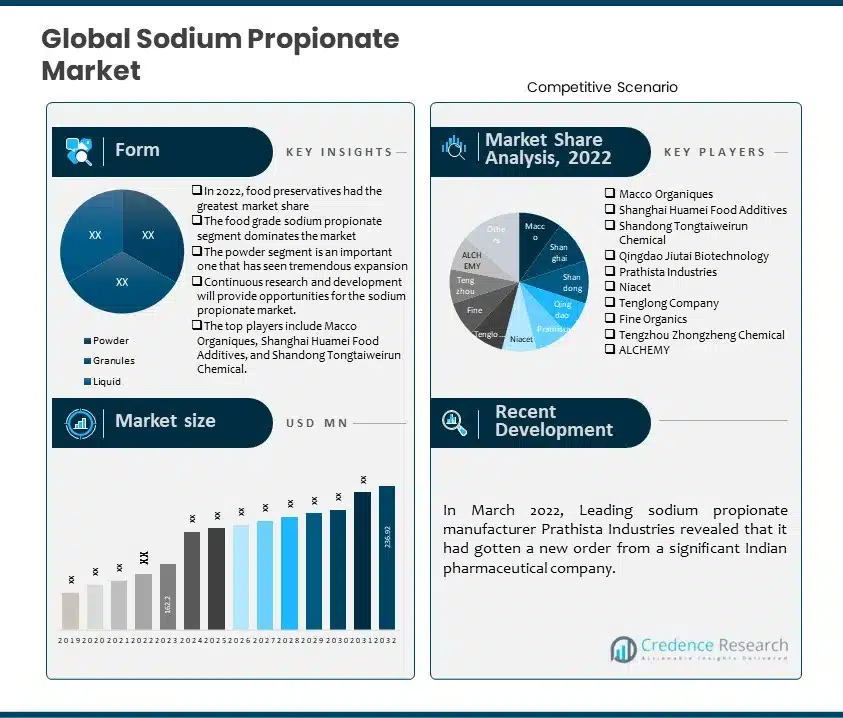
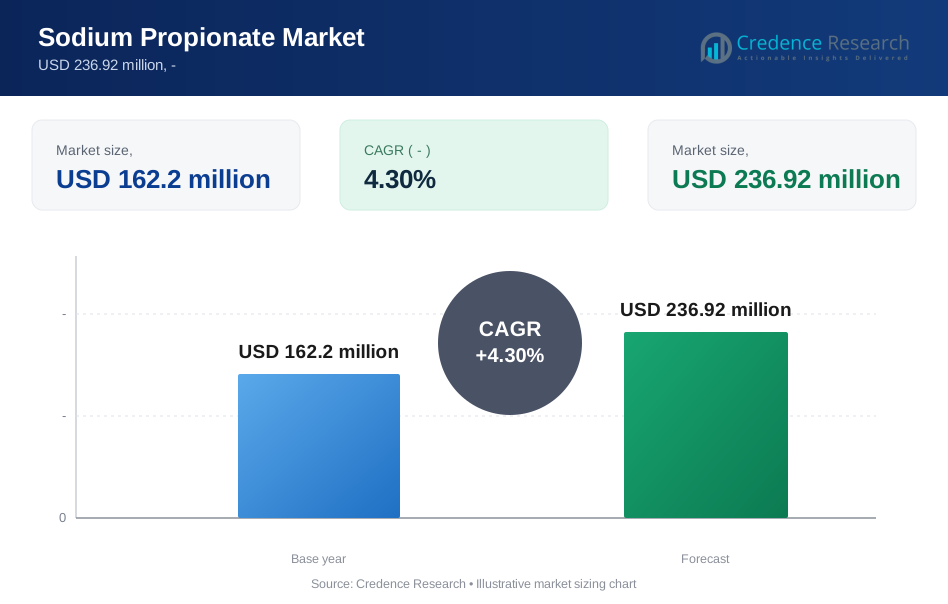
- The global market for sodium propionate is expected to grow from USD 162.2 million in 2023 to USD 236.92 million in 2032 at a compound annual growth rate (CAGR) of 4.30% between 2024 and 2032.
- The significant category is food preservatives. Pharmaceuticals, on the other hand, are expected to grow at a strong CAGR.
- The leading grade segment is food-grade sodium propionate.
- The CAGR for powder is expected to be the highest during the projection period.
- The food and beverage industry segment will have the highest CAGR throughout the prediction period.
- Preservatives are estimated to have the greatest CAGR during the forecast period.
- Direct sales (manufacturer to end user) are predicted to grow fastest over the projection period.
- Asia Pacific dominated the sodium propionate market.
- Regarding the market share of sodium propionate, Europe is expected to come second.
- In the sodium propionate market, North America is anticipated to grow fastest.
- The market's main drivers are the growing dairy and bakery industries, the rise in convenience food demand owing to busy lifestyles and changing lifestyles, and the expansion of the bakery sector, particularly in emerging markets.
- The growing demand for convenience foods, growing consumer health consciousness, and ongoing innovation in food processing methods and product formulations are the main drivers of the sodium propionate market.
Executive Summary
Market Definition
The market for sodium propionate, a compound frequently used as a food additive, can be defined as global or regional. Propionic acid is the source of sodium propionate, a salt mainly used as a preservative in food and drink products to stop mold and fungus growth and increase shelf life. The market includes sodium propionate production, distribution, and consumption in various industries, including food and beverage, pharmaceuticals, animal feed, and others.
Market Overview
The sodium propionate sector is estimated to develop at a 4.30% compound annual growth rate (CAGR) between 2024 and 2032, maintaining its current upward trend. The market will continue to develop, rising from its estimated value of USD 162.2 million in 2023 to USD 236.92 million in 2032.
Sodium propionate market growth may be significantly influenced by the dairy industry's expansion, especially in developing nations. To prolong the shelf life of dairy products, sodium propionate is a chemical compound frequently used as a food preservative. There is frequently a corresponding rise in demand for dairy products in emerging markets as they see economic growth and income growth. In response, the dairy industry boosts output to keep up with demand. The need to preserve dairy products becomes more pressing as production levels rise to keep them fresher longer. Dairy products benefit greatly from using sodium propionate as a preservative, which prevents mold growth and extends the shelf life.
Investments in processing facilities to handle larger volumes of milk and dairy products are frequently prompted by the expansion of the dairy industry in emerging markets. To maintain the products' quality and safety during storage and distribution, these facilities need preservatives like sodium propionate. Regulatory organizations might enforce stricter guidelines for food safety and shelf life extension in developing nations. Dairy producers can adhere to these regulations while maintaining the quality and safety of their products by using sodium propionate, a recognized and approved food preservative. As food supply chains become more globalized, emerging market dairy producers frequently have to comply with international norms and regulations to export their goods. Dairy products to be exported must contain sodium propionate because it complies with international food safety regulations.
Segmentation by Application
- Food preservatives dominated the market. The demand for processed and convenience foods is rising due to busy schedules and changing lifestyles. For these foods to remain safe and high-quality while being stored and transported, efficient preservation techniques are needed.
- The pharmaceuticals category will exhibit a sizable CAGR during the projected period. Pharmaceuticals in the sodium propionate market are defined as drugs or medications containing sodium propionate as an additive or an active ingredient. One chemical frequently used as a preservative in various food and pharmaceutical products is sodium propionate.
- Other applications, such as agriculture, cosmetics, personal care, and industrial, additionally support the need for sodium propionate.
Segmentation by Grade
- The significant grade category is food-grade sodium propionate. Food-grade sodium propionate must meet strict purity standards for human consumption to be safe. Limits on contaminants and impurities that might endanger consumers are part of this. Suppliers and manufacturers usually follow strict quality control procedures to guarantee that their sodium propionate fulfills these requirements.
- The pharmaceutical-grade sodium propionate category will likely register a significant CAGR during forecasting. Pharmaceutical Grade Sodium Propionate is manufactured in a way that satisfies the exacting purity and quality standards required for pharmaceutical purposes. It goes through extensive testing and purification procedures to ensure it satisfies the requirements for use in pharmaceuticals.
- Other grades, such as industrial-grade sodium propionate, also contribute to the demand for sodium propionate.
Segmentation by Form
- The powder category is projected to grow at the fastest rate over the projection period. Powdered sodium propionate is easy to handle and store. During the manufacturing process, it is easily mixed and measured accurately into food formulations.
- The need for sodium propionate is also influenced by other forms, including granules and liquid.
Segmentation by End-Use Industry
- The food and beverage industry segment category will likely have the highest CAGR during the projection period. Sodium propionate is primarily used in the food and beverage industry for its mold-inhibiting and preservative properties. Food products frequently contain sodium propionate, a propionic acid salt, to prolong shelf life by inhibiting mold growth and certain bacteria. This substance is especially helpful in processed cheese, fruit juices, baked goods, cakes, pastries, and other bakery goods.
- Other end-use industries, such as the pharmaceutical, agriculture, cosmetics, and personal care industries, and other industrial sectors, also contribute to the demand for sodium propionate.
Segmentation by Function
- Preservatives will be expected to have the highest CAGR during the prediction period. One type of chemical included in the organic salts category is sodium propionate. It is mostly utilized in a variety of food products as a preservative. Its primary purpose is to prevent mold and some bacteria from growing, prevent food from spoiling, and extend its shelf life.
- Other functions, such as pH regulator, mold inhibitor, flavor enhancer, and antimicrobial agent, also contribute to the demand for sodium propionate.
Segmentation by Distribution Channel
- Direct sales (manufacturer to end user) will be expected to have the foremost CAGR during the prediction period. The practice of manufacturers of sodium propionate selling their goods directly to consumers without the involvement of middlemen like distributors or retailers is known as direct sales in the sodium propionate market. With this approach, manufacturers can engage directly with customers and exert more control over the sales process.
- Other distribution channels, such as distributors and wholesalers, online retailers, and specialty stores, also contribute to the demand for sodium propionate.
Segmentation by Region
- Asia Pacific leads the sodium propionate market. Due to growing awareness of fitness and maintaining good digestive health, consumers in this region are becoming more selective when purchasing healthy products.
- Europe is estimated to rank second in market size for sodium propionate.
- North America will witness the most rapid growth of the sodium propionate market.
- Regions such as Africa, the Middle East, and Latin America cover the remaining sodium propionate requirement.
The globalization of the food industry has profoundly affected how food is produced, shipped, and consumed around the world. Convenience foods, which are simple to make, store, and eat and suit the hectic lifestyles of contemporary consumers, are in higher demand due to this phenomenon. To preserve their quality and freshness over time, convenience foods frequently need a longer shelf life, which necessitates the use of preservatives like sodium propionate. Food producers now face more competition due to globalization, which makes creative solutions necessary to satisfy consumer demands and maintain profitability. The market for sodium propionate is expected to grow due to the product's economical and effective method of food product preservation.
The Asia Pacific region dominates the sodium propionate market. The area's food industry is expanding due to urbanization, population growth, and shifting consumer tastes. To increase the shelf life of various food products, such as dairy products, processed meats, and baked goods, sodium propionate is frequently used as a food preservative. Preservatives are used more often to preserve the freshness and quality of food products as people become more conscious of food safety issues and health risks. For food manufacturers in the area, sodium propionate is the preferred option because it is deemed safe for consumption when used within regulatory limits.
Throughout the forecast, the sodium propionate market in North America is anticipated to expand fastest. Preservatives such as sodium propionate are frequently found in processed meats, baked goods, dairy products, and other food items. Because of the size and diversity of the North American food industry, there is a high demand for preservatives like sodium propionate to preserve food freshness and lengthen its shelf life. The regulatory frameworks controlling food safety and additives are well-established in North America. Health Canada and the U.S. Food and Drug Administration (FDA) have approved sodium propionate for use in food products as long as it is used within certain bounds. Its widespread adoption throughout the region is encouraged by this regulatory approval.
Key Highlights of the Report
The global sodium propionate market is segmented by application, grade, form, end-use industry, function, distribution channel, and region. Food preservatives are the market spearhead. Food-grade sodium propionate is the top-grade segment. The powder category is anticipated to increase at the highest CAGR throughout the projection period. The food and beverage industry segment will experience the highest CAGR during the forecast period. The sodium propionate market is expanding mostly in Asia Pacific.
One well-known benefit of sodium propionate as a preservative is its effectiveness. It prevents some bacteria and mold from growing in various products, including medications. Preservatives such as Sodium Propionate are essential to the pharmaceutical industry because they prolong the shelf life and safety of pharmaceutical products, which is critical given the importance of maintaining the stability and efficacy of medications. Pharmaceutical products frequently have a short shelf life because of the possibility of microbial contamination or active ingredient deterioration. Drug makers can increase the shelf life of their products, lower the chance of spoiling, and guarantee that prescriptions stay effective for longer by adding sodium propionate to their formulas. The Food and Drug Administration (FDA) and the European Medicines Agency (EMA) are two regulatory bodies with strict guidelines about pharmaceutical products' stability and safety. Pharmaceutical businesses can adhere to these regulations by using established preservatives, such as sodium propionate, which guarantees that their products fulfill the necessary quality standards.
The Asia Pacific is expected to account for the largest portion of the sodium propionate market globally. While food safety regulations are strict in the Asia Pacific region, some food additives, such as sodium propionate, are permitted to be used within certain bounds. The regulatory framework in place creates a favorable atmosphere for the regional sodium propionate market to grow. The North American region is also assumed to have the market's sharpest growth. Preservatives are in more demand as consumers place a greater emphasis on packaged foods and convenience to preserve the quality and safety of these goods. Sodium Propionate is a preservative that works well and doesn't negatively affect taste or texture, which makes it a good fit for North American consumers.
Which Key Factors Are Driving The Global Sodium Propionate Market?
The market for sodium propionate is being driven by rising consumer demand for baked goods like pastries, cookies, and biscuits, as well as natural, safe, clean-label preservatives.
What Are The Main Challenges Confronting The Sodium Propionate Market Globally?
The sodium propionate industry faces several obstacles, including growing consumer awareness of the possible health risks linked to the consumption of synthetic preservatives like sodium propionate and rising consumer demand for minimally processed and natural foods.
What Market Opportunities Exist For Sodium Propionate Globally?
Constant advancements in food processing technology and product formulations, together with the food processing industry in growing areas, are creating opportunities in the sodium propionate market.
Market Drivers
Multiple factors propel the sodium propionate industry across the globe. The primary factors propelling the global sodium propionate market are as follows:
Extension of Shelf Life and Food Safety
Sodium propionate acts by preventing the growth of bacteria and molds, including those that cause food to deteriorate. It helps prolong food products' shelf lives by inhibiting microbial growth, which keeps them fresher for longer. Food deterioration is frequently caused by mold, which poses health risks if ingested. Sodium propionate works especially well at preventing the growth of mold in dairy products, processed meats, and baked goods like bread and cakes. Its capacity to stop mold growth makes a substantial contribution to preserving the food products' safety and quality. Sodium propionate helps maintain the flavor and freshness of food items in addition to preventing microbial growth. This is especially critical for perishable goods, such as processed meats and baked goods, where keeping flavor and texture for longer is essential to satisfy customers. Regulatory bodies, including the European Food Safety Authority (EFSA) in the European Union and the Food and Drug Administration (FDA) in the United States, have approved sodium propionate as a food additive. Because of its well-established safety profile and effectiveness as a preservative, food manufacturers who want to increase the shelf life of their products while still adhering to food safety regulations choose to use it.
Market Restraints
There are several obstacles that the global sodium propionate market must overcome to continue growing. Among them are the following:
Growing Preference Among Consumers for Natural Ingredients with Clear Labels
Customers are becoming more conscious of the possible health hazards of artificial preservatives such as sodium propionate. A growing number of people choose products with natural preservatives because they are concerned about the long-term effects of such additives. Consumers are reading food labels more carefully than in the past due to an increased emphasis on health and wellness. Because they are thought to be linked to health problems, synthetic preservatives are frequently regarded with suspicion. This encourages customers to select natural preservative-containing products over ones that contain sodium propionate. Regulating bodies are also reacting to the needs of consumers who want more transparent and healthier food options. The use of artificial preservatives like sodium propionate may be subject to stronger laws or labeling specifications, which would encourage producers to look into natural substitutes. Producers are repurposing their products in response to shifting consumer tastes, focusing on natural and clean-label ingredients. Due to increased market competition and consumers' growing preference for natural alternatives, sodium propionate will find it difficult to hold onto its position.
Opportunities
There are plenty of potential prospects in the global sodium propionate industry. Among these are the following:
Continuous Innovation in Product Formulations and Food Processing Methods
Sodium propionate use as a preservative in the food industry has been greatly impacted by ongoing innovation in food processing techniques and product formulations. Sodium propionate, a propionic acid salt, is widely used as a preservative in food products to prevent the growth of bacteria and mold, prolonging their shelf life and preserving their freshness. The need for food preservation solutions in the face of changing consumer preferences, shifting regulations, and improvements in food processing technologies creates an opportunity for the sodium propionate market. Clean-label products are becoming increasingly in demand as consumers become more conscious of their health and wellness. Customers are looking for foods with the fewest possible preservatives and additives. Through constant innovation, producers can create sodium propionate formulations that both efficiently and cleanly meet clean label requirements.
Competitive Landscape
Key Players
There are several major competitors in the fiercely competitive global sodium propionate market. The following are a few of the leading market participants and their market shares:
- Macco Organiques
- Shanghai Huamei Food Additives
- Shandong Tongtaiweirun Chemical
- Qingdao Jiutai Biotechnology
- Prathista Industries
- Niacet
- Tenglong Company
- Fine Organics
- Tengzhou Zhongzheng Chemical
- ALCHEMY
- Lianyungang Shuren Kechuang Food Additive
- Qingdao Dawei Biological Engineering
- Others
These companies prioritize product innovation, distribution channel expansion, mergers, and acquisitions to remain competitive.
The largest suppliers in the global sodium propionate market continuously work to keep one step ahead of the competition by developing innovative concepts and products.
In March 2023, The European Food Safety Authority approved sodium propionate as a preservative in a wider variety of food products. This includes pastries, cakes, bread, and other baked items.
In January 2022, Niacet Corporation, the Leading producer of sodium propionate, announced that it would increase its production capacity by 25% to meet the growing demand for the substance from the food and pharmaceutical industries.
Summary of Key Findings
- Convenience food demand is rising due to changing lifestyles and hectic schedules, and this is anticipated to support market growth over the forecast period.
- The market is segmented by application, grade, form, end-use industry, function, distribution channel, and region.
- The most prevalent application in the market is food preservatives.
- Food-grade sodium propionate is the foremost category.
- Regarding CAGR, the powder category is expected to grow fastest during the forecast period.
- Over the projected period, the preservative category will have the highest CAGR.
- Asia Pacific is leading market development; the market is highly competitive with key players including Macco Organiques, Shanghai Huamei Food Additives, Shandong Tongtaiweirun Chemical, Qingdao Jiutai Biotechnology, Prathista Industries, Niacet, Tenglong Company, Fine Organics, Tengzhou Zhongzheng Chemical, ALCHEMY, Lianyungang Shuren Kechuang Food Additive, Qingdao Dawei Biological Engineering, and Others.
Future Outlook
- The sodium propionate industry is expected to increase significantly in Asia Pacific and has a positive outlook worldwide.
- The market for sodium propionate is anticipated to expand faster due to innovations in baked goods, such as the development of new tastes and formulations.
- During the forecast duration, one of the main challenges expected to impede the growth of the sodium propionate market is rising consumer knowledge of the possible health hazards of consuming artificial preservatives like sodium propionate.
- To stay ahead of the competition, key enterprises must develop new products, expand their market reach, and keep their prices competitive.
How CXOs Can Benefit from the Credence Research Sodium Propionate Market Report
CXOs may get a detailed picture of the market in the Credence Research Sodium Propionate Market Report, which includes:
- Market size and growth forecast: The report provides detailed estimates of the global sodium propionate market size, segmented by application, grade, form, end-use industry, function, distribution channel, and region. It also includes forecasts for the market through 2032 based on key trends and drivers.
- Market segmentation: The research report breaks down the sodium propionate market into segments based on application, grade, form, end-use industry, function, distribution channel, and region. This segmentation provides CXOs with a granular understanding of the market and the opportunities in each segment.
- Competitive landscape: The research report offers a detailed analysis of the major companies in the sodium propionate industry, including information on their business plans, product lines, and earnings. CXOs can use this information to evaluate and identify their competitors.
- Key trends and drivers: The research report identifies and evaluates the main trends and factors influencing the market for sodium propionate. CXOs can use this information to make well-informed choices regarding their plans and investments.
CXOs can use the insights from the Credence Research Sodium Propionate Market Report to:
- Identify growth opportunities: With the help of this analysis, CXOs may identify new growth opportunities in the sodium propionate sector. For example, the report identifies the growing demand for sodium propionate from the pharmaceutical industry as a key opportunity.
- Make informed investment decisions: With the help of the report, CXOs can choose sodium propionate wisely. For example, the research study provides information on the critical factors to consider while selecting sodium propionate solutions and evaluating sodium propionate suppliers.
- Develop competitive strategies: CXOs can use the research report to develop competitive strategies for their sodium propionate businesses. For example, the research paper outlines the main strategies suppliers utilize to differentiate themselves from competitors.
- Track market developments: This research report may help CXOs stay ahead of the curve by tracking market developments. For instance, it offers insights into the most recent developments and trends in the sodium propionate market.
CXOs seeking to expand their industry knowledge and spot growth prospects will find the Credence Research Sodium Propionate Market Report a useful tool.
Segmentation
- By Application
- Food preservatives
- Bakery products
- Dairy and cheese products
- Meat and poultry products
- Confectionery products
- Beverages
- Other processed foods
- Pharmaceuticals
- Antifungal agents in medications
- Veterinary drugs
- Other pharmaceutical formulations
- Agriculture
- Animal feed additives
- Crop protection chemicals
- Cosmetics and Personal Care
- Skincare products
- Haircare products
- Oral care products
- Industrial
- Chemical synthesis
- Water treatment
- Other industrial applications
- By Grade
- Food Grade Sodium Propionate
- Pharmaceutical Grade Sodium Propionate
- Industrial Grade Sodium Propionate
- By Form
- Powder
- Granules
- Liquid
- By End-Use Industry
- Food and Beverage Industry
- Pharmaceutical Industry
- Agriculture Industry
- Cosmetics and Personal Care Industry
- Other Industrial Sectors
- By Function
- Preservative
- pH Regulator
- Mold Inhibitor
- Flavor Enhancer
- Antimicrobial Agent
- By Distribution Channel
- Direct Sales (Manufacturer to End User)
- Distributors and Wholesalers
- Online Retailers
- Specialty Stores
- By Region
- North America
- The U.S.
- Canada
- Mexico
- Europe
- Germany
- France
- The U.K.
- Italy
- Spain
- Rest of Europe
- Asia Pacific
- China
- Japan
- India
- South Korea
- South-east Asia
- Rest of Asia Pacific
- Latin America
- Brazil
- Argentina
- Rest of Latin America
- Middle East & Africa
- GCC Countries
- South Africa
- Rest of Middle East and Africa
- North America
Request a Free Sample
Fill in your details and we'll send you a free sample report.
- Sample data tables & charts
- Research methodology
Need a Custom Version of This Report?
Tailor the scope, geography, or segments to your exact requirements.
- Custom geography or segment scope
- Direct access to our analyst team
Frequently Asked Questions
How much does the global market currently hold for sodium propionate?
What is the projected growth rate of the sodium propionate market between 2024 and 2032?
Which end-use industry segment is estimated to have the highest CAGR throughout the forecast period?
In which region is the market for sodium propionate expanding?
Who are the main players in the sodium propionate industry globally?
Table of Content
Chapter 1. Report Introduction
- 1.1 Report Description & Purpose
- 1.1.1 Report Title & Market Definition
- 1.1.2 Unique Selling Propositions (USP) & Key Differentiators
- 1.1.3 Value Proposition for Stakeholders
- 1.2 Research Objectives
- 1.2.1 Market Sizing Objectives (Volume & Revenue)
- 1.2.2 Segmentation Objectives
- 1.2.3 Competitive Intelligence Objectives
- 1.2.4 Forecast & Scenario Objectives
- 1.3 Report Scope
- 1.3.1 Sodium Propionate Scope – Types & Subtypes Covered
- 1.3.2 Geographic Scope – Regions & Countries Covered
- 1.3.3 Historical Period, Base Year & Forecast Period (the historical period; forecast to the forecast period)
- 1.3.4 Inclusions & Exclusions
- 1.4 HS Code & Classification Framework
- 1.5 Currency, Units & Pricing Basis
- 1.6 Target Stakeholders
- 1.7 Limitations & Assumptions
Chapter 2. Executive Summary
- 2.1 Global Sodium Propionate Market Snapshot
- 2.1.1 Market Size – Historical (the historical period) & Forecast (the forecast period) (base year: USD 162.2 million → forecast year: USD 236.92 million)
- 2.1.2 Volume & Revenue – Global Totals
- 2.1.3 Key Market Highlights – Top Five Facts
- 2.2 Sodium Propionate Market Segmentation Snapshot
- 2.2.1 Market Split by Region – vs.
- 2.3 Competitive Snapshot
- 2.3.1 Top 10 Players by Revenue Share –
- 2.3.2 Top 10 Players by Volume Share –
- 2.3.3 Recent Strategic Developments (18-Month Summary)
- 2.4 Key Investment Highlights & Strategic Conclusions
Chapter 3. Sodium Propionate Market Dynamics & Industry Analysis
- 3.1 Market Overview & Context
- 3.1.1 Sodium Propionate Market Position in the Broader Automotive Value Chain
- 3.1.2 OEM vs. Replacement Market Dynamics
- 3.1.3 Market Maturity & Development Stage by Region
- 3.2 Sodium Propionate Market Drivers
- 3.3 Sodium Propionate Market Restraints & Challenges
- 3.4 Sodium Propionate Market Opportunities
- 3.5 Porter's Five Forces Analysis
- 3.5.1 Threat of New Entrants
- 3.5.2 Bargaining Power of Suppliers
- 3.5.3 Bargaining Power of Buyers
- 3.5.4 Threat of Substitutes
- 3.5.5 Competitive Rivalry – Intensity Assessment
- 3.6 Sodium Propionate Value Chain Analysis
- 3.6.1 Upstream – Raw Material/Input Suppliers
- 3.6.1.1 Raw Material/Input 1
- 3.6.1.2 Raw Material/Input 2
- 3.6.1.3 Raw Material/Input 3
- 3.6.2 Midstream – Production/Manufacturing/Service Delivery
- 3.6.2.1 Production/Process Overview
- 3.6.2.2 Key Facility Locations & Capacity by Manufacturer
- 3.6.3 Downstream – Distribution & End Consumer
- 3.6.3.1 Primary Channel – B2B/OEM
- 3.6.3.2 Secondary Channels – Dealer, Retail, Online, Direct
- 3.6.4 Value Chain Profitability Analysis
- 3.6.1 Upstream – Raw Material/Input Suppliers
- 3.7 PESTEL Analysis
- 3.7.1 Political Factors
- 3.7.2 Economic Factors
- 3.7.3 Social Factors
- 3.7.4 Technological Factors
- 3.7.5 Environmental Factors
- 3.7.6 Legal Factors
- 3.8 Sodium Propionate Supply Chain Analysis
- 3.8.1 Raw Material/Input Supply Risk Assessment
- 3.8.2 Manufacturing Concentration Risk (Geographic Exposure)
- 3.8.3 Trade Disruption Impact Analysis
- 3.9 Regulatory & Policy Landscape
Note: The regulatory and policy landscape section covers regulations based on their applicability to the market, Sodium Propionate category, geography, and scope of the study. Only regulatory frameworks with a material impact on operations, compliance, trade, sustainability, or market access are analyzed in detail.
Chapter 4. Key Investment Pockets & Opportunity Analysis
- 4.1 Sodium Propionate Market Attractiveness Analysis
- 4.1.1 By Region – Investment Attractiveness Matrix (Volume × CAGR)
- 4.2 Absolute Revenue Growth Opportunity
- 4.2.1 By Region – Absolute USD Growth Through the forecast period
- 4.3 Incremental Volume Opportunity
- 4.3.1 By Region – Incremental Volume Through the forecast period
- 4.3.2 Segment – Incremental Volume
- 4.4 Emerging Submarket Opportunity Deep Dive (Subject to Applicability)
- 4.5 Emerging Market Opportunity Scorecards
- 4.5.1 United States
- 4.5.2 Europe
- 4.5.3 Asia
- 4.5.4 Middle East & Africa
Note: Emerging Market Opportunity Scorecards will be included based on relevance and strategic importance. Regions listed are indicative and may vary depending on data availability and market dynamics.
Chapter 5. Sodium Propionate Import-Export Analysis & Trade Flows
- 5.1 Global Trade Overview
- 5.1.1 Global Export Value by Country (the historical period)
- 5.1.2 Global Export Volume by Country (the historical period)
- 5.1.3 Global Import Value by Country (the historical period)
- 5.1.4 Global Import Volume by Country (the historical period)
- 5.1.5 Net Trade Balance by Country (the historical period)
- 5.2 Export Analysis – Segment
- 5.2.1 Type 1 (HS Code)
- 5.2.2 Type 2 (HS Code)
- 5.2.3 Type 3 (HS Code)
- 5.2.4 Type 4 (HS Code)
- 5.2.5 Type 5 (HS Code)
- 5.3 Import Analysis – Segment
- 5.3.1 Type 1 (HS Code)
- 5.3.2 Type 2 (HS Code)
- 5.3.3 Type 3 (HS Code)
- 5.3.4 Type 4 (HS Code)
- 5.3.5 Type 5 (HS Code)
- 5.4 Average Unit Trade Prices
- 5.4.1 Average Export Price – Segment & Country
- 5.4.2 Average Import Price – Segment & Source Country
- 5.4.3 Price Trends (the historical period)
- 5.5 Key Trade Route Analysis
- 5.5.1 Trade Route 1
- 5.5.2 Trade Route 2
- 5.5.3 Trade Route 3
- 5.5.4 Trade Route 4
- 5.5.5 Trade Route 5
- 5.6 Trade Policy Impact Assessment
- 5.6.1 US Anti-Dumping & Section 301 Tariffs
- 5.6.2 EU Customs Union Impact
- 5.6.3 Major Free Trade Agreements
- 5.6.4 USMCA Rules of Origin
Note: Trade policy analysis will be included only where relevant to the Sodium Propionate market.
Chapter 6. Competitive Landscape & Company Benchmarking
- 6.1 Sodium Propionate Market Concentration & Structure
- 6.1.1 Herfindahl-Hirschman Index (HHI) – vs.
- 6.1.2 Tier 1, Tier 2 & Tier 3 Market Structure
- 6.1.3 Global, Regional & Local Player Dynamics
- 6.2 Sodium Propionate Market Share Analysis –
- 6.2.1 Global Revenue Share by Company
- 6.2.2 Global Volume Share by Company
- 6.2.3 Regional Revenue Share
- 6.2.4 Market Share Evolution ( vs. )
- 6.2.5 OEM Segment Share by Company
- 6.2.6 Replacement Segment Share by Company
- 6.3 Production/Delivery Capacity & Facility Analysis
- 6.3.1 Global Installed Capacity
- 6.3.2 Capacity Utilization Rates
- 6.3.3 Production/Output Volume
- 6.3.4 Facility Locations & Capacity Map
- 6.3.5 Planned Capacity Additions
- 6.4 Sodium Propionate Competitive Benchmarking Matrix
- 6.4.1 Revenue, Volume, CAGR & Profitability Comparison
- 6.4.2 Channel Revenue Mix
- 6.4.3 Geographic Revenue Exposure
- 6.4.4 R&D Intensity
- 6.4.5 Sustainability Maturity
- 6.5 Strategic Developments in Sodium Propionate (Last 24 Months)
- 6.5.1 Mergers, Acquisitions & Divestments
- 6.5.2 New Sodium Propionate Launches
- 6.5.3 Facility Expansions
- 6.5.4 Strategic Alliances, Joint Ventures & Partnerships
- 6.5.5 Distribution Expansion & Market Entry
- 6.5.6 Sustainability & ESG Initiatives
- 6.6 Competitive Strategy Mapping
- 6.6.1 Leader, Challenger, Follower & Niche Classification
- 6.6.2 Pricing Strategy Comparison
- 6.6.3 Channel Strategy Matrix
Note: Strategic developments are included based on their materiality and the availability of reliable information.
Chapter 7. Global Sodium Propionate Market – By Distribution Channel
- 7.1 Segment Overview
- 7.1.1 Volume & Revenue Split by Channel ( & )
- 7.1.2 Channel Mix Evolution (the forecast period)
Chapter 8. Regional Market Analysis – Global Overview
- 8.1 Global Regional Overview
- 8.1.1 Regional Volume Share
- 8.1.2 Regional Revenue Share
- 8.1.3 Regional Volume by Region
- 8.1.4 Regional Revenue by Region
- 8.1.5 Regional Forecast Through the forecast period
- 8.2 Cross-Regional Segment Analysis
- 8.2.1 By Distribution Channel
- 8.2.2 By Brand/Price Tier
Chapter 9. North America Sodium Propionate Market
- 9.1 United States
- 9.2 Canada
- 9.3 Mexico
Chapter 10. Europe Sodium Propionate Market
- 10.1 Germany
- 10.2 France
- 10.3 Italy
- 10.4 United Kingdom
- 10.5 Spain
- 10.6 Poland
- 10.7 Russia
- 10.8 Netherlands
- 10.9 Belgium
- 10.10 Sweden
- 10.11 Denmark
- 10.12 Norway
- 10.13 Rest of Europe
Chapter 11. Asia Pacific Sodium Propionate Market
- 11.1 China
- 11.2 India
- 11.3 Japan
- 11.4 South Korea
- 11.5 Thailand
- 11.6 Indonesia
- 11.7 Vietnam
- 11.8 Malaysia
- 11.9 Australia
- 11.10 Rest of Asia Pacific
Chapter 12. Latin America Sodium Propionate Market
- 12.1 Brazil
- 12.2 Argentina
- 12.3 Colombia
- 12.4 Chile
- 12.5 Rest of Latin America
Chapter 13. Middle East Sodium Propionate Market
- 13.1 Saudi Arabia
- 13.2 United Arab Emirates
- 13.3 Turkey
- 13.4 Israel
- 13.5 Iran
- 13.6 Rest of the Middle East
Chapter 14. Africa Sodium Propionate Market
- 14.1 South Africa
- 14.2 Egypt
- 14.3 Nigeria
- 14.4 Morocco
- 14.5 Rest of Africa
Chapter 15. Sodium Propionate Company Profiles
- 15.1 [Company 01]
- 15.1.1 Company Overview
- 15.1.2 Key Management Personnel
- 15.1.3 Products & Services Portfolio
- 15.1.4 Financial Performance
- 15.1.5 Key Market Focus & Geographic Presence
- 15.1.6 Recent Developments & Strategic Initiatives
Note: The company profile list is preliminary and may change based on research findings, market developments, data availability, and client requirements.
Chapter 16. Appendices
- Appendix A – List of Abbreviations & Acronyms
- Appendix B – Industry Classification Code Reference – Full Series
- Appendix C – Production & Capacity Data Tables
- Appendix D – End-Use & Demand Base Tables
- Appendix E – Consumption & Replacement Rate Assumptions
- Appendix F – ASP Reference Tables
- Appendix G – Manufacturing & Facility Database
- Appendix H – Import-Export Data Tables
- Appendix I – Regulatory Summary Tables
- Appendix J – Primary Research Participant List (Anonymized)
- Appendix K – Primary Research Questionnaire Framework
- Appendix L – Data Sources & Bibliography
- Appendix M – Market Size Divergence & Source Comparison
Chapter 17. Research Methodology
- 17.1 Research Framework & Philosophy
- 17.2 Secondary Research – Sources, Hierarchy & Data Extraction
- 17.3 Data Modeling – Bottom-Up & Top-Down Market Sizing
- 17.4 Primary Research – Stakeholder Framework, LOI & Sample Sizes
- 17.5 Forecast Methodology – Regression, Scenario & Sensitivity Analysis
- 17.6 Quality Control – Four-Layer Validation Framework
- 17.7 Limitations & Standard Assumptions
- 17.8 Disclaimer
