
Market Overview:
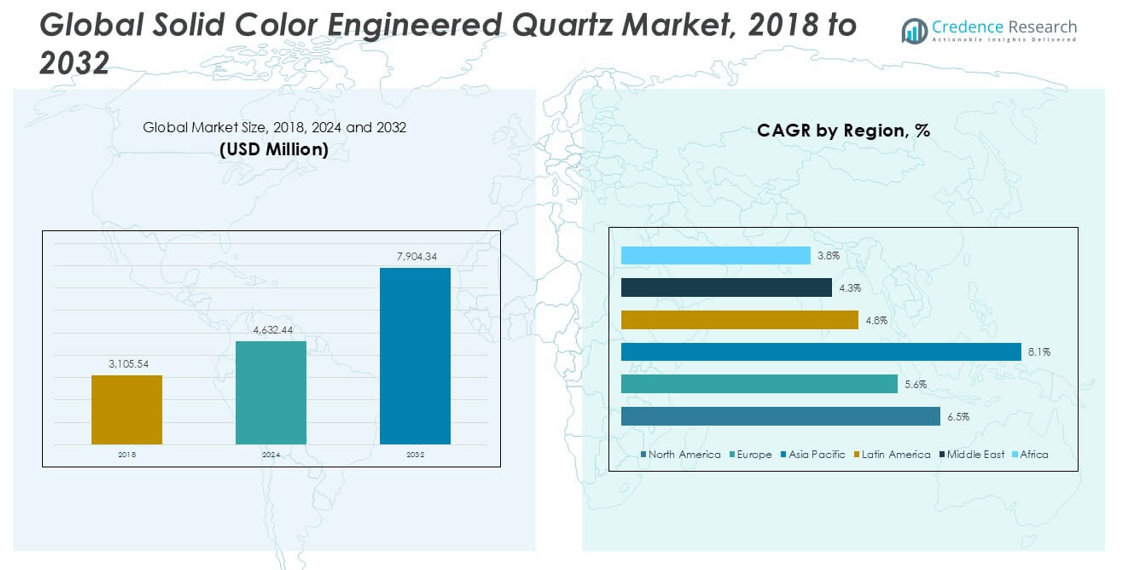
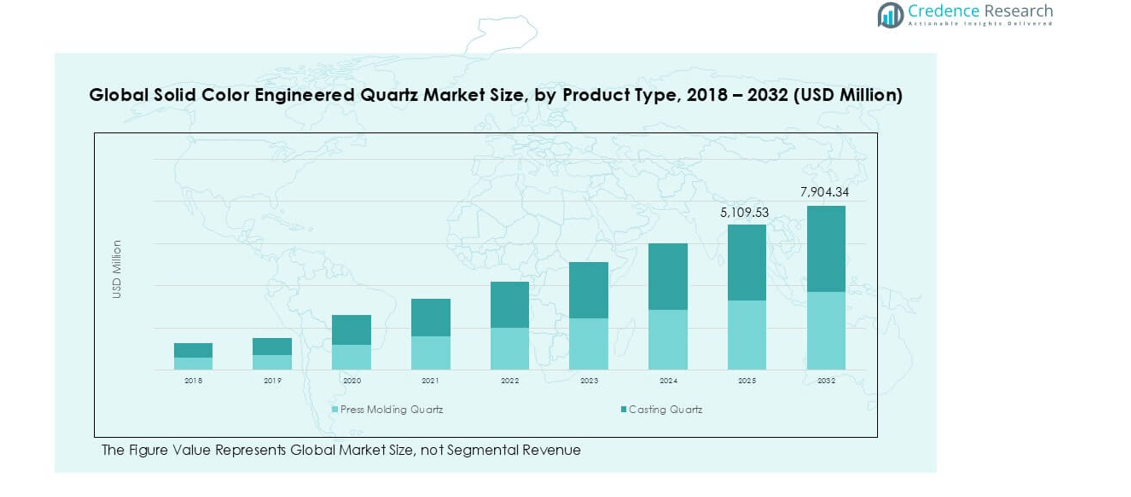
The Solid Color Engineered Quartz market size was valued at USD 3,105.54 million in 2018, increased to USD 4,632.44 million in 2024, and is anticipated to reach USD 7,904.34 million by 2032, growing at a CAGR of 6.43% during the forecast period.
| REPORT ATTRIBUTE | DETAILS |
|---|---|
| Historical Period | 2020-2023 |
| Base Year | 2024 |
| Forecast Period | 2025-2032 |
| Solid Color Engineered Quartz Market Size 2024 | USD 4,632.44 million |
| Solid Color Engineered Quartz Market, CAGR | 6.43% |
| Solid Color Engineered Quartz Market Size 2032 | USD 7,904.34 million |
The solid color engineered quartz market is led by established players such as Cosentino S.A., Caesarstone Ltd., Cambria Company LLC, Hanwha Corporation, , RAK Ceramics, Levantina Group, Q Holdings PLC, and Stone Italiana S.p.A. These companies dominate through extensive product portfolios, global distribution, and investments in sustainable innovations. North America remains the largest regional market, holding 43% share in 2024, valued at USD 2,022.98 million, driven by high adoption in residential remodeling and commercial interiors. Europe follows with a 26% share, supported by demand for sustainable, design-driven surfaces, while Asia Pacific, at 20% share, is the fastest-growing region, fueled by rapid urbanization and rising middle-class housing projects.
Market Insights
- The solid color engineered quartz market was valued at USD 3,105.54 million in 2018, reached USD 4,632.44 million in 2024, and is projected to hit USD 7,904.34 million by 2032 at a CAGR of 6.43%.
- Rising demand from residential and commercial construction is a key driver, supported by growing remodeling projects, premium interiors, and the durability of quartz compared to natural stones.
- Market trends highlight strong adoption of countertops with over 45% share, while press molding quartz dominates product type with more than 60% share, driven by design flexibility and cost efficiency.
- Leading players such as Cosentino S.A., Caesarstone Ltd., Cambria Company LLC, and Hanwha Corporation strengthen their position through innovation, sustainability, and expanded distribution, while regional manufacturers target niche demand.
- Regionally, North America leads with 43% share, followed by Europe at 26% and Asia Pacific at 20%, where rapid urbanization drives the fastest growth at 8.1% CAGR.
Market Segmentation Analysis:
By Product Type
The solid color engineered quartz market by product type is dominated by press molding quartz, which accounted for over 60% of revenue share in 2024. This dominance stems from its superior durability, consistent texture, and ability to withstand heavy use in both residential and commercial settings. Press molding technology offers greater design flexibility and cost efficiency, making it the preferred choice for large-scale projects. Casting quartz, while growing at a steady pace, holds a smaller share due to higher production complexity but appeals to niche applications demanding customized finishes.
- For instance, in 2023, Cosentino completed a milestone in its sustainable manufacturing strategy for Silestone, with 85% of its production containing less than 40% crystalline silica. This is a result of the company's HybriQ technology, which uses a sustainable process including 99% reused water and 100% renewable electric energy.
By Application
Countertops emerged as the leading application segment in 2024, capturing more than 45% of the market share. Their dominance is driven by rising demand for premium kitchen and bathroom designs, coupled with engineered quartz’s superior resistance to scratches, stains, and heat. Flooring also represents a significant segment, supported by growing adoption in high-traffic commercial areas where longevity and easy maintenance are essential. Applications such as walls, door jambs, and other custom uses contribute steadily, reflecting expanding architectural and interior design trends favoring modern, seamless aesthetics.
- For instance, in 2023, Cambria maintained its status as a major U.S.-based quartz countertop manufacturer, contributing to strong residential demand in the North American market
By End User
The residential sector led the market in 2024, accounting for nearly 65% of total revenue share. Rising consumer preference for durable and stylish interiors has fueled adoption across kitchens, bathrooms, and flooring applications. Home renovation projects and urban housing developments further support this segment’s leadership. The commercial sector, while smaller, is experiencing rapid growth due to increasing use of engineered quartz in hospitality, office spaces, and retail interiors. Its expansion is primarily driven by the need for materials that combine aesthetic appeal with long-term performance and cost efficiency.
Key Growth Drivers
Rising Demand in Residential and Commercial Construction
The increasing pace of residential and commercial construction is a primary driver of the solid color engineered quartz market. In the residential sector, the surge in kitchen remodeling, bathroom upgrades, and flooring replacements has fueled demand for durable and aesthetically pleasing materials. Urbanization trends and expanding housing projects, especially in Asia-Pacific and North America, continue to support steady consumption. In commercial spaces, such as offices, hotels, and retail outlets, engineered quartz is preferred due to its resistance to wear and low maintenance costs. The combination of functionality, durability, and modern design appeal positions engineered quartz as the material of choice in both new constructions and renovation projects.
- For instance, Quartz countertops remained a popular choice for kitchen renovation projects throughout 2023. Major home improvement retailers like Home Depot sell a variety of quartz products and services to meet this demand.
Superior Material Properties Enhancing Adoption
Engineered quartz offers unique benefits such as non-porosity, resistance to stains and scratches, and uniform color consistency, making it highly attractive across end-use industries. These technical advantages outperform natural stones like granite and marble, which often require regular sealing and carry inconsistencies in texture. Consumers and designers prefer solid color engineered quartz for its reliable performance in heavy-use applications, including countertops and flooring. The material’s heat resistance also supports its use in modern kitchens and commercial facilities. Additionally, technological advancements in press molding and surface finishing enhance product quality and availability. As awareness of these features grows, adoption rates increase, strengthening the market’s growth trajectory over the forecast period.
- For instance, Quartz countertops, like Hanwha's HanStone Quartz, are highly durable and heat-resistant. To prevent damage from thermal shock, the manufacturer and other quartz experts recommend using trivets or hot pads when placing searing-hot objects on the surface.
Growing Consumer Preference for Aesthetics and Sustainability
Consumer preferences are shifting toward materials that combine style, durability, and environmental responsibility. Solid color engineered quartz aligns with these demands by offering sleek, modern designs that integrate seamlessly with contemporary interiors. The material’s ability to mimic natural stone while maintaining color uniformity appeals to homeowners and commercial designers seeking premium finishes. At the same time, manufacturers are emphasizing sustainable production processes, such as recycling industrial waste and reducing energy consumption during manufacturing. Growing awareness of green building certifications and sustainable interior materials further boosts demand. As the construction industry adopts eco-friendly practices, engineered quartz is well-positioned to meet both regulatory requirements and consumer expectations for sustainable, stylish solutions.
Key Trends & Opportunities
Expansion in Customization and Design Innovation
A major trend shaping the market is the growing demand for customization and design flexibility in engineered quartz products. Manufacturers are focusing on offering a wide range of solid colors, finishes, and textures to cater to evolving consumer tastes. Digital design tools and advanced casting techniques allow companies to produce quartz surfaces tailored for unique applications such as walls, furniture, and door jambs. This trend is particularly strong in premium residential and luxury commercial spaces, where clients seek personalized aesthetics. As customization capabilities expand, opportunities emerge for suppliers to capture niche markets and enhance brand value.
- For instance, in 2023, Cosentino launched two new Silestone collections, Le Chic and Urban Crush, which included a total of 10 new colors inspired by fashion, industrial style, and urban textures.
Rising Adoption in Emerging Economies
Emerging markets present significant growth opportunities due to rapid urbanization, increasing disposable incomes, and expanding infrastructure projects. In regions like Asia-Pacific, large-scale residential construction and commercial developments are driving demand for cost-effective yet durable interior materials. Government initiatives promoting affordable housing and urban development further accelerate adoption. Solid color engineered quartz, with its balance of affordability, durability, and premium aesthetics, aligns well with these regional demands. Companies expanding distribution networks in these high-growth economies stand to benefit from the rising adoption and broader customer base.
Key Challenges
High Production Costs and Price Sensitivity
One of the major challenges in the market is the relatively high production cost of engineered quartz compared to traditional surface materials. The costs associated with advanced processing technologies, resin additives, and precision manufacturing make quartz products more expensive than alternatives like laminates or ceramic tiles. In price-sensitive markets, this limits adoption, particularly in budget residential projects. Furthermore, fluctuations in raw material prices can impact profitability for manufacturers. Balancing cost efficiency while maintaining product quality remains a critical challenge for sustaining competitiveness in both developed and emerging markets.
Competition from Alternative Materials
The solid color engineered quartz market faces growing competition from alternative surface materials, such as natural stones, ceramics, and innovative composites. Materials like porcelain slabs and high-performance laminates offer comparable aesthetics at lower costs, making them attractive for cost-conscious consumers. Additionally, the prestige of natural marble and granite still appeals to a segment of premium buyers. To overcome this challenge, engineered quartz manufacturers must emphasize the durability, consistency, and sustainability of their products while investing in design innovations. Failure to differentiate effectively may restrict market expansion, especially in competitive, design-driven segments.
Regional Analysis
North America
North America dominated the solid color engineered quartz market in 2024, accounting for over 43% share with a market size of USD 2,022.98 million, up from USD 1,370.27 million in 2018. The region is projected to reach USD 3,461.30 million by 2032, expanding at a CAGR of 6.5%. Growth is driven by strong demand from the U.S. and Canada for premium countertops and flooring in residential remodeling and commercial projects. Rising investments in luxury housing, coupled with consumer preference for durable and stylish interiors, continue to reinforce North America’s leadership in the global market.
Europe
Europe captured nearly 26% of the global market share in 2024, with revenue of USD 1,232.26 million, compared to USD 857.86 million in 2018. The market is expected to reach USD 1,976.14 million by 2032, at a CAGR of 5.6%. Demand is supported by widespread adoption of engineered quartz in kitchens, bathrooms, and commercial spaces, especially in Germany, France, and the UK. Increasing focus on sustainable building materials and stringent EU regulations are accelerating the shift from natural stones to engineered quartz. The region’s design-driven consumer base also favors solid color quartz for its aesthetic consistency.
Asia Pacific
Asia Pacific is the fastest-growing regional market, accounting for around 20% share in 2024, with a size of USD 946.73 million, rising from USD 584.57 million in 2018. It is projected to reach USD 1,833.88 million by 2032, registering the highest CAGR of 8.1%. Growth is fueled by rapid urbanization, expanding middle-class housing, and large-scale commercial projects across China, India, and Southeast Asia. Government-backed infrastructure and residential development programs also support demand. The region’s consumers increasingly prefer engineered quartz for its affordability, durability, and modern appeal, making Asia Pacific a key growth hub for global manufacturers.
Latin America
Latin America represented about 5% of the global market in 2024, with revenue of USD 215.57 million, compared to USD 146.34 million in 2018. The market is expected to reach USD 325.47 million by 2032, growing at a CAGR of 4.8%. Brazil and Mexico drive the majority of regional demand, supported by rising adoption of quartz in urban housing and hospitality projects. Economic recovery and investments in real estate are gradually boosting consumer spending on premium interior materials. However, price sensitivity remains a challenge, making solid color engineered quartz more popular in upper-middle income residential and commercial projects.
Middle East
The Middle East accounted for nearly 3% share of the global market in 2024, with revenue of USD 123.76 million, up from USD 90.44 million in 2018. It is anticipated to reach USD 179.56 million by 2032, at a CAGR of 4.3%. The market benefits from extensive investments in luxury residential and commercial infrastructure, particularly in the UAE and Saudi Arabia. Growing demand for high-end interior finishes in hospitality, retail, and housing projects supports adoption. However, reliance on imported materials and economic fluctuations limit wider market penetration, though premium solid color quartz remains in steady demand.
Africa
Africa held a modest 2% share of the global market in 2024, generating USD 91.13 million, up from USD 56.06 million in 2018. The market is projected to grow to USD 127.99 million by 2032, registering a CAGR of 3.8%. Demand is primarily driven by urban housing developments and commercial real estate expansion in countries like South Africa and Nigeria. However, limited purchasing power and competition from low-cost alternatives restrain wider adoption. Despite these challenges, increasing urbanization and gradual growth in the middle-class population are expected to create opportunities for steady market expansion over the forecast period.
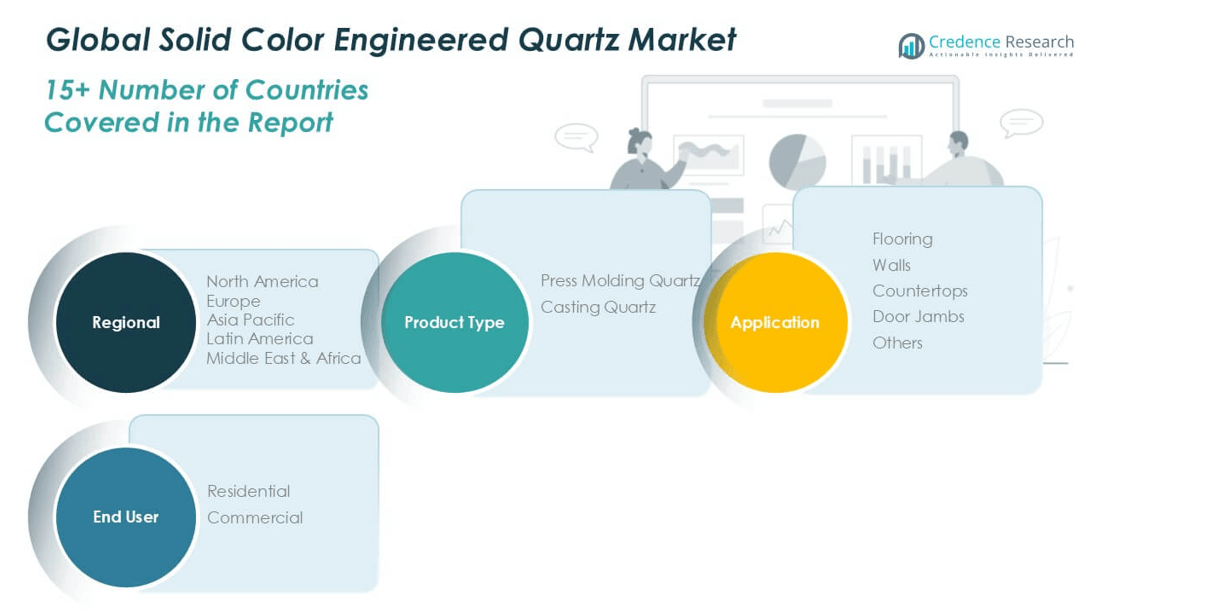
Market Segmentations:
By Product Type
- Press Molding Quartz
- Casting Quartz
By Application
- Flooring
- Walls
- Countertops
- Door Jambs
- Others
By End User
- Residential
- Commercial
By Geography
- North America
- U.S.
- Canada
- Mexico
- Europe
- Germany
- France
- U.K.
- Italy
- Spain
- Rest of Europe
- Asia Pacific
- China
- Japan
- India
- South Korea
- South-east Asia
- Rest of Asia Pacific
- Latin America
- Brazil
- Argentina
- Rest of Latin America
- Middle East & Africa
- GCC Countries
- South Africa
- Rest of the Middle East and Africa
Competitive Landscape
The competitive landscape of the solid color engineered quartz market is characterized by the presence of established global players and regional manufacturers that compete on design, quality, and innovation. Companies such as Cosentino S.A., Caesarstone Ltd., Cambria Company LLC, and Hanwha Corporation hold significant market shares through their wide distribution networks and advanced product portfolios. These firms invest heavily in research and development to expand their range of finishes, textures, and eco-friendly products, aligning with rising demand for sustainable surfaces. Mid-sized players like Vicostone, , and RAK Ceramics leverage niche positioning and regional strength to capture growing opportunities. Strategic initiatives such as mergers, acquisitions, and capacity expansions remain common, with manufacturers also focusing on digital marketing and showroom experiences to build brand visibility. Overall, competition is intensifying as both international and regional companies target customization, design innovation, and cost efficiency to secure growth in a fragmented yet expanding market.
Key Player Analysis
- Cosentino S.A.
- Caesarstone Ltd.
- Cambria Company LLC
- Hanwha Corporation
- Compac The Surfaces Company
- Vicostone
- RAK Ceramics
- Q Holdings PLC
- Levantina Group
- Stone Italiana S.p.A.
Recent Developments
- In July 2025, Caesarstone launched ICON™, a revolutionary crystalline silica-free solid surface (less than 1% silica) with approximately 80% recycled content, prioritizing both safety for fabricators and sustainability for consumers.
- In July 2025, Vicostone launched 10 new quartz colors for the fall season, focusing on inspirations from natural elements and aesthetics.
- In May 2025, RAK Ceramics commissioned its new next-generation slab production facility using Continua+ PCR 2180 technology, marking a significant technological leap in large-format engineered quartz and ceramic surfaces.
- In May 2024, WK Stone partnered with Eight Homes to offer Quantum Zero, a recycled surface as a safe alternative to high-silica engineered stone
Report Coverage
The research report offers an in-depth analysis based on Product Type, Application, End User and Geography. It details leading market players, providing an overview of their business, product offerings, investments, revenue streams, and key applications. Additionally, the report includes insights into the competitive environment, SWOT analysis, current market trends, as well as the primary drivers and constraints. Furthermore, it discusses various factors that have driven market expansion in recent years. The report also explores market dynamics, regulatory scenarios, and technological advancements that are shaping the industry. It assesses the impact of external factors and global economic changes on market growth. Lastly, it provides strategic recommendations for new entrants and established companies to navigate the complexities of the market.
Future Outlook
- The market will continue expanding with steady demand from residential and commercial construction.
- Countertops will remain the leading application due to durability and premium interior demand.
- Flooring applications will grow as adoption rises in high-traffic commercial spaces.
- Press molding quartz will sustain dominance, supported by cost efficiency and design flexibility.
- Casting quartz will gain traction in niche applications requiring customization and aesthetics.
- Asia Pacific will witness the fastest growth, driven by urbanization and middle-class housing.
- North America will maintain leadership with strong remodeling and renovation activities.
- Europe will see stable growth supported by sustainability regulations and design-driven consumers.
- Companies will focus on eco-friendly production and recycled raw materials to align with green building trends.
- Competitive intensity will increase as global and regional players invest in product innovation and market expansion.

Request a Free Sample
Fill in your details and we'll send you a free sample report.
- Sample data tables & charts
- Research methodology
Market Dynamics
Growth in Residential and Commercial Construction
The surge in residential remodeling, new housing developments, and commercial interior projects is fueling demand for solid color engineered quartz, which is valued for its durability and modern aesthetics in kitchens, bathrooms, and high-traffic commercial spaces.
Superior Material Properties
Engineered quartz offers non-porosity, resistance to stains, scratches, and heat, and consistent color, making it a preferred alternative to natural stone for both homeowners and commercial designers seeking long-lasting, low-maintenance surfaces.
Design Flexibility and Customization
Advancements in press molding and digital design tools enable manufacturers to offer a wide range of colors, finishes, and textures, meeting the growing consumer demand for personalized and contemporary interior solutions.
Sustainability and Eco-Friendly Production
Increasing consumer and regulatory focus on sustainable building materials is driving manufacturers to adopt recycled content, reduce crystalline silica, and use renewable energy, making engineered quartz more attractive for green building projects.
Rapid Urbanization in Emerging Markets
Asia Pacific and other emerging regions are experiencing rapid urbanization and rising middle-class incomes, leading to increased adoption of engineered quartz in large-scale residential and commercial developments due to its affordability and premium appeal.
Need a Custom Version of This Report?
Tailor the scope, geography, or segments to your exact requirements.
- Custom geography or segment scope
- Direct access to our analyst team
Frequently Asked Questions
What is the current market size for the Solid Color Engineered Quartz market, and what is its projected size in 2032?
At what Compound Annual Growth Rate is the Solid Color Engineered Quartz market projected to grow between 2025 and 2032?
Which Solid Color Engineered Quartz market segment held the largest share in 2024?
What are the primary factors fueling the growth of the Solid Color Engineered Quartz market?
Who are the leading companies in the Solid Color Engineered Quartz market?
Table of Content
Chapter 1 Market Segmentation
- 1.1 Segmentation Framework
- 1.1.1 Product and Service Classification
- 1.1.2 Application and End-Use Classification
- 1.1.3 Technology and Solution Classification
- 1.1.4 Customer and Distribution Channel Classification
- 1.1.5 Geographic Segmentation
- 1.1.6 Market Segment Definitions and Boundaries
- 1.2 By End User
- 1.2.1 Residential
- 1.2.2 Commercial
- 1.3 By Application
- 1.3.1 Countertops
- 1.3.2 Flooring
- 1.3.3 Walls
- 1.3.4 Door Jambs
- 1.3.5 Others
- 1.4 By Product Type
- 1.4.1 Press Molding Quartz
- 1.4.2 Casting Quartz
Chapter 2 Introduction
- 2.1 Report Objectives and Scope
- 2.2 Product Definition and Industry Terminology
- 2.3 Market Inclusions and Exclusions
- 2.4 Research Process
- 2.4.1 Primary Research and Expert Interviews
- 2.4.2 Secondary Research and Source Review
- 2.4.3 Top-Down and Bottom-Up Estimation
- 2.4.4 Data Triangulation and Verification
- 2.5 Market Size Measurement Basis
- 2.5.1 2024: USD 4,632.44 million → 2032: USD 7,904.34 million
- 2.6 Historical and Forecast Reference Periods
- 2.6.1 Base Year: 2024
- 2.6.2 Forecast Period: 2024-2032
- 2.7 Research Assumptions and Limitations
Chapter 3 Executive Summary
- 3.1 Market Snapshot and Key Findings
- 3.2 Base-Year Market Size, 2024
- 3.3 Forecast Market Size, 2032
- 3.4 Revenue and Volume Growth Outlook
- 3.5 Key Demand and Supply Indicators
- 3.6 Leading Market Segments
- 3.7 Fastest-Growing Market Opportunities
- 3.8 Regional Performance Highlights
- 3.9 Technology and Industry Transformation
- 3.10 Competitive Landscape Summary
- 3.11 Analyst View and Strategic Implications
Chapter 4 Global Solid Color Engineered Quartz Market Trends and Developments
- 4.1 Historical Industry Development
- 4.2 Recent Market Trends and Developments
- 4.3 Demand and Customer Behavior Trends
- 4.4 Technology and Product Innovation
- 4.5 Artificial Intelligence, Automation and Digitalization
- 4.6 Local Manufacturing and Supply Chain Realignment
- 4.7 Industry Partnerships, Mergers and Acquisitions
- 4.8 Sustainability and Circular Economy Developments
- 4.9 Government and Private Sector Investment Trends
- 4.10 Emerging Business Models and Commercialization
- 4.11 Industry Developments and Announcements
Chapter 5 Global Solid Color Engineered Quartz Market Production, Supply and Demand Analysis
- 5.1 Demand Trend and Consumption Analysis
- 5.2 Demand Forecast, 2024-2032
- 5.3 Production and Output Trend
- 5.4 Production and Output Forecast, 2024-2032
- 5.5 Installed Capacity and Capacity Utilization
- 5.6 Company-Wise Production Plants and Statistics
- 5.6.1 Installed Production Capacity
- 5.6.2 Actual Production
- 5.6.3 Planned Capacity and Expansion Targets
- 5.7 Supply Chain Structure and Procurement Trends
- 5.8 Supply-Demand Gap and Bottlenecks
- 5.9 Import Dependence and Sourcing Structure
- 5.10 Contract Manufacturing and Outsourcing
- 5.11 Regional Supply and Demand Concentration
Chapter 6 Global Solid Color Engineered Quartz Market Pricing Analysis
- 6.1 Pricing Structure and Measurement
- 6.2 Historical Pricing Trends
- 6.3 Pricing Outlook, 2024-2032
- 6.4 Average Selling Price and Unit Economics
- 6.5 Pricing by Product and Market Segment
- 6.6 Geographic Pricing Differences
- 6.7 Key Input, Energy, Labor and Logistics Costs
- 6.8 Contract Pricing and Purchasing Models
- 6.9 Pricing Sensitivity and Competitive Positioning
- 6.10 Price, Margin and Profitability Implications
Chapter 7 Global Solid Color Engineered Quartz Market Dynamics
- 7.1 Market Growth Drivers
- 7.1.1 Demand-Side Drivers
- 7.1.2 Technology and Innovation Drivers
- 7.1.3 Infrastructure and Investment Drivers
- 7.1.4 Regulatory and Policy Drivers
- 7.2 Market Restraints
- 7.2.1 Cost and Affordability Constraints
- 7.2.2 Technology and Adoption Barriers
- 7.2.3 Supply Chain and Operational Constraints
- 7.3 Market Challenges
- 7.3.1 Competitive Pressure and Margin Erosion
- 7.3.2 Skills, Infrastructure and Implementation Gaps
- 7.4 Emerging Market Opportunities
- 7.5 Market Dynamics Impact and Time-Horizon Assessment
Chapter 8 Global Solid Color Engineered Quartz Value Chain Analysis
- 8.1 Industry Value Chain Overview
- 8.2 Upstream Suppliers and Critical Inputs
- 8.3 Technology and Component Providers
- 8.4 Manufacturing or Service Delivery
- 8.5 Distribution, Channel Partners and Integrators
- 8.6 Downstream Applications and End Users
- 8.7 Value Addition and Profit Pools
- 8.8 Vertical Integration and Outsourcing
- 8.9 Supplier Concentration and Risk
- 8.10 Supply Chain Localization and Resilience
Chapter 9 Global Solid Color Engineered Quartz Market Regulations and Policies
- 9.1 Relevant Laws, Standards and Compliance Frameworks
- 9.2 Product, Service, Safety and Quality Requirements
- 9.3 Government Policies, Incentives and Subsidies
- 9.4 Imports, Exports and Trade Barriers
- 9.5 Public Procurement and Local Content Requirements
- 9.6 Environmental and Sustainability Compliance
- 9.7 Upcoming Policy Changes and Market Implications
Chapter 10 Global Solid Color Engineered Quartz Market Hotspots and Opportunities
- 10.1 Market Opportunity Mapping and Growth Hotspots
- 10.2 High-Growth Applications and Customer Groups
- 10.3 Underserved Markets and White-Space Opportunities
- 10.4 Emerging Technology and Product Opportunities
- 10.5 New Capacity and Investment Hotspots
- 10.6 Market Entry and Expansion Opportunities
- 10.7 Distribution and Partnership Opportunities
- 10.8 Near-Term and Long-Term Commercial Potential
- 10.9 Opportunity Attractiveness and Execution Risks
Chapter 11 Global Solid Color Engineered Quartz Market Outlook, 2024-2032
- 11.1 Market Size and Analysis
- 11.1.1 Revenue (Market Measurement: 2024: USD 4,632.44 million → 2032: USD 7,904.34 million)
- 11.1.2 Market Volume and Quantity Sold
- 11.1.3 Historical Market Size
- 11.1.4 Base-Year Market Size, 2024
- 11.2 Market Forecast, 2024-2032
- 11.2.1 Revenue Forecast to 2032
- 11.2.2 Volume Forecast to 2032
- 11.2.3 CAGR and Year-on-Year Growth
- 11.2.4 Incremental Revenue Opportunity
- 11.3 Forecast Assumptions and Scenario Analysis
- 11.3.1 Base-Case Forecast
- 11.3.2 Optimistic and Conservative Scenarios
- 11.3.3 Technology, Pricing and Policy Sensitivities
- 11.4 Market Attractiveness and Growth Outlook
Chapter 12 Global Solid Color Engineered Quartz Market Segmentation and Outlook
- 12.1 Segmentation Summary and Market Shares, 2024
- 12.2 Largest and Fastest-Growing Segments
- 12.3 By End User - Market Size and Forecast, 2024-2032
- 12.3.1 Segment Definition and Scope
- 12.3.2 Historical Market Size
- 12.3.3 Revenue Forecast, 2024-2032
- 12.3.4 Volume Forecast, 2024-2032
- 12.3.5 Base-Year Market Share, 2024
- 12.3.6 Segment CAGR and Growth Drivers
- 12.3.7 Subsegment Market Size and Forecast
- 12.3.7.1 Residential
- 12.3.7.2 Commercial
- 12.3.8 Subsegment Pricing and Adoption Trends
- 12.3.9 Leading Suppliers and Competition
- 12.3.10 Regional Demand and Opportunities
- 12.4 By Application - Market Size and Forecast, 2024-2032
- 12.4.1 Segment Definition and Scope
- 12.4.2 Historical Market Size
- 12.4.3 Revenue Forecast, 2024-2032
- 12.4.4 Volume Forecast, 2024-2032
- 12.4.5 Base-Year Market Share, 2024
- 12.4.6 Segment CAGR and Growth Drivers
- 12.4.7 Subsegment Market Size and Forecast
- 12.4.7.1 Countertops
- 12.4.7.2 Flooring
- 12.4.7.3 Walls
- 12.4.7.4 Door Jambs
- 12.4.7.5 Others
- 12.4.8 Subsegment Pricing and Adoption Trends
- 12.4.9 Leading Suppliers and Competition
- 12.4.10 Regional Demand and Opportunities
- 12.5 By Product Type - Market Size and Forecast, 2024-2032
- 12.5.1 Segment Definition and Scope
- 12.5.2 Historical Market Size
- 12.5.3 Revenue Forecast, 2024-2032
- 12.5.4 Volume Forecast, 2024-2032
- 12.5.5 Base-Year Market Share, 2024
- 12.5.6 Segment CAGR and Growth Drivers
- 12.5.7 Subsegment Market Size and Forecast
- 12.5.7.1 Press Molding Quartz
- 12.5.7.2 Casting Quartz
- 12.5.8 Subsegment Pricing and Adoption Trends
- 12.5.9 Leading Suppliers and Competition
- 12.5.10 Regional Demand and Opportunities
- 12.6 Segment Growth Comparison
- 12.7 Segment Attractiveness and Priority Matrix
Chapter 13 Global Solid Color Engineered Quartz End-Use and Application Market Outlook
- 13.1 End-Use Industry and Customer Demand Structure
- 13.2 Leading Applications and Customer Groups
- 13.3 End-Use Market Size, Share and Forecast
- 13.4 Major End-Use Industry Deep Dives
- 13.4.1 Customer Requirements and Use Cases
- 13.4.2 Demand and Replacement Cycles
- 13.4.3 Technical and Regulatory Considerations
- 13.4.4 Purchasing and Procurement Models
- 13.4.5 Leading Vendors and Distribution Channels
- 13.4.6 Forecast and Commercial Opportunities
- 13.5 Emerging Applications and Cross-Segment Demand
- 13.6 End-Use Industry Investment Priorities
Chapter 14 Global Solid Color Engineered Quartz Geographic Market Outlook, 2024-2032
- 14.1 Regional Market Size and Share, 2024
- 14.2 Regional Market Forecast, 2024-2032
- 14.3 Regional Pricing, Production and Demand Differences
- 14.4 North America
- 14.4.1 United States
- 14.4.2 Canada
- 14.4.3 Mexico
- 14.5 Europe
- 14.5.1 Germany
- 14.5.2 France
- 14.5.3 Italy
- 14.5.4 United Kingdom
- 14.5.5 Spain
- 14.5.6 Poland
- 14.5.7 Russia
- 14.5.8 Netherlands
- 14.5.9 Belgium
- 14.5.10 Sweden
- 14.5.11 Denmark
- 14.5.12 Norway
- 14.5.13 Rest of Europe
- 14.6 Asia Pacific
- 14.6.1 China
- 14.6.2 India
- 14.6.3 Japan
- 14.6.4 South Korea
- 14.6.5 Thailand
- 14.6.6 Indonesia
- 14.6.7 Vietnam
- 14.6.8 Malaysia
- 14.6.9 Australia
- 14.6.10 Rest of Asia Pacific
- 14.7 Latin America
- 14.7.1 Brazil
- 14.7.2 Argentina
- 14.7.3 Colombia
- 14.7.4 Chile
- 14.7.5 Rest of Latin America
- 14.8 Middle East
- 14.8.1 Saudi Arabia
- 14.8.2 United Arab Emirates
- 14.8.3 Turkey
- 14.8.4 Israel
- 14.8.5 Iran
- 14.8.6 Rest of the Middle East
- 14.9 Africa
- 14.9.1 South Africa
- 14.9.2 Egypt
- 14.9.3 Nigeria
- 14.9.4 Morocco
- 14.9.5 Rest of Africa
- 14.10 Regional Investment, Policy and Supply Chain Differences
- 14.11 Regional Competitive Landscape
- 14.12 Geographic Growth Hotspots
Chapter 15 Global Solid Color Engineered Quartz Technology, Innovation and Sustainability Outlook
- 15.1 Technology Landscape and Maturity
- 15.2 Product, Process and Service Innovation
- 15.3 AI, Automation and Digital Tools in the Industry
- 15.4 Technology Adoption and Performance Benchmarking
- 15.5 Innovation Pipeline and R&D Investment
- 15.6 Patent and Intellectual Property Trends
- 15.7 Energy Efficiency and Resource Management
- 15.8 Sustainability, Recycling and Circularity
- 15.9 Technology Roadmap, 2024-2032
- 15.10 Risks of Obsolescence and Technology Substitution
Chapter 16 Global Solid Color Engineered Quartz Market Key Strategic Imperatives
- 16.1 Growth and Market Entry Priorities
- 16.2 High-Return Products and Segments
- 16.3 Pricing, Profitability and Cost Optimization
- 16.4 Technology Investment and Product Differentiation
- 16.5 Supply Chain Localization and Resilience
- 16.6 Distribution and Customer Acquisition
- 16.7 Partnership, Acquisition and Capacity Strategy
- 16.8 Regional Expansion Priorities
- 16.9 Short-, Medium- and Long-Term Actions
Chapter 17 Competition Outlook
- 17.1 Industry Competition Characteristics
- 17.2 Market Structure and Concentration
- 17.3 Market Share and Competitive Positioning, 2024
- 17.4 Company-Wise Revenue and Product Benchmarking
- 17.5 Production and Service Capacity Benchmarking
- 17.6 Technology, Pricing and Differentiation
- 17.7 Regional Footprint and Distribution Strength
- 17.8 Mergers, Acquisitions and Strategic Alliances
- 17.9 New Entrants and Competitive Threats
- 17.10 Porter's Five Forces and Industry Attractiveness
- 17.11 Competitive Outlook, 2024-2032
Chapter 18 Company Profiles
- 18.1 Company Coverage and Selection Criteria
- 18.2 Cosentino S.A.
- 18.2.1 Business Description
- 18.2.2 Company Ownership and Geographic Presence
- 18.2.3 Product and Service Portfolio
- 18.2.4 Manufacturing and Operating Footprint
- 18.2.5 Production Capacity and Expansion Plans
- 18.2.6 Financial Performance and Investment
- 18.2.7 Market Share and Competitive Position
- 18.2.8 Technology and Innovation Capabilities
- 18.2.9 Strategic Alliances or Partnerships
- 18.2.10 Recent Developments
- 18.2.11 Growth Strategy and Outlook
- 18.3 Caesarstone Ltd.
- 18.4 Cambria Company LLC
- 18.5 Hanwha Corporation
- 18.6 Compac The Surfaces Company
- 18.7 Vicostone
- 18.8 RAK Ceramics
- 18.9 Q Holdings PLC
- 18.10 Levantina Group
- 18.11 Stone Italiana S.p.A.
- 18.12 Other Relevant Market Participants
Note: Every listed company is profiled on the structure shown under the first company. The company list is preliminary and may change based on research findings, market developments, data availability and client requirements.
Chapter 19 Disclaimer
- 19.1 Research and Forecast Disclaimer
- 19.2 Data Source and Estimation Limitations
Note: The depth of individual sections depends on data availability for this market. Volume, capacity, trade and other unit-based metrics are included where applicable.

