Reishi networks and Brazilian Agaricus anchor demand
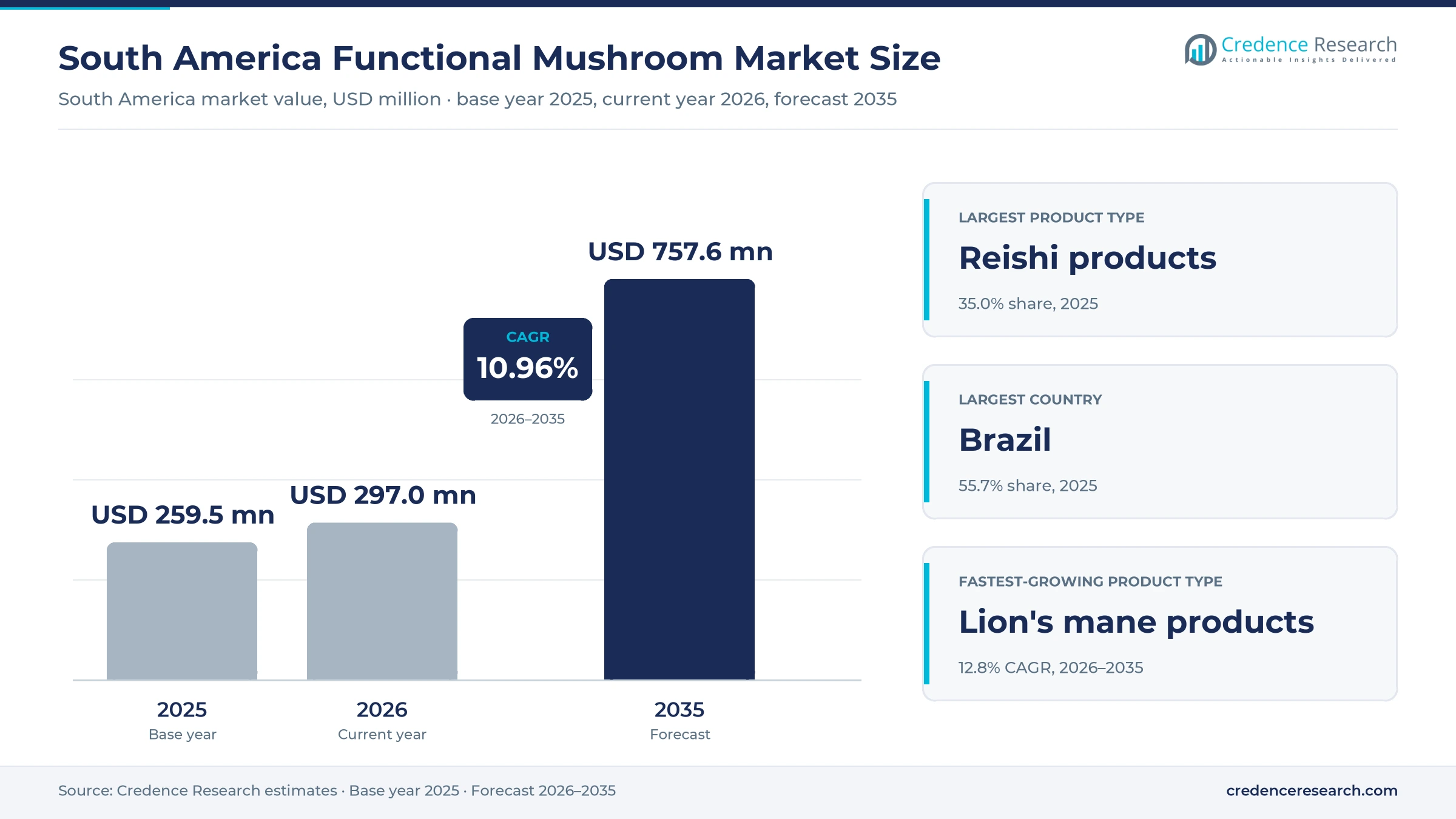
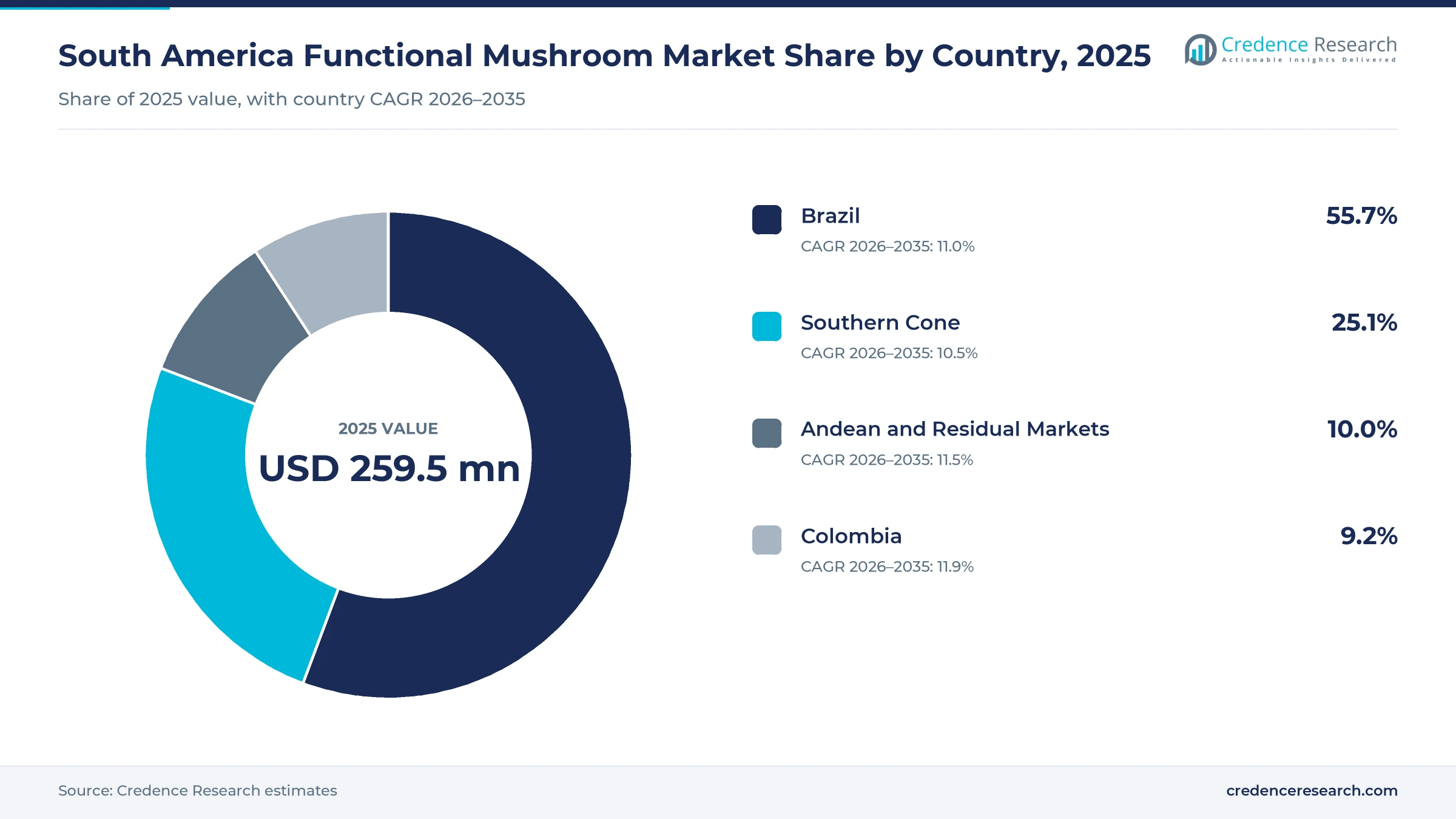
The South America functional mushroom market was valued at USD 259.5 million in 2025 and is projected to increase from USD 297.0 million in 2026 to USD 757.6 million by 2035, registering a CAGR of 10.96% during 2026–2035. Demand rests on capsules, powders and coffee blends built around reishi, Agaricus and lion's mane, sold through direct-selling networks, e-commerce and pharmacies. Brazil held the largest regional share, 55.7% in 2025, because it combines the largest supplement-using population with a long Agaricus growing tradition around Sorocaba and Piedade in São Paulo state. Colombia is the fastest-growing country at 11.8% a year in functional mushroom demand, as registered supplement ranges widen beyond specialist stores. The main commercial change is local manufacturing, with a Malaysian direct seller building plants in Peru, Bolivia and Brazil between 2025 and 2026. Regulation remains the swing factor, because most mushroom species still lack a clear supplement route in Brazil and Argentina.
Which mushroom products buyers in South America pay for
The market counts the value paid by consumers, food and supplement formulators and specialized ingredient buyers for products made from Agaricus, reishi, lion's mane and other medicinal species, including cordyceps, chaga and turkey tail blends. It covers capsules, tablets, powders, liquid extracts, chews and beverage blends, plus extracts sold into pharmaceutical and cosmetic formulations, across Brazil, Colombia, the Southern Cone and the Andean countries.
Fresh and dried culinary mushrooms sold for cooking, psilocybin products and mycelium materials are excluded. The chain runs from growers and Asian extract suppliers through local formulators and contract plants to direct-selling networks, online stores, pharmacies, health shops and food retailers, under national rules set by Anvisa, INVIMA, ANMAT and their regional peers.
South America Functional Mushroom Market Insights
- The South America functional mushroom market rises from USD 259.5 million in 2025 to USD 757.6 million by 2035, a 10.96% CAGR, as local plants and coffee formats widen access.
- Brazil held 55.7% of 2025 value, as the largest supplement-using population and a domestic Agaricus growing base sit in one country.
- Reishi products held 35.0% of 2025 value, because Ganoderma coffee and capsules form the largest direct-selling range in the region.
- DXN broke ground on a plant in Ibiá, Minas Gerais, in September 2026, after starting facilities in Peru in 2025 and Bolivia in 2026.
- Anvisa banned or suspended three mushroom product lines between July 2025 and January 2026, which makes ingredient approval the key competitive asset.
Reishi leads as lion's mane and coffee blends gain fastest
Why reishi products lead while lion's mane grows fastest
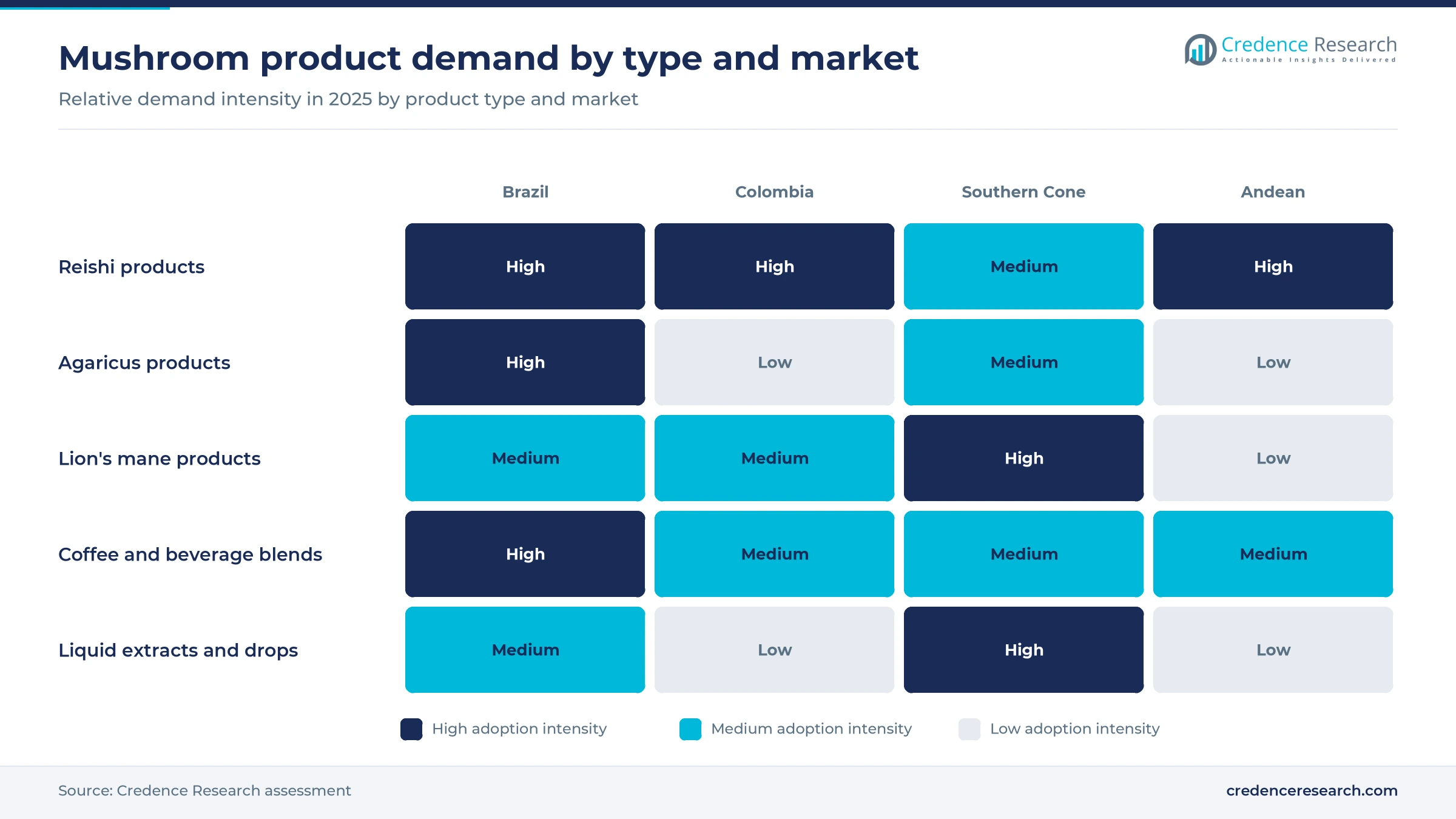
Based on product type, the market is categorized into Agaricus products, reishi products, lion's mane products and complementary species and blends. Reishi Products led with 35.0% of 2025 value because Ganoderma is the base of the largest direct-selling range in the region, and DXN had 10 products already approved for Brazil when it entered the country in February 2024, according to the New Straits Times. Agaricus keeps second place on Brazil's growing tradition in São Paulo state. Lion's Mane Products grow fastest at 12.8% a year as mainstream retailers add the species, with Drogarias Pacheco in Brazil and the Paris.cl store in Chile both listing lion's mane products in November 2026.
Supplements dominate as mushroom coffee pulls food demand
Based on application, the market is categorized into dietary supplements, functional foods and beverages, pharmaceutical-grade inputs and cosmetic and personal care inputs. Dietary Supplements led with 52.0% of 2025 value because capsules and extracts are the registered route to buyers, and INVIMA counted 37 mushroom-based products with valid dietary supplement registrations in June 2023, according to Bloomberg Línea. Functional Foods and Beverages grow fastest at 12.1% a year as coffee buyers trade up, with Brazil's Tudo Gostoso food portal reporting in July 2025 that consumers were swapping regular coffee for blends with reishi, chaga, lion's mane and cordyceps. Cosmetic and personal care inputs remain a small niche served mainly by imported extracts.
Capsules lead as chews and beverage blends gain fastest
Based on form, the market is categorized into powders, capsules and tablets, liquid extracts and chews and beverage blends. Capsules and Tablets led with 38.0% of 2025 value because pharmacy and direct-selling ranges standardize on dosed capsules, such as the 500 mg, 60-count lion's mane pack in the pricing table. Liquid extracts carry real volume, since the maker of the Mushdrops line claimed sales of more than 18,000 units a month, according to Sechat. Chews and Beverage Blends grow fastest at 12.6% a year as brands move mushrooms into everyday foods, after Smush relaunched granolas, spreads and bars at the Naturaltech fair in 2025.
Direct supply leads while online retail grows fastest
Based on distribution channel, the market is categorized into online retail, specialty health retail, pharmacies and food retail and direct business supply. Food Retail and Direct Business Supply led with 34.0% of 2025 value because network-marketing and food-store sales carry the Ganoderma coffee range, and DXN reported 3.6 million users in Latin America since its 2004 entry, according to the New Straits Times. Online Retail grows fastest at 12.1% a year as Brazilian e-commerce reached R$204.3 billion in 2024, up 10.5%, with 91.3 million buyers, according to the Brazilian Electronic Commerce Association.
| Segment Group | Leading Sub-segment | Share, 2025 | Fastest-growing Sub-segment | CAGR, 2026–2035 |
|---|---|---|---|---|
| By Product Type | Reishi Products | 35.0% | Lion's Mane Products | 12.8% |
| By Application | Dietary Supplements | 52.0% | Functional Foods and Beverages | 12.1% |
| By Form | Capsules and Tablets | 38.0% | Chews and Beverage Blends | 12.6% |
| By Distribution Channel | Food Retail and Direct Business Supply | 34.0% | Online Retail | 12.1% |
Retail packs sell at a steep premium to bulk extract
Prices are set per pack at retail and per kilogram of extract in business supply, and the gap between them is where brand margins sit. A 60-capsule, 500 mg lion's mane pack holds 30 grams of extract, worth less than USD 2 at USD 20 to 60 per kilogram, yet it retails at R$162.71, so formulation, registration and shelf costs, not raw material, set the price. Exchange rates move the floor, because most extract arrives from Asia priced in dollars. Registration costs and shelf fees lift the price of pharmacy ranges, while direct sellers spread those costs across large catalogs. Buyers therefore pay most for dosed capsules and drops, and least for coffee sachets that dilute the mushroom content.
| Product and market | Typical price or fee | Basis |
|---|---|---|
| Lion's mane capsules, 500 mg, 60 count, Brazil | R$162.71 per pack | Drogarias Pacheco online listing, November 2026 |
| Lion's mane sublingual drops, two 30 ml bottles, Chile | CLP 32,990 per pack | Paris.cl listing for New Pharma, November 2026 |
| Mushroom coffee sachet box, 20 to 30 servings, Brazil | R$80 to 150 per box | Credence Research estimate from online retail listings |
| Imported mushroom extract powder for formulators | USD 20 to 60 per kg | Credence Research estimate from Asian ingredient export listings |
Request a Free Sample
Fill in your details and we'll send you a free sample report.
- Sample data tables & charts
- Research methodology
Supplement habits and local plants widen mushroom demand
Supplement habits widen the shelf for mushroom formats
Mushroom products ride on a supplement habit that is already mainstream in the two largest markets. ABIAD, the Brazilian association for special-purpose foods, found in 2020 that 59% of Brazilian homes had at least one supplement user. The association also reported that the sector grew 2.4% in 2024 and added more than 4,300 jobs, which shows makers adding capacity at home. In Colombia, 66% of people had used a supplement in the previous six months, according to the pharmaceutical chamber of ANDI. Because buyers already purchase dietary supplements in capsule and powder form, a mushroom formulation needs shelf space and a credible claim rather than a new habit.
Plants in Brazil, Peru and Bolivia localize supply
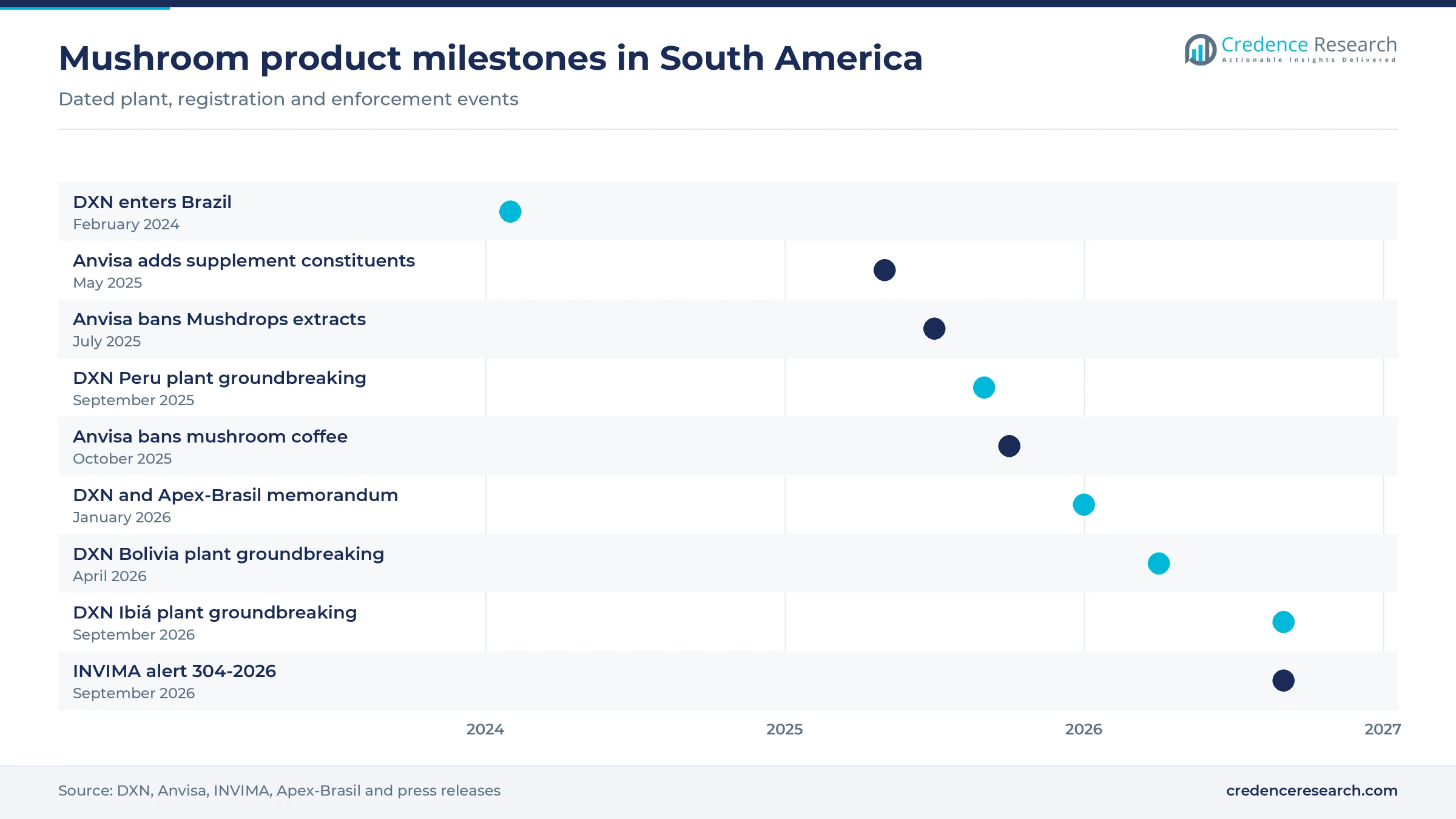
Manufacturing is moving into the region, which lowers landed cost and shortens the path from registration to shelf. DXN broke ground in Ibiá, Minas Gerais, in September 2026 on what it expects to be its largest plant in Latin America, with at least 100 million reais to be invested over five years. The company had already broken ground in Peru in September 2025 and in Bolivia in April 2026, and it runs two plants in Mexico. In January 2026 it signed a memorandum with Apex-Brasil in Brasília, which agreed to support the registration of Ganoderma-based products. Local plants let suppliers adapt coffee and capsule formats to each country and hold less imported stock, which strengthens Reishi Products in the near term.
Domestic specialist brands build local product ranges
A new group of domestic specialist brands is turning imported mushroom powders into products made for local tastes. Smush, founded in September 2022, imports six species from Asia as powder and has partner plants make its coffee capsules, granolas, spreads, bars and drops, according to NeoFeed in June 2025. The company raised R$3 million after a R$1 million seed round and filed with Anvisa to register the six species as supplement ingredients. In Argentina, Fungalia makes powdered mushroom drinks in cacao, chai, golden milk and matcha flavors under ANMAT authorization, according to Forbes Argentina in June 2026. These brands reach younger buyers who would not join a direct-selling network.
A growing farm base adds local mushroom biomass
Domestic cultivation is expanding, which gives formulators a nearer source of fruiting bodies for whole-biomass powders. Paraná produced 982 metric tons of mushrooms in 2024, 106% more than in 2014, according to the state rural economics department. About 80% of Brazilian producers are micro or small family farms, according to the national producers' agency cited by the Paraná government, so supply is spread across many growers. In Buenos Aires, The Mushroom raised output from 200 kg to 1,000 kg a month after its December 2023 start, with lion's mane among its species, according to Forbes Argentina. A larger local base matters most for Agaricus products and blends, which can use regional biomass rather than imported extract.
Coffee formats and tighter enforcement reshape the category
Coffee blends shift mushrooms into the daily cup
Coffee is emerging as the main entry point for mushroom ingredients in a region that drinks it every day. DXN said in February 2024 that its flagship instant coffee fits Brazil's coffee culture, and its range blends Ganoderma into ready sachets. Its second Mexican plant, 2.8 times larger than the first, makes beverages, supplements and coffee products. Smush made Mushroom Espresso capsules its first and flagship product, according to NeoFeed. Coffee blends sit next to other adaptogen formulations in online stores, which lets brands price above regular coffee without a pharmacy listing, and Tudo Gostoso reported the swap from regular coffee in July 2025. This shift supports Chews and Beverage Blends, which grow at 12.6% a year, because each sachet or capsule repeats daily and builds loyal buyers faster than a monthly capsule pack.
Regulators shift from warnings to product bans
Enforcement is rising across the two largest regulated markets, and it now removes products from sale rather than only issuing warnings. In Brazil, Anvisa banned five Mushdrops extracts by Mush Mush Club in July 2025, a mushroom coffee in October 2025 and the sale of Smush products in January 2026, according to Bahia Notícias, IstoÉ Dinheiro and Viva. In Colombia, INVIMA issued alert 304-2026 on Sept. 18, 2026 against unregistered lion's mane, reishi and turkey tail capsules sold online, after a similar alert in October 2023. Each of these actions pushes buyers toward registered brands, pharmacies and supermarket ranges. This rising enforcement favors suppliers that already hold approvals and penalizes sellers that rely on social media and imported stock.
Ingredient approvals can open the regulated supplement channel
A formal route for mushroom ingredients in Brazil would move a large gray-market volume into pharmacies and supermarkets. Anvisa shows it adds constituents when dossiers arrive, as Normative Instruction 361 of May 15, 2025, added two bioactive substances to the approved supplement list with a 24-month adjustment period, according to ChemLinked. Smush has a dossier for six species before Anvisa, and Apex-Brasil has agreed to help DXN register Ganoderma products, as noted above. Suppliers that fund safety data for reishi, lion's mane or Agaricus extracts could win a listed position that competitors must wait years to match. Dietary Supplements would gain the most from such a listing, since pharmacies stock only registered ranges.
Higher incomes in Chile and Argentina reward premium ranges
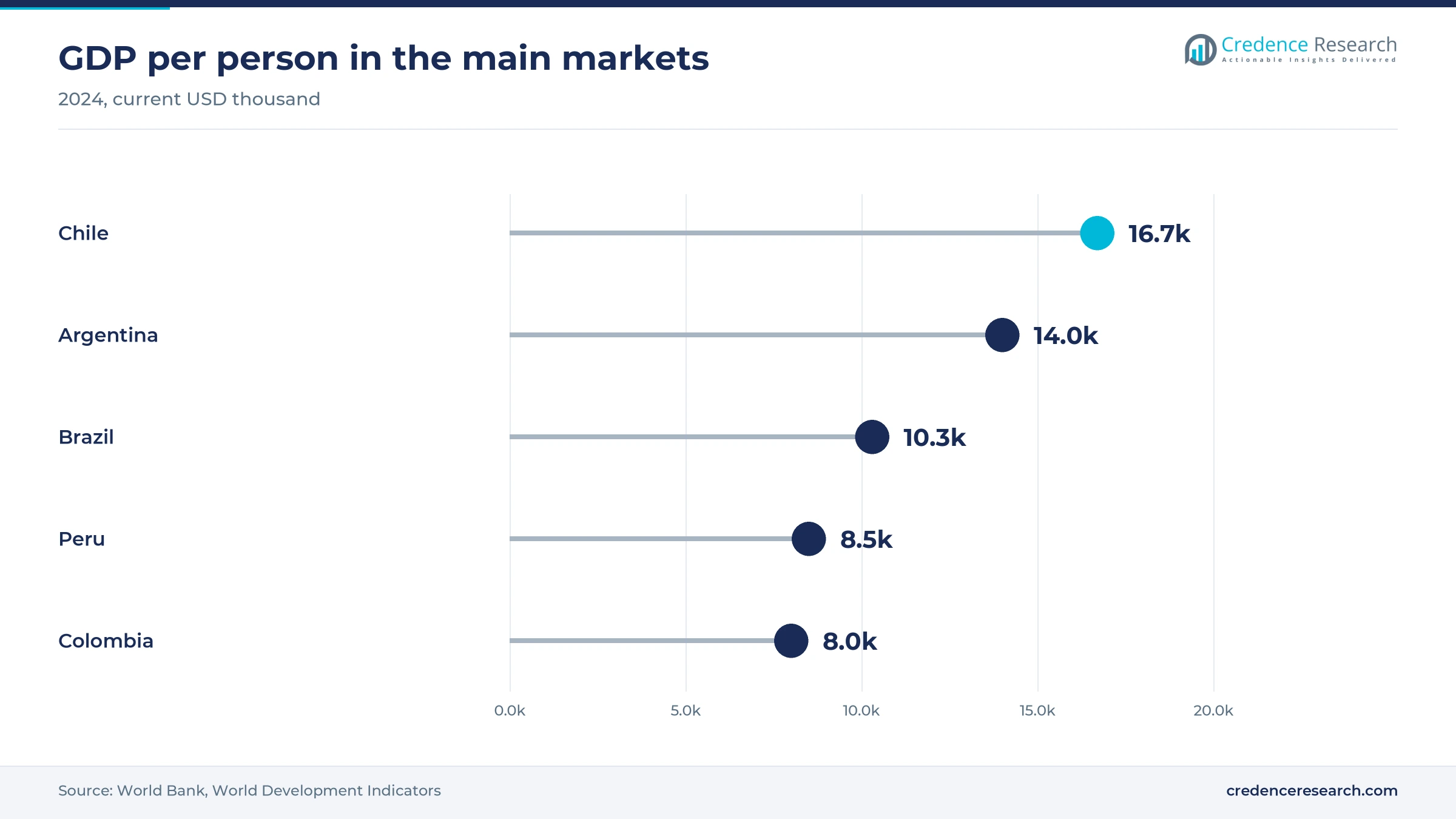
The Southern Cone offers the highest spending power per person in the region, which suits premium drops and extracts. World Bank data put 2024 GDP per person at USD 16,659 in Chile and USD 13,970 in Argentina, against USD 10,311 in Brazil and USD 7,951 in Colombia. DXN said in 2024 that it aims to enter Argentina and Chile after Brazil, according to the Malaysian Investment Development Authority. Chilean retail already lists New Pharma lion's mane drops through Paris.cl, so premium formats have shelf access. Brands that pair imported extracts with local registration can earn higher prices per pack in Santiago and Buenos Aires than in Bogotá or Lima.
Ingredient lists, imports and low intake hold growth back
Brazil's approved list leaves most species outside
Most medicinal mushroom species are not on Anvisa's list of approved supplement constituents under Normative Instruction 28 of 2018. When Anvisa banned a mushroom coffee in October 2025, it said the Agaricus bisporus extract had no safety assessment for use in food, according to IstoÉ Dinheiro. Brands therefore sell as conventional foods with weak claims or risk seizure, which caps pharmacy listings.
Argentina's food code restricts reishi and lion's mane
Argentina's food code admits mushrooms mainly as foods, which limits supplement formats. Joint Resolution 3 of March 14, 2023 added Article 1249 bis to the Código Alimentario Argentino. It lists lion's mane (Hericium erinaceus) among species to be eaten raw or cooked as a food, so capsules and drops have no ready supplement route. Suppliers must file with CONAL for new uses, which slows launches of capsules and drops in Argentina.
Imported strains and extracts raise currency exposure
The region relies on Asian strains and extracts, so local prices move with exchange rates and freight. Foreign strains make up 80% to 90% of Colombian mushroom cultivation, according to Bloomberg Línea in June 2023. Brazilian brands such as Smush import their species as powder, as noted above. A weaker real or peso lifts landed cost within weeks, and small brands cannot hedge, which squeezes margins or pushes retail prices higher.
Low mushroom intake leaves a small habit to build on
Mushroom consumption is low across the region, which means most buyers meet the species for the first time as a supplement. Argentines eat about 30 grams of mushrooms a person each year, against 3 to 9 kg in Europe and Asia, according to Forbes Argentina in June 2026. Suppliers must therefore pay to educate buyers, and claims rules limit what they can say. Coffee and food formats help bridge that gap because buyers already know the base product.
Brazil leads while Colombia grows fastest in the region
| Country | Value, 2025 (USD million) | Share, 2025 | CAGR, 2026–2035 |
|---|---|---|---|
| Brazil | 144.5 | 55.7% | 10.9% |
| Southern Cone | 65.1 | 25.1% | 10.4% |
| Andean and Residual Markets | 25.9 | 10.0% | 11.4% |
| Colombia | 23.9 | 9.2% | 11.8% |
Brazil leads on population and Agaricus heritage
Brazil held a 55.7% share of 2025 value and grows at 10.9% a year. Its 212.0 million people in 2024, according to World Bank data, form the largest supplement-buying base in the region, and commercial Agaricus growing has long been concentrated around Sorocaba and Piedade, according to Pesquisa FAPESP. New manufacturing in Minas Gerais and the e-commerce growth noted above support the country's lead. Growth is held near the regional rate because ingredient approval at Anvisa still limits pharmacy ranges.
Southern Cone buyers pay the highest prices per pack
The Southern Cone held a 25.1% share of 2025 value and grows at 10.4% a year, the slowest pace of the four markets. Argentina had 45.7 million people, Chile 19.8 million and Uruguay 3.4 million in 2024, according to the World Bank. Income per person is the highest in the region, but Argentina's food code admits lion's mane only as a food, which limits supplement formats. Chile carries the premium drops and extracts, so value per buyer stays high even where volumes are small.
Colombia grows fastest as registered ranges widen
Colombia held a 9.2% share of 2025 value and is the fastest-growing country at 11.8% a year. Cultivation is concentrated in Antioquia, Cundinamarca and Valle del Cauca, according to Bloomberg Línea, so domestic growers sit close to the Medellín and Bogotá buyers. Its 52.9 million people in 2024 and a high supplement-use rate give registered brands room to grow. INVIMA enforcement, described above, moves sales from informal online sellers to registered products, so recorded value rises faster than in Brazil.
Andean and residual markets rest on direct selling
Andean and residual markets held a 10.0% share of 2025 value and grow at 11.4% a year. Peru had 34.2 million people, Ecuador 18.1 million and Bolivia 12.4 million in 2024, according to the World Bank. DXN told the Peruvian foreign ministry in February 2023 that a second stage of its Peru plan would add Ganoderma cultivation in the country. Agraria reported in November 2025 that Peruvian mushroom shipments grew 10.9% and reached 12 countries, so local biomass supply is also developing.
Plants, registrations and bans mark 2024 to 2026
| Development | Status and market relevance |
|---|---|
| In February 2024, DXN entered Brazil with 10 products already approved for sale and plans for a second branch office. | Completed; extends Ganoderma coffee and capsules to Brazil |
| In July 2025, Anvisa banned the manufacture, sale and advertising of five Mushdrops mushroom extracts marketed as superfoods. | Enforced; tightens oversight of liquid extracts |
| In September 2025, DXN broke ground on its manufacturing facility in Peru, followed by a Bolivia plant in April 2026. | Under construction; localizes Andean supply |
| In January 2026, DXN signed a memorandum with Apex-Brasil in Brasília covering potential investment of about USD 50 million. | Signed; includes support for Ganoderma product registration |
| In September 2026, DXN broke ground in Ibiá, Minas Gerais, on its planned largest manufacturing site in Latin America. | Construction started; at least 100 million reais over five years |
Extraction method decides potency claims and price
- Whole-biomass processing dries and mills fruiting bodies or mycelium into powders, the cheapest route and the one best suited to Brazilian Agaricus.
- Aqueous extraction uses hot water to concentrate beta-glucans, the basis of most reishi and Agaricus capsules and of Ganoderma extracts blended into coffee.
- Dual and advanced extraction adds an alcohol step to recover triterpenes and other non-soluble compounds, the basis of tinctures and sublingual drops.
- Jun-Cao cultivation grows mushrooms on grass substrates and was adapted for Brazil by Embrapa in 1995, which lowers the cost of local biomass.
Need a Custom Version of This Report?
Tailor the scope, geography, or segments to your exact requirements.
- Custom geography or segment scope
- Direct access to our analyst team
One direct seller faces a field of small specialists
Competition in South America separates into a direct-selling arena and a specialist arena. DXN Holdings Berhad leads the first with Ganoderma coffee, capsules and drinks sold through member networks in Peru, Bolivia, Colombia and Brazil, and it is now adding local plants to cut lead times. The specialist arena is fragmented among small brands with narrow ranges. In Brazil, Smush sells coffee capsules and foods, Fungalia makes powdered drinks in Argentina and New Pharma sells lion's mane drops in Chile. Pharmacy brands compete on registered capsule ranges and price per dose. Regulatory standing decides much of the contest, since a single Anvisa or INVIMA action can remove a brand from sale. Buyers reward clear labeling, verified extraction ratios and a local registration number more than species novelty.
How the supply side of the region is organized
The supply side is split between one vertically integrated direct seller and many small brands that buy extract from Asia. The direct seller runs two plants in Mexico and is building plants in Peru, Bolivia and Brazil, so it controls cost from formulation to sachet. Small brands rely on importers and contract manufacturing partners, which keeps entry cheap but leaves them exposed to registration risk. Product approvals are the main barrier, and margins sit with brand owners and networks rather than growers or extract traders.
Companies profiled and their roles in this market
| Company | Type | Role in the market |
|---|---|---|
| DXN Holdings Berhad | Direct seller | Ganoderma coffee and capsules; plants under way in Peru, Bolivia and Ibiá, Brazil |
| NewPharma | Specialist brand | Lion's mane sublingual drops listed on Paris.cl in Chile |
| Smush | Foodtech brand | Mushroom coffee capsules and foods; sale suspended by Anvisa in January 2026, ingredient dossier for six species pending |
| Fungalia | Beverage brand | Powdered mushroom drinks made under ANMAT authorization in Argentina |
Registration, not demand, sets the pace of growth
Credence Research's view is that registration, not consumer interest, sets the pace of the South America functional mushroom market. Demand is already broad, with supplement use reaching most households in Brazil and Colombia, yet the products that buyers want often sit outside approved ingredient lists. The direct seller building plants in Peru, Bolivia and Brazil is best placed, because it already holds registrations and controls supply. Specialist brands can win if they invest in safety dossiers rather than social media alone. Lion's mane products, growing at 12.8% a year, are where an early approval would pay off most.
Regulator records and trade data anchor the estimates
The report uses 2025 as the base year and forecasts value to 2035 in USD million from the Credence Research market model. Segment and country splits are Credence Research estimates built from regulator records and alerts from Anvisa and INVIMA, World Bank population and income data, Paraná state production statistics, trade association data from ABIAD, ANDI and the Brazilian Electronic Commerce Association, retail price listings and company releases. No interviews or surveys were used for this edition of the report.
Local plants and approved ingredients carry growth to 2035
The South America functional mushroom market reaches USD 757.6 million by 2035, growing at 10.96% a year from USD 297.0 million in 2026. Reishi products keep the largest share as Ganoderma coffee and capsules gain from local plants, while lion's mane products grow fastest on pharmacy and online listings. Brazil stays the largest country, and Colombia gains share as registered ranges replace informal sellers. An Anvisa decision on mushroom ingredients is the single event most likely to move the forecast, while currency swings remain the main cost risk for importers.
Ingredient approvals decide the range to 2035
The spread between cases depends mostly on regulators rather than on consumers. If Anvisa keeps most species off the approved list and enforcement keeps removing products, growth stays in direct selling and coffee formats, which gives the downside. Approval of reishi, Agaricus or lion's mane extracts in Brazil, together with the new regional plants running on time, would open pharmacies and supermarkets and produce the upside.
| Scenario | CAGR, 2026–2035 | Value, 2035 | What has to hold |
|---|---|---|---|
| Downside | 9.0% | USD 642.9 million | Anvisa approves no mushroom species and bans continue to remove brands from sale |
| Base | 10.96% | USD 757.6 million | Regional plants start on schedule and approvals arrive slowly for one or two species |
| Upside | 12.8% | USD 875.3 million | Brazil lists reishi and lion's mane extracts and pharmacies add full ranges |
Frequently Asked Questions
How big is the South America functional mushroom market?
Which product type leads the market?
Which product type grows fastest?
Which country leads demand in South America?
Which country grows fastest?
How does regulation affect mushroom products in Brazil?
What are the main challenges for suppliers?
Who are the key companies in the market?
Table of Content
Chapter 1 Market Segmentation
- 1.1 Segmentation Framework
- 1.1.1 Product and Service Classification
- 1.1.2 Application and End-Use Classification
- 1.1.3 Technology and Solution Classification
- 1.1.4 Customer and Distribution Channel Classification
- 1.1.5 Geographic Segmentation
- 1.1.6 Market Segment Definitions and Boundaries
- 1.2 By Product Type
- 1.2.1 Agaricus Products
- 1.2.2 Reishi Products
- 1.2.3 Lion's Mane Products
- 1.2.4 Complementary Species and Blends
- 1.3 By Application
- 1.3.1 Dietary Supplements
- 1.3.2 Functional Foods and Beverages
- 1.3.3 Pharmaceutical-Grade Inputs
- 1.3.4 Cosmetic and Personal Care Inputs
- 1.4 By Form
- 1.4.1 Powders
- 1.4.2 Capsules and Tablets
- 1.4.3 Liquid Extracts
- 1.4.4 Chews and Beverage Blends
- 1.5 By Country
- 1.5.1 Brazil
- 1.5.2 Colombia
- 1.5.3 Southern Cone
- 1.5.4 Andean and Residual Markets
Chapter 2 Introduction
- 2.1 Report Objectives and Scope
- 2.2 Product Definition and Industry Terminology
- 2.3 Market Inclusions and Exclusions
- 2.4 Research Process
- 2.4.1 Primary Research and Expert Interviews
- 2.4.2 Secondary Research and Source Review
- 2.4.3 Top-Down and Bottom-Up Estimation
- 2.4.4 Data Triangulation and Verification
- 2.5 Market Size Measurement Basis
- 2.5.1 2025: USD 259.5 million → 2035: USD 757.6 million
- 2.6 Historical and Forecast Reference Periods
- 2.6.1 Historical Period: 2018-2025
- 2.6.2 Base Year: 2025
- 2.6.3 Forecast Period: 2025-2035
- 2.7 Research Assumptions and Limitations
Chapter 3 Executive Summary
- 3.1 Market Snapshot and Key Findings
- 3.2 Base-Year Market Size, 2025
- 3.3 Forecast Market Size, 2035
- 3.4 Revenue and Volume Growth Outlook
- 3.5 Key Demand and Supply Indicators
- 3.6 Leading Market Segments
- 3.7 Fastest-Growing Market Opportunities
- 3.8 Regional Performance Highlights
- 3.9 Technology and Industry Transformation
- 3.10 Competitive Landscape Summary
- 3.11 Analyst View and Strategic Implications
Chapter 4 South America Functional Mushroom Market Trends and Developments
- 4.1 Historical Industry Development, 2018-2025
- 4.2 Recent Market Trends and Developments
- 4.3 Demand and Customer Behavior Trends
- 4.4 Technology and Product Innovation
- 4.5 Artificial Intelligence, Automation and Digitalization
- 4.6 Local Manufacturing and Supply Chain Realignment
- 4.7 Industry Partnerships, Mergers and Acquisitions
- 4.8 Sustainability and Circular Economy Developments
- 4.9 Government and Private Sector Investment Trends
- 4.10 Emerging Business Models and Commercialization
- 4.11 Industry Developments and Announcements
Chapter 5 South America Functional Mushroom Market Production, Supply and Demand Analysis
- 5.1 Demand Trend and Consumption Analysis, 2018-2025
- 5.2 Demand Forecast, 2025-2035
- 5.3 Production and Output Trend, 2018-2025
- 5.4 Production and Output Forecast, 2025-2035
- 5.5 Installed Capacity and Capacity Utilization
- 5.6 Company-Wise Production Plants and Statistics
- 5.6.1 Installed Production Capacity
- 5.6.2 Actual Production
- 5.6.3 Planned Capacity and Expansion Targets
- 5.7 Supply Chain Structure and Procurement Trends
- 5.8 Supply-Demand Gap and Bottlenecks
- 5.9 Import Dependence and Sourcing Structure
- 5.10 Contract Manufacturing and Outsourcing
- 5.11 Regional Supply and Demand Concentration
Chapter 6 South America Functional Mushroom Market Pricing Analysis
- 6.1 Pricing Structure and Measurement
- 6.2 Historical Pricing Trends, 2018-2025
- 6.3 Pricing Outlook, 2025-2035
- 6.4 Average Selling Price and Unit Economics
- 6.5 Pricing by Product and Market Segment
- 6.6 Geographic Pricing Differences
- 6.7 Key Input, Energy, Labor and Logistics Costs
- 6.8 Contract Pricing and Purchasing Models
- 6.9 Pricing Sensitivity and Competitive Positioning
- 6.10 Price, Margin and Profitability Implications
Chapter 7 South America Functional Mushroom Market Dynamics
- 7.1 Market Growth Drivers
- 7.1.1 Demand-Side Drivers
- 7.1.2 Technology and Innovation Drivers
- 7.1.3 Infrastructure and Investment Drivers
- 7.1.4 Regulatory and Policy Drivers
- 7.2 Market Restraints
- 7.2.1 Cost and Affordability Constraints
- 7.2.2 Technology and Adoption Barriers
- 7.2.3 Supply Chain and Operational Constraints
- 7.3 Market Challenges
- 7.3.1 Competitive Pressure and Margin Erosion
- 7.3.2 Skills, Infrastructure and Implementation Gaps
- 7.4 Emerging Market Opportunities
- 7.5 Market Dynamics Impact and Time-Horizon Assessment
Chapter 8 South America Functional Mushroom Value Chain Analysis
- 8.1 Industry Value Chain Overview
- 8.2 Upstream Suppliers and Critical Inputs
- 8.3 Technology and Component Providers
- 8.4 Manufacturing or Service Delivery
- 8.5 Distribution, Channel Partners and Integrators
- 8.6 Downstream Applications and End Users
- 8.7 Value Addition and Profit Pools
- 8.8 Vertical Integration and Outsourcing
- 8.9 Supplier Concentration and Risk
- 8.10 Supply Chain Localization and Resilience
Chapter 9 South America Functional Mushroom Market Regulations and Policies
- 9.1 Relevant Laws, Standards and Compliance Frameworks
- 9.2 Product, Service, Safety and Quality Requirements
- 9.3 Government Policies, Incentives and Subsidies
- 9.4 Imports, Exports and Trade Barriers
- 9.5 Public Procurement and Local Content Requirements
- 9.6 Environmental and Sustainability Compliance
- 9.7 Upcoming Policy Changes and Market Implications
Chapter 10 South America Functional Mushroom Market Hotspots and Opportunities
- 10.1 Market Opportunity Mapping and Growth Hotspots
- 10.2 High-Growth Applications and Customer Groups
- 10.3 Underserved Markets and White-Space Opportunities
- 10.4 Emerging Technology and Product Opportunities
- 10.5 New Capacity and Investment Hotspots
- 10.6 Market Entry and Expansion Opportunities
- 10.7 Distribution and Partnership Opportunities
- 10.8 Near-Term and Long-Term Commercial Potential
- 10.9 Opportunity Attractiveness and Execution Risks
Chapter 11 South America Functional Mushroom Market Outlook, 2025-2035
- 11.1 Market Size and Analysis
- 11.1.1 Revenue (Market Measurement: 2025: USD 259.5 million → 2035: USD 757.6 million)
- 11.1.2 Market Volume and Quantity Sold
- 11.1.3 Historical Market Size, 2018-2025
- 11.1.4 Base-Year Market Size, 2025
- 11.2 Market Forecast, 2025-2035
- 11.2.1 Revenue Forecast to 2035
- 11.2.2 Volume Forecast to 2035
- 11.2.3 CAGR and Year-on-Year Growth
- 11.2.4 Incremental Revenue Opportunity
- 11.3 Forecast Assumptions and Scenario Analysis
- 11.3.1 Base-Case Forecast
- 11.3.2 Optimistic and Conservative Scenarios
- 11.3.3 Technology, Pricing and Policy Sensitivities
- 11.4 Market Attractiveness and Growth Outlook
Chapter 12 South America Functional Mushroom Market Segmentation and Outlook
- 12.1 Segmentation Summary and Market Shares, 2025
- 12.2 Largest and Fastest-Growing Segments
- 12.3 By Product Type - Market Size and Forecast, 2025-2035
- 12.3.1 Segment Definition and Scope
- 12.3.2 Historical Market Size, 2018-2025
- 12.3.3 Revenue Forecast, 2025-2035
- 12.3.4 Volume Forecast, 2025-2035
- 12.3.5 Base-Year Market Share, 2025
- 12.3.6 Segment CAGR and Growth Drivers
- 12.3.7 Subsegment Market Size and Forecast
- 12.3.7.1 Agaricus Products
- 12.3.7.2 Reishi Products
- 12.3.7.3 Lion's Mane Products
- 12.3.7.4 Complementary Species and Blends
- 12.3.8 Subsegment Pricing and Adoption Trends
- 12.3.9 Leading Suppliers and Competition
- 12.3.10 Regional Demand and Opportunities
- 12.4 By Application - Market Size and Forecast, 2025-2035
- 12.4.1 Segment Definition and Scope
- 12.4.2 Historical Market Size, 2018-2025
- 12.4.3 Revenue Forecast, 2025-2035
- 12.4.4 Volume Forecast, 2025-2035
- 12.4.5 Base-Year Market Share, 2025
- 12.4.6 Segment CAGR and Growth Drivers
- 12.4.7 Subsegment Market Size and Forecast
- 12.4.7.1 Dietary Supplements
- 12.4.7.2 Functional Foods and Beverages
- 12.4.7.3 Pharmaceutical-Grade Inputs
- 12.4.7.4 Cosmetic and Personal Care Inputs
- 12.4.8 Subsegment Pricing and Adoption Trends
- 12.4.9 Leading Suppliers and Competition
- 12.4.10 Regional Demand and Opportunities
- 12.5 By Form - Market Size and Forecast, 2025-2035
- 12.5.1 Segment Definition and Scope
- 12.5.2 Historical Market Size, 2018-2025
- 12.5.3 Revenue Forecast, 2025-2035
- 12.5.4 Volume Forecast, 2025-2035
- 12.5.5 Base-Year Market Share, 2025
- 12.5.6 Segment CAGR and Growth Drivers
- 12.5.7 Subsegment Market Size and Forecast
- 12.5.7.1 Powders
- 12.5.7.2 Capsules and Tablets
- 12.5.7.3 Liquid Extracts
- 12.5.7.4 Chews and Beverage Blends
- 12.5.8 Subsegment Pricing and Adoption Trends
- 12.5.9 Leading Suppliers and Competition
- 12.5.10 Regional Demand and Opportunities
- 12.6 By Country - Market Size and Forecast, 2025-2035
- 12.6.1 Segment Definition and Scope
- 12.6.2 Historical Market Size, 2018-2025
- 12.6.3 Revenue Forecast, 2025-2035
- 12.6.4 Volume Forecast, 2025-2035
- 12.6.5 Base-Year Market Share, 2025
- 12.6.6 Segment CAGR and Growth Drivers
- 12.6.7 Subsegment Market Size and Forecast
- 12.6.7.1 Brazil
- 12.6.7.2 Colombia
- 12.6.7.3 Southern Cone
- 12.6.7.4 Andean and Residual Markets
- 12.6.8 Subsegment Pricing and Adoption Trends
- 12.6.9 Leading Suppliers and Competition
- 12.6.10 Regional Demand and Opportunities
- 12.7 Segment Growth Comparison
- 12.8 Segment Attractiveness and Priority Matrix
Chapter 13 South America Functional Mushroom End-Use and Application Market Outlook
- 13.1 End-Use Industry and Customer Demand Structure
- 13.2 Leading Applications and Customer Groups
- 13.3 End-Use Market Size, Share and Forecast
- 13.4 Major End-Use Industry Deep Dives
- 13.4.1 Customer Requirements and Use Cases
- 13.4.2 Demand and Replacement Cycles
- 13.4.3 Technical and Regulatory Considerations
- 13.4.4 Purchasing and Procurement Models
- 13.4.5 Leading Vendors and Distribution Channels
- 13.4.6 Forecast and Commercial Opportunities
- 13.5 Emerging Applications and Cross-Segment Demand
- 13.6 End-Use Industry Investment Priorities
Chapter 14 South America Functional Mushroom Geographic Market Outlook, 2025-2035
- 14.1 Regional Market Size and Country-Level Shares, 2025
- 14.2 Country Market Size Comparison, 2025
- 14.3 Country Market Forecasts, 2025-2035
- 14.4 Subregional Industrial and Demand Clusters
- 14.5 Intra-Regional Pricing and Cost Differences
- 14.6 Cross-Border Trade and Supply Networks
- 14.7 Regional Supply and Demand Balances
- 14.8 Country Opportunity Comparison and Prioritization
Note: Every listed country is covered on the structure shown under the first country.
Chapter 15 South America Functional Mushroom Technology, Innovation and Sustainability Outlook
- 15.1 Technology Landscape and Maturity
- 15.2 Product, Process and Service Innovation
- 15.3 AI, Automation and Digital Tools in the Industry
- 15.4 Technology Adoption and Performance Benchmarking
- 15.5 Innovation Pipeline and R&D Investment
- 15.6 Patent and Intellectual Property Trends
- 15.7 Energy Efficiency and Resource Management
- 15.8 Sustainability, Recycling and Circularity
- 15.9 Technology Roadmap, 2025-2035
- 15.10 Risks of Obsolescence and Technology Substitution
Chapter 16 South America Functional Mushroom Market Key Strategic Imperatives
- 16.1 Growth and Market Entry Priorities
- 16.2 High-Return Products and Segments
- 16.3 Pricing, Profitability and Cost Optimization
- 16.4 Technology Investment and Product Differentiation
- 16.5 Supply Chain Localization and Resilience
- 16.6 Distribution and Customer Acquisition
- 16.7 Partnership, Acquisition and Capacity Strategy
- 16.8 Regional Expansion Priorities
- 16.9 Short-, Medium- and Long-Term Actions
Chapter 17 Competition Outlook
- 17.1 Industry Competition Characteristics
- 17.2 Market Structure and Concentration
- 17.3 Market Share and Competitive Positioning, 2025
- 17.4 Company-Wise Revenue and Product Benchmarking
- 17.5 Production and Service Capacity Benchmarking
- 17.6 Technology, Pricing and Differentiation
- 17.7 Regional Footprint and Distribution Strength
- 17.8 Mergers, Acquisitions and Strategic Alliances
- 17.9 New Entrants and Competitive Threats
- 17.10 Porter's Five Forces and Industry Attractiveness
- 17.11 Competitive Outlook, 2025-2035
Chapter 18 Company Profiles
- 18.1 Company Coverage and Selection Criteria
- 18.2 DXN Holdings Berhad
- 18.2.1 Business Description
- 18.2.2 Company Ownership and Geographic Presence
- 18.2.3 Product and Service Portfolio
- 18.2.4 Manufacturing and Operating Footprint
- 18.2.5 Production Capacity and Expansion Plans
- 18.2.6 Financial Performance and Investment
- 18.2.7 Market Share and Competitive Position
- 18.2.8 Technology and Innovation Capabilities
- 18.2.9 Strategic Alliances or Partnerships
- 18.2.10 Recent Developments
- 18.2.11 Growth Strategy and Outlook
- 18.3 NewPharma
- 18.4 Smush
- 18.5 Fungalia
- 18.6 Other Relevant Market Participants
Note: Every listed company is profiled on the structure shown under the first company. The company list is preliminary and may change based on research findings, market developments, data availability and client requirements.
Chapter 19 Disclaimer
- 19.1 Research and Forecast Disclaimer
- 19.2 Data Source and Estimation Limitations
Note: The depth of individual sections depends on data availability for this market. Volume, capacity, trade and other unit-based metrics are included where applicable.