
Market Overview:
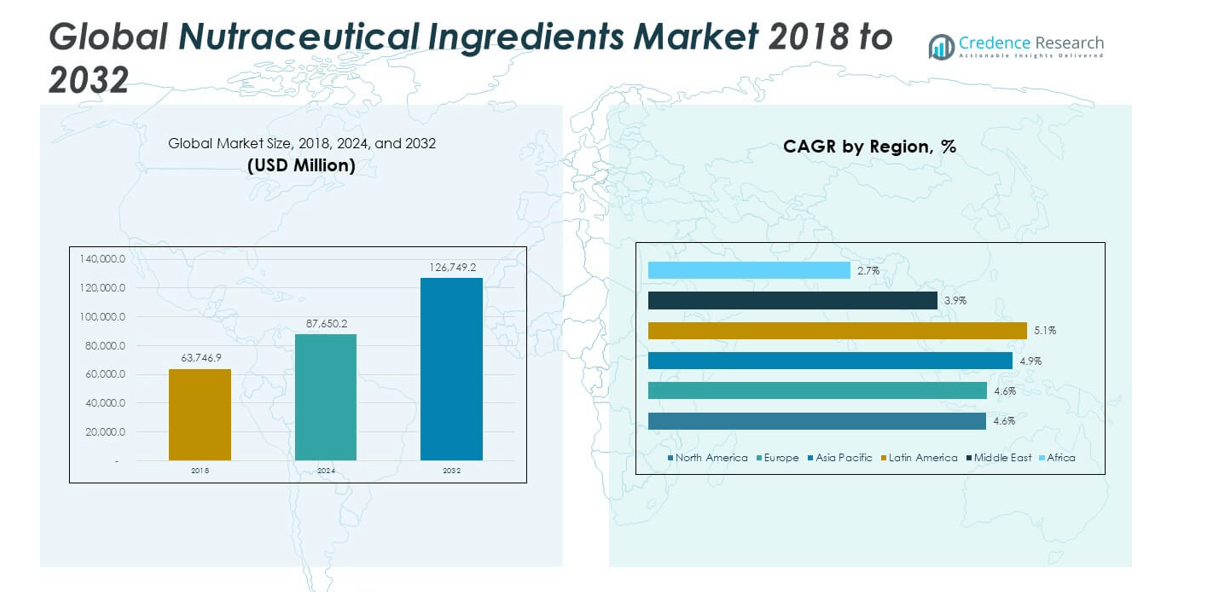
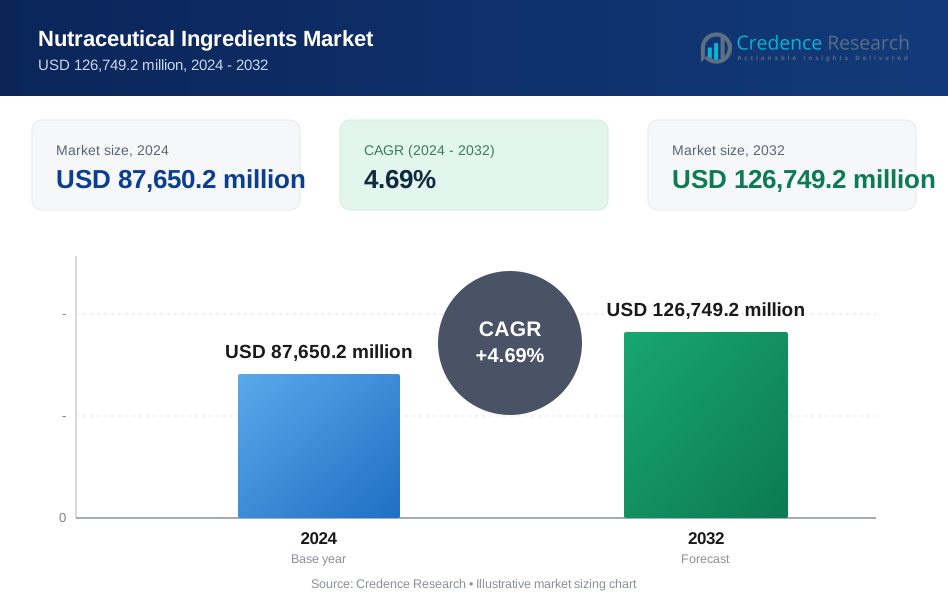
The Global Nutraceutical Ingredients Market size was valued at USD 63,746.9 million in 2018 to USD 87,650.2 million in 2024 and is anticipated to reach USD 126,749.2 million by 2032, at a CAGR of 4.69% during the forecast period.
| REPORT ATTRIBUTE | DETAILS |
|---|---|
| Historical Period | 2020-2023 |
| Base Year | 2024 |
| Forecast Period | 2025-2032 |
| Nutraceutical Ingredients Market Size 2024 | USD 87,650.2 million |
| Nutraceutical Ingredients Market, CAGR | 4.69% |
| Nutraceutical Ingredients Market Size 2032 | USD 126,749.2 million |
The market is experiencing strong growth driven by rising consumer demand for functional foods, dietary supplements, and fortified beverages that support preventive healthcare. Increasing awareness of lifestyle-related diseases and the benefits of nutraceuticals is encouraging manufacturers to develop innovative formulations. The growing preference for natural and plant-based ingredients, coupled with expanding applications in sports nutrition, weight management, and personalized health solutions, is further fueling market expansion across both developed and emerging economies.
Geographically, North America and Europe dominate the nutraceutical ingredients market due to strong consumer awareness, advanced healthcare infrastructure, and high demand for dietary supplements. Asia-Pacific is emerging rapidly, led by countries like China, India, and Japan, where rising disposable incomes, urbanization, and shifting lifestyles are accelerating adoption. Meanwhile, Latin America and the Middle East are gaining momentum, supported by increasing investments in functional food production and the gradual rise in consumer focus on health and wellness.
Market Insights:
- The Global Nutraceutical Ingredients Market. was valued at USD 63,746.9 million in 2018, reached USD 87,650.2 million in 2024, and is projected to hit USD 126,749.2 million by 2032, expanding at a CAGR of 4.69%.
- Asia Pacific led the market in 2024 with a 35.3% share, followed by North America at 27.2% and Europe at 21.9%, driven by strong health awareness, mature retail channels, and regulatory support.
- Latin America is the fastest-growing region with a 5.1% CAGR, fueled by urbanization, Brazil’s dominance in functional foods, and rising immunity-focused product adoption.
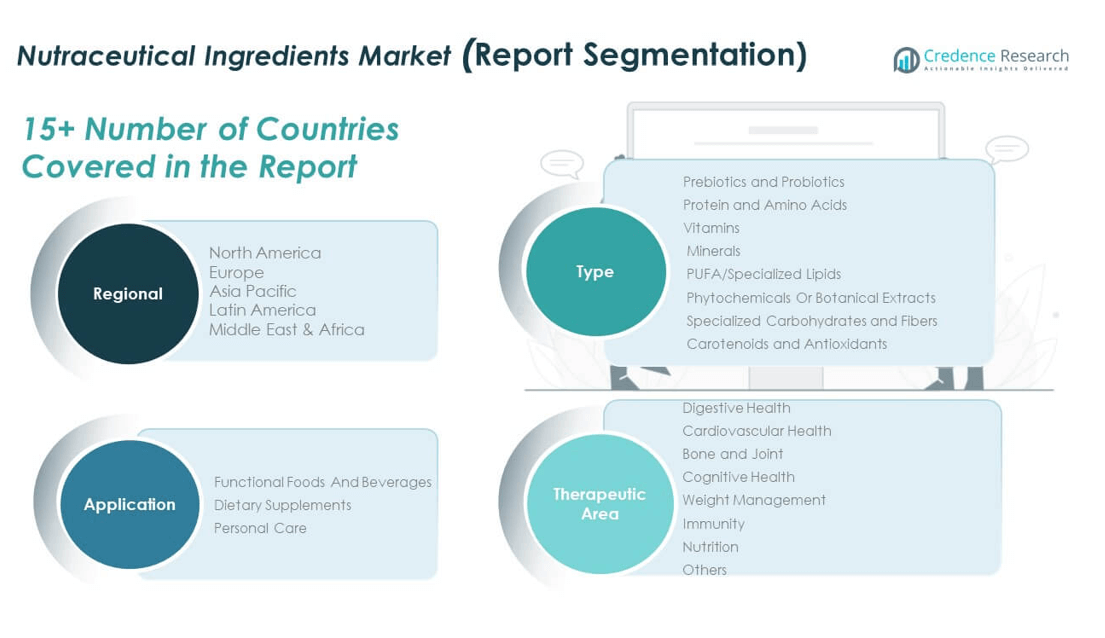
- Functional foods and beverages represented nearly 55% of the Global Nutraceutical Ingredients Market. in 2024, reflecting widespread consumer preference for fortified and convenient dietary products.
- Dietary supplements accounted for around 35%, while personal care contributed close to 10%, highlighting steady integration of nutraceuticals in wellness-oriented beauty products.
Market Drivers
Rising Health Awareness and Shift Toward Preventive Care
The Global Nutraceutical Ingredients Market. is gaining momentum due to a growing focus on preventive health solutions. Consumers are actively seeking products that support long-term wellness and reduce dependency on pharmaceuticals. It is driven by rising incidences of chronic diseases, which have created strong demand for functional foods and dietary supplements. Preventive healthcare spending is increasing, particularly in urban areas where lifestyle-related issues are prominent. Consumers are also shifting preferences toward plant-based and natural solutions that align with holistic health goals. Government initiatives promoting better diets and stronger nutritional standards are further supporting this demand. The expanding use of nutraceuticals in everyday diets is strengthening the overall market outlook.
Expansion of Functional Food and Beverage Consumption
The market is propelled by a steady rise in functional food and beverage consumption worldwide. Consumers prefer fortified snacks, energy drinks, and wellness beverages that provide health benefits beyond basic nutrition. It is influenced by busy lifestyles that limit traditional diet patterns, creating room for convenient yet nutrient-dense options. Companies are introducing formulations that combine vitamins, minerals, and probiotics to deliver targeted health benefits. Sports nutrition and weight management products are gaining traction among young adults and fitness-conscious populations. Global players are focusing on innovative delivery formats such as gummies, powders, and ready-to-drink products. Expanding product availability through e-commerce is further accelerating consumer access.
- For instance, Nestlé Health Science supports innovation in functional foods through global research partnerships with leading academic institutions, fostering product development focused on healthy aging and overall wellness. The company emphasizes science-backed functional ingredient applications, highlighting its commitment to advancing the field of functional foods and beverages.
Growing Influence of Personalized Nutrition Solutions
The demand for personalized nutrition solutions is becoming a significant driver for the market. It is influenced by technological advancements in diagnostics, genetic testing, and digital health tools that guide tailored diet plans. Consumers are increasingly valuing products that align with their individual health requirements. Nutraceutical companies are collaborating with technology firms to create integrated solutions for personalized well-being. Rising adoption of wearable devices is enabling consumers to track health metrics and demand relevant ingredients. These shifts are fostering strong growth opportunities for niche ingredient categories such as probiotics, omega-3 fatty acids, and plant-based proteins. The market is adapting to meet expectations of customization across demographics.
- For instance, Nutrigenomix offers genetic testing designed to provide personalized nutrition advice based on DNA analysis. Its tests are available in more than 40 countries and are widely used by health professionals to tailor dietary recommendations to individual genetic profiles, supporting more effective nutrition strategies and improved health outcomes.
Influence of Regulatory Support and Industry Investments
The Global Nutraceutical Ingredients Market. benefits from evolving regulatory frameworks that support product safety and transparency. Governments are encouraging labeling practices that highlight health benefits and ensure consumer trust. It is further supported by increasing industry investments in research and development for innovative formulations. Major players are expanding production capacities and exploring new ingredient sources to maintain competitiveness. Investors are showing strong interest in startups that focus on natural and science-backed solutions. Partnerships between food manufacturers and pharmaceutical companies are reshaping the product landscape. The combination of regulatory backing and capital inflow is creating a strong foundation for market growth.
Market Trends
Integration of Nutraceuticals with Digital Health Ecosystems
The Global Nutraceutical Ingredients Market. is witnessing a trend where digital health tools and nutraceuticals are merging. Mobile applications and telehealth platforms are integrating supplement tracking into personalized care systems. It is empowering consumers to monitor nutrition intake and align with health goals. Companies are leveraging data-driven insights to recommend suitable nutraceutical formulations. Wearable devices are also contributing by linking nutrient gaps with supplement use. This integration supports a more informed consumer base that prioritizes wellness. The collaboration of digital healthcare and nutraceuticals is expected to transform consumer engagement strategies.
Expansion of Plant-Based and Clean-Label Nutraceuticals
The clean-label movement is influencing the market by prioritizing transparency and natural sourcing. The Global Nutraceutical Ingredients Market. is increasingly shaped by consumer demand for plant-based, organic, and minimally processed ingredients. It is pushing manufacturers to eliminate artificial additives and focus on natural alternatives. Botanical extracts, herbal supplements, and superfood-based ingredients are gaining traction. Consumers associate clean-label products with safety and higher nutritional value. This trend is particularly strong among millennials and Gen Z populations. The rise of vegan and vegetarian lifestyles is also reinforcing the preference for plant-derived nutraceuticals.
- For instance, Nuritas employs its proprietary AI platform, Magnifier Nπϕ™, to analyze billions of peptides from natural sources, enabling discovery of bioactives up to 10 times faster than traditional methods. The company has demonstrated strong clinical validation for its AI-discovered peptides, supporting the development of plant-based nutraceutical ingredients that align with clean-label and natural product trends.
Rising Popularity of Innovative Delivery Formats
The market is evolving through the introduction of innovative delivery formats that enhance convenience. The Global Nutraceutical Ingredients Market. is seeing strong interest in gummies, chewables, effervescent tablets, and fortified drinks. It is transforming consumer experiences by making supplements more enjoyable and accessible. Companies are investing in technologies that improve taste, texture, and absorption rates. These formats are helping overcome traditional barriers related to pill fatigue and compliance. Premium packaging and on-the-go product designs are also influencing buying behavior. Such innovations are extending nutraceutical consumption beyond traditional users to broader demographics.
- For example, in March 2025, SIRIO Pharma launched its XtraGummies™ range, introducing high-potency gummy supplements such as omega-3, creatine, and iron. The new line was developed to meet rising demand for consumer-friendly, convenient, and effective supplement formats, reinforcing the company’s position in the growing global nutraceutical ingredients market.
Emergence of Sustainable and Ethical Sourcing Practices
The market is aligning with sustainability trends by emphasizing eco-friendly ingredient sourcing. The Global Nutraceutical Ingredients Market. is witnessing greater demand for ingredients produced through ethical and traceable supply chains. It is driving companies to adopt sustainable farming, renewable processing, and waste reduction strategies. Certification programs highlighting sustainability credentials are gaining consumer trust. The emphasis on reducing carbon footprints and supporting local communities is strengthening brand reputation. Manufacturers are adopting circular economy models to minimize environmental impact. The alignment of nutraceutical production with global sustainability goals is creating long-term growth opportunities.
Market Challenges Analysis
Complex Regulatory Environment and Quality Concerns
The Global Nutraceutical Ingredients Market. faces major challenges due to complex regulatory requirements across regions. It is difficult for manufacturers to comply with varying global standards related to safety, labeling, and approvals. Stringent procedures often delay product launches and increase operational costs. Ensuring product consistency and quality across supply chains is also a key hurdle. Adulteration risks and misleading health claims can damage consumer trust. Manufacturers must invest heavily in testing and certification to meet compliance needs. The lack of harmonized global standards adds further complexity for exporters. These barriers create uncertainty and slow down market penetration.
Rising Raw Material Costs and Supply Chain Disruptions
The market is challenged by rising raw material costs and ongoing supply chain disruptions. The Global Nutraceutical Ingredients Market. is vulnerable to fluctuations in natural ingredient availability due to climate conditions and geopolitical tensions. It is pushing up procurement expenses for botanical extracts, proteins, and specialty compounds. Companies are struggling to balance affordability with premium quality expectations from consumers. Disruptions in global trade logistics are causing irregular supply and delayed deliveries. Smaller firms face greater risks as they have limited capacity to absorb cost fluctuations. Increasing reliance on imports further exposes the industry to risks of currency volatility. These factors collectively restrict scalability and profitability in the sector.
Market Opportunities
Expansion into Emerging Economies with Growing Health Awareness
The Global Nutraceutical Ingredients Market. is witnessing strong opportunities in emerging economies. It is driven by rising disposable incomes, rapid urbanization, and shifting consumer preferences toward wellness. Governments are launching awareness campaigns to promote healthier lifestyles and dietary habits. Multinational players are expanding footprints by investing in localized production facilities. Consumers in these regions are becoming more open to preventive healthcare products. Retailers and e-commerce platforms are improving access to a wider variety of nutraceuticals. The untapped potential of rural and semi-urban markets presents avenues for long-term growth.
Innovation in Science-Backed and Niche Ingredient Segments
The market is positioned for opportunities through innovation in niche and science-backed ingredients. The Global Nutraceutical Ingredients Market. is benefiting from rising demand for probiotics, adaptogens, omega-3s, and specialty plant extracts. It is encouraging research collaborations that focus on clinical validation of ingredient efficacy. Companies are differentiating by developing products that target specific health conditions like immunity, cognition, and digestive wellness. Advanced delivery technologies are also enabling better absorption and user experience. Growing consumer trust in evidence-based formulations is strengthening brand value. Expanding product portfolios in targeted niches is expected to open high-margin opportunities for market players.
Market Segmentation Analysis:
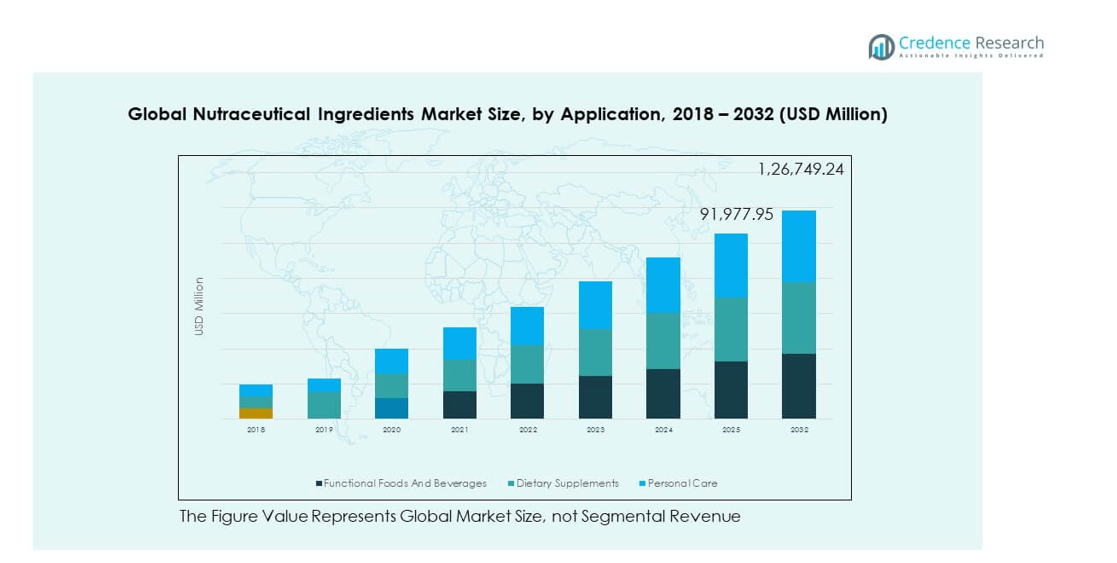
By type, the Global Nutraceutical Ingredients Market. demonstrates strong diversity across its type segments, reflecting evolving consumer health needs. Prebiotics and probiotics dominate due to their proven role in digestive health and immunity. Protein and amino acids maintain high demand in sports nutrition and weight management. Vitamins and minerals hold steady adoption as foundational dietary components, while PUFA and specialized lipids gain traction for cardiovascular and cognitive health benefits. Phytochemicals and botanical extracts are expanding through plant-based trends, and specialized carbohydrates and fibers remain critical for gut health. Carotenoids and antioxidants strengthen growth with their role in skin, eye, and cellular protection.
- For example, Cargill is innovating plant proteins with improved functionality for acidic applications and new hybrid solutions combining plant and animal proteins, addressing demand in sports nutrition and weight management.
By application, functional foods and beverages lead the market with broad integration in daily diets and fortified products. Dietary supplements represent a significant share, driven by preventive healthcare adoption and personalized nutrition. Personal care applications are expanding rapidly as nutraceuticals are infused into skincare, haircare, and beauty-from-within products. It is supported by rising consumer focus on natural, wellness-oriented formulations in lifestyle products.
By therapeutic area segmentation shows digestive health as a dominant category supported by global demand for probiotics and fibers. Cardiovascular health is advancing with rising intake of omega-3s and PUFAs. Bone and joint health is reinforced by minerals and collagen-based solutions, while cognitive health is supported by specialty lipids and botanical extracts. Weight management products are expanding with protein and amino acid innovations. Immunity-focused nutraceuticals continue strong growth following heightened health awareness. Nutrition solutions remain essential across demographics, and other areas present opportunities through specialized formulations.
- For example, Bone and joint health is reinforced by Glanbia Nutritionals’ collagen-based innovations and mineral formulations designed for performance and recovery in active populations.
Segmentation:
By Type
- Prebiotics and Probiotics
- Protein and Amino Acids
- Vitamins
- Minerals
- PUFA / Specialized Lipids
- Phytochemicals or Botanical Extracts
- Specialized Carbohydrates and Fibers
- Carotenoids and Antioxidants
By Application
- Functional Foods and Beverages
- Dietary Supplements
- Personal Care
By Therapeutic Area
- Digestive Health
- Cardiovascular Health
- Bone and Joint
- Cognitive Health
- Weight Management
- Immunity
- Nutrition
- Others
By Region
- North America
- U.S.
- Canada
- Mexico
- Europe
- UK
- France
- Germany
- Italy
- Spain
- Russia
- Belgium
- Netherlands
- Austria
- Sweden
- Poland
- Denmark
- Switzerland
- Rest of Europe
- Asia Pacific
- China
- Japan
- South Korea
- India
- Australia
- Thailand
- Indonesia
- Vietnam
- Malaysia
- Philippines
- Taiwan
- Rest of Asia Pacific
- Latin America
- Brazil
- Argentina
- Peru
- Chile
- Colombia
- Rest of Latin America
- Middle East
- UAE
- KSA
- Israel
- Turkey
- Iran
- Rest of Middle East
- Africa
- Egypt
- Nigeria
- Algeria
- Morocco
- Rest of Africa
Regional Analysis:
North America
The North America Global Nutraceutical Ingredients Market. size was valued at USD 17,479.39 million in 2018 to USD 23,875.92 million in 2024 and is anticipated to reach USD 34,222.29 million by 2032, at a CAGR of 4.6% during the forecast period. North America accounts for nearly 27.2% of the 2024 global share. The region benefits from strong consumer awareness, high disposable incomes, and widespread adoption of dietary supplements. It is supported by robust regulatory frameworks that promote product safety and labeling transparency. Functional foods and beverages are popular in the U.S., with fortified dairy, cereals, and energy products driving demand. Canada and Mexico are witnessing increased uptake of personalized nutrition and clean-label products. Strong presence of multinational players further consolidates growth. The mature retail and e-commerce channels provide wide product accessibility.
Europe
The Europe Global Nutraceutical Ingredients Market. size was valued at USD 14,094.43 million in 2018 to USD 19,255.50 million in 2024 and is anticipated to reach USD 27,605.98 million by 2032, at a CAGR of 4.6% during the forecast period. Europe holds around 21.9% of the 2024 global share. The market is shaped by strict food safety regulations and consumer demand for high-quality, science-backed products. It is experiencing strong growth in probiotics, vitamins, and botanical extracts, particularly in countries like Germany, France, and the UK. Nutraceuticals supporting cardiovascular, cognitive, and bone health are in high demand due to aging populations. Functional beverages and fortified dairy products are expanding rapidly. Sustainability initiatives and plant-based trends are shaping product development strategies. Distribution through pharmacies and health stores remains dominant, supported by growing online platforms.
Asia Pacific
The Asia Pacific Global Nutraceutical Ingredients Market. size was valued at USD 22,171.16 million in 2018 to USD 30,901.71 million in 2024 and is anticipated to reach USD 45,490.30 million by 2032, at a CAGR of 4.9% during the forecast period. Asia Pacific contributes the largest share at 35.3% of the 2024 global market. It is driven by rising health awareness, urbanization, and growing middle-class populations in China, India, and Southeast Asia. Japan and South Korea lead in innovation, particularly in functional beverages and beauty-from-within products. Traditional herbal ingredients and plant-based solutions are strongly integrated with modern nutraceuticals. Expanding e-commerce penetration and retail innovations support access across urban and rural markets. Rising chronic health conditions encourage adoption of preventive healthcare. Regional manufacturers are investing in R&D to align global trends with local preferences. Asia Pacific’s large and diverse consumer base makes it the fastest-expanding region.
Latin America
The Latin America Global Nutraceutical Ingredients Market. size was valued at USD 5,679.85 million in 2018 to USD 8,012.48 million in 2024 and is anticipated to reach USD 11,977.80 million by 2032, at a CAGR of 5.1% during the forecast period. Latin America accounts for nearly 9.2% of the 2024 global share. It is driven by growing urban populations and rising demand for fortified food and beverage products. Brazil dominates the market with strong adoption of protein-based supplements and functional foods. Mexico and Argentina are increasing investments in wellness and immunity-boosting products. Regulatory improvements are helping expand formal nutraceutical markets across the region. Demand for affordable and locally sourced ingredients is strong. Expansion of retail supermarkets and online platforms is broadening consumer access. Latin America is positioning itself as a growth hotspot with untapped opportunities.
Middle East
The Middle East Global Nutraceutical Ingredients Market. size was valued at USD 3,047.10 million in 2018 to USD 4,016.88 million in 2024 and is anticipated to reach USD 5,475.57 million by 2032, at a CAGR of 3.9% during the forecast period. The Middle East represents around 4.6% of the 2024 global share. It is fueled by increasing awareness of lifestyle-related diseases and the importance of preventive care. GCC countries lead with high consumption of dietary supplements and functional foods. Israel is emerging with strong innovation in botanical and specialty ingredients. Growing interest in sports nutrition aligns with a rising fitness culture. The market is supported by expanding pharmacy chains and wellness retail channels. Consumers are showing interest in clean-label and natural solutions. Regional investments in food security and health initiatives are providing additional momentum.
Africa
The Africa Global Nutraceutical Ingredients Market. size was valued at USD 1,274.94 million in 2018 to USD 1,587.72 million in 2024 and is anticipated to reach USD 1,977.29 million by 2032, at a CAGR of 2.7% during the forecast period. Africa captures nearly 1.8% of the 2024 global share. The market is at a nascent stage but holds promise due to growing urban populations and rising interest in preventive healthcare. South Africa is the leading country, with expanding supplement consumption and fortified food adoption. Egypt and Nigeria are showing early growth signs with dietary product innovation. It is challenged by limited consumer affordability and weaker distribution networks. Government health campaigns and international partnerships are encouraging awareness. Opportunities exist in low-cost fortified products and plant-based nutrition. The market outlook remains positive with gradual expansion across urban clusters.
Key Player Analysis:
- Archer Daniels Midland Company (ADM)
- DuPont
- BASF SE
- Cargill, Incorporated
- Tate & Lyle
- Ajinomoto Co., Inc.
- Ingredion Incorporated
- Arla Foods amba
- Other Key Players
Competitive Analysis:
The Global Nutraceutical Ingredients Market. features strong competition among multinational corporations and regional players focused on innovation, product quality, and distribution reach. Leading companies such as Archer Daniels Midland, DuPont, BASF, Cargill, Tate & Lyle, Ajinomoto, Ingredion, and Arla Foods dominate with diverse portfolios and global presence. It is characterized by strategic mergers, acquisitions, and collaborations that expand product offerings and market access. Firms are investing in research and development to introduce science-backed, clean-label, and plant-based ingredients. Expansion into emerging economies is strengthening growth potential, while established markets continue to emphasize regulatory compliance and sustainability. Companies are also focusing on advanced delivery formats and personalized nutrition to address evolving consumer preferences. Intense rivalry is driving continuous innovation and price competition, while smaller firms are leveraging niche categories to differentiate. The market remains dynamic, shaped by technological advances and shifting consumer health priorities.
Recent Developments:
- In August 2025, Greenvit opened its new North American headquarters and warehouse in New Jersey to enhance its service in the U.S. nutraceutical market, aiming to support growing demand and streamline operations.
- In May 2025, Prinova announced the acquisition of Aplinova, a Brazilian ingredient distributor that supplies sectors such as food, beverage, supplements, and personal care
- In September 2024, ACI Group Ltd from the U.K. partnered with DolCas Biotech LLC of New Jersey to distribute clinically researched nutraceutical ingredients in the U.K. This partnership introduced innovative products like Curcugen, Morikol, and NitrateBurst, enhancing the U.K. market's access to advanced nutraceutical formulations.
Report Coverage:
The research report offers an in-depth analysis based on Type, Application, Therapeutic Area. It details leading market players, providing an overview of their business, product offerings, investments, revenue streams, and key applications. Additionally, the report includes insights into the competitive environment, SWOT analysis, current market trends, as well as the primary drivers and constraints. Furthermore, it discusses various factors that have driven market expansion in recent years. The report also explores market dynamics, regulatory scenarios, and technological advancements that are shaping the industry. It assesses the impact of external factors and global economic changes on market growth. Lastly, it provides strategic recommendations for new entrants and established companies to navigate the complexities of the market.
Future Outlook:
- The Global Nutraceutical Ingredients Market. will expand with rising consumer focus on preventive healthcare.
- Demand for plant-based and clean-label formulations will strengthen across food, beverage, and supplement categories.
- Personalized nutrition solutions will gain traction through digital health tools and diagnostic advancements.
- Functional beverages will experience rapid growth, driven by convenience and lifestyle alignment.
- Investments in clinical validation will enhance consumer trust in science-backed nutraceutical claims.
- E-commerce platforms will play a larger role in product accessibility and market penetration.
- Sustainability practices in sourcing and production will influence brand positioning and consumer loyalty.
- Emerging economies will offer new opportunities through rising incomes and growing health awareness.
- Innovation in delivery systems will support wider adoption across diverse demographics.
- Strategic partnerships between food, pharma, and technology firms will reshape competitive dynamics.
Request a Free Sample
Fill in your details and we'll send you a free sample report.
- Sample data tables & charts
- Research methodology
Need a Custom Version of This Report?
Tailor the scope, geography, or segments to your exact requirements.
- Custom geography or segment scope
- Direct access to our analyst team
Frequently Asked Questions
What is the current market size for Global Nutraceutical Ingredients Market., and what is its projected size in 2032?
Which Global Nutraceutical Ingredients Market. market segment held the largest share in 2024?
What are the primary factors fueling the growth of the Global Nutraceutical Ingredients Market.?
Who are the leading companies in the Global Nutraceutical Ingredients Market.?
Table of Content
Chapter 1. Report Introduction
- 1.1 Report Description & Purpose
- 1.1.1 Report Title & Market Definition
- 1.1.2 Unique Selling Propositions (USP) & Key Differentiators
- 1.1.3 Value Proposition for Stakeholders
- 1.2 Research Objectives
- 1.2.1 Market Sizing Objectives (Volume & Revenue)
- 1.2.2 Segmentation Objectives
- 1.2.3 Competitive Intelligence Objectives
- 1.2.4 Forecast & Scenario Objectives
- 1.3 Report Scope
- 1.3.1 Nutraceutical Ingredients Scope – Types & Subtypes Covered
- 1.3.2 Geographic Scope – Regions & Countries Covered
- 1.3.3 Historical Period, Base Year & Forecast Period (2024; forecast to 2032)
- 1.3.4 Inclusions & Exclusions
- 1.4 HS Code & Classification Framework
- 1.5 Currency, Units & Pricing Basis
- 1.6 Target Stakeholders
- 1.7 Limitations & Assumptions
Chapter 2. Executive Summary
- 2.1 Global Nutraceutical Ingredients Market Snapshot
- 2.1.1 Market Size – Historical (2024) & Forecast (2024-2032) (2024: USD 87,650.2 million → 2032: USD 126,749.2 million)
- 2.1.2 Volume & Revenue – Global Totals
- 2.1.3 Key Market Highlights – Top Five Facts
- 2.2 Nutraceutical Ingredients Market Segmentation Snapshot
- 2.2.1 Market Split by Region – 2024 vs. 2032
- 2.3 Competitive Snapshot
- 2.3.1 Top 10 Players by Revenue Share – 2024
- 2.3.2 Top 10 Players by Volume Share – 2024
- 2.3.3 Recent Strategic Developments (18-Month Summary)
- 2.4 Key Investment Highlights & Strategic Conclusions
Chapter 3. Nutraceutical Ingredients Market Dynamics & Industry Analysis
- 3.1 Market Overview & Context
- 3.1.1 Nutraceutical Ingredients Market Position in the Broader Automotive Value Chain
- 3.1.2 OEM vs. Replacement Market Dynamics
- 3.1.3 Market Maturity & Development Stage by Region
- 3.2 Nutraceutical Ingredients Market Drivers
- 3.3 Nutraceutical Ingredients Market Restraints & Challenges
- 3.4 Nutraceutical Ingredients Market Opportunities
- 3.5 Porter's Five Forces Analysis
- 3.5.1 Threat of New Entrants
- 3.5.2 Bargaining Power of Suppliers
- 3.5.3 Bargaining Power of Buyers
- 3.5.4 Threat of Substitutes
- 3.5.5 Competitive Rivalry – Intensity Assessment
- 3.6 Nutraceutical Ingredients Value Chain Analysis
- 3.6.1 Upstream – Raw Material/Input Suppliers
- 3.6.1.1 Raw Material/Input 1
- 3.6.1.2 Raw Material/Input 2
- 3.6.1.3 Raw Material/Input 3
- 3.6.2 Midstream – Production/Manufacturing/Service Delivery
- 3.6.2.1 Production/Process Overview
- 3.6.2.2 Key Facility Locations & Capacity by Manufacturer
- 3.6.3 Downstream – Distribution & End Consumer
- 3.6.3.1 Primary Channel – B2B/OEM
- 3.6.3.2 Secondary Channels – Dealer, Retail, Online, Direct
- 3.6.4 Value Chain Profitability Analysis
- 3.6.1 Upstream – Raw Material/Input Suppliers
- 3.7 PESTEL Analysis
- 3.7.1 Political Factors
- 3.7.2 Economic Factors
- 3.7.3 Social Factors
- 3.7.4 Technological Factors
- 3.7.5 Environmental Factors
- 3.7.6 Legal Factors
- 3.8 Nutraceutical Ingredients Supply Chain Analysis
- 3.8.1 Raw Material/Input Supply Risk Assessment
- 3.8.2 Manufacturing Concentration Risk (Geographic Exposure)
- 3.8.3 Trade Disruption Impact Analysis
- 3.9 Regulatory & Policy Landscape
Note: The regulatory and policy landscape section covers regulations based on their applicability to the market, Nutraceutical Ingredients category, geography, and scope of the study. Only regulatory frameworks with a material impact on operations, compliance, trade, sustainability, or market access are analyzed in detail.
Chapter 4. Key Investment Pockets & Opportunity Analysis
- 4.1 Nutraceutical Ingredients Market Attractiveness Analysis
- 4.1.1 By Region – Investment Attractiveness Matrix (Volume × CAGR)
- 4.2 Absolute Revenue Growth Opportunity
- 4.2.1 By Region – Absolute USD Growth Through 2032
- 4.3 Incremental Volume Opportunity
- 4.3.1 By Region – Incremental Volume Through 2032
- 4.3.2 Segment – Incremental Volume
- 4.4 Emerging Submarket Opportunity Deep Dive (Subject to Applicability)
- 4.5 Emerging Market Opportunity Scorecards
- 4.5.1 United States
- 4.5.2 Europe
- 4.5.3 Asia
- 4.5.4 Middle East & Africa
Note: Emerging Market Opportunity Scorecards will be included based on relevance and strategic importance. Regions listed are indicative and may vary depending on data availability and market dynamics.
Chapter 5. Nutraceutical Ingredients Import-Export Analysis & Trade Flows
- 5.1 Global Trade Overview
- 5.1.1 Global Export Value by Country (2024)
- 5.1.2 Global Export Volume by Country (2024)
- 5.1.3 Global Import Value by Country (2024)
- 5.1.4 Global Import Volume by Country (2024)
- 5.1.5 Net Trade Balance by Country (2024)
- 5.2 Export Analysis – Segment
- 5.2.1 Type 1 (HS Code)
- 5.2.2 Type 2 (HS Code)
- 5.2.3 Type 3 (HS Code)
- 5.2.4 Type 4 (HS Code)
- 5.2.5 Type 5 (HS Code)
- 5.3 Import Analysis – Segment
- 5.3.1 Type 1 (HS Code)
- 5.3.2 Type 2 (HS Code)
- 5.3.3 Type 3 (HS Code)
- 5.3.4 Type 4 (HS Code)
- 5.3.5 Type 5 (HS Code)
- 5.4 Average Unit Trade Prices
- 5.4.1 Average Export Price – Segment & Country
- 5.4.2 Average Import Price – Segment & Source Country
- 5.4.3 Price Trends (2024)
- 5.5 Key Trade Route Analysis
- 5.5.1 Trade Route 1
- 5.5.2 Trade Route 2
- 5.5.3 Trade Route 3
- 5.5.4 Trade Route 4
- 5.5.5 Trade Route 5
- 5.6 Trade Policy Impact Assessment
- 5.6.1 US Anti-Dumping & Section 301 Tariffs
- 5.6.2 EU Customs Union Impact
- 5.6.3 Major Free Trade Agreements
- 5.6.4 USMCA Rules of Origin
Note: Trade policy analysis will be included only where relevant to the Nutraceutical Ingredients market.
Chapter 6. Competitive Landscape & Company Benchmarking
- 6.1 Nutraceutical Ingredients Market Concentration & Structure
- 6.1.1 Herfindahl-Hirschman Index (HHI) – vs. 2024
- 6.1.2 Tier 1, Tier 2 & Tier 3 Market Structure
- 6.1.3 Global, Regional & Local Player Dynamics
- 6.2 Nutraceutical Ingredients Market Share Analysis – 2024
- 6.2.1 Global Revenue Share by Company
- 6.2.2 Global Volume Share by Company
- 6.2.3 Regional Revenue Share
- 6.2.4 Market Share Evolution ( vs. 2024)
- 6.2.5 OEM Segment Share by Company
- 6.2.6 Replacement Segment Share by Company
- 6.3 Production/Delivery Capacity & Facility Analysis
- 6.3.1 Global Installed Capacity
- 6.3.2 Capacity Utilization Rates
- 6.3.3 Production/Output Volume
- 6.3.4 Facility Locations & Capacity Map
- 6.3.5 Planned Capacity Additions
- 6.4 Nutraceutical Ingredients Competitive Benchmarking Matrix
- 6.4.1 Revenue, Volume, CAGR & Profitability Comparison
- 6.4.2 Channel Revenue Mix
- 6.4.3 Geographic Revenue Exposure
- 6.4.4 R&D Intensity
- 6.4.5 Sustainability Maturity
- 6.5 Strategic Developments in Nutraceutical Ingredients (Last 24 Months)
- 6.5.1 Mergers, Acquisitions & Divestments
- 6.5.2 New Nutraceutical Ingredients Launches
- 6.5.3 Facility Expansions
- 6.5.4 Strategic Alliances, Joint Ventures & Partnerships
- 6.5.5 Distribution Expansion & Market Entry
- 6.5.6 Sustainability & ESG Initiatives
- 6.6 Competitive Strategy Mapping
- 6.6.1 Leader, Challenger, Follower & Niche Classification
- 6.6.2 Pricing Strategy Comparison
- 6.6.3 Channel Strategy Matrix
Note: Strategic developments are included based on their materiality and the availability of reliable information.
Chapter 7. Global Nutraceutical Ingredients Market – By Distribution Channel
- 7.1 Segment Overview
- 7.1.1 Volume & Revenue Split by Channel (2024 & 2032)
- 7.1.2 Channel Mix Evolution (2024-2032)
Chapter 8. Regional Market Analysis – Global Overview
- 8.1 Global Regional Overview
- 8.1.1 Regional Volume Share
- 8.1.2 Regional Revenue Share
- 8.1.3 Regional Volume by Region
- 8.1.4 Regional Revenue by Region
- 8.1.5 Regional Forecast Through 2032
- 8.2 Cross-Regional Segment Analysis
- 8.2.1 By Distribution Channel
- 8.2.2 By Brand/Price Tier
Chapter 9. North America Nutraceutical Ingredients Market
- 9.1 United States
- 9.2 Canada
- 9.3 Mexico
Chapter 10. Europe Nutraceutical Ingredients Market
- 10.1 Germany
- 10.2 France
- 10.3 Italy
- 10.4 United Kingdom
- 10.5 Spain
- 10.6 Poland
- 10.7 Russia
- 10.8 Netherlands
- 10.9 Belgium
- 10.10 Sweden
- 10.11 Denmark
- 10.12 Norway
- 10.13 Rest of Europe
Chapter 11. Asia Pacific Nutraceutical Ingredients Market
- 11.1 China
- 11.2 India
- 11.3 Japan
- 11.4 South Korea
- 11.5 Thailand
- 11.6 Indonesia
- 11.7 Vietnam
- 11.8 Malaysia
- 11.9 Australia
- 11.10 Rest of Asia Pacific
Chapter 12. Latin America Nutraceutical Ingredients Market
- 12.1 Brazil
- 12.2 Argentina
- 12.3 Colombia
- 12.4 Chile
- 12.5 Rest of Latin America
Chapter 13. Middle East Nutraceutical Ingredients Market
- 13.1 Saudi Arabia
- 13.2 United Arab Emirates
- 13.3 Turkey
- 13.4 Israel
- 13.5 Iran
- 13.6 Rest of the Middle East
Chapter 14. Africa Nutraceutical Ingredients Market
- 14.1 South Africa
- 14.2 Egypt
- 14.3 Nigeria
- 14.4 Morocco
- 14.5 Rest of Africa
Chapter 15. Nutraceutical Ingredients Company Profiles
- 15.1 [Company 01]
- 15.1.1 Company Overview
- 15.1.2 Key Management Personnel
- 15.1.3 Products & Services Portfolio
- 15.1.4 Financial Performance
- 15.1.5 Key Market Focus & Geographic Presence
- 15.1.6 Recent Developments & Strategic Initiatives
Note: The company profile list is preliminary and may change based on research findings, market developments, data availability, and client requirements.
Chapter 16. Appendices
- Appendix A – List of Abbreviations & Acronyms
- Appendix B – Industry Classification Code Reference – Full Series
- Appendix C – Production & Capacity Data Tables
- Appendix D – End-Use & Demand Base Tables
- Appendix E – Consumption & Replacement Rate Assumptions
- Appendix F – ASP Reference Tables
- Appendix G – Manufacturing & Facility Database
- Appendix H – Import-Export Data Tables
- Appendix I – Regulatory Summary Tables
- Appendix J – Primary Research Participant List (Anonymized)
- Appendix K – Primary Research Questionnaire Framework
- Appendix L – Data Sources & Bibliography
- Appendix M – Market Size Divergence & Source Comparison
Chapter 17. Research Methodology
- 17.1 Research Framework & Philosophy
- 17.2 Secondary Research – Sources, Hierarchy & Data Extraction
- 17.3 Data Modeling – Bottom-Up & Top-Down Market Sizing
- 17.4 Primary Research – Stakeholder Framework, LOI & Sample Sizes
- 17.5 Forecast Methodology – Regression, Scenario & Sensitivity Analysis
- 17.6 Quality Control – Four-Layer Validation Framework
- 17.7 Limitations & Standard Assumptions
- 17.8 Disclaimer
