
Market Overview:
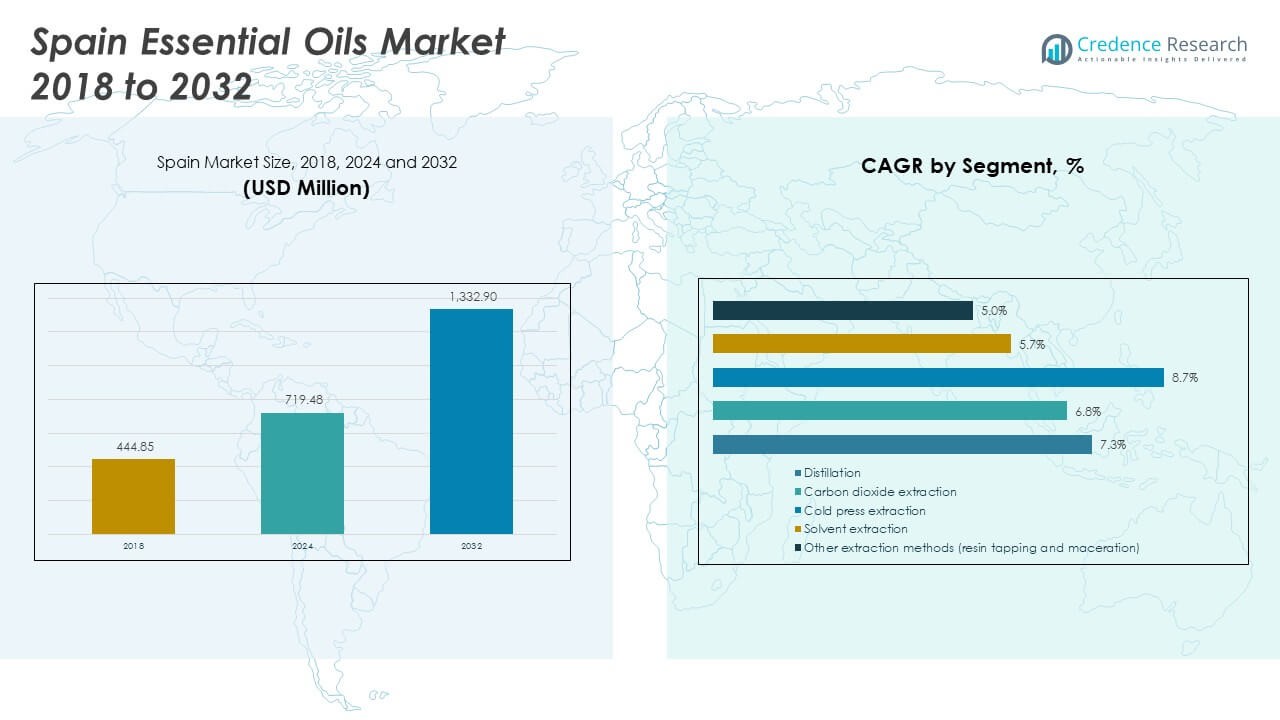
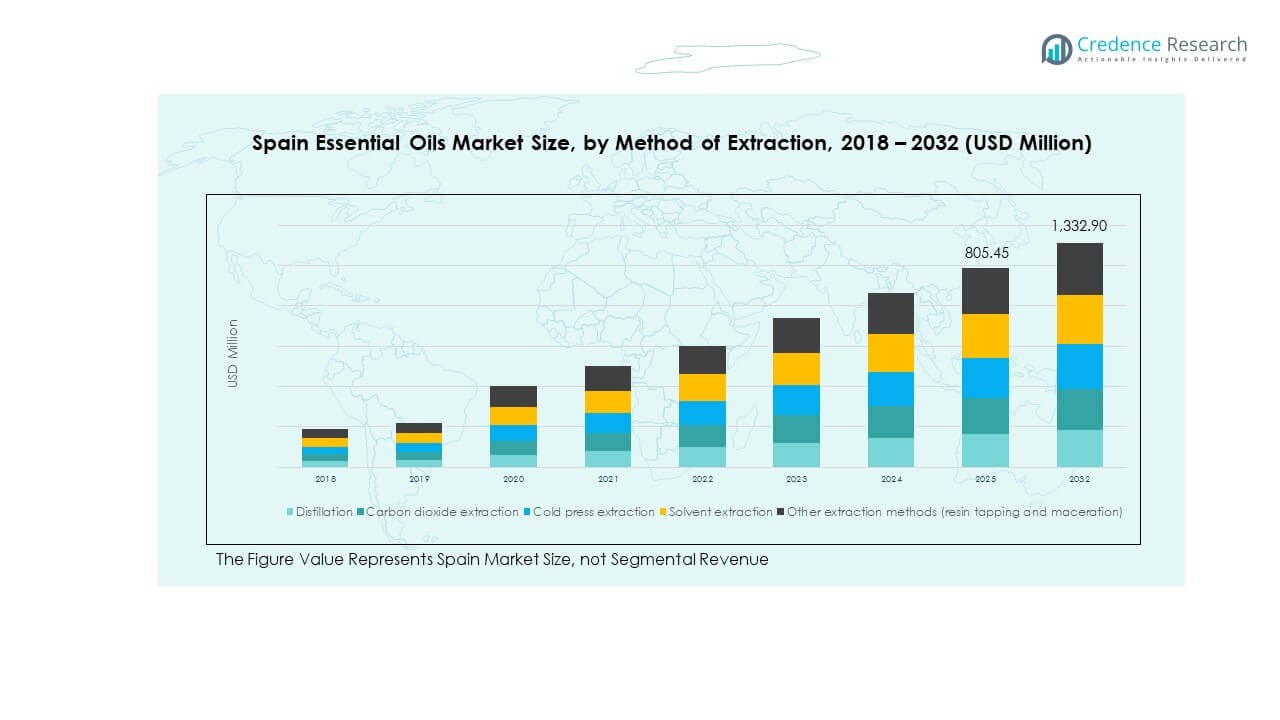
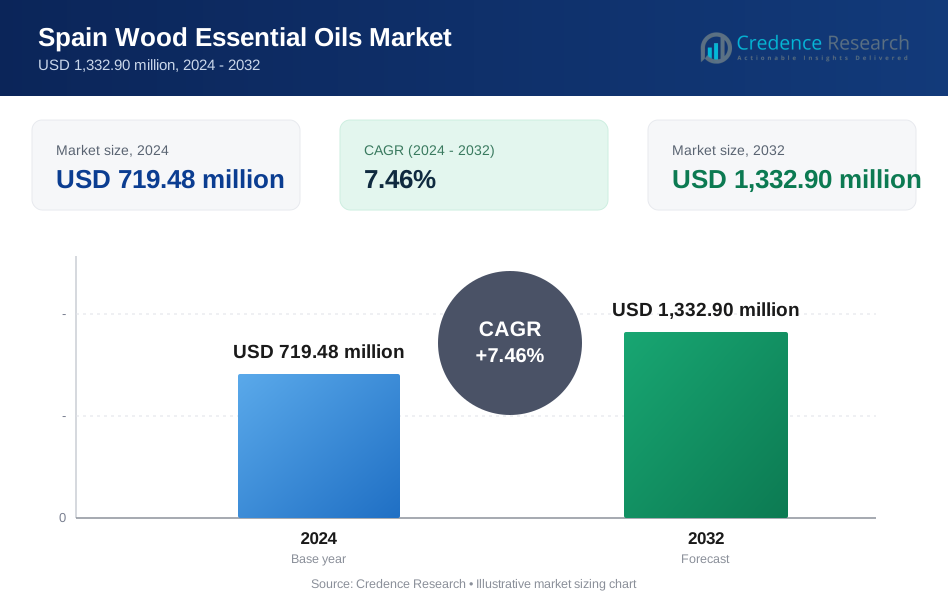
The Spain Wood Essential Oils Market size was valued at USD 444.85 million in 2018, expanded to USD 719.48 million in 2024 and is anticipated to reach USD 1,332.90 million by 2032, at a CAGR of 7.46% during the forecast period.
| REPORT ATTRIBUTE | DETAILS |
|---|---|
| Historical Period | 2020-2023 |
| Base Year | 2024 |
| Forecast Period | 2025-2032 |
| Spain Wood Essential Oils Market Size 2024 | USD 719.48 Million |
| Spain Wood Essential Oils Market, CAGR | 7.46% |
| Spain Wood Essential Oils Market Size 2032 | USD 1,332.90 Million |
Demand for wood-based essential oils in Spain has surged thanks to rising consumer focus on natural wellness. Producers emphasize sustainable harvesting practices to protect forests and meet eco-conscious preferences. Retail channels have boosted visibility through specialty stores and digital platforms. High interest in aromatherapy and organic fragrances drives investments in local distillation facilities. Companies promote benefits of cedarwood, sandalwood, and pine oils in personal care and home products. Collaboration between farmers and processors ensures consistent supply of quality raw material. This trend supports growth across the value chain.
Spain leads southern Europe in wood essential oils output, thanks to abundant forestry resources. Regions like Galicia and Catalonia host key distillation centers for chestnut and cork oak extracts. Producers in emerging areas such as Andalusia expand cultivation of native tree species. Export demand strengthens northern Spain’s production focus, helping smaller provinces benefit. Retail growth in Mediterranean tourism spots fuels domestic consumption. Industrial clusters in Madrid and Valencia support R&D in novel extraction methods. Cross-border trade with France and Italy shapes supply routes. This geographic diversity strengthens national resilience.
Market Insights:
- The Spain Wood Essential Oils Market was valued at USD 444.85 million in 2018, grew to USD 719.48 million in 2024, and is projected to reach USD 1,332.90 million by 2032 at a CAGR of 7.46%.
- Europe commanded the largest share at 42% in 2024, driven by strong demand in cosmetics and wellness; North America followed with 28% due to premium product adoption; Asia Pacific held 20% share, supported by rising aromatherapy and personal care demand.
- Asia Pacific is the fastest-growing region, with increasing imports of natural oils and expanding wellness applications boosting demand.
- Distillation accounted for around 46% of the Spain Wood Essential Oils Market share in 2024, remaining the dominant extraction method due to established infrastructure.
- Cold press extraction held about 21% share in 2024, driven mainly by citrus oils, while solvent and CO₂ extraction methods expanded in premium product categories.
Market Drivers:
Strong consumer shift toward natural wellness:
Consumers now choose plant-based oils over synthetic variants. Health trends push demand for natural aromatherapy and personal care products. Spain Wood Essential Oils Market grows due to that trend. It taps into rising preferences for sustainable natural ingredients. Producers respond by expanding supply and refining extraction methods. Retailers highlight purity, forest origin and traditional uses. It raises market value and broadens product lines. Growth continues as wellness awareness expands.
- For instance, A Spanish company based in Murcia, Essential Oils SL focuses on sustainable essential oil production through biomass-powered distillation and organic certifications. The company emphasizes sustainable forestry, traceability, and eco-friendly practices to produce cedarwood, pine, and other wood-based essential oils that meet growing consumer demand for natural and pure products.
Sustainable forestry boosts supply chains:
Spain adopts responsible forestry to support essential oil sourcing. It ensures steady access to cedarwood, pine and oak oils. Producers invest in reforestation and traceability systems. Markets benefit from consistent quality and ethical branding. It strengthens confidence among eco-conscious consumers. Such practices help differentiate Spanish oils globally. It also secures long-term resource availability. That commitment reinforces market stability and growth.
- For instance, Labdassence Specializes in organic essential oils within Spain, offering a product range aligned with EU organic certification standards. Labdassence highlights traceability, organic forestry, and high-quality sustainable extraction methods, targeting premium and eco-conscious markets.
Digital channels expand reach:
Online platforms and e-commerce accelerate product discovery and purchase. Spain Wood Essential Oils Market gains wider visibility through digital marketing. Small producers gain access to national and international buyers. Platforms host educational content, boosting buyer confidence. It improves pricing and distribution efficiency. Retailers use targeted ads to highlight benefits. It empowers niche brands alongside large firms. This trend sustains steady demand growth.
Innovation in extraction boosts quality:
Research in gentler and efficient extraction methods yields better yields. Spain Wood Essential Oils Market benefits from CO₂ and distillation improvements. Producers adopt greener technologies to enhance aroma profiles. It lowers energy use and improves sustainability credentials. Labs collaborate with forestry experts to optimize oil profiles. It elevates product quality and opens premium segments. That innovation attracts premium buyers and drives value growth.
Market Trends:
Premiumization of wood oil blends:
Consumers now value custom blends with unique scent profiles. Spain Wood Essential Oils Market explores mixing cedar, pine and oak oils. Brands craft signature fragrances for home and wellness sectors. It elevates perceived value and justifies higher prices. Craft distillers’ experiment with aged and barrel-infused oils. It fuels demand for artisanal and limited-edition ranges. Retailers respond with curated gift collections and seasonal blends. Trend pushes differentiation and consumer interest.
- For instance, Florihana Operating extensively in Spain, Florihana offers natural and organic essential oils, including wood oils, with a focus on purity and sustainable extraction techniques. Florihana is noted for combining traditional distillation expertise with modern quality controls.
Demand for certified organic and sustainable oils:
Organic certification gains traction among end-users and retailers. Spain Wood Essential Oils Market aligns with EU eco-labels to assure quality. Producers pursue organic forestry to meet demand. It appeals to eco-conscious buyers and premium markets. Traceability and certification deliver brand credibility. Consumers trust labeled products more. It drives growth in certified oil categories. That trend reshapes sourcing and marketing strategies.
- For instance, Spanish distillers like Bordas S.A. and Esencias Martínez Lozano focus on producing a wide range of essential oils from native Mediterranean botanicals such as citrus, rosemary, and thyme. These companies, with decades of experience, emphasize sustainable sourcing and quality control. Smaller, artisanal distillers in Spain also exist, specializing in local, organic, and wild-harvested plant oils to cater to the wellness and premium market.
Rise of functional wellness applications:
Wood essential oils gain use in mental wellness and stress relief products. Spain Wood Essential Oils Market sees demand in aromatherapy diffusers and sleep aids. It drives collaborations with wellness brands and spas. Products tout benefits like relaxation and focus. It expands applications beyond fragrances. Retailers bundle oils with wellness kits. That diversifies channels and increases consumption. The trend supports new product development.
Focus on circular economy practices:
Producers now repurpose residual biomass from extraction. Spain Wood Essential Oils Market integrates by-products into compost or biomass energy. It reduces waste and cuts costs. Circular practices enhance environmental credentials. Consumers value sustainable use of all materials. It creates synergy between forestry and agribusiness sectors. That trend reinforces green branding. It attracts investors and policy support.
Market Challenges Analysis:
Regulatory complexity and compliance hurdles:
Spain Wood Essential Oils Market must meet EU and national regulations on purity and labeling. It complicates exports and slows product launch cycles. Firms must test oils for contaminants and adhere to chemical safety norms. It raises compliance costs for small producers. Changing rules require constant adjustment and documentation. It delays time-to-market and strains resources. Companies manage by investing in lab testing and legal expertise. That improves compliance but narrows margins.
Supply volatility and climate risks:
Spain depends on forest yields for oil production. It faces challenges from droughts, wildfires and pests. That volatility disrupts supply and inflates raw material prices. Market confidence can suffer when stocks fluctuate. Producers may struggle to meet large orders. It pressures margins and planning accuracy. Firms explore supplier diversification and climate-resilient forestry. That response helps secure supply long-term but requires capital.
Market Opportunities:
Expansion into wellness tourism:
Wellness tourism sectors like spas and resorts now seek local aromatherapy offerings. Spain Wood Essential Oils Market can supply exclusive oils for hospitality. It can craft themed product lines for regional experiences. Hotels likely to partner for house blends. It creates high-margin B2B channels. Producers may co-brand with resorts or wellness centers. That expands visibility and reach. It fosters premium positioning and tourism synergy.
Export growth through EU partnerships:
Spain borders EU markets with shared cultural ties and logistics advantages. Spain Wood Essential Oils Market can tap into France and Italy via trade agreements. It can boost exports through joint trade fairs and co-marketing. Firms may partner with EU distributors. It opens access to growing wellness segments abroad. Cross-border supply chains reduce costs. That increases economies of scale and brand presence. It accelerates international expansion.
Market Segmentation Analysis:
By Type
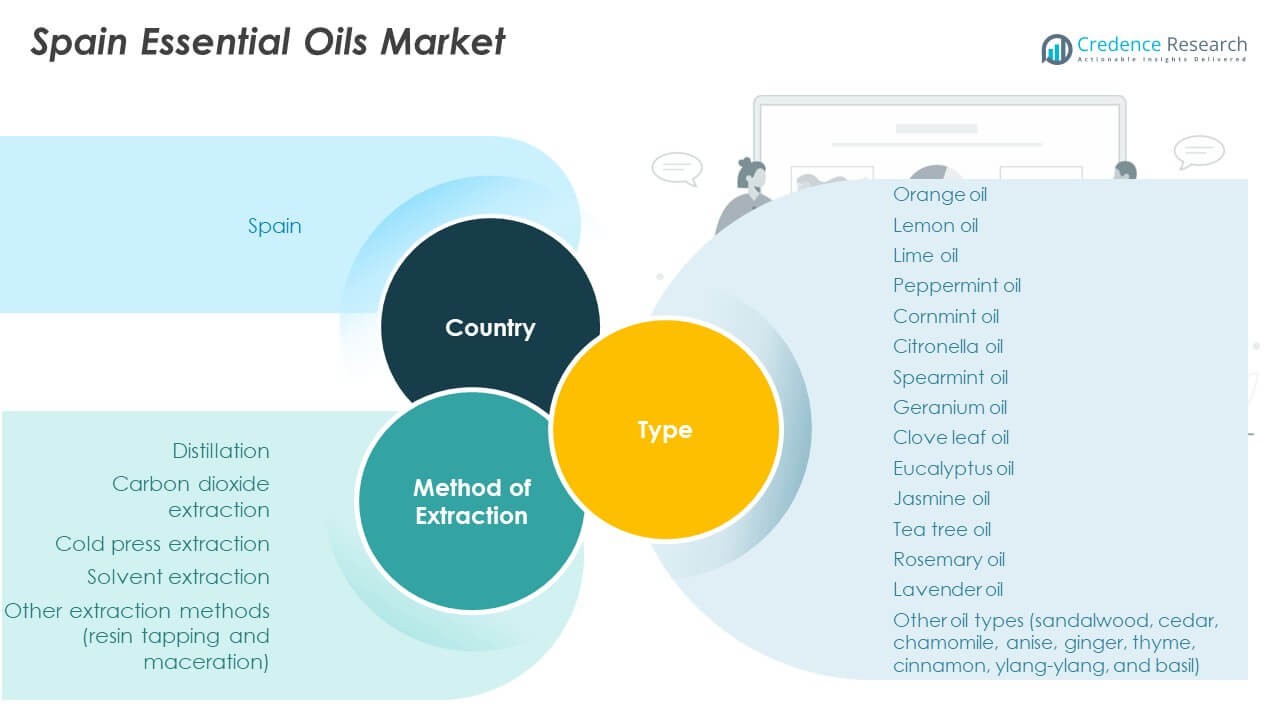
The Spain Wood Essential Oils Market covers a wide range of oils derived from diverse tree species. Citrus oils such as orange, lemon, and lime remain significant due to their strong use in flavoring and fragrance industries. Peppermint, cornmint, and spearmint oils gain demand in pharmaceuticals and oral care. Eucalyptus, rosemary, and lavender oils drive wellness and aromatherapy applications, reflecting Spain’s traditional herbal medicine practices. Premium oils such as sandalwood, cedarwood, chamomile, and ylang-ylang attract niche luxury buyers in cosmetics and perfumery. This diversity ensures a balanced market with both mass-use and premium categories.
- For instance, Premium oils such as sandalwood, cedarwood, chamomile, and ylang-ylang attract niche luxury buyers in cosmetics and perfumery—with artisans and producers crafting limited-edition wood oil blends that command higher prices, illustrating this market’s diversity and balance between mass-use and premium categories.
By Method of Extraction
Distillation dominates the market, supported by Spain’s well-established distillation facilities and historical expertise. Cold press extraction is widely used for citrus-based oils, offering purity and high yield. Carbon dioxide extraction is gaining ground for its efficiency and ability to preserve delicate aromas. Solvent extraction remains important for premium oils like jasmine and rose, where yield is naturally low. Resin tapping and maceration techniques serve niche producers specializing in artisanal and organic outputs. These methods highlight the industry’s blend of tradition and modern innovation.
- For instance, Carbon dioxide extraction is gaining momentum due to its ability to efficiently preserve delicate aromas and increase oil quality, now accounting for approximately 12% annual growth in use within premium oil segments.
Segmentation:
By Type
- Orange oil
- Lemon oil
- Lime oil
- Peppermint oil
- Cornmint oil
- Citronella oil
- Spearmint oil
- Geranium oil
- Clove leaf oil
- Eucalyptus oil
- Jasmine oil
- Tea tree oil
- Rosemary oil
- Lavender oil
- Other oil types (sandalwood, cedar, chamomile, anise, ginger, thyme, cinnamon, ylang-ylang, basil)
By Method of Extraction
- Distillation
- Carbon dioxide extraction
- Cold press extraction
- Solvent extraction
- Other extraction methods (resin tapping, maceration)
By Country Analysis
- Spain Essential Oils Market Revenue Share By Country
- Country-wise production and demand
- Type-based revenue breakdown
- Method of extraction-based revenue breakdown
By Application / End Use (implied within TOC scope)
- Personal care & cosmetics
- Aromatherapy & wellness
- Food & beverages (flavoring)
- Pharmaceuticals
- Household & cleaning products
- Industrial uses
Regional Analysis:
Northern Spain (Galicia and Catalonia) – 45% Share
Northern Spain leads the Spain Wood Essential Oils Market with around 45% share. Galicia and Catalonia are rich in forestry resources, providing chestnut, pine, and cork oak for extraction. It benefits from well-established distillation hubs and skilled local expertise. Companies emphasize sustainable forestry practices to protect biodiversity and ensure supply stability. Export-oriented players prefer this region due to easy access to France and other European buyers. Strong infrastructure and tradition in natural product processing maintain northern Spain’s dominance. This region continues to anchor Spain’s leadership in essential oils.
Southern Spain (Andalusia) – 30% Share
Andalusia contributes about 30% of the Spain Wood Essential Oils Market. Its climate supports the cultivation of aromatic species such as cedar and cypress. It is also supported by wellness tourism, with spas and resorts demanding locally sourced oils. Producers collaborate with farmers to expand cultivation under sustainable methods. CO₂ and advanced extraction technologies are gradually being introduced in this region. Andalusia is emerging as a dynamic production center beyond the northern hubs. This expansion strengthens Spain’s overall market resilience and diversity.
Eastern Spain (Valencia and Surrounding Areas) – 25% Share
Eastern Spain accounts for nearly 25% of the Spain Wood Essential Oils Market. Valencia benefits from industrial infrastructure and port access, facilitating both exports and domestic distribution. It has become a hub for innovation, with R&D efforts enhancing extraction quality and efficiency. Local firms specialize in premium oils used in cosmetics, perfumery, and household products. It also plays a critical role in connecting production with major retail centers such as Madrid. Strong focus on certifications and traceability supports competitiveness in export markets. Eastern Spain’s strategic location and innovation base make it vital for future market growth.
Key Player Analysis:
- Symrise AG
- Givaudan SA
- Firmenich International SA
- Robertet Group
- Mane SA
- BASF SE
- Kerry Group plc
- Biolandes SAS
- Flavex Naturextrakte GmbH
- Ungerer Limited
Competitive Analysis:
The Spain Wood Essential Oils Market is highly competitive, with global and regional players shaping its structure. Leading multinationals such as Symrise, Givaudan, Firmenich, Robertet, and BASF dominate through innovation, scale, and established distribution channels. Local firms including Biolandes and Flavex strengthen the market with specialized products and sustainable sourcing practices. It benefits from competition between large-scale production and artisanal, eco-focused approaches. Companies prioritize R&D, eco-certification, and advanced extraction methods to secure customer trust. Strategic alliances with wellness, cosmetic, and aromatherapy brands broaden reach. It fosters an environment where product quality, traceability, and brand identity remain key differentiators. The balance of international influence and regional expertise makes the market dynamic and diverse.
Recent Developments:
- In September 2025, Symrise AG started a new production unit in Granada, Spain, to enable a more secure and sustainable supply of Hydrolite® 5 green, addressing the growing demand for clean and natural beauty ingredients in personal care products.
- In June 2025, Givaudan SA announced the acquisition of a majority stake in Vollmens Fragrances Ltda, a Brazilian fragrance house, as part of its strategy to expand regional presence. Although this relates to Latin America, it impacts Givaudan’s global fragrance business which includes Spain.
- Mane SA signed a new fragrance distribution agreement with Brenntag for the Spanish market, enhancing opportunities for customers in personal care and household & industrial (HI&I) products by leveraging Mane’s extensive portfolio of natural fragrances.
- Firmenich International SA continues to lead with science-driven research and strategic partnerships focusing on premium and mid-range essential oils, though no specific Spain wood oils update was found recently.
Report Coverage:
The research report offers an in-depth analysis based on Type and Method of Extraction segments. It details leading market players, providing an overview of their business, product offerings, investments, revenue streams, and key applications. Additionally, the report includes insights into the competitive environment, SWOT analysis, current market trends, as well as the primary drivers and constraints. Furthermore, it discusses various factors that have driven market expansion in recent years. The report also explores market dynamics, regulatory scenarios, and technological advancements that are shaping the industry. It assesses the impact of external factors and global economic changes on market growth. Lastly, it provides strategic recommendations for new entrants and established companies to navigate the complexities of the market.
Future Outlook:
- Producers will expand sustainable forestry initiatives to secure long-term raw material availability.
- Organic certification will continue to drive premium positioning for Spanish oils in global markets.
- Advances in CO₂ extraction and distillation methods will improve yield and product quality.
- Growing wellness tourism in Spain will create demand for exclusive spa and aromatherapy blends.
- Export opportunities into Europe and Asia-Pacific will strengthen through trade partnerships.
- Digital platforms and e-commerce channels will enhance visibility for both global and local brands.
- Climate-resilient forestry practices will emerge as a safeguard against supply disruptions.
- Niche premium products like sandalwood and cedarwood will attract luxury buyers.
- Circular economy practices, such as biomass reuse, will improve sustainability credentials.
- Collaboration between local farmers and international fragrance companies will expand regional value chains.
Request a Free Sample
Fill in your details and we'll send you a free sample report.
- Sample data tables & charts
- Research methodology
Need a Custom Version of This Report?
Tailor the scope, geography, or segments to your exact requirements.
- Custom geography or segment scope
- Direct access to our analyst team
Frequently Asked Questions
What is the current market size for Spain Wood Essential Oils Market, and what is its projected size in 2032?
At what Compound Annual Growth Rate is the Spain Wood Essential Oils Market projected to grow between 2024 and 2032?
Which Spain Wood Essential Oils Market segment held the largest share in 2024?
What are the primary factors fueling the growth of the Spain Wood Essential Oils Market?
Who are the leading companies in the Spain Wood Essential Oils Market?
Which region commanded the largest share of the Spain Wood Essential Oils Market in 2024?
Table of Content
Chapter 1. Report Introduction
- 1.1 Report Description & Purpose
- 1.1.1 Report Title & Market Definition
- 1.1.2 Unique Selling Propositions (USP) & Key Differentiators
- 1.1.3 Value Proposition for Stakeholders
- 1.2 Research Objectives
- 1.2.1 Market Sizing Objectives (Volume & Revenue)
- 1.2.2 Segmentation Objectives
- 1.2.3 Competitive Intelligence Objectives
- 1.2.4 Forecast & Scenario Objectives
- 1.3 Report Scope
- 1.3.1 Spain Wood Essential Oils Scope – Types & Subtypes Covered
- 1.3.2 Geographic Scope – Regions & Countries Covered
- 1.3.3 Historical Period, Base Year & Forecast Period (2024; forecast to 2032)
- 1.3.4 Inclusions & Exclusions
- 1.4 HS Code & Classification Framework
- 1.5 Currency, Units & Pricing Basis
- 1.6 Target Stakeholders
- 1.7 Limitations & Assumptions
Chapter 2. Executive Summary
- 2.1 Global Spain Wood Essential Oils Market Snapshot
- 2.1.1 Market Size – Historical (2024) & Forecast (2024-2032) (2024: USD 719.48 million → 2032: USD 1,332.90 million)
- 2.1.2 Volume & Revenue – Global Totals
- 2.1.3 Key Market Highlights – Top Five Facts
- 2.2 Spain Wood Essential Oils Market Segmentation Snapshot
- 2.2.1 Market Split by Region – 2024 vs. 2032
- 2.3 Competitive Snapshot
- 2.3.1 Top 10 Players by Revenue Share – 2024
- 2.3.2 Top 10 Players by Volume Share – 2024
- 2.3.3 Recent Strategic Developments (18-Month Summary)
- 2.4 Key Investment Highlights & Strategic Conclusions
Chapter 3. Spain Wood Essential Oils Market Dynamics & Industry Analysis
- 3.1 Market Overview & Context
- 3.1.1 Spain Wood Essential Oils Market Position in the Broader Automotive Value Chain
- 3.1.2 OEM vs. Replacement Market Dynamics
- 3.1.3 Market Maturity & Development Stage by Region
- 3.2 Spain Wood Essential Oils Market Drivers
- 3.3 Spain Wood Essential Oils Market Restraints & Challenges
- 3.4 Spain Wood Essential Oils Market Opportunities
- 3.5 Porter's Five Forces Analysis
- 3.5.1 Threat of New Entrants
- 3.5.2 Bargaining Power of Suppliers
- 3.5.3 Bargaining Power of Buyers
- 3.5.4 Threat of Substitutes
- 3.5.5 Competitive Rivalry – Intensity Assessment
- 3.6 Spain Wood Essential Oils Value Chain Analysis
- 3.6.1 Upstream – Raw Material/Input Suppliers
- 3.6.1.1 Raw Material/Input 1
- 3.6.1.2 Raw Material/Input 2
- 3.6.1.3 Raw Material/Input 3
- 3.6.2 Midstream – Production/Manufacturing/Service Delivery
- 3.6.2.1 Production/Process Overview
- 3.6.2.2 Key Facility Locations & Capacity by Manufacturer
- 3.6.3 Downstream – Distribution & End Consumer
- 3.6.3.1 Primary Channel – B2B/OEM
- 3.6.3.2 Secondary Channels – Dealer, Retail, Online, Direct
- 3.6.4 Value Chain Profitability Analysis
- 3.6.1 Upstream – Raw Material/Input Suppliers
- 3.7 PESTEL Analysis
- 3.7.1 Political Factors
- 3.7.2 Economic Factors
- 3.7.3 Social Factors
- 3.7.4 Technological Factors
- 3.7.5 Environmental Factors
- 3.7.6 Legal Factors
- 3.8 Spain Wood Essential Oils Supply Chain Analysis
- 3.8.1 Raw Material/Input Supply Risk Assessment
- 3.8.2 Manufacturing Concentration Risk (Geographic Exposure)
- 3.8.3 Trade Disruption Impact Analysis
- 3.9 Regulatory & Policy Landscape
Note: The regulatory and policy landscape section covers regulations based on their applicability to the market, Spain Wood Essential Oils category, geography, and scope of the study. Only regulatory frameworks with a material impact on operations, compliance, trade, sustainability, or market access are analyzed in detail.
Chapter 4. Key Investment Pockets & Opportunity Analysis
- 4.1 Spain Wood Essential Oils Market Attractiveness Analysis
- 4.1.1 By Region – Investment Attractiveness Matrix (Volume × CAGR)
- 4.2 Absolute Revenue Growth Opportunity
- 4.2.1 By Region – Absolute USD Growth Through 2032
- 4.3 Incremental Volume Opportunity
- 4.3.1 By Region – Incremental Volume Through 2032
- 4.3.2 Segment – Incremental Volume
- 4.4 Emerging Submarket Opportunity Deep Dive (Subject to Applicability)
- 4.5 Emerging Market Opportunity Scorecards
- 4.5.1 United States
- 4.5.2 Europe
- 4.5.3 Asia
- 4.5.4 Middle East & Africa
Note: Emerging Market Opportunity Scorecards will be included based on relevance and strategic importance. Regions listed are indicative and may vary depending on data availability and market dynamics.
Chapter 5. Spain Wood Essential Oils Import-Export Analysis & Trade Flows
- 5.1 Global Trade Overview
- 5.1.1 Global Export Value by Country (2024)
- 5.1.2 Global Export Volume by Country (2024)
- 5.1.3 Global Import Value by Country (2024)
- 5.1.4 Global Import Volume by Country (2024)
- 5.1.5 Net Trade Balance by Country (2024)
- 5.2 Export Analysis – Segment
- 5.2.1 Type 1 (HS Code)
- 5.2.2 Type 2 (HS Code)
- 5.2.3 Type 3 (HS Code)
- 5.2.4 Type 4 (HS Code)
- 5.2.5 Type 5 (HS Code)
- 5.3 Import Analysis – Segment
- 5.3.1 Type 1 (HS Code)
- 5.3.2 Type 2 (HS Code)
- 5.3.3 Type 3 (HS Code)
- 5.3.4 Type 4 (HS Code)
- 5.3.5 Type 5 (HS Code)
- 5.4 Average Unit Trade Prices
- 5.4.1 Average Export Price – Segment & Country
- 5.4.2 Average Import Price – Segment & Source Country
- 5.4.3 Price Trends (2024)
- 5.5 Key Trade Route Analysis
- 5.5.1 Trade Route 1
- 5.5.2 Trade Route 2
- 5.5.3 Trade Route 3
- 5.5.4 Trade Route 4
- 5.5.5 Trade Route 5
- 5.6 Trade Policy Impact Assessment
- 5.6.1 US Anti-Dumping & Section 301 Tariffs
- 5.6.2 EU Customs Union Impact
- 5.6.3 Major Free Trade Agreements
- 5.6.4 USMCA Rules of Origin
Note: Trade policy analysis will be included only where relevant to the Spain Wood Essential Oils market.
Chapter 6. Competitive Landscape & Company Benchmarking
- 6.1 Spain Wood Essential Oils Market Concentration & Structure
- 6.1.1 Herfindahl-Hirschman Index (HHI) – vs. 2024
- 6.1.2 Tier 1, Tier 2 & Tier 3 Market Structure
- 6.1.3 Global, Regional & Local Player Dynamics
- 6.2 Spain Wood Essential Oils Market Share Analysis – 2024
- 6.2.1 Global Revenue Share by Company
- 6.2.2 Global Volume Share by Company
- 6.2.3 Regional Revenue Share
- 6.2.4 Market Share Evolution ( vs. 2024)
- 6.2.5 OEM Segment Share by Company
- 6.2.6 Replacement Segment Share by Company
- 6.3 Production/Delivery Capacity & Facility Analysis
- 6.3.1 Global Installed Capacity
- 6.3.2 Capacity Utilization Rates
- 6.3.3 Production/Output Volume
- 6.3.4 Facility Locations & Capacity Map
- 6.3.5 Planned Capacity Additions
- 6.4 Spain Wood Essential Oils Competitive Benchmarking Matrix
- 6.4.1 Revenue, Volume, CAGR & Profitability Comparison
- 6.4.2 Channel Revenue Mix
- 6.4.3 Geographic Revenue Exposure
- 6.4.4 R&D Intensity
- 6.4.5 Sustainability Maturity
- 6.5 Strategic Developments in Spain Wood Essential Oils (Last 24 Months)
- 6.5.1 Mergers, Acquisitions & Divestments
- 6.5.2 New Spain Wood Essential Oils Launches
- 6.5.3 Facility Expansions
- 6.5.4 Strategic Alliances, Joint Ventures & Partnerships
- 6.5.5 Distribution Expansion & Market Entry
- 6.5.6 Sustainability & ESG Initiatives
- 6.6 Competitive Strategy Mapping
- 6.6.1 Leader, Challenger, Follower & Niche Classification
- 6.6.2 Pricing Strategy Comparison
- 6.6.3 Channel Strategy Matrix
Note: Strategic developments are included based on their materiality and the availability of reliable information.
Chapter 7. Global Spain Wood Essential Oils Market – By Distribution Channel
- 7.1 Segment Overview
- 7.1.1 Volume & Revenue Split by Channel (2024 & 2032)
- 7.1.2 Channel Mix Evolution (2024-2032)
Chapter 8. Regional Market Analysis – Global Overview
- 8.1 Global Regional Overview
- 8.1.1 Regional Volume Share
- 8.1.2 Regional Revenue Share
- 8.1.3 Regional Volume by Region
- 8.1.4 Regional Revenue by Region
- 8.1.5 Regional Forecast Through 2032
- 8.2 Cross-Regional Segment Analysis
- 8.2.1 By Distribution Channel
- 8.2.2 By Brand/Price Tier
Chapter 9. North America Spain Wood Essential Oils Market
- 9.1 United States
- 9.2 Canada
- 9.3 Mexico
Chapter 10. Europe Spain Wood Essential Oils Market
- 10.1 Germany
- 10.2 France
- 10.3 Italy
- 10.4 United Kingdom
- 10.5 Spain
- 10.6 Poland
- 10.7 Russia
- 10.8 Netherlands
- 10.9 Belgium
- 10.10 Sweden
- 10.11 Denmark
- 10.12 Norway
- 10.13 Rest of Europe
Chapter 11. Asia Pacific Spain Wood Essential Oils Market
- 11.1 China
- 11.2 India
- 11.3 Japan
- 11.4 South Korea
- 11.5 Thailand
- 11.6 Indonesia
- 11.7 Vietnam
- 11.8 Malaysia
- 11.9 Australia
- 11.10 Rest of Asia Pacific
Chapter 12. Latin America Spain Wood Essential Oils Market
- 12.1 Brazil
- 12.2 Argentina
- 12.3 Colombia
- 12.4 Chile
- 12.5 Rest of Latin America
Chapter 13. Middle East Spain Wood Essential Oils Market
- 13.1 Saudi Arabia
- 13.2 United Arab Emirates
- 13.3 Turkey
- 13.4 Israel
- 13.5 Iran
- 13.6 Rest of the Middle East
Chapter 14. Africa Spain Wood Essential Oils Market
- 14.1 South Africa
- 14.2 Egypt
- 14.3 Nigeria
- 14.4 Morocco
- 14.5 Rest of Africa
Chapter 15. Spain Wood Essential Oils Company Profiles
- 15.1 [Company 01]
- 15.1.1 Company Overview
- 15.1.2 Key Management Personnel
- 15.1.3 Products & Services Portfolio
- 15.1.4 Financial Performance
- 15.1.5 Key Market Focus & Geographic Presence
- 15.1.6 Recent Developments & Strategic Initiatives
Note: The company profile list is preliminary and may change based on research findings, market developments, data availability, and client requirements.
Chapter 16. Appendices
- Appendix A – List of Abbreviations & Acronyms
- Appendix B – Industry Classification Code Reference – Full Series
- Appendix C – Production & Capacity Data Tables
- Appendix D – End-Use & Demand Base Tables
- Appendix E – Consumption & Replacement Rate Assumptions
- Appendix F – ASP Reference Tables
- Appendix G – Manufacturing & Facility Database
- Appendix H – Import-Export Data Tables
- Appendix I – Regulatory Summary Tables
- Appendix J – Primary Research Participant List (Anonymized)
- Appendix K – Primary Research Questionnaire Framework
- Appendix L – Data Sources & Bibliography
- Appendix M – Market Size Divergence & Source Comparison
Chapter 17. Research Methodology
- 17.1 Research Framework & Philosophy
- 17.2 Secondary Research – Sources, Hierarchy & Data Extraction
- 17.3 Data Modeling – Bottom-Up & Top-Down Market Sizing
- 17.4 Primary Research – Stakeholder Framework, LOI & Sample Sizes
- 17.5 Forecast Methodology – Regression, Scenario & Sensitivity Analysis
- 17.6 Quality Control – Four-Layer Validation Framework
- 17.7 Limitations & Standard Assumptions
- 17.8 Disclaimer
