
Market Overview:
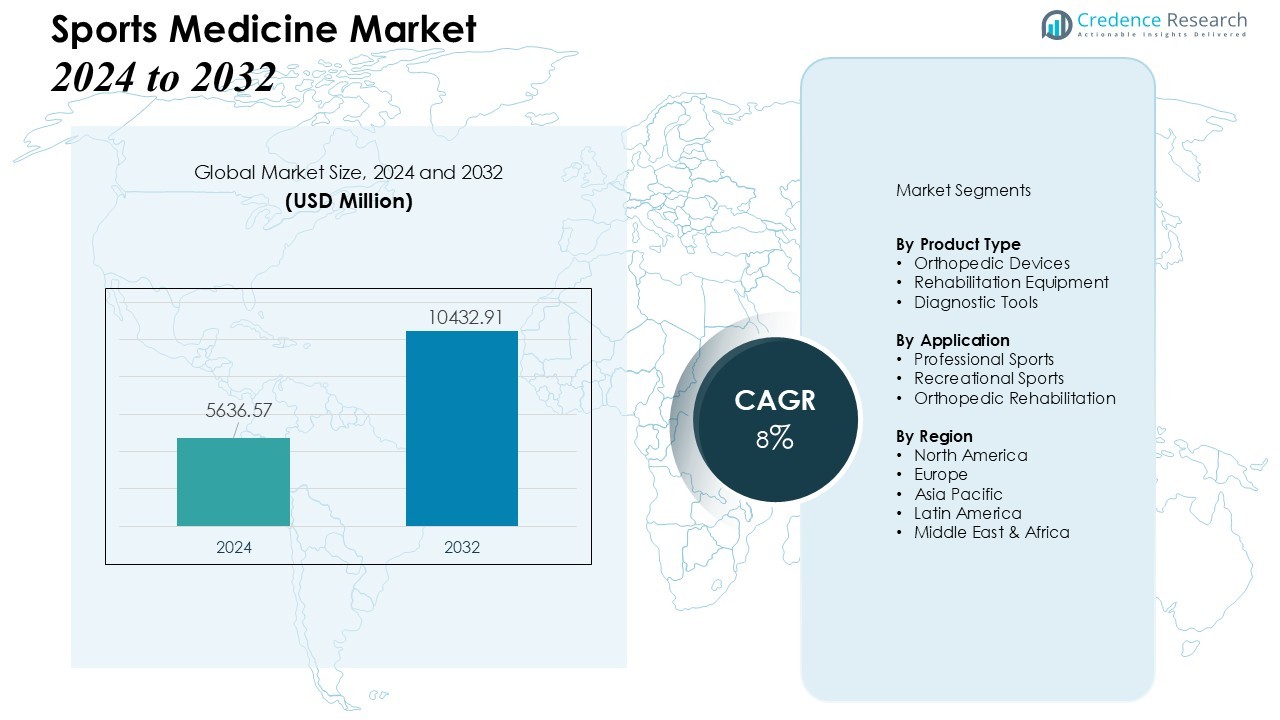
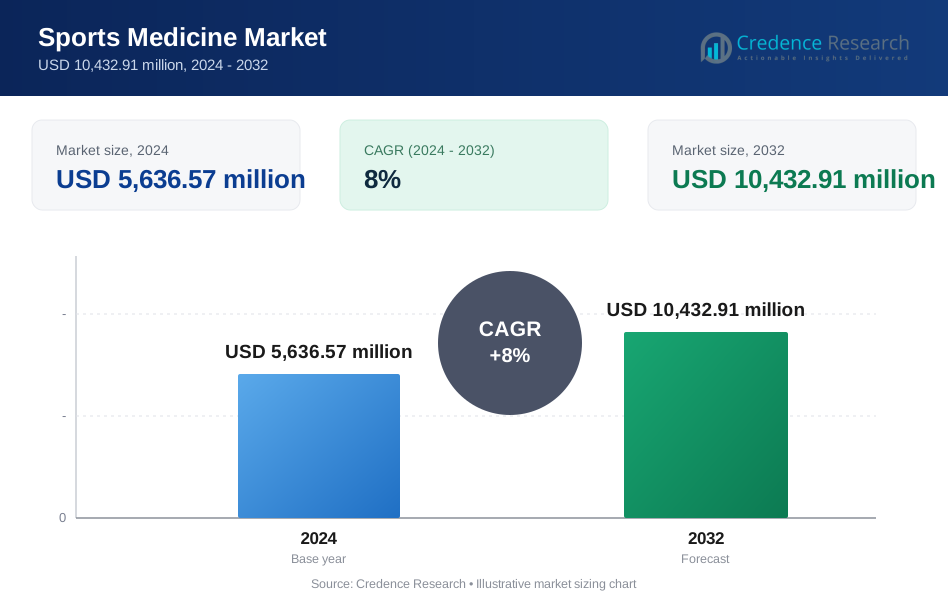
The Sports Medicine Market size was valued at USD 5636.57 million in 2024 and is anticipated to reach USD 10432.91 million by 2032, at a CAGR of 8% during the forecast period (2024-2032).
| REPORT ATTRIBUTE | DETAILS |
|---|---|
| Historical Period | 2020-2023 |
| Base Year | 2024 |
| Forecast Period | 2025-2032 |
| Sports Medicine Market Size 2024 | USD 5636.57 Million |
| Sports Medicine Market, CAGR | 8% |
| Sports Medicine Market Size 2032 | USD 10432.91Million |
The expansion is primarily driven by rising participation in sports and fitness activities worldwide, increased incidence of sports‑related injuries, and greater awareness of preventive and rehabilitative care. Advancements in medical technologies - such as minimally invasive surgical techniques, orthobiologics, and rehabilitation devices - further support demand, alongside growing healthcare expenditures and funding for research and development.
Regionally, North America maintains the largest share of the global market, owing to well‑developed healthcare infrastructure, high per‑capita medical spending, widespread insurance coverage, and strong sports culture. Meanwhile, Asia Pacific emerges as the fastest‑growing region, propelled by growing sports participation, expanding private healthcare, rising awareness of joint preservation and rehabilitation solutions, and increasing elective orthopedic procedures in countries such as India and China.
Market Insights:
- The Sports Medicine Market was valued at USD 5,636.57 million in 2024 and is projected to reach USD 10,432.91 million by 2032, registering a CAGR of 8% during the forecast period. Rising global participation in sports and fitness activities drives market expansion.
- Increasing incidence of sports-related injuries and musculoskeletal conditions fuels demand for diagnostic, reconstructive, and rehabilitation solutions. It extends the user base from professional athletes to the general active population, enhancing adoption of orthopedic devices and therapies.
- Technological advancements in minimally invasive surgical procedures, orthobiologics, wearable rehabilitation devices, and regenerative medicine improve treatment outcomes. It promotes faster recovery, mobility restoration, and personalized patient care, supporting broader market growth.
- The aging active population and expanding healthcare infrastructure, especially in emerging regions, create new demand for musculoskeletal care and injury recovery services. It allows market players to address both preventive and restorative healthcare needs across diverse populations.
- Regionally, North America leads with 42% share due to advanced healthcare systems and high sports participation. Europe holds 28%, supported by awareness and healthcare advancements, while Asia Pacific accounts for 21%, emerging as the fastest-growing region with increasing adoption of orthopedic and rehabilitation solutions.
 Market Drivers:
Rapid Rise in Sports and Fitness Participation Globally
The increasing global focus on health, fitness, and wellness has spurred more individuals to join sports, recreational exercises, and gym‑based workouts. This expansion in active participation drives demand for protective gear, injury prevention, and rehabilitation therapies. As people of all ages engage in physical activities - from amateur fitness enthusiasts to professional athletes - need for medical support, injury management, and performance recovery rises. The Sports Medicine Market benefits directly from higher numbers of participants seeking preventative and therapeutic care for sports‑related strains, tears, and overuse injuries.
- For instance, Smith & Nephew developed the REGENETEN Bioinductive Implant, which augments tendon repair by inducing new tissue formation in rotator cuff injuries in athletes.
Rising Incidence of Sports‑Related Injuries and Musculoskeletal Conditions
With a surge in athletic and recreational physical activity worldwide, the incidence of injuries such as ligament tears, fractures, sprains, and tendonitis has escalated. These injuries often require medical intervention ranging from physiotherapy to advanced surgical repair. Growing occurrence of such injuries prompts demand for diagnostic, reconstructive, and rehabilitative solutions. It also broadens the user base beyond elite athletes to the general active population, boosting demand for orthopedic devices and rehabilitation services.
- For Instance, The Zimmer Biomet ROSA Shoulder system is the world's first robotic assistant for shoulder replacement surgery, specifically designed for use in anatomic and reverse total shoulder arthroplasty procedures.
Advancements in Medical Technology and Treatment Modalities
Technological innovation heavily influences the market. Minimally invasive surgical procedures, arthroscopy devices, bio‑absorbable implants, 3D‑printed prosthetics, and regenerative medicine options - including orthobiologics - have improved treatment outcomes. These innovations shorten recovery time, enhance joint repair, and restore mobility, which encourages adoption. The availability of smarter diagnostics, wearable sensors, and improved post‑operative rehabilitation tools drives broader acceptance of sports medicine solutions.
Growing Demand from Aging Active Population and Broader Healthcare Infrastructure Expansion
An increasing number of older adults are maintaining active lifestyles to preserve mobility and wellness. This demographic shift raises need for treatments addressing degenerative joint conditions, chronic musculoskeletal issues, and injury recovery. Concurrently, expansion of healthcare infrastructure, especially in emerging regions, boosts access to surgical centers, rehabilitation clinics, and advanced orthopedic care. This combination positions the Sports Medicine Market to serve both injury‑related needs among active individuals and age‑related musculoskeletal care across diverse populations.Top of Form
Market Trends:
Integration of Advanced Diagnostic and Therapeutic Technologies Driving Market Growth
The Sports Medicine Market experiences significant momentum from the integration of cutting-edge diagnostic and therapeutic technologies. Wearable devices, AI-powered imaging tools, and smart rehabilitation equipment enable precise injury detection and personalized treatment plans. It allows medical professionals to monitor patient progress, adjust therapies, and improve recovery outcomes efficiently. Minimally invasive surgical techniques, coupled with orthobiologics and regenerative medicine, enhance treatment effectiveness and reduce downtime. Hospitals and sports clinics increasingly adopt robotic-assisted procedures and tele-rehabilitation platforms, expanding accessibility and convenience. The adoption of digital health solutions fosters greater patient engagement and accelerates adoption of advanced sports medicine interventions.
- For instance, Stryker’s Mako robotic-arm assisted surgery platform has been reported to achieve postoperative alignment accuracy within approximately 1–3 degrees in knee arthroplasty and has supported more than 500,000 procedures globally, illustrating how robotic precision and scale are reshaping orthopedic sports interventions.
Expansion of Preventive Care and Rehabilitation Services Across Diverse Regions
The market trends indicate a strong focus on preventive care and post-injury rehabilitation across global healthcare networks. Sports organizations, fitness centers, and wellness programs promote preventive strategies to reduce the risk of musculoskeletal injuries. It supports demand for physiotherapy, orthopedic devices, and structured rehabilitation protocols tailored to individual needs. Growing awareness about early intervention and continuous recovery drives adoption of both in-clinic and home-based rehabilitation services. The Sports Medicine Market also benefits from collaboration between healthcare providers and sports teams to implement injury management programs. Increasing government initiatives and private investments in sports infrastructure further support the development of comprehensive rehabilitation and preventive care offerings.
- For instance, Össur's Unloader One X brace uses a mechanical 3-Point Leverage System with a SmartDosing dial to deliver personalized knee offloading, which has been clinically demonstrated to significantly reduce pain and improve function for osteoarthritis patients during daily activities.
Market Challenges Analysis:
High Cost of Advanced Treatments and Medical Devices Limiting Market Penetration
The Sports Medicine Market faces challenges due to the high cost of advanced surgical procedures, diagnostic tools, and rehabilitation devices. Premium technologies such as robotic-assisted surgeries, orthobiologics, and smart wearable sensors remain expensive for many healthcare providers and patients. It limits adoption in small clinics and developing regions where budget constraints are significant. Insurance coverage for sports medicine interventions is often inconsistent, creating additional barriers for patients seeking specialized care. The cost factor slows the widespread implementation of innovative treatments despite their proven clinical benefits.
Regulatory Complexities and Skilled Workforce Shortages Affecting Market Expansion
Strict regulatory frameworks for medical devices and therapeutic procedures pose challenges for manufacturers and healthcare providers. Compliance with regional approvals, quality standards, and clinical validation processes can delay product launches and market entry. It also requires continuous investment in research and certification, adding to operational burdens. Shortages of trained orthopedic surgeons, physiotherapists, and rehabilitation specialists further restrict service availability. These workforce limitations impede the scalability of sports medicine programs, particularly in emerging markets, affecting overall market growth potential.
Market Opportunities:
Expansion of Digital Health and Tele-Rehabilitation Solutions Creating New Growth Avenues
The Sports Medicine Market is poised to benefit from the rapid adoption of digital health technologies and tele-rehabilitation platforms. Remote monitoring tools, virtual physiotherapy sessions, and AI-driven recovery plans enable patients to access specialized care from home. It increases treatment compliance, enhances recovery outcomes, and reduces the burden on healthcare facilities. Integration of wearable sensors with mobile applications provides real-time data for injury prevention and performance optimization. Rising acceptance of telehealth in both developed and emerging markets offers significant opportunities for service providers to reach broader patient populations. Investment in digital platforms also supports personalized care, improving patient engagement and satisfaction.
Growing Demand for Preventive Care and Sports-Specific Rehabilitation Services
Increasing awareness about injury prevention and the importance of rehabilitation drives opportunities in the Sports Medicine Market. Sports teams, fitness centers, and wellness programs seek specialized preventive care programs to minimize injury risks and maintain athlete performance. It promotes the adoption of advanced therapeutic equipment, orthopedic devices, and customized rehabilitation protocols. Aging populations maintaining active lifestyles further fuel demand for preventive and restorative interventions. Expanding collaborations between healthcare providers, sports organizations, and educational institutions create avenues for research and specialized training programs. These trends collectively support market expansion across diverse geographies and patient segments.
Market Segmentation Analysis:
By Product Type
The Sports Medicine Market is segmented by product type into orthopedic devices, rehabilitation equipment, and diagnostic tools. Orthopedic devices, including implants, braces, and supports, dominate the market due to increasing incidence of musculoskeletal injuries and demand for joint repair solutions. It benefits from continuous technological advancements such as bio-absorbable implants and minimally invasive surgical tools, which improve recovery outcomes. Rehabilitation equipment, including physiotherapy and exercise devices, experiences strong growth driven by rising focus on post-injury recovery and preventive care. Diagnostic tools, such as imaging systems and wearable sensors, support early detection of injuries and optimize treatment planning, boosting adoption among healthcare providers and sports institutions.
- For instance, DJO Global produces devices like the Empi Phoenix, which utilizes neuromuscular electrical stimulation (NMES) to manage muscle atrophy both before and after surgery.
By Application
By application, the market is classified into professional sports, recreational sports, and orthopedic rehabilitation. Professional sports account for a significant share, driven by high injury risk and the need for advanced preventive and therapeutic solutions. It gains traction through partnerships between healthcare providers and sports teams to implement specialized care programs. Recreational sports and fitness activities contribute to market expansion due to increasing global participation and awareness of injury prevention. Orthopedic rehabilitation applications experience growth from aging populations and active individuals seeking restorative care for musculoskeletal conditions. These application segments collectively support the Sports Medicine Market’s broad adoption across diverse patient groups and regions.
- For instance, smart helmets from companies like Riddell incorporate impact sensors (accelerometers) that measure collision forces and wirelessly alert sideline staff (such as athletic trainers or coaches) in real-time during youth, high school, and college football practices and games when a player or series of impacts exceeds a predetermined, position-specific threshold.
Segmentations:
By Product Type
- Orthopedic Devices
- Rehabilitation Equipment
- Diagnostic Tools
By Application
- Professional Sports
- Recreational Sports
- Orthopedic Rehabilitation
By Region
- North America
- U.S.
- Canada
- Mexico
- Europe
- Germany
- France
- U.K.
- Italy
- Spain
- Rest of Europe
- Asia Pacific
- China
- Japan
- India
- South Korea
- South-east Asia
- Rest of Asia Pacific
- Latin America
- Brazil
- Argentina
- Rest of Latin America
- Middle East & Africa
- GCC Countries
- South Africa
- Rest of the Middle East and Africa
Regional Analysis:
North America Leads with Advanced Healthcare Infrastructure
North America holds a 42% share of the Sports Medicine Market, driven by highly developed healthcare infrastructure and widespread access to specialized medical services. High adoption of advanced surgical techniques, rehabilitation devices, and diagnostic tools supports market growth. It benefits from substantial investment in sports medicine research and strong participation in professional and recreational sports. Government initiatives promoting athlete safety and injury prevention further enhance demand for orthopedic care and rehabilitation services. The presence of key market players and well-established distribution networks strengthens regional leadership.
Europe Demonstrates Consistent Growth Through Sports and Healthcare Advancements
Europe accounts for 28% of the global Sports Medicine Market, supported by high awareness of injury prevention and robust sports participation across multiple countries. It gains momentum from advancements in minimally invasive procedures, orthobiologics, and physiotherapy services. Countries such as Germany, the UK, and France have well-structured healthcare systems that support rapid adoption of innovative sports medicine solutions. Collaborative efforts between sports organizations and healthcare providers drive the development of rehabilitation programs and preventive care services. Rising demand for personalized treatment plans fuels market expansion in the region.
Asia Pacific Expands Rapidly with Emerging Opportunities
Asia Pacific holds 21% of the Sports Medicine Market and represents the fastest-growing region, propelled by increasing sports participation and rising awareness of musculoskeletal health. It benefits from expanding private healthcare infrastructure, growing urban populations, and rising disposable income. Emerging countries like India, China, and Japan witness increased adoption of orthopedic devices, rehabilitation services, and minimally invasive surgical procedures. Government initiatives promoting health and fitness contribute to higher demand for preventive care programs. The region offers substantial opportunities for market players to introduce cost-effective, innovative solutions catering to both elite athletes and the general population.Top of Form
Key Player Analysis:
- Smith+Nephew
- Stryker
- Zimmer Biomet
- Arthrex, Inc.
- Enovis (DJO, LLC)
- DePuy Synthes (Johnson & Johnson)
- CONMED Corporation
- Mueller Sports Medicine, Inc.
- Breg, Inc.
- Performance Health
- Bauerfeind
Competitive Analysis:
The Sports Medicine Market exhibits a highly competitive landscape characterized by established global players and emerging regional companies. Leading companies focus on strategic partnerships, mergers, and acquisitions to strengthen their product portfolios and expand market reach. It drives innovation in orthopedic devices, minimally invasive surgical tools, and rehabilitation solutions. Continuous investment in research and development enables companies to launch advanced technologies, enhance treatment efficacy, and improve patient outcomes. Firms also prioritize regional expansion, targeting emerging markets with growing demand for sports medicine services. Price optimization, product differentiation, and superior customer support remain key strategies to maintain market position. Intense competition encourages innovation, enhances service quality, and ensures widespread availability of preventive and therapeutic solutions across both professional athletes and general active populations.
Recent Developments:
- In December 2025, Smith+Nephew announced its RISE strategy, targeting 6-7% underlying revenue CAGR, over $1 billion in free cash flow, and 12-13% ROIC by 2028, with a $200 million non-cash inventory provision to streamline its portfolio.
- In October 2025, Johnson & Johnson announced intent to separate its orthopaedics business, including DePuy Synthes, into an independent company.
Report Coverage:
The research report offers an in-depth analysis based on Product Type, Application and Region. It details leading market players, providing an overview of their business, product offerings, investments, revenue streams, and key applications. Additionally, the report includes insights into the competitive environment, SWOT analysis, current market trends, as well as the primary drivers and constraints. Furthermore, it discusses various factors that have driven market expansion in recent years. The report also explores market dynamics, regulatory scenarios, and technological advancements that are shaping the industry. It assesses the impact of external factors and ITALY economic changes on market growth. Lastly, it provides strategic recommendations for new entrants and established companies to navigate the complexities of the market.
Future Outlook:
- Increasing global participation in sports and fitness activities will continue to drive demand for preventive and therapeutic sports medicine solutions.
- Adoption of advanced diagnostic technologies, including wearable sensors and AI-powered imaging, will improve injury detection and treatment planning.
- Expansion of minimally invasive surgical procedures and orthobiologics will enhance recovery outcomes and reduce patient downtime.
- Rising awareness of musculoskeletal health among aging populations will boost demand for orthopedic rehabilitation and restorative care.
- Integration of digital health and tele-rehabilitation platforms will expand access to specialized care and support remote patient monitoring.
- Growing focus on preventive care programs by sports organizations, fitness centers, and wellness initiatives will strengthen the market.
- Technological innovation in rehabilitation devices and exercise equipment will support personalized and efficient recovery solutions.
- Expansion of private healthcare infrastructure in emerging regions will create new opportunities for market players.
- Strategic partnerships, mergers, and acquisitions among key players will accelerate product development and regional market penetration.
- Increasing government initiatives and funding for sports safety, research, and orthopedic care will sustain long-term growth and adoption of sports medicine solutions.
Request a Free Sample
Fill in your details and we'll send you a free sample report.
- Sample data tables & charts
- Research methodology
Need a Custom Version of This Report?
Tailor the scope, geography, or segments to your exact requirements.
- Custom geography or segment scope
- Direct access to our analyst team
Frequently Asked Questions
What is the current market size for the Sports Medicine Market, and what is its projected size in 2032?
At what Compound Annual Growth Rate is the Sports Medicine Market projected to grow between 2024 and 2032?
Which segment held the largest share in the Sports Medicine Market in 2024?
What are the primary factors fueling the growth of the Sports Medicine Market?
Who are the leading companies in the Sports Medicine Market?
Table of Content
Chapter 1 Market Segmentation
- 1.1 Segmentation Framework
- 1.1.1 Product and Service Classification
- 1.1.2 Application and End-Use Classification
- 1.1.3 Technology and Solution Classification
- 1.1.4 Customer and Distribution Channel Classification
- 1.1.5 Geographic Segmentation
- 1.1.6 Market Segment Definitions and Boundaries
Chapter 2 Introduction
- 2.1 Report Objectives and Scope
- 2.2 Product Definition and Industry Terminology
- 2.3 Market Inclusions and Exclusions
- 2.4 Research Process
- 2.4.1 Primary Research and Expert Interviews
- 2.4.2 Secondary Research and Source Review
- 2.4.3 Top-Down and Bottom-Up Estimation
- 2.4.4 Data Triangulation and Verification
- 2.5 Market Size Measurement Basis
- 2.5.1 2024: USD 5,636.57 million → 2032: USD 10,432.91 million
- 2.6 Historical and Forecast Reference Periods
- 2.6.1 Base Year: 2024
- 2.6.2 Forecast Period: 2024-2032
- 2.7 Research Assumptions and Limitations
Chapter 3 Executive Summary
- 3.1 Market Snapshot and Key Findings
- 3.2 Base-Year Market Size, 2024
- 3.3 Forecast Market Size, 2032
- 3.4 Revenue and Volume Growth Outlook
- 3.5 Key Demand and Supply Indicators
- 3.6 Leading Market Segments
- 3.7 Fastest-Growing Market Opportunities
- 3.8 Regional Performance Highlights
- 3.9 Technology and Industry Transformation
- 3.10 Competitive Landscape Summary
- 3.11 Analyst View and Strategic Implications
Chapter 4 Global Sports Medicine Market Trends and Developments
- 4.1 Historical Industry Development
- 4.2 Recent Market Trends and Developments
- 4.3 Demand and Customer Behavior Trends
- 4.4 Technology and Product Innovation
- 4.5 Artificial Intelligence, Automation and Digitalization
- 4.6 Local Manufacturing and Supply Chain Realignment
- 4.7 Industry Partnerships, Mergers and Acquisitions
- 4.8 Sustainability and Circular Economy Developments
- 4.9 Government and Private Sector Investment Trends
- 4.10 Emerging Business Models and Commercialization
- 4.11 Industry Developments and Announcements
Chapter 5 Global Sports Medicine Market Production, Supply and Demand Analysis
- 5.1 Demand Trend and Consumption Analysis
- 5.2 Demand Forecast, 2024-2032
- 5.3 Production and Output Trend
- 5.4 Production and Output Forecast, 2024-2032
- 5.5 Installed Capacity and Capacity Utilization
- 5.6 Company-Wise Production Plants and Statistics
- 5.6.1 Installed Production Capacity
- 5.6.2 Actual Production
- 5.6.3 Planned Capacity and Expansion Targets
- 5.7 Supply Chain Structure and Procurement Trends
- 5.8 Supply-Demand Gap and Bottlenecks
- 5.9 Import Dependence and Sourcing Structure
- 5.10 Contract Manufacturing and Outsourcing
- 5.11 Regional Supply and Demand Concentration
Chapter 6 Global Sports Medicine Market Pricing Analysis
- 6.1 Pricing Structure and Measurement
- 6.2 Historical Pricing Trends
- 6.3 Pricing Outlook, 2024-2032
- 6.4 Average Selling Price and Unit Economics
- 6.5 Pricing by Product and Market Segment
- 6.6 Geographic Pricing Differences
- 6.7 Key Input, Energy, Labor and Logistics Costs
- 6.8 Contract Pricing and Purchasing Models
- 6.9 Pricing Sensitivity and Competitive Positioning
- 6.10 Price, Margin and Profitability Implications
Chapter 7 Global Sports Medicine Market Dynamics
- 7.1 Market Growth Drivers
- 7.1.1 Demand-Side Drivers
- 7.1.2 Technology and Innovation Drivers
- 7.1.3 Infrastructure and Investment Drivers
- 7.1.4 Regulatory and Policy Drivers
- 7.2 Market Restraints
- 7.2.1 Cost and Affordability Constraints
- 7.2.2 Technology and Adoption Barriers
- 7.2.3 Supply Chain and Operational Constraints
- 7.3 Market Challenges
- 7.3.1 Competitive Pressure and Margin Erosion
- 7.3.2 Skills, Infrastructure and Implementation Gaps
- 7.4 Emerging Market Opportunities
- 7.5 Market Dynamics Impact and Time-Horizon Assessment
Chapter 8 Global Sports Medicine Value Chain Analysis
- 8.1 Industry Value Chain Overview
- 8.2 Upstream Suppliers and Critical Inputs
- 8.3 Technology and Component Providers
- 8.4 Manufacturing or Service Delivery
- 8.5 Distribution, Channel Partners and Integrators
- 8.6 Downstream Applications and End Users
- 8.7 Value Addition and Profit Pools
- 8.8 Vertical Integration and Outsourcing
- 8.9 Supplier Concentration and Risk
- 8.10 Supply Chain Localization and Resilience
Chapter 9 Global Sports Medicine Market Regulations and Policies
- 9.1 Relevant Laws, Standards and Compliance Frameworks
- 9.2 Product, Service, Safety and Quality Requirements
- 9.3 Government Policies, Incentives and Subsidies
- 9.4 Imports, Exports and Trade Barriers
- 9.5 Public Procurement and Local Content Requirements
- 9.6 Environmental and Sustainability Compliance
- 9.7 Upcoming Policy Changes and Market Implications
Chapter 10 Global Sports Medicine Market Hotspots and Opportunities
- 10.1 Market Opportunity Mapping and Growth Hotspots
- 10.2 High-Growth Applications and Customer Groups
- 10.3 Underserved Markets and White-Space Opportunities
- 10.4 Emerging Technology and Product Opportunities
- 10.5 New Capacity and Investment Hotspots
- 10.6 Market Entry and Expansion Opportunities
- 10.7 Distribution and Partnership Opportunities
- 10.8 Near-Term and Long-Term Commercial Potential
- 10.9 Opportunity Attractiveness and Execution Risks
Chapter 11 Global Sports Medicine Market Outlook, 2024-2032
- 11.1 Market Size and Analysis
- 11.1.1 Revenue (Market Measurement: 2024: USD 5,636.57 million → 2032: USD 10,432.91 million)
- 11.1.2 Market Volume and Quantity Sold
- 11.1.3 Historical Market Size
- 11.1.4 Base-Year Market Size, 2024
- 11.2 Market Forecast, 2024-2032
- 11.2.1 Revenue Forecast to 2032
- 11.2.2 Volume Forecast to 2032
- 11.2.3 CAGR and Year-on-Year Growth
- 11.2.4 Incremental Revenue Opportunity
- 11.3 Forecast Assumptions and Scenario Analysis
- 11.3.1 Base-Case Forecast
- 11.3.2 Optimistic and Conservative Scenarios
- 11.3.3 Technology, Pricing and Policy Sensitivities
- 11.4 Market Attractiveness and Growth Outlook
Chapter 12 Global Sports Medicine Market Segmentation and Outlook
- 12.1 Segmentation Summary and Market Shares, 2024
- 12.2 Largest and Fastest-Growing Segments
- 12.3 Segment Growth Comparison
- 12.4 Segment Attractiveness and Priority Matrix
Chapter 13 Global Sports Medicine Geographic Market Outlook, 2024-2032
- 13.1 Regional Market Size and Share, 2024
- 13.2 Regional Market Forecast, 2024-2032
- 13.3 Regional Pricing, Production and Demand Differences
- 13.4 North America
- 13.4.1 United States
- 13.4.2 Canada
- 13.4.3 Mexico
- 13.5 Europe
- 13.5.1 Germany
- 13.5.2 France
- 13.5.3 Italy
- 13.5.4 United Kingdom
- 13.5.5 Spain
- 13.5.6 Poland
- 13.5.7 Russia
- 13.5.8 Netherlands
- 13.5.9 Belgium
- 13.5.10 Sweden
- 13.5.11 Denmark
- 13.5.12 Norway
- 13.5.13 Rest of Europe
- 13.6 Asia Pacific
- 13.6.1 China
- 13.6.2 India
- 13.6.3 Japan
- 13.6.4 South Korea
- 13.6.5 Thailand
- 13.6.6 Indonesia
- 13.6.7 Vietnam
- 13.6.8 Malaysia
- 13.6.9 Australia
- 13.6.10 Rest of Asia Pacific
- 13.7 Latin America
- 13.7.1 Brazil
- 13.7.2 Argentina
- 13.7.3 Colombia
- 13.7.4 Chile
- 13.7.5 Rest of Latin America
- 13.8 Middle East
- 13.8.1 Saudi Arabia
- 13.8.2 United Arab Emirates
- 13.8.3 Turkey
- 13.8.4 Israel
- 13.8.5 Iran
- 13.8.6 Rest of the Middle East
- 13.9 Africa
- 13.9.1 South Africa
- 13.9.2 Egypt
- 13.9.3 Nigeria
- 13.9.4 Morocco
- 13.9.5 Rest of Africa
- 13.10 Regional Investment, Policy and Supply Chain Differences
- 13.11 Regional Competitive Landscape
- 13.12 Geographic Growth Hotspots
Chapter 14 Global Sports Medicine Technology, Innovation and Sustainability Outlook
- 14.1 Technology Landscape and Maturity
- 14.2 Product, Process and Service Innovation
- 14.3 AI, Automation and Digital Tools in the Industry
- 14.4 Technology Adoption and Performance Benchmarking
- 14.5 Innovation Pipeline and R&D Investment
- 14.6 Patent and Intellectual Property Trends
- 14.7 Energy Efficiency and Resource Management
- 14.8 Sustainability, Recycling and Circularity
- 14.9 Technology Roadmap, 2024-2032
- 14.10 Risks of Obsolescence and Technology Substitution
Chapter 15 Global Sports Medicine Market Key Strategic Imperatives
- 15.1 Growth and Market Entry Priorities
- 15.2 High-Return Products and Segments
- 15.3 Pricing, Profitability and Cost Optimization
- 15.4 Technology Investment and Product Differentiation
- 15.5 Supply Chain Localization and Resilience
- 15.6 Distribution and Customer Acquisition
- 15.7 Partnership, Acquisition and Capacity Strategy
- 15.8 Regional Expansion Priorities
- 15.9 Short-, Medium- and Long-Term Actions
Chapter 16 Competition Outlook
- 16.1 Industry Competition Characteristics
- 16.2 Market Structure and Concentration
- 16.3 Market Share and Competitive Positioning, 2024
- 16.4 Company-Wise Revenue and Product Benchmarking
- 16.5 Production and Service Capacity Benchmarking
- 16.6 Technology, Pricing and Differentiation
- 16.7 Regional Footprint and Distribution Strength
- 16.8 Mergers, Acquisitions and Strategic Alliances
- 16.9 New Entrants and Competitive Threats
- 16.10 Porter's Five Forces and Industry Attractiveness
- 16.11 Competitive Outlook, 2024-2032
Chapter 17 Company Profiles
- 17.1 Company Coverage and Selection Criteria
- 17.2 Leading Market Participants – Standard Profile Structure
- 17.2.1 Business Description
- 17.2.2 Company Ownership and Geographic Presence
- 17.2.3 Product and Service Portfolio
- 17.2.4 Manufacturing and Operating Footprint
- 17.2.5 Production Capacity and Expansion Plans
- 17.2.6 Financial Performance and Investment
- 17.2.7 Market Share and Competitive Position
- 17.2.8 Technology and Innovation Capabilities
- 17.2.9 Strategic Alliances or Partnerships
- 17.2.10 Recent Developments
- 17.2.11 Growth Strategy and Outlook
- 17.3 Other Relevant Market Participants
Note: Every listed company is profiled on the structure shown under the first company. The company list is preliminary and may change based on research findings, market developments, data availability and client requirements.
Chapter 18 Disclaimer
- 18.1 Research and Forecast Disclaimer
- 18.2 Data Source and Estimation Limitations
Note: The depth of individual sections depends on data availability for this market. Volume, capacity, trade and other unit-based metrics are included where applicable.

