
| REPORT ATTRIBUTE | DETAILS |
|---|---|
| Historical Period | 2019-2022 |
| Base Year | 2023 |
| Forecast Period | 2024-2032 |
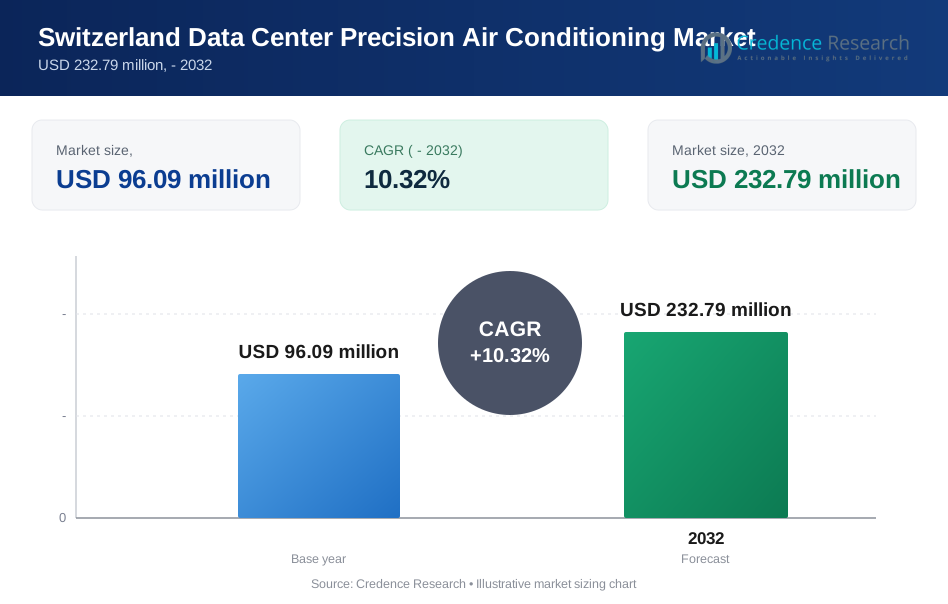
| Switzerland Data Center Precision Air Conditioning Market Size 2023 | USD 96.09 Million |
| Switzerland Data Center Precision Air Conditioning Market, CAGR | 10.32% |
| Switzerland Data Center Precision Air Conditioning Market Size 2032 | USD 232.79 Million |
Market Overview
The Switzerland Data Center Precision Air Conditioning Market is projected to grow from USD 96.09 million in 2023 to an estimated USD 232.79 million by 2032, representing a compound annual growth rate (CAGR) of 10.32% from 2024 to 2032. This growth is driven by the increasing demand for energy-efficient cooling solutions as data center operations expand to accommodate rising digitalization and cloud computing needs.
The market is propelled by several key drivers, including the growing need to maintain optimal temperatures in high-density data centers and the emphasis on sustainability through energy-efficient technologies. Trends such as the integration of IoT-enabled monitoring systems and automation in precision air conditioning are gaining traction, offering enhanced operational efficiency and reduced energy consumption. Moreover, regulatory standards promoting green data center initiatives are encouraging investments in eco-friendly cooling solutions, further fueling market growth.
Geographically, major urban areas such as Zurich and Geneva are leading in data center developments due to their strong connectivity infrastructure and growing IT service demands. These regions serve as hubs for large-scale data center projects, driving the demand for precision air conditioning systems. Key players in the market include Schneider Electric, Vertiv Group, STULZ GmbH, Mitsubishi Electric, and Airedale International Air Conditioning, who are continually innovating to deliver advanced and energy-efficient cooling solutions tailored to data center requirements.
Market Insights
- The Switzerland data center precision air conditioning market is projected to grow from USD 96.09 million in 2023 to USD 232.79 million by 2032, with a CAGR of 10.32% driven by increasing data center investments.
- Energy-efficient cooling systems, such as free cooling and liquid cooling technologies, are gaining popularity as data center operators prioritize sustainability and cost reduction.
- Strict environmental regulations and Switzerland’s commitment to carbon neutrality are compelling data centers to adopt advanced, eco-friendly precision air conditioning solutions.
- High initial investment and maintenance costs for precision cooling systems remain significant restraints, particularly for small and medium-sized data center operators.
- Regions like Zurich and Geneva dominate the market due to their robust connectivity infrastructure and high concentration of data centers, while Basel and Lausanne are emerging as growth hubs.
- The integration of IoT, AI-driven predictive maintenance, and modular cooling designs is transforming the market, enhancing efficiency and reliability.
- The growth of edge computing and decentralized data center infrastructure is driving demand for scalable and compact precision air conditioning solutions, creating new opportunities.
Market Drivers
Rising Demand for Energy-Efficient and Sustainable Cooling Solutions
The growing emphasis on sustainability and energy efficiency in Switzerland has become a pivotal driver of the precision air conditioning market. Data centers consume significant amounts of energy, with cooling systems accounting for a substantial share of this consumption. For instance, the information and communication technology (ICT) sector represents nearly 5% of the country's total electricity consumption, with data centers contributing significantly to this figure. More than half of the electricity consumed by the ICT sector is attributed to server rooms and data centers, underscoring their substantial energy demands. Precision air conditioning systems, designed to provide targeted cooling while minimizing energy waste, are increasingly preferred over conventional HVAC systems.Switzerland's strict environmental regulations and commitments to carbon neutrality further amplify this demand. Businesses and data center operators are under pressure to reduce their carbon footprints and operational costs. Advanced precision air conditioning technologies, incorporating variable speed compressors, free cooling, and liquid cooling systems, provide innovative solutions to meet these challenges. This trend aligns with the country's broader sustainability goals, fostering widespread adoption of energy-efficient cooling solutions that not only enhance operational performance but also contribute to a greener future.
Rapid Expansion of Data Centers and Increased IT Workloads
Switzerland's status as a hub for global IT services, cloud computing, and financial operations is driving the rapid expansion of data centers. Companies are investing heavily in infrastructure to accommodate the growing volume of digital data and the increasing reliance on high-performance computing. As data centers grow in size and complexity, they generate significant heat loads that require efficient cooling solutions. For instance, with 86 data centers in Switzerland—ranking second in Europe for data center density per capita—these facilities are projected to double their energy usage within the next five years due to rising digitalization and IT workloads.Precision air conditioning systems are essential in maintaining precise temperature and humidity levels, ensuring optimal performance and reliability of IT equipment. The rising adoption of edge computing and the proliferation of AI and machine learning workloads have further intensified the need for advanced cooling technologies, as these applications demand high computational power, resulting in greater heat generation. Consequently, investing in precision cooling solutions is critical for businesses aiming to support their expanding IT infrastructure while managing energy consumption effectively.
Technological Advancements in Precision Cooling Systems
The precision air conditioning market in Switzerland is benefiting significantly from technological innovations. Manufacturers are integrating cutting-edge technologies such as Internet of Things (IoT), artificial intelligence (AI), and machine learning (ML) to enhance the performance of cooling systems. For example, IoT-enabled precision air conditioning systems allow data center operators to monitor and control cooling systems remotely, improving operational efficiency. These advancements enable real-time monitoring, predictive maintenance, and automation, ensuring consistent performance while reducing downtime and operational costs.AI-driven algorithms can predict temperature fluctuations and adjust cooling output dynamically, optimizing energy use. This capability is particularly vital as data centers face increasing demands for computational power due to the rise of AI applications. Furthermore, these technological improvements not only meet the demands of modern data centers but also contribute to the growing adoption of precision air conditioning solutions in Switzerland. By leveraging these innovations, businesses can enhance their operational efficiency while aligning with sustainability goals.
Supportive Regulatory Environment and Industry Standards
Switzerland's regulatory framework strongly supports the adoption of precision air conditioning systems in data centers. The government has implemented stringent energy efficiency standards and incentives to encourage businesses to adopt green technologies. For instance, compliance with industry standards such as ASHRAE (American Society of Heating, Refrigerating, and Air-Conditioning Engineers) guidelines emphasizes the importance of precision air conditioning systems in maintaining optimal thermal conditions within data centers.These measures align with global sustainability initiatives and Switzerland's goal to reduce greenhouse gas emissions significantly. Additionally, as data centers are projected to double their energy usage within five years due to increased digitalization demands, adherence to these regulations becomes essential for achieving certifications and maintaining operational credibility. This supportive regulatory environment drives investments in advanced cooling solutions that not only enhance energy efficiency but also position Swiss businesses as leaders in sustainable practices within the global market.
Market Trends
Adoption of Liquid Cooling Technologies
One of the most significant trends in the Switzerland data center precision air conditioning market is the growing adoption of liquid cooling technologies. As data centers scale up their processing capabilities, traditional air-based cooling systems struggle to meet the increasing heat dissipation requirements efficiently. Liquid cooling, which uses water or other fluids to remove heat directly from server components, offers superior cooling performance and energy efficiency compared to conventional systems. For instance, in Switzerland, the implementation of liquid cooling technologies has become increasingly relevant as data centers face the challenge of managing heat generated by high-performance computing (HPC) and artificial intelligence (AI) workloads. This trend is underscored by significant investments in innovative cooling solutions, such as a Swiss startup that recently secured funding to develop metal foam cooling technology, enhancing heat exchange efficiency in liquid cooling systems. Furthermore, leading data center operators are adopting liquid cooling to address the rising energy demands associated with AI advancements, indicating a shift towards more sustainable and efficient cooling practices. This growing reliance on liquid cooling not only improves thermal management but also supports higher server densities, ultimately enabling data centers to operate more effectively in a competitive landscape.
Integration of IoT and Smart Monitoring Systems
The integration of Internet of Things (IoT) technology and smart monitoring systems into precision air conditioning solutions is transforming the market. IoT-enabled systems allow real-time monitoring of key parameters such as temperature, humidity, and airflow. These systems provide data center operators with actionable insights, enabling proactive maintenance, energy optimization, and rapid response to anomalies.For instance, Swiss data centers are increasingly incorporating IoT-enabled smart monitoring systems that facilitate real-time tracking of environmental parameters like temperature and humidity. This integration allows operators to optimize energy consumption and improve operational efficiency; a notable example is Arimax Distribution AG's recent incorporation of AI-driven optimization software into their cooling solutions, which enhances thermal monitoring capabilities and significantly reduces energy costs. This proactive approach not only minimizes downtime but also extends the lifespan of equipment by enabling predictive maintenance strategies. As energy costs and sustainability become critical concerns in Switzerland, IoT-based precision cooling systems are gaining widespread acceptance, ultimately transforming how data centers manage their operations.
Shift Toward Modular and Scalable Cooling Solutions
The shift toward modular and scalable cooling systems is another notable trend in the Switzerland data center precision air conditioning market. As businesses adopt hybrid and edge computing models, the need for flexible cooling solutions has grown. Modular precision air conditioning systems, designed to be deployed incrementally, allow data centers to expand capacity without overhauling their existing infrastructure.For instance, the growing demand for modular and scalable cooling solutions is evident in Switzerland's small and medium-sized data centers, which prioritize flexibility and cost-efficiency. These modular systems can be deployed incrementally, allowing for easy expansion without extensive infrastructure overhauls. This adaptability is particularly beneficial for edge data centers that support decentralized computing models. By enabling operators to activate only the necessary cooling capacity when needed, these modular solutions contribute significantly to energy savings while meeting the dynamic demands of modern IT environments. The trend towards modularity not only aligns with business needs but also enhances operational efficiency and sustainability within the Swiss data center landscape.
Emphasis on Sustainability and Green Data Centers
Sustainability has emerged as a key priority for data centers in Switzerland, driven by stringent government regulations, industry standards, and corporate environmental goals. Precision air conditioning systems that incorporate energy-efficient technologies are increasingly in demand.For instance, Switzerland's commitment to sustainability is reflected in the increasing adoption of precision air conditioning systems that utilize energy-efficient technologies. The country’s cool climate enables data centers to leverage free cooling methods effectively, reducing reliance on traditional active cooling systems during colder months. Additionally, many operators are implementing heat recovery systems to repurpose waste heat for district heating applications, aligning with national initiatives aimed at promoting renewable energy and carbon neutrality. This focus on sustainability not only meets regulatory requirements but also supports corporate environmental goals within the industry. By adopting these innovative practices, Swiss data centers are not only enhancing operational efficiency but also contributing positively to global efforts toward reducing carbon footprints and promoting sustainable growth.
Market Challenges
High Initial Investment and Maintenance Costs
The high upfront costs associated with precision air conditioning systems pose a significant challenge for the Switzerland data center market. These systems, designed to provide targeted and efficient cooling, often require advanced technologies such as IoT-enabled monitoring, liquid cooling, and modular configurations. While these features enhance operational efficiency and sustainability, their implementation demands substantial financial investment in equipment, installation, and skilled labor. Additionally, ongoing maintenance costs add to the financial burden. Precision air conditioning systems require regular upkeep, including software updates, component replacements, and system optimization, to ensure consistent performance. Small and medium-sized data centers, which form a growing segment of Switzerland’s market, often face difficulties in allocating sufficient budgets for such expenditures. This cost barrier can delay adoption and limit market penetration, particularly for operators without substantial capital reserves.
Increasing Complexity of Cooling Requirements
The growing complexity of data center cooling requirements is another critical challenge. Modern data centers in Switzerland are becoming denser and more diverse, driven by the rise of high-performance computing (HPC), artificial intelligence (AI), and edge computing workloads. These applications generate significantly more heat than traditional workloads, necessitating advanced cooling solutions capable of maintaining precise thermal conditions. Meeting these demands requires innovative technologies such as liquid cooling, which can be difficult to implement in existing facilities. Retrofitting older data centers to accommodate advanced cooling systems often involves extensive modifications, leading to operational disruptions and additional costs. Moreover, balancing energy efficiency with effective heat dissipation remains a technical challenge, especially as operators strive to align with Switzerland’s strict environmental regulations and energy efficiency standards. These complexities increase the need for specialized expertise, further complicating market adoption.
Market Opportunities
Growing Demand for Energy-Efficient Solutions
The increasing emphasis on sustainability and energy efficiency presents a significant opportunity for the Switzerland data center precision air conditioning market. As data centers become larger and more power-intensive, operators are seeking cooling solutions that minimize energy consumption while maintaining optimal performance. Precision air conditioning systems equipped with advanced technologies such as variable speed compressors, free cooling, and heat recovery systems are well-positioned to meet this demand. Switzerland’s stringent environmental regulations and national commitments to carbon neutrality further drive the need for sustainable cooling solutions. This creates a lucrative opportunity for manufacturers and service providers to develop and offer energy-efficient, eco-friendly products tailored to the specific requirements of the Swiss market. Leveraging these opportunities can help companies capture a growing customer base committed to green data center initiatives.
Expansion of Edge Computing and High-Density Data Centers
The rapid adoption of edge computing and high-performance workloads, such as artificial intelligence (AI) and machine learning, is driving the need for advanced cooling technologies. These trends are fueling the growth of high-density and edge data centers across Switzerland, creating demand for compact, scalable, and highly efficient precision air conditioning systems. Manufacturers can capitalize on this opportunity by designing modular cooling solutions that cater to evolving infrastructure needs. Innovations in liquid cooling and IoT-enabled systems further enhance market prospects, allowing operators to ensure reliable performance while maintaining cost-effectiveness. As the digital transformation accelerates, these opportunities offer significant growth potential for businesses within the precision air conditioning sector.
Market Segmentation Analysis
By Type
Based on type, Computer Room Air Conditioners (CRACs) dominate the Switzerland data center precision air conditioning market due to their reliability and ability to maintain consistent environmental conditions, making them ideal for large-scale data centers handling significant cooling loads. The adoption of advanced CRAC units with energy-saving features like variable speed drives and free cooling is increasing, driven by the country’s emphasis on sustainability and cost efficiency. Meanwhile, Close Coupled Computer Room Air Handlers (CCRAHs) are gaining popularity for their localized cooling capabilities, which minimize energy wastage and enhance thermal management. These systems are particularly suited for high-density racks and edge data centers, where efficient heat dissipation is essential, and their demand is further bolstered by the growing preference for modular and scalable data center designs in Switzerland.
By Capacity
Based on capacity, the Switzerland data center precision air conditioning market caters to diverse needs. Systems below 100 kW serve small-scale and edge data centers, driven by the rise of decentralized computing, offering cost-effective cooling for compact spaces and aligning with the requirements of small and medium enterprises. The 100-200 kW segment addresses mid-sized data centers, growing due to the demand for cloud computing and colocation services, providing a balance between performance and energy efficiency. Systems in the 200-300 kW range are critical for medium to large data centers, fueled by the adoption of high-performance computing (HPC) and artificial intelligence (AI) workloads, which generate significant heat. For capacities above 300 kW, advanced cooling solutions like liquid cooling and heat recovery are essential for managing massive heat loads in large-scale and hyperscale data centers, a segment experiencing rapid growth in Switzerland.
Segments
Based on Type:
- Computer Room Air Conditioners (CRACs)
- Close Coupled Computer Room Air Handlers (CCRAHs)
Based on Capacity:
- Below 100 kW
- 100-200 kW
- 200-300 kW
- Above 300 kW
Based on Free Cooling Capacity:
- Direct Free Cooling
- Indirect Free Cooling
Based on Deployment:
- New Installations
- Retrofits
- Upgrades
Based on Application:
- Data Centers
- Server Rooms
- Telecommunication Facilities
Based on Region:
- Zurich
- Geneva
- Basel
- Lausanne
Regional Analysis
Zurich (40%)
Zurich leads the Switzerland data center precision air conditioning market due to its status as the country's financial and technological hub. The region hosts a significant number of data centers, including hyperscale facilities and colocation centers, driven by the demand from banking, insurance, and IT sectors. Zurich’s advanced connectivity infrastructure, coupled with the presence of international corporations, fuels investments in high-performance data centers. Precision air conditioning systems in Zurich are characterized by the adoption of energy-efficient technologies and compliance with stringent environmental regulations.
Geneva (25%)
Geneva ranks second in market share, supported by its strong international business environment and strategic location near European markets. The city is a hub for multinational organizations, driving demand for reliable data center services. Geneva's data centers often prioritize green initiatives, creating a robust market for sustainable precision air conditioning solutions. The focus on compliance with energy efficiency standards has spurred the adoption of advanced cooling technologies, such as free cooling and liquid cooling, in this region.
Key players
- Asetek
- STULZ GmbH
- Coolcentric
- Rittal GmbH & Co. KG
- Nortek Air Solutions, LLC
- Schneider Electric SE
- Vertiv Holdings Co
- Green
- JASC Contracting
Competitive Analysis
The Switzerland data center precision air conditioning market is highly competitive, with several global and regional players vying for market share. Established companies like Schneider Electric, Vertiv Holdings Co, and STULZ GmbH dominate the market due to their extensive product portfolios, technological advancements, and strong presence in key regions such as Zurich and Geneva. Specialized players such as Asetek and Coolcentric focus on niche cooling technologies, including liquid cooling solutions, addressing the growing demand for high-density and sustainable cooling. Regional companies like JASC Contracting cater to specific local needs, providing customized solutions for small and medium-sized data centers. The competition is driven by innovation, with companies leveraging IoT, AI, and energy-efficient technologies to gain a competitive edge. Regulatory compliance and sustainability goals further push players to invest in advanced solutions, ensuring growth opportunities for both established leaders and emerging players.
Recent Developments
- In October 2024, STULZ GmbH launched its new line of precision air conditioning units designed specifically for high-performance data centers, emphasizing energy efficiency and sustainability in line with Switzerland's environmental regulations.
- In September 2024, Coolcentric reported successful deployments of its cooling systems in several Swiss data centers, showcasing their effectiveness in reducing energy consumption while maintaining optimal operating conditions.
- In July 2024, Nortek announced the launch of a new precision air conditioning system that integrates IoT capabilities for real-time monitoring and optimization of cooling performance.
- In June 2024, Schneider Electric introduced an AI-driven cooling management platform aimed at optimizing energy use across Swiss data centers, aligning with sustainability goals.
- In April 2024, Green, a company specializing in eco-friendly technologies, launched a new line of sustainable cooling systems. These systems are designed to minimize environmental impact while ensuring efficient temperature control within data centers.
- In March 2024, JASC completed a major project for a Swiss telecom provider, implementing advanced cooling solutions that significantly improved energy efficiency and reduced operational costs.
Market Concentration and Characteristics
The Switzerland data center precision air conditioning market exhibits a moderately concentrated structure, dominated by a mix of global leaders and regional specialists. Established multinational corporations such as Schneider Electric, Vertiv Holdings Co, and STULZ GmbH hold significant market shares due to their advanced product offerings and strong customer bases in key regions like Zurich and Geneva. These players leverage their technological expertise to address the growing demand for energy-efficient and sustainable cooling solutions. Meanwhile, regional and niche players, including JASC Contracting and Coolcentric, focus on tailored solutions for smaller data centers and edge computing facilities, enhancing market diversity. The market is characterized by rapid innovation, driven by the adoption of IoT, AI-enabled monitoring, and liquid cooling technologies. High entry barriers, due to substantial initial investments and technical expertise requirements, further shape the competitive landscape, ensuring dominance by established players while providing opportunities for specialized providers.
Report Coverage
The research report offers an in-depth analysis based on Type, Capacity, Free Cooling Capacity, Deployment, Application, and Region. It details leading market players, providing an overview of their business, product offerings, investments, revenue streams, and key applications. Additionally, the report includes insights into the competitive environment, SWOT analysis, current market trends, as well as the primary drivers and constraints. Furthermore, it discusses various factors that have driven market expansion in recent years. The report also explores market dynamics, regulatory scenarios, and technological advancements that are shaping the industry. It assesses the impact of external factors and global economic changes on market growth. Lastly, it provides strategic recommendations for new entrants and established companies to navigate the complexities of the market.
Future Outlook
- The market is projected to grow steadily, driven by increasing digitalization, cloud adoption, and the expansion of high-density data centers across Switzerland.
- Data center operators will increasingly prioritize energy-efficient and environmentally friendly cooling solutions to align with Switzerland’s stringent environmental regulations and carbon neutrality goals.
- The demand for liquid cooling systems is expected to rise as high-performance computing (HPC) and artificial intelligence (AI) workloads generate significant heat.
- IoT-enabled precision air conditioning systems with AI-based monitoring and predictive maintenance will become standard, enhancing efficiency and reducing operational costs.
- The growth of edge computing will drive demand for compact, modular, and scalable precision air conditioning solutions to meet decentralized cooling requirements.
- Manufacturers will continue to innovate, introducing advanced features such as free cooling, heat recovery, and adaptive cooling technologies to enhance performance.
- The development of hyperscale data centers in major cities like Zurich and Geneva will spur demand for advanced cooling systems capable of handling large heat loads.
- While Zurich and Geneva will remain dominant, other regions such as Basel and Lausanne will see increased data center investments, boosting market growth.
- Companies will form strategic partnerships to leverage technological expertise and expand their market presence, focusing on tailored solutions for specific industry needs.
- Stringent energy efficiency standards and government incentives for green technologies will shape product development and drive further adoption of sustainable cooling systems.
Request a Free Sample
Fill in your details and we'll send you a free sample report.
- Sample data tables & charts
- Research methodology
Need a Custom Version of This Report?
Tailor the scope, geography, or segments to your exact requirements.
- Custom geography or segment scope
- Direct access to our analyst team
Frequently Asked Questions
What is the market size of the Switzerland data center precision air conditioning market in 2023 and 2032, and what is the projected CAGR?
What are the key drivers of growth in the Switzerland data center precision air conditioning market?
How is sustainability influencing the adoption of precision air conditioning systems?
Which geographical regions dominate the Switzerland data center precision air conditioning market?
Who are the key players in the Switzerland data center precision air conditioning market?
Table of Content
Chapter 1. Report Introduction
- 1.1 Report Description & Purpose
- 1.1.1 Report Title & Market Definition
- 1.1.2 Unique Selling Propositions (USP) & Key Differentiators
- 1.1.3 Value Proposition for Stakeholders
- 1.2 Research Objectives
- 1.2.1 Market Sizing Objectives (Volume & Revenue)
- 1.2.2 Segmentation Objectives
- 1.2.3 Competitive Intelligence Objectives
- 1.2.4 Forecast & Scenario Objectives
- 1.3 Report Scope
- 1.3.1 Switzerland Data Center Precision Air Conditioning Scope – Types & Subtypes Covered
- 1.3.2 Geographic Scope – Regions & Countries Covered
- 1.3.3 Historical Period, Base Year & Forecast Period (the historical period; forecast to 2032)
- 1.3.4 Inclusions & Exclusions
- 1.4 HS Code & Classification Framework
- 1.5 Currency, Units & Pricing Basis
- 1.6 Target Stakeholders
- 1.7 Limitations & Assumptions
Chapter 2. Executive Summary
- 2.1 Global Switzerland Data Center Precision Air Conditioning Market Snapshot
- 2.1.1 Market Size – Historical (the historical period) & Forecast (2032) (base year: USD 96.09 million → 2032: USD 232.79 million)
- 2.1.2 Volume & Revenue – Global Totals
- 2.1.3 Key Market Highlights – Top Five Facts
- 2.2 Switzerland Data Center Precision Air Conditioning Market Segmentation Snapshot
- 2.2.1 Market Split by Region – vs. 2032
- 2.3 Competitive Snapshot
- 2.3.1 Top 10 Players by Revenue Share –
- 2.3.2 Top 10 Players by Volume Share –
- 2.3.3 Recent Strategic Developments (18-Month Summary)
- 2.4 Key Investment Highlights & Strategic Conclusions
Chapter 3. Switzerland Data Center Precision Air Conditioning Market Dynamics & Industry Analysis
- 3.1 Market Overview & Context
- 3.1.1 Switzerland Data Center Precision Air Conditioning Market Position in the Broader Automotive Value Chain
- 3.1.2 OEM vs. Replacement Market Dynamics
- 3.1.3 Market Maturity & Development Stage by Region
- 3.2 Switzerland Data Center Precision Air Conditioning Market Drivers
- 3.3 Switzerland Data Center Precision Air Conditioning Market Restraints & Challenges
- 3.4 Switzerland Data Center Precision Air Conditioning Market Opportunities
- 3.5 Porter's Five Forces Analysis
- 3.5.1 Threat of New Entrants
- 3.5.2 Bargaining Power of Suppliers
- 3.5.3 Bargaining Power of Buyers
- 3.5.4 Threat of Substitutes
- 3.5.5 Competitive Rivalry – Intensity Assessment
- 3.6 Switzerland Data Center Precision Air Conditioning Value Chain Analysis
- 3.6.1 Upstream – Raw Material/Input Suppliers
- 3.6.1.1 Raw Material/Input 1
- 3.6.1.2 Raw Material/Input 2
- 3.6.1.3 Raw Material/Input 3
- 3.6.2 Midstream – Production/Manufacturing/Service Delivery
- 3.6.2.1 Production/Process Overview
- 3.6.2.2 Key Facility Locations & Capacity by Manufacturer
- 3.6.3 Downstream – Distribution & End Consumer
- 3.6.3.1 Primary Channel – B2B/OEM
- 3.6.3.2 Secondary Channels – Dealer, Retail, Online, Direct
- 3.6.4 Value Chain Profitability Analysis
- 3.6.1 Upstream – Raw Material/Input Suppliers
- 3.7 PESTEL Analysis
- 3.7.1 Political Factors
- 3.7.2 Economic Factors
- 3.7.3 Social Factors
- 3.7.4 Technological Factors
- 3.7.5 Environmental Factors
- 3.7.6 Legal Factors
- 3.8 Switzerland Data Center Precision Air Conditioning Supply Chain Analysis
- 3.8.1 Raw Material/Input Supply Risk Assessment
- 3.8.2 Manufacturing Concentration Risk (Geographic Exposure)
- 3.8.3 Trade Disruption Impact Analysis
- 3.9 Regulatory & Policy Landscape
Note: The regulatory and policy landscape section covers regulations based on their applicability to the market, Switzerland Data Center Precision Air Conditioning category, geography, and scope of the study. Only regulatory frameworks with a material impact on operations, compliance, trade, sustainability, or market access are analyzed in detail.
Chapter 4. Key Investment Pockets & Opportunity Analysis
- 4.1 Switzerland Data Center Precision Air Conditioning Market Attractiveness Analysis
- 4.1.1 By Region – Investment Attractiveness Matrix (Volume × CAGR)
- 4.2 Absolute Revenue Growth Opportunity
- 4.2.1 By Region – Absolute USD Growth Through 2032
- 4.3 Incremental Volume Opportunity
- 4.3.1 By Region – Incremental Volume Through 2032
- 4.3.2 Segment – Incremental Volume
- 4.4 Emerging Submarket Opportunity Deep Dive (Subject to Applicability)
- 4.5 Emerging Market Opportunity Scorecards
- 4.5.1 United States
- 4.5.2 Europe
- 4.5.3 Asia
- 4.5.4 Middle East & Africa
Note: Emerging Market Opportunity Scorecards will be included based on relevance and strategic importance. Regions listed are indicative and may vary depending on data availability and market dynamics.
Chapter 5. Switzerland Data Center Precision Air Conditioning Import-Export Analysis & Trade Flows
- 5.1 Global Trade Overview
- 5.1.1 Global Export Value by Country (the historical period)
- 5.1.2 Global Export Volume by Country (the historical period)
- 5.1.3 Global Import Value by Country (the historical period)
- 5.1.4 Global Import Volume by Country (the historical period)
- 5.1.5 Net Trade Balance by Country (the historical period)
- 5.2 Export Analysis – Segment
- 5.2.1 Type 1 (HS Code)
- 5.2.2 Type 2 (HS Code)
- 5.2.3 Type 3 (HS Code)
- 5.2.4 Type 4 (HS Code)
- 5.2.5 Type 5 (HS Code)
- 5.3 Import Analysis – Segment
- 5.3.1 Type 1 (HS Code)
- 5.3.2 Type 2 (HS Code)
- 5.3.3 Type 3 (HS Code)
- 5.3.4 Type 4 (HS Code)
- 5.3.5 Type 5 (HS Code)
- 5.4 Average Unit Trade Prices
- 5.4.1 Average Export Price – Segment & Country
- 5.4.2 Average Import Price – Segment & Source Country
- 5.4.3 Price Trends (the historical period)
- 5.5 Key Trade Route Analysis
- 5.5.1 Trade Route 1
- 5.5.2 Trade Route 2
- 5.5.3 Trade Route 3
- 5.5.4 Trade Route 4
- 5.5.5 Trade Route 5
- 5.6 Trade Policy Impact Assessment
- 5.6.1 US Anti-Dumping & Section 301 Tariffs
- 5.6.2 EU Customs Union Impact
- 5.6.3 Major Free Trade Agreements
- 5.6.4 USMCA Rules of Origin
Note: Trade policy analysis will be included only where relevant to the Switzerland Data Center Precision Air Conditioning market.
Chapter 6. Competitive Landscape & Company Benchmarking
- 6.1 Switzerland Data Center Precision Air Conditioning Market Concentration & Structure
- 6.1.1 Herfindahl-Hirschman Index (HHI) – vs.
- 6.1.2 Tier 1, Tier 2 & Tier 3 Market Structure
- 6.1.3 Global, Regional & Local Player Dynamics
- 6.2 Switzerland Data Center Precision Air Conditioning Market Share Analysis –
- 6.2.1 Global Revenue Share by Company
- 6.2.2 Global Volume Share by Company
- 6.2.3 Regional Revenue Share
- 6.2.4 Market Share Evolution ( vs. )
- 6.2.5 OEM Segment Share by Company
- 6.2.6 Replacement Segment Share by Company
- 6.3 Production/Delivery Capacity & Facility Analysis
- 6.3.1 Global Installed Capacity
- 6.3.2 Capacity Utilization Rates
- 6.3.3 Production/Output Volume
- 6.3.4 Facility Locations & Capacity Map
- 6.3.5 Planned Capacity Additions
- 6.4 Switzerland Data Center Precision Air Conditioning Competitive Benchmarking Matrix
- 6.4.1 Revenue, Volume, CAGR & Profitability Comparison
- 6.4.2 Channel Revenue Mix
- 6.4.3 Geographic Revenue Exposure
- 6.4.4 R&D Intensity
- 6.4.5 Sustainability Maturity
- 6.5 Strategic Developments in Switzerland Data Center Precision Air Conditioning (Last 24 Months)
- 6.5.1 Mergers, Acquisitions & Divestments
- 6.5.2 New Switzerland Data Center Precision Air Conditioning Launches
- 6.5.3 Facility Expansions
- 6.5.4 Strategic Alliances, Joint Ventures & Partnerships
- 6.5.5 Distribution Expansion & Market Entry
- 6.5.6 Sustainability & ESG Initiatives
- 6.6 Competitive Strategy Mapping
- 6.6.1 Leader, Challenger, Follower & Niche Classification
- 6.6.2 Pricing Strategy Comparison
- 6.6.3 Channel Strategy Matrix
Note: Strategic developments are included based on their materiality and the availability of reliable information.
Chapter 7. Global Switzerland Data Center Precision Air Conditioning Market – By Distribution Channel
- 7.1 Segment Overview
- 7.1.1 Volume & Revenue Split by Channel ( & 2032)
- 7.1.2 Channel Mix Evolution (2032)
Chapter 8. Regional Market Analysis – Global Overview
- 8.1 Global Regional Overview
- 8.1.1 Regional Volume Share
- 8.1.2 Regional Revenue Share
- 8.1.3 Regional Volume by Region
- 8.1.4 Regional Revenue by Region
- 8.1.5 Regional Forecast Through 2032
- 8.2 Cross-Regional Segment Analysis
- 8.2.1 By Distribution Channel
- 8.2.2 By Brand/Price Tier
Chapter 9. North America Switzerland Data Center Precision Air Conditioning Market
- 9.1 United States
- 9.2 Canada
- 9.3 Mexico
Chapter 10. Europe Switzerland Data Center Precision Air Conditioning Market
- 10.1 Germany
- 10.2 France
- 10.3 Italy
- 10.4 United Kingdom
- 10.5 Spain
- 10.6 Poland
- 10.7 Russia
- 10.8 Netherlands
- 10.9 Belgium
- 10.10 Sweden
- 10.11 Denmark
- 10.12 Norway
- 10.13 Rest of Europe
Chapter 11. Asia Pacific Switzerland Data Center Precision Air Conditioning Market
- 11.1 China
- 11.2 India
- 11.3 Japan
- 11.4 South Korea
- 11.5 Thailand
- 11.6 Indonesia
- 11.7 Vietnam
- 11.8 Malaysia
- 11.9 Australia
- 11.10 Rest of Asia Pacific
Chapter 12. Latin America Switzerland Data Center Precision Air Conditioning Market
- 12.1 Brazil
- 12.2 Argentina
- 12.3 Colombia
- 12.4 Chile
- 12.5 Rest of Latin America
Chapter 13. Middle East Switzerland Data Center Precision Air Conditioning Market
- 13.1 Saudi Arabia
- 13.2 United Arab Emirates
- 13.3 Turkey
- 13.4 Israel
- 13.5 Iran
- 13.6 Rest of the Middle East
Chapter 14. Africa Switzerland Data Center Precision Air Conditioning Market
- 14.1 South Africa
- 14.2 Egypt
- 14.3 Nigeria
- 14.4 Morocco
- 14.5 Rest of Africa
Chapter 15. Switzerland Data Center Precision Air Conditioning Company Profiles
- 15.1 [Company 01]
- 15.1.1 Company Overview
- 15.1.2 Key Management Personnel
- 15.1.3 Products & Services Portfolio
- 15.1.4 Financial Performance
- 15.1.5 Key Market Focus & Geographic Presence
- 15.1.6 Recent Developments & Strategic Initiatives
Note: The company profile list is preliminary and may change based on research findings, market developments, data availability, and client requirements.
Chapter 16. Appendices
- Appendix A – List of Abbreviations & Acronyms
- Appendix B – Industry Classification Code Reference – Full Series
- Appendix C – Production & Capacity Data Tables
- Appendix D – End-Use & Demand Base Tables
- Appendix E – Consumption & Replacement Rate Assumptions
- Appendix F – ASP Reference Tables
- Appendix G – Manufacturing & Facility Database
- Appendix H – Import-Export Data Tables
- Appendix I – Regulatory Summary Tables
- Appendix J – Primary Research Participant List (Anonymized)
- Appendix K – Primary Research Questionnaire Framework
- Appendix L – Data Sources & Bibliography
- Appendix M – Market Size Divergence & Source Comparison
Chapter 17. Research Methodology
- 17.1 Research Framework & Philosophy
- 17.2 Secondary Research – Sources, Hierarchy & Data Extraction
- 17.3 Data Modeling – Bottom-Up & Top-Down Market Sizing
- 17.4 Primary Research – Stakeholder Framework, LOI & Sample Sizes
- 17.5 Forecast Methodology – Regression, Scenario & Sensitivity Analysis
- 17.6 Quality Control – Four-Layer Validation Framework
- 17.7 Limitations & Standard Assumptions
- 17.8 Disclaimer
