Market Overview
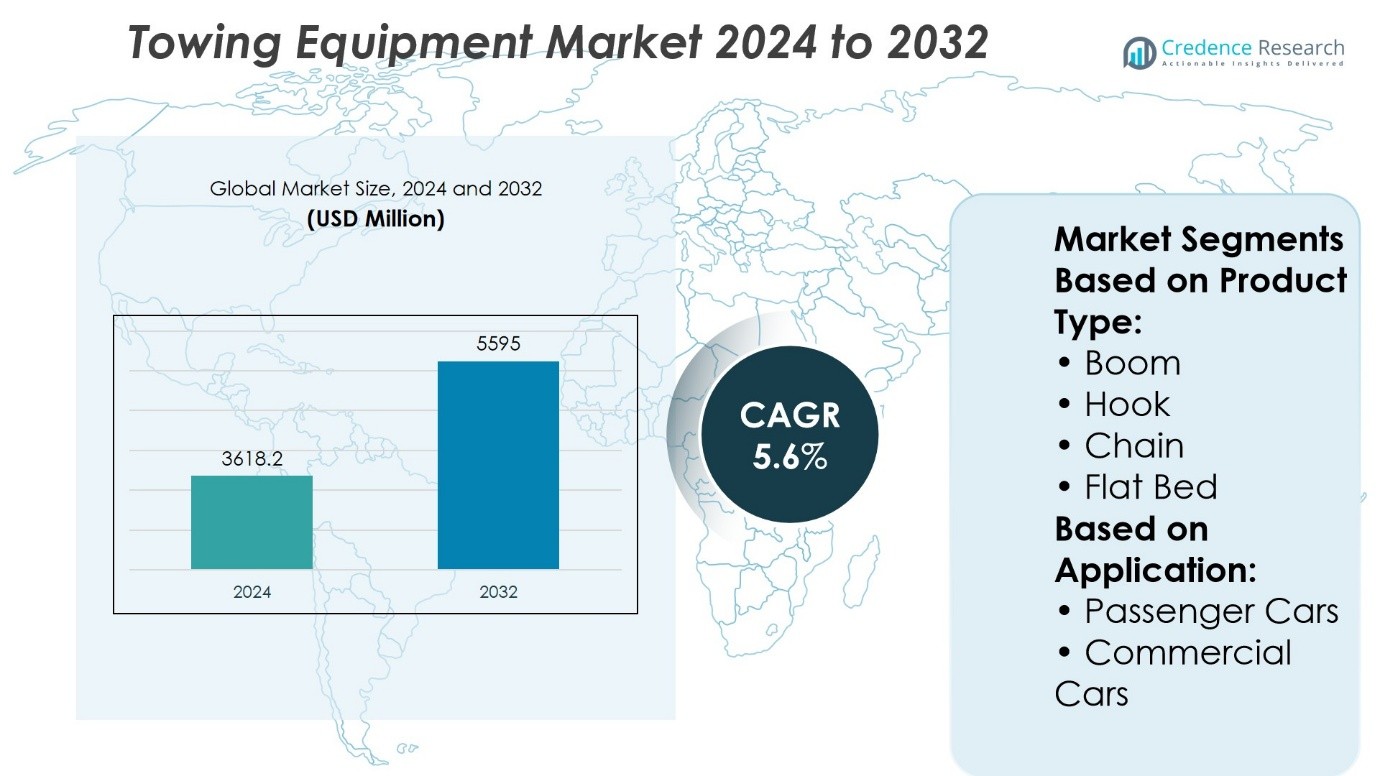
Towing Equipment Market size was valued at USD 3618.2 million in 2024 and is anticipated to reach USD 5595 million by 2032, at a CAGR of 5.6% during the forecast period.
| REPORT ATTRIBUTE | DETAILS |
|---|---|
| Historical Period | 2020-2024 |
| Base Year | 2024 |
| Forecast Period | 2025-2032 |
| Towing Equipment Market Size 2024 | USD 3618.2 Million |
| Towing Equipment Market, CAGR | 5.6% |
| Towing Equipment Market Size 2032 | USD 5595 Million |
The Towing Equipment Market grows through rising demand for commercial and recreational vehicles, supported by expanding e-commerce logistics and infrastructure development. Increasing adoption of advanced hitch systems, lightweight materials, and enhanced safety features strengthens market potential. Electric vehicle integration drives innovation in compatible towing solutions, while off-road and leisure activities boost specialized equipment demand. Automation in manufacturing improves product consistency and cost efficiency. Regulatory requirements for safety and performance accelerate technological advancements. Growing aftermarket demand for replacements and upgrades further sustains revenue. Emerging markets contribute to expansion, with rising urbanization and logistics needs creating new growth opportunities across regions.
The Towing Equipment Market has a strong presence across North America, Europe, Asia Pacific, Latin America, and the Middle East & Africa, with North America leading due to high commercial vehicle usage and advanced infrastructure. Europe follows with robust automotive manufacturing, while Asia Pacific shows rapid growth from expanding logistics and recreational activities. Key players include CURT Manufacturing LLC, Brink Group, Bosal Nederland BV, B&W Trailer Hitches, Andersen Hitches, Hopkins Manufacturing Corp., and Fastway Trailer Products, driving innovation and competitive product offerings globally.
Market Insights
- Towing Equipment Market size was valued at USD 3618.2 million in 2024 and is anticipated to reach USD 5595 million by 2032, at a CAGR of 5.6%.
- Demand grows with rising commercial and recreational vehicle usage and expanding e-commerce logistics.
- Trends include adoption of advanced hitch systems, lightweight materials, and integration with electric vehicles.
- Competitive landscape features CURT Manufacturing LLC, Brink Group, Bosal Nederland BV, B&W Trailer Hitches, Andersen Hitches, Hopkins Manufacturing Corp., and Fastway Trailer Products.
- Restraints include fluctuating raw material costs and dependency on automotive production cycles.
- North America leads the market due to high commercial vehicle usage, followed by Europe with strong automotive manufacturing and Asia Pacific with rapid logistics growth.
- Emerging markets show high potential, driven by urbanization, infrastructure development, and increasing aftermarket replacement demand.
Market Drivers
Rising Vehicle Ownership and Road Traffic Incidents
The Towing Equipment Market benefits from increasing global vehicle ownership and the corresponding rise in road accidents and breakdowns. Higher traffic density in urban and suburban areas creates steady demand for roadside assistance and towing services. It supports the need for reliable towing systems in both light-duty and heavy-duty applications. Emergency service providers and fleet operators invest in advanced tow trucks and accessories to improve response times. Growth in commercial transportation further drives requirements for heavy towing solutions. Expanding insurance coverage for roadside services strengthens the adoption of towing equipment across regions.
- For instance, Brink Towing Systems delivered more than 6,000 tow bars for the Ford Ranger in a single month and is on track to produce 100,000 tow bars this year.
Growth in Commercial and Industrial Logistics Operations
The Towing Equipment Market gains momentum from the expansion of logistics, construction, and mining sectors. Companies operating in these industries require specialized towing and recovery equipment to manage large vehicles and machinery. It enables safe transport of damaged or non-operational assets from worksites to repair facilities. Heavy-duty towing systems with enhanced load capacity support operations in demanding environments. Equipment durability and compliance with safety regulations remain critical for industrial users. These factors ensure sustained investment in towing solutions from commercial fleet operators.
- For instance, Brink Towing Systems manufactures over 1 million tow bars annually, delivering more than 2,000 different types and introducing around 200 new models each year.
Technological Advancements in Towing Systems and Accessories
The Towing Equipment Market advances with the integration of hydraulic systems, wireless controls, and load-monitoring technologies. Manufacturers focus on developing equipment that improves operational efficiency and reduces manual intervention. It offers features such as adjustable boom arms, self-loading mechanisms, and enhanced braking systems for improved safety. Smart towing accessories provide real-time data on towing capacity and vehicle stability. Innovations in material engineering enhance strength while reducing overall weight. These improvements increase productivity for towing service providers and fleet managers.
Expansion of Recreational Vehicle and Boat Transportation
The Towing Equipment Market sees strong demand from the growing popularity of recreational vehicles, trailers, and boats. Outdoor lifestyle trends and tourism activities encourage investments in personal towing accessories and hitches. It supports the safe movement of leisure assets across long distances and varied terrains. Manufacturers introduce corrosion-resistant materials and quick-install hitch systems to enhance user convenience. Dealerships and aftermarket suppliers expand product offerings to cater to diverse towing needs. Seasonal peaks in travel and tourism further stimulate equipment sales in this segment.
Market Trends
Integration of Advanced Hydraulic and Remote-Control Systems
The Towing Equipment Market is adopting advanced hydraulic mechanisms and remote-control capabilities to improve operational efficiency. Hydraulic systems provide greater lifting capacity and smoother operation for both light and heavy-duty applications. It enhances safety by reducing manual handling and minimizing operator fatigue. Remote-control features allow precise maneuvering of tow arms and winches from a safe distance. Manufacturers focus on integrating real-time monitoring systems for load management. These advancements cater to professional towing services and fleet operators seeking higher productivity.
- For instance, Miller Industries fields the world’s broadest portfolio of towing and recovery vehicles-ranging from 8,000‑lb light‑duty wreckers to trucks rated at 100,000 lb and 200,000 lb.
Shift Toward Lightweight and High-Strength Materials
The Towing Equipment Market is trending toward the use of high-strength steel alloys, aluminum, and composite materials. This shift reduces vehicle weight without compromising structural integrity. It supports improved fuel efficiency for tow trucks and compliance with weight regulations. Corrosion-resistant materials extend service life and reduce maintenance costs. Manufacturers develop modular components to enable easier replacement and customization. The focus on material innovation aligns with industry demands for durability and cost-effectiveness.
- For instance, CURT Manufacturing distributes more than 1.2 million trailer hitches each year, including its AlumaLite aluminum models.
Growth in Demand from Recreational and Lifestyle Segments
The Towing Equipment Market benefits from rising interest in recreational vehicles, boats, and trailers. Outdoor lifestyle trends drive the need for hitches, tow bars, and specialized hauling accessories. It supports safe and efficient transport of leisure assets across long distances. Seasonal travel surges create higher sales for aftermarket towing solutions. Manufacturers introduce quick-install and user-friendly designs to appeal to individual consumers. This segment expansion complements the professional towing services market.
Expansion of Global Roadside Assistance and Recovery Services
The Towing Equipment Market is experiencing growth from the expansion of roadside assistance networks and vehicle recovery services. Insurance companies and automotive clubs invest in modern tow trucks equipped with advanced recovery tools. It drives demand for versatile towing platforms capable of handling diverse vehicle types. Urbanization and higher traffic density increase the frequency of towing operations. Service providers seek equipment that balances performance with ease of operation. This trend sustains steady demand across both developed and emerging markets.
Market Challenges Analysis
High Operational Costs and Capital Investment Requirements
The Towing Equipment Market faces challenges from the substantial capital investment needed for advanced tow trucks, hydraulic systems, and specialized recovery tools. Fleet operators must allocate significant budgets for acquisition, maintenance, and compliance with safety regulations. It becomes more complex when factoring in fuel costs, insurance, and periodic equipment upgrades. Smaller service providers often struggle to match the technological capabilities of larger competitors. Maintenance of heavy-duty towing equipment demands skilled labor and quality parts, further increasing operational expenses. These financial pressures can restrict expansion plans and limit service coverage in certain regions.
Regulatory Compliance and Supply Chain Disruptions
The Towing Equipment Market must navigate stringent regulations related to road safety, weight limits, and equipment certification in multiple jurisdictions. Meeting these standards requires precise engineering and adherence to manufacturing guidelines. It faces additional risks from supply chain disruptions affecting the availability of chassis, hydraulic components, and electronic control systems. Global shipping delays, raw material shortages, and price volatility can extend lead times and raise costs. Dependence on specialized suppliers makes timely procurement challenging during periods of high demand. Balancing compliance with operational efficiency remains a critical issue for industry players.
Market Opportunities
Expansion of Roadside Assistance and Recovery Networks
The Towing Equipment Market can benefit from the growing expansion of organized roadside assistance and vehicle recovery services. Insurance companies, automotive clubs, and fleet operators are investing in modern tow trucks and specialized recovery tools to improve service efficiency. It can leverage this trend by offering advanced hydraulic systems, remote-control features, and multi-vehicle towing capabilities. Rising vehicle ownership and increased long-distance travel create consistent demand for reliable towing solutions. Partnerships with large service providers can secure steady sales channels. The ability to meet diverse operational requirements enhances the market’s long-term growth prospects.
Growth in Recreational Vehicle and Specialty Transport Segments
The Towing Equipment Market has opportunities in the expanding recreational vehicle, trailer, and boat transport segments. Outdoor lifestyle trends and tourism growth drive the need for personal towing accessories and high-capacity hitches. It can capture this demand by introducing lightweight, corrosion-resistant materials and quick-install systems for consumer convenience. Manufacturers that tailor products for off-road and specialty applications can address niche markets effectively. Collaborations with dealerships and aftermarket distributors can broaden market reach. Seasonal demand peaks in tourism-heavy regions further strengthen revenue potential for towing equipment suppliers.
Market Segmentation Analysis:
By Product Type
The Towing Equipment Market includes Boom, Hook & Chain, Flat Bed, Integrated, and Wheel Lift systems. Boom systems deliver strong lifting capacity for recovery operations in challenging terrains. Hook & Chain models remain relevant for older or damaged vehicles, though their usage has declined due to potential vehicle damage. Flat Bed designs offer secure and damage-free transport, making them a preferred choice for high-value or all-wheel-drive vehicles. Integrated tow trucks combine boom and wheel lift functions, offering efficiency for quick recovery and heavy-duty applications. Wheel Lift systems use hydraulic mechanisms to lift vehicles by the tires, providing cost-effective and versatile solutions for short-distance towing.
- For instance, Miller Industries manufactures over 2.8 million lbs of towing and recovery equipment annually, with its Century® 1150 rotator offering a boom rating.
By Application
It serves both Passenger Cars and Commercial Cars segments. Passenger car applications focus on roadside assistance, accident recovery, and transport of non-operational vehicles. This segment benefits from increased urban vehicle density and the expansion of roadside service providers. Commercial car applications demand higher towing capacity, durability, and adaptability for fleet support, logistics operations, and large-scale recovery. Growing commercial fleet sizes and stricter road safety compliance drive adoption of robust and multi-functional towing equipment in this category.
- For instance, CAA (Canadian Automobile Association) responds to more than 2.5 million roadside service requests each year.
Segments:
Based on Product Type:
- Boom
- Hook
- Chain
- Flat Bed
Based on Application:
- Passenger Cars
- Commercial Cars
Based on the Geography:
- North America
- U.S.
- Canada
- Mexico
- Europe
- Germany
- France
- U.K.
- Italy
- Spain
- Rest of Europe
- Asia Pacific
- China
- Japan
- India
- South Korea
- South-east Asia
- Rest of Asia Pacific
- Latin America
- Brazil
- Argentina
- Rest of Latin America
- Middle East & Africa
- GCC Countries
- South Africa
- Rest of the Middle East and Africa
Regional Analysis
North America
North America holds the largest share of the towing equipment market at approximately 38%. The region benefits from a strong network of roadside assistance providers, extensive use of recreational vehicles, and large commercial fleet operations. The United States leads with widespread adoption of advanced towing technologies, including trailer sway control systems, GPS-enabled fleet monitoring, and hydraulic lift innovations. A well-developed automotive service industry, combined with strict road safety regulations, supports consistent demand for reliable and high-capacity towing solutions. Seasonal demand peaks in regions prone to harsh weather, where towing services are essential for accident recovery and breakdown assistance.
Europe
Europe accounts for around 29% of global market share, with its growth shaped by stringent safety standards, a mature automotive manufacturing base, and high consumer awareness of vehicle safety. Flatbed and integrated towing systems are in strong demand for luxury and high-performance vehicles that require damage-free transport. Germany, France, and the UK are leading markets, supported by robust road infrastructure and a focus on sustainable equipment designs. Regional regulations encourage the use of eco-friendly tow trucks with reduced emissions, driving innovation in electric and hybrid towing vehicles. Fleet operators in Europe prioritize advanced control systems to enhance efficiency and reduce operational downtime.
Asia Pacific
Asia Pacific holds close to 27% of the market, driven by rapid urbanization, infrastructure growth, and expanding commercial transportation fleets in countries such as China, India, and Japan. Rising middle-class income levels and increasing vehicle ownership create higher demand for passenger car towing services, while industrial growth fuels the need for heavy-duty towing in commercial applications. Local manufacturers offer cost-effective and adaptable equipment suited to diverse terrains and vehicle types. Logistics expansion and cross-border trade within the region add to the demand for efficient towing solutions, particularly in ports, highways, and urban centers.
Latin America
Latin America accounts for roughly 7% of the towing equipment market, with Brazil, Argentina, and Chile as the primary contributors. Demand in the region is supported by rising vehicle ownership, expansion of commercial fleets, and ongoing improvements in road infrastructure. Urban areas with high traffic density, such as São Paulo, Buenos Aires, and Santiago, see consistent use of towing services for both passenger cars and light commercial vehicles.Flatbed and integrated towing systems are gaining popularity due to their ability to transport vehicles without damage, which is particularly important for servicing imported and high-value cars. The region also has growing adoption of hydraulic lift and wheel lift systems in fleet operations, as they offer versatility and lower maintenance costs.
Middle East & Africa
The Middle East & Africa together contribute around 4% of the towing equipment market. While the share is smaller compared to other regions, the demand is steady in industries such as oil and gas, mining, and construction, where heavy-duty vehicle recovery is essential. Urban centers in the Gulf countries see consistent use of towing services for luxury vehicles, supported by high per capita income and premium car ownership. Infrastructure development projects across Africa are gradually increasing the need for commercial towing services, particularly in logistics and freight transport.
Key Player Analysis
- Fastway Trailer Products
- Hopkins Manufacturing Corp.
- Andersen Hitches
- Bosal Nederland BV
- Brinkgroup
- Butler Products
- CURT Manufacturing LLC
- CAMCO MANUFACTURING LLC.
- B and W Trailer Hitches
- Demco Products
Competitive Analysis
The towing equipment market features include Andersen Hitches, B and W Trailer Hitches, Bosal Nederland BV, Brinkgroup, Butler Products, CAMCO Manufacturing LLC., CURT Manufacturing LLC, Demco Products, Fastway Trailer Products, and Hopkins Manufacturing Corp. The towing equipment market is highly competitive, with manufacturers focusing on product innovation, durability, and expanding service networks to capture greater market share. Companies compete by offering diverse product portfolios that cater to both passenger and commercial vehicle needs, emphasizing safety, ease of use, and adaptability to various towing conditions. Advanced materials, corrosion-resistant finishes, and ergonomic designs are increasingly adopted to improve performance and extend product lifespan. Strategic partnerships with automotive OEMs, along with strong aftermarket distribution channels, enhance brand reach and customer retention. Continuous investment in research and development supports the integration of smart features, improved load management, and compliance with evolving global safety regulations, ensuring market players remain competitive in both mature and emerging regions.
Recent Developments
- In February 2025, CURT Manufacturing LLC (USA) announced in February 2025 the launch of its SmartLink Towing System.
- In January 2025, Hayman Reese (Australia) showed its X-Bar Urban Series, a compact heavy-duty towbar designed for SUVs used in both urban and off-road settings.
- In October 2023, Hopkins Towing Solutions, located in Kansas, disclosed the acquisition of Hayes Towing Electronics, a trailer brake control company situated in Arab, Alabama.
- In September 2023, New England TruckMaster, an established and reputable supplier of light, medium, and heavy-duty tow trucks and recovery vehicles, was acquired after operating.
Market Concentration & Characteristics
The Towing Equipment Market shows a moderately concentrated structure, with a mix of global leaders and specialized regional manufacturers competing on product quality, innovation, and distribution strength. It features established brands with strong OEM partnerships and extensive aftermarket networks, alongside smaller players focusing on niche applications and cost-efficient solutions. The market serves both passenger and commercial vehicle segments, demanding products that meet diverse capacity, safety, and operational requirements. Product differentiation is driven by advanced materials, ergonomic designs, and integration of safety-enhancing technologies. Competition remains intense in mature markets where regulations and customer expectations drive continuous product upgrades, while emerging markets offer growth potential through infrastructure expansion and increasing vehicle ownership. It benefits from consistent demand in roadside assistance, logistics, and recovery services, ensuring steady revenue opportunities across varied economic cycles.
Report Coverage
The research report offers an in-depth analysis based on Product Type, Application and Geography. It details leading market players, providing an overview of their business, product offerings, investments, revenue streams, and key applications. Additionally, the report includes insights into the competitive environment, SWOT analysis, current market trends, as well as the primary drivers and constraints. Furthermore, it discusses various factors that have driven market expansion in recent years. The report also explores market dynamics, regulatory scenarios, and technological advancements that are shaping the industry. It assesses the impact of external factors and global economic changes on market growth. Lastly, it provides strategic recommendations for new entrants and established companies to navigate the complexities of the market.
Future Outlook
- Demand will grow with increasing commercial vehicle production.
- Electric vehicle adoption will boost demand for compatible towing systems.
- Safety regulations will drive innovation in towing equipment design.
- Lightweight materials will gain preference to improve fuel efficiency.
- Advanced hitch systems will see higher adoption in passenger vehicles.
- E-commerce growth will increase towing needs for delivery fleets.
- Off-road and recreational vehicle trends will expand specialized towing demand.
- Automation in manufacturing will improve product quality and consistency.
- Aftermarket sales will benefit from replacement and upgrade demand.
- Emerging markets will contribute to significant new growth opportunities.

Request a Free Sample
Fill in your details and we'll send you a free sample report.
- Sample data tables & charts
- Research methodology
Market Dynamics
Rising Vehicle Ownership and Road Traffic Incidents
Increasing global vehicle ownership and higher rates of road accidents and breakdowns are driving demand for towing equipment, as more vehicles on the road require reliable roadside assistance and recovery solutions.
Growth in Commercial and Industrial Logistics Operations
Expansion in logistics, construction, and mining sectors is fueling demand for specialized towing and recovery equipment to manage large vehicles and machinery, supporting safe transport and compliance with safety regulations.
Technological Advancements in Towing Systems
Integration of hydraulic systems, wireless controls, and load-monitoring technologies is enhancing operational efficiency, safety, and ease of use, making advanced towing equipment more attractive to fleet operators and service providers.
Expansion of Recreational Vehicle and Boat Transportation
The growing popularity of recreational vehicles, trailers, and boats is boosting demand for personal towing accessories and hitches, as consumers seek safe and convenient solutions for leisure and tourism activities.
Regulatory Requirements and Safety Standards
Stricter safety and performance regulations are accelerating innovation in towing equipment design, encouraging manufacturers to develop products with enhanced safety features, lightweight materials, and compliance with global standards.
Need a Custom Version of This Report?
Tailor the scope, geography, or segments to your exact requirements.
- Custom geography or segment scope
- Direct access to our analyst team
Frequently Asked Questions
What is the current market size for Towing Equipment Market, and what is its projected size in 2032?
At what Compound Annual Growth Rate is the Towing Equipment Market projected to grow between 2025 and 2032?
Which Towing Equipment Market segment held the largest share in 2024?
What are the primary factors fueling the growth of the Towing Equipment Market?
Who are the leading companies in the Towing Equipment Market?
Which region commanded the largest share of the Towing Equipment Market in 2024?
Table of Content
Chapter 1 Market Segmentation
- 1.1 Segmentation Framework
- 1.1.1 Product and Service Classification
- 1.1.2 Application and End-Use Classification
- 1.1.3 Technology and Solution Classification
- 1.1.4 Customer and Distribution Channel Classification
- 1.1.5 Geographic Segmentation
- 1.1.6 Market Segment Definitions and Boundaries
- 1.2 By Material
- 1.2.1 High-Strength Steel
- 1.2.2 Aluminum
- 1.2.3 Composite Materials
- 1.2.4 Others
- 1.3 By Application
- 1.3.1 Passenger Cars
- 1.3.2 Commercial Cars
- 1.4 By Product Type
- 1.4.1 Boom
- 1.4.2 Hook
- 1.4.3 Chain
- 1.4.4 Flat Bed
- 1.4.5 Integrated
- 1.4.6 Wheel Lift
Chapter 2 Introduction
- 2.1 Report Objectives and Scope
- 2.2 Product Definition and Industry Terminology
- 2.3 Market Inclusions and Exclusions
- 2.4 Research Process
- 2.4.1 Primary Research and Expert Interviews
- 2.4.2 Secondary Research and Source Review
- 2.4.3 Top-Down and Bottom-Up Estimation
- 2.4.4 Data Triangulation and Verification
- 2.5 Market Size Measurement Basis
- 2.5.1 2024: USD 3618.2 million → 2032: USD 5595 million
- 2.6 Historical and Forecast Reference Periods
- 2.6.1 Base Year: 2024
- 2.6.2 Forecast Period: 2024-2032
- 2.7 Research Assumptions and Limitations
Chapter 3 Executive Summary
- 3.1 Market Snapshot and Key Findings
- 3.2 Base-Year Market Size, 2024
- 3.3 Forecast Market Size, 2032
- 3.4 Revenue and Volume Growth Outlook
- 3.5 Key Demand and Supply Indicators
- 3.6 Leading Market Segments
- 3.7 Fastest-Growing Market Opportunities
- 3.8 Regional Performance Highlights
- 3.9 Technology and Industry Transformation
- 3.10 Competitive Landscape Summary
- 3.11 Analyst View and Strategic Implications
Chapter 4 Global Towing Equipment Market Trends and Developments
- 4.1 Historical Industry Development
- 4.2 Recent Market Trends and Developments
- 4.3 Demand and Customer Behavior Trends
- 4.4 Technology and Product Innovation
- 4.5 Artificial Intelligence, Automation and Digitalization
- 4.6 Local Manufacturing and Supply Chain Realignment
- 4.7 Industry Partnerships, Mergers and Acquisitions
- 4.8 Sustainability and Circular Economy Developments
- 4.9 Government and Private Sector Investment Trends
- 4.10 Emerging Business Models and Commercialization
- 4.11 Industry Developments and Announcements
Chapter 5 Global Towing Equipment Market Production, Supply and Demand Analysis
- 5.1 Demand Trend and Consumption Analysis
- 5.2 Demand Forecast, 2024-2032
- 5.3 Production and Output Trend
- 5.4 Production and Output Forecast, 2024-2032
- 5.5 Installed Capacity and Capacity Utilization
- 5.6 Company-Wise Production Plants and Statistics
- 5.6.1 Installed Production Capacity
- 5.6.2 Actual Production
- 5.6.3 Planned Capacity and Expansion Targets
- 5.7 Supply Chain Structure and Procurement Trends
- 5.8 Supply-Demand Gap and Bottlenecks
- 5.9 Import Dependence and Sourcing Structure
- 5.10 Contract Manufacturing and Outsourcing
- 5.11 Regional Supply and Demand Concentration
Chapter 6 Global Towing Equipment Market Pricing Analysis
- 6.1 Pricing Structure and Measurement
- 6.2 Historical Pricing Trends
- 6.3 Pricing Outlook, 2024-2032
- 6.4 Average Selling Price and Unit Economics
- 6.5 Pricing by Product and Market Segment
- 6.6 Geographic Pricing Differences
- 6.7 Key Input, Energy, Labor and Logistics Costs
- 6.8 Contract Pricing and Purchasing Models
- 6.9 Pricing Sensitivity and Competitive Positioning
- 6.10 Price, Margin and Profitability Implications
Chapter 7 Global Towing Equipment Market Dynamics
- 7.1 Market Growth Drivers
- 7.1.1 Demand-Side Drivers
- 7.1.2 Technology and Innovation Drivers
- 7.1.3 Infrastructure and Investment Drivers
- 7.1.4 Regulatory and Policy Drivers
- 7.2 Market Restraints
- 7.2.1 Cost and Affordability Constraints
- 7.2.2 Technology and Adoption Barriers
- 7.2.3 Supply Chain and Operational Constraints
- 7.3 Market Challenges
- 7.3.1 Competitive Pressure and Margin Erosion
- 7.3.2 Skills, Infrastructure and Implementation Gaps
- 7.4 Emerging Market Opportunities
- 7.5 Market Dynamics Impact and Time-Horizon Assessment
Chapter 8 Global Towing Equipment Value Chain Analysis
- 8.1 Industry Value Chain Overview
- 8.2 Upstream Suppliers and Critical Inputs
- 8.3 Technology and Component Providers
- 8.4 Manufacturing or Service Delivery
- 8.5 Distribution, Channel Partners and Integrators
- 8.6 Downstream Applications and End Users
- 8.7 Value Addition and Profit Pools
- 8.8 Vertical Integration and Outsourcing
- 8.9 Supplier Concentration and Risk
- 8.10 Supply Chain Localization and Resilience
Chapter 9 Global Towing Equipment Market Regulations and Policies
- 9.1 Relevant Laws, Standards and Compliance Frameworks
- 9.2 Product, Service, Safety and Quality Requirements
- 9.3 Government Policies, Incentives and Subsidies
- 9.4 Imports, Exports and Trade Barriers
- 9.5 Public Procurement and Local Content Requirements
- 9.6 Environmental and Sustainability Compliance
- 9.7 Upcoming Policy Changes and Market Implications
Chapter 10 Global Towing Equipment Market Hotspots and Opportunities
- 10.1 Market Opportunity Mapping and Growth Hotspots
- 10.2 High-Growth Applications and Customer Groups
- 10.3 Underserved Markets and White-Space Opportunities
- 10.4 Emerging Technology and Product Opportunities
- 10.5 New Capacity and Investment Hotspots
- 10.6 Market Entry and Expansion Opportunities
- 10.7 Distribution and Partnership Opportunities
- 10.8 Near-Term and Long-Term Commercial Potential
- 10.9 Opportunity Attractiveness and Execution Risks
Chapter 11 Global Towing Equipment Market Outlook, 2024-2032
- 11.1 Market Size and Analysis
- 11.1.1 Revenue (Market Measurement: 2024: USD 3618.2 million → 2032: USD 5595 million)
- 11.1.2 Market Volume and Quantity Sold
- 11.1.3 Historical Market Size
- 11.1.4 Base-Year Market Size, 2024
- 11.2 Market Forecast, 2024-2032
- 11.2.1 Revenue Forecast to 2032
- 11.2.2 Volume Forecast to 2032
- 11.2.3 CAGR and Year-on-Year Growth
- 11.2.4 Incremental Revenue Opportunity
- 11.3 Forecast Assumptions and Scenario Analysis
- 11.3.1 Base-Case Forecast
- 11.3.2 Optimistic and Conservative Scenarios
- 11.3.3 Technology, Pricing and Policy Sensitivities
- 11.4 Market Attractiveness and Growth Outlook
Chapter 12 Global Towing Equipment Market Segmentation and Outlook
- 12.1 Segmentation Summary and Market Shares, 2024
- 12.2 Largest and Fastest-Growing Segments
- 12.3 By Material - Market Size and Forecast, 2024-2032
- 12.3.1 Segment Definition and Scope
- 12.3.2 Historical Market Size
- 12.3.3 Revenue Forecast, 2024-2032
- 12.3.4 Volume Forecast, 2024-2032
- 12.3.5 Base-Year Market Share, 2024
- 12.3.6 Segment CAGR and Growth Drivers
- 12.3.7 Subsegment Market Size and Forecast
- 12.3.7.1 High-Strength Steel
- 12.3.7.2 Aluminum
- 12.3.7.3 Composite Materials
- 12.3.7.4 Others
- 12.3.8 Subsegment Pricing and Adoption Trends
- 12.3.9 Leading Suppliers and Competition
- 12.3.10 Regional Demand and Opportunities
- 12.4 By Application - Market Size and Forecast, 2024-2032
- 12.4.1 Segment Definition and Scope
- 12.4.2 Historical Market Size
- 12.4.3 Revenue Forecast, 2024-2032
- 12.4.4 Volume Forecast, 2024-2032
- 12.4.5 Base-Year Market Share, 2024
- 12.4.6 Segment CAGR and Growth Drivers
- 12.4.7 Subsegment Market Size and Forecast
- 12.4.7.1 Passenger Cars
- 12.4.7.2 Commercial Cars
- 12.4.8 Subsegment Pricing and Adoption Trends
- 12.4.9 Leading Suppliers and Competition
- 12.4.10 Regional Demand and Opportunities
- 12.5 By Product Type - Market Size and Forecast, 2024-2032
- 12.5.1 Segment Definition and Scope
- 12.5.2 Historical Market Size
- 12.5.3 Revenue Forecast, 2024-2032
- 12.5.4 Volume Forecast, 2024-2032
- 12.5.5 Base-Year Market Share, 2024
- 12.5.6 Segment CAGR and Growth Drivers
- 12.5.7 Subsegment Market Size and Forecast
- 12.5.7.1 Boom
- 12.5.7.2 Hook
- 12.5.7.3 Chain
- 12.5.7.4 Flat Bed
- 12.5.7.5 Integrated
- 12.5.7.6 Wheel Lift
- 12.5.8 Subsegment Pricing and Adoption Trends
- 12.5.9 Leading Suppliers and Competition
- 12.5.10 Regional Demand and Opportunities
- 12.6 Segment Growth Comparison
- 12.7 Segment Attractiveness and Priority Matrix
Chapter 13 Global Towing Equipment End-Use and Application Market Outlook
- 13.1 End-Use Industry and Customer Demand Structure
- 13.2 Leading Applications and Customer Groups
- 13.3 End-Use Market Size, Share and Forecast
- 13.4 Major End-Use Industry Deep Dives
- 13.4.1 Customer Requirements and Use Cases
- 13.4.2 Demand and Replacement Cycles
- 13.4.3 Technical and Regulatory Considerations
- 13.4.4 Purchasing and Procurement Models
- 13.4.5 Leading Vendors and Distribution Channels
- 13.4.6 Forecast and Commercial Opportunities
- 13.5 Emerging Applications and Cross-Segment Demand
- 13.6 End-Use Industry Investment Priorities
Chapter 14 Global Towing Equipment Geographic Market Outlook, 2024-2032
- 14.1 Regional Market Size and Share, 2024
- 14.2 Regional Market Forecast, 2024-2032
- 14.3 Regional Pricing, Production and Demand Differences
- 14.4 North America
- 14.4.1 United States
- 14.4.2 Canada
- 14.4.3 Mexico
- 14.5 Europe
- 14.5.1 Germany
- 14.5.2 France
- 14.5.3 Italy
- 14.5.4 United Kingdom
- 14.5.5 Spain
- 14.5.6 Poland
- 14.5.7 Russia
- 14.5.8 Netherlands
- 14.5.9 Belgium
- 14.5.10 Sweden
- 14.5.11 Denmark
- 14.5.12 Norway
- 14.5.13 Rest of Europe
- 14.6 Asia Pacific
- 14.6.1 China
- 14.6.2 India
- 14.6.3 Japan
- 14.6.4 South Korea
- 14.6.5 Thailand
- 14.6.6 Indonesia
- 14.6.7 Vietnam
- 14.6.8 Malaysia
- 14.6.9 Australia
- 14.6.10 Rest of Asia Pacific
- 14.7 Latin America
- 14.7.1 Brazil
- 14.7.2 Argentina
- 14.7.3 Colombia
- 14.7.4 Chile
- 14.7.5 Rest of Latin America
- 14.8 Middle East
- 14.8.1 Saudi Arabia
- 14.8.2 United Arab Emirates
- 14.8.3 Turkey
- 14.8.4 Israel
- 14.8.5 Iran
- 14.8.6 Rest of the Middle East
- 14.9 Africa
- 14.9.1 South Africa
- 14.9.2 Egypt
- 14.9.3 Nigeria
- 14.9.4 Morocco
- 14.9.5 Rest of Africa
- 14.10 Regional Investment, Policy and Supply Chain Differences
- 14.11 Regional Competitive Landscape
- 14.12 Geographic Growth Hotspots
Chapter 15 Global Towing Equipment Technology, Innovation and Sustainability Outlook
- 15.1 Technology Landscape and Maturity
- 15.2 Product, Process and Service Innovation
- 15.3 AI, Automation and Digital Tools in the Industry
- 15.4 Technology Adoption and Performance Benchmarking
- 15.5 Innovation Pipeline and R&D Investment
- 15.6 Patent and Intellectual Property Trends
- 15.7 Energy Efficiency and Resource Management
- 15.8 Sustainability, Recycling and Circularity
- 15.9 Technology Roadmap, 2024-2032
- 15.10 Risks of Obsolescence and Technology Substitution
Chapter 16 Global Towing Equipment Market Key Strategic Imperatives
- 16.1 Growth and Market Entry Priorities
- 16.2 High-Return Products and Segments
- 16.3 Pricing, Profitability and Cost Optimization
- 16.4 Technology Investment and Product Differentiation
- 16.5 Supply Chain Localization and Resilience
- 16.6 Distribution and Customer Acquisition
- 16.7 Partnership, Acquisition and Capacity Strategy
- 16.8 Regional Expansion Priorities
- 16.9 Short-, Medium- and Long-Term Actions
Chapter 17 Competition Outlook
- 17.1 Industry Competition Characteristics
- 17.2 Market Structure and Concentration
- 17.3 Market Share and Competitive Positioning, 2024
- 17.4 Company-Wise Revenue and Product Benchmarking
- 17.5 Production and Service Capacity Benchmarking
- 17.6 Technology, Pricing and Differentiation
- 17.7 Regional Footprint and Distribution Strength
- 17.8 Mergers, Acquisitions and Strategic Alliances
- 17.9 New Entrants and Competitive Threats
- 17.10 Porter's Five Forces and Industry Attractiveness
- 17.11 Competitive Outlook, 2024-2032
Chapter 18 Company Profiles
- 18.1 Company Coverage and Selection Criteria
- 18.2 CURT Manufacturing LLC
- 18.2.1 Business Description
- 18.2.2 Company Ownership and Geographic Presence
- 18.2.3 Product and Service Portfolio
- 18.2.4 Manufacturing and Operating Footprint
- 18.2.5 Production Capacity and Expansion Plans
- 18.2.6 Financial Performance and Investment
- 18.2.7 Market Share and Competitive Position
- 18.2.8 Technology and Innovation Capabilities
- 18.2.9 Strategic Alliances or Partnerships
- 18.2.10 Recent Developments
- 18.2.11 Growth Strategy and Outlook
- 18.3 Brink Group
- 18.4 Bosal Nederland BV
- 18.5 B&W Trailer Hitches
- 18.6 Andersen Hitches
- 18.7 Hopkins Manufacturing Corp.
- 18.8 Fastway Trailer Products
- 18.9 Butler Products
- 18.10 CAMCO Manufacturing LLC
- 18.11 Demco Products
- 18.12 Other Relevant Market Participants
Note: Every listed company is profiled on the structure shown under the first company. The company list is preliminary and may change based on research findings, market developments, data availability and client requirements.
Chapter 19 Disclaimer
- 19.1 Research and Forecast Disclaimer
- 19.2 Data Source and Estimation Limitations
Note: The depth of individual sections depends on data availability for this market. Volume, capacity, trade and other unit-based metrics are included where applicable.