UAE digital SME banking platforms earn most from credit
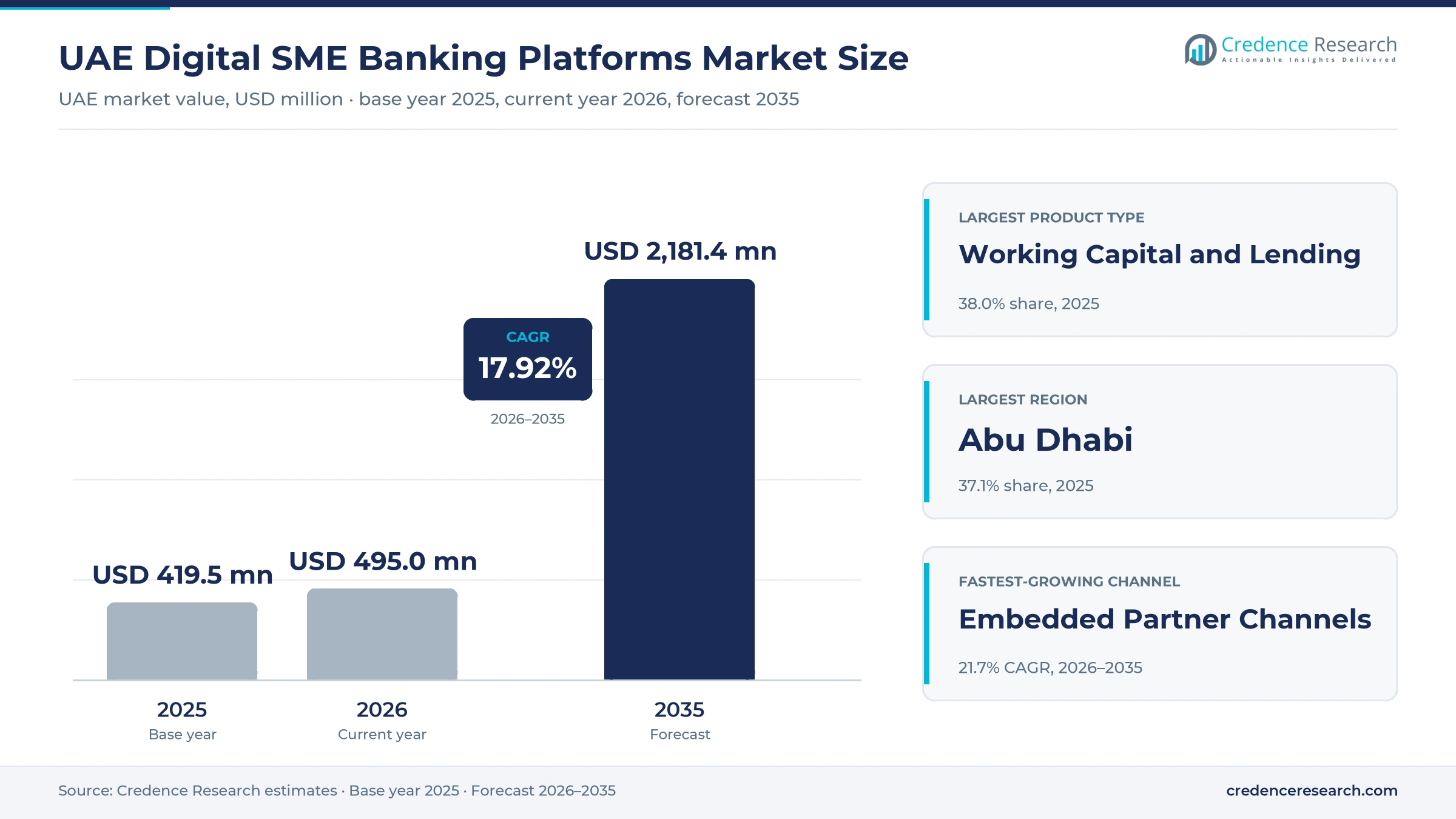
The UAE digital SME banking platforms market was valued at USD 419.5 million in 2025 and is projected to increase from USD 495.0 million in 2026 to USD 2.18 billion by 2035, registering a CAGR of 17.92% during 2026–2035. Revenue comes from the fees, interest and foreign exchange income that banks earn when small firms open accounts, pay suppliers and staff, and borrow through apps and web portals instead of branches. Abu Dhabi held the largest regional share, 37.1% in 2025, because government-linked supply chains and large national banks concentrate business balances in the capital. The Northern Emirates are the fastest-growing region at 18.7% a year, as lenders report the strongest rise in business credit demand there. The main change is regulatory, since the Central Bank's open finance framework makes data sharing and payment initiation mandatory for supervised banks, which lowers the cost of switching providers. Pressure on fee income from free business accounts remains the main restraint on revenue per client.
Bank revenue from small firms served through apps and portals
The market counts revenue that banks and their partners in the UAE earn from sole proprietors, micro, small and medium enterprises served mainly through mobile apps, web portals and partner channels. It covers account and subscription fees, payment and collection fees, net interest and financing income on working capital and loans, and foreign exchange and partner commissions on business activity that starts or is managed digitally.
Software licence fees that banks pay to technology vendors, lending by non-bank finance companies without a bank partner, corporate banking for large companies, and branch-only relationships are excluded. Value moves from core banking and onboarding systems through licensed banks, which hold deposits and credit risk, to app, portal and partner channels that reach business owners at the point of licensing, payment or invoicing.
UAE Digital SME Banking Platforms Market Insights
- The UAE digital SME banking platforms market rises from USD 419.5 million in 2025 to USD 2.18 billion by 2035 at a 17.92% CAGR as SME credit moves into apps.
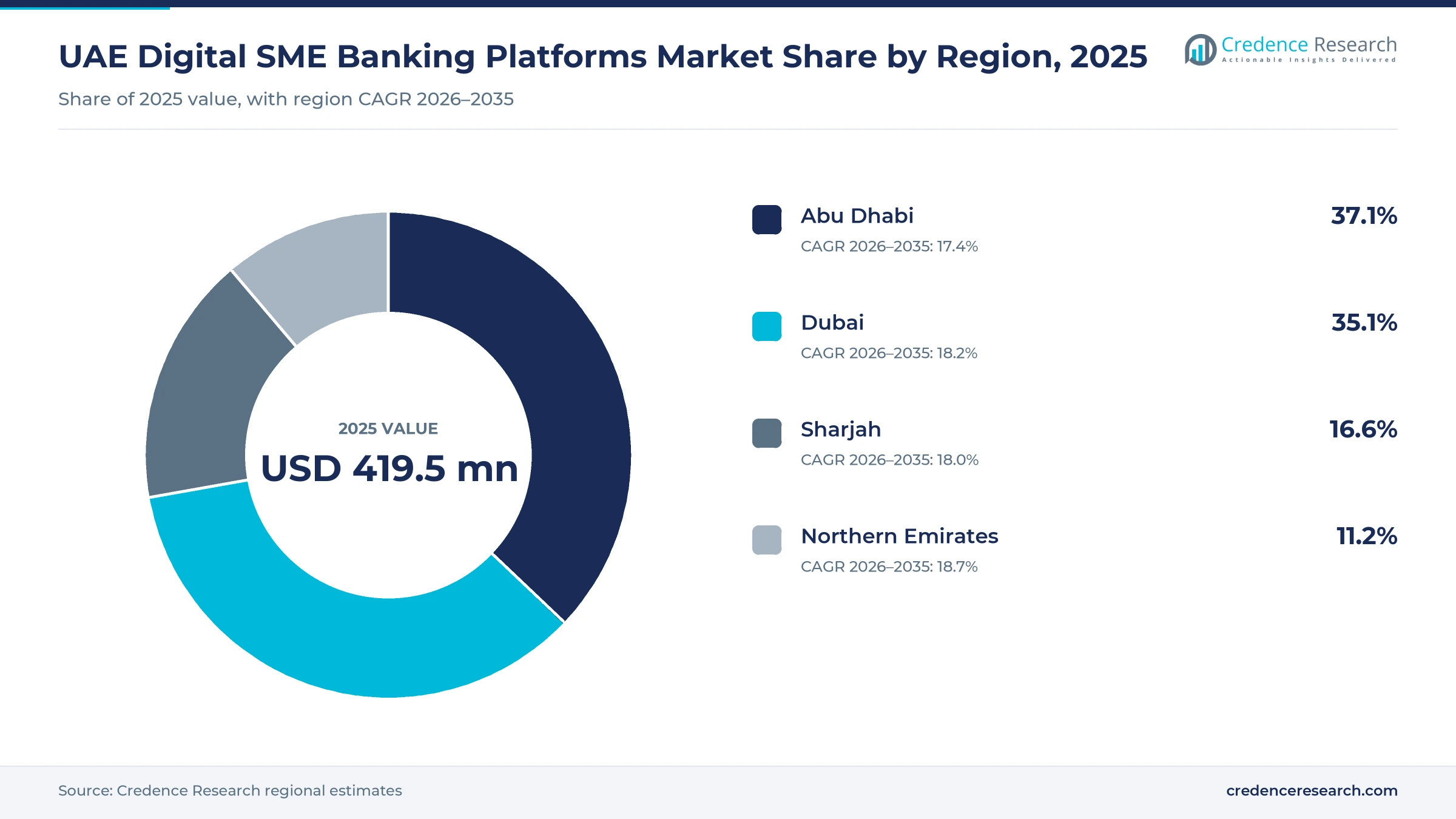
- Abu Dhabi held 37.1% of 2025 value, ahead of Dubai at 35.1%, because government-linked supply chains and large national banks concentrate business balances in the capital.
- Working Capital and Lending led product types with 38.0% of 2025 value, because interest on credit lines and loans earns more per client than account and transfer fees.
- Commercial Bank of Dubai became the first UAE bank to fully activate open finance for customers in December 2025, which moved the framework from testing to live use.
- Mashreq guaranteed business account opening within one day from May 2026, with AED 1,000 cashback if it misses, which sets a public service benchmark for rival banks.
Credit leads while embedded channels grow fastest
Product, customer size, channel and institution type explain how SME banking revenue divides in the UAE, and each split below is a Credence Research estimate. Credit, not account fees, sets the revenue ranking, while partner channels and very small firms set the growth ranking.
Credit leads while treasury and embedded tools grow fastest
Based on product type, the market is categorized into digital business accounts, payments and collections, working capital and lending, and treasury and embedded services. Working Capital and Lending led with 38.0% of 2025 value because interest on credit earns more per client than account fees, and RAKBANK alone disbursed more than AED 4.9 billion of new business finance in 2025, Khaleej Times reported in March 2026. Treasury and Embedded Services grow fastest at 19.9% a year, as Emirates NBD added 49 services to its businessONLINE platform in 2024, including a real-time payment tracker, which moves cash management into the bank app.
Small enterprises lead while freelancers grow fastest
Based on customer segment, the market is categorized into sole proprietors and freelancers, micro enterprises, small enterprises and medium enterprises. Small Enterprises led with 36.0% of 2025 value because they run payroll, supplier payments and credit lines at the same time, and RAKBANK offers eligible firms unsecured facilities of up to AED 5 million over 60 months. Sole Proprietors and Freelancers grow fastest at 19.6% a year, as the number of companies in the UAE doubled to 1.2 million in five years, The National reported in September 2025, and new founders now open their first account on a phone.
Omnichannel leads while embedded partner channels grow fastest
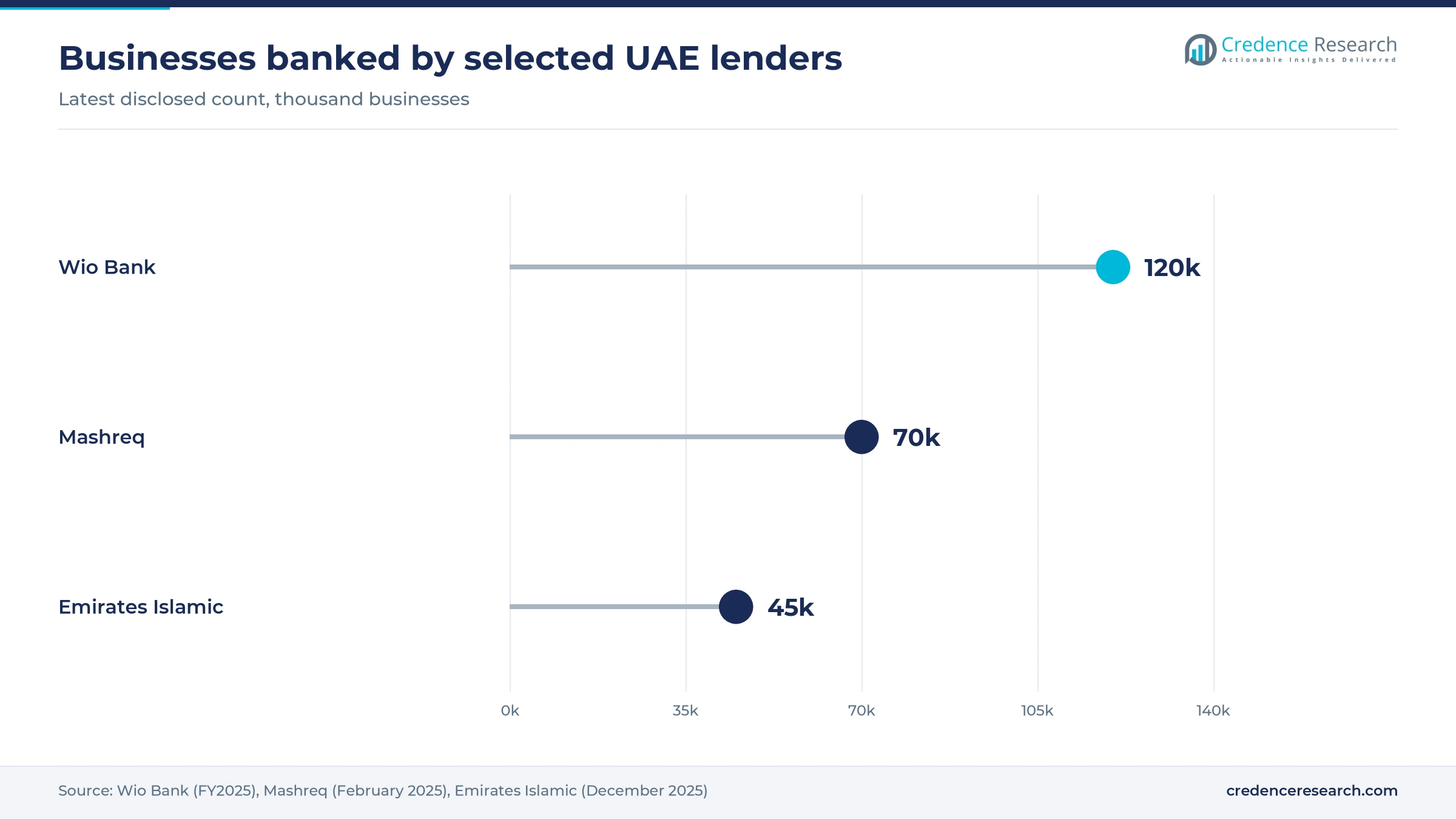
Based on distribution channel, the market is categorized into mobile-only applications, web and mobile omnichannel, embedded partner channels and relationship-assisted digital channels. Web and Mobile Omnichannel led with 46.0% of 2025 value because finance teams approve bulk payments on the web while owners check balances on phones, and Mashreq said it was moving more than 70,000 business customers to its Mashreq Biz web and mobile platform from February 2025. Embedded Partner Channels grow fastest at 21.7% a year, as Yuze began offering eligible startups business accounts provided by Zand in January 2026, which lets a business software provider sell bank accounts inside its own app.
Universal banks lead while digital-only banks grow fastest
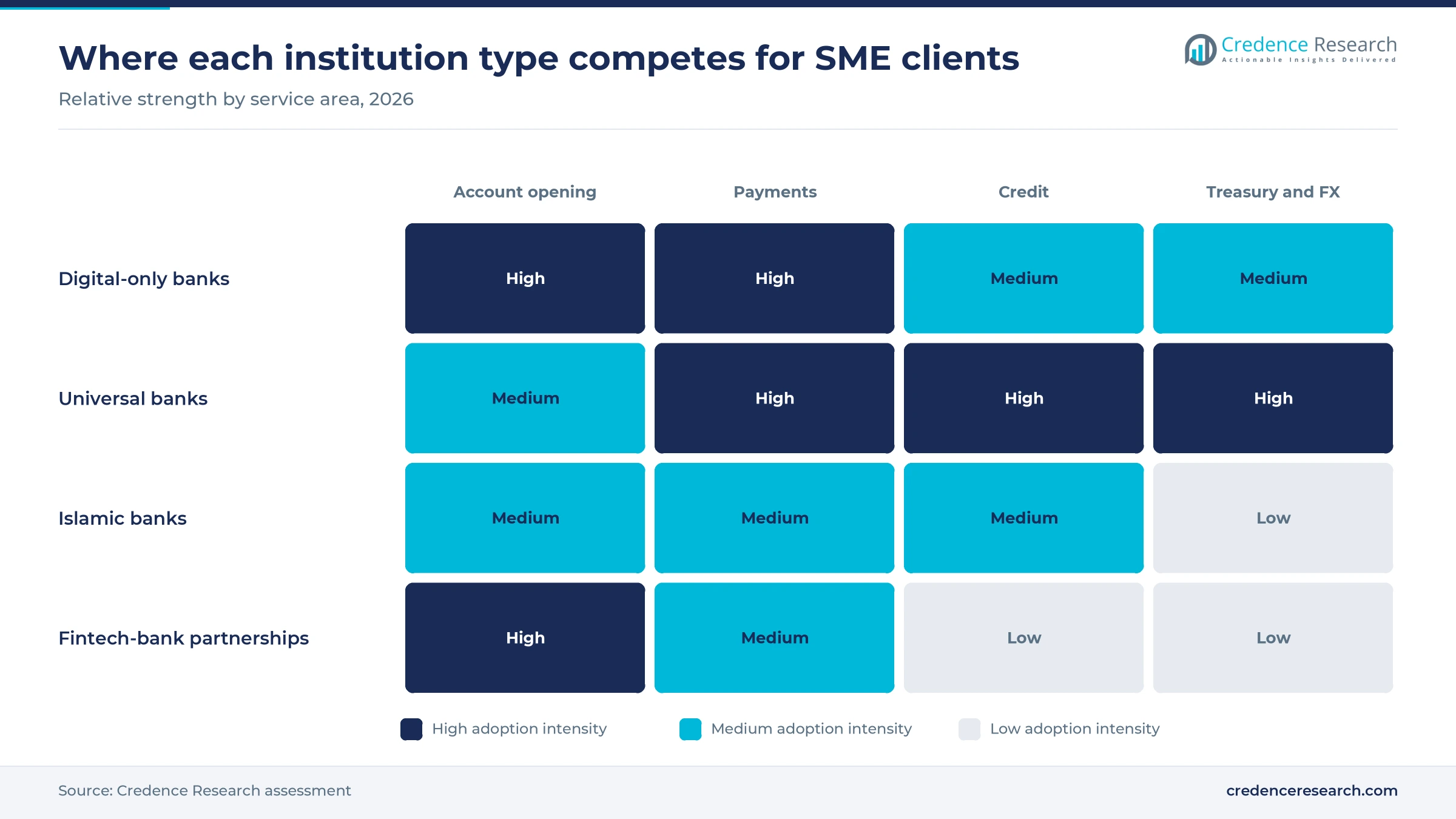
Based on institution type, the market is categorized into digital-only banks, universal banks, Islamic banks and fintech-bank partnerships. Universal Banks led with 46.0% of 2025 value because they hold the credit appetite and branch support that larger firms need, and one in four UAE SMEs used Emirates NBD as its primary bank, Euromoney reported in 2025. Digital-only Banks grow fastest at 19.8% a year, as more than 120,000 businesses used Wio as their main business bank in 2025, while its customer deposits rose 66% to above AED 57 billion, Wio said in March 2026.
| Segment Group | Leading Sub-segment | Share, 2025 | Fastest-growing Sub-segment | CAGR, 2026–2035 |
|---|---|---|---|---|
| By Product Type | Working Capital and Lending | 38.0% | Treasury and Embedded Services | 19.9% |
| By Customer Segment | Small Enterprises | 36.0% | Sole Proprietors and Freelancers | 19.6% |
| By Distribution Channel | Web and Mobile Omnichannel | 46.0% | Embedded Partner Channels | 21.7% |
| By Institution Type | Universal Banks | 46.0% | Digital-only Banks | 19.8% |
Subscription tiers replace minimum balances in SME pricing
SME pricing in the UAE is moving from minimum balance rules toward monthly subscription plans, zero-balance accounts and per-transaction fees for international transfers. Wio charges a monthly fee for each plan and halves the Swift transfer fee on its higher plan, which rewards firms that send more payments abroad. Zero-fee entry accounts lower the barrier for founders, but they shift the burden of revenue onto credit, FX and payroll services. Banks now advertise approval speed as much as price, as the onboarding guarantee in the table shows, which suggests that speed decides more account choices than the monthly fee.
| Offer or price point | Typical price or fee | Basis |
|---|---|---|
| Wio Business Essential plan | AED 99 a month | Wio Bank price page, November 2026 |
| Wio Business Grow plan | AED 249 a month | Wio Bank price page, November 2026 |
| Swift transfer, Wio Essential and Grow plans | AED 52.50 and AED 26.25 per transfer | Wio Bank price page, November 2026 |
| Mbank account for Meydan Free Zone firms | AED 0 minimum balance and AED 0 monthly fee | Mbank and Meydan, November 2024 |
| Missed one-day account opening at Mashreq | AED 1,000 cashback | Mashreq, May 2026 |
Request a Free Sample
Fill in your details and we'll send you a free sample report.
- Sample data tables & charts
- Research methodology
Company growth, open rails and tax rules lift demand
A larger company base widens the pool of digital clients
The pool of firms that need a business account is growing faster than branch networks can serve it, which pushes new clients toward app-based onboarding. The UAE counted about 557,000 SMEs at the end of 2022, according to the Ministry of Economy, and the government aims to lift the total number of companies to 2 million by 2031, The National reported in September 2025. More than 640,000 businesses had registered for corporate tax by October 2025, Gulf News reported, and each one adds demand for bank records that match its filings. Economic growth supports new company formation, because the IMF projected UAE growth of 4.8% in 2025 and 5.0% in 2026. Banks with fast digital onboarding capture most of these first accounts, which later carry payroll, cards and credit.
Open finance and instant payments cut switching costs
Shared payment and data rails lower the cost for a small firm to move its banking, which rewards providers with better apps rather than bigger branch networks. The Central Bank's open finance regulation makes participation mandatory for supervised institutions and requires data holders to share account data and allow payment initiation with customer consent, Zawya reported. Commercial Bank of Dubai became the first bank to fully activate open finance in December 2025, working with Pay10 and Lean Technologies. The Aani instant payment platform connected 74 institutions and about 774,000 merchants, Al Etihad Payments said in its 2025 results release, and its roadmap includes business-to-business payments and electronic direct debit. Collections and payables products gain first as these rails reach business accounts.
Transaction data unlocks credit for thin-file firms
Banks that see a firm's daily payments and invoices can price credit without property collateral, which turns account data into interest income. Demand is strong, since SME loan demand reached its highest level since 2014 in the Central Bank's fourth-quarter 2025 credit sentiment survey, EnterpriseAM reported in March 2026. Wio's supply chain finance platform delivered more than AED 1 billion of financing in 2025, alongside point-of-sale lending and SME credit cards, the bank said. RAKBANK's Quick Apply journey gives instant in-principle approval online, with funds disbursed within days. Bank SME lending stood at AED 81.2 billion in June 2024, only 9.5% of commercial and industrial financing, according to Central Bank data reported by Zawya, which leaves room for lenders that underwrite from transaction data.
Tax and e-invoicing rules pull bookkeeping into bank apps
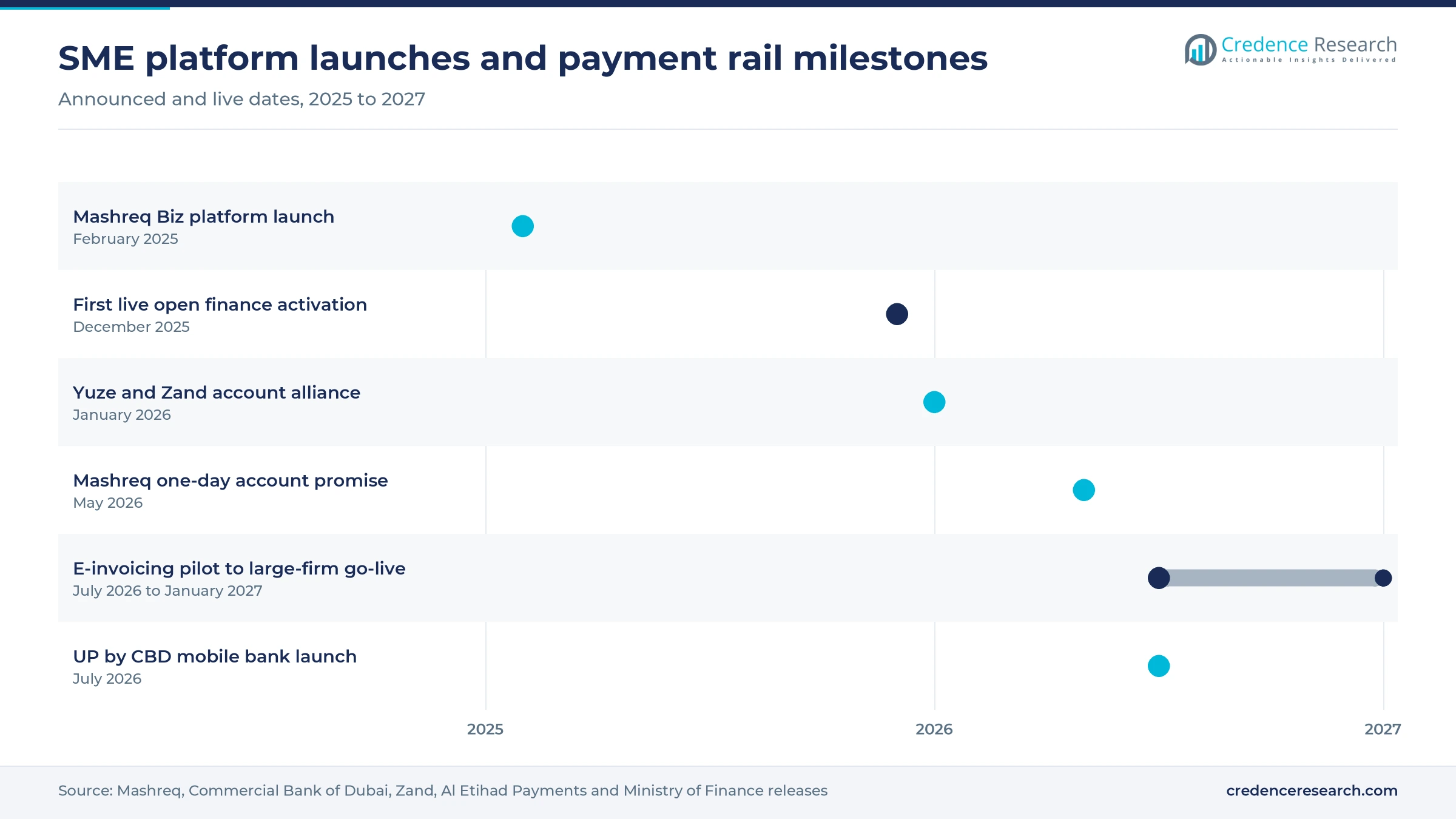
Tax rules now require small firms to keep digital records that match their bank flows, which raises the value of accounts linked to bookkeeping and invoicing tools. The Ministry of Finance set an e-invoicing pilot from July 1, 2026, with businesses earning AED 50 million or more required to implement the system from Jan. 1, 2027, and smaller businesses from July 1, 2027. Small Business Relief covers firms with revenue of up to AED 3 million, Khaleej Times noted in March 2026, yet those firms still file returns. Wio has built integrations with accounting and taxation platforms, the bank said in March 2026, and banks that connect to accounting software for small firms keep the client relationship when invoices go digital.
Hybrid onboarding and Islamic apps reshape SME offers
Universal banks are shifting SME onboarding to self-service
Large banks are shifting routine onboarding and servicing to apps while keeping branches for advice, which narrows the speed gap with digital-only rivals. About 80% of Emirates NBD's SME accounts were opened digitally in 2024, while the bank added more than 13,000 new business accounts in the year, according to Euromoney. First Abu Dhabi Bank launched an SME commercial cards suite with Mastercard in May 2026, linked to its new business application. Mbank opened a branch at City Walk in Dubai in April 2026 that serves SMEs with onboarding, payroll and merchant acquiring, while describing its model as digital first. This hybrid model favors banks that can pair app onboarding with relationship managers for larger credit decisions.
Shariah-compliant digital offers are rising among SME banks
Shariah-compliant banking is shifting from branch-led relationships to digital channels, which widens choice for business owners who want Islamic accounts and finance. Emirates Islamic served more than 45,000 SMEs, or one in every 15 in the country, and launched its Business Banking Diamond account in May 2025, the bank said in December 2025. Abu Dhabi Islamic Bank became the first Islamic bank to implement open finance under the AlTareq initiative in January 2026, Zawya reported. Wio is developing an Islamic banking proposition for 2026, subject to regulatory approval, the bank said in March 2026. Islamic banks that match digital rivals on speed can defend clients who will not move to conventional accounts.
Cross-border trade payments offer a growing fee pool
Trade-heavy SMEs pay for foreign exchange and international transfers more often than for domestic services, which makes cross-border flows the clearest fee opening once accounts become free. Emirates NBD ran a zero-fee FX campaign from November 2024 to February 2025 and launched the Dubai International Growth Initiative with the Dubai government to help SMEs expand abroad, according to Euromoney. Wio charges AED 52.50 per Swift transfer on its Essential plan and half that on its higher-priced plan, the pricing noted above, which shows banks charging trade-heavy firms for payment volume rather than for the account. Banks that bundle multicurrency accounts with cross-border payments can earn FX margins that survive zero-fee account pricing.
Free zone and software partners offer embedded distribution
Free zones and business software providers are an underserved route to new SMEs, because they meet founders at licensing, before a bank does. Mbank signed an agreement with Meydan Management Services in November 2024 to open fully digital accounts for Meydan Free Zone companies in six steps and under two days. ADGM made Zand its sixth banking partner in February 2023, giving ADGM-licensed SMEs faster account opening and access to Zand's SME tools. The January 2026 alliance between Yuze and Zand noted above applies the same model to business software. Banks that supply embedded finance through these partners gain clients at a lower acquisition cost than branch sales teams can reach.
AML costs, credit risk and fee pressure limit growth
Stricter AML enforcement raises onboarding costs
Anti-money laundering enforcement raises the cost of serving cash-intensive and cross-border SMEs, which makes banks cautious about these clients. The Central Bank fined a foreign bank branch AED 200 million for significant, repeated anti-money laundering failures, Gulf News reported in October 2026, and ordered a remediation program under independent validation. Digital-only banks that onboard at speed carry the most exposure, because automated checks must meet the same standard. Many banks respond with tighter document checks, which slows account opening for traders.
Rising costs weaken repayment capacity at small firms
Rising operating costs reduce the margin that small firms have for debt service, which limits how far banks can push unsecured lending. More than two-thirds of SMEs reported higher operating costs and only 39% were confident of meeting debt obligations in the RAKBANK SME Confidence Index published in June 2025, which surveyed firms from October to December 2024. Lenders that grew unsecured books fastest are the most exposed if defaults rise. Many now link credit limits to live account flows instead of annual statements.
Lower policy rates compress income on business deposits
Falling interest rates cut the income that banks earn on free business current account balances, which fund many zero-fee SME offers. The Central Bank lowered its base rate in three steps between September and December 2025, to 3.65% from 4.40%, Gulf News and EnterpriseAM reported, which trims deposit income across every customer segment. Digital banks that price accounts at zero and rely on deposit spreads are the most exposed to this change. Further cuts would push them to raise subscription fees or sell more credit and FX products to keep returns.
Free accounts and new rails squeeze fee income
Price competition is squeezing account and payment fees, which weakens the revenue lines that once covered the cost of SME servicing. UP by CBD launched in July 2026 with a zero-balance account, and Al Etihad Payments said in July 2026 that domestic Jaywan card routing would lower merchant processing fees, The National reported. Non-bank fintech lenders and credit marketplaces also compete for working capital clients. Smaller banks without scale in credit face the most pressure.
Abu Dhabi leads while the Northern Emirates grow fastest
SME banking revenue in the UAE divides across four zones that differ in output, business mix and credit demand, and the shares below are Credence Research estimates. Abu Dhabi and Dubai together account for 72.2% of 2025 value, while Abu Dhabi, the slowest-growing zone, cedes some share to the other three by 2035.
| Region | Value, 2025 (USD million) | Share, 2025 | CAGR, 2026–2035 |
|---|---|---|---|
| Abu Dhabi | 155.6 | 37.1% | 17.4% |
| Dubai | 147.2 | 35.1% | 18.2% |
| Sharjah | 69.6 | 16.6% | 18.0% |
| Northern Emirates | 47.0 | 11.2% | 18.7% |
Government-linked supply chains keep Abu Dhabi ahead
Abu Dhabi held 37.1% of 2025 value and grows at 17.4% a year. The emirate's real GDP reached a record AED 1.2 trillion in 2024, with finance and insurance growing 10.7% to AED 77.8 billion, the Statistics Centre Abu Dhabi said in March 2025. Non-oil activity made up 54.7% of output, so supplier networks around energy and government contracts carry large business balances. No official split of SME bank revenue by emirate exists, an evidence gap, so the lead over Dubai is a Credence Research estimate with a wide range.
Trading and services firms keep Dubai close behind
Dubai held 35.1% of 2025 value and grows at 18.2% a year. The emirate's GDP reached about AED 355 billion in the first nine months of 2025, up 4.7%, and financial and insurance activities grew 8.5%, the Dubai Media Office said in January 2026. Dubai-based lenders Mashreq and Commercial Bank of Dubai run their SME apps from the city, and new branches such as Mbank's City Walk site, noted above, target business clients. The slightly faster growth than Abu Dhabi is a Credence Research estimate, since no emirate-level account data are published.
Traders and manufacturers shape demand in Sharjah
Sharjah held 16.6% of 2025 value and grows at 18.0% a year. Sharjah's GDP rose 6.5% to about AED 145.2 billion in 2023, with wholesale and retail trade contributing 24% and manufacturing AED 24.3 billion, according to the emirate's statistics department as reported by Zawya in May 2024. Traders and small manufacturers need supplier payments, payroll and trade finance more than premium treasury tools, which keeps revenue per client below the Dubai level. No emirate-level revenue data exist, so this share is a Credence Research estimate.
Credit demand makes the Northern Emirates the fastest zone
The Northern Emirates held 11.2% of 2025 value and grow fastest at 18.7% a year. Lenders reported the strongest increase in business loan demand in the Northern Emirates, ahead of Abu Dhabi and Dubai, in the Central Bank's fourth-quarter 2025 credit sentiment survey, EnterpriseAM reported. RAKBANK, based in Ras Al Khaimah, offers its Quick Apply online loan journey noted above, which gives small firms an app-based option without trips to Dubai branches. The faster growth starts from a small base and remains a Credence Research estimate.
Platform launches and open finance go-lives, 2025 to 2026
| Development | Status and market relevance |
|---|---|
| In February 2025, Mashreq launched Mashreq Biz, a web and mobile platform for SMEs, and began moving more than 70,000 NEO BIZ and business banking customers to it. | Operational launch; customer migration under way |
| In December 2025, Commercial Bank of Dubai became the first UAE bank to fully activate open finance under the AlTareq initiative, with Pay10 and Lean Technologies. | Live for retail current and savings accounts; business use cases still to follow |
| In January 2026, Yuze and Zand formed an alliance that gives eligible UAE SMEs and startups business accounts provided by Zand inside the Yuze app. | Partnership announced; accounts subject to eligibility |
| In May 2026, Mashreq launched its One-Day Service Promise for business account opening through NEO BIZ, with AED 1,000 cashback if the bank misses it. | Operational service commitment for eligible customers |
| In July 2026, Commercial Bank of Dubai launched UP by CBD, a mobile bank for micro and small businesses with a zero-balance account and an instant business credit card. | Commercial launch |
Open finance APIs, instant payments and e-invoicing links
- AlTareq open finance APIs let licensed third parties read account data and start payments with customer consent, which turns bank data into input for credit and bookkeeping tools.
- Aani instant payments settle transfers in seconds using mobile numbers, QR codes and Request to Pay, which gives small merchants a low-cost way to collect money.
- Electronic KYC and UAE Pass let banks verify owners and documents without branch visits, and Mashreq credits electronic KYC and links with local authorities for its one-day account promise.
- Accredited e-invoicing service providers will exchange structured invoices under the Ministry of Finance system, which gives banks that connect to them a verified view of receivables.
Need a Custom Version of This Report?
Tailor the scope, geography, or segments to your exact requirements.
- Custom geography or segment scope
- Direct access to our analyst team
Universal banks defend credit as digital banks win founders
Competition divides between universal banks that hold most SME credit and digital-only banks that win new founders on speed and price. Emirates NBD, Mashreq, First Abu Dhabi Bank, Abu Dhabi Commercial Bank and Commercial Bank of Dubai defend their books with business apps, cards and faster onboarding, while Wio, Zand and Mbank compete on fully digital accounts and partner channels. RAKBANK has built its position on unsecured SME lending and online loan applications, and Islamic lenders such as Abu Dhabi Islamic Bank and Emirates NBD's Emirates Islamic compete for Shariah-compliant business accounts. Service guarantees are becoming a competitive tool, as the onboarding promise listed under recent developments shows. Price competition on accounts pushes rivals toward credit, FX and payroll income, where risk models and data matter more than branches. Banks that can approve credit from transaction data without long document checks hold the strongest position as open finance matures.
How concentrated is SME banking supply in the UAE?
Supply is concentrated among licensed banks, because only Central Bank licensees can hold SME deposits, and fintech firms reach business owners through bank partners. Zand was only the second lender to receive a digital banking licence from the Central Bank, The National reported in December 2025, which shows how few new entrants have reached full licensing. Barriers sit in capital, anti-money laundering systems and credit models rather than in app design. Margins sit mainly in lending and FX, while account and transfer fees face pressure from free offers. Partnerships let software providers share in revenue without holding a licence.
Banks that UAE business owners shortlist for digital accounts
| Company | Type | Role in the market |
|---|---|---|
| Wio Bank | Digital-only bank | Mobile business accounts, supply chain finance and SME credit cards |
| Emirates NBD (Emirates Islamic) | Universal bank | businessONLINE platform, SME lending and digital account opening, plus Shariah-compliant SME accounts through Emirates Islamic |
| Mashreq | Universal bank | NEO BIZ and Mashreq Biz apps with one-day account opening |
| RAKBANK | Universal bank | Unsecured SME loans and Quick Apply online loan applications |
| First Abu Dhabi Bank | Universal bank | FAB Business app and SME commercial cards with Mastercard |
| Abu Dhabi Commercial Bank | Universal bank | ADCB Business digital platform for accounts, payments and transaction tracking |
| Commercial Bank of Dubai | Universal bank | UP by CBD mobile bank for micro and small businesses |
| Abu Dhabi Islamic Bank | Islamic bank | Digital SME accounts, including the DET Connect account on Dubai's SME in a Box platform |
| Zand Bank | Digital-only bank | Digital corporate accounts, ADGM partnership and the Yuze account alliance |
| Mbank | Digital and community bank | Digital business accounts, payroll services and free zone account opening |
Underwriting quality matters more than free accounts
Credence Research's view is that this market rewards banks that turn account data into credit decisions, not those with the cheapest account. Free and low-cost accounts now win founders, yet interest on working capital and FX margins on trade payments carry most of the revenue. Universal banks keep the edge in credit and relationship support, while digital-only banks, which grow at 19.8% a year in Credence Research estimates, gain the newest firms. Open finance and e-invoicing will make transaction data portable, so the next phase of competition turns on underwriting quality and service speed rather than branch reach. Banks that underprice credit risk to win share are the most exposed.
SME counts, product use and margins anchor the estimate
The report uses 2025 as the base year and forecasts to 2035. Market values come from the Credence Research model, which builds revenue from the number of SMEs served through digital channels, the products they use and typical fees and interest margins. All segment and regional splits in this report are Credence Research estimates. Inputs include Central Bank of the UAE statistics and releases, Ministry of Economy and Ministry of Finance publications, emirate statistics centers, IMF material and company disclosures. The analysis did not use interviews or surveys with market participants.
E-invoicing data and open finance shape growth to 2035
The UAE digital SME banking platforms market is expected to grow from USD 495.0 million in 2026 to USD 2.18 billion by 2035, as company formation, tax digitization and shared payment rails pull more SME banking into apps. E-invoicing from 2027 will give banks structured receivables data, which supports invoice finance and faster credit approvals. Business use of open finance should widen the gap between banks with strong data models and those that rely on fees. Sole proprietors and freelancers, which grow at 19.6% a year, add demand, though their revenue per client stays below that of medium enterprises.
Credit quality and open finance uptake set the range to 2035
The range of outcomes depends mainly on whether data-led SME lending keeps credit losses low and whether open finance moves from retail accounts to business accounts. A rise in defaults or tighter anti-money laundering controls would slow both account growth and credit, while fast e-invoicing adoption would give banks better data for lending. The base case assumes steady company formation and gradual business use of open finance from 2027.
| Scenario | CAGR, 2026–2035 | Value, 2035 | What has to hold |
|---|---|---|---|
| Downside | 14.9% | USD 1.73 billion | SME defaults rise, banks cut unsecured limits and open finance stays limited to retail accounts |
| Base | 17.92% | USD 2.18 billion | Company formation continues and business open finance use cases launch gradually from 2027 |
| Upside | 19.9% | USD 2.54 billion | E-invoicing data feed credit models and Aani business-to-business payments launch at scale |
Frequently Asked Questions
How big is the UAE digital SME banking platforms market?
Which product type leads SME digital banking revenue in the UAE?
Which emirate holds the largest share of the market?
How does open finance affect SME banking in the UAE?
When does e-invoicing start for UAE businesses?
Which companies lead the market?
What do SME business accounts cost in the UAE?
What are the main risks to market growth?
Table of Content
Chapter 1 Market Segmentation
- 1.1 Segmentation Framework
- 1.1.1 Product and Service Classification
- 1.1.2 Application and End-Use Classification
- 1.1.3 Technology and Solution Classification
- 1.1.4 Customer and Distribution Channel Classification
- 1.1.5 Geographic Segmentation
- 1.1.6 Market Segment Definitions and Boundaries
- 1.2 By Product Type
- 1.2.1 Digital Business Accounts
- 1.2.2 Payments and Collections
- 1.2.3 Working Capital and Lending
- 1.2.4 Treasury and Embedded Services
- 1.3 By Customer Segment
- 1.3.1 Sole Proprietors and Freelancers
- 1.3.2 Micro Enterprises
- 1.3.3 Small Enterprises
- 1.3.4 Medium Enterprises
- 1.4 By Institution Type
- 1.4.1 Digital-only Banks
- 1.4.2 Universal Banks
- 1.4.3 Islamic Banks
- 1.4.4 Fintech-Bank Partnerships
Chapter 2 Introduction
- 2.1 Report Objectives and Scope
- 2.2 Product Definition and Industry Terminology
- 2.3 Market Inclusions and Exclusions
- 2.4 Research Process
- 2.4.1 Primary Research and Expert Interviews
- 2.4.2 Secondary Research and Source Review
- 2.4.3 Top-Down and Bottom-Up Estimation
- 2.4.4 Data Triangulation and Verification
- 2.5 Market Size Measurement Basis
- 2.5.1 2025: USD 419.5 million → 2035: USD 2.18 billion
- 2.6 Historical and Forecast Reference Periods
- 2.6.1 Historical Period: 2018-2025
- 2.6.2 Base Year: 2025
- 2.6.3 Forecast Period: 2025-2035
- 2.7 Research Assumptions and Limitations
Chapter 3 Executive Summary
- 3.1 Market Snapshot and Key Findings
- 3.2 Base-Year Market Size, 2025
- 3.3 Forecast Market Size, 2035
- 3.4 Revenue and Volume Growth Outlook
- 3.5 Key Demand and Supply Indicators
- 3.6 Leading Market Segments
- 3.7 Fastest-Growing Market Opportunities
- 3.8 Regional Performance Highlights
- 3.9 Technology and Industry Transformation
- 3.10 Competitive Landscape Summary
- 3.11 Analyst View and Strategic Implications
Chapter 4 UAE Digital SME Banking Platforms Market Trends and Developments
- 4.1 Historical Industry Development, 2018-2025
- 4.2 Recent Market Trends and Developments
- 4.3 Demand and Customer Behavior Trends
- 4.4 Technology and Product Innovation
- 4.5 Artificial Intelligence, Automation and Digitalization
- 4.6 Local Manufacturing and Supply Chain Realignment
- 4.7 Industry Partnerships, Mergers and Acquisitions
- 4.8 Sustainability and Circular Economy Developments
- 4.9 Government and Private Sector Investment Trends
- 4.10 Emerging Business Models and Commercialization
- 4.11 Industry Developments and Announcements
Chapter 5 UAE Digital SME Banking Platforms Market Supply and Demand Analysis
- 5.1 Demand Trend and Consumption Analysis, 2018-2025
- 5.2 Demand Forecast, 2025-2035
- 5.3 Supply Chain Structure and Procurement Trends
- 5.4 Supply-Demand Gap and Bottlenecks
- 5.5 Import Dependence and Sourcing Structure
- 5.6 Regional Supply and Demand Concentration
Chapter 6 UAE Digital SME Banking Platforms Market Pricing Analysis
- 6.1 Pricing Structure and Measurement
- 6.2 Historical Pricing Trends, 2018-2025
- 6.3 Pricing Outlook, 2025-2035
- 6.4 Pricing by Product and Market Segment
- 6.5 Geographic Pricing Differences
- 6.6 Key Input, Energy, Labor and Logistics Costs
- 6.7 Contract Pricing and Purchasing Models
- 6.8 Pricing Sensitivity and Competitive Positioning
- 6.9 Price, Margin and Profitability Implications
Chapter 7 UAE Digital SME Banking Platforms Market Dynamics
- 7.1 Market Growth Drivers
- 7.1.1 Demand-Side Drivers
- 7.1.2 Technology and Innovation Drivers
- 7.1.3 Infrastructure and Investment Drivers
- 7.1.4 Regulatory and Policy Drivers
- 7.2 Market Restraints
- 7.2.1 Cost and Affordability Constraints
- 7.2.2 Technology and Adoption Barriers
- 7.2.3 Supply Chain and Operational Constraints
- 7.3 Market Challenges
- 7.3.1 Competitive Pressure and Margin Erosion
- 7.3.2 Skills, Infrastructure and Implementation Gaps
- 7.4 Emerging Market Opportunities
- 7.5 Market Dynamics Impact and Time-Horizon Assessment
Chapter 8 UAE Digital SME Banking Platforms Value Chain Analysis
- 8.1 Industry Value Chain Overview
- 8.2 Upstream Suppliers and Critical Inputs
- 8.3 Technology and Component Providers
- 8.4 Manufacturing or Service Delivery
- 8.5 Distribution, Channel Partners and Integrators
- 8.6 Downstream Applications and End Users
- 8.7 Value Addition and Profit Pools
- 8.8 Vertical Integration and Outsourcing
- 8.9 Supplier Concentration and Risk
- 8.10 Supply Chain Localization and Resilience
Chapter 9 UAE Digital SME Banking Platforms Market Regulations and Policies
- 9.1 Relevant Laws, Standards and Compliance Frameworks
- 9.2 Product, Service, Safety and Quality Requirements
- 9.3 Government Policies, Incentives and Subsidies
- 9.4 Imports, Exports and Trade Barriers
- 9.5 Public Procurement and Local Content Requirements
- 9.6 Data Protection, AI and Cybersecurity Compliance
- 9.7 Upcoming Policy Changes and Market Implications
Chapter 10 UAE Digital SME Banking Platforms Market Hotspots and Opportunities
- 10.1 Market Opportunity Mapping and Growth Hotspots
- 10.2 High-Growth Applications and Customer Groups
- 10.3 Underserved Markets and White-Space Opportunities
- 10.4 Emerging Technology and Product Opportunities
- 10.5 New Capacity and Investment Hotspots
- 10.6 Market Entry and Expansion Opportunities
- 10.7 Distribution and Partnership Opportunities
- 10.8 Near-Term and Long-Term Commercial Potential
- 10.9 Opportunity Attractiveness and Execution Risks
Chapter 11 UAE Digital SME Banking Platforms Market Outlook, 2025-2035
- 11.1 Market Size and Analysis
- 11.1.1 Revenue (Market Measurement: 2025: USD 419.5 million → 2035: USD 2.18 billion)
- 11.1.2 Historical Market Size, 2018-2025
- 11.1.3 Base-Year Market Size, 2025
- 11.2 Market Forecast, 2025-2035
- 11.2.1 Revenue Forecast to 2035
- 11.2.2 CAGR and Year-on-Year Growth
- 11.2.3 Incremental Revenue Opportunity
- 11.3 Forecast Assumptions and Scenario Analysis
- 11.3.1 Base-Case Forecast
- 11.3.2 Optimistic and Conservative Scenarios
- 11.3.3 Technology, Pricing and Policy Sensitivities
- 11.4 Market Attractiveness and Growth Outlook
Chapter 12 UAE Digital SME Banking Platforms Market Segmentation and Outlook
- 12.1 Segmentation Summary and Market Shares, 2025
- 12.2 Largest and Fastest-Growing Segments
- 12.3 By Product Type - Market Size and Forecast, 2025-2035
- 12.3.1 Segment Definition and Scope
- 12.3.2 Historical Market Size, 2018-2025
- 12.3.3 Revenue Forecast, 2025-2035
- 12.3.4 Base-Year Market Share, 2025
- 12.3.5 Segment CAGR and Growth Drivers
- 12.3.6 Subsegment Market Size and Forecast
- 12.3.6.1 Digital Business Accounts
- 12.3.6.2 Payments and Collections
- 12.3.6.3 Working Capital and Lending
- 12.3.6.4 Treasury and Embedded Services
- 12.3.7 Subsegment Pricing and Adoption Trends
- 12.3.8 Leading Suppliers and Competition
- 12.3.9 Regional Demand and Opportunities
- 12.4 By Customer Segment - Market Size and Forecast, 2025-2035
- 12.4.1 Segment Definition and Scope
- 12.4.2 Historical Market Size, 2018-2025
- 12.4.3 Revenue Forecast, 2025-2035
- 12.4.4 Base-Year Market Share, 2025
- 12.4.5 Segment CAGR and Growth Drivers
- 12.4.6 Subsegment Market Size and Forecast
- 12.4.6.1 Sole Proprietors and Freelancers
- 12.4.6.2 Micro Enterprises
- 12.4.6.3 Small Enterprises
- 12.4.6.4 Medium Enterprises
- 12.4.7 Subsegment Pricing and Adoption Trends
- 12.4.8 Leading Suppliers and Competition
- 12.4.9 Regional Demand and Opportunities
- 12.5 By Institution Type - Market Size and Forecast, 2025-2035
- 12.5.1 Segment Definition and Scope
- 12.5.2 Historical Market Size, 2018-2025
- 12.5.3 Revenue Forecast, 2025-2035
- 12.5.4 Base-Year Market Share, 2025
- 12.5.5 Segment CAGR and Growth Drivers
- 12.5.6 Subsegment Market Size and Forecast
- 12.5.6.1 Digital-only Banks
- 12.5.6.2 Universal Banks
- 12.5.6.3 Islamic Banks
- 12.5.6.4 Fintech-Bank Partnerships
- 12.5.7 Subsegment Pricing and Adoption Trends
- 12.5.8 Leading Suppliers and Competition
- 12.5.9 Regional Demand and Opportunities
- 12.6 Segment Growth Comparison
- 12.7 Segment Attractiveness and Priority Matrix
Chapter 13 UAE Digital SME Banking Platforms End-Use and Application Market Outlook
- 13.1 End-Use Industry and Customer Demand Structure
- 13.2 Leading Applications and Customer Groups
- 13.3 End-Use Market Size, Share and Forecast
- 13.4 Major End-Use Industry Deep Dives
- 13.4.1 Customer Requirements and Use Cases
- 13.4.2 Demand and Replacement Cycles
- 13.4.3 Technical and Regulatory Considerations
- 13.4.4 Purchasing and Procurement Models
- 13.4.5 Leading Vendors and Distribution Channels
- 13.4.6 Forecast and Commercial Opportunities
- 13.5 Emerging Applications and Cross-Segment Demand
- 13.6 End-Use Industry Investment Priorities
Chapter 14 UAE Digital SME Banking Platforms Geographic Market Outlook, 2025-2035
- 14.1 Domestic Market Distribution and Demand Clusters
- 14.2 State- or Province-Wise Market Size and Forecast, 2025-2035
- 14.3 City and Metropolitan Market Outlook
- 14.4 Industrial, Manufacturing and Commercial Clusters
- 14.5 Geographic Concentration of Key End Users
- 14.6 Local Pricing and Purchasing Differences
- 14.7 Domestic Production Facilities and Capacity Map
- 14.8 Local Infrastructure and Project Pipeline
- 14.9 State-Level Policy and Incentive Differences
- 14.10 Subnational Investment Hotspots and Opportunities
- 14.11 Distribution and Logistics Networks
- 14.12 Domestic Competitive Footprint
Chapter 15 UAE Digital SME Banking Platforms Technology, Innovation and Sustainability Outlook
- 15.1 Technology Landscape and Maturity
- 15.2 Product, Process and Service Innovation
- 15.3 AI, Automation and Digital Tools in the Industry
- 15.4 Technology Adoption and Performance Benchmarking
- 15.5 Innovation Pipeline and R&D Investment
- 15.6 Energy Efficiency and Resource Management
- 15.7 Sustainability, Recycling and Circularity
- 15.8 Technology Roadmap, 2025-2035
- 15.9 Risks of Obsolescence and Technology Substitution
Chapter 16 UAE Digital SME Banking Platforms Market Key Strategic Imperatives
- 16.1 Growth and Market Entry Priorities
- 16.2 High-Return Products and Segments
- 16.3 Pricing, Profitability and Cost Optimization
- 16.4 Technology Investment and Product Differentiation
- 16.5 Supply Chain Localization and Resilience
- 16.6 Distribution and Customer Acquisition
- 16.7 Partnership, Acquisition and Capacity Strategy
- 16.8 Regional Expansion Priorities
- 16.9 Short-, Medium- and Long-Term Actions
Chapter 17 Competition Outlook
- 17.1 Industry Competition Characteristics
- 17.2 Market Structure and Concentration
- 17.3 Market Share and Competitive Positioning, 2025
- 17.4 Company-Wise Revenue and Product Benchmarking
- 17.5 Production and Service Capacity Benchmarking
- 17.6 Technology, Pricing and Differentiation
- 17.7 Regional Footprint and Distribution Strength
- 17.8 Mergers, Acquisitions and Strategic Alliances
- 17.9 New Entrants and Competitive Threats
- 17.10 Porter's Five Forces and Industry Attractiveness
- 17.11 Competitive Outlook, 2025-2035
Chapter 18 Company Profiles
- 18.1 Company Coverage and Selection Criteria
- 18.2 Wio Bank
- 18.2.1 Business Description
- 18.2.2 Company Ownership and Geographic Presence
- 18.2.3 Product and Service Portfolio
- 18.2.4 Manufacturing and Operating Footprint
- 18.2.5 Financial Performance and Investment
- 18.2.6 Market Share and Competitive Position
- 18.2.7 Technology and Innovation Capabilities
- 18.2.8 Strategic Alliances or Partnerships
- 18.2.9 Recent Developments
- 18.2.10 Growth Strategy and Outlook
- 18.3 Emirates NBD (Emirates Islamic)
- 18.4 Mashreq
- 18.5 RAKBANK
- 18.6 First Abu Dhabi Bank
- 18.7 Abu Dhabi Commercial Bank
- 18.8 Commercial Bank of Dubai
- 18.9 Abu Dhabi Islamic Bank
- 18.10 Zand Bank
- 18.11 Mbank
- 18.12 Other Relevant Market Participants
Note: Every listed company is profiled on the structure shown under the first company. The company list is preliminary and may change based on research findings, market developments, data availability and client requirements.
Chapter 19 Disclaimer
- 19.1 Research and Forecast Disclaimer
- 19.2 Data Source and Estimation Limitations
Note: The depth of individual sections depends on data availability for this market. Volume, capacity, trade and other unit-based metrics are included where applicable.