
Market Overview:
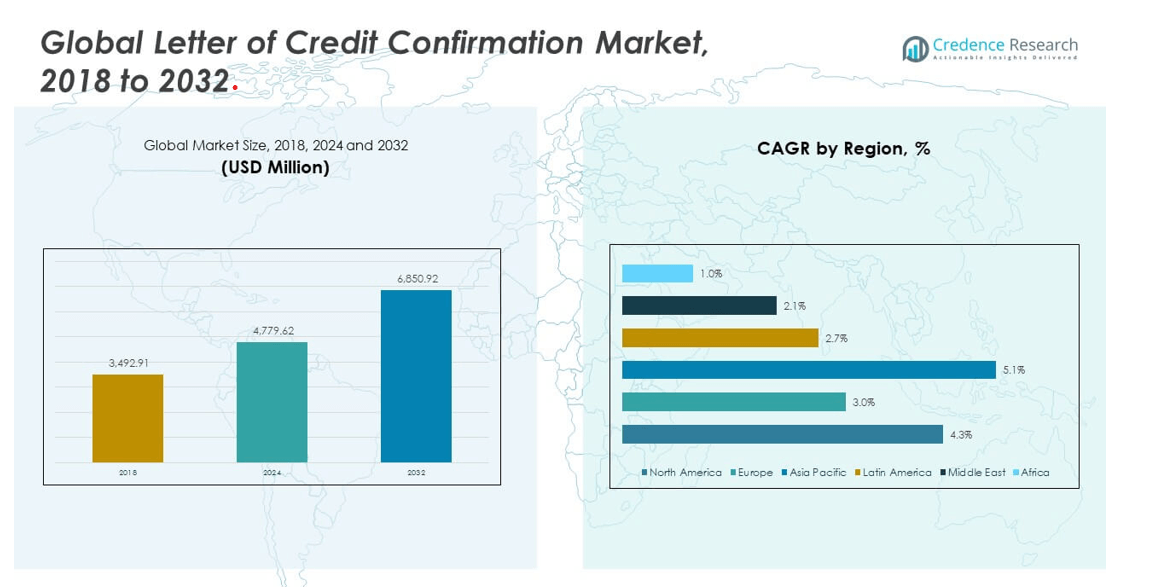
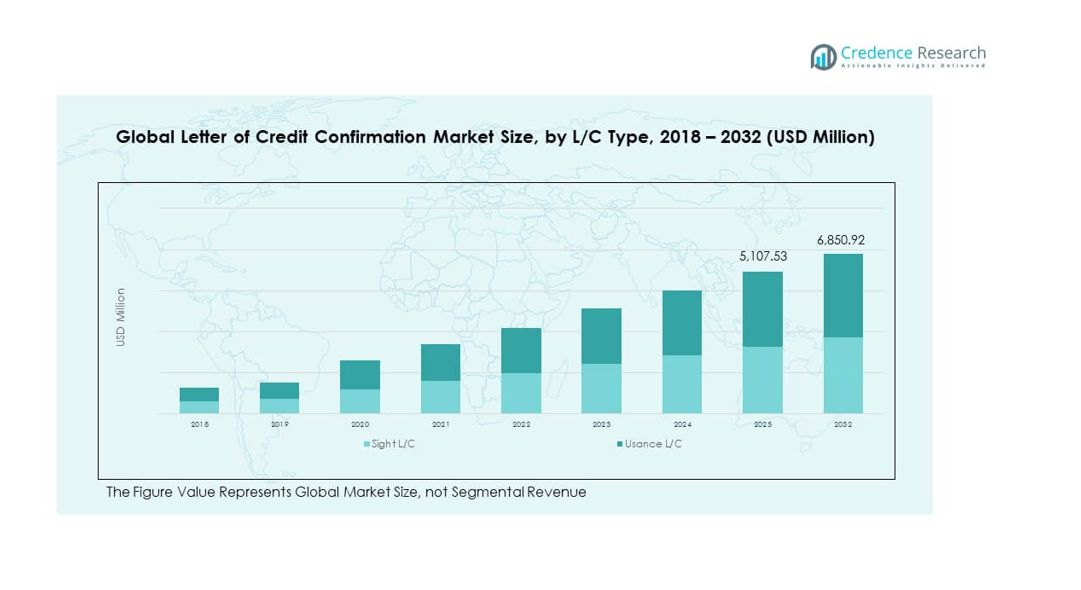
The Global Letter of Credit Confirmation Market size was valued at USD 3,492.91 million in 2018 to USD 4,779.62 million in 2024 and is anticipated to reach USD 6,850.92 million by 2032, at a CAGR of 4.28% during the forecast period.
| REPORT ATTRIBUTE | DETAILS |
|---|---|
| Historical Period | 2020-2023 |
| Base Year | 2024 |
| Forecast Period | 2025-2032 |
| Letter of Credit Confirmation Market Size 2024 | USD 4,779.62 million |
| Letter of Credit Confirmation Market, CAGR | 4.28% |
| Letter of Credit Confirmation Market Size 2032 | USD 6,850.92 million |
The market growth is driven by rising international trade volumes and increasing demand for secure payment mechanisms. It ensures sellers receive guaranteed payments, mitigating financial and political risks. Banks offer confirmation services to strengthen trade relationships and reduce transaction uncertainty. Companies across industries prefer letters of credit to protect high-value shipments and maintain operational stability. Technological integration, including digital platforms and automated processes, improves efficiency. Corporates rely on confirmations to manage cash flow and credit exposure effectively. Financial institutions continuously innovate services to meet evolving trade requirements.
Regionally, Asia Pacific leads the market, driven by expanding manufacturing exports and growing international trade participation. North America and Europe remain key markets with mature banking infrastructures supporting secure transactions. Emerging economies in Latin America, the Middle East, and Africa witness increasing adoption due to expanding trade finance infrastructure. It helps SMEs and large corporations mitigate payment risks. The market benefits from government trade policies, digitalization of banking, and integration with global supply chains. Trade growth in Asia Pacific and strategic partnerships globally fuel market expansion.
Market Insights:
- The Global Letter of Credit Confirmation Market size was USD 3,492.91 million in 2018, USD 4,779.62 million in 2024, and is projected to reach USD 6,850.92 million by 2032, growing at a CAGR of 4.28% during the forecast period.
- North America holds 28% share, Asia Pacific 47%, and Europe 17% of the market. These regions dominate due to mature banking infrastructure, high cross-border trade volumes, and strong regulatory frameworks supporting secure transactions.
- Asia Pacific is the fastest-growing region with 47% share, driven by rising manufacturing exports, increasing SME participation in global trade, and expanding trade finance infrastructure.
- By L/C type, Sight L/C accounts for approximately 55% of the market, reflecting preference for immediate payment guarantees, while Usance L/C holds 45% for deferred payment flexibility.
- By application, import transactions represent 60% of usage due to high international procurement volumes, while export and domestic transactions account for 25% and 15%, respectively, supporting secure trade settlements globally.
Market Drivers
Rising International Trade Volumes and Demand for Secure Payment Methods
The Global Letter of Credit Confirmation Market experiences growth due to increasing cross-border trade transactions. It provides sellers with assurance against buyer default and enhances trust between trading partners. Banks actively offer confirmation services to protect financial exposure. Companies prefer letters of credit for high-value shipments, reducing risk of non-payment. Strong global economic growth fuels trade financing requirements. Multinational corporations integrate confirmation services into treasury operations. Regulatory frameworks encourage transparency and risk mitigation in trade settlements. It also supports SMEs entering international markets by offering reliable financial guarantees. The market expands alongside global commerce and trade diversification.
- For instance, HSBC processes more than 250,000 letters of credit annually, acting as a confirming bank in over 50 markets, providing multinational corporations with 24/7 transaction visibility and integrated treasury solutions through platforms like HSBCnet. The bank supports sellers in securing high-value, cross-border shipments and assures reliable payment guarantees, demonstrating scalable, real-time operational support for both large corporates and SMEs entering new export markets.
Technological Integration and Digitalisation in Trade Finance Operations
It benefits from digital platforms that streamline issuance and confirmation processes. Blockchain-enabled systems improve transparency, reduce fraud, and enhance transaction speed. Financial institutions adopt automated platforms to manage confirmations efficiently. It reduces paperwork, accelerates processing times, and improves record-keeping. Data analytics tools allow better risk assessment and credit evaluation. Integration with enterprise resource planning systems strengthens corporate finance workflows. Market participants invest in secure IT infrastructure to support scalable operations. These technological improvements attract more clients to confirmation services. It establishes a competitive edge for banks offering digital trade finance solutions.
Regulatory Compliance and Strengthening Risk Management Practices
It gains traction due to stricter global regulatory requirements in trade finance. Banks must ensure compliance with anti-money laundering and KYC norms. Confirmation services protect sellers from political and financial uncertainties. It reduces exposure to default risks and currency fluctuations. Companies rely on confirmations to meet internal risk management guidelines. Financial institutions offer tailored products aligned with local and international regulations. Risk-averse investors encourage adoption of confirmed letters of credit. It reinforces the stability and credibility of cross-border transactions. The market evolves alongside regulatory oversight and global financial reforms.
- For instance, Standard Chartered continually updates its regulatory compliance framework to meet global and local anti-money laundering (AML) and know-your-customer (KYC) standards, as published in their recent regulatory compliance statements. The bank employs automated screening and due diligence for every trade finance transaction, helping reinforce seller protection and fostering full regulatory alignment for all letters of credit under its purview.
Expansion of Emerging Economies and Growth in Trade Financing Needs
The Global Letter of Credit Confirmation Market benefits from rising trade activity in Asia-Pacific and Latin America. Emerging markets increase import-export operations, driving demand for financial guarantees. It enables businesses to secure contracts with international suppliers and buyers. Banks expand networks to cover untapped regions and high-growth sectors. It supports the scaling of SMEs in global supply chains. Regional trade agreements further increase transaction volumes and financing needs. Companies leverage confirmations to mitigate geopolitical and market risks. The market grows through diversified economic participation and enhanced financial infrastructure. It strengthens trade relationships in developing regions.
Market Trends
Adoption of Blockchain and Distributed Ledger Technology in Trade Finance Operations
The Global Letter of Credit Confirmation Market observes increasing adoption of blockchain for secure and transparent transactions. It ensures immutable records and reduces operational errors. Banks implement smart contracts to automate confirmation approvals. It provides real-time monitoring of trade settlements and reduces reconciliation delays. Corporates prefer blockchain-enabled letters of credit for risk minimisation. Technology partners integrate advanced analytics for fraud detection. It enables faster cross-border fund transfers and enhances trust among participants. The market shifts towards digital-first solutions to improve efficiency. It attracts fintech collaboration for innovative trade finance services.
- For example, in 2019, HSBC, using the Voltron (now Contour) blockchain platform, completed the world’s first cross-border RMB-denominated blockchain-based letter of credit transaction between Shenzhen MTC and MTC Hong Kong. The transaction was completed within 24 hours, significantly faster than the typical 5–10 days required for traditional documentation.
Growth in Customized Financial Solutions and Industry-Specific Offerings
It follows trends of providing tailored confirmation services for diverse industries. Corporates in manufacturing, energy, and electronics demand specialized letters of credit. It facilitates compliance with sector-specific regulations and contract requirements. Banks design flexible terms to accommodate buyer-seller agreements. Financial institutions introduce risk-sharing and hedging options alongside confirmations. It strengthens client relationships through customized service models. Digital platforms allow efficient management of complex trade agreements. The market sees increased collaboration between banks and corporates for bespoke solutions. It promotes adoption by high-value, project-driven trade participants.
Integration with Supply Chain Financing and Treasury Management Systems
It aligns with trends of embedding confirmation services within corporate treasury solutions. Companies streamline cash flow and working capital management using confirmed letters of credit. It provides visibility across global supply chains and reduces payment delays. Automated reconciliation improves operational efficiency for banks and clients. It allows corporates to manage risk across multiple geographies. Financial institutions offer bundled services combining financing, confirmation, and risk assessment. It attracts enterprises seeking comprehensive trade finance solutions. The market evolves through seamless integration with digital supply chain platforms. It drives adoption in multinational and export-oriented firms.
- For example, Citigroup’s Treasury and Trade Solutions (TTS) platform processes an average of $4 trillion in daily trade flows globally. It provides supply chain finance solutions that support buyers and suppliers by enabling digital integration of payments and trade transactions.
Emphasis on Sustainable Trade Practices and ESG-Compliant Financing Options
The Global Letter of Credit Confirmation Market follows trends in environmental, social, and governance compliance. Banks offer confirmations linked to sustainable and ethically compliant projects. It encourages adoption by corporates focused on responsible sourcing and supply chains. Financial institutions integrate ESG evaluation into trade finance risk assessments. It reduces reputational and operational risks for stakeholders. Digital platforms provide reporting tools for ESG metrics. Companies prefer confirmations supporting sustainable development initiatives. The market responds to investor demand for socially responsible trade financing. It positions itself as a facilitator of sustainable global commerce.
Market Challenges Analysis
Complex Regulatory Environments and Compliance Requirements Across Multiple Jurisdictions
The Global Letter of Credit Confirmation Market faces challenges due to varied regulations in different countries. It requires banks to align with both local and international trade finance rules. Complex KYC and AML procedures increase operational burdens. Companies experience delays when documentation standards differ across regions. It limits market participation for smaller banks lacking compliance infrastructure. Cross-border legal discrepancies complicate dispute resolution. Financial institutions invest heavily in compliance systems and staff training. It faces resistance from clients who perceive confirmation processes as cumbersome. These regulatory hurdles slow market expansion in some geographies.
Operational Inefficiencies and High Costs in Traditional Confirmation Processes
It encounters difficulties due to legacy systems and manual procedures. Traditional documentation involves extensive paperwork and multiple verification steps. It increases processing time and operational expenses for banks. Corporates face delays in transaction completion and risk exposure. It requires skilled personnel to manage complex confirmations and monitor trade settlements. Banks struggle to scale operations efficiently without digital support. It hinders adoption among SMEs due to resource constraints. The market experiences pressure to modernize and reduce costs. Operational inefficiencies challenge service delivery speed and overall market competitiveness.
Market Opportunities
Expansion into Underserved Regions and Emerging Market Economies
The Global Letter of Credit Confirmation Market finds opportunities in emerging trade hubs with growing exports. It enables banks to offer financial security to SMEs entering international markets. Corporates gain confidence in cross-border transactions. It supports expansion of trade finance infrastructure in Africa, Latin America, and Southeast Asia. Financial institutions establish partnerships to cover untapped regions. It allows tailored solutions for local industries and project financing. Digital platforms facilitate scalable service delivery in these markets. It strengthens trade relationships and encourages participation from diverse economic players.
Integration with Advanced Digital Platforms and Fintech Innovations
It benefits from opportunities in leveraging fintech and digital tools to improve efficiency. Banks implement automated confirmation systems for faster transaction processing. It allows real-time monitoring, risk assessment, and record-keeping. Corporates adopt platforms that integrate confirmation with supply chain financing. It opens avenues for AI-driven analytics to predict default risks. Financial institutions explore blockchain-enabled solutions to enhance transparency. It supports remote and cross-border trade operations with minimal friction. The market can increase adoption by combining technology with traditional financial guarantees.
Market Segmentation Analysis:
By L/C Type
The Global Letter of Credit Confirmation Market shows significant activity in both Sight L/C and Usance L/C segments. Sight L/C dominates due to immediate payment assurance, reducing financial exposure for exporters. It provides sellers with guaranteed settlement upon document presentation, strengthening trust in cross-border trade. Usance L/C attracts importers seeking deferred payment terms, allowing flexible cash flow management. It balances risk between buyers and banks while supporting longer credit periods. Banks tailor confirmation fees and terms according to L/C type, optimizing revenue. Both segments drive market adoption among international trade participants. It underpins the stability and reliability of global commercial transactions.
By Application
Import transactions lead the market, driven by high international procurement volumes. It ensures sellers receive secure payments and mitigates default risks. Export confirmations grow alongside rising global trade and overseas shipments. Domestic transactions increasingly leverage confirmation services to strengthen buyer-seller confidence in large-value deals. It provides standardization and operational efficiency across national trade networks. Banks design flexible confirmation solutions to accommodate various transaction sizes. Market participants adopt confirmations for compliance, risk mitigation, and smooth settlement. It promotes financial security in both international and domestic trade operations.
- For instance, Citi Bank has outlined in its official international documentation that its import and export L/C services require mandatory document verification-including commercial invoice, bill of lading, and certificate of inspection-for every transaction, ensuring compliance and payment certainty in global trade operations across regions including Asia, Africa, and Latin America.
By End User
Large enterprises dominate demand due to high-value contracts and complex supply chains. It reduces financial risk in multi-country operations and supports global expansion. Medium-sized businesses adopt confirmations to secure international partnerships and improve credit credibility. Small-sized businesses increasingly rely on confirmation services to enter new export markets safely. It offers reassurance to suppliers and facilitates competitive trade engagement. Banks customize services for end-user size and transaction complexity. It strengthens trade finance adoption across corporate tiers. The segment mix reflects diverse client needs and growing market penetration.
- For example, in 2024, Standard Chartered Bank launched a mobile-based platform in Hong Kong to streamline structured product transactions, enhancing digital processing and operational efficiency for corporate clients.
Segmentation:
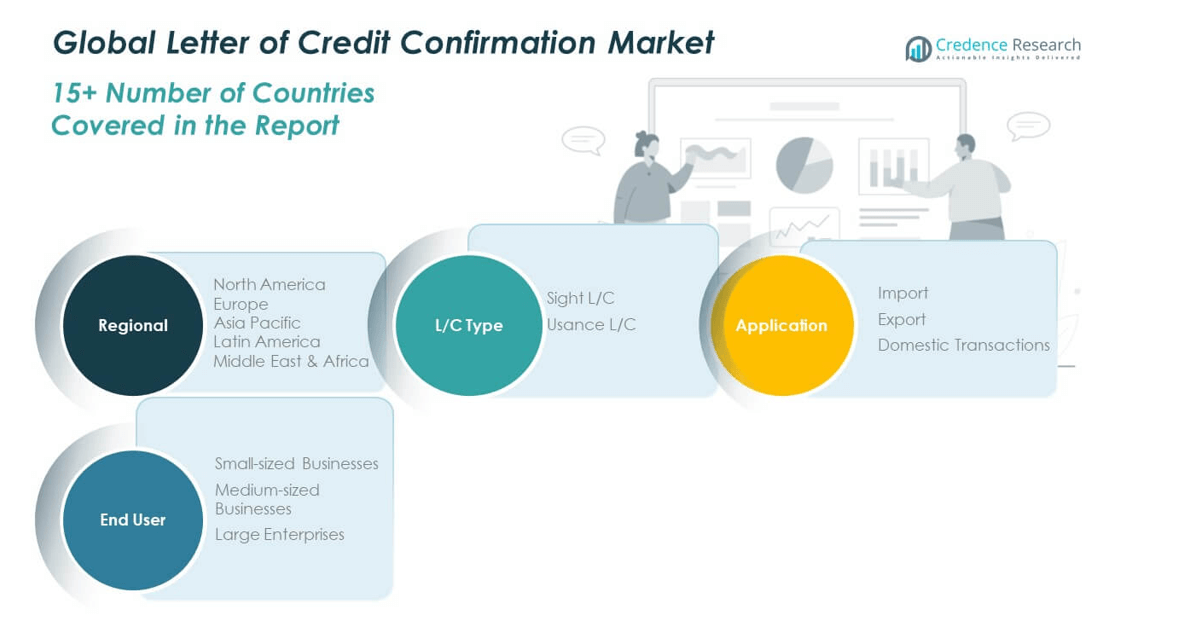
By L/C Type
- Sight L/C
- Usance L/C
By Application
- Import
- Export
- Domestic Transactions
By End User
- Small-sized Businesses
- Medium-sized Businesses
- Large Enterprises
By Region
- North America
- U.S.
- Canada
- Mexico
- Europe
- Germany
- France
- U.K.
- Italy
- Spain
- Rest of Europe
- Asia Pacific
- China
- Japan
- India
- South Korea
- South-east Asia
- Rest of Asia Pacific
- Latin America
- Brazil
- Argentina
- Rest of Latin America
- Middle East & Africa
- GCC Countries
- South Africa
- Rest of the Middle East and Africa
Regional Analysis:
North America
The North America Global Letter of Credit Confirmation Market size was valued at USD 1,017.26 million in 2018 to USD 1,370.31 million in 2024 and is anticipated to reach USD 1,972.38 million by 2032, at a CAGR of 4.3% during the forecast period. North America holds approximately 28% of the global market share. It benefits from mature banking infrastructure and high cross-border trade volumes. Companies prioritize secure payment solutions and risk mitigation strategies. It supports large-scale imports and exports across multiple industries. Financial institutions adopt advanced digital confirmation platforms for efficiency. It maintains regulatory compliance and ensures transparency in transactions. Banks offer tailored solutions for SMEs and large corporations. It remains a key revenue contributor to the global market.
Europe
The Europe Global Letter of Credit Confirmation Market size was valued at USD 640.02 million in 2018 to USD 826.91 million in 2024 and is anticipated to reach USD 1,075.64 million by 2032, at a CAGR of 3.0% during the forecast period. Europe accounts for roughly 17% of the global market share. It experiences steady growth driven by cross-border trade within the EU. Banks provide reliable confirmation services to mitigate default risks. It supports complex supply chains across multiple industries. Financial institutions integrate digital platforms for faster processing. It strengthens trade security in high-value transactions. Export-oriented nations rely on confirmed L/Cs to protect revenues. It benefits from strong regulatory frameworks and compliance standards.
Asia Pacific
The Asia Pacific Global Letter of Credit Confirmation Market size was valued at USD 1,527.61 million in 2018 to USD 2,167.46 million in 2024 and is anticipated to reach USD 3,296.11 million by 2032, at a CAGR of 5.1% during the forecast period. Asia Pacific contributes approximately 47% of the global market share. It experiences rapid growth due to rising international trade and manufacturing exports. Banks offer confirmations to secure payment in high-risk regions. It supports SMEs entering global markets and large corporations managing diverse supply chains. Financial institutions implement fintech solutions for efficiency. It benefits from government initiatives promoting trade financing. Export-driven economies like China and India drive demand. It remains the fastest-growing regional market globally.
Latin America
The Latin America Global Letter of Credit Confirmation Market size was valued at USD 161.10 million in 2018 to USD 217.65 million in 2024 and is anticipated to reach USD 275.24 million by 2032, at a CAGR of 2.7% during the forecast period. Latin America represents roughly 4% of the global market share. It experiences moderate growth from increasing trade with North America and Asia. Banks offer confirmation services to reduce payment risks for exporters. It supports agricultural, mining, and industrial exports. Financial institutions develop region-specific solutions to address local market needs. It provides secure settlement for high-value transactions. Trade liberalization policies encourage adoption of confirmations. It gradually strengthens financial infrastructure across emerging economies.
Middle East
The Middle East Global Letter of Credit Confirmation Market size was valued at USD 98.62 million in 2018 to USD 123.45 million in 2024 and is anticipated to reach USD 149.54 million by 2032, at a CAGR of 2.1% during the forecast period. The region holds approximately 2% of the global market share. It relies on confirmations for energy, petrochemical, and construction trade. Banks provide financial security for import-export transactions. It facilitates trade across GCC countries and strategic partners. Financial institutions focus on compliance and risk management. It supports both domestic and international transactions. Growing infrastructure projects boost demand for confirmed letters of credit. It remains a niche market with steady growth potential.
Africa
The Africa Global Letter of Credit Confirmation Market size was valued at USD 48.30 million in 2018 to USD 73.84 million in 2024 and is anticipated to reach USD 82.00 million by 2032, at a CAGR of 1.0% during the forecast period. Africa contributes roughly 1% of the global market share. It faces limited adoption due to underdeveloped trade finance infrastructure. Banks provide confirmations mainly for high-value imports and exports. It supports industries such as mining, energy, and agriculture. Financial institutions aim to enhance risk management and transaction security. It facilitates international trade with strategic partners. Regulatory reforms encourage gradual market penetration. It remains a small but emerging market with long-term growth potential.
Key Player Analysis:
- Citigroup Inc.
- DBS Bank Ltd.
- JPMorgan Chase & Co.
- Mizuho Bank Ltd.
- Standard Chartered plc
- Scotiabank
- Sumitomo Mitsui Banking Corporation
Competitive Analysis:
The Global Letter of Credit Confirmation Market features a robust competitive landscape with leading global banks vying for dominance. Players such as Citigroup Inc., DBS Bank Ltd., JPMorgan Chase & Co., Mizuho Bank Ltd., and Standard Chartered plc hold significant market shares and maintain strong global footprints. These institutions invest in digital trade finance platforms and expand confirmation service offerings to strengthen client relationships. They focus on risk management, compliance, and transaction speed to meet evolving trade finance needs. Smaller or regional banks innovate niche services or partner fintechs to challenge large banks’ dominance. Service differentiation occurs through customized fee structures, global correspondent networks, and streamlined processes. It fosters continuous innovation and encourages strategic alliances. The competitive pressure drives improved customer service, broader geographic coverage, and advanced technological integration across the market.
Recent Developments:
- In September 2025, JPMorgan Chase Bank formed a new credit agreement with Black Rock Coffee, underlining the bank’s ongoing commitment to provide robust credit facilities as part of comprehensive global trade finance, including support for confirmed letters of credit.
Report Coverage:
The research report offers an in-depth analysis based on L/C Type, Application and End User. It details leading market players, providing an overview of their business, product offerings, investments, revenue streams, and key applications. Additionally, the report includes insights into the competitive environment, SWOT analysis, current market trends, as well as the primary drivers and constraints. Furthermore, it discusses various factors that have driven market expansion in recent years. The report also explores market dynamics, regulatory scenarios, and technological advancements that are shaping the industry. It assesses the impact of external factors and global economic changes on market growth. Lastly, it provides strategic recommendations for new entrants and established companies to navigate the complexities of the market.
Future Outlook:
- The market will expand as international trade volumes continue to rise, driving demand for secure payment solutions.
- Digital platforms will increasingly dominate, streamlining confirmation processes and enhancing operational efficiency.
- Adoption of blockchain and fintech innovations will strengthen transparency and reduce transaction risks.
- SMEs will increasingly leverage confirmation services to enter global trade with financial security.
- Banks will offer tailored solutions for different L/C types and industry-specific applications.
- Cross-border and regional trade agreements will boost reliance on confirmed letters of credit.
- Integration with treasury and supply chain management systems will enhance corporate financial planning.
- Regulatory compliance and risk mitigation will continue to drive service adoption across markets.
- Emerging economies will contribute to market growth through rising export-import activities.
- Strategic partnerships, mergers, and expansions will intensify competition and innovation in the market.

Request a Free Sample
Fill in your details and we'll send you a free sample report.
- Sample data tables & charts
- Research methodology
Market Dynamics
Rising International Trade Volumes and Demand for Secure Payment Methods
As global trade expands, companies increasingly require secure payment mechanisms to mitigate risks of non-payment and political instability. Letter of credit confirmation provides sellers with guaranteed payments, fostering trust and enabling higher-value cross-border transactions.
Technological Integration and Digitalisation in Trade Finance Operations
The adoption of digital platforms, blockchain, and automated processes streamlines the issuance and confirmation of letters of credit, reducing paperwork, accelerating transaction times, and improving transparency. This technological shift attracts more corporates and banks to use confirmation services.
Regulatory Compliance and Strengthening Risk Management Practices
Stricter global regulations around anti-money laundering (AML) and know-your-customer (KYC) drive banks and corporates to adopt confirmed letters of credit, which offer enhanced compliance, reduce exposure to default and currency risks, and align with evolving risk management standards.
Expansion of Emerging Economies and Growth in Trade Financing Needs
Emerging markets in Asia Pacific, Latin America, and Africa are increasing their participation in international trade, driving demand for financial guarantees and confirmation services to support SMEs and large enterprises entering new markets and managing complex supply chains.
Integration with Supply Chain Financing and Treasury Management Systems
Corporates are embedding letter of credit confirmation within broader treasury and supply chain finance solutions, enabling better cash flow management, risk mitigation, and operational efficiency across global trade networks.
Need a Custom Version of This Report?
Tailor the scope, geography, or segments to your exact requirements.
- Custom geography or segment scope
- Direct access to our analyst team
Frequently Asked Questions
What is the current market size for Global Letter of Credit Confirmation Market, and what is its projected size in 2032?
At what Compound Annual Growth Rate is the Global Letter of Credit Confirmation Market projected to grow between 2024 and 2032?
What are the primary factors fueling the growth of the Global Letter of Credit Confirmation Market?
Which L/C type segment holds second-largest share of the market in the world?
Which segment is expected to post the highest CAGR during the forecast period?
Which region is fueling the growth of the letter of credit confirmation industry?
Who are the major players in the global letter of credit confirmation market?
What are the major market drivers of the letter of credit confirmation industry?
What are the major market restraints of the letter of credit confirmation industry?
What are the major market opportunities of the letter of credit confirmation industry?
Table of Content
Chapter 1 Market Segmentation
- 1.1 Segmentation Framework
- 1.1.1 Product and Service Classification
- 1.1.2 Application and End-Use Classification
- 1.1.3 Technology and Solution Classification
- 1.1.4 Customer and Distribution Channel Classification
- 1.1.5 Geographic Segmentation
- 1.1.6 Market Segment Definitions and Boundaries
- 1.2 By End User
- 1.2.1 Small-sized Businesses
- 1.2.2 Medium-sized Businesses
- 1.2.3 Large Enterprises
- 1.3 By L/C Type
- 1.3.1 Sight L/C
- 1.3.2 Usance L/C
- 1.4 By Application
- 1.4.1 Import
- 1.4.2 Export
- 1.4.3 Domestic Transactions
Chapter 2 Introduction
- 2.1 Report Objectives and Scope
- 2.2 Product Definition and Industry Terminology
- 2.3 Market Inclusions and Exclusions
- 2.4 Research Process
- 2.4.1 Primary Research and Expert Interviews
- 2.4.2 Secondary Research and Source Review
- 2.4.3 Top-Down and Bottom-Up Estimation
- 2.4.4 Data Triangulation and Verification
- 2.5 Market Size Measurement Basis
- 2.5.1 2024: USD 4,779.62 million → 2032: USD 6,850.92 million
- 2.6 Historical and Forecast Reference Periods
- 2.6.1 Base Year: 2024
- 2.6.2 Forecast Period: 2024-2032
- 2.7 Research Assumptions and Limitations
Chapter 3 Executive Summary
- 3.1 Market Snapshot and Key Findings
- 3.2 Base-Year Market Size, 2024
- 3.3 Forecast Market Size, 2032
- 3.4 Revenue and Volume Growth Outlook
- 3.5 Key Demand and Supply Indicators
- 3.6 Leading Market Segments
- 3.7 Fastest-Growing Market Opportunities
- 3.8 Regional Performance Highlights
- 3.9 Technology and Industry Transformation
- 3.10 Competitive Landscape Summary
- 3.11 Analyst View and Strategic Implications
Chapter 4 Global Letter of Credit Confirmation Market Trends and Developments
- 4.1 Historical Industry Development
- 4.2 Recent Market Trends and Developments
- 4.3 Demand and Customer Behavior Trends
- 4.4 Technology and Product Innovation
- 4.5 Artificial Intelligence, Automation and Digitalization
- 4.6 Local Manufacturing and Supply Chain Realignment
- 4.7 Industry Partnerships, Mergers and Acquisitions
- 4.8 Sustainability and Circular Economy Developments
- 4.9 Government and Private Sector Investment Trends
- 4.10 Emerging Business Models and Commercialization
- 4.11 Industry Developments and Announcements
Chapter 5 Global Letter of Credit Confirmation Market Supply and Demand Analysis
- 5.1 Demand Trend and Consumption Analysis
- 5.2 Demand Forecast, 2024-2032
- 5.3 Supply Chain Structure and Procurement Trends
- 5.4 Supply-Demand Gap and Bottlenecks
- 5.5 Import Dependence and Sourcing Structure
- 5.6 Regional Supply and Demand Concentration
Chapter 6 Global Letter of Credit Confirmation Market Pricing Analysis
- 6.1 Pricing Structure and Measurement
- 6.2 Historical Pricing Trends
- 6.3 Pricing Outlook, 2024-2032
- 6.4 Pricing by Product and Market Segment
- 6.5 Geographic Pricing Differences
- 6.6 Key Input, Energy, Labor and Logistics Costs
- 6.7 Contract Pricing and Purchasing Models
- 6.8 Pricing Sensitivity and Competitive Positioning
- 6.9 Price, Margin and Profitability Implications
Chapter 7 Global Letter of Credit Confirmation Market Dynamics
- 7.1 Market Growth Drivers
- 7.1.1 Demand-Side Drivers
- 7.1.2 Technology and Innovation Drivers
- 7.1.3 Infrastructure and Investment Drivers
- 7.1.4 Regulatory and Policy Drivers
- 7.2 Market Restraints
- 7.2.1 Cost and Affordability Constraints
- 7.2.2 Technology and Adoption Barriers
- 7.2.3 Supply Chain and Operational Constraints
- 7.3 Market Challenges
- 7.3.1 Competitive Pressure and Margin Erosion
- 7.3.2 Skills, Infrastructure and Implementation Gaps
- 7.4 Emerging Market Opportunities
- 7.5 Market Dynamics Impact and Time-Horizon Assessment
Chapter 8 Global Letter of Credit Confirmation Value Chain Analysis
- 8.1 Industry Value Chain Overview
- 8.2 Upstream Suppliers and Critical Inputs
- 8.3 Technology and Component Providers
- 8.4 Manufacturing or Service Delivery
- 8.5 Distribution, Channel Partners and Integrators
- 8.6 Downstream Applications and End Users
- 8.7 Value Addition and Profit Pools
- 8.8 Vertical Integration and Outsourcing
- 8.9 Supplier Concentration and Risk
- 8.10 Supply Chain Localization and Resilience
Chapter 9 Global Letter of Credit Confirmation Market Regulations and Policies
- 9.1 Relevant Laws, Standards and Compliance Frameworks
- 9.2 Product, Service, Safety and Quality Requirements
- 9.3 Government Policies, Incentives and Subsidies
- 9.4 Imports, Exports and Trade Barriers
- 9.5 Public Procurement and Local Content Requirements
- 9.6 Data Protection, AI and Cybersecurity Compliance
- 9.7 Upcoming Policy Changes and Market Implications
Chapter 10 Global Letter of Credit Confirmation Market Hotspots and Opportunities
- 10.1 Market Opportunity Mapping and Growth Hotspots
- 10.2 High-Growth Applications and Customer Groups
- 10.3 Underserved Markets and White-Space Opportunities
- 10.4 Emerging Technology and Product Opportunities
- 10.5 New Capacity and Investment Hotspots
- 10.6 Market Entry and Expansion Opportunities
- 10.7 Distribution and Partnership Opportunities
- 10.8 Near-Term and Long-Term Commercial Potential
- 10.9 Opportunity Attractiveness and Execution Risks
Chapter 11 Global Letter of Credit Confirmation Market Outlook, 2024-2032
- 11.1 Market Size and Analysis
- 11.1.1 Revenue (Market Measurement: 2024: USD 4,779.62 million → 2032: USD 6,850.92 million)
- 11.1.2 Historical Market Size
- 11.1.3 Base-Year Market Size, 2024
- 11.2 Market Forecast, 2024-2032
- 11.2.1 Revenue Forecast to 2032
- 11.2.2 CAGR and Year-on-Year Growth
- 11.2.3 Incremental Revenue Opportunity
- 11.3 Forecast Assumptions and Scenario Analysis
- 11.3.1 Base-Case Forecast
- 11.3.2 Optimistic and Conservative Scenarios
- 11.3.3 Technology, Pricing and Policy Sensitivities
- 11.4 Market Attractiveness and Growth Outlook
Chapter 12 Global Letter of Credit Confirmation Market Segmentation and Outlook
- 12.1 Segmentation Summary and Market Shares, 2024
- 12.2 Largest and Fastest-Growing Segments
- 12.3 By End User - Market Size and Forecast, 2024-2032
- 12.3.1 Segment Definition and Scope
- 12.3.2 Historical Market Size
- 12.3.3 Revenue Forecast, 2024-2032
- 12.3.4 Base-Year Market Share, 2024
- 12.3.5 Segment CAGR and Growth Drivers
- 12.3.6 Subsegment Market Size and Forecast
- 12.3.6.1 Small-sized Businesses
- 12.3.6.2 Medium-sized Businesses
- 12.3.6.3 Large Enterprises
- 12.3.7 Subsegment Pricing and Adoption Trends
- 12.3.8 Leading Suppliers and Competition
- 12.3.9 Regional Demand and Opportunities
- 12.4 By L/C Type - Market Size and Forecast, 2024-2032
- 12.4.1 Segment Definition and Scope
- 12.4.2 Historical Market Size
- 12.4.3 Revenue Forecast, 2024-2032
- 12.4.4 Base-Year Market Share, 2024
- 12.4.5 Segment CAGR and Growth Drivers
- 12.4.6 Subsegment Market Size and Forecast
- 12.4.6.1 Sight L/C
- 12.4.6.2 Usance L/C
- 12.4.7 Subsegment Pricing and Adoption Trends
- 12.4.8 Leading Suppliers and Competition
- 12.4.9 Regional Demand and Opportunities
- 12.5 By Application - Market Size and Forecast, 2024-2032
- 12.5.1 Segment Definition and Scope
- 12.5.2 Historical Market Size
- 12.5.3 Revenue Forecast, 2024-2032
- 12.5.4 Base-Year Market Share, 2024
- 12.5.5 Segment CAGR and Growth Drivers
- 12.5.6 Subsegment Market Size and Forecast
- 12.5.6.1 Import
- 12.5.6.2 Export
- 12.5.6.3 Domestic Transactions
- 12.5.7 Subsegment Pricing and Adoption Trends
- 12.5.8 Leading Suppliers and Competition
- 12.5.9 Regional Demand and Opportunities
- 12.6 Segment Growth Comparison
- 12.7 Segment Attractiveness and Priority Matrix
Chapter 13 Global Letter of Credit Confirmation End-Use and Application Market Outlook
- 13.1 End-Use Industry and Customer Demand Structure
- 13.2 Leading Applications and Customer Groups
- 13.3 End-Use Market Size, Share and Forecast
- 13.4 Major End-Use Industry Deep Dives
- 13.4.1 Customer Requirements and Use Cases
- 13.4.2 Demand and Replacement Cycles
- 13.4.3 Technical and Regulatory Considerations
- 13.4.4 Purchasing and Procurement Models
- 13.4.5 Leading Vendors and Distribution Channels
- 13.4.6 Forecast and Commercial Opportunities
- 13.5 Emerging Applications and Cross-Segment Demand
- 13.6 End-Use Industry Investment Priorities
Chapter 14 Global Letter of Credit Confirmation Geographic Market Outlook, 2024-2032
- 14.1 Regional Market Size and Share, 2024
- 14.2 Regional Market Forecast, 2024-2032
- 14.3 Regional Pricing, Production and Demand Differences
- 14.4 North America
- 14.4.1 United States
- 14.4.2 Canada
- 14.4.3 Mexico
- 14.5 Europe
- 14.5.1 Germany
- 14.5.2 France
- 14.5.3 Italy
- 14.5.4 United Kingdom
- 14.5.5 Spain
- 14.5.6 Poland
- 14.5.7 Russia
- 14.5.8 Netherlands
- 14.5.9 Belgium
- 14.5.10 Sweden
- 14.5.11 Denmark
- 14.5.12 Norway
- 14.5.13 Rest of Europe
- 14.6 Asia Pacific
- 14.6.1 China
- 14.6.2 India
- 14.6.3 Japan
- 14.6.4 South Korea
- 14.6.5 Thailand
- 14.6.6 Indonesia
- 14.6.7 Vietnam
- 14.6.8 Malaysia
- 14.6.9 Australia
- 14.6.10 Rest of Asia Pacific
- 14.7 Latin America
- 14.7.1 Brazil
- 14.7.2 Argentina
- 14.7.3 Colombia
- 14.7.4 Chile
- 14.7.5 Rest of Latin America
- 14.8 Middle East
- 14.8.1 Saudi Arabia
- 14.8.2 United Arab Emirates
- 14.8.3 Turkey
- 14.8.4 Israel
- 14.8.5 Iran
- 14.8.6 Rest of the Middle East
- 14.9 Africa
- 14.9.1 South Africa
- 14.9.2 Egypt
- 14.9.3 Nigeria
- 14.9.4 Morocco
- 14.9.5 Rest of Africa
- 14.10 Regional Investment, Policy and Supply Chain Differences
- 14.11 Regional Competitive Landscape
- 14.12 Geographic Growth Hotspots
Chapter 15 Global Letter of Credit Confirmation Technology, Innovation and Sustainability Outlook
- 15.1 Technology Landscape and Maturity
- 15.2 Product, Process and Service Innovation
- 15.3 AI, Automation and Digital Tools in the Industry
- 15.4 Technology Adoption and Performance Benchmarking
- 15.5 Innovation Pipeline and R&D Investment
- 15.6 Energy Efficiency and Resource Management
- 15.7 Sustainability, Recycling and Circularity
- 15.8 Technology Roadmap, 2024-2032
- 15.9 Risks of Obsolescence and Technology Substitution
Chapter 16 Global Letter of Credit Confirmation Market Key Strategic Imperatives
- 16.1 Growth and Market Entry Priorities
- 16.2 High-Return Products and Segments
- 16.3 Pricing, Profitability and Cost Optimization
- 16.4 Technology Investment and Product Differentiation
- 16.5 Supply Chain Localization and Resilience
- 16.6 Distribution and Customer Acquisition
- 16.7 Partnership, Acquisition and Capacity Strategy
- 16.8 Regional Expansion Priorities
- 16.9 Short-, Medium- and Long-Term Actions
Chapter 17 Competition Outlook
- 17.1 Industry Competition Characteristics
- 17.2 Market Structure and Concentration
- 17.3 Market Share and Competitive Positioning, 2024
- 17.4 Company-Wise Revenue and Product Benchmarking
- 17.5 Production and Service Capacity Benchmarking
- 17.6 Technology, Pricing and Differentiation
- 17.7 Regional Footprint and Distribution Strength
- 17.8 Mergers, Acquisitions and Strategic Alliances
- 17.9 New Entrants and Competitive Threats
- 17.10 Porter's Five Forces and Industry Attractiveness
- 17.11 Competitive Outlook, 2024-2032
Chapter 18 Company Profiles
- 18.1 Company Coverage and Selection Criteria
- 18.2 Citigroup Inc.
- 18.2.1 Business Description
- 18.2.2 Company Ownership and Geographic Presence
- 18.2.3 Product and Service Portfolio
- 18.2.4 Manufacturing and Operating Footprint
- 18.2.5 Financial Performance and Investment
- 18.2.6 Market Share and Competitive Position
- 18.2.7 Technology and Innovation Capabilities
- 18.2.8 Strategic Alliances or Partnerships
- 18.2.9 Recent Developments
- 18.2.10 Growth Strategy and Outlook
- 18.3 DBS Bank Ltd.
- 18.4 JPMorgan Chase & Co.
- 18.5 Mizuho Bank Ltd.
- 18.6 Standard Chartered plc
- 18.7 Scotiabank
- 18.8 Sumitomo Mitsui Banking Corporation
- 18.9 HSBC Holdings plc
- 18.10 Bank of America
- 18.11 BNP Paribas
- 18.12 Other Relevant Market Participants
Note: Every listed company is profiled on the structure shown under the first company. The company list is preliminary and may change based on research findings, market developments, data availability and client requirements.
Chapter 19 Disclaimer
- 19.1 Research and Forecast Disclaimer
- 19.2 Data Source and Estimation Limitations
Note: The depth of individual sections depends on data availability for this market. Volume, capacity, trade and other unit-based metrics are included where applicable.

