Market Overview:
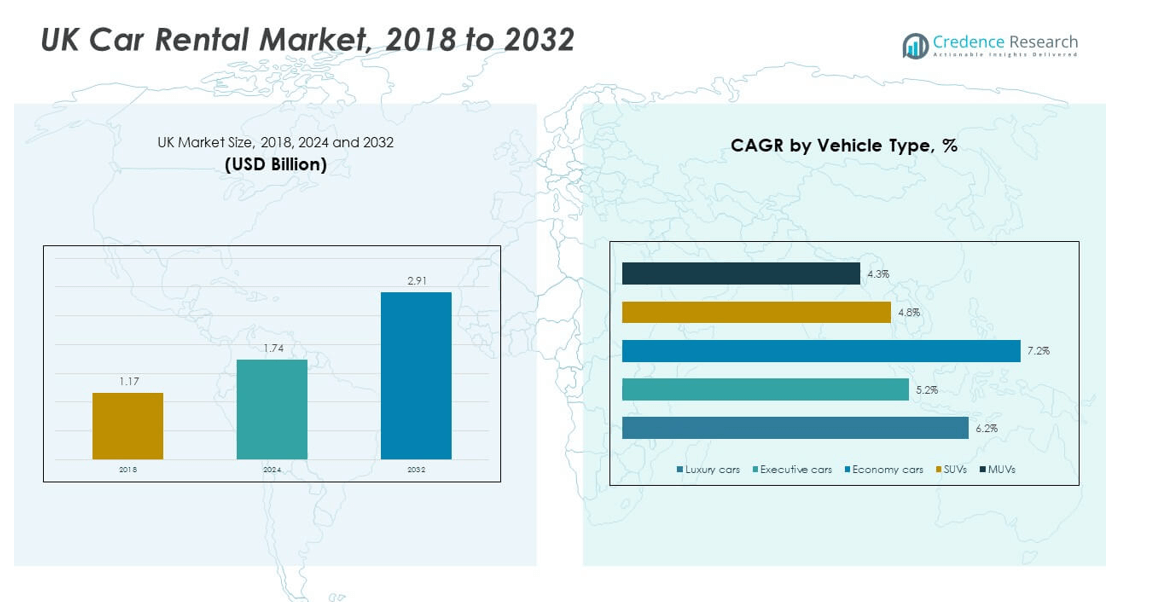
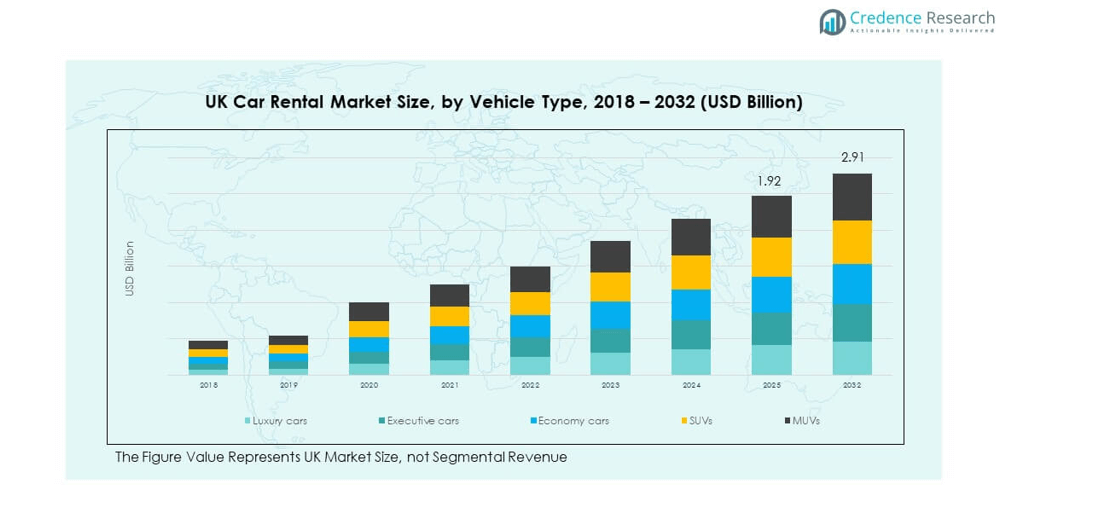
The UK Car Rental Market size was valued at USD 1.17 billion in 2018, grew to USD 1.74 billion in 2024, and is anticipated to reach USD 2.91 billion by 2032, at a CAGR of 6.15 % during the forecast period.
| REPORT ATTRIBUTE | DETAILS |
|---|---|
| Historical Period | 2020-2023 |
| Base Year | 2024 |
| Forecast Period | 2025-2032 |
| UK Car Rental Market Size 2024 | USD 1.74 billion |
| UK Car Rental Market, CAGR | 6.15% |
| UK Car Rental Market Size 2032 | USD 2.91 billion |
Growth is being driven by increasing tourism, rising demand for flexible mobility solutions and the shift away from vehicle ownership. Rental firms actively adapt by expanding short‑term offerings and embracing digital bookings to capture younger, tech‑savvy customers. Environmental factors also push expansion as fleets incorporate hybrids and EVs to meet sustainability goals and appeal to eco‑conscious renters.
Regionally, England remains the dominant market within the UK thanks to high tourism volumes in London and major airports such as Heathrow and Gatwick. Scotland and Wales are emerging as growth areas due to increasing domestic travel and rural rental demand. Northern Ireland, while smaller, is gaining traction as improved connectivity and rental services expand beyond major urban centres.
Market Insights:
- The UK Car Rental Market size was valued at USD 1.17 billion in 2018, expected to reach USD 1.92 billion by 2024, and projected to grow to USD 2.91 billion by 2032, with a CAGR of 6.15%.
- England holds the largest market share at around 70%, followed by Scotland and Wales at 20%, and Northern Ireland at 10%, with England dominating due to its major urban centers and tourism traffic.
- The fastest-growing region is Scotland and Wales, with a 20% market share, driven by growing domestic travel, scenic tourism, and rising rental demands in rural and regional areas.
- The Economy Cars segment held the largest share in 2024, contributing significantly to the UK Car Rental Market, followed by SUVs and Executive Cars.
- By 2032, MUVs and SUVs are expected to show the highest growth, supported by increasing demand for versatile, space-efficient vehicles for both leisure and business travel.
Market Drivers:
Increasing Tourism and Business Travel
The growth of the UK Car Rental Market is driven by the increasing influx of international and domestic tourists. Popular tourist destinations like London, Edinburgh, and Manchester contribute to this demand. The rise in business travel further supports this trend, as companies prefer car rentals for greater flexibility and convenience. Rental services offer a seamless option for business professionals attending meetings, conferences, and corporate events. The availability of rental vehicles enables tourists and professionals alike to navigate the country efficiently, further boosting the market's potential.
- For instance, car rental companies in the UK, including major players like Hertz, experienced increased demand during major events like the London 2012 Olympics, which attracted millions of visitors. News reports from the time advised visitors to book their car hire early to avoid disappointment, indicating a significant surge in demand.
Shift Toward Flexible Mobility Solutions
There is a noticeable shift from vehicle ownership to flexible mobility options. Consumers are increasingly preferring rental vehicles over long-term commitments such as purchasing or leasing a car. This trend is driven by the convenience of renting a car for specific needs like travel, leisure, or business trips, without the burden of maintenance and ownership costs. The growth of shared mobility solutions such as car-sharing services is also playing a role in changing mobility preferences. This shift is expected to support sustained demand for car rental services.
- For instance, Sixt SE has capitalized on this trend by offering its car-sharing service, Sixt Share, which allows customers to rent cars by the hour, offering a flexible solution for those who need a vehicle for short-term use.
Environmental Awareness and Sustainability Initiatives
The rise in environmental awareness has encouraged rental companies to offer more eco-friendly options, such as hybrid and electric vehicles (EVs). The UK government's push for greener transport options aligns with this trend, with policies supporting sustainability and carbon reduction. This trend also aligns with the increasing consumer demand for green alternatives in transportation. As car rental companies adopt more sustainable practices, it strengthens the market's appeal among environmentally conscious customers.
Technological Advancements in Rental Processes
Advancements in technology are enhancing the rental experience and fueling market growth. The proliferation of mobile apps, online booking platforms, and digital payment methods has made renting cars more convenient and efficient. Customers can now book vehicles on-the-go, select their preferred car models, and complete payments seamlessly. These innovations are improving the customer experience, driving greater demand for car rentals in the UK market.
Market Trends:
Rise in Electric Vehicle (EV) Rentals
The UK Car Rental Market is witnessing a significant trend toward electric vehicle (EV) rentals. The increasing focus on reducing carbon emissions is driving rental companies to expand their EV fleets. Customers are more inclined to opt for EVs, as they align with their eco-conscious preferences. In response, car rental companies are introducing a broader range of EV models to meet this demand. This trend not only supports environmental goals but also caters to the growing consumer interest in electric mobility, paving the way for EVs to become a mainstream choice in the rental sector.
- For instance, Enterprise Rent-A-Car UK added over 300 electric vehicles to its fleet in 2023, responding to the growing demand for eco-friendly travel options. Customers are more inclined to opt for EVs, as they align with their eco-conscious preferences. In response, car rental companies like Hertz UK and Sixt SE are introducing a broader range of EV models, such as the Tesla Model 3 and Nissan Leaf, to meet this demand.
Integration of Artificial Intelligence (AI) in Rental Operations
AI and machine learning are becoming integral to the operations of car rental companies. AI is being used for predictive maintenance, route optimization, and fleet management, enabling rental companies to enhance operational efficiency. Additionally, AI-powered chatbots and virtual assistants are being incorporated into customer service to provide real-time assistance and streamline the booking process. The use of AI helps rental firms provide better services while reducing operational costs, making the UK Car Rental Market more competitive.
- For instance, Avis UK has integrated AI-based algorithms to manage its fleet in real-time, allowing it to predict demand surges and adjust pricing accordingly. Additionally, AI-powered chatbots and virtual assistants are being incorporated into customer service to provide real-time assistance and streamline the booking process.
Expansion of Car-Sharing Services
Car-sharing services are rapidly expanding across the UK, offering customers a more flexible and cost-effective alternative to traditional rentals. With the rise of apps like Zipcar and Enterprise CarShare, individuals can rent cars by the hour or day without the long-term commitment of ownership. This model caters to younger consumers and urban dwellers who prefer short-term access to vehicles. As more consumers embrace car-sharing services, the demand for such services is expected to increase, contributing to the growth of the UK Car Rental Market.
Partnerships and Collaborations for Fleet Expansion
Car rental companies are increasingly forming partnerships with automotive manufacturers, ride-sharing platforms, and technology providers to expand their fleets and improve service offerings. These collaborations allow rental firms to diversify their fleet by introducing more electric vehicles, luxury models, and specialized vehicles. By collaborating with ride-sharing companies, car rental firms are also tapping into a new market segment, where customers can use their rental cars for both personal and business purposes. These partnerships are expected to boost market growth by expanding rental options and improving accessibility.
Market Challenges:
Intense Competition and Price Sensitivity
The UK Car Rental Market faces intense competition from both traditional rental companies and new entrants offering alternative mobility solutions. The increasing availability of car-sharing services, along with the introduction of ride-hailing apps like Uber and Lyft, is putting pressure on traditional rental services. Rental companies must continuously innovate to stay competitive by offering better pricing, more convenient services, and an extensive fleet. Price sensitivity among customers also adds to the challenge, as consumers seek value for money, which limits the profitability of rental firms.
Regulatory and Compliance Issues
The UK Car Rental Market is subject to numerous regulatory and compliance requirements, including safety standards, environmental regulations, and insurance laws. Rental companies must navigate these complex regulations, which can lead to increased operational costs. Stricter emissions regulations are also pushing companies to transition to cleaner vehicles, requiring significant investment in new fleets. Adapting to these regulatory demands can be challenging for rental companies, especially smaller firms that may not have the financial resources to keep up with these changes.
Market Opportunities:
Growing Demand for Short-Term Rentals
The increasing demand for short-term rentals presents a significant opportunity for the UK Car Rental Market. As consumers continue to move away from long-term car ownership, the preference for short-term rental solutions is expected to rise. Business professionals, tourists, and local customers are all seeking flexible rental options that allow them to access vehicles as needed, without the commitment of owning a car. Rental companies can capitalize on this opportunity by expanding their short-term rental offerings, thus capturing a larger share of the market.
Expansion of Digital and Contactless Services
The growth of digital and contactless services offers substantial opportunities for the UK Car Rental Market. Customers are increasingly expecting seamless and contactless rental experiences, from booking and payment to vehicle pickup and drop-off. By investing in digital platforms and contactless check-ins, rental companies can enhance customer satisfaction and streamline their operations. This trend also caters to health and safety concerns, which have been particularly relevant post-pandemic. Car rental companies can leverage digital services to improve efficiency and attract a tech-savvy customer base.
Market Segmentation Analysis:
Vehicle Type Segment:
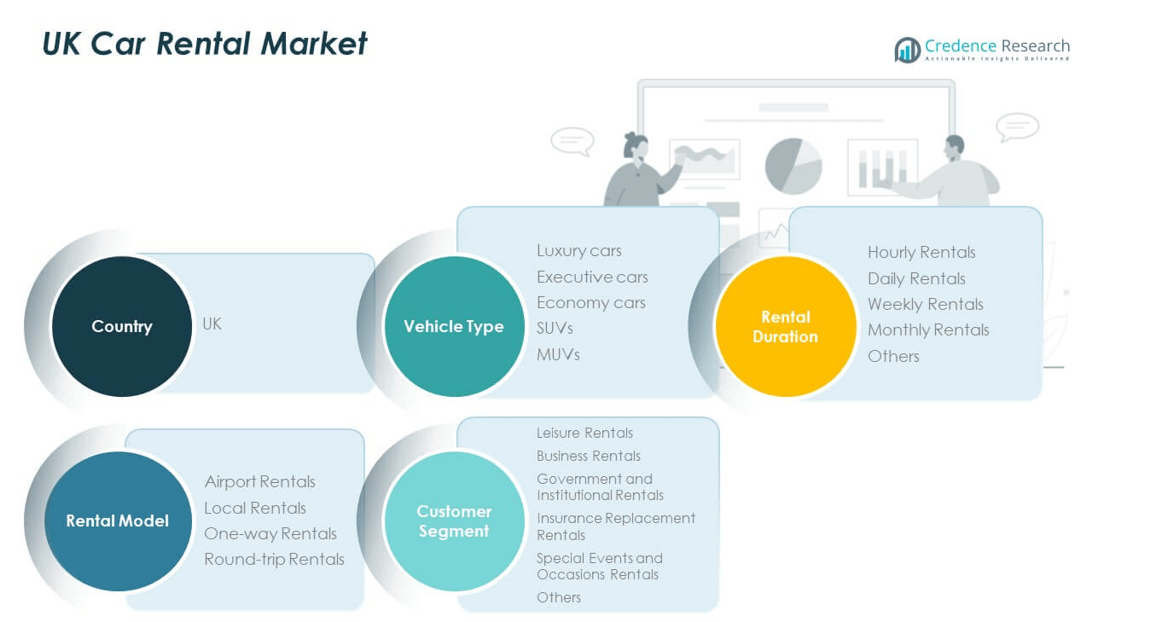
The UK Car Rental Market offers a diverse range of vehicle types to cater to varying customer needs. Luxury cars are preferred for high-end business travel and leisure, offering premium comfort and performance. Executive cars are popular for corporate rentals, combining style and practicality. Economy cars dominate the market due to their affordability and fuel efficiency, making them ideal for budget-conscious consumers. SUVs and MUVs are gaining popularity, particularly for families and travelers seeking more space and versatility for longer trips.
- For example, Sixt SE's luxury fleet includes top-tier brands like Mercedes-Benz and BMW, designed for corporate clients and premium leisure travelers. Executive cars are popular for corporate rentals, combining style and practicality. Enterprise Rent-A-Car UK has seen growing demand for these vehicles, especially among business professionals.
Rental Duration Segment:
The demand for hourly rentals is growing, driven by customers who need flexibility for short trips. Daily rentals remain the most popular option for tourists and business professionals seeking a car for a few days. Weekly rentals are often favored by customers needing a vehicle for extended trips or vacations. Monthly rentals cater to business professionals or long-term visitors who require a vehicle for extended periods. Other rental durations, such as long-term and subscription-based models, are also emerging in the UK market.
- For instance, Sixt SE introduced its "Sixt Share" car-sharing service, allowing customers to rent vehicles by the minute, hour, or day in specific markets, such as Germany (cities like Berlin, Hamburg, and Munich) and the Netherlands (cities like Amsterdam, Rotterdam, The Hague, and Utrecht). While Sixt is expanding its general car rental network in the UK, its primary UK operations focus on traditional daily, weekly, and monthly rentals of cars and vans.
Rental Model Segment:
Airport rentals are a key segment in the UK Car Rental Market, as airports remain major hubs for both tourists and business travelers. Local rentals cater to customers needing a vehicle within city limits for short-term purposes. One-way rentals are increasingly sought after for road trips and travel flexibility. Round-trip rentals are ideal for customers looking to explore a region and return to the starting point.
Customer Segment:
Leisure rentals dominate as tourists and individuals seek vehicles for personal trips. Business rentals cater to corporate clients who require vehicles for professional purposes. Government and institutional rentals support public sector organizations. Insurance replacement rentals are necessary for customers whose vehicles are being repaired or replaced. Special events and occasions rentals cater to weddings, parties, and other significant events. Other customer segments include long-term and fleet rentals.
Segmentation:
By Vehicle Type Segment:
- Luxury Cars
- Executive Cars
- Economy Cars
- SUVs
- MUVs
By Rental Duration Segment:
- Hourly Rentals
- Daily Rentals
- Weekly Rentals
- Monthly Rentals
- Others
By Rental Model Segment:
- Airport Rentals
- Local Rentals
- One-way Rentals
- Round-trip Rentals
By Customer Segment:
- Leisure Rentals
- Business Rentals
- Government and Institutional Rentals
- Insurance Replacement Rentals
- Special Events and Occasions Rentals
- Others
By Country Segment:
- UK Car Rental Market (volume and revenue share by country, vehicle type, rental duration, rental model, customer segment)
Regional Analysis:
England Region
The UK Car Rental Market in England holds the largest regional share, estimated at around 70 % of national revenue. It generates strong demand through major airports, metropolitan travel hubs and high tourist footfall. Business travel and corporate leasing remain concentrated in London and the South East, supporting premium segment rentals. Urban commuters and regional holidaymakers also contribute significantly. Rental operators in this region optimise fleets and services for high utilisation and dynamic pricing. Competitive pressure remains intense, driving innovation in digital booking and loyalty programmes.
Scotland and Wales Region
Scotland and Wales collectively account for approximately 20 % of the UK rental market share. These regions attract more leisure and domestic travel bookings, driven by scenic routes and holiday destinations. Operators focus on economy and SUV segments to suit local preferences and longer rental durations. Seasonality affects demand more in these regions than in England, prompting flexible pricing. Rental firms invest in branch network expansion and partnerships with regional tourism boards. Growth potential remains strong due to rising stay‑cation trends and mobility of remote workers.
Northern Ireland Region
Northern Ireland contributes roughly 10 % of the total market share in the UK car rental business. Market activity centres on airport pickups and regional road trips, with fewer corporate accounts than in mainland UK. Fleet composition tends toward economy and one‑way rentals, driven by inter‑island travel needs and tourism. Infrastructure limitations and fewer large‑scale airports restrict scale but also offer niche opportunities. Rental providers in Northern Ireland emphasise local customer service and partnerships with travel agencies. Emerging mobility models may further stimulate growth in this region.
Key Player Analysis:
- Enterprise Rent-A-Car UK
- Hertz UK
- Europcar UK
- Sixt SE
- Avis UK
- Alamo UK
- Drivalia
- Thrifty UK
- Arnold Clark Rental
- Green Motion UK
Competitive Analysis:
The UK Car Rental Market is highly competitive, with key players offering diverse services to meet evolving customer needs. Leading companies like Enterprise Rent-A-Car, Hertz UK, and Europcar UK dominate, focusing on a broad fleet range that includes luxury, economy, and electric vehicles. New entrants and local players are leveraging niche offerings, such as eco-friendly car rentals and tech-enabled services. Strategic alliances and technology adoption are reshaping the competitive landscape. Companies are enhancing customer experience through digital platforms, loyalty programs, and improved service offerings. Operational efficiency remains key for market leaders, particularly in managing fleet size and pricing flexibility to meet demand.
Recent Developments:
- In June 2025, Enterprise Rent-A-Car UK secured a significant partnership with the National League, becoming its title sponsor. The agreement, which commenced in June 2025, granted Enterprise naming rights to the National League and its three divisions – the Enterprise National League, Enterprise National League North, and Enterprise National League South.
- In August 2025, Hertz Global announced a strategic partnership with Amazon, marking a significant expansion of its retail operations. On August 20, 2025, Hertz Car Sales launched on Amazon Autos, allowing shoppers to browse, finance, and purchase from thousands of high-quality pre-owned vehicles through Amazon's marketplace.
Report Coverage:
The research report offers an in-depth analysis based on vehicle types, rental models, customer segments, and regional dynamics. It details leading market players, providing an overview of their business, product offerings, investments, revenue streams, and key applications. Additionally, the report includes insights into the competitive environment, SWOT analysis, current market trends, as well as the primary drivers and constraints. Furthermore, it discusses various factors that have driven market expansion in recent years. The report also explores market dynamics, regulatory scenarios, and technological advancements that are shaping the industry. It assesses the impact of external factors and global economic changes on market growth. Lastly, it provides strategic recommendations for new entrants and established companies to navigate the complexities of the market.
Future Outlook:
- The UK Car Rental Market will see increasing adoption of electric and hybrid vehicles.
- Rental companies will continue focusing on providing flexible, short-term rentals to meet changing consumer preferences.
- Car-sharing services will rise as a competitive alternative to traditional rentals.
- Digital platforms and mobile apps will enhance customer experience, enabling easier bookings and payments.
- Growing demand for luxury and executive car rentals will cater to business professionals.
- Partnerships between car rental firms and ride-sharing companies will expand.
- Government policies supporting green transport will accelerate the fleet transition to EVs.
- Sustainable business practices will be a key differentiator for market players.
- Increasing tourism will continue to drive demand for car rentals, especially in major cities.
- Regulatory challenges around emissions will influence rental fleets and business operations.

Request a Free Sample
Fill in your details and we'll send you a free sample report.
- Sample data tables & charts
- Research methodology
Need a Custom Version of This Report?
Tailor the scope, geography, or segments to your exact requirements.
- Custom geography or segment scope
- Direct access to our analyst team
Frequently Asked Questions
What is the current market size for the UK Car Rental Market, and what is its projected size in 2032?
At what Compound Annual Growth Rate is the UK Car Rental Market projected to grow between 2024 and 2032?
Which UK Car Rental Market segment held the largest share in 2024?
What are the primary factors fueling the growth of the UK Car Rental Market?
Who are the leading companies in the UK Car Rental Market?
Which region commanded the largest share of the UK Car Rental Market in 2024?
Table of Content
Chapter 1 Market Segmentation
- 1.1 Segmentation Framework
- 1.1.1 Product and Service Classification
- 1.1.2 Application and End-Use Classification
- 1.1.3 Technology and Solution Classification
- 1.1.4 Customer and Distribution Channel Classification
- 1.1.5 Geographic Segmentation
- 1.1.6 Market Segment Definitions and Boundaries
Chapter 2 Introduction
- 2.1 Report Objectives and Scope
- 2.2 Product Definition and Industry Terminology
- 2.3 Market Inclusions and Exclusions
- 2.4 Research Process
- 2.4.1 Primary Research and Expert Interviews
- 2.4.2 Secondary Research and Source Review
- 2.4.3 Top-Down and Bottom-Up Estimation
- 2.4.4 Data Triangulation and Verification
- 2.5 Market Size Measurement Basis
- 2.5.1 2024: USD 1.74 billion → 2032: USD 2.91 billion
- 2.6 Historical and Forecast Reference Periods
- 2.6.1 Base Year: 2024
- 2.6.2 Forecast Period: 2024-2032
- 2.7 Research Assumptions and Limitations
Chapter 3 Executive Summary
- 3.1 Market Snapshot and Key Findings
- 3.2 Base-Year Market Size, 2024
- 3.3 Forecast Market Size, 2032
- 3.4 Revenue and Volume Growth Outlook
- 3.5 Key Demand and Supply Indicators
- 3.6 Leading Market Segments
- 3.7 Fastest-Growing Market Opportunities
- 3.8 Regional Performance Highlights
- 3.9 Technology and Industry Transformation
- 3.10 Competitive Landscape Summary
- 3.11 Analyst View and Strategic Implications
Chapter 4 UK Car Rental Market Trends and Developments
- 4.1 Historical Industry Development
- 4.2 Recent Market Trends and Developments
- 4.3 Demand and Customer Behavior Trends
- 4.4 Technology and Product Innovation
- 4.5 Artificial Intelligence, Automation and Digitalization
- 4.6 Local Manufacturing and Supply Chain Realignment
- 4.7 Industry Partnerships, Mergers and Acquisitions
- 4.8 Sustainability and Circular Economy Developments
- 4.9 Government and Private Sector Investment Trends
- 4.10 Emerging Business Models and Commercialization
- 4.11 Industry Developments and Announcements
Chapter 5 UK Car Rental Market Production, Supply and Demand Analysis
- 5.1 Demand Trend and Consumption Analysis
- 5.2 Demand Forecast, 2024-2032
- 5.3 Production and Output Trend
- 5.4 Production and Output Forecast, 2024-2032
- 5.5 Installed Capacity and Capacity Utilization
- 5.6 Company-Wise Production Plants and Statistics
- 5.6.1 Installed Production Capacity
- 5.6.2 Actual Production
- 5.6.3 Planned Capacity and Expansion Targets
- 5.7 Supply Chain Structure and Procurement Trends
- 5.8 Supply-Demand Gap and Bottlenecks
- 5.9 Import Dependence and Sourcing Structure
- 5.10 Contract Manufacturing and Outsourcing
- 5.11 Regional Supply and Demand Concentration
Chapter 6 UK Car Rental Market Pricing Analysis
- 6.1 Pricing Structure and Measurement
- 6.2 Historical Pricing Trends
- 6.3 Pricing Outlook, 2024-2032
- 6.4 Average Selling Price and Unit Economics
- 6.5 Pricing by Product and Market Segment
- 6.6 Geographic Pricing Differences
- 6.7 Key Input, Energy, Labor and Logistics Costs
- 6.8 Contract Pricing and Purchasing Models
- 6.9 Pricing Sensitivity and Competitive Positioning
- 6.10 Price, Margin and Profitability Implications
Chapter 7 UK Car Rental Market Dynamics
- 7.1 Market Growth Drivers
- 7.1.1 Demand-Side Drivers
- 7.1.2 Technology and Innovation Drivers
- 7.1.3 Infrastructure and Investment Drivers
- 7.1.4 Regulatory and Policy Drivers
- 7.2 Market Restraints
- 7.2.1 Cost and Affordability Constraints
- 7.2.2 Technology and Adoption Barriers
- 7.2.3 Supply Chain and Operational Constraints
- 7.3 Market Challenges
- 7.3.1 Competitive Pressure and Margin Erosion
- 7.3.2 Skills, Infrastructure and Implementation Gaps
- 7.4 Emerging Market Opportunities
- 7.5 Market Dynamics Impact and Time-Horizon Assessment
Chapter 8 UK Car Rental Value Chain Analysis
- 8.1 Industry Value Chain Overview
- 8.2 Upstream Suppliers and Critical Inputs
- 8.3 Technology and Component Providers
- 8.4 Manufacturing or Service Delivery
- 8.5 Distribution, Channel Partners and Integrators
- 8.6 Downstream Applications and End Users
- 8.7 Value Addition and Profit Pools
- 8.8 Vertical Integration and Outsourcing
- 8.9 Supplier Concentration and Risk
- 8.10 Supply Chain Localization and Resilience
Chapter 9 UK Car Rental Market Regulations and Policies
- 9.1 Relevant Laws, Standards and Compliance Frameworks
- 9.2 Product, Service, Safety and Quality Requirements
- 9.3 Government Policies, Incentives and Subsidies
- 9.4 Imports, Exports and Trade Barriers
- 9.5 Public Procurement and Local Content Requirements
- 9.6 Environmental and Sustainability Compliance
- 9.7 Upcoming Policy Changes and Market Implications
Chapter 10 UK Car Rental Market Hotspots and Opportunities
- 10.1 Market Opportunity Mapping and Growth Hotspots
- 10.2 High-Growth Applications and Customer Groups
- 10.3 Underserved Markets and White-Space Opportunities
- 10.4 Emerging Technology and Product Opportunities
- 10.5 New Capacity and Investment Hotspots
- 10.6 Market Entry and Expansion Opportunities
- 10.7 Distribution and Partnership Opportunities
- 10.8 Near-Term and Long-Term Commercial Potential
- 10.9 Opportunity Attractiveness and Execution Risks
Chapter 11 UK Car Rental Market Outlook, 2024-2032
- 11.1 Market Size and Analysis
- 11.1.1 Revenue (Market Measurement: 2024: USD 1.74 billion → 2032: USD 2.91 billion)
- 11.1.2 Market Volume and Quantity Sold
- 11.1.3 Historical Market Size
- 11.1.4 Base-Year Market Size, 2024
- 11.2 Market Forecast, 2024-2032
- 11.2.1 Revenue Forecast to 2032
- 11.2.2 Volume Forecast to 2032
- 11.2.3 CAGR and Year-on-Year Growth
- 11.2.4 Incremental Revenue Opportunity
- 11.3 Forecast Assumptions and Scenario Analysis
- 11.3.1 Base-Case Forecast
- 11.3.2 Optimistic and Conservative Scenarios
- 11.3.3 Technology, Pricing and Policy Sensitivities
- 11.4 Market Attractiveness and Growth Outlook
Chapter 12 UK Car Rental Market Segmentation and Outlook
- 12.1 Segmentation Summary and Market Shares, 2024
- 12.2 Largest and Fastest-Growing Segments
- 12.3 Segment Growth Comparison
- 12.4 Segment Attractiveness and Priority Matrix
Chapter 13 UK Car Rental Geographic Market Outlook, 2024-2032
- 13.1 Domestic Market Distribution and Demand Clusters
- 13.2 State- or Province-Wise Market Size and Forecast, 2024-2032
- 13.3 City and Metropolitan Market Outlook
- 13.4 Industrial, Manufacturing and Commercial Clusters
- 13.5 Geographic Concentration of Key End Users
- 13.6 Local Pricing and Purchasing Differences
- 13.7 Domestic Production Facilities and Capacity Map
- 13.8 Local Infrastructure and Project Pipeline
- 13.9 State-Level Policy and Incentive Differences
- 13.10 Subnational Investment Hotspots and Opportunities
- 13.11 Distribution and Logistics Networks
- 13.12 Domestic Competitive Footprint
Chapter 14 UK Car Rental Technology, Innovation and Sustainability Outlook
- 14.1 Technology Landscape and Maturity
- 14.2 Product, Process and Service Innovation
- 14.3 AI, Automation and Digital Tools in the Industry
- 14.4 Technology Adoption and Performance Benchmarking
- 14.5 Innovation Pipeline and R&D Investment
- 14.6 Patent and Intellectual Property Trends
- 14.7 Energy Efficiency and Resource Management
- 14.8 Sustainability, Recycling and Circularity
- 14.9 Technology Roadmap, 2024-2032
- 14.10 Risks of Obsolescence and Technology Substitution
Chapter 15 UK Car Rental Market Key Strategic Imperatives
- 15.1 Growth and Market Entry Priorities
- 15.2 High-Return Products and Segments
- 15.3 Pricing, Profitability and Cost Optimization
- 15.4 Technology Investment and Product Differentiation
- 15.5 Supply Chain Localization and Resilience
- 15.6 Distribution and Customer Acquisition
- 15.7 Partnership, Acquisition and Capacity Strategy
- 15.8 Regional Expansion Priorities
- 15.9 Short-, Medium- and Long-Term Actions
Chapter 16 Competition Outlook
- 16.1 Industry Competition Characteristics
- 16.2 Market Structure and Concentration
- 16.3 Market Share and Competitive Positioning, 2024
- 16.4 Company-Wise Revenue and Product Benchmarking
- 16.5 Production and Service Capacity Benchmarking
- 16.6 Technology, Pricing and Differentiation
- 16.7 Regional Footprint and Distribution Strength
- 16.8 Mergers, Acquisitions and Strategic Alliances
- 16.9 New Entrants and Competitive Threats
- 16.10 Porter's Five Forces and Industry Attractiveness
- 16.11 Competitive Outlook, 2024-2032
Chapter 17 Company Profiles
- 17.1 Company Coverage and Selection Criteria
- 17.2 Leading Market Participants – Standard Profile Structure
- 17.2.1 Business Description
- 17.2.2 Company Ownership and Geographic Presence
- 17.2.3 Product and Service Portfolio
- 17.2.4 Manufacturing and Operating Footprint
- 17.2.5 Production Capacity and Expansion Plans
- 17.2.6 Financial Performance and Investment
- 17.2.7 Market Share and Competitive Position
- 17.2.8 Technology and Innovation Capabilities
- 17.2.9 Strategic Alliances or Partnerships
- 17.2.10 Recent Developments
- 17.2.11 Growth Strategy and Outlook
- 17.3 Other Relevant Market Participants
Note: Every listed company is profiled on the structure shown under the first company. The company list is preliminary and may change based on research findings, market developments, data availability and client requirements.
Chapter 18 Disclaimer
- 18.1 Research and Forecast Disclaimer
- 18.2 Data Source and Estimation Limitations
Note: The depth of individual sections depends on data availability for this market. Volume, capacity, trade and other unit-based metrics are included where applicable.