
Market Overview:
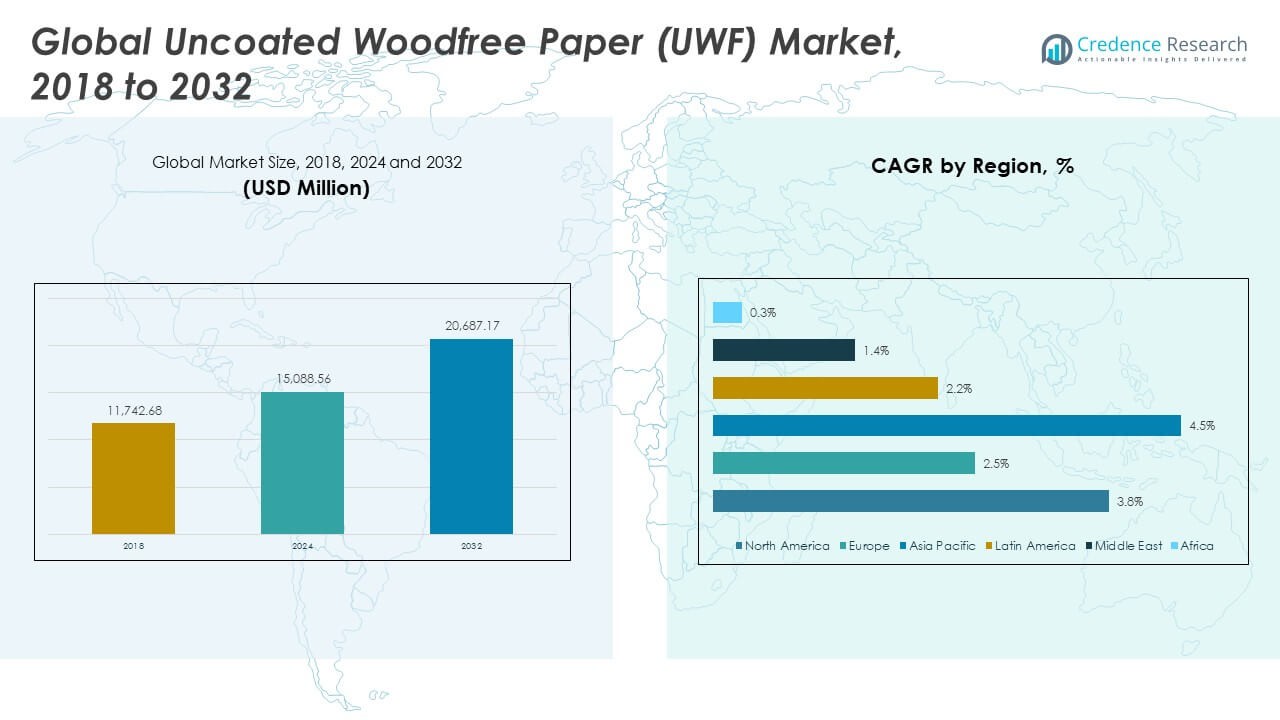
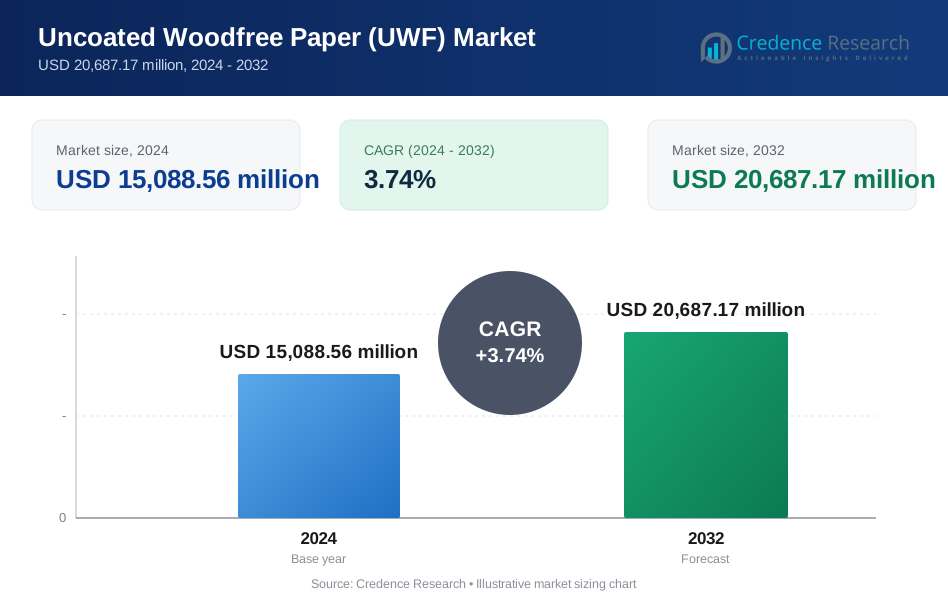
The Global Uncoated Woodfree Paper (UWF) Market continues to grow due to steady use across office, publishing, and commercial print needs. The Global Uncoated Woodfree Paper (UWF) Market size was valued at USD 11,742.68 million in 2018 to USD 15,088.56 million in 2024 and is anticipated to reach USD 20,687.17 million by 2032, at a CAGR of 3.74% during the forecast period.
| REPORT ATTRIBUTE | DETAILS |
|---|---|
| Historical Period | 2020-2023 |
| Base Year | 2024 |
| Forecast Period | 2025-2032 |
| Uncoated Woodfree Paper (UWF) Market Size 2024 | USD 11,742.68 Million |
| Uncoated Woodfree Paper (UWF) Market, CAGR | 3.74% |
| Uncoated Woodfree Paper (UWF) Market Size 2032 | USD 20,687.17 Million |
Growth in this market comes from rising education needs, expanding corporate documentation, and sustained demand from book printing. Many buyers prefer UWF grades for clean print quality, reliable runnability, and stronger archival properties. Producers focus on improved fiber use, higher brightness levels, and better surface treatment to meet tight quality norms. The shift toward sustainable pulp production also supports interest in eco-safe UWF grades. Digital print expansion helps widen product use across short-run jobs.
North America and Europe lead due to strong print infrastructure, wide office paper use, and established education networks. Asia Pacific moves upward at a faster pace as schools, publishers, and commercial printers expand capacity. China and India strengthen demand due to rising literacy, larger student populations, and growing corporate print needs. Latin America shows steady progress supported by gradual modernization in print and packaging. The Middle East and Africa gain traction through expanding education systems and rising business formation.
Market Insights:
- The Global Uncoated Woodfree Paper (UWF) Market grew from USD 11,742.68 million in 2018 to USD 15,088.56 million in 2024 and is projected to reach USD 20,687.17 million by 2032, advancing at a CAGR of 3.74% across the period.
- Asia Pacific (46.36%), North America (27.41%), and Europe (17.70%) held the top three regional shares in 2024, driven by strong education sectors, high-volume publishing, established printing networks, and mature office documentation demand.
- Asia Pacific, the fastest-growing region, leads with a 36% share, supported by rapid literacy growth, expanding student populations, strong domestic production, and rising corporate print needs.
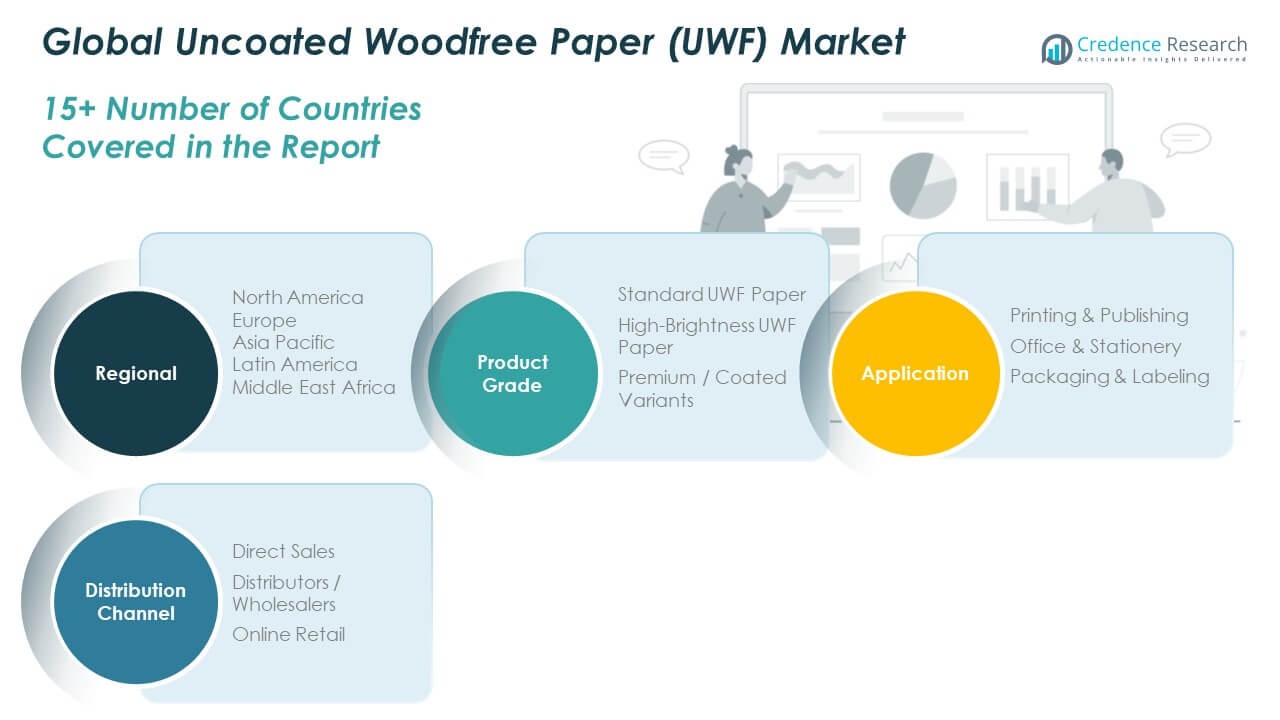
- Based on the visual segment distribution, Standard UWF Paper accounts for ~50% of the product mix, reflecting its dominant use in textbooks, office documentation, and bulk printing.
- High-Brightness UWF (~30%) and Premium/Coated Variants (~20%) together drive growth in quality-sensitive applications, including commercial print, branding material, and digital print environments.
Market Drivers:
Rising Need for High-Quality Print Grades Across Education and Corporate Sectors
Demand grows due to strong use of premium paper across schools, offices, and print houses. Buyers prefer consistent brightness and smooth surfaces for clear text output. The Global Uncoated Woodfree Paper (UWF) Market benefits from stable adoption in documentation and book work. It supports heavy-volume printing where durability matters. Publishers depend on UWF grades for long-run titles that need reliable opacity. Corporate units use these sheets for reports, manuals, and branded content. Government agencies depend on these formats for records and exam materials. Strong print culture in many regions keeps long-term interest steady.
- For instance, HP Indigo digital presses support high-quality uncoated substrates and deliver print resolutions up to 812 dpi, ensuring sharp text for publishing and education markets.
Shift Toward Sustainable Pulp Use and Cleaner Production Technologies
Producers invest in certified pulp lines to meet strict environmental goals. Many mills upgrade processes to cut emissions during bleaching. It helps the Global Uncoated Woodfree Paper (UWF) Market gain trust from eco-focused buyers. Firms adopt better fiber recovery to lift resource efficiency. Cleaner inputs support brands that target green labelling. Procurement teams choose mills with traceable raw materials. Publishers use these grades to match sustainability programs. Growing consumer awareness pushes demand for responsibly produced paper.
- For instance, Stora Enso reduced its fossil CO₂ emissions by over 30% between 2019 and 2023 through cleaner pulp processes, as confirmed in its sustainability reporting.
Greater Preference for Archival Strength, Longevity, and Stable Run Performance
Users value UWF sheets for long-term storage needs in libraries and offices. These papers resist yellowing and protect printed text for many years. The Global Uncoated Woodfree Paper (UWF) Market gains support from clients that need stable print handling. It offers strong dimensional control that limits paper jams. Educational printers use these sheets to run bulk exam material. Legal groups choose these formats for permanent files. High opacity improves readability across both sides of a page. Production lines adapt to meet strict runnability targets.
Expansion of Digital Printing That Widens Use Across Short-Run and On-Demand Jobs
Digital printers rely on UWF sheets for sharp image clarity and steady toner bonding. Growth in short-run publishing lifts consumption across small presses. The Global Uncoated Woodfree Paper (UWF) Market benefits from flexible print cycles that need reliable substrates. It supports quick turnaround jobs for manuals and guides. Many firms use UWF grades for low-volume packaging inserts. Print-on-demand services depend on these sheets for fast replenishment. Broad compatibility with laser and inkjet units strengthens adoption. Service providers expand portfolios that require clean sheet quality.
Market Trends:
Growing Shift Toward Premium Texture, Higher Brightness, and Enhanced Surface Refinement
Producers release refined grades with smoother textures that suit high-end print tasks. Buyers request advanced brightness levels that improve text contrast. The Global Uncoated Woodfree Paper (UWF) Market adapts to rising demand for premium feel. It attracts users that want upscale finishes for corporate identity work. Custom textures gain interest across creative agencies. New surface treatments support vibrant color printing. Designers choose these sheets for catalogues that need a refined look. Print shops adopt these grades to lift final output quality.
- For instance, Mondi’s “NEUJET Natural” uncoated range uses advanced surface engineering that supports high-definition printing with inkjet systems operating at up to 120 m/min, improving color density and fine-detail rendering.
Rising Alignment of UWF Grades With Digital-First Production Ecosystems
Manufacturers tailor UWF sheets for digital press compatibility. Coating-free surfaces help deliver accurate toner adhesion. The Global Uncoated Woodfree Paper (UWF) Market gains traction in workflows built around automated print cycles. It supports hybrid environments that mix offset and digital lines. Print shops seek media that performs well in both systems. Growth in quick-turn jobs increases the need for uniformity. Software-driven calibration tools encourage mills to refine sheet profiles. These changes support consistent performance across varied printers.
- For instance, Canon’s imagePRESS digital systems are engineered to handle uncoated papers with consistent color accuracy through advanced features like the Dynamic Transfer Technology and in-line spectrophotometric sensors for real-time calibration.
Increasing Adoption of Recycled Fiber and Circular Paper Concepts in Commercial Printing
Many producers add recycled fiber to meet corporate sustainability goals. Buyers support circular models that reuse recovered paper. The Global Uncoated Woodfree Paper (UWF) Market benefits from policies that promote low-impact materials. It aligns with procurement rules in education and government. Mills shift toward balanced blends that protect sheet strength. Improved fiber sorting upgrades overall quality. Brands highlight eco-focused paper choices in packaging inserts. Demand grows for recycled grades that still retain high brightness.
Expansion of Custom-Size, Lightweight, and Specialty Office Paper Formats
Users request lighter GSM formats that reduce shipping loads. Custom cutting trends grow across office supply firms. The Global Uncoated Woodfree Paper (UWF) Market responds with diverse sheet dimensions. It serves firms that need exact formats for automated machines. Lightweight grades support energy savings in transport. Specialty office paper gains traction in corporate stores. Flexible sizing helps reduce waste in print production. Demand rises for tailored products that match precise workflow setups.
Market Challenges Analysis:
High Pressure From Digitalization, Declining Office Print Volumes, and Rising Cost Fluctuations in Pulp
Digital workflows reduce routine print work across corporate units. Many firms cut paper use through cloud-based tools. The Global Uncoated Woodfree Paper (UWF) Market faces pressure from shrinking office print habits. It deals with volatile pulp prices that strain margins. Mills manage higher energy costs in many regions. Publishers shift selective content toward digital reading formats. Demand patterns vary across markets due to new media habits. These changes force producers to rethink capacity plans.
Tight Environmental Rules, Supply Chain Gaps, and Complex Mill Modernization Requirements
Mills must follow strict emission standards across leading regions. Compliance raises capital needs for upgrades. The Global Uncoated Woodfree Paper (UWF) Market encounters delays tied to logistics constraints. It deals with limited fiber supply during seasonal disruptions. Many plants require modern equipment to improve energy use. Procurement teams demand stronger certification trails. Lower-quality imports challenge some markets. Producers work to balance cost control with sustainability goals.
Market Opportunities:
Rising Scope for Eco-Certified Grades, Recycled Fiber Integration, and Low-Emission Mill Processes
Green procurement programs boost interest in eco-certified UWF sheets. Buyers prefer paper with transparent sourcing standards. The Global Uncoated Woodfree Paper (UWF) Market gains fresh demand from education and government units. It benefits from mills that adopt low-emission production lines. Recycled blends create new product tiers for sustainability-driven clients. Designers choose eco-focused materials for brand identity work. These trends widen the scope for premium green offerings. Producers strengthen value through certified fiber chains.
Expanding Demand From Digital Printing, Premium Commercial Work, and Custom Office Products
Short-run digital jobs lift consumption across small and mid-size presses. Buyers seek paper that performs well across mixed print systems. The Global Uncoated Woodfree Paper (UWF) Market sees growth in premium formats for corporate content. It supports new business from catalogues, manuals, and branded documents. Custom-size sheets help firms reduce waste. Lightweight formats appeal to logistics-focused buyers. Specialty office paper gains interest from workplace suppliers. These shifts create room for portfolio expansion across regions.
Market Segmentation Analysis:
By Product Grade
Standard UWF Paper dominates core demand due to broad use across offices, books, and mass printing. High-Brightness UWF Paper gains traction where sharp contrast and premium appearance matter. Premium or coated variants serve niche segments that value enhanced print quality and stronger aesthetics. The Global Uncoated Woodfree Paper (UWF) Market benefits from buyers that seek consistent surface strength and stable runnability. It maintains steady growth across each grade due to diverse print needs.
By Application
Printing and Publishing remain the largest consumers due to high-volume book work and learning material. Office and Stationery keep strong usage through reports, forms, and daily print tasks. Packaging and Labeling show rising adoption for lightweight inserts and product information sheets. Each segment contributes to balanced demand, supported by strong distribution networks.
- For instance, UPM’s Raflatac labeling division reports that its uncoated paper labels meet high-speed application rates of up to 500 labels per minute, supporting the rise in packaging workflows requiring uncoated substrates.
By Distribution Channel
Direct Sales lead where large enterprises procure high volumes with strict quality control. Distributors and Wholesalers support broad market access and help supply small and mid-size buyers. Online Retail expands due to quick delivery needs and flexible ordering patterns. It supports buyers that prefer digital procurement and diverse product choices.
Segmentation:
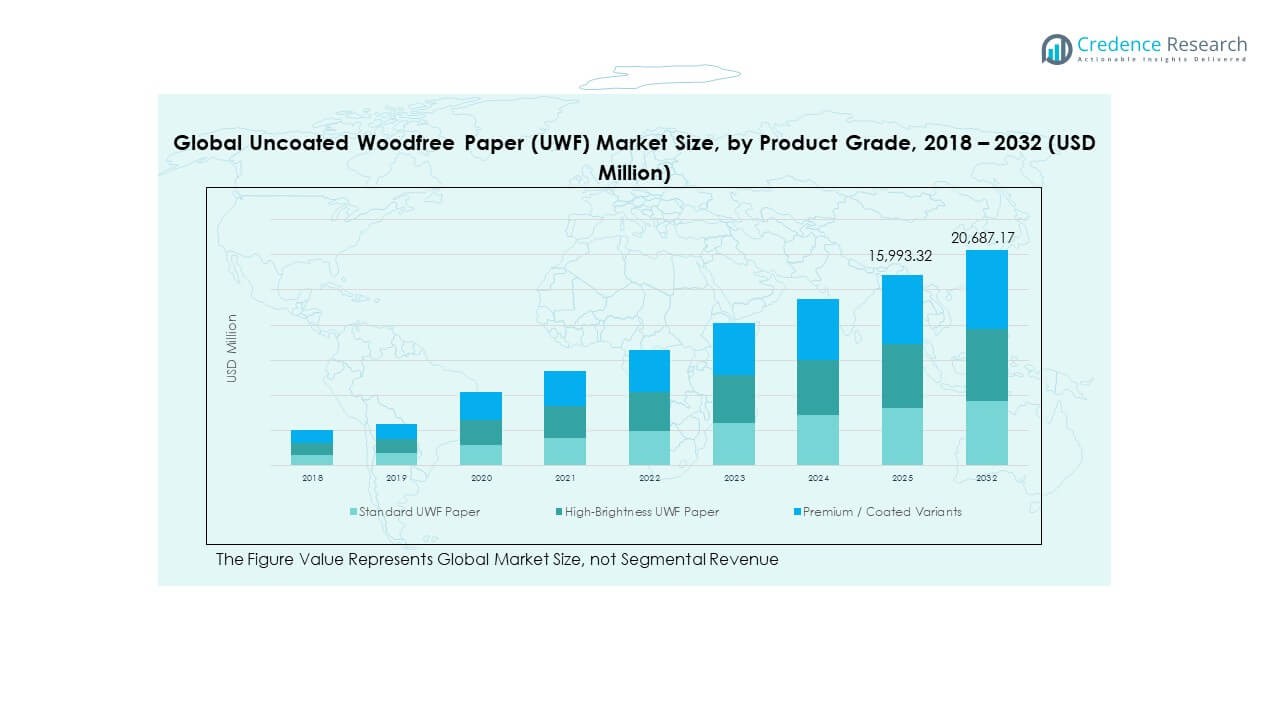
By Product Grade
- Standard UWF Paper
- High-Brightness UWF Paper
- Premium / Coated Variants
By Application
- Printing & Publishing
- Office & Stationery
- Packaging & Labeling
By Distribution Channel
- Direct Sales
- Distributors / Wholesalers
- Online Retail
By Region
- North America
- U.S.
- Canada
- Mexico
- Europe
- Germany
- France
- U.K.
- Italy
- Spain
- Rest of Europe
- Asia Pacific
- China
- Japan
- India
- South Korea
- South-east Asia
- Rest of Asia Pacific
- Latin America
- Brazil
- Argentina
- Rest of Latin America
- Middle East & Africa
- GCC Countries
- South Africa
- Rest of the Middle East and Africa
Regional Analysis:
North America
North America holds a strong position in the Global Uncoated Woodfree Paper (UWF) Market due to large education systems and steady publishing demand. The region benefits from advanced printing networks and high-quality standards across corporate environments. Strong procurement from office supply chains supports consistent sheet use, while the U.S. maintains stable book printing activity. Buyers rely on premium grades for legal, government, and academic documentation. The region attracts ongoing investments in mill upgrades focused on energy efficiency. Logistics networks remain well developed, supporting broad retail availability. Rising sustainability goals push buyers toward certified and responsibly sourced fiber.
Europe
Europe maintains steady demand within the Global Uncoated Woodfree Paper (UWF) Market, supported by strong educational publishing and structured corporate printing habits. Strict sustainability laws encourage certified pulp sourcing, strengthening regional demand. Advanced printing technology and long-term archival needs drive consistent consumption across multiple countries. UWF grades are widely used for administrative records and exam materials. Buyers value high brightness for quality book production, while premium segments cater to creative and design-focused users. Efficient logistics networks ensure smooth movement across EU markets. Mills continue focusing on low-emission production to meet regulatory expectations.
Asia Pacific
Asia Pacific leads the Global Uncoated Woodfree Paper (UWF) Market due to massive education growth and expanding corporate sectors. Strong publishing volumes, driven by rising student populations, support sustained demand for UWF grades. Affordable paper options remain essential for textbooks and workbooks across developing economies. Office stationery use continues to expand with broader business formation. Digital printing adoption lifts demand for higher-grade substrates in commercial hubs. Regional mills scale output to match domestic demand while improving pulp sourcing and cost efficiency. Strong retail and distribution networks increase access to diverse UWF formats.
Latin America
Latin America shows gradual progress in the Global Uncoated Woodfree Paper (UWF) Market, supported by rising education enrollment and growing office needs. Publishing activity remains steady, and standardized stationery gains wider adoption. Many organizations rely on UWF grades for training material and administrative tasks. Import networks help supply dispersed markets across the region. Local mills work to strengthen competitiveness through better fiber utilization. Buyers value consistent print quality for everyday office use. Digital workflow adoption influences moderate changes in consumption, while retail expansion improves product reach.
Middle East
The Middle East maintains limited yet stable demand in the Global Uncoated Woodfree Paper (UWF) Market, driven mainly by education systems and government documentation. Public sector printing and exam paper requirements support recurring consumption. Corporate users adopt UWF grades for reports and internal documents that require steady sheet performance. Regional production remains limited, increasing reliance on imports. Buyers prioritize brightness and quality stability for professional use. Strong GCC distribution networks support availability across key markets. Growing digital workflow investments influence long-term demand patterns across the region.
Africa
Africa shows slow but steady activity in the Global Uncoated Woodfree Paper (UWF) Market due to uneven print infrastructure and limited manufacturing capacity. Education sectors continue to drive essential demand for textbooks and learning materials. Government procurement supports administrative printing needs. The region relies heavily on imports to meet consumption levels. Buyers prioritize cost-effective grades for school and office requirements. Urban markets exhibit stronger interest in premium formats. Supply-chain challenges affect product availability across several countries, although rising literacy initiatives support long-term growth potential.
Key Player Analysis:
- International Paper
- Stora Enso
- UPM-Kymmene
- Sappi
- WestRock
Competitive Analysis:
The Global Uncoated Woodfree Paper (UWF) Market features strong competition among established paper manufacturers with wide production bases and strong supply networks. It reflects steady rivalry driven by quality consistency, cost efficiency, and sustainable pulp sourcing. Major players expand portfolios with high-brightness and premium sheets that support commercial printing and publishing. It benefits from firms that invest in energy-efficient mills and low-emission production systems. Many producers strengthen distribution through direct sales, wholesalers, and digital retail channels. Competition grows with new grades tailored for digital printing. Strategic mergers and regional expansions help firms secure long-term market positions. Product innovation, supply reliability, and broad customer reach remain core strengths for top companies.
Recent Developments:
- in August 2025, American Industrial Partners signed a definitive agreement to acquire International Paper’s Global Cellulose Fibers (GCF) division, which is a prominent supplier of absorbent fluff pulp for health and personal care products. This divestment aligns with International Paper’s strategy to focus on core packaging and paper operations and could impact its future footprint in the woodfree paper sector.
- In July 2025, Stora Enso collaborated with Novapor on a pilot project to develop cellulose foam packaging material (Papira®), furthering the shift from fossil-based to wood fiber packaging. This initiative is directly aligned with enhancing the sustainable profile of woodfree paper and packaging materials.
- In June 2025, Stora Enso entered a strategic partnership with Matrix Pack to transition toward circular, bio-based packaging. This collaboration involves scaling up formed fiber technologies to replace conventional packaging materials, integrating strengths in fiber sourcing, supply chain, and sustainable practices. Stora Enso’s minority stake acquisition and board representation in Matrix Pack mark an ongoing commitment to next-generation fiber-based packaging and uncoated papers.
- In February 2025, International Paper finalized a major acquisition of DS Smith, forming a new global leader in sustainable packaging that spans operations in over 30 countries, with a robust focus on North America and EMEA. This strategic move strengthens International Paper's offerings in uncoated woodfree papers and aims to drive innovation and extend sustainability leadership in packaging. The merger emphasizes customer experience, innovation, and responsible forestry practices, positioning International Paper at the forefront of sustainable solutions in the packaging and UWF segments.
Report Coverage:
The research report offers an in-depth analysis based on By Product Grade, By Application and by distribution channel. It details leading market players, providing an overview of their business, product offerings, investments, revenue streams, and key applications. Additionally, the report includes insights into the competitive environment, SWOT analysis, current market trends, as well as the primary drivers and constraints. Furthermore, it discusses various factors that have driven market expansion in recent years. The report also explores market dynamics, regulatory scenarios, and technological advancements that are shaping the industry. It assesses the impact of external factors and global economic changes on market growth. Lastly, it provides strategic recommendations for new entrants and established companies to navigate the complexities of the market.
Future Outlook:
- Market growth will rise through demand for high-brightness and premium grades.
- Digital printing expansion will increase the need for refined UWF substrates.
- Sustainable fiber sourcing will guide procurement choices across regions.
- Energy-efficient mill upgrades will improve cost performance for producers.
- Packaging inserts and labeling work will support new application growth.
- Corporate demand will favor UWF grades with reliable runnability and opacity.
- Regional consumption will shift upward in Asia Pacific due to large education bases.
- Distribution networks will expand through digital procurement channels.
- Innovation in fiber treatment will enhance sheet strength and print clarity.
- Global supply chains will stabilize with broader investment in pulp integration.
Request a Free Sample
Fill in your details and we'll send you a free sample report.
- Sample data tables & charts
- Research methodology
Need a Custom Version of This Report?
Tailor the scope, geography, or segments to your exact requirements.
- Custom geography or segment scope
- Direct access to our analyst team
Frequently Asked Questions
What is the current market size for the Global Uncoated Woodfree Paper (UWF) Market, and what is its projected size in 2032?
At what Compound Annual Growth Rate is the Global Uncoated Woodfree Paper (UWF) Market projected to grow between 2025 and 2032?
Which Global Uncoated Woodfree Paper (UWF) Market segment held the largest share in 2024?
What are the primary factors fueling the growth of the Global Uncoated Woodfree Paper (UWF) Market?
Who are the leading companies in the Global Uncoated Woodfree Paper (UWF) Market?
Which region commanded the largest share of the Global Uncoated Woodfree Paper (UWF) Market in 2024?
Table of Content
Chapter 1. Report Introduction
- 1.1 Report Description & Purpose
- 1.1.1 Report Title & Market Definition
- 1.1.2 Unique Selling Propositions (USP) & Key Differentiators
- 1.1.3 Value Proposition for Stakeholders
- 1.2 Research Objectives
- 1.2.1 Market Sizing Objectives (Volume & Revenue)
- 1.2.2 Segmentation Objectives
- 1.2.3 Competitive Intelligence Objectives
- 1.2.4 Forecast & Scenario Objectives
- 1.3 Report Scope
- 1.3.1 Uncoated Woodfree Paper (UWF) Scope – Types & Subtypes Covered
- 1.3.2 Geographic Scope – Regions & Countries Covered
- 1.3.3 Historical Period, Base Year & Forecast Period (2024; forecast to 2032)
- 1.3.4 Inclusions & Exclusions
- 1.4 HS Code & Classification Framework
- 1.5 Currency, Units & Pricing Basis
- 1.6 Target Stakeholders
- 1.7 Limitations & Assumptions
Chapter 2. Executive Summary
- 2.1 Global Uncoated Woodfree Paper (UWF) Market Snapshot
- 2.1.1 Market Size – Historical (2024) & Forecast (2024-2032) (2024: USD 15,088.56 million → 2032: USD 20,687.17 million)
- 2.1.2 Volume & Revenue – Global Totals
- 2.1.3 Key Market Highlights – Top Five Facts
- 2.2 Uncoated Woodfree Paper (UWF) Market Segmentation Snapshot
- 2.2.1 Market Split by Region – 2024 vs. 2032
- 2.3 Competitive Snapshot
- 2.3.1 Top 10 Players by Revenue Share – 2024
- 2.3.2 Top 10 Players by Volume Share – 2024
- 2.3.3 Recent Strategic Developments (18-Month Summary)
- 2.4 Key Investment Highlights & Strategic Conclusions
Chapter 3. Uncoated Woodfree Paper (UWF) Market Dynamics & Industry Analysis
- 3.1 Market Overview & Context
- 3.1.1 Uncoated Woodfree Paper (UWF) Market Position in the Broader Automotive Value Chain
- 3.1.2 OEM vs. Replacement Market Dynamics
- 3.1.3 Market Maturity & Development Stage by Region
- 3.2 Uncoated Woodfree Paper (UWF) Market Drivers
- 3.3 Uncoated Woodfree Paper (UWF) Market Restraints & Challenges
- 3.4 Uncoated Woodfree Paper (UWF) Market Opportunities
- 3.5 Porter's Five Forces Analysis
- 3.5.1 Threat of New Entrants
- 3.5.2 Bargaining Power of Suppliers
- 3.5.3 Bargaining Power of Buyers
- 3.5.4 Threat of Substitutes
- 3.5.5 Competitive Rivalry – Intensity Assessment
- 3.6 Uncoated Woodfree Paper (UWF) Value Chain Analysis
- 3.6.1 Upstream – Raw Material/Input Suppliers
- 3.6.1.1 Raw Material/Input 1
- 3.6.1.2 Raw Material/Input 2
- 3.6.1.3 Raw Material/Input 3
- 3.6.2 Midstream – Production/Manufacturing/Service Delivery
- 3.6.2.1 Production/Process Overview
- 3.6.2.2 Key Facility Locations & Capacity by Manufacturer
- 3.6.3 Downstream – Distribution & End Consumer
- 3.6.3.1 Primary Channel – B2B/OEM
- 3.6.3.2 Secondary Channels – Dealer, Retail, Online, Direct
- 3.6.4 Value Chain Profitability Analysis
- 3.6.1 Upstream – Raw Material/Input Suppliers
- 3.7 PESTEL Analysis
- 3.7.1 Political Factors
- 3.7.2 Economic Factors
- 3.7.3 Social Factors
- 3.7.4 Technological Factors
- 3.7.5 Environmental Factors
- 3.7.6 Legal Factors
- 3.8 Uncoated Woodfree Paper (UWF) Supply Chain Analysis
- 3.8.1 Raw Material/Input Supply Risk Assessment
- 3.8.2 Manufacturing Concentration Risk (Geographic Exposure)
- 3.8.3 Trade Disruption Impact Analysis
- 3.9 Regulatory & Policy Landscape
Note: The regulatory and policy landscape section covers regulations based on their applicability to the market, Uncoated Woodfree Paper (UWF) category, geography, and scope of the study. Only regulatory frameworks with a material impact on operations, compliance, trade, sustainability, or market access are analyzed in detail.
Chapter 4. Key Investment Pockets & Opportunity Analysis
- 4.1 Uncoated Woodfree Paper (UWF) Market Attractiveness Analysis
- 4.1.1 By Region – Investment Attractiveness Matrix (Volume × CAGR)
- 4.2 Absolute Revenue Growth Opportunity
- 4.2.1 By Region – Absolute USD Growth Through 2032
- 4.3 Incremental Volume Opportunity
- 4.3.1 By Region – Incremental Volume Through 2032
- 4.3.2 Segment – Incremental Volume
- 4.4 Emerging Submarket Opportunity Deep Dive (Subject to Applicability)
- 4.5 Emerging Market Opportunity Scorecards
- 4.5.1 United States
- 4.5.2 Europe
- 4.5.3 Asia
- 4.5.4 Middle East & Africa
Note: Emerging Market Opportunity Scorecards will be included based on relevance and strategic importance. Regions listed are indicative and may vary depending on data availability and market dynamics.
Chapter 5. Uncoated Woodfree Paper (UWF) Import-Export Analysis & Trade Flows
- 5.1 Global Trade Overview
- 5.1.1 Global Export Value by Country (2024)
- 5.1.2 Global Export Volume by Country (2024)
- 5.1.3 Global Import Value by Country (2024)
- 5.1.4 Global Import Volume by Country (2024)
- 5.1.5 Net Trade Balance by Country (2024)
- 5.2 Export Analysis – Segment
- 5.2.1 Type 1 (HS Code)
- 5.2.2 Type 2 (HS Code)
- 5.2.3 Type 3 (HS Code)
- 5.2.4 Type 4 (HS Code)
- 5.2.5 Type 5 (HS Code)
- 5.3 Import Analysis – Segment
- 5.3.1 Type 1 (HS Code)
- 5.3.2 Type 2 (HS Code)
- 5.3.3 Type 3 (HS Code)
- 5.3.4 Type 4 (HS Code)
- 5.3.5 Type 5 (HS Code)
- 5.4 Average Unit Trade Prices
- 5.4.1 Average Export Price – Segment & Country
- 5.4.2 Average Import Price – Segment & Source Country
- 5.4.3 Price Trends (2024)
- 5.5 Key Trade Route Analysis
- 5.5.1 Trade Route 1
- 5.5.2 Trade Route 2
- 5.5.3 Trade Route 3
- 5.5.4 Trade Route 4
- 5.5.5 Trade Route 5
- 5.6 Trade Policy Impact Assessment
- 5.6.1 US Anti-Dumping & Section 301 Tariffs
- 5.6.2 EU Customs Union Impact
- 5.6.3 Major Free Trade Agreements
- 5.6.4 USMCA Rules of Origin
Note: Trade policy analysis will be included only where relevant to the Uncoated Woodfree Paper (UWF) market.
Chapter 6. Competitive Landscape & Company Benchmarking
- 6.1 Uncoated Woodfree Paper (UWF) Market Concentration & Structure
- 6.1.1 Herfindahl-Hirschman Index (HHI) – vs. 2024
- 6.1.2 Tier 1, Tier 2 & Tier 3 Market Structure
- 6.1.3 Global, Regional & Local Player Dynamics
- 6.2 Uncoated Woodfree Paper (UWF) Market Share Analysis – 2024
- 6.2.1 Global Revenue Share by Company
- 6.2.2 Global Volume Share by Company
- 6.2.3 Regional Revenue Share
- 6.2.4 Market Share Evolution ( vs. 2024)
- 6.2.5 OEM Segment Share by Company
- 6.2.6 Replacement Segment Share by Company
- 6.3 Production/Delivery Capacity & Facility Analysis
- 6.3.1 Global Installed Capacity
- 6.3.2 Capacity Utilization Rates
- 6.3.3 Production/Output Volume
- 6.3.4 Facility Locations & Capacity Map
- 6.3.5 Planned Capacity Additions
- 6.4 Uncoated Woodfree Paper (UWF) Competitive Benchmarking Matrix
- 6.4.1 Revenue, Volume, CAGR & Profitability Comparison
- 6.4.2 Channel Revenue Mix
- 6.4.3 Geographic Revenue Exposure
- 6.4.4 R&D Intensity
- 6.4.5 Sustainability Maturity
- 6.5 Strategic Developments in Uncoated Woodfree Paper (UWF) (Last 24 Months)
- 6.5.1 Mergers, Acquisitions & Divestments
- 6.5.2 New Uncoated Woodfree Paper (UWF) Launches
- 6.5.3 Facility Expansions
- 6.5.4 Strategic Alliances, Joint Ventures & Partnerships
- 6.5.5 Distribution Expansion & Market Entry
- 6.5.6 Sustainability & ESG Initiatives
- 6.6 Competitive Strategy Mapping
- 6.6.1 Leader, Challenger, Follower & Niche Classification
- 6.6.2 Pricing Strategy Comparison
- 6.6.3 Channel Strategy Matrix
Note: Strategic developments are included based on their materiality and the availability of reliable information.
Chapter 7. Global Uncoated Woodfree Paper (UWF) Market – By Distribution Channel
- 7.1 Segment Overview
- 7.1.1 Volume & Revenue Split by Channel (2024 & 2032)
- 7.1.2 Channel Mix Evolution (2024-2032)
Chapter 8. Regional Market Analysis – Global Overview
- 8.1 Global Regional Overview
- 8.1.1 Regional Volume Share
- 8.1.2 Regional Revenue Share
- 8.1.3 Regional Volume by Region
- 8.1.4 Regional Revenue by Region
- 8.1.5 Regional Forecast Through 2032
- 8.2 Cross-Regional Segment Analysis
- 8.2.1 By Distribution Channel
- 8.2.2 By Brand/Price Tier
Chapter 9. North America Uncoated Woodfree Paper (UWF) Market
- 9.1 United States
- 9.2 Canada
- 9.3 Mexico
Chapter 10. Europe Uncoated Woodfree Paper (UWF) Market
- 10.1 Germany
- 10.2 France
- 10.3 Italy
- 10.4 United Kingdom
- 10.5 Spain
- 10.6 Poland
- 10.7 Russia
- 10.8 Netherlands
- 10.9 Belgium
- 10.10 Sweden
- 10.11 Denmark
- 10.12 Norway
- 10.13 Rest of Europe
Chapter 11. Asia Pacific Uncoated Woodfree Paper (UWF) Market
- 11.1 China
- 11.2 India
- 11.3 Japan
- 11.4 South Korea
- 11.5 Thailand
- 11.6 Indonesia
- 11.7 Vietnam
- 11.8 Malaysia
- 11.9 Australia
- 11.10 Rest of Asia Pacific
Chapter 12. Latin America Uncoated Woodfree Paper (UWF) Market
- 12.1 Brazil
- 12.2 Argentina
- 12.3 Colombia
- 12.4 Chile
- 12.5 Rest of Latin America
Chapter 13. Middle East Uncoated Woodfree Paper (UWF) Market
- 13.1 Saudi Arabia
- 13.2 United Arab Emirates
- 13.3 Turkey
- 13.4 Israel
- 13.5 Iran
- 13.6 Rest of the Middle East
Chapter 14. Africa Uncoated Woodfree Paper (UWF) Market
- 14.1 South Africa
- 14.2 Egypt
- 14.3 Nigeria
- 14.4 Morocco
- 14.5 Rest of Africa
Chapter 15. Uncoated Woodfree Paper (UWF) Company Profiles
- 15.1 [Company 01]
- 15.1.1 Company Overview
- 15.1.2 Key Management Personnel
- 15.1.3 Products & Services Portfolio
- 15.1.4 Financial Performance
- 15.1.5 Key Market Focus & Geographic Presence
- 15.1.6 Recent Developments & Strategic Initiatives
Note: The company profile list is preliminary and may change based on research findings, market developments, data availability, and client requirements.
Chapter 16. Appendices
- Appendix A – List of Abbreviations & Acronyms
- Appendix B – Industry Classification Code Reference – Full Series
- Appendix C – Production & Capacity Data Tables
- Appendix D – End-Use & Demand Base Tables
- Appendix E – Consumption & Replacement Rate Assumptions
- Appendix F – ASP Reference Tables
- Appendix G – Manufacturing & Facility Database
- Appendix H – Import-Export Data Tables
- Appendix I – Regulatory Summary Tables
- Appendix J – Primary Research Participant List (Anonymized)
- Appendix K – Primary Research Questionnaire Framework
- Appendix L – Data Sources & Bibliography
- Appendix M – Market Size Divergence & Source Comparison
Chapter 17. Research Methodology
- 17.1 Research Framework & Philosophy
- 17.2 Secondary Research – Sources, Hierarchy & Data Extraction
- 17.3 Data Modeling – Bottom-Up & Top-Down Market Sizing
- 17.4 Primary Research – Stakeholder Framework, LOI & Sample Sizes
- 17.5 Forecast Methodology – Regression, Scenario & Sensitivity Analysis
- 17.6 Quality Control – Four-Layer Validation Framework
- 17.7 Limitations & Standard Assumptions
- 17.8 Disclaimer
