
Market Overview:
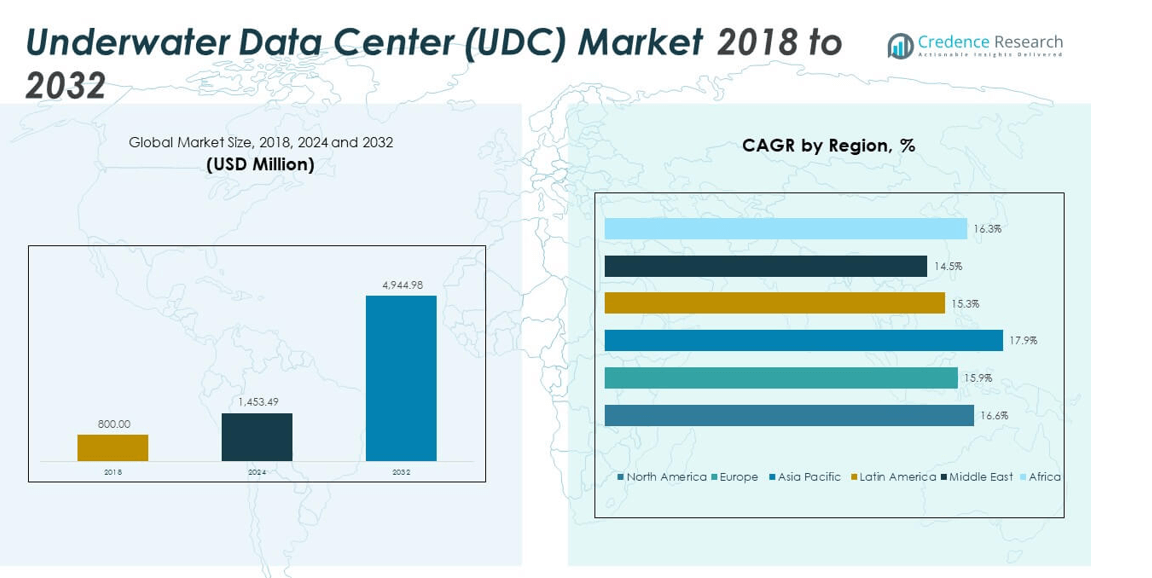
The Global Underwater Data Center (UDC) Market size was valued at USD 800.00 million in 2018 to USD 1,453.49 million in 2024 and is anticipated to reach USD 4,944.98 million by 2032, at a CAGR of 16.62% during the forecast period.
| REPORT ATTRIBUTE | DETAILS |
|---|---|
| Historical Period | 2020-2023 |
| Base Year | 2024 |
| Forecast Period | 2025-2032 |
| Underwater Data Center (UDC) Market Size 2024 | USD 1,453.49 million |
| Underwater Data Center (UDC) Market, CAGR | 16.62% |
| Underwater Data Center (UDC) Market Size 2032 | USD 4,944.98 million |
The market is expanding rapidly as demand for efficient, low-latency, and energy-saving data storage solutions rises. Growing digital transformation, cloud adoption, and increasing data traffic are pushing enterprises to explore sustainable infrastructure. UDCs leverage natural cooling and proximity to coastal regions to reduce energy costs and improve performance. Their ability to support emerging technologies like AI, IoT, and edge computing further accelerates adoption. Major tech firms are investing in pilot projects, validating UDCs as a viable long-term alternative to traditional data centers.
Regionally, North America leads the market due to strong cloud infrastructure demand and early trials by leading technology companies. Europe follows, driven by sustainability goals and government support for energy-efficient IT solutions. Asia-Pacific is emerging as the fastest-growing region, with expanding digital economies in China, India, and Southeast Asia boosting the need for scalable infrastructure. Meanwhile, the Middle East and Africa show potential with rising smart city initiatives and digital connectivity projects.
Market Insights:
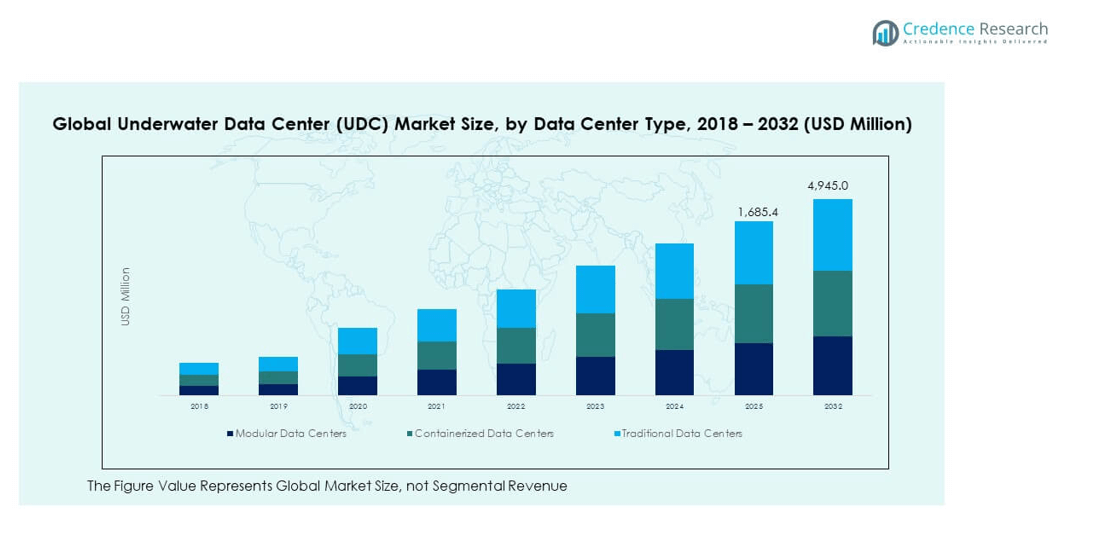
- The Global Underwater Data Center (UDC) Market was valued at USD 800.0 million in 2018, USD 1,453.49 million in 2024, and is projected to reach USD 4,945.0 million by 2032, expanding at a CAGR of 16.62%.
- Europe led the market with 28.26% share in 2024, supported by sustainability initiatives, renewable integration, and strong regulatory frameworks across Germany, the UK, and France.
- North America held 21.16% share in 2024, driven by early adoption in the U.S., strong cloud infrastructure, and pilot deployments by leading technology firms.
- Traditional data centers represented 41% of the market share in 2024, supported by established deployments and integration with existing IT systems.
- Modular data centers accounted for 34% share, while containerized data centers contributed 25%, indicating steady growth in scalable and flexible models.
Market Drivers:
Rising Demand for Sustainable and Energy-Efficient Infrastructure
The Global Underwater Data Center (UDC) Market is gaining momentum due to the urgent need for energy-efficient and sustainable infrastructure. Traditional data centers face high cooling costs, while underwater systems leverage natural cooling, reducing energy consumption significantly. Enterprises are prioritizing solutions that cut carbon emissions and support green IT strategies. Governments and organizations are also investing in sustainable models to meet global climate targets. UDCs offer a direct answer to sustainability regulations across developed and emerging economies. Their efficiency aligns with environmental policies promoting low-emission technologies. Rising awareness of ecological impact and rising corporate ESG commitments further fuel adoption. Sustainability remains one of the most influential forces driving this market’s expansion.
- For instance, Microsoft’s Project Natick Phase 2 submerged its data center off the coast of Scotland for two years, achieving a hardware failure rate just 1/8th that of comparable land-based data centers and operating with a power usage effectiveness (PUE) of 1.07-better than most traditional facilities-all while consuming zero water (water usage effectiveness, WUE, of 0), compared to land data centers that may consume up to 4.8 liters per kilowatt-hour.
Growing Data Consumption Driven by Cloud and Digital Transformation
Rising internet usage, cloud computing, and global digitalization are fueling strong growth for the Global Underwater Data Center (UDC) Market. The surge in big data analytics, IoT applications, and AI-driven processes demands infrastructure with high efficiency. Traditional land-based data centers are under pressure due to rising traffic volumes and space limitations. UDCs offer scalable solutions located near coastal cities to reduce latency and enhance performance. The expansion of smart cities, fintech platforms, and e-commerce sectors further drives requirements for advanced storage solutions. Organizations are adopting hybrid models combining traditional and underwater facilities for better flexibility. This dynamic is creating a long-term market expansion cycle. The demand for scalable, resilient, and low-latency solutions strengthens UDC growth.
- For instance, Nautilus Data Technologies commissioned the world’s first zero-water consumption commercial floating data center at the Port of Stockton, California, verified by Black & Veatch, supporting a 1.45 MW IT load while maintaining stable cooling at 73°F, and using less than one-third the cooling power required by standard air-conditioned land-based data centers.
Cost Optimization and Operational Efficiency in Deployment
Enterprises are exploring underwater data centers to address high operational costs tied to land-based facilities. UDCs utilize ocean cooling, significantly lowering electricity bills and enhancing system lifespan. This cost advantage positions them as competitive alternatives for global corporations. They are particularly valuable for industries requiring constant high-performance computing such as banking, healthcare, and telecom. Lower infrastructure maintenance and automated system designs further reduce operating costs. Enterprises view UDCs as an investment to balance performance with expenditure. The Global Underwater Data Center (UDC) Market benefits from this trend, with cost savings being a decisive factor. Companies are aligning UDC deployments with long-term financial sustainability goals.
Accelerating Edge Computing and Latency Reduction Requirements
The rising adoption of edge computing is enhancing the growth prospects of UDCs worldwide. Businesses seek faster data access to support real-time applications like online gaming, video streaming, and autonomous systems. Underwater facilities built closer to coastal hubs enable quick processing and minimize delays. Industries are investing in UDCs to enhance responsiveness for next-generation services. The integration of AI and IoT also requires reduced data transfer distances. The Global Underwater Data Center (UDC) Market capitalizes on this demand, offering enhanced connectivity advantages. Edge-driven demand is increasing deployment near dense population centers. This shift ensures that underwater systems become a crucial enabler of real-time and low-latency data applications.
Market Trends:
Integration of Renewable Energy Sources into Underwater Systems
A major trend shaping the Global Underwater Data Center (UDC) Market is the integration of renewable energy solutions. Developers are experimenting with offshore wind, tidal, and solar systems to power underwater modules. This innovation strengthens energy independence and reduces reliance on fossil fuels. Renewable integration supports sustainability goals while ensuring long-term operational efficiency. Companies are using hybrid models that combine grid power with renewable generation. The alignment with clean energy strategies enhances the market’s appeal to governments and corporations. It is becoming an attractive model for regions pushing aggressive renewable targets. This trend reflects a growing synergy between green technology and digital infrastructure.
- For instance, Microsoft’s Project Natick powered its submerged Phase 2 data center with 100% locally-produced renewable electricity, including onshore wind, solar, and offshore tidal and wave energy, running 864 servers at a total load of 240 kW for two years beneath the ocean surface.
Advancements in Modular and Scalable Underwater Designs
The market is witnessing increased innovation in modular architectures to support scalability and faster deployment. Modular pods allow enterprises to expand storage needs without extensive reconstruction. UDC developers are focusing on compact, flexible designs for ease of transport and maintenance. This trend helps reduce project lead times and improves adaptability across geographies. The Global Underwater Data Center (UDC) Market benefits from these advancements by offering flexible deployment models. Companies are targeting emerging regions where space and land costs restrict large onshore data centers. Modular approaches are gaining traction in pilot projects across Europe and Asia. They represent a scalable response to unpredictable global data growth.
- For instance, Subsea Cloud’s modular pod system advertises up to 40% energy and CO₂ savings for coastal deployments using immersion cooling, plus a 90% reduction in deployment cost per MW and the ability to bring a pod online, swap components, and redeploy within 4–16 hours, supporting future expansions such as the upcoming Njord01 deployment in the Gulf of Mexico.
Collaboration Between Tech Firms and Maritime Industries
Growing partnerships between technology firms and maritime service providers are shaping the industry. Technology companies are engaging with marine engineers, energy providers, and logistics firms to refine deployment. Such collaboration ensures safer installation, robust maintenance, and optimized operations. It reduces technical risks and enhances the viability of underwater infrastructure. The Global Underwater Data Center (UDC) Market is strengthening its ecosystem through these alliances. Strong partnerships are particularly visible in coastal markets with advanced marine capabilities. By bridging expertise from both digital and maritime domains, UDC adoption accelerates. This trend ensures more secure, efficient, and commercially viable deployments globally.
Focus on Cybersecurity and Data Sovereignty in Underwater Systems
Data protection and sovereignty concerns are driving significant advancements in underwater facilities. Enterprises and governments demand secure infrastructures located within controlled maritime zones. UDCs offer controlled environments with limited access, strengthening security protocols. They also align with data sovereignty policies by keeping critical information within national waters. The Global Underwater Data Center (UDC) Market is adapting to this demand with robust encryption and monitoring systems. Cybersecurity advancements in underwater environments are helping gain trust from enterprise clients. Countries with strong regulatory frameworks are encouraging localized UDC deployment. This trend underlines the role of secure design in shaping the market’s long-term direction.
Market Challenges Analysis:
High Capital Costs and Technical Deployment Barriers
One of the major challenges in the Global Underwater Data Center (UDC) Market is high upfront capital investment. Designing, building, and deploying underwater facilities require specialized equipment and marine engineering expertise. These costs are significantly higher compared to traditional data centers. It creates barriers for small and mid-sized enterprises with limited budgets. Furthermore, installation requires specialized ships, robotic systems, and long-term structural testing. These requirements increase deployment timelines and restrict rapid expansion. It also limits adoption in developing economies where funding for advanced infrastructure is low. High capital intensity remains one of the toughest challenges for widespread global adoption.
Maintenance Complexity and Environmental Concerns
Maintaining UDCs is another significant obstacle due to underwater conditions and technical limitations. Repairs require specialized marine crews and equipment, increasing operational costs. In addition, there are concerns about the ecological impact of submerged data centers on marine ecosystems. Environmental regulators closely monitor projects to ensure compliance with marine conservation laws. The Global Underwater Data Center (UDC) Market faces scrutiny over potential disruption to ocean biodiversity. Environmental approvals often delay projects, especially in regions with strict ecological policies. Security and safety concerns regarding long-term underwater stability also persist. These issues make maintenance and regulatory approvals ongoing challenges for this emerging market.
Market Opportunities:
Expansion in Emerging Digital Economies and Coastal Cities
The Global Underwater Data Center (UDC) Market presents strong opportunities in emerging digital economies. Countries in Asia-Pacific, Latin America, and Africa are experiencing rapid cloud adoption and urbanization. Coastal cities with limited land availability view UDCs as a practical solution for space optimization. These markets demand low-latency infrastructure to support fintech, e-commerce, and telecom expansion. Enterprises are partnering with technology firms to explore scalable underwater projects. It offers strong opportunities to establish UDCs in regions with rising internet penetration. These economies represent fertile ground for long-term deployments. The demand surge in emerging markets makes this segment highly attractive for future expansion.
Technological Advancements and Industry Partnerships Driving Adoption
Ongoing innovations in modular design, automation, and energy integration create opportunities for global expansion. Automated monitoring tools and AI-powered control systems enhance performance efficiency. Partnerships between data center operators, renewable energy firms, and marine experts are accelerating viable deployments. The Global Underwater Data Center (UDC) Market benefits from these collaborations by strengthening operational feasibility. Enterprises are eager to adopt solutions that combine sustainability with performance. The rising focus on eco-friendly systems also boosts partnership-based initiatives. These opportunities enhance global credibility and accelerate adoption rates. The integration of technology and collaboration unlocks strong growth avenues for the market’s future.
Market Segmentation Analysis:
By Data Center Type
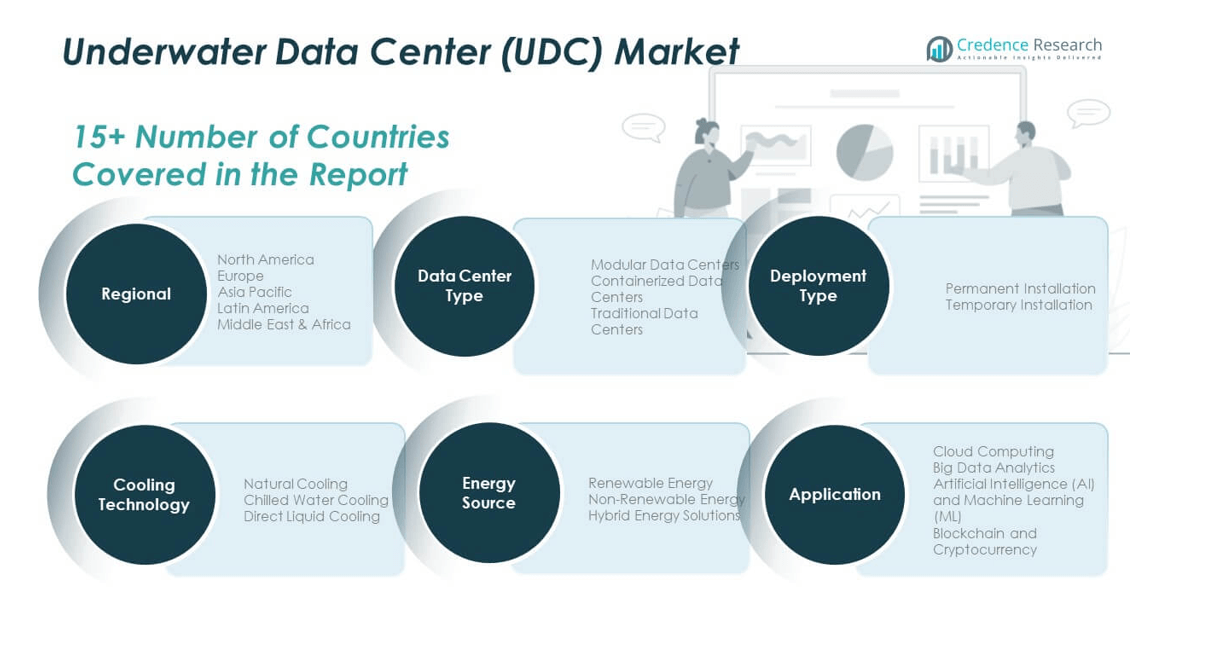
The Global Underwater Data Center (UDC) Market is segmented into modular, containerized, and traditional data centers. Modular data centers dominate due to their scalability and ease of deployment near coastal areas. Containerized facilities provide mobility and adaptability for short-term needs. Traditional formats remain relevant but face challenges from higher costs and lower flexibility. It is evolving toward modular and containerized solutions to match demand for efficiency and rapid installation.
- For instance, Nautilus Data Technologies’ floating Stockton data center uses a modular design, enabling reduced facility footprint by up to 60% and high-density racks across its four vaults for a combined 6.5 MW IT load, supporting rapid scalability and zero water use.
By Application
Cloud computing leads the application segment, driven by massive adoption across enterprises and digital platforms. Big data analytics contributes significantly, fueled by increasing reliance on advanced storage and processing. Artificial intelligence and machine learning require high-performance computing, strengthening UDC deployment. Blockchain and cryptocurrency applications expand infrastructure needs due to continuous transaction growth.
- For instance, Microsoft’s Project Natick achieved 99.9% uptime during its two-year operational test, surpassing typical land-based data center reliability, and ran live cloud workloads for the Azure platform in a fully sealed underwater module.
By Energy Source
The market is classified into renewable, non-renewable, and hybrid energy models. Renewable energy is gaining strong traction to reduce operational costs and carbon footprint. Non-renewable sources still contribute, particularly in regions with limited renewable integration. Hybrid solutions bridge sustainability with reliability, offering balanced performance.
By Deployment Type
Permanent installations dominate the market due to their stability and long-term value. Temporary installations are gaining attention for pilot projects, testing, and flexible deployments. It enables organizations to test viability before committing large investments.
By Cooling Technology
Natural cooling remains the most attractive due to cost efficiency and eco-friendly operations. Chilled water cooling is adopted for enhanced thermal regulation in high-density deployments. Direct liquid cooling is emerging as a preferred choice for advanced workloads requiring precise control. This mix highlights efficiency as a key differentiator in UDC adoption.
Segmentation:
By Data Center Type- Modular Data Centers
- Containerized Data Centers
- Traditional Data Centers
- Cloud Computing
- Big Data Analytics
- Artificial Intelligence (AI) and Machine Learning (ML)
- Blockchain and Cryptocurrency
- Renewable Energy
- Non-Renewable Energy
- Hybrid Energy Solutions
- Permanent Installation
- Temporary Installation
- Natural Cooling
- Chilled Water Cooling
- Direct Liquid Cooling
- North America
- U.S.
- Canada
- Mexico
- Europe
- Germany
- France
- U.K.
- Italy
- Spain
- Rest of Europe
- Asia Pacific
- China
- Japan
- India
- South Korea
- South-east Asia
- Rest of Asia Pacific
- Latin America
- Brazil
- Argentina
- Rest of Latin America
- Middle East & Africa
- GCC Countries
- South Africa
- Rest of the Middle East and Africa
Regional Analysis:
North America
The North America Underwater Data Center (UDC) Market size was valued at USD 286.40 million in 2018 to USD 307.57 million in 2024 and is anticipated to reach USD 1,043.94 million by 2032, at a CAGR of 16.34% during the forecast period. North America accounts for 21.16% of the global share in 2024, led primarily by the U.S., which itself contributes USD 272.32 million. The region benefits from strong demand for cloud computing, advanced telecom networks, and early pilot projects from major technology companies. The U.S. leads growth, driven by its robust digital economy and leadership in AI and IoT integration. Canada and Mexico are expected to expand steadily, with investments in smart city projects and green energy adoption. The Global Underwater Data Center (UDC) Market sees North America as an innovation hub where companies validate large-scale deployments. It is also supported by high digital infrastructure spending and favorable government initiatives promoting sustainable technologies. Increasing adoption of renewable energy in coastal regions strengthens long-term market prospects.
Europe
The Europe Underwater Data Center (UDC) Market size was valued at USD 234.16 million in 2018 to USD 410.57 million in 2024 and is anticipated to reach USD 1,327.49 million by 2032, at a CAGR of 16.80% during the forecast period. Europe holds 28.26% of the global share in 2024, making it the largest regional market. Germany leads within the region, with rapid adoption supported by strong industrial digitization and energy-efficient IT policies. The UK and France are advancing through investments in modular and renewable-powered data centers. Italy shows steady growth despite lower initial adoption, while the rest of Europe contributes with increasing smart infrastructure initiatives. The Global Underwater Data Center (UDC) Market benefits from Europe’s aggressive carbon neutrality targets, pushing firms to adopt sustainable IT models. Governments and private firms collaborate on pilot projects to align with regional energy and climate strategies. Europe’s strong regulatory frameworks and technology ecosystem ensure consistent demand. It is positioned as a leader in balancing digital expansion with sustainability goals.
Key Player Analysis:
- Highlander
- HiCloud
- COOEC (China Offshore Oil Engineering Co.)
- China Telecom
- SenseTime
- Microsoft
- NetworkOcean
- Nautilus Data Technologies
- Amazon Web Services (AWS)
- IBM
- Alibaba Cloud
- Huawei
- Dell Technologies
- Fujitsu
Competitive Analysis:
The Global Underwater Data Center (UDC) Market is characterized by a mix of established technology giants and emerging innovators focusing on modular and renewable-powered deployments. Companies such as Microsoft, Google, AWS, and Huawei are investing in pilot projects and partnerships to test large-scale feasibility. Nautilus Data Technologies and Highlander bring specialized expertise in containerized and maritime-based designs, adding diversity to the market. It is highly competitive, with firms differentiating based on energy efficiency, sustainability, and advanced cooling technologies. Strategic collaborations with marine engineering firms and renewable energy providers are strengthening market positions. Competition is intensifying as enterprises seek solutions that align with global digitalization and sustainability goals.
Recent Developments:
- In October 2025, China Telecom became one of the first clients for Shanghai’s commercial underwater data center project led by Highlander, which relies on 95% renewable energy from offshore wind farms and showcases China’s push for greener data infrastructure. The partnership underscores growing interest in leveraging underwater installations to cut carbon emissions and optimize cooling.
- In June 2025, HiCloud, a division of Highlander, announced the launch of the world’s first wind-powered commercial underwater data center in Shanghai, with an initial investment of ¥1.6 billion ($222.8 million). The project will roll out in two phases-the first, a 2.3MW demonstration facility operational in September, followed by a scale-up to 24MW-integrating renewable energy and advanced cooling for improved efficiency.
- In March 2025, China Offshore Oil Engineering Co. (COOEC) collaborated with Highlander to build and expand China’s underwater data center infrastructure off Hainan’s coast, with modules designed to endure 25 years underwater and deliver compute power equal to 6 million desktop computers. This partnership is enabling sustainable operation and massive land, energy, and water savings for large-scale data processing.
Report Coverage:
The research report offers an in-depth analysis based on Data Center Type, Application, Energy Source, Deployment Type, and Cooling Technology. It details leading market players, providing an overview of their business, product offerings, investments, revenue streams, and key applications. Additionally, the report includes insights into the competitive environment, SWOT analysis, current market trends, as well as the primary drivers and constraints. Furthermore, it discusses various factors that have driven market expansion in recent years. The report also explores market dynamics, regulatory scenarios, and technological advancements that are shaping the industry. It assesses the impact of external factors and global economic changes on market growth. Lastly, it provides strategic recommendations for new entrants and established companies to navigate the complexities of the market.
Future Outlook:
- Rising adoption of modular underwater data centers to meet scalable storage needs.
- Expansion of renewable-powered facilities to align with sustainability targets.
- Growth in edge computing to support low-latency applications in coastal regions.
- Increased partnerships between tech firms and marine engineering companies.
- Strong demand from AI and big data applications driving high-performance systems.
- Hybrid deployment models emerging to balance reliability and cost-efficiency.
- Rising government initiatives promoting green IT infrastructure investments.
- Pilot projects transitioning into full-scale commercial installations.
- Strong growth in Asia Pacific driven by digital economy expansion.
- Increasing focus on cybersecurity and data sovereignty in underwater systems.

Request a Free Sample
Fill in your details and we'll send you a free sample report.
- Sample data tables & charts
- Research methodology
Market Dynamics
Sustainability and Energy Efficiency Mandates
Underwater data centers leverage natural ocean cooling, drastically reducing energy consumption and supporting global sustainability and carbon reduction goals. This aligns with increasing regulatory and corporate pressure to adopt green IT infrastructure, making UDCs attractive for organizations prioritizing ESG commitments.
Surging Data Traffic and Digital Transformation
The exponential growth in cloud computing, IoT, AI, and big data analytics is straining traditional land-based data centers. UDCs offer scalable, high-density solutions near coastal cities, reducing latency and supporting the infrastructure needs of rapidly digitizing economies.
Cost Optimization and Operational Efficiency
By utilizing ocean water for cooling and automating maintenance, UDCs significantly lower operational costs compared to traditional data centers. This cost advantage is particularly compelling for industries with high-performance computing needs, such as finance, healthcare, and telecom.
Edge Computing and Latency Reduction
The need for real-time data processing in applications like streaming, gaming, and autonomous systems is driving demand for edge infrastructure. UDCs, located close to population centers, enable low-latency services and support the proliferation of edge computing.
Integration of Renewable Energy Sources
The trend toward powering underwater data centers with offshore wind, tidal, and solar energy enhances their sustainability profile and energy independence. This integration supports both operational efficiency and compliance with aggressive renewable energy targets in key markets.
Need a Custom Version of This Report?
Tailor the scope, geography, or segments to your exact requirements.
- Custom geography or segment scope
- Direct access to our analyst team
Frequently Asked Questions
What is the current market size for Global Underwater Data Center (UDC) Market, and what is its projected size in 2032?
At what Compound Annual Growth Rate is the Global Underwater Data Center (UDC) Market projected to grow between 2025 and 2032?
Which Global Underwater Data Center (UDC) Market segment held the largest share in 2024?
What are the primary factors fueling the growth of the Global Underwater Data Center (UDC) Market?
Who are the leading companies in the Global Underwater Data Center (UDC) Market?
Table of Content
Chapter 1 Market Segmentation
- 1.1 Segmentation Framework
- 1.1.1 Product and Service Classification
- 1.1.2 Application and End-Use Classification
- 1.1.3 Technology and Solution Classification
- 1.1.4 Customer and Distribution Channel Classification
- 1.1.5 Geographic Segmentation
- 1.1.6 Market Segment Definitions and Boundaries
- 1.2 By Application
- 1.2.1 Cloud Computing
- 1.2.2 Big Data Analytics
- 1.2.3 Artificial Intelligence (AI) and Machine Learning (ML)
- 1.2.4 Blockchain and Cryptocurrency
- 1.3 By Energy Source
- 1.3.1 Renewable Energy
- 1.3.2 Non-Renewable Energy
- 1.3.3 Hybrid Energy Solutions
- 1.4 By Data Center Type
- 1.4.1 Modular Data Centers
- 1.4.2 Containerized Data Centers
- 1.4.3 Traditional Data Centers
- 1.5 By Cooling Technology
- 1.5.1 Natural Cooling
- 1.5.2 Chilled Water Cooling
- 1.5.3 Direct Liquid Cooling
Chapter 2 Introduction
- 2.1 Report Objectives and Scope
- 2.2 Product Definition and Industry Terminology
- 2.3 Market Inclusions and Exclusions
- 2.4 Research Process
- 2.4.1 Primary Research and Expert Interviews
- 2.4.2 Secondary Research and Source Review
- 2.4.3 Top-Down and Bottom-Up Estimation
- 2.4.4 Data Triangulation and Verification
- 2.5 Market Size Measurement Basis
- 2.5.1 2018: USD 800.00 million → 2032: USD 4,944.98 million
- 2.6 Historical and Forecast Reference Periods
- 2.6.1 Base Year: 2018
- 2.6.2 Forecast Period: 2018-2032
- 2.7 Research Assumptions and Limitations
Chapter 3 Executive Summary
- 3.1 Market Snapshot and Key Findings
- 3.2 Base-Year Market Size, 2018
- 3.3 Forecast Market Size, 2032
- 3.4 Revenue and Volume Growth Outlook
- 3.5 Key Demand and Supply Indicators
- 3.6 Leading Market Segments
- 3.7 Fastest-Growing Market Opportunities
- 3.8 Regional Performance Highlights
- 3.9 Technology and Industry Transformation
- 3.10 Competitive Landscape Summary
- 3.11 Analyst View and Strategic Implications
Chapter 4 Global Underwater Data Center Market Trends and Developments
- 4.1 Historical Industry Development
- 4.2 Recent Market Trends and Developments
- 4.3 Demand and Customer Behavior Trends
- 4.4 Technology and Product Innovation
- 4.5 Artificial Intelligence, Automation and Digitalization
- 4.6 Local Manufacturing and Supply Chain Realignment
- 4.7 Industry Partnerships, Mergers and Acquisitions
- 4.8 Sustainability and Circular Economy Developments
- 4.9 Government and Private Sector Investment Trends
- 4.10 Emerging Business Models and Commercialization
- 4.11 Industry Developments and Announcements
Chapter 5 Global Underwater Data Center Market Production, Supply and Demand Analysis
- 5.1 Demand Trend and Consumption Analysis
- 5.2 Demand Forecast, 2018-2032
- 5.3 Production and Output Trend
- 5.4 Production and Output Forecast, 2018-2032
- 5.5 Installed Capacity and Capacity Utilization
- 5.6 Company-Wise Production Plants and Statistics
- 5.6.1 Installed Production Capacity
- 5.6.2 Actual Production
- 5.6.3 Planned Capacity and Expansion Targets
- 5.7 Supply Chain Structure and Procurement Trends
- 5.8 Supply-Demand Gap and Bottlenecks
- 5.9 Import Dependence and Sourcing Structure
- 5.10 Contract Manufacturing and Outsourcing
- 5.11 Regional Supply and Demand Concentration
Chapter 6 Global Underwater Data Center Market Pricing Analysis
- 6.1 Pricing Structure and Measurement
- 6.2 Historical Pricing Trends
- 6.3 Pricing Outlook, 2018-2032
- 6.4 Average Selling Price and Unit Economics
- 6.5 Pricing by Product and Market Segment
- 6.6 Geographic Pricing Differences
- 6.7 Key Input, Energy, Labor and Logistics Costs
- 6.8 Contract Pricing and Purchasing Models
- 6.9 Pricing Sensitivity and Competitive Positioning
- 6.10 Price, Margin and Profitability Implications
Chapter 7 Global Underwater Data Center Market Dynamics
- 7.1 Market Growth Drivers
- 7.1.1 Demand-Side Drivers
- 7.1.2 Technology and Innovation Drivers
- 7.1.3 Infrastructure and Investment Drivers
- 7.1.4 Regulatory and Policy Drivers
- 7.2 Market Restraints
- 7.2.1 Cost and Affordability Constraints
- 7.2.2 Technology and Adoption Barriers
- 7.2.3 Supply Chain and Operational Constraints
- 7.3 Market Challenges
- 7.3.1 Competitive Pressure and Margin Erosion
- 7.3.2 Skills, Infrastructure and Implementation Gaps
- 7.4 Emerging Market Opportunities
- 7.5 Market Dynamics Impact and Time-Horizon Assessment
Chapter 8 Global Underwater Data Center Value Chain Analysis
- 8.1 Industry Value Chain Overview
- 8.2 Upstream Suppliers and Critical Inputs
- 8.3 Technology and Component Providers
- 8.4 Manufacturing or Service Delivery
- 8.5 Distribution, Channel Partners and Integrators
- 8.6 Downstream Applications and End Users
- 8.7 Value Addition and Profit Pools
- 8.8 Vertical Integration and Outsourcing
- 8.9 Supplier Concentration and Risk
- 8.10 Supply Chain Localization and Resilience
Chapter 9 Global Underwater Data Center Market Regulations and Policies
- 9.1 Relevant Laws, Standards and Compliance Frameworks
- 9.2 Product, Service, Safety and Quality Requirements
- 9.3 Government Policies, Incentives and Subsidies
- 9.4 Imports, Exports and Trade Barriers
- 9.5 Public Procurement and Local Content Requirements
- 9.6 Environmental and Sustainability Compliance
- 9.7 Data Protection, AI and Cybersecurity Compliance
- 9.8 Upcoming Policy Changes and Market Implications
Chapter 10 Global Underwater Data Center Market Hotspots and Opportunities
- 10.1 Market Opportunity Mapping and Growth Hotspots
- 10.2 High-Growth Applications and Customer Groups
- 10.3 Underserved Markets and White-Space Opportunities
- 10.4 Emerging Technology and Product Opportunities
- 10.5 New Capacity and Investment Hotspots
- 10.6 Market Entry and Expansion Opportunities
- 10.7 Distribution and Partnership Opportunities
- 10.8 Near-Term and Long-Term Commercial Potential
- 10.9 Opportunity Attractiveness and Execution Risks
Chapter 11 Global Underwater Data Center Market Outlook, 2018-2032
- 11.1 Market Size and Analysis
- 11.1.1 Revenue (Market Measurement: 2018: USD 800.00 million → 2032: USD 4,944.98 million)
- 11.1.2 Market Volume and Quantity Sold
- 11.1.3 Historical Market Size
- 11.1.4 Base-Year Market Size, 2018
- 11.2 Market Forecast, 2018-2032
- 11.2.1 Revenue Forecast to 2032
- 11.2.2 Volume Forecast to 2032
- 11.2.3 CAGR and Year-on-Year Growth
- 11.2.4 Incremental Revenue Opportunity
- 11.3 Forecast Assumptions and Scenario Analysis
- 11.3.1 Base-Case Forecast
- 11.3.2 Optimistic and Conservative Scenarios
- 11.3.3 Technology, Pricing and Policy Sensitivities
- 11.4 Market Attractiveness and Growth Outlook
Chapter 12 Global Underwater Data Center Market Segmentation and Outlook
- 12.1 Segmentation Summary and Market Shares, 2018
- 12.2 Largest and Fastest-Growing Segments
- 12.3 By Application - Market Size and Forecast, 2018-2032
- 12.3.1 Segment Definition and Scope
- 12.3.2 Historical Market Size
- 12.3.3 Revenue Forecast, 2018-2032
- 12.3.4 Volume Forecast, 2018-2032
- 12.3.5 Base-Year Market Share, 2018
- 12.3.6 Segment CAGR and Growth Drivers
- 12.3.7 Subsegment Market Size and Forecast
- 12.3.7.1 Cloud Computing
- 12.3.7.2 Big Data Analytics
- 12.3.7.3 Artificial Intelligence (AI) and Machine Learning (ML)
- 12.3.7.4 Blockchain and Cryptocurrency
- 12.3.8 Subsegment Pricing and Adoption Trends
- 12.3.9 Leading Suppliers and Competition
- 12.3.10 Regional Demand and Opportunities
- 12.4 By Energy Source - Market Size and Forecast, 2018-2032
- 12.4.1 Segment Definition and Scope
- 12.4.2 Historical Market Size
- 12.4.3 Revenue Forecast, 2018-2032
- 12.4.4 Volume Forecast, 2018-2032
- 12.4.5 Base-Year Market Share, 2018
- 12.4.6 Segment CAGR and Growth Drivers
- 12.4.7 Subsegment Market Size and Forecast
- 12.4.7.1 Renewable Energy
- 12.4.7.2 Non-Renewable Energy
- 12.4.7.3 Hybrid Energy Solutions
- 12.4.8 Subsegment Pricing and Adoption Trends
- 12.4.9 Leading Suppliers and Competition
- 12.4.10 Regional Demand and Opportunities
- 12.5 By Data Center Type - Market Size and Forecast, 2018-2032
- 12.5.1 Segment Definition and Scope
- 12.5.2 Historical Market Size
- 12.5.3 Revenue Forecast, 2018-2032
- 12.5.4 Volume Forecast, 2018-2032
- 12.5.5 Base-Year Market Share, 2018
- 12.5.6 Segment CAGR and Growth Drivers
- 12.5.7 Subsegment Market Size and Forecast
- 12.5.7.1 Modular Data Centers
- 12.5.7.2 Containerized Data Centers
- 12.5.7.3 Traditional Data Centers
- 12.5.8 Subsegment Pricing and Adoption Trends
- 12.5.9 Leading Suppliers and Competition
- 12.5.10 Regional Demand and Opportunities
- 12.6 By Cooling Technology - Market Size and Forecast, 2018-2032
- 12.6.1 Segment Definition and Scope
- 12.6.2 Historical Market Size
- 12.6.3 Revenue Forecast, 2018-2032
- 12.6.4 Volume Forecast, 2018-2032
- 12.6.5 Base-Year Market Share, 2018
- 12.6.6 Segment CAGR and Growth Drivers
- 12.6.7 Subsegment Market Size and Forecast
- 12.6.7.1 Natural Cooling
- 12.6.7.2 Chilled Water Cooling
- 12.6.7.3 Direct Liquid Cooling
- 12.6.8 Subsegment Pricing and Adoption Trends
- 12.6.9 Leading Suppliers and Competition
- 12.6.10 Regional Demand and Opportunities
- 12.7 Segment Growth Comparison
- 12.8 Segment Attractiveness and Priority Matrix
Chapter 13 Global Underwater Data Center End-Use and Application Market Outlook
- 13.1 End-Use Industry and Customer Demand Structure
- 13.2 Leading Applications and Customer Groups
- 13.3 End-Use Market Size, Share and Forecast
- 13.4 Major End-Use Industry Deep Dives
- 13.4.1 Customer Requirements and Use Cases
- 13.4.2 Demand and Replacement Cycles
- 13.4.3 Technical and Regulatory Considerations
- 13.4.4 Purchasing and Procurement Models
- 13.4.5 Leading Vendors and Distribution Channels
- 13.4.6 Forecast and Commercial Opportunities
- 13.5 Emerging Applications and Cross-Segment Demand
- 13.6 End-Use Industry Investment Priorities
Chapter 14 Global Underwater Data Center Geographic Market Outlook, 2018-2032
- 14.1 Regional Market Size and Share, 2018
- 14.2 Regional Market Forecast, 2018-2032
- 14.3 Regional Pricing, Production and Demand Differences
- 14.4 North America
- 14.4.1 United States
- 14.4.2 Canada
- 14.4.3 Mexico
- 14.5 Europe
- 14.5.1 Germany
- 14.5.2 France
- 14.5.3 Italy
- 14.5.4 United Kingdom
- 14.5.5 Spain
- 14.5.6 Poland
- 14.5.7 Russia
- 14.5.8 Netherlands
- 14.5.9 Belgium
- 14.5.10 Sweden
- 14.5.11 Denmark
- 14.5.12 Norway
- 14.5.13 Rest of Europe
- 14.6 Asia Pacific
- 14.6.1 China
- 14.6.2 India
- 14.6.3 Japan
- 14.6.4 South Korea
- 14.6.5 Thailand
- 14.6.6 Indonesia
- 14.6.7 Vietnam
- 14.6.8 Malaysia
- 14.6.9 Australia
- 14.6.10 Rest of Asia Pacific
- 14.7 Latin America
- 14.7.1 Brazil
- 14.7.2 Argentina
- 14.7.3 Colombia
- 14.7.4 Chile
- 14.7.5 Rest of Latin America
- 14.8 Middle East
- 14.8.1 Saudi Arabia
- 14.8.2 United Arab Emirates
- 14.8.3 Turkey
- 14.8.4 Israel
- 14.8.5 Iran
- 14.8.6 Rest of the Middle East
- 14.9 Africa
- 14.9.1 South Africa
- 14.9.2 Egypt
- 14.9.3 Nigeria
- 14.9.4 Morocco
- 14.9.5 Rest of Africa
- 14.10 Regional Investment, Policy and Supply Chain Differences
- 14.11 Regional Competitive Landscape
- 14.12 Geographic Growth Hotspots
Chapter 15 Global Underwater Data Center Technology, Innovation and Sustainability Outlook
- 15.1 Technology Landscape and Maturity
- 15.2 Product, Process and Service Innovation
- 15.3 AI, Automation and Digital Tools in the Industry
- 15.4 Technology Adoption and Performance Benchmarking
- 15.5 Innovation Pipeline and R&D Investment
- 15.6 Patent and Intellectual Property Trends
- 15.7 Energy Efficiency and Resource Management
- 15.8 Sustainability, Recycling and Circularity
- 15.9 Technology Roadmap, 2018-2032
- 15.10 Risks of Obsolescence and Technology Substitution
Chapter 16 Global Underwater Data Center Market Key Strategic Imperatives
- 16.1 Growth and Market Entry Priorities
- 16.2 High-Return Products and Segments
- 16.3 Pricing, Profitability and Cost Optimization
- 16.4 Technology Investment and Product Differentiation
- 16.5 Supply Chain Localization and Resilience
- 16.6 Distribution and Customer Acquisition
- 16.7 Partnership, Acquisition and Capacity Strategy
- 16.8 Regional Expansion Priorities
- 16.9 Short-, Medium- and Long-Term Actions
Chapter 17 Competition Outlook
- 17.1 Industry Competition Characteristics
- 17.2 Market Structure and Concentration
- 17.3 Market Share and Competitive Positioning, 2018
- 17.4 Company-Wise Revenue and Product Benchmarking
- 17.5 Production and Service Capacity Benchmarking
- 17.6 Technology, Pricing and Differentiation
- 17.7 Regional Footprint and Distribution Strength
- 17.8 Mergers, Acquisitions and Strategic Alliances
- 17.9 New Entrants and Competitive Threats
- 17.10 Porter's Five Forces and Industry Attractiveness
- 17.11 Competitive Outlook, 2018-2032
Chapter 18 Company Profiles
- 18.1 Company Coverage and Selection Criteria
- 18.2 Microsoft
- 18.2.1 Business Description
- 18.2.2 Company Ownership and Geographic Presence
- 18.2.3 Product and Service Portfolio
- 18.2.4 Manufacturing and Operating Footprint
- 18.2.5 Production Capacity and Expansion Plans
- 18.2.6 Financial Performance and Investment
- 18.2.7 Market Share and Competitive Position
- 18.2.8 Technology and Innovation Capabilities
- 18.2.9 Strategic Alliances or Partnerships
- 18.2.10 Recent Developments
- 18.2.11 Growth Strategy and Outlook
- 18.3 Google
- 18.4 Amazon Web Services (AWS)
- 18.5 Nautilus Data Technologies
- 18.6 Highlander
- 18.7 Huawei
- 18.8 Alibaba Cloud
- 18.9 IBM
- 18.10 Dell Technologies
- 18.11 COOEC (China Offshore Oil Engineering Co.)
- 18.12 Other Relevant Market Participants
Note: Every listed company is profiled on the structure shown under the first company. The company list is preliminary and may change based on research findings, market developments, data availability and client requirements.
Chapter 19 Disclaimer
- 19.1 Research and Forecast Disclaimer
- 19.2 Data Source and Estimation Limitations
Note: The depth of individual sections depends on data availability for this market. Volume, capacity, trade and other unit-based metrics are included where applicable.

