
Market Overview:
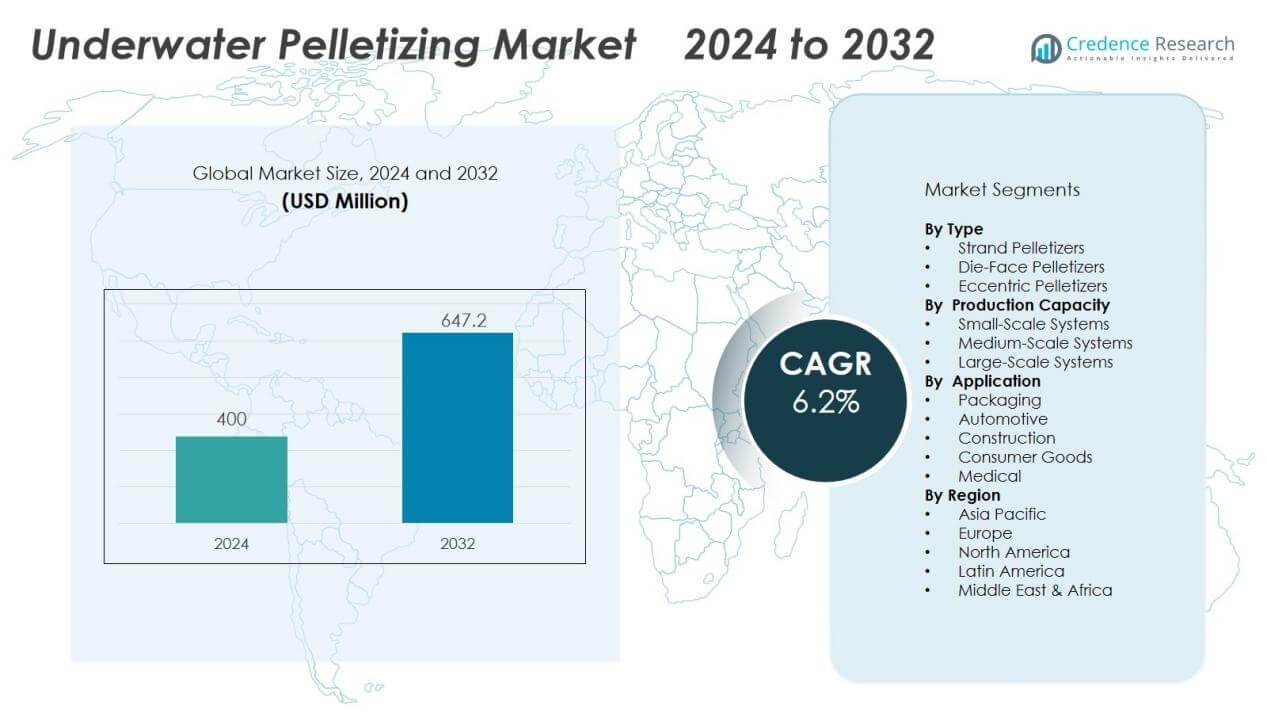
The Underwater pelletizing market size was valued at USD 400 million in 2024 and is anticipated to reach USD 647.2 million by 2032, at a CAGR of 6.2 % during the forecast period (2024-2032).
| REPORT ATTRIBUTE | DETAILS |
|---|---|
| Historical Period | 2020-2024 |
| Base Year | 2024 |
| Forecast Period | 2025-2032 |
| Underwater Pelletizing Market Size 2024 | USD 400 Million |
| Underwater Pelletizing Market, CAGR | 6.2 % |
| Underwater Pelletizing Market Size 2032 | USD 647.2 Million |
Key market drivers include the rising demand for efficient pelletizing solutions capable of handling a wide range of polymers and formulations. The shift toward sustainable materials and circular economy initiatives has prompted investments in advanced pelletizing technology, supporting the production of recycled and bio-based plastics. Technological advancements, such as automated control systems and improved cutting mechanisms, enhance productivity while reducing downtime and maintenance costs. Growth in packaging, automotive, construction, and electronics sectors further accelerates the adoption of underwater pelletizing systems globally.
Regionally, Asia-Pacific dominates the underwater pelletizing market due to its robust plastics manufacturing industry and strong investments in capacity expansion across China, India, and Southeast Asia. North America and Europe remain significant markets, driven by stringent environmental regulations, adoption of recycling practices, and a well-established polymer processing sector.
Market Insights:
- The underwater pelletizing market was valued at USD 400 million in 2024 and is expected to reach USD 647.2 million by 2032.
- Rising demand for high-quality thermoplastics and specialty polymers drives adoption in packaging, automotive, and consumer goods industries.
- Investments in sustainable materials and circular economy initiatives support growth in recycled and bio-based plastics production.
- Technological advancements in automation and precision cutting enhance system efficiency, flexibility, and reduce operational downtime.
- High initial investment and complex maintenance requirements pose challenges, especially for small and medium-sized manufacturers.
- Asia-Pacific leads the market with 45% share, driven by robust plastics manufacturing and strong capacity expansion in China, India, and Southeast Asia.
- North America and Europe remain significant markets, supported by advanced infrastructure, regulatory support for recycling, and strict environmental standards.
Market Drivers:
Rising Demand for High-Quality Thermoplastics and Polymers Across Industries:
The underwater pelletizing market benefits from the growing need for high-quality thermoplastics and specialty polymers across packaging, automotive, and consumer goods industries. Manufacturers seek advanced pelletizing solutions to produce uniform pellets that ensure superior product performance and consistency. The demand for lightweight and durable plastics in automotive and electronics sectors drives the adoption of reliable pelletizing systems. Companies invest in state-of-the-art equipment to maintain competitive advantage and deliver precise material specifications.
Shift Toward Sustainability and Circular Economy Initiatives Stimulates Innovation:
Increasing focus on sustainability prompts manufacturers to invest in underwater pelletizing systems capable of processing recycled and bio-based materials. The market supports global initiatives for reducing plastic waste and promoting the circular economy. It enables efficient conversion of post-consumer and post-industrial plastics into reusable pellets for various applications. Manufacturers benefit from technology upgrades that facilitate recycling and align with environmental regulations.
- For instance, Gamma Meccanica’s underwater pelletizer TI 5.6 allows the granulation of recycled PET at capacities reaching 2,800kg/h, helping transform high-MFI plastics into uniform, reusable pellets for downstream manufacturing.
Technological Advancements Enhance Efficiency and Operational Flexibility:
Advancements in automation, precision cutting, and process control improve the efficiency and flexibility of underwater pelletizing systems. It allows producers to quickly switch between different polymer grades and product specifications without compromising output quality. Automated monitoring and feedback systems optimize production and reduce operational downtime. Companies rely on these innovations to improve productivity and lower maintenance costs.
- For instance, Nordson’s BKG® Type AH D pelletizer features a blade wear indicator with automatic in-operation blade sharpening, which extends blade lifetime by up to 30%, reducing machine downtime for maintenance and ensuring optimal operational performance even at throughputs of up to 11,500kg/hr.
Expansion of Polymer Processing Capacity in Emerging Economies Drives Market Growth:
The underwater pelletizing market expands rapidly in Asia-Pacific, driven by strong investments in polymer processing infrastructure across China, India, and Southeast Asia. Growing demand for plastic components in construction, packaging, and automotive industries supports capacity expansion. It benefits from government policies promoting industrialization and foreign direct investment. Global players collaborate with local manufacturers to address rising demand and ensure supply chain resilience.
Market Trends:
Adoption of Automation, Digitalization, and Smart Process Controls Accelerates Modernization:
The underwater pelletizing market witnesses rapid integration of automation and digital technologies to enhance productivity, quality, and operational reliability. Advanced systems equipped with smart sensors, real-time data analytics, and remote monitoring enable manufacturers to optimize pelletizing processes and reduce manual intervention. Automation supports precise control over temperature, pressure, and pellet size, leading to consistent output and minimal waste. Digitalization allows predictive maintenance and quick identification of process deviations, helping companies minimize downtime and maintenance expenses. The market benefits from growing interest in Industry 4.0 practices, which enable seamless connectivity between equipment and centralized management platforms. Companies leverage these technological advancements to meet evolving customer requirements for custom formulations and high-volume production runs.
- For instance, Nordson’s BKG® Type AH D pelletizer features a blade wear indicator with automatic in-operation blade sharpening, which extends blade lifetime by up to 30%, reducing machine downtime for maintenance and ensuring optimal operational performance even at throughputs of up to 11,500kg/hr.
Rising Focus on Recycled and Biodegradable Polymers Creates New Opportunities for Innovation:
Sustainability trends continue to influence the underwater pelletizing market, driving investments in solutions tailored for recycled and biodegradable plastics. The demand for eco-friendly packaging, automotive components, and consumer products prompts manufacturers to seek advanced pelletizing systems compatible with challenging materials such as bioplastics and post-consumer recyclates. Companies develop cutting mechanisms, filtration systems, and water management solutions specifically designed to maintain pellet quality when processing recycled content. This focus supports regulatory compliance and strengthens brand reputation among environmentally conscious customers. The market evolves to address new material challenges and enable flexible, high-efficiency production lines, reflecting broader shifts toward circular economy goals and green manufacturing standards.
- For instance, EREMA customers produce more than 14 million tonnes of plastic pellets every year, and annually, they process 2.5 million tonnes of PET into food-grade rPET, which is then used to make beverage bottles and similar products.
Market Challenges Analysis:
High Initial Investment and Complex Maintenance Requirements Limit Adoption:
The underwater pelletizing market faces challenges related to the high upfront costs and technical complexity of advanced pelletizing systems. Small and medium-sized manufacturers may hesitate to adopt modern equipment due to significant capital investment and ongoing maintenance demands. Complex machinery requires skilled operators and regular technical support, increasing operational expenses. Frequent wear on cutting components and pumps can lead to production interruptions if not addressed promptly. Companies must balance the need for productivity with cost control, making the decision to upgrade or expand capacity more difficult.
Variability in Raw Material Quality and Process Integration Issues Impede Efficiency:
Variations in raw material quality present operational hurdles for the underwater pelletizing market, affecting pellet consistency and product performance. It must address the integration of pelletizing systems with existing polymer processing lines, which may involve compatibility and process synchronization issues. Inconsistent feedstock or improper process calibration can lead to increased waste and downtime. Adhering to stringent quality and environmental standards adds further complexity. Manufacturers face pressure to maintain efficiency and quality while minimizing resource consumption and regulatory risk.
Market Opportunities:
Expansion of Bioplastics and Sustainable Materials Creates Growth Prospects for Equipment Providers:
The underwater pelletizing market stands to benefit from rapid growth in the bioplastics sector and the shift toward sustainable material production. Governments and major brands pursue aggressive targets for reducing plastic waste and carbon emissions, fueling investments in bio-based and compostable polymers. Equipment providers have the opportunity to develop systems optimized for processing new material formulations that require precise temperature and moisture control. Manufacturers are open to adopting innovative pelletizing technologies that support circular economy goals and help achieve regulatory compliance. This trend expands the addressable market for system suppliers and technology developers.
Rising Investments in Emerging Markets Support Infrastructure Development and System Upgrades:
Emerging economies in Asia-Pacific, Latin America, and the Middle East are witnessing significant investments in polymer processing and manufacturing infrastructure. The underwater pelletizing market can capitalize on these investments by offering advanced systems designed for high-capacity, energy-efficient operation. It meets the needs of local producers seeking to upgrade legacy equipment and align with global quality standards. Strategic partnerships with regional players open new channels for market entry and customer engagement. Companies that tailor solutions for local requirements and support after-sales services can build long-term growth opportunities.
Market Segmentation Analysis:
By Type:
The underwater pelletizing market includes strand pelletizers, die-face pelletizers, and eccentric pelletizers. Strand pelletizers are preferred for their versatility in processing a wide range of thermoplastics and engineering polymers. Die-face pelletizers offer superior performance for specialty materials and high-throughput applications, making them ideal for continuous production lines. Eccentric pelletizers address niche requirements, particularly for sensitive or specialty polymers that demand precise cutting and minimal thermal exposure.
- For example, Intype’s Die-Face Cutter Type Pelletizing Machine is equipped with an advanced low-temperature mixing screw and vacuum-assisted degassing, resulting in steady pellet output and strong pellet density, with some models capable of producing up to 1,200kg/hr of uniform pellets for engineering plastics.
By Production Capacity:
It segments into small, medium, and large-scale systems. Small-capacity pelletizing lines cater to R&D facilities and niche manufacturers requiring flexible, low-volume production. Medium-capacity systems suit regional converters and custom compounders balancing efficiency and product diversity. Large-scale underwater pelletizing systems dominate high-volume industrial operations, supporting global polymer producers seeking consistent output and process reliability.
- For instance, GEMCO Energy portable pellet production line offers a specific output of 400–600 kg/h, supporting testing, innovation, and compact environments for laboratory and small business use.
By Application:
The underwater pelletizing market serves packaging, automotive, construction, consumer goods, and medical sectors. Packaging applications drive major demand due to high-volume polymer consumption and strict quality requirements. Automotive and construction sectors leverage pelletizing systems for specialty materials with advanced performance attributes. Consumer goods and medical applications require uniform pellets to ensure product safety and regulatory compliance. It continues to expand its reach into new applications, reflecting broader material innovation and industry shifts.
Segmentations:
By Type:
- Strand Pelletizers
- Die-Face Pelletizers
- Eccentric Pelletizers
By Production Capacity:
- Small-Scale Systems
- Medium-Scale Systems
- Large-Scale Systems
By Application:
- Packaging
- Automotive
- Construction
- Consumer Goods
- Medical
By Region:
- North America
- U.S.
- Canada
- Mexico
- Europe
- Germany
- France
- U.K.
- Italy
- Spain
- Rest of Europe
- Asia Pacific
- China
- Japan
- India
- South Korea
- South-east Asia
- Rest of Asia Pacific
- Latin America
- Brazil
- Argentina
- Rest of Latin America
- Middle East & Africa
- GCC Countries
- South Africa
- Rest of the Middle East and Africa
Regional Analysis:
Asia-Pacific :
Asia-Pacific holds a 45% market share in the underwater pelletizing market, driven by rapid growth in plastics manufacturing and significant investments in production capacity across China, India, and Southeast Asia. Strong demand from packaging, automotive, and consumer goods industries supports the adoption of advanced pelletizing systems. Governments in the region encourage industrialization and support technological upgrades in polymer processing. It benefits from a robust supplier ecosystem and rising exports of plastic resins and finished products. Leading manufacturers establish regional headquarters and technical centers to enhance customer support and service responsiveness. The growing focus on sustainable production and recycling drives further investments in next-generation pelletizing solutions.
North America :
North America accounts for a 26% share of the underwater pelletizing market, backed by established polymer processing infrastructure and widespread adoption of recycling practices. The region demonstrates consistent demand for high-performance pelletizing equipment in packaging, automotive, and construction applications. Stringent regulations related to waste management and plastic recycling drive investments in efficient and eco-friendly systems. Major companies prioritize technology upgrades that improve material efficiency and operational reliability. It maintains a reputation for technological innovation and collaborates with research institutions to develop advanced solutions. Stable economic conditions and strong end-user industries sustain regional market growth.
Europe :
Europe represents a 21% market share in the underwater pelletizing market, supported by advanced manufacturing capabilities and strict environmental standards. The region emphasizes the adoption of sustainable materials, aligning with ambitious circular economy targets and regulatory requirements. Leading players develop premium-grade polymers and specialty compounds for automotive, electronics, and medical applications. It invests in high-efficiency, automated pelletizing systems that deliver superior pellet quality and resource efficiency. Collaborative efforts between industry, government, and academia drive product innovation and support workforce development. The commitment to sustainability positions Europe as a key market for technology adoption and new product development.
Key Player Analysis:
- Coperion
- Cowell Extrusion
- CGC Technology
- Nordson
- Chuangbo Machine
- Cowin Extrusion
- Farrel Pomini
- MAAG
- Crown Machine
- ECON
- Neoplast
Competitive Analysis:
The underwater pelletizing market features strong competition among global players such as Coperion, Cowell Extrusion, CGC Technology, Nordson, Chuangbo Machine, Cowin Extrusion, Farrel Pomini, and MAAG. These companies focus on developing advanced pelletizing systems that offer high throughput, reliability, and adaptability to a wide range of polymers. It drives innovation in automation, process control, and energy efficiency to meet evolving customer needs. Leading players invest in expanding service networks, technical support, and after-sales solutions to strengthen customer relationships. The market values product differentiation through customization, robust design, and compatibility with sustainable materials. Strategic collaborations with polymer producers and continuous research and development activities reinforce competitive positioning. It remains dynamic, shaped by rapid technological advancements and growing demand for specialty and recycled polymers across diverse industries.
Recent Developments:
- In August 2024, Coperion completed the integration of the Schenck Process Food and Performance Materials (FPM) group, bringing several brands such as Baker Perkins and Unifiller under its portfolio.
- June 2025: CGC Digital (Malaysia) established a partnership with B2B Finpal to expand digital lending solutions for MSMEs.
- In July 2025, Nordson launched the VersaBlue® II Melter, a new adhesive dispensing solution aimed at the hygiene sector.
Market Concentration & Characteristics:
The underwater pelletizing market exhibits moderate concentration, with a mix of established global players and specialized regional manufacturers. Leading companies maintain a strong presence by offering advanced, customizable systems and comprehensive after-sales support. It features high entry barriers due to significant capital investment, technical expertise, and stringent quality requirements. Product differentiation centers on automation, energy efficiency, and compatibility with diverse polymers, including recycled and biodegradable materials. Continuous innovation and technology upgrades drive competition, while long-term relationships with major polymer producers strengthen market positions. The market remains dynamic, shaped by regulatory developments, customer demands, and rapid adoption of digital process controls.
Report Coverage:
The research report offers an in-depth analysis based on Type, Production Capacity, Application and Region. It details leading Market players, providing an overview of their business, product offerings, investments, revenue streams, and key applications. Additionally, the report includes insights into the competitive environment, SWOT analysis, current Market trends, as well as the primary drivers and constraints. Furthermore, it discusses various factors that have driven Market expansion in recent years. The report also explores Market dynamics, regulatory scenarios, and technological advancements that are shaping the industry. It assesses the impact of external factors and global economic changes on Market growth. Lastly, it provides strategic recommendations for new entrants and established companies to navigate the complexities of the Market.
Future Outlook:
- Equipment providers will focus on modular designs to support flexible production and faster changeover between polymer grades.
- It will adopt advanced digital process control features to enable real‑time process optimization and predictive maintenance.
- Manufacturers will pursue water‑recycling and filtration innovations to reduce resource consumption and minimize waste discharge.
- The market will develop systems tailored for handling post‑consumer plastics and bio‑based materials with sensitive properties.
- Leaders will form strategic alliances with polymer producers and recyclers to co‑develop solutions for new formulations.
- Service offerings will expand to include remote diagnostics, performance analytics, and usage‑based maintenance contracts.
- Equipment makers will gradually integrate AI‑based control algorithms to enhance throughput, pellet uniformity, and energy efficiency.
- Focused markets in Latin America, Middle East, and Africa will create demand for robust and lower‑cost pelletizing lines suited to local conditions.
- Manufacturers will seek regulatory approval and industry certification in regions enforcing strict environmental and safety standards.
- It will support circular economy goals by enabling closed‑loop pellet production from recycled streams, boosting sustainability credentials.

Request a Free Sample
Fill in your details and we'll send you a free sample report.
- Sample data tables & charts
- Research methodology
Market Dynamics
Demand for High-Quality Thermoplastics and Specialty Polymers
Industries such as packaging, automotive, and consumer goods require uniform, high-performance pellets, driving adoption of advanced underwater pelletizing systems that ensure consistent product quality and material properties.
Shift Toward Sustainability and Circular Economy
Growing regulatory and consumer focus on recycled and bio-based plastics is prompting manufacturers to invest in pelletizing equipment capable of processing challenging materials, supporting circular economy initiatives and compliance with environmental standards.
Technological Advancements in Automation and Precision Cutting
Innovations such as automated control systems, smart sensors, and improved cutting mechanisms increase operational efficiency, reduce downtime, and enable flexible production, making underwater pelletizing systems more attractive to large-scale and specialty producers.
Expansion of Polymer Processing in Emerging Economies
Significant investments in plastics manufacturing infrastructure, especially in Asia-Pacific, are boosting demand for high-capacity, reliable pelletizing systems to support growing output in packaging, automotive, and construction sectors.
Adoption of Digitalization and Smart Process Controls
Integration of real-time monitoring, predictive maintenance, and digital process optimization enables manufacturers to minimize waste, improve resource efficiency, and quickly adapt to changing material requirements, further accelerating market growth.
Need a Custom Version of This Report?
Tailor the scope, geography, or segments to your exact requirements.
- Custom geography or segment scope
- Direct access to our analyst team
Frequently Asked Questions
What is the current market size for the underwater pelletizing market and what is its projected size in 2032?
At what Compound Annual Growth Rate is the underwater pelletizing market projected to grow between 2024 and 2032?
Which underwater pelletizing market segment held the largest share in 2024?
Q4: What are the primary factors fueling the growth of the underwater pelletizing market?
Who are the leading companies in the underwater pelletizing market?
Table of Content
Chapter 1 Market Segmentation
- 1.1 Segmentation Framework
- 1.1.1 Product and Service Classification
- 1.1.2 Application and End-Use Classification
- 1.1.3 Technology and Solution Classification
- 1.1.4 Customer and Distribution Channel Classification
- 1.1.5 Geographic Segmentation
- 1.1.6 Market Segment Definitions and Boundaries
- 1.2 By Type
- 1.2.1 Strand Pelletizers
- 1.2.2 Die-Face Pelletizers
- 1.2.3 Eccentric Pelletizers
- 1.3 By Application
- 1.3.1 Packaging
- 1.3.2 Automotive
- 1.3.3 Construction
- 1.3.4 Consumer Goods
- 1.3.5 Medical
- 1.4 By Production Capacity
- 1.4.1 Small-Scale Systems
- 1.4.2 Medium-Scale Systems
- 1.4.3 Large-Scale Systems
Chapter 2 Introduction
- 2.1 Report Objectives and Scope
- 2.2 Product Definition and Industry Terminology
- 2.3 Market Inclusions and Exclusions
- 2.4 Research Process
- 2.4.1 Primary Research and Expert Interviews
- 2.4.2 Secondary Research and Source Review
- 2.4.3 Top-Down and Bottom-Up Estimation
- 2.4.4 Data Triangulation and Verification
- 2.5 Market Size Measurement Basis
- 2.5.1 2024: USD 400 million → 2032: USD 647.2 million
- 2.6 Historical and Forecast Reference Periods
- 2.6.1 Base Year: 2024
- 2.6.2 Forecast Period: 2024-2032
- 2.7 Research Assumptions and Limitations
Chapter 3 Executive Summary
- 3.1 Market Snapshot and Key Findings
- 3.2 Base-Year Market Size, 2024
- 3.3 Forecast Market Size, 2032
- 3.4 Revenue and Volume Growth Outlook
- 3.5 Key Demand and Supply Indicators
- 3.6 Leading Market Segments
- 3.7 Fastest-Growing Market Opportunities
- 3.8 Regional Performance Highlights
- 3.9 Technology and Industry Transformation
- 3.10 Competitive Landscape Summary
- 3.11 Analyst View and Strategic Implications
Chapter 4 Global Underwater Pelletizing Market Market Trends and Developments
- 4.1 Historical Industry Development
- 4.2 Recent Market Trends and Developments
- 4.3 Demand and Customer Behavior Trends
- 4.4 Technology and Product Innovation
- 4.5 Artificial Intelligence, Automation and Digitalization
- 4.6 Local Manufacturing and Supply Chain Realignment
- 4.7 Industry Partnerships, Mergers and Acquisitions
- 4.8 Sustainability and Circular Economy Developments
- 4.9 Government and Private Sector Investment Trends
- 4.10 Emerging Business Models and Commercialization
- 4.11 Industry Developments and Announcements
Chapter 5 Global Underwater Pelletizing Market Market Production, Supply and Demand Analysis
- 5.1 Demand Trend and Consumption Analysis
- 5.2 Demand Forecast, 2024-2032
- 5.3 Production and Output Trend
- 5.4 Production and Output Forecast, 2024-2032
- 5.5 Installed Capacity and Capacity Utilization
- 5.6 Company-Wise Production Plants and Statistics
- 5.6.1 Installed Production Capacity
- 5.6.2 Actual Production
- 5.6.3 Planned Capacity and Expansion Targets
- 5.7 Supply Chain Structure and Procurement Trends
- 5.8 Supply-Demand Gap and Bottlenecks
- 5.9 Import Dependence and Sourcing Structure
- 5.10 Contract Manufacturing and Outsourcing
- 5.11 Regional Supply and Demand Concentration
Chapter 6 Global Underwater Pelletizing Market Market Pricing Analysis
- 6.1 Pricing Structure and Measurement
- 6.2 Historical Pricing Trends
- 6.3 Pricing Outlook, 2024-2032
- 6.4 Average Selling Price and Unit Economics
- 6.5 Pricing by Product and Market Segment
- 6.6 Geographic Pricing Differences
- 6.7 Key Input, Energy, Labor and Logistics Costs
- 6.8 Contract Pricing and Purchasing Models
- 6.9 Pricing Sensitivity and Competitive Positioning
- 6.10 Price, Margin and Profitability Implications
Chapter 7 Global Underwater Pelletizing Market Market Dynamics
- 7.1 Market Growth Drivers
- 7.1.1 Demand-Side Drivers
- 7.1.2 Technology and Innovation Drivers
- 7.1.3 Infrastructure and Investment Drivers
- 7.1.4 Regulatory and Policy Drivers
- 7.2 Market Restraints
- 7.2.1 Cost and Affordability Constraints
- 7.2.2 Technology and Adoption Barriers
- 7.2.3 Supply Chain and Operational Constraints
- 7.3 Market Challenges
- 7.3.1 Competitive Pressure and Margin Erosion
- 7.3.2 Skills, Infrastructure and Implementation Gaps
- 7.4 Emerging Market Opportunities
- 7.5 Market Dynamics Impact and Time-Horizon Assessment
Chapter 8 Global Underwater Pelletizing Market Value Chain Analysis
- 8.1 Industry Value Chain Overview
- 8.2 Upstream Suppliers and Critical Inputs
- 8.3 Technology and Component Providers
- 8.4 Manufacturing or Service Delivery
- 8.5 Distribution, Channel Partners and Integrators
- 8.6 Downstream Applications and End Users
- 8.7 Value Addition and Profit Pools
- 8.8 Vertical Integration and Outsourcing
- 8.9 Supplier Concentration and Risk
- 8.10 Supply Chain Localization and Resilience
Chapter 9 Global Underwater Pelletizing Market Market Regulations and Policies
- 9.1 Relevant Laws, Standards and Compliance Frameworks
- 9.2 Product, Service, Safety and Quality Requirements
- 9.3 Government Policies, Incentives and Subsidies
- 9.4 Imports, Exports and Trade Barriers
- 9.5 Public Procurement and Local Content Requirements
- 9.6 Environmental and Sustainability Compliance
- 9.7 Upcoming Policy Changes and Market Implications
Chapter 10 Global Underwater Pelletizing Market Market Hotspots and Opportunities
- 10.1 Market Opportunity Mapping and Growth Hotspots
- 10.2 High-Growth Applications and Customer Groups
- 10.3 Underserved Markets and White-Space Opportunities
- 10.4 Emerging Technology and Product Opportunities
- 10.5 New Capacity and Investment Hotspots
- 10.6 Market Entry and Expansion Opportunities
- 10.7 Distribution and Partnership Opportunities
- 10.8 Near-Term and Long-Term Commercial Potential
- 10.9 Opportunity Attractiveness and Execution Risks
Chapter 11 Global Underwater Pelletizing Market Market Outlook, 2024-2032
- 11.1 Market Size and Analysis
- 11.1.1 Revenue (Market Measurement: 2024: USD 400 million → 2032: USD 647.2 million)
- 11.1.2 Market Volume and Quantity Sold
- 11.1.3 Historical Market Size
- 11.1.4 Base-Year Market Size, 2024
- 11.2 Market Forecast, 2024-2032
- 11.2.1 Revenue Forecast to 2032
- 11.2.2 Volume Forecast to 2032
- 11.2.3 CAGR and Year-on-Year Growth
- 11.2.4 Incremental Revenue Opportunity
- 11.3 Forecast Assumptions and Scenario Analysis
- 11.3.1 Base-Case Forecast
- 11.3.2 Optimistic and Conservative Scenarios
- 11.3.3 Technology, Pricing and Policy Sensitivities
- 11.4 Market Attractiveness and Growth Outlook
Chapter 12 Global Underwater Pelletizing Market Market Segmentation and Outlook
- 12.1 Segmentation Summary and Market Shares, 2024
- 12.2 Largest and Fastest-Growing Segments
- 12.3 By Type - Market Size and Forecast, 2024-2032
- 12.3.1 Segment Definition and Scope
- 12.3.2 Historical Market Size
- 12.3.3 Revenue Forecast, 2024-2032
- 12.3.4 Volume Forecast, 2024-2032
- 12.3.5 Base-Year Market Share, 2024
- 12.3.6 Segment CAGR and Growth Drivers
- 12.3.7 Subsegment Market Size and Forecast
- 12.3.7.1 Strand Pelletizers
- 12.3.7.2 Die-Face Pelletizers
- 12.3.7.3 Eccentric Pelletizers
- 12.3.8 Subsegment Pricing and Adoption Trends
- 12.3.9 Leading Suppliers and Competition
- 12.3.10 Regional Demand and Opportunities
- 12.4 By Application - Market Size and Forecast, 2024-2032
- 12.4.1 Segment Definition and Scope
- 12.4.2 Historical Market Size
- 12.4.3 Revenue Forecast, 2024-2032
- 12.4.4 Volume Forecast, 2024-2032
- 12.4.5 Base-Year Market Share, 2024
- 12.4.6 Segment CAGR and Growth Drivers
- 12.4.7 Subsegment Market Size and Forecast
- 12.4.7.1 Packaging
- 12.4.7.2 Automotive
- 12.4.7.3 Construction
- 12.4.7.4 Consumer Goods
- 12.4.7.5 Medical
- 12.4.8 Subsegment Pricing and Adoption Trends
- 12.4.9 Leading Suppliers and Competition
- 12.4.10 Regional Demand and Opportunities
- 12.5 By Production Capacity - Market Size and Forecast, 2024-2032
- 12.5.1 Segment Definition and Scope
- 12.5.2 Historical Market Size
- 12.5.3 Revenue Forecast, 2024-2032
- 12.5.4 Volume Forecast, 2024-2032
- 12.5.5 Base-Year Market Share, 2024
- 12.5.6 Segment CAGR and Growth Drivers
- 12.5.7 Subsegment Market Size and Forecast
- 12.5.7.1 Small-Scale Systems
- 12.5.7.2 Medium-Scale Systems
- 12.5.7.3 Large-Scale Systems
- 12.5.8 Subsegment Pricing and Adoption Trends
- 12.5.9 Leading Suppliers and Competition
- 12.5.10 Regional Demand and Opportunities
- 12.6 Segment Growth Comparison
- 12.7 Segment Attractiveness and Priority Matrix
Chapter 13 Global Underwater Pelletizing Market End-Use and Application Market Outlook
- 13.1 End-Use Industry and Customer Demand Structure
- 13.2 Leading Applications and Customer Groups
- 13.3 End-Use Market Size, Share and Forecast
- 13.4 Major End-Use Industry Deep Dives
- 13.4.1 Customer Requirements and Use Cases
- 13.4.2 Demand and Replacement Cycles
- 13.4.3 Technical and Regulatory Considerations
- 13.4.4 Purchasing and Procurement Models
- 13.4.5 Leading Vendors and Distribution Channels
- 13.4.6 Forecast and Commercial Opportunities
- 13.5 Emerging Applications and Cross-Segment Demand
- 13.6 End-Use Industry Investment Priorities
Chapter 14 Global Underwater Pelletizing Market Geographic Market Outlook, 2024-2032
- 14.1 Regional Market Size and Share, 2024
- 14.2 Regional Market Forecast, 2024-2032
- 14.3 Regional Pricing, Production and Demand Differences
- 14.4 North America
- 14.4.1 United States
- 14.4.2 Canada
- 14.4.3 Mexico
- 14.5 Europe
- 14.5.1 Germany
- 14.5.2 France
- 14.5.3 Italy
- 14.5.4 United Kingdom
- 14.5.5 Spain
- 14.5.6 Poland
- 14.5.7 Russia
- 14.5.8 Netherlands
- 14.5.9 Belgium
- 14.5.10 Sweden
- 14.5.11 Denmark
- 14.5.12 Norway
- 14.5.13 Rest of Europe
- 14.6 Asia Pacific
- 14.6.1 China
- 14.6.2 India
- 14.6.3 Japan
- 14.6.4 South Korea
- 14.6.5 Thailand
- 14.6.6 Indonesia
- 14.6.7 Vietnam
- 14.6.8 Malaysia
- 14.6.9 Australia
- 14.6.10 Rest of Asia Pacific
- 14.7 Latin America
- 14.7.1 Brazil
- 14.7.2 Argentina
- 14.7.3 Colombia
- 14.7.4 Chile
- 14.7.5 Rest of Latin America
- 14.8 Middle East
- 14.8.1 Saudi Arabia
- 14.8.2 United Arab Emirates
- 14.8.3 Turkey
- 14.8.4 Israel
- 14.8.5 Iran
- 14.8.6 Rest of the Middle East
- 14.9 Africa
- 14.9.1 South Africa
- 14.9.2 Egypt
- 14.9.3 Nigeria
- 14.9.4 Morocco
- 14.9.5 Rest of Africa
- 14.10 Regional Investment, Policy and Supply Chain Differences
- 14.11 Regional Competitive Landscape
- 14.12 Geographic Growth Hotspots
Chapter 15 Global Underwater Pelletizing Market Technology, Innovation and Sustainability Outlook
- 15.1 Technology Landscape and Maturity
- 15.2 Product, Process and Service Innovation
- 15.3 AI, Automation and Digital Tools in the Industry
- 15.4 Technology Adoption and Performance Benchmarking
- 15.5 Innovation Pipeline and R&D Investment
- 15.6 Patent and Intellectual Property Trends
- 15.7 Energy Efficiency and Resource Management
- 15.8 Sustainability, Recycling and Circularity
- 15.9 Technology Roadmap, 2024-2032
- 15.10 Risks of Obsolescence and Technology Substitution
Chapter 16 Global Underwater Pelletizing Market Market Key Strategic Imperatives
- 16.1 Growth and Market Entry Priorities
- 16.2 High-Return Products and Segments
- 16.3 Pricing, Profitability and Cost Optimization
- 16.4 Technology Investment and Product Differentiation
- 16.5 Supply Chain Localization and Resilience
- 16.6 Distribution and Customer Acquisition
- 16.7 Partnership, Acquisition and Capacity Strategy
- 16.8 Regional Expansion Priorities
- 16.9 Short-, Medium- and Long-Term Actions
Chapter 17 Competition Outlook
- 17.1 Industry Competition Characteristics
- 17.2 Market Structure and Concentration
- 17.3 Market Share and Competitive Positioning, 2024
- 17.4 Company-Wise Revenue and Product Benchmarking
- 17.5 Production and Service Capacity Benchmarking
- 17.6 Technology, Pricing and Differentiation
- 17.7 Regional Footprint and Distribution Strength
- 17.8 Mergers, Acquisitions and Strategic Alliances
- 17.9 New Entrants and Competitive Threats
- 17.10 Porter's Five Forces and Industry Attractiveness
- 17.11 Competitive Outlook, 2024-2032
Chapter 18 Company Profiles
- 18.1 Company Coverage and Selection Criteria
- 18.2 Coperion
- 18.2.1 Business Description
- 18.2.2 Company Ownership and Geographic Presence
- 18.2.3 Product and Service Portfolio
- 18.2.4 Manufacturing and Operating Footprint
- 18.2.5 Production Capacity and Expansion Plans
- 18.2.6 Financial Performance and Investment
- 18.2.7 Market Share and Competitive Position
- 18.2.8 Technology and Innovation Capabilities
- 18.2.9 Strategic Alliances or Partnerships
- 18.2.10 Recent Developments
- 18.2.11 Growth Strategy and Outlook
- 18.3 Cowell Extrusion
- 18.4 CGC Technology
- 18.5 Nordson
- 18.6 Chuangbo Machine
- 18.7 Cowin Extrusion
- 18.8 Farrel Pomini
- 18.9 MAAG
- 18.10 Crown Machine
- 18.11 ECON
- 18.12 Other Relevant Market Participants
Note: Every listed company is profiled on the structure shown under the first company. The company list is preliminary and may change based on research findings, market developments, data availability and client requirements.
Chapter 19 Disclaimer
- 19.1 Research and Forecast Disclaimer
- 19.2 Data Source and Estimation Limitations
Note: The depth of individual sections depends on data availability for this market. Volume, capacity, trade and other unit-based metrics are included where applicable.

