Branded options, not new patients, drive value growth
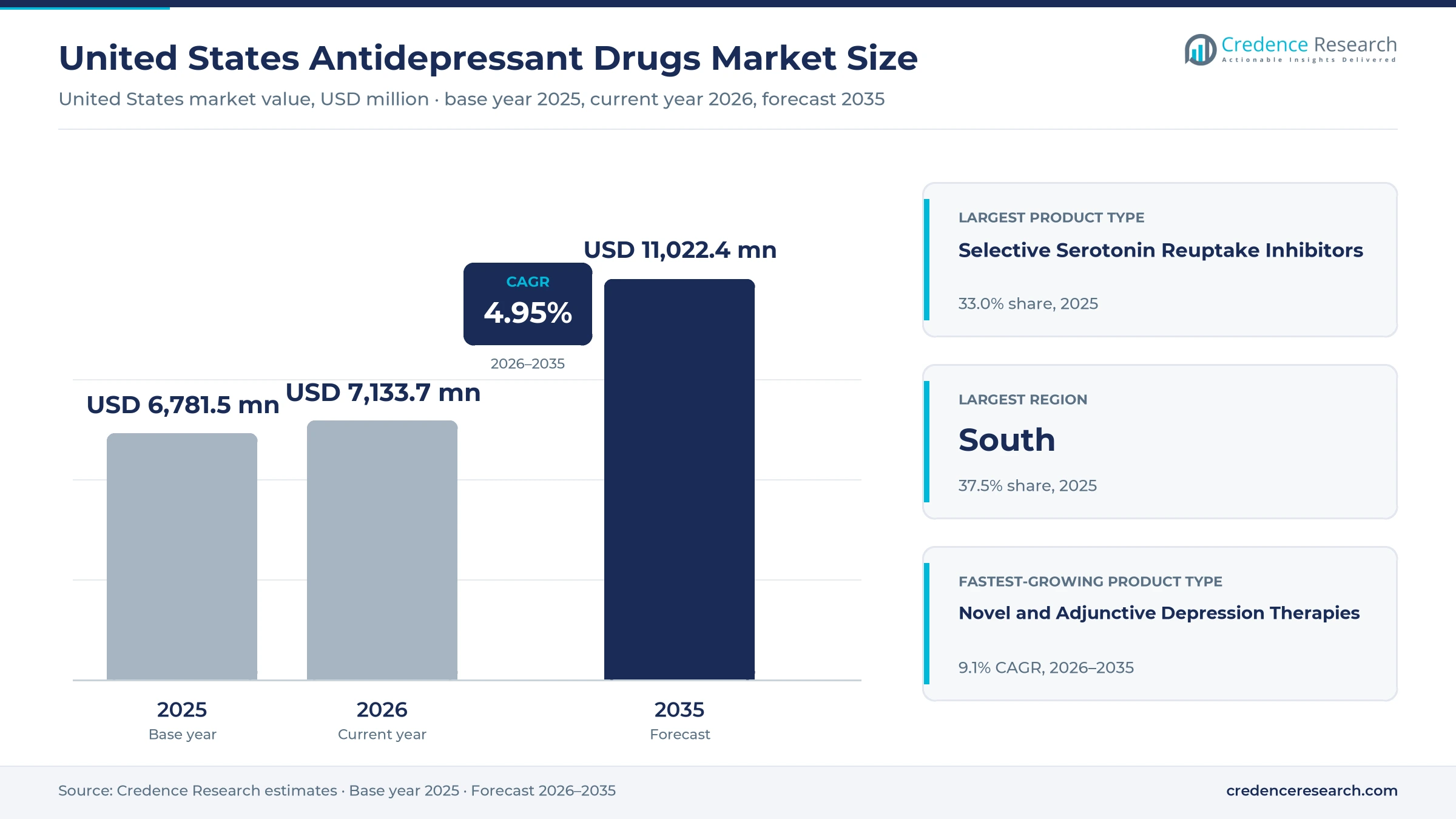
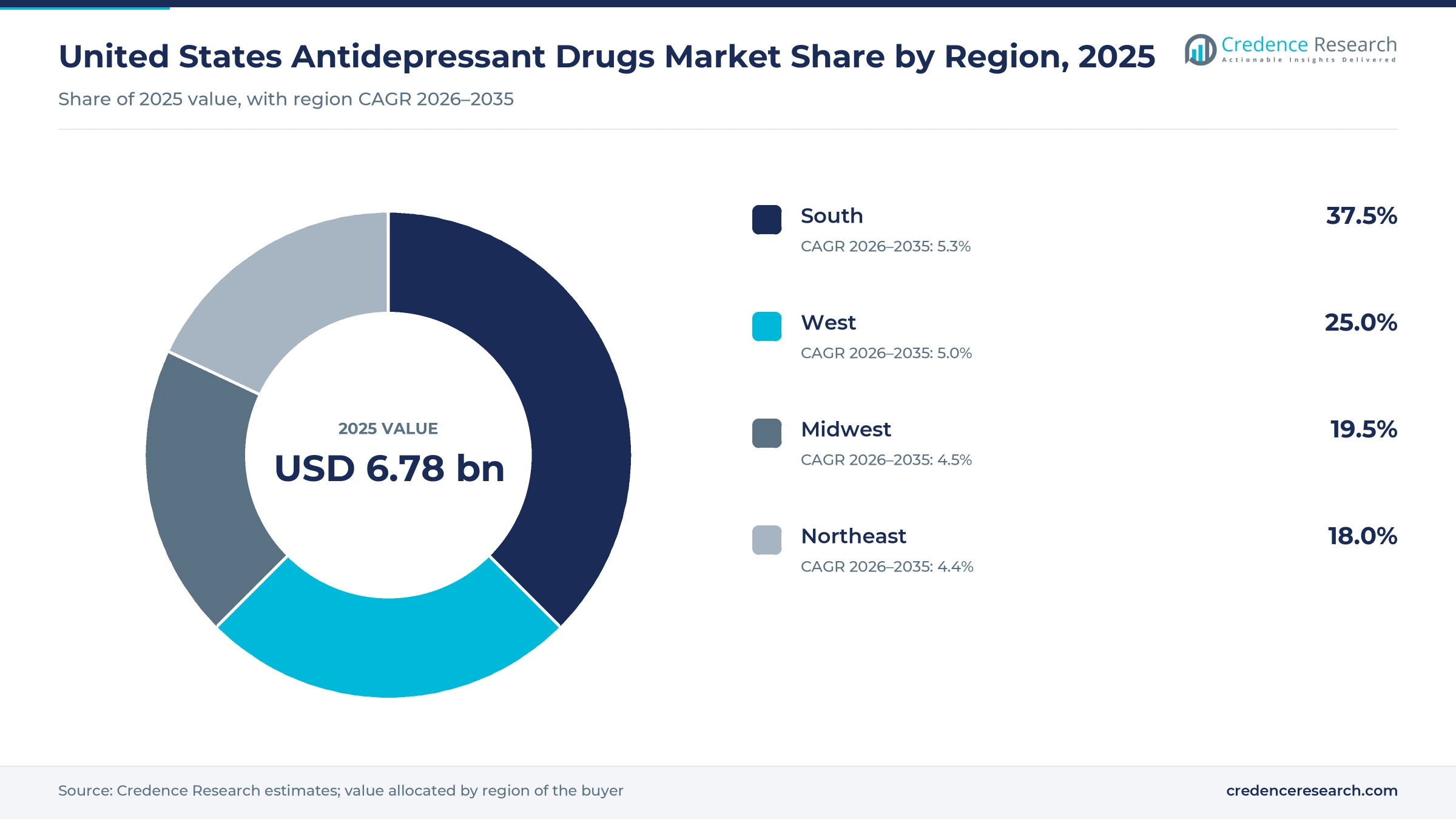
The United States antidepressant drugs market was valued at USD 6.78 billion in 2025 and is projected to increase from USD 7.13 billion in 2026 to USD 11.02 billion by 2035, registering a CAGR of 4.95% during 2026–2035. Value sits in two layers, a large base of low-cost generic SSRIs and SNRIs refilled through retail pharmacies and a smaller, faster-growing layer of branded therapies for patients who do not respond to first-line pills. The South held the largest regional share, 37.5% in 2025, because it holds the largest and fastest-growing population of the four census regions. It is also the fastest-growing region at 5.3% a year, slightly ahead of the West. The main commercial change is the widening of branded second-line care, since the FDA approved esketamine nasal spray as a standalone treatment in January 2025, which lets clinics treat resistant patients without pairing the spray with a second oral drug.
Generic pills and branded second-line drugs share one value base
The market covers prescription medicines used to treat depression and related conditions in the United States, namely SSRIs, SNRIs, other monoaminergic agents such as bupropion, mirtazapine, trazodone and vortioxetine, and novel or adjunctive therapies such as esketamine, dextromethorphan with bupropion, zuranolone, gepirone and atypical antipsychotics used as add-on treatment for depression. Value is measured at manufacturer net selling prices across retail, mail-order, specialty, clinic and long-term care pharmacies.
Psychotherapy, neuromodulation devices, compounded ketamine infusions and over-the-counter supplements are excluded from the estimate. Atypical antipsychotics are counted only for the share of use tied to depression, while their schizophrenia and bipolar use sits outside the market, so originator sales of those brands overstate their weight here.
United States Antidepressant Drugs Market Insights
- The United States antidepressant drugs market grows from USD 6.78 billion in 2025 to USD 11.02 billion by 2035, a 4.95% CAGR, as branded second-line therapies add value faster than generic volume.
- The South held 37.5% of national antidepressant value in 2025 and is also the fastest-growing region at 5.3% a year.
- Selective serotonin reuptake inhibitors accounted for 33.0% of 2025 value, while novel and adjunctive depression therapies grow fastest at 9.1% a year.
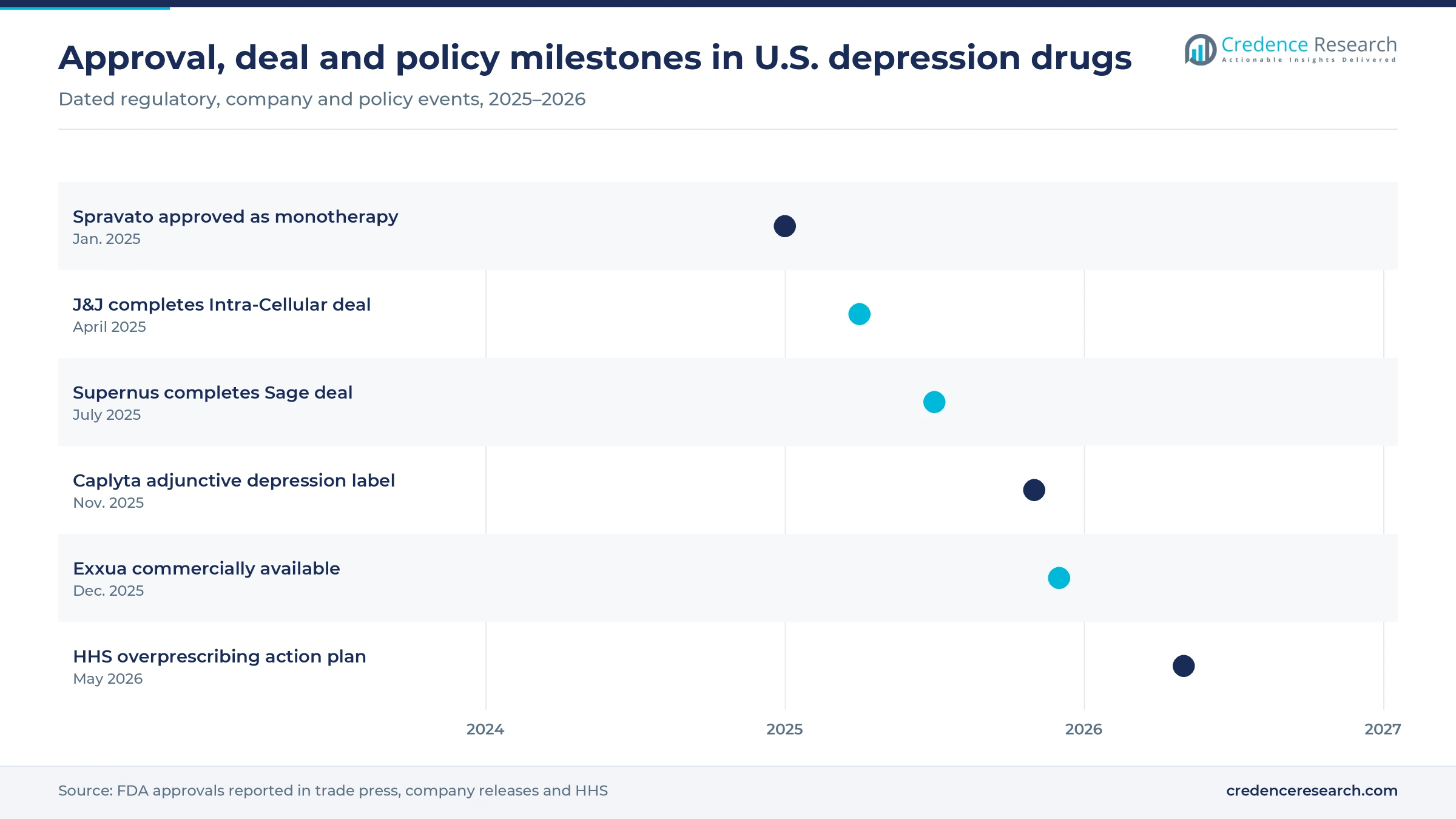
- The FDA approved Spravato as the first standalone treatment for adults with depression unresponsive to two oral antidepressants on Jan. 21, 2025.
- Trintellix loses U.S. patent protection at the end of 2026, which opens the largest branded oral antidepressant to generic competition.
Generic SSRIs lead volume as novel therapies lead growth
Why do generic SSRIs still anchor antidepressant spending?
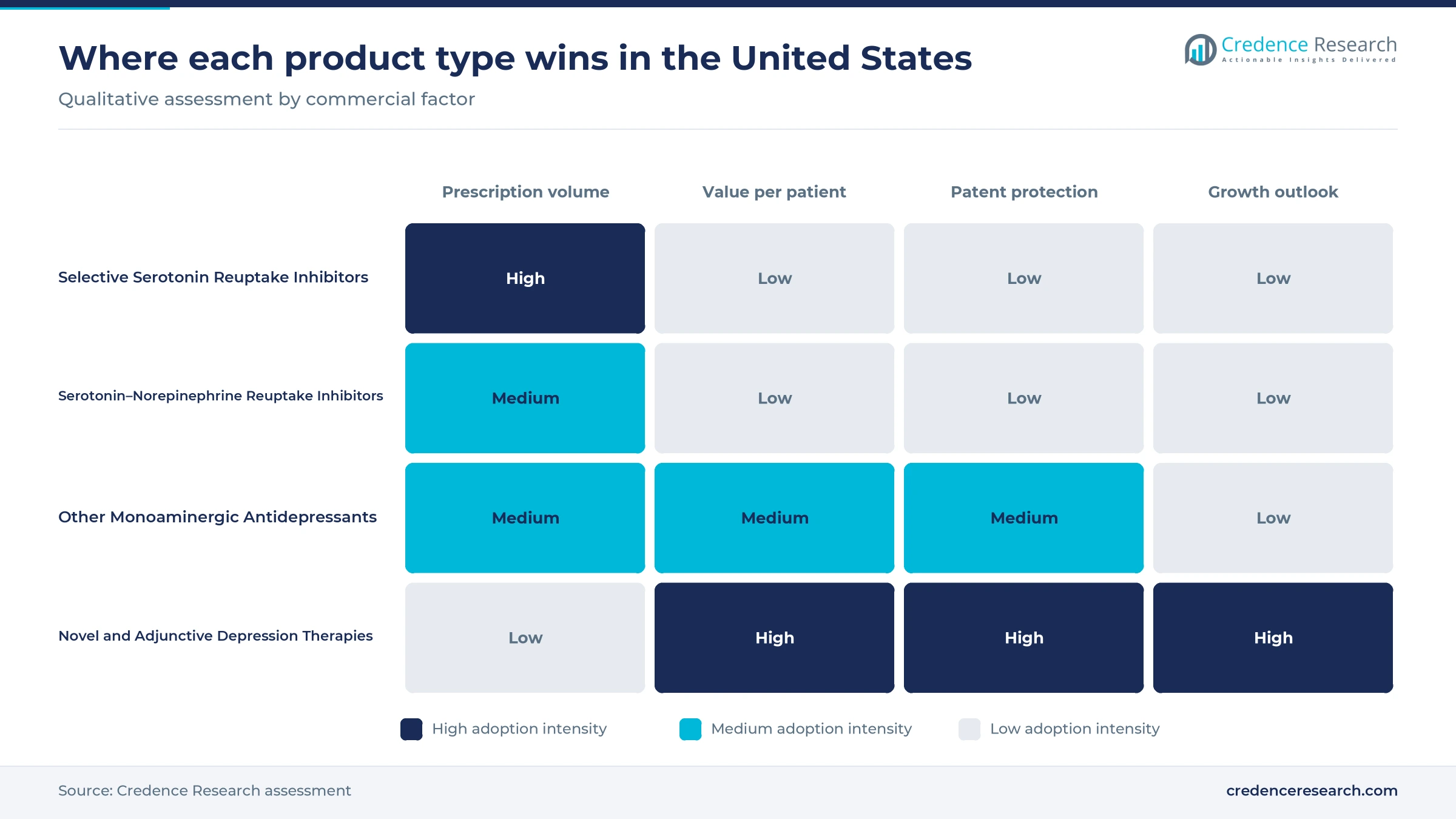
Based on product type, the market is categorized into selective serotonin reuptake inhibitors, serotonin–norepinephrine reuptake inhibitors, other monoaminergic antidepressants and novel and adjunctive depression therapies. Selective Serotonin Reuptake Inhibitors led with 33.0% of 2025 value because sertraline, escitalopram and fluoxetine remain the default first prescription, and GoodRx puts the average retail price of 30 generic sertraline 50 mg tablets at $27.56. Novel and Adjunctive Depression Therapies grow fastest at 9.1% a year as patients move to branded agents, and Axsome reported about 209,000 Auvelity prescriptions in the third quarter of 2025, up 46% from a year earlier. Volume stays generic, but new value increasingly comes from brands.
How do labels for resistant and maternal depression shift value?
Based on disease area, the market is categorized into major depressive disorder, anxiety and related disorders, persistent depressive disorder, postpartum depression and nonpsychiatric antidepressant applications. Major Depressive Disorder led with 61.5% of 2025 value because each recent branded label targets that diagnosis first, including AbbVie's adjunctive Vraylar label on Dec. 16, 2022, and Johnson & Johnson's adjunctive Caplyta label on Nov. 6, 2025. Postpartum Depression grows fastest at 9.8% a year as Zurzuvae, the first oral treatment for the condition, launched in December 2023, while a CDC study in MMWR found postpartum depressive symptoms in 13.2% of recent mothers in 2018. A single short course carries the value of years of generic therapy.
Which age groups carry most of the treatment value?
Based on end user, the market is categorized into patients below 18 years, patients aged 18–64 years and patients aged 65 years and older. Patients Aged 18–64 Years led with 72.0% of 2025 value because working-age adults carry most diagnoses and most commercial insurance, and the novel brands launched since 2019 carry adult labels. Patients Aged 65 Years and Older grow fastest at 5.8% a year as the FDA approved Auvelity on April 30, 2026, for agitation in Alzheimer's dementia, the first non-antipsychotic option for that symptom, according to Healio. That label carries a branded antidepressant combination into nursing homes and geriatric clinics, where prescribers have relied on antipsychotics until now.
Where do antidepressants reach patients?
Based on distribution channel, the market is categorized into retail pharmacy, mail-order and specialty pharmacy, hospital and outpatient clinic pharmacy, and long-term care pharmacy. Retail Pharmacy led with 58.0% of 2025 value because generic refills dominate dispensing, and Aytu, citing industry data at its January 2026 investor day, put annual U.S. antidepressant prescriptions above 345 million. Hospital and Outpatient Clinic Pharmacy grows fastest at 7.1% a year as Spravato is dosed in the clinic under a restricted program, as the Psychopharmacology Institute notes in its 2025 review. Each new esketamine patient adds clinic-dispensed value rather than pharmacy volume, which favors health systems that run certified sites.
| Segment Group | Leading Sub-segment | Share, 2025 | Fastest-growing Sub-segment | CAGR, 2026–2035 |
|---|---|---|---|---|
| By Product Type | Selective Serotonin Reuptake Inhibitors | 33.0% | Novel and Adjunctive Depression Therapies | 9.1% |
| By Disease Area | Major Depressive Disorder | 61.5% | Postpartum Depression | 9.8% |
| By End User | Patients Aged 18–64 Years | 72.0% | Patients Aged 65 Years and Older | 5.8% |
| By Distribution Channel | Retail Pharmacy | 58.0% | Hospital and Outpatient Clinic Pharmacy | 7.1% |
Generic pills cost dollars while brands cost thousands
Pricing in this market runs on two separate tracks that rarely meet. Generic SSRIs and SNRIs trade as commodities, where pharmacy benefit managers and discount cards set the price a patient sees and manufacturer value per pack is a few dollars. Branded therapies are priced per month, per session or per course and recover value through rebates and coverage, so list price says little about net revenue. A month of Vraylar lists at about 50 times the retail cost of generic sertraline, so a small share of patients on branded adjuncts carries a large share of value. Medicare's negotiated Vraylar price from 2027 and generic vortioxetine after Trintellix loses patent protection are the two clearest downward forces on branded prices.
| Product and pack | Typical price or fee | Basis |
|---|---|---|
| Generic sertraline 50 mg, 30 tablets | $27.56 average retail, $10.20 with a discount coupon | GoodRx price guide, Aug. 2026 |
| Trintellix (vortioxetine), 30-day supply | About $514 list price | GoodRx, citing the January 2025 list price |
| Vraylar (cariprazine), one month | $1,376 list, $770 Medicare negotiated price from 2027 | CMS negotiation results reported by Fierce Healthcare |
| Spravato (esketamine) 56 mg or 84 mg, one session | $590 or $885 launch list price | Johnson & Johnson pricing, March 2019 |
| Zurzuvae (zuranolone), full course | $15,900 wholesale acquisition cost | Sage Therapeutics and Biogen, Nov. 2023 |
Request a Free Sample
Fill in your details and we'll send you a free sample report.
- Sample data tables & charts
- Research methodology
Treatment conversion and new mechanisms drive demand
Depression treatment conversion widens the treated pool
The largest volume lever is turning diagnosed depression into sustained drug treatment. The 2024 National Survey on Drug Use and Health found that 21.4 million adults had a past-year major depressive episode, and 14.7 million of them had severe impairment, according to SAMHSA. CDC's National Health Interview Survey found that 11.4% of adults took prescription medication for depression in 2023, with use among women at 15.3%, roughly twice the rate among men. Medication use is broader than one year of episodes, because many patients stay on maintenance therapy or take the same drugs for anxiety. Each newly treated patient usually starts on a generic pill, which is why Selective Serotonin Reuptake Inhibitors keep 33.0% of 2025 value despite very low unit prices.
Differentiated depression treatment expansion lifts brands
The faster value lever is the widening set of branded options for patients who fail first-line pills. The FDA approved Spravato on Jan. 21, 2025, as the first monotherapy for adults with major depressive disorder who responded inadequately to at least two oral antidepressants, after a trial in which 22.5% of patients on esketamine reached remission at week four against 7.6% on placebo, Drug Topics reported. Johnson & Johnson completed its acquisition of Intra-Cellular Therapies on April 2, 2025, adding the Caplyta adjunct noted above. Axsome said about 85% of all covered lives had access to Auvelity by the third quarter of 2025. Together these labels and coverage gains move value toward Novel and Adjunctive Depression Therapies, which grow at 9.1% a year.
Younger-patient dispensing expansion adds long-term users
Younger patients became the fastest-growing source of new prescriptions after 2020, and they tend to stay on therapy for years. A study in Pediatrics, using a national database that covers 92% of prescriptions dispensed in U.S. pharmacies, found that the antidepressant dispensing rate to people aged 12 to 25 rose nearly 64% faster after March 2020, according to the University of Michigan Institute for Healthcare Policy and Innovation. Among female adolescents the rate rose 130% faster, while dispensing to male adolescents declined. CDC data also put medication use for depression at 10.7% among adults aged 18 to 44 in 2023. Value from this group stays modest because almost all of it is generic, yet long treatment duration makes young patients central to refill volume.
An older population raises long-term treatment demand
Population ageing adds patients who stay on therapy and often take several medicines at once. The Census Bureau's Vintage 2025 estimates put the population aged 65 and older at 64.6 million in July 2025, up 16.2% since April 2020, against 3.1% growth for the population as a whole. In the South the older population grew 17.5% over the same period. Medication use for depression is also slightly higher in this group, at 12.4% among adults aged 65 to 74, according to the CDC National Center for Health Statistics. These forces explain why Patients Aged 65 Years and Older grow at 5.8% a year, ahead of working-age adults, and why long-term care pharmacies remain a stable channel.
Tolerability brands and virtual care reshape prescribing
Shift toward mechanisms that avoid SSRI side effects
Prescribers are adding brands whose main claim is tolerability rather than speed. Aytu made Exxua, the first FDA-approved 5-HT1A agonist for major depressive disorder, commercially available on Dec. 15, 2025, under an agreement with Fabre-Kramer signed in June 2025, according to an investor day summary carried by BioSpace. Aytu positions the drug against the sexual dysfunction and weight gain that its speakers linked to long-term SSRI use. Takeda took over sole U.S. promotion of Trintellix on Jan. 1, 2025, as Lundbeck moved to a royalty, Fierce Pharma reported, which keeps a dedicated sales force behind a differentiated brand until generic entry. The shift supports branded pricing, but each brand still has to win formulary access against cheap generics.
Rise of virtual prescribing and home delivery
Virtual care has become a normal entry point for antidepressant treatment, and it changes where prescriptions are filled. A JAMA Network Open study reported by Behavioral Health Business found that telehealth's share of antidepressant prescriptions rose from 1.5% in 2019 to 31.4% in 2022. Amazon launched RxPass on Jan. 23, 2023, a $5 monthly subscription for generic medicines covering more than 80 common conditions, including anxiety. Retail pharmacy still held 58.0% of 2025 value, so the shift is gradual rather than sudden. For generic makers, the result is more volume through mail-order contracts with thin margins, while brand owners gain from digital prescribers who are quicker to try newer agents.
Postpartum screening opens a defined treatment pathway
Maternal depression is a clear opening for targeted brands because the patient pool is countable and screening already reaches most mothers. The National Center for Health Statistics counted 3,606,400 births in 2025, down 1% from 2024. The CDC study cited above found that 87.4% of women with a recent birth were asked about depression at a postpartum visit, so detection is already routine. Supernus completed its acquisition of Sage Therapeutics on July 31, 2025, gaining Zurzuvae, the only oral medicine approved for the condition in adults. Suppliers that link postpartum depression care with obstetric practices can turn routine screening into short, high-value treatment courses.
Resistant-depression clinics offer service-linked growth
The second opening lies in patients whose depression persists after several oral drugs, because their care is moving into dedicated clinics. The 2024 national survey counted 14.7 million adults with a severe major depressive episode, the pool from which most treatment-resistant depression cases come. Esketamine induction lists at about $4,720 to $6,785 for the first month, according to a 2019 report on Johnson & Johnson's pricing, which gives clinics a clear reimbursement base. The 2025 monotherapy label also removes the need to pair the spray with another pill. Health systems and specialty practices that add certified rooms and payer contracts can capture this demand as Hospital and Outpatient Clinic Pharmacy grows at 7.1% a year.
Federal scrutiny and patent expiry cap branded value
A federal deprescribing push raises prescribing scrutiny
Federal policy now questions long-term antidepressant use directly and publicly. On May 4, 2026, the Department of Health and Human Services launched an action plan on psychiatric overprescribing, with CMS guidance on paying clinicians for deprescribing care and a SAMHSA letter urging regular review of risks and benefits. HHS said a technical expert panel in July 2026 would inform formal clinical guidance on the appropriate use of psychiatric medications. The plan mainly threatens new starts and long refills of generic SSRIs, so manufacturers should expect slower volume growth.
The pregnancy safety debate clouds perinatal prescribing
Perinatal use faces renewed safety questions from the regulator itself. The FDA convened an expert panel on SSRIs in pregnancy on July 21, 2025, where Commissioner Marty Makary said up to 5% of pregnant women take an antidepressant, Contemporary OB/GYN reported. Several panelists called for stronger warnings, which may make obstetricians more cautious about starting or continuing SSRIs. Clear guidance from professional societies is the main counterweight, and short-course postpartum therapies avoid much of the debate about exposure during pregnancy.
Patent expiry and Medicare negotiation compress brand prices
The two largest branded oral franchises face price resets within two years. Trintellix loses U.S. patent protection at the end of 2026, according to Fierce Pharma, which opens the leading branded oral antidepressant to generic vortioxetine. Medicare's negotiated price for Vraylar takes effect in 2027 at $770 a month, about 44% below list. Both changes cut value per patient for originators, so Takeda and AbbVie must lean on volume, and generic makers gain a new molecule to supply.
Neuromodulation devices compete for the same patients
Devices are widening their labels into groups that drugs have long served. The FDA cleared MagVenture TMS for adolescents aged 15 to 21 with depression on Aug. 25, 2025, followed by Apollo TMS and BrainsWay Deep TMS that autumn, and authorized the Flow home tDCS headset for adults on Dec. 11, 2025, the Psychopharmacology Institute reports. Families wary of medication may choose these options for teenagers. The risk is greatest for second-line brands, which compete with devices for the same resistant patients.
Population growth makes the South the fastest region
| Region | Value, 2025 (USD billion) | Share, 2025 | CAGR, 2026–2035 |
|---|---|---|---|
| South | 2.54 | 37.5% | 5.3% |
| West | 1.70 | 25.0% | 5.0% |
| Midwest | 1.32 | 19.5% | 4.5% |
| Northeast | 1.22 | 18.0% | 4.4% |
The South leads on population and grows fastest
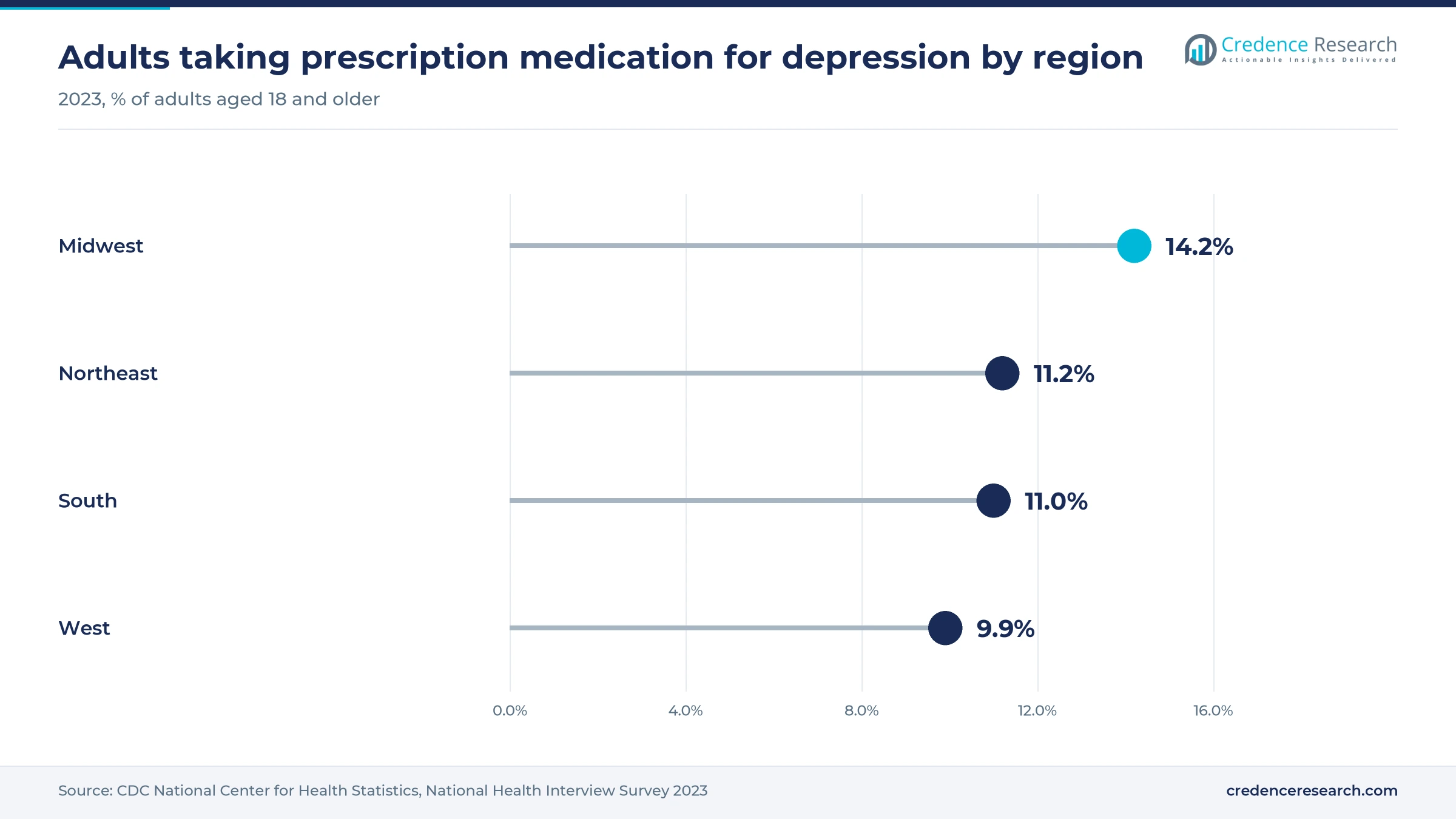
The South held 37.5% of 2025 value and grows at 5.3% a year, the fastest rate of the four regions. The Census Bureau counted 133.8 million residents in July 2025, after 6.0% growth since April 2020, nearly twice the national pace. Medication use for depression in the South, at 11.0% of adults in 2023, sits close to the national rate. Maternal need is also high, since Mississippi had the highest rate of postpartum depressive symptoms, 23.5%, among the CDC study sites. Population growth, not higher use rates, is what keeps the region ahead.
The West grows on population despite the lowest use rate
The West held 25.0% of 2025 value and grows at 5.0% a year, second only to the South. The region has the lowest medication use for depression, at 9.9% of adults in 2023, consistent with the national pattern in which large central cities report lower use, 9.5%, than nonmetropolitan areas at 13.5%. The population of the West grew 1.9% between 2020 and 2025, below the South. Brands that rely on telehealth prescribers and mail-order delivery fit the large metropolitan markets of California, Washington and Arizona.
The Midwest has the highest rate of treatment
The Midwest held 19.5% of 2025 value and grows at 4.5% a year. The region has the highest medication use for depression in the country, at 14.2% of adults in 2023, which supports steady refill volume. Its population grew only 1.1% between 2020 and 2025, so new patients come mainly from higher treatment rates rather than from population. Illinois recorded the lowest postpartum depressive symptom rate among the CDC study sites, at 9.7%, which shows how much need varies within the region.
The Northeast grows slowest from an older base
The Northeast held 18.0% of 2025 value and grows at 4.4% a year, the slowest of the four regions. Medication use for depression stood at 11.2% of adults in 2023, while the population grew just 0.7% between 2020 and 2025. The older population grew 14.6% over the same period, which supports geriatric and long-term care demand. Dense academic medical centers make the region an early adopter of esketamine and other clinic-based therapies, which partly offsets its slow population growth.
Acquisitions and approvals reshaped supply in 2025 and 2026
| Development | Status and market relevance |
|---|---|
| In April 2025, Johnson & Johnson completed its acquisition of Intra-Cellular Therapies, adding Caplyta to its neuroscience portfolio. | Completed; combined with Spravato, it gives one company two branded second-line depression options. |
| In July 2025, Supernus Pharmaceuticals completed its acquisition of Sage Therapeutics, taking over Zurzuvae for postpartum depression. | Completed; moves the only oral postpartum depression drug to a neuropsychiatry-focused company. |
| In December 2025, Aytu BioPharma made Exxua (gepirone) commercially available in the United States. | Launched; adds a 5-HT1A agonist positioned on tolerability to the branded oral segment. |
| In April 2026, the FDA approved Auvelity for agitation associated with Alzheimer's dementia. | Approved; extends an antidepressant combination into geriatric and long-term care settings. |
| In May 2026, the Department of Health and Human Services launched an action plan on psychiatric overprescribing. | In progress; adds deprescribing guidance and payment routes that may slow new SSRI starts. |
Oral pills dominate as nasal and patch routes stay niche
- Oral tablets and capsules carry almost all prescriptions, from generic SSRIs to the Auvelity combination of dextromethorphan and bupropion and the short Zurzuvae course.
- Intranasal esketamine is self-administered in certified settings under a restricted program, which ties the product to clinic capacity rather than pharmacy shelves.
- Transdermal selegiline delivers an MAO inhibitor through the skin as the Emsam patch, introduced by Bristol-Myers Squibb and Somerset Pharmaceuticals in 2006, and remains a niche option.
- Neuromodulation devices such as TMS and home tDCS compete with drugs rather than deliver them, and their recent clearances are the main substitute risk.
Need a Custom Version of This Report?
Tailor the scope, geography, or segments to your exact requirements.
- Custom geography or segment scope
- Direct access to our analyst team
Generic makers hold volume while originators hold brands
Competition splits along the treatment ladder, and each rung has different rules. In first-line care, many generic manufacturers supply sertraline, escitalopram, fluoxetine, duloxetine and bupropion, and they compete on price, supply reliability and pharmacy contracts rather than on brand. In second-line care, a small group of originators competes for the same resistant patients with different mechanisms. Johnson & Johnson holds esketamine and lumateperone, AbbVie and Otsuka market atypical antipsychotics with adjunctive depression labels, and Axsome sells Auvelity. Takeda now promotes Trintellix on its own in the United States ahead of generic entry. Smaller firms such as Supernus and Aytu compete in narrower niches, postpartum depression and tolerability-led prescribing. Companies win by securing formulary access with commercial plans and Medicare Part D, building psychiatry sales reach, and supporting certified treatment sites where clinic dosing is required.
Where do margins sit between generic makers and brand owners?
Supply is split between a crowded generic tier and a concentrated branded tier. Generic and biosimilar medicines filled about 90% of U.S. prescriptions in 2024 but took roughly one-eighth of drug spending, according to the Association for Accessible Medicines report of Sept. 3, 2025. Generic antidepressants follow that pattern, with many makers and little pricing power, and pharmacy benefit managers capture much of the spread. In the branded tier each novel mechanism has a single owner, and entry needs clinical trials, restricted-program certification and a psychiatry sales force. Margins therefore sit with originators until their patents expire and generics arrive.
Companies profiled and their roles in this market
| Company | Type | Role in the market |
|---|---|---|
| Johnson & Johnson | Originator | Spravato (esketamine) nasal spray, approved as monotherapy in January 2025; Caplyta adjunctive label from November 2025 |
| Takeda Pharmaceutical | Originator | Sole U.S. promotion of Trintellix (vortioxetine) since January 2025, ahead of patent expiry at the end of 2026 |
| Otsuka Pharmaceutical | Originator | Rexulti (brexpiprazole), approved with Lundbeck as adjunctive treatment for adults with major depressive disorder in July 2015 |
| Axsome Therapeutics | Originator | Auvelity (dextromethorphan and bupropion), about 209,000 prescriptions in the third quarter of 2025; Alzheimer's agitation label from April 2026 |
| AbbVie | Originator | Vraylar (cariprazine), adjunctive depression label since December 2022; Medicare negotiated price from 2027 |
| Supernus Pharmaceuticals | Specialty neuropsychiatry company | Owns Zurzuvae (zuranolone) for postpartum depression after acquiring Sage Therapeutics in July 2025 |
| Aytu BioPharma | Specialty commercial company | U.S. commercial rights to Exxua (gepirone), commercially available since December 2025 |
Second-line therapy will decide where value accrues
Credence Research's view is that the United States antidepressant drugs market will be decided by second-line therapy rather than by the number of people taking a daily pill. Generic SSRIs and SNRIs will keep most prescriptions, but their value grows slowly and faces new federal scrutiny. Growth comes from patients who fail first-line drugs, where esketamine, adjunctive antipsychotics and newer oral brands compete. Suppliers should watch three signals, namely payer coverage of novel brands, the pace of generic vortioxetine uptake after 2026, and whether deprescribing guidance actually lowers new SSRI starts.
Survey prevalence and dispensing data anchor the estimates
The report uses 2025 as the base year and forecasts to 2035. Market values come from the Credence Research model, built from treated-patient estimates based on SAMHSA and CDC surveys, therapy mix and list and retail prices, and checked against company disclosures of prescription volumes. Regional, product, disease, age and channel splits are Credence Research estimates from these inputs. Sources include SAMHSA and NCHS publications, Census Bureau estimates, FDA approval coverage in medical trade press, company releases and SEC filings, Medicare negotiation results and pharmacy price guides. Credence Research conducted no interviews or surveys for this edition.
Novel therapies gain value share through 2035
By 2035 the United States antidepressant drugs market reaches USD 11.02 billion, and its mix changes more than its patient count. Generic SSRIs remain the treatment most patients take, but novel and adjunctive therapies are likely to overtake them in value before the end of the forecast period. Clinic-based esketamine care expands with certified sites, and short-course postpartum therapy becomes a standard option after screening. Generic vortioxetine and Medicare negotiation lower branded prices from 2027, while the South keeps the largest share as its population continues to grow faster than the rest of the country.
What separates the downside and upside cases to 2035?
The range of outcomes depends on two policy questions rather than on prevalence. The first is whether federal deprescribing guidance actually cuts new SSRI starts and long refills, or mainly changes how often regimens are reviewed. The second is how widely commercial plans and Medicare cover novel brands once generic vortioxetine and negotiated prices reset the price benchmark. Tight coverage combined with real deprescribing produces the downside, while broad coverage of second-line care produces the upside.
| Scenario | CAGR, 2026–2035 | Value, 2035 | What has to hold |
|---|---|---|---|
| Downside | 3.5% | USD 9.68 billion | Deprescribing lowers new SSRI starts while payers restrict novel brands to patients who failed several drugs |
| Base | 4.95% | USD 11.02 billion | Generic volume grows slowly and novel therapies gain coverage at the pace seen in 2025 |
| Upside | 6.5% | USD 12.52 billion | Payers cover esketamine, adjuncts and newer oral brands earlier, and postpartum screening converts into treatment |
Frequently Asked Questions
How big is the United States antidepressant drugs market?
Which product type leads the market?
Which product type grows fastest?
Which region leads and which grows fastest?
How many adults in the United States have major depression?
What changed for esketamine in 2025?
How will patent expiry affect the market?
Which companies compete in the market?
Table of Content
Chapter 1 Market Segmentation
- 1.1 Segmentation Framework
- 1.1.1 Product and Service Classification
- 1.1.2 Application and End-Use Classification
- 1.1.3 Technology and Solution Classification
- 1.1.4 Customer and Distribution Channel Classification
- 1.1.5 Geographic Segmentation
- 1.1.6 Market Segment Definitions and Boundaries
- 1.2 By Product Type
- 1.2.1 Selective Serotonin Reuptake Inhibitors
- 1.2.2 Serotonin–Norepinephrine Reuptake Inhibitors
- 1.2.3 Other Monoaminergic Antidepressants
- 1.2.4 Novel and Adjunctive Depression Therapies
- 1.3 By Disease Area
- 1.3.1 Major Depressive Disorder
- 1.3.2 Anxiety and Related Disorders
- 1.3.3 Persistent Depressive Disorder
- 1.3.4 Postpartum Depression
- 1.3.5 Nonpsychiatric Antidepressant Applications
- 1.4 By End User
- 1.4.1 Patients Below 18 Years
- 1.4.2 Patients Aged 18–64 Years
- 1.4.3 Patients Aged 65 Years and Older
Chapter 2 Introduction
- 2.1 Report Objectives and Scope
- 2.2 Product Definition and Industry Terminology
- 2.3 Market Inclusions and Exclusions
- 2.4 Research Process
- 2.4.1 Primary Research and Expert Interviews
- 2.4.2 Secondary Research and Source Review
- 2.4.3 Top-Down and Bottom-Up Estimation
- 2.4.4 Data Triangulation and Verification
- 2.5 Market Size Measurement Basis
- 2.5.1 2025: USD 6.78 billion → 2035: USD 11.02 billion
- 2.6 Historical and Forecast Reference Periods
- 2.6.1 Historical Period: 2018-2025
- 2.6.2 Base Year: 2025
- 2.6.3 Forecast Period: 2025-2035
- 2.7 Research Assumptions and Limitations
Chapter 3 Executive Summary
- 3.1 Market Snapshot and Key Findings
- 3.2 Base-Year Market Size, 2025
- 3.3 Forecast Market Size, 2035
- 3.4 Revenue and Volume Growth Outlook
- 3.5 Key Demand and Supply Indicators
- 3.6 Leading Market Segments
- 3.7 Fastest-Growing Market Opportunities
- 3.8 Regional Performance Highlights
- 3.9 Technology and Industry Transformation
- 3.10 Competitive Landscape Summary
- 3.11 Analyst View and Strategic Implications
Chapter 4 United States Antidepressant Drugs Market Trends and Developments
- 4.1 Historical Industry Development, 2018-2025
- 4.2 Recent Market Trends and Developments
- 4.3 Demand and Customer Behavior Trends
- 4.4 Technology and Product Innovation
- 4.5 Artificial Intelligence, Automation and Digitalization
- 4.6 Local Manufacturing and Supply Chain Realignment
- 4.7 Industry Partnerships, Mergers and Acquisitions
- 4.8 Sustainability and Circular Economy Developments
- 4.9 Government and Private Sector Investment Trends
- 4.10 Emerging Business Models and Commercialization
- 4.11 Industry Developments and Announcements
Chapter 5 United States Antidepressant Drugs Market Production, Supply and Demand Analysis
- 5.1 Demand Trend and Consumption Analysis, 2018-2025
- 5.2 Demand Forecast, 2025-2035
- 5.3 Production and Output Trend, 2018-2025
- 5.4 Production and Output Forecast, 2025-2035
- 5.5 Installed Capacity and Capacity Utilization
- 5.6 Company-Wise Production Plants and Statistics
- 5.6.1 Installed Production Capacity
- 5.6.2 Actual Production
- 5.6.3 Planned Capacity and Expansion Targets
- 5.7 Supply Chain Structure and Procurement Trends
- 5.8 Supply-Demand Gap and Bottlenecks
- 5.9 Import Dependence and Sourcing Structure
- 5.10 Contract Manufacturing and Outsourcing
- 5.11 Regional Supply and Demand Concentration
Chapter 6 United States Antidepressant Drugs Market Pricing Analysis
- 6.1 Pricing Structure and Measurement
- 6.2 Historical Pricing Trends, 2018-2025
- 6.3 Pricing Outlook, 2025-2035
- 6.4 Average Selling Price and Unit Economics
- 6.5 Pricing by Product and Market Segment
- 6.6 Geographic Pricing Differences
- 6.7 Key Input, Energy, Labor and Logistics Costs
- 6.8 Contract Pricing and Purchasing Models
- 6.9 Pricing Sensitivity and Competitive Positioning
- 6.10 Price, Margin and Profitability Implications
Chapter 7 United States Antidepressant Drugs Market Dynamics
- 7.1 Market Growth Drivers
- 7.1.1 Demand-Side Drivers
- 7.1.2 Technology and Innovation Drivers
- 7.1.3 Infrastructure and Investment Drivers
- 7.1.4 Regulatory and Policy Drivers
- 7.2 Market Restraints
- 7.2.1 Cost and Affordability Constraints
- 7.2.2 Technology and Adoption Barriers
- 7.2.3 Supply Chain and Operational Constraints
- 7.3 Market Challenges
- 7.3.1 Competitive Pressure and Margin Erosion
- 7.3.2 Skills, Infrastructure and Implementation Gaps
- 7.4 Emerging Market Opportunities
- 7.5 Market Dynamics Impact and Time-Horizon Assessment
Chapter 8 United States Antidepressant Drugs Value Chain Analysis
- 8.1 Industry Value Chain Overview
- 8.2 Upstream Suppliers and Critical Inputs
- 8.3 Technology and Component Providers
- 8.4 Manufacturing or Service Delivery
- 8.5 Distribution, Channel Partners and Integrators
- 8.6 Downstream Applications and End Users
- 8.7 Value Addition and Profit Pools
- 8.8 Vertical Integration and Outsourcing
- 8.9 Supplier Concentration and Risk
- 8.10 Supply Chain Localization and Resilience
Chapter 9 United States Antidepressant Drugs Market Regulations and Policies
- 9.1 Relevant Laws, Standards and Compliance Frameworks
- 9.2 Product, Service, Safety and Quality Requirements
- 9.3 Government Policies, Incentives and Subsidies
- 9.4 Imports, Exports and Trade Barriers
- 9.5 Public Procurement and Local Content Requirements
- 9.6 Environmental and Sustainability Compliance
- 9.7 Upcoming Policy Changes and Market Implications
Chapter 10 United States Antidepressant Drugs Market Hotspots and Opportunities
- 10.1 Market Opportunity Mapping and Growth Hotspots
- 10.2 High-Growth Applications and Customer Groups
- 10.3 Underserved Markets and White-Space Opportunities
- 10.4 Emerging Technology and Product Opportunities
- 10.5 New Capacity and Investment Hotspots
- 10.6 Market Entry and Expansion Opportunities
- 10.7 Distribution and Partnership Opportunities
- 10.8 Near-Term and Long-Term Commercial Potential
- 10.9 Opportunity Attractiveness and Execution Risks
Chapter 11 United States Antidepressant Drugs Market Outlook, 2025-2035
- 11.1 Market Size and Analysis
- 11.1.1 Revenue (Market Measurement: 2025: USD 6.78 billion → 2035: USD 11.02 billion)
- 11.1.2 Market Volume and Quantity Sold
- 11.1.3 Historical Market Size, 2018-2025
- 11.1.4 Base-Year Market Size, 2025
- 11.2 Market Forecast, 2025-2035
- 11.2.1 Revenue Forecast to 2035
- 11.2.2 Volume Forecast to 2035
- 11.2.3 CAGR and Year-on-Year Growth
- 11.2.4 Incremental Revenue Opportunity
- 11.3 Forecast Assumptions and Scenario Analysis
- 11.3.1 Base-Case Forecast
- 11.3.2 Optimistic and Conservative Scenarios
- 11.3.3 Technology, Pricing and Policy Sensitivities
- 11.4 Market Attractiveness and Growth Outlook
Chapter 12 United States Antidepressant Drugs Market Segmentation and Outlook
- 12.1 Segmentation Summary and Market Shares, 2025
- 12.2 Largest and Fastest-Growing Segments
- 12.3 By Product Type - Market Size and Forecast, 2025-2035
- 12.3.1 Segment Definition and Scope
- 12.3.2 Historical Market Size, 2018-2025
- 12.3.3 Revenue Forecast, 2025-2035
- 12.3.4 Volume Forecast, 2025-2035
- 12.3.5 Base-Year Market Share, 2025
- 12.3.6 Segment CAGR and Growth Drivers
- 12.3.7 Subsegment Market Size and Forecast
- 12.3.7.1 Selective Serotonin Reuptake Inhibitors
- 12.3.7.2 Serotonin–Norepinephrine Reuptake Inhibitors
- 12.3.7.3 Other Monoaminergic Antidepressants
- 12.3.7.4 Novel and Adjunctive Depression Therapies
- 12.3.8 Subsegment Pricing and Adoption Trends
- 12.3.9 Leading Suppliers and Competition
- 12.3.10 Regional Demand and Opportunities
- 12.4 By Disease Area - Market Size and Forecast, 2025-2035
- 12.4.1 Segment Definition and Scope
- 12.4.2 Historical Market Size, 2018-2025
- 12.4.3 Revenue Forecast, 2025-2035
- 12.4.4 Volume Forecast, 2025-2035
- 12.4.5 Base-Year Market Share, 2025
- 12.4.6 Segment CAGR and Growth Drivers
- 12.4.7 Subsegment Market Size and Forecast
- 12.4.7.1 Major Depressive Disorder
- 12.4.7.2 Anxiety and Related Disorders
- 12.4.7.3 Persistent Depressive Disorder
- 12.4.7.4 Postpartum Depression
- 12.4.7.5 Nonpsychiatric Antidepressant Applications
- 12.4.8 Subsegment Pricing and Adoption Trends
- 12.4.9 Leading Suppliers and Competition
- 12.4.10 Regional Demand and Opportunities
- 12.5 By End User - Market Size and Forecast, 2025-2035
- 12.5.1 Segment Definition and Scope
- 12.5.2 Historical Market Size, 2018-2025
- 12.5.3 Revenue Forecast, 2025-2035
- 12.5.4 Volume Forecast, 2025-2035
- 12.5.5 Base-Year Market Share, 2025
- 12.5.6 Segment CAGR and Growth Drivers
- 12.5.7 Subsegment Market Size and Forecast
- 12.5.7.1 Patients Below 18 Years
- 12.5.7.2 Patients Aged 18–64 Years
- 12.5.7.3 Patients Aged 65 Years and Older
- 12.5.8 Subsegment Pricing and Adoption Trends
- 12.5.9 Leading Suppliers and Competition
- 12.5.10 Regional Demand and Opportunities
- 12.6 Segment Growth Comparison
- 12.7 Segment Attractiveness and Priority Matrix
Chapter 13 United States Antidepressant Drugs End-Use and Application Market Outlook
- 13.1 End-Use Industry and Customer Demand Structure
- 13.2 Leading Applications and Customer Groups
- 13.3 End-Use Market Size, Share and Forecast
- 13.4 Major End-Use Industry Deep Dives
- 13.4.1 Customer Requirements and Use Cases
- 13.4.2 Demand and Replacement Cycles
- 13.4.3 Technical and Regulatory Considerations
- 13.4.4 Purchasing and Procurement Models
- 13.4.5 Leading Vendors and Distribution Channels
- 13.4.6 Forecast and Commercial Opportunities
- 13.5 Emerging Applications and Cross-Segment Demand
- 13.6 End-Use Industry Investment Priorities
Chapter 14 United States Antidepressant Drugs Geographic Market Outlook, 2025-2035
- 14.1 Domestic Market Distribution and Demand Clusters
- 14.2 State- or Province-Wise Market Size and Forecast, 2025-2035
- 14.3 City and Metropolitan Market Outlook
- 14.4 Industrial, Manufacturing and Commercial Clusters
- 14.5 Geographic Concentration of Key End Users
- 14.6 Local Pricing and Purchasing Differences
- 14.7 Domestic Production Facilities and Capacity Map
- 14.8 Local Infrastructure and Project Pipeline
- 14.9 State-Level Policy and Incentive Differences
- 14.10 Subnational Investment Hotspots and Opportunities
- 14.11 Distribution and Logistics Networks
- 14.12 Domestic Competitive Footprint
Chapter 15 United States Antidepressant Drugs Technology, Innovation and Sustainability Outlook
- 15.1 Technology Landscape and Maturity
- 15.2 Product, Process and Service Innovation
- 15.3 AI, Automation and Digital Tools in the Industry
- 15.4 Technology Adoption and Performance Benchmarking
- 15.5 Innovation Pipeline and R&D Investment
- 15.6 Patent and Intellectual Property Trends
- 15.7 Energy Efficiency and Resource Management
- 15.8 Sustainability, Recycling and Circularity
- 15.9 Technology Roadmap, 2025-2035
- 15.10 Risks of Obsolescence and Technology Substitution
Chapter 16 United States Antidepressant Drugs Market Key Strategic Imperatives
- 16.1 Growth and Market Entry Priorities
- 16.2 High-Return Products and Segments
- 16.3 Pricing, Profitability and Cost Optimization
- 16.4 Technology Investment and Product Differentiation
- 16.5 Supply Chain Localization and Resilience
- 16.6 Distribution and Customer Acquisition
- 16.7 Partnership, Acquisition and Capacity Strategy
- 16.8 Regional Expansion Priorities
- 16.9 Short-, Medium- and Long-Term Actions
Chapter 17 Competition Outlook
- 17.1 Industry Competition Characteristics
- 17.2 Market Structure and Concentration
- 17.3 Market Share and Competitive Positioning, 2025
- 17.4 Company-Wise Revenue and Product Benchmarking
- 17.5 Production and Service Capacity Benchmarking
- 17.6 Technology, Pricing and Differentiation
- 17.7 Regional Footprint and Distribution Strength
- 17.8 Mergers, Acquisitions and Strategic Alliances
- 17.9 New Entrants and Competitive Threats
- 17.10 Porter's Five Forces and Industry Attractiveness
- 17.11 Competitive Outlook, 2025-2035
Chapter 18 Company Profiles
- 18.1 Company Coverage and Selection Criteria
- 18.2 Johnson & Johnson
- 18.2.1 Business Description
- 18.2.2 Company Ownership and Geographic Presence
- 18.2.3 Product and Service Portfolio
- 18.2.4 Manufacturing and Operating Footprint
- 18.2.5 Production Capacity and Expansion Plans
- 18.2.6 Financial Performance and Investment
- 18.2.7 Market Share and Competitive Position
- 18.2.8 Technology and Innovation Capabilities
- 18.2.9 Strategic Alliances or Partnerships
- 18.2.10 Recent Developments
- 18.2.11 Growth Strategy and Outlook
- 18.3 Takeda Pharmaceutical
- 18.4 Otsuka Pharmaceutical
- 18.5 Axsome Therapeutics
- 18.6 AbbVie
- 18.7 Supernus Pharmaceuticals
- 18.8 Aytu BioPharma
- 18.9 Other Relevant Market Participants
Note: Every listed company is profiled on the structure shown under the first company. The company list is preliminary and may change based on research findings, market developments, data availability and client requirements.
Chapter 19 Disclaimer
- 19.1 Research and Forecast Disclaimer
- 19.2 Data Source and Estimation Limitations
Note: The depth of individual sections depends on data availability for this market. Volume, capacity, trade and other unit-based metrics are included where applicable.