
Market Overview:
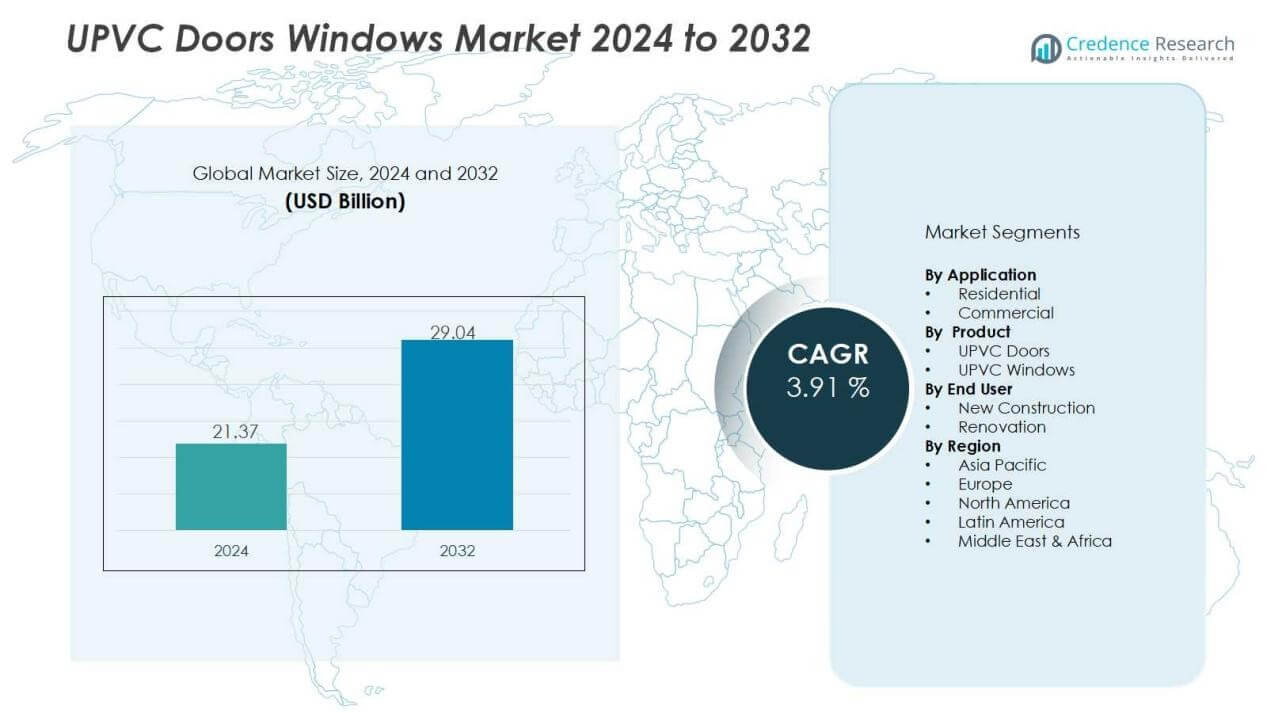
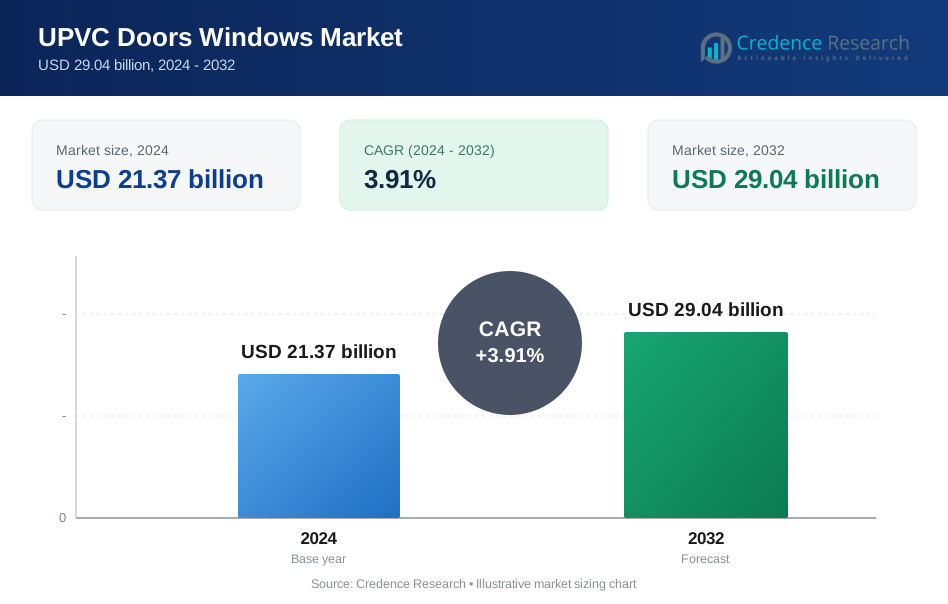
The upvc doors windows market size was valued at USD 21.37 billion in 2024 and is anticipated to reach USD 29.04 billion by 2032, at a CAGR of 3.91 % during the forecast period (2024-2032).
| REPORT ATTRIBUTE | DETAILS |
|---|---|
| Historical Period | 2020-2023 |
| Base Year | 2024 |
| Forecast Period | 2025-2032 |
| UPVC Doors Windows Market Size 2024 | USD 21.37 Billion |
| UPVC Doors Windows Market, CAGR | 3.91% |
| UPVC Doors Windows Market Size 2032 | USD 29.04 Billion |
Several factors drive the market’s expansion. The demand for energy-efficient housing solutions, coupled with rising urbanization and disposable incomes, boosts adoption. UPVC products offer advantages such as weather resistance, low maintenance, thermal insulation, and cost savings compared to traditional materials. Growing awareness of green building standards and rapid infrastructure development across developing regions also support market penetration. Additionally, technological advancements in product design and manufacturing are enabling customized solutions that cater to both aesthetic appeal and functional performance.
Regionally, Asia-Pacific dominates the UPVC doors and windows market due to large-scale construction activities, rapid urbanization, and government housing initiatives. Europe follows closely, driven by stringent energy-efficiency regulations and demand for sustainable materials. North America maintains a strong market presence, supported by renovation projects and adoption of energy-saving construction solutions. Emerging markets in the Middle East, Latin America, and Africa are also presenting opportunities as infrastructure investments rise and modern housing demand increases.
Market Insights:
- The UPVC doors windows market size was USD 21.37 billion in 2024 and is expected to reach USD 29.04 billion by 2032 at a CAGR of 3.91%.
- Rising demand for energy-efficient and sustainable building materials drives market adoption, supported by government regulations and consumer preference for insulation benefits.
- Expanding urbanization and residential construction growth in emerging economies creates strong opportunities, supported by government housing schemes and private investments.
- Superior performance features such as weather resistance, thermal insulation, and soundproofing enhance comfort while lowering maintenance costs compared to wood and aluminum.
- Technological advancements enable greater customization in designs, colors, and finishes, meeting consumer expectations for aesthetics and functionality.
- Challenges arise from fluctuating raw material prices, environmental concerns, and strong competition from aluminum and wooden alternatives.
- Asia-Pacific leads with 45% market share due to urbanization and housing initiatives, followed by Europe with 28% and North America with 19% driven by renovation and modernization projects.
Market Drivers:
Rising Demand for Energy-Efficient and Sustainable Building Materials:
The UPVC doors windows market is driven by the growing preference for energy-efficient construction solutions. Consumers and developers increasingly adopt UPVC products for their insulation properties, which help reduce energy consumption in heating and cooling. Governments worldwide promote sustainable construction through strict regulations and incentives. This shift strengthens the demand for UPVC doors and windows as a preferred alternative to traditional materials.
- For instance, Kömmerling's 76 MD uPVC window system features a six-chamber profile delivering U-values as low as 0.76 W/m²K, achieving passive house energy efficiency standards and significantly reducing heating and cooling needs in residential buildings.
Expanding Urbanization and Residential Construction Growth:
Rapid urbanization and housing development projects play a central role in expanding the UPVC doors windows market. Growing populations in emerging economies drive the need for affordable, durable, and low-maintenance housing materials. UPVC products meet these requirements, making them a popular choice in both new construction and replacement segments. The market benefits from government housing schemes and private investments supporting urban infrastructure.
- For Instance, The VEKA Softline 82 profile features an innovative multi-chamber design, with seven chambers in the frame and six in the sash, achieving excellent thermal insulation.
Superior Performance Features and Cost Advantages:
The UPVC doors windows market benefits from the material’s unique performance features, including weather resistance, thermal insulation, and soundproofing. These properties enhance living comfort and reduce maintenance costs compared to wood or aluminum alternatives. It also supports cost efficiency by offering a longer lifespan with minimal upkeep. These advantages drive adoption across residential, commercial, and industrial applications.
Technological Advancements and Customization Trends:
Innovation in design and manufacturing contributes significantly to the growth of the UPVC doors windows market. Advanced fabrication techniques allow greater customization, offering products in various styles, colors, and finishes. Consumers seek modern, aesthetically appealing solutions that do not compromise on durability or energy performance. This trend supports product differentiation and expands the market’s reach to diverse customer segments.
Market Trends:
Growing Focus on Smart Homes, Sustainability, and Aesthetic Appeal:
The UPVC doors windows market is witnessing strong momentum from the global shift toward smart and sustainable living. Rising adoption of energy-efficient materials aligns with green building certifications and stricter energy codes. Smart home integration is expanding, with UPVC doors and windows designed to support advanced locking systems and IoT-enabled features. Aesthetic preferences also influence demand, as consumers seek modern designs, customizable finishes, and color options. It benefits from this trend by offering versatile solutions that combine performance with style. The alignment of durability, cost efficiency, and modern design preferences ensures continued demand in both residential and commercial sectors.
- For Instance, Aluplast's Ideal 7000 profile demonstrated a water-tightness class 9A under EN 12208 standards.
Expansion of Renovation Activities and Emerging Market Adoption:
The UPVC doors windows market is gaining traction from renovation and retrofit projects across mature economies such as Europe and North America. Aging building stock fuels replacement demand, while growing awareness of thermal insulation benefits supports wider acceptance. In emerging markets, rapid urbanization and rising disposable incomes accelerate adoption in new residential and commercial construction. Manufacturers respond with tailored solutions suited to diverse climate conditions and architectural requirements. It also benefits from rising government housing initiatives in Asia-Pacific and the Middle East, which support affordable yet durable building materials. The dual push from replacement demand in mature markets and new installations in developing regions shapes a balanced growth outlook.
- For instance, REHAU, a leading uPVC window and door system manufacturer in North America, reports its window systems deliver up to 35% better energy performance than typical residential windows, with thermal performance reaching U-values as low as 0.13 Btu/hrft²°F, greatly supporting energy-efficient renovation projects.
Market Challenges Analysis:
Fluctuating Raw Material Prices and Environmental Concerns:
The UPVC doors windows market faces challenges from fluctuations in raw material prices, particularly PVC resins derived from petrochemicals. Volatile crude oil costs directly impact production expenses and profit margins. Environmental concerns regarding plastic waste and recycling limitations also create pressure on manufacturers to adopt sustainable practices. It struggles to balance cost efficiency with regulatory compliance and rising demand for eco-friendly materials. Companies must invest in green alternatives and improved recycling processes to maintain competitiveness. These issues limit market expansion in regions with strict sustainability mandates.
Intense Competition and Low Consumer Awareness in Emerging Markets:
The UPVC doors windows market also contends with intense competition from aluminum and wooden alternatives, which retain strong customer loyalty in some regions. Local manufacturers often compete aggressively on price, leading to margin pressures for established players. Consumer awareness in emerging markets remains low, with misconceptions about durability and design flexibility slowing adoption. It requires continuous marketing efforts and educational campaigns to highlight long-term benefits. Regulatory differences across countries add complexity, creating barriers for global brands. These challenges slow market penetration in less mature economies despite growing demand potential.
Market Opportunities:
Rising Demand for Green Buildings and Energy-Efficient Solutions:
The UPVC doors windows market holds strong opportunities in the global push toward sustainable construction. Governments and regulatory bodies enforce stricter building codes, creating demand for energy-efficient and recyclable materials. Consumers prioritize eco-friendly housing, opening space for UPVC products that offer insulation, durability, and low maintenance. It benefits from alignment with green building certifications, which enhance adoption in both residential and commercial projects. The growing focus on net-zero energy buildings further drives investments in advanced UPVC solutions. These factors strengthen long-term growth opportunities across developed and emerging economies.
Expansion in Emerging Markets and Smart Home Integration:
The UPVC doors windows market can capitalize on rapid urbanization and rising disposable incomes in Asia-Pacific, the Middle East, and Africa. Affordable housing projects and large-scale infrastructure investments create steady demand for cost-effective building materials. It also benefits from integration with smart home systems, offering advanced locking mechanisms and IoT-enabled features. Customization in colors, finishes, and designs further appeals to consumers seeking modern aesthetics. Renovation and replacement demand in Europe and North America add another layer of opportunity. Together, these drivers expand the market’s reach across diverse consumer and regional segments.
Market Segmentation Analysis:
By Product:
The UPVC doors windows market is segmented into doors and windows, with windows holding a larger share due to their wide use in both residential and commercial projects. Windows offer strong insulation, soundproofing, and durability, making them essential in energy-efficient building designs. Doors are also gaining traction in modern housing projects because of their strength, weather resistance, and low maintenance requirements. It benefits from the increasing demand for stylish yet functional designs in both segments.
- For instance, REHAU Group, a leading manufacturer, produces uPVC window systems known for industry-leading energy efficiency and durability, with over 20,000 employees worldwide and presence in 50+ countries, reflecting strong global adoption (REHAU's windows combine proprietary uPVC formulations and low-e glazing technologies).
By Application:
The market is divided into residential and commercial applications, with the residential sector leading adoption. Urbanization, housing projects, and demand for cost-effective building solutions drive residential growth. The commercial segment, including offices, educational institutions, and retail, is also expanding with the rising need for durable and low-maintenance structures. It gains demand from government-backed housing schemes and infrastructure investments.
- For instance, Holcim successfully trialled a battery-diesel hybrid mobile concrete batching plant in South West Queensland that produced 49 cubic meters of concrete in a single day using only 15 liters of diesel during the trial in October 2023.
By End User:
End users in the market include new construction and renovation projects. New construction dominates due to strong activity in emerging economies supported by urban growth and housing demand. Renovation projects contribute significantly in mature markets like Europe and North America, where aging building stock fuels replacement. It sees opportunity in both areas as consumers seek energy efficiency, design flexibility, and long-lasting materials.
Segmentations:
By Product:
- UPVC Doors
- UPVC Windows
By Application:
- Residential
- Commercial
By End User:
- New Construction
- Renovation
By Region:
- North America
- U.S.
- Canada
- Mexico
- Europe
- UK
- France
- Germany
- Italy
- Spain
- Russia
- Rest of Europe
- Asia Pacific
- China
- Japan
- South Korea
- India
- Australia
- Southeast Asia
- Rest of Asia Pacific
- Latin America
- Brazil
- Argentina
- Rest of Latin America
- Middle East
- GCC Countries
- Israel
- Turkey
- Rest of Middle East
- Africa
- South Africa
- Egypt
- Rest of Africa
Regional Analysis:
Asia-Pacific:
Asia-Pacific holds 45% market share in the UPVC doors windows market and continues to expand steadily. The region benefits from rapid urbanization, large-scale residential projects, and supportive government housing initiatives. China and India lead demand, supported by population growth, infrastructure investment, and rising middle-class incomes. It gains strength from the need for affordable, durable, and energy-efficient building materials. Southeast Asia also emerges as a promising hub due to expanding real estate and industrial construction. Growing adoption in commercial and institutional buildings further supports regional momentum. This strong demand solidifies Asia-Pacific as the most dominant market worldwide.
Europe:
Europe accounts for 28% market share in the UPVC doors windows market with steady demand driven by energy-efficiency regulations. The region focuses on green building standards and strict insulation codes that encourage replacement of traditional materials. Germany, France, and the UK remain primary contributors, supported by renovation activities in aging housing stock. It benefits from government incentives promoting sustainable construction practices. Consumers in Europe prefer UPVC products for thermal insulation, low maintenance, and durability. Eastern Europe also shows rising adoption as new housing and commercial projects expand. These trends secure Europe’s position as a strong growth contributor.
North America:
North America holds 19% market share in the UPVC doors windows market and continues to grow steadily. The region benefits from high demand for renovation and modernization of residential and commercial spaces. The United States leads adoption, supported by strong awareness of energy conservation and home improvement spending. It also gains momentum from integration with smart home technologies and advanced product designs. Canada contributes with demand for insulated, weather-resistant solutions suitable for colder climates. Mexico supports growth through urban housing projects and expanding middle-class demand. These combined factors reinforce North America’s steady role in the global market landscape.
Key Player Analysis:
Competitive Analysis:
The UPVC doors windows market is highly competitive, with global and regional players focusing on innovation and market expansion. Key companies compete on product quality, design flexibility, durability, and energy efficiency to capture customer preference. Large multinational brands leverage advanced manufacturing technologies and strong distribution networks to strengthen their market presence. Regional players emphasize cost competitiveness and local customization to secure demand in emerging economies. It faces pressure from alternative materials such as aluminum and wood, making differentiation essential for growth. Companies are investing in sustainable solutions, recycling initiatives, and smart home integration to meet evolving consumer expectations. Strategic collaborations with real estate developers and infrastructure projects also help strengthen positioning. This dynamic environment drives continuous innovation and intensifies competition across diverse market segments.
Recent Developments:
- In February 2025, Marauder Capital announced the acquisition of Mako Lift, expanding its portfolio in lift technologies.
- In March 2025, Simpson Strong-Tie introduced the Strong-Link Moment Connection for steel construction in wind-governed and low seismic areas, enhancing structural design capabilities.
Report Coverage:
The research report offers an in-depth analysis based on Product, Application, End User and Region. It details leading Market players, providing an overview of their business, product offerings, investments, revenue streams, and key applications. Additionally, the report includes insights into the competitive environment, SWOT analysis, current Market trends, as well as the primary drivers and constraints. Furthermore, it discusses various factors that have driven Market expansion in recent years. The report also explores Market dynamics, regulatory scenarios, and technological advancements that are shaping the industry. It assesses the impact of external factors and global economic changes on Market growth. Lastly, it provides strategic recommendations for new entrants and established companies to navigate the complexities of the Market.
Future Outlook:
- The UPVC doors windows market will see strong demand from sustainable construction practices and green building initiatives.
- It will expand through increasing adoption of energy-efficient housing materials across residential and commercial sectors.
- Manufacturers will focus on design innovation, offering customized finishes, colors, and smart integration features.
- Renovation and retrofit projects in developed regions will continue to drive steady replacement demand.
- Emerging markets in Asia-Pacific, the Middle East, and Africa will unlock growth with urban housing projects.
- The market will benefit from rising consumer awareness of insulation, durability, and low-maintenance advantages.
- It will face pressure to align with stricter environmental regulations and improve recyclability of materials.
- Collaborations and partnerships between manufacturers and real estate developers will support wider adoption.
- Smart home compatibility, including IoT-enabled locking systems, will shape product development strategies.
- The market will remain competitive, with global and regional players investing in capacity expansion and sustainable technologies.
Request a Free Sample
Fill in your details and we'll send you a free sample report.
- Sample data tables & charts
- Research methodology
Need a Custom Version of This Report?
Tailor the scope, geography, or segments to your exact requirements.
- Custom geography or segment scope
- Direct access to our analyst team
Frequently Asked Questions
What is the current market size for the UPVC Doors Windows Market, and what is its projected size in 2032?
At what Compound Annual Growth Rate is the UPVC Doors Windows Market projected to grow between 2024 and 2032?
Which UPVC Doors Windows Market segment held the largest share in 2024?
What are the primary factors fueling the growth of the UPVC Doors Windows Market?
Who are the leading companies in the UPVC Doors Windows Market?
Which region commanded the largest share of the UPVC Doors Windows Market in 2024?
Table of Content
Chapter 1. Report Introduction
- 1.1 Report Description & Purpose
- 1.1.1 Report Title & Market Definition
- 1.1.2 Unique Selling Propositions (USP) & Key Differentiators
- 1.1.3 Value Proposition for Stakeholders
- 1.2 Research Objectives
- 1.2.1 Market Sizing Objectives (Volume & Revenue)
- 1.2.2 Segmentation Objectives
- 1.2.3 Competitive Intelligence Objectives
- 1.2.4 Forecast & Scenario Objectives
- 1.3 Report Scope
- 1.3.1 UPVC Doors Windows Scope – Types & Subtypes Covered
- 1.3.2 Geographic Scope – Regions & Countries Covered
- 1.3.3 Historical Period, Base Year & Forecast Period (2024; forecast to 2032)
- 1.3.4 Inclusions & Exclusions
- 1.4 HS Code & Classification Framework
- 1.5 Currency, Units & Pricing Basis
- 1.6 Target Stakeholders
- 1.7 Limitations & Assumptions
Chapter 2. Executive Summary
- 2.1 Global UPVC Doors Windows Market Snapshot
- 2.1.1 Market Size – Historical (2024) & Forecast (2024-2032) (2024: USD 21.37 billion → 2032: USD 29.04 billion)
- 2.1.2 Volume & Revenue – Global Totals
- 2.1.3 Key Market Highlights – Top Five Facts
- 2.2 UPVC Doors Windows Market Segmentation Snapshot
- 2.2.1 Market Split by Region – 2024 vs. 2032
- 2.3 Competitive Snapshot
- 2.3.1 Top 10 Players by Revenue Share – 2024
- 2.3.2 Top 10 Players by Volume Share – 2024
- 2.3.3 Recent Strategic Developments (18-Month Summary)
- 2.4 Key Investment Highlights & Strategic Conclusions
Chapter 3. UPVC Doors Windows Market Dynamics & Industry Analysis
- 3.1 Market Overview & Context
- 3.1.1 UPVC Doors Windows Market Position in the Broader Automotive Value Chain
- 3.1.2 OEM vs. Replacement Market Dynamics
- 3.1.3 Market Maturity & Development Stage by Region
- 3.2 UPVC Doors Windows Market Drivers
- 3.3 UPVC Doors Windows Market Restraints & Challenges
- 3.4 UPVC Doors Windows Market Opportunities
- 3.5 Porter's Five Forces Analysis
- 3.5.1 Threat of New Entrants
- 3.5.2 Bargaining Power of Suppliers
- 3.5.3 Bargaining Power of Buyers
- 3.5.4 Threat of Substitutes
- 3.5.5 Competitive Rivalry – Intensity Assessment
- 3.6 UPVC Doors Windows Value Chain Analysis
- 3.6.1 Upstream – Raw Material/Input Suppliers
- 3.6.1.1 Raw Material/Input 1
- 3.6.1.2 Raw Material/Input 2
- 3.6.1.3 Raw Material/Input 3
- 3.6.2 Midstream – Production/Manufacturing/Service Delivery
- 3.6.2.1 Production/Process Overview
- 3.6.2.2 Key Facility Locations & Capacity by Manufacturer
- 3.6.3 Downstream – Distribution & End Consumer
- 3.6.3.1 Primary Channel – B2B/OEM
- 3.6.3.2 Secondary Channels – Dealer, Retail, Online, Direct
- 3.6.4 Value Chain Profitability Analysis
- 3.6.1 Upstream – Raw Material/Input Suppliers
- 3.7 PESTEL Analysis
- 3.7.1 Political Factors
- 3.7.2 Economic Factors
- 3.7.3 Social Factors
- 3.7.4 Technological Factors
- 3.7.5 Environmental Factors
- 3.7.6 Legal Factors
- 3.8 UPVC Doors Windows Supply Chain Analysis
- 3.8.1 Raw Material/Input Supply Risk Assessment
- 3.8.2 Manufacturing Concentration Risk (Geographic Exposure)
- 3.8.3 Trade Disruption Impact Analysis
- 3.9 Regulatory & Policy Landscape
Note: The regulatory and policy landscape section covers regulations based on their applicability to the market, UPVC Doors Windows category, geography, and scope of the study. Only regulatory frameworks with a material impact on operations, compliance, trade, sustainability, or market access are analyzed in detail.
Chapter 4. Key Investment Pockets & Opportunity Analysis
- 4.1 UPVC Doors Windows Market Attractiveness Analysis
- 4.1.1 By Region – Investment Attractiveness Matrix (Volume × CAGR)
- 4.2 Absolute Revenue Growth Opportunity
- 4.2.1 By Region – Absolute USD Growth Through 2032
- 4.3 Incremental Volume Opportunity
- 4.3.1 By Region – Incremental Volume Through 2032
- 4.3.2 Segment – Incremental Volume
- 4.4 Emerging Submarket Opportunity Deep Dive (Subject to Applicability)
- 4.5 Emerging Market Opportunity Scorecards
- 4.5.1 United States
- 4.5.2 Europe
- 4.5.3 Asia
- 4.5.4 Middle East & Africa
Note: Emerging Market Opportunity Scorecards will be included based on relevance and strategic importance. Regions listed are indicative and may vary depending on data availability and market dynamics.
Chapter 5. UPVC Doors Windows Import-Export Analysis & Trade Flows
- 5.1 Global Trade Overview
- 5.1.1 Global Export Value by Country (2024)
- 5.1.2 Global Export Volume by Country (2024)
- 5.1.3 Global Import Value by Country (2024)
- 5.1.4 Global Import Volume by Country (2024)
- 5.1.5 Net Trade Balance by Country (2024)
- 5.2 Export Analysis – Segment
- 5.2.1 Type 1 (HS Code)
- 5.2.2 Type 2 (HS Code)
- 5.2.3 Type 3 (HS Code)
- 5.2.4 Type 4 (HS Code)
- 5.2.5 Type 5 (HS Code)
- 5.3 Import Analysis – Segment
- 5.3.1 Type 1 (HS Code)
- 5.3.2 Type 2 (HS Code)
- 5.3.3 Type 3 (HS Code)
- 5.3.4 Type 4 (HS Code)
- 5.3.5 Type 5 (HS Code)
- 5.4 Average Unit Trade Prices
- 5.4.1 Average Export Price – Segment & Country
- 5.4.2 Average Import Price – Segment & Source Country
- 5.4.3 Price Trends (2024)
- 5.5 Key Trade Route Analysis
- 5.5.1 Trade Route 1
- 5.5.2 Trade Route 2
- 5.5.3 Trade Route 3
- 5.5.4 Trade Route 4
- 5.5.5 Trade Route 5
- 5.6 Trade Policy Impact Assessment
- 5.6.1 US Anti-Dumping & Section 301 Tariffs
- 5.6.2 EU Customs Union Impact
- 5.6.3 Major Free Trade Agreements
- 5.6.4 USMCA Rules of Origin
Note: Trade policy analysis will be included only where relevant to the UPVC Doors Windows market.
Chapter 6. Competitive Landscape & Company Benchmarking
- 6.1 UPVC Doors Windows Market Concentration & Structure
- 6.1.1 Herfindahl-Hirschman Index (HHI) – vs. 2024
- 6.1.2 Tier 1, Tier 2 & Tier 3 Market Structure
- 6.1.3 Global, Regional & Local Player Dynamics
- 6.2 UPVC Doors Windows Market Share Analysis – 2024
- 6.2.1 Global Revenue Share by Company
- 6.2.2 Global Volume Share by Company
- 6.2.3 Regional Revenue Share
- 6.2.4 Market Share Evolution ( vs. 2024)
- 6.2.5 OEM Segment Share by Company
- 6.2.6 Replacement Segment Share by Company
- 6.3 Production/Delivery Capacity & Facility Analysis
- 6.3.1 Global Installed Capacity
- 6.3.2 Capacity Utilization Rates
- 6.3.3 Production/Output Volume
- 6.3.4 Facility Locations & Capacity Map
- 6.3.5 Planned Capacity Additions
- 6.4 UPVC Doors Windows Competitive Benchmarking Matrix
- 6.4.1 Revenue, Volume, CAGR & Profitability Comparison
- 6.4.2 Channel Revenue Mix
- 6.4.3 Geographic Revenue Exposure
- 6.4.4 R&D Intensity
- 6.4.5 Sustainability Maturity
- 6.5 Strategic Developments in UPVC Doors Windows (Last 24 Months)
- 6.5.1 Mergers, Acquisitions & Divestments
- 6.5.2 New UPVC Doors Windows Launches
- 6.5.3 Facility Expansions
- 6.5.4 Strategic Alliances, Joint Ventures & Partnerships
- 6.5.5 Distribution Expansion & Market Entry
- 6.5.6 Sustainability & ESG Initiatives
- 6.6 Competitive Strategy Mapping
- 6.6.1 Leader, Challenger, Follower & Niche Classification
- 6.6.2 Pricing Strategy Comparison
- 6.6.3 Channel Strategy Matrix
Note: Strategic developments are included based on their materiality and the availability of reliable information.
Chapter 7. Global UPVC Doors Windows Market – By Distribution Channel
- 7.1 Segment Overview
- 7.1.1 Volume & Revenue Split by Channel (2024 & 2032)
- 7.1.2 Channel Mix Evolution (2024-2032)
Chapter 8. Regional Market Analysis – Global Overview
- 8.1 Global Regional Overview
- 8.1.1 Regional Volume Share
- 8.1.2 Regional Revenue Share
- 8.1.3 Regional Volume by Region
- 8.1.4 Regional Revenue by Region
- 8.1.5 Regional Forecast Through 2032
- 8.2 Cross-Regional Segment Analysis
- 8.2.1 By Distribution Channel
- 8.2.2 By Brand/Price Tier
Chapter 9. North America UPVC Doors Windows Market
- 9.1 United States
- 9.2 Canada
- 9.3 Mexico
Chapter 10. Europe UPVC Doors Windows Market
- 10.1 Germany
- 10.2 France
- 10.3 Italy
- 10.4 United Kingdom
- 10.5 Spain
- 10.6 Poland
- 10.7 Russia
- 10.8 Netherlands
- 10.9 Belgium
- 10.10 Sweden
- 10.11 Denmark
- 10.12 Norway
- 10.13 Rest of Europe
Chapter 11. Asia Pacific UPVC Doors Windows Market
- 11.1 China
- 11.2 India
- 11.3 Japan
- 11.4 South Korea
- 11.5 Thailand
- 11.6 Indonesia
- 11.7 Vietnam
- 11.8 Malaysia
- 11.9 Australia
- 11.10 Rest of Asia Pacific
Chapter 12. Latin America UPVC Doors Windows Market
- 12.1 Brazil
- 12.2 Argentina
- 12.3 Colombia
- 12.4 Chile
- 12.5 Rest of Latin America
Chapter 13. Middle East UPVC Doors Windows Market
- 13.1 Saudi Arabia
- 13.2 United Arab Emirates
- 13.3 Turkey
- 13.4 Israel
- 13.5 Iran
- 13.6 Rest of the Middle East
Chapter 14. Africa UPVC Doors Windows Market
- 14.1 South Africa
- 14.2 Egypt
- 14.3 Nigeria
- 14.4 Morocco
- 14.5 Rest of Africa
Chapter 15. UPVC Doors Windows Company Profiles
- 15.1 [Company 01]
- 15.1.1 Company Overview
- 15.1.2 Key Management Personnel
- 15.1.3 Products & Services Portfolio
- 15.1.4 Financial Performance
- 15.1.5 Key Market Focus & Geographic Presence
- 15.1.6 Recent Developments & Strategic Initiatives
Note: The company profile list is preliminary and may change based on research findings, market developments, data availability, and client requirements.
Chapter 16. Appendices
- Appendix A – List of Abbreviations & Acronyms
- Appendix B – Industry Classification Code Reference – Full Series
- Appendix C – Production & Capacity Data Tables
- Appendix D – End-Use & Demand Base Tables
- Appendix E – Consumption & Replacement Rate Assumptions
- Appendix F – ASP Reference Tables
- Appendix G – Manufacturing & Facility Database
- Appendix H – Import-Export Data Tables
- Appendix I – Regulatory Summary Tables
- Appendix J – Primary Research Participant List (Anonymized)
- Appendix K – Primary Research Questionnaire Framework
- Appendix L – Data Sources & Bibliography
- Appendix M – Market Size Divergence & Source Comparison
Chapter 17. Research Methodology
- 17.1 Research Framework & Philosophy
- 17.2 Secondary Research – Sources, Hierarchy & Data Extraction
- 17.3 Data Modeling – Bottom-Up & Top-Down Market Sizing
- 17.4 Primary Research – Stakeholder Framework, LOI & Sample Sizes
- 17.5 Forecast Methodology – Regression, Scenario & Sensitivity Analysis
- 17.6 Quality Control – Four-Layer Validation Framework
- 17.7 Limitations & Standard Assumptions
- 17.8 Disclaimer
