
REPORT ATTRIBUTE | DETAILS |
Historical Period | 2020-2025 |
Base Year | 2025 |
Forecast Period | 2027-2032 |
Urban Street Furniture Market Size 2026 | USD 18,398.6 Million |
Urban Street Furniture Market, CAGR | 7.34% |
Urban Street Furniture Market Size 2032 | USD 28236.47 Million |
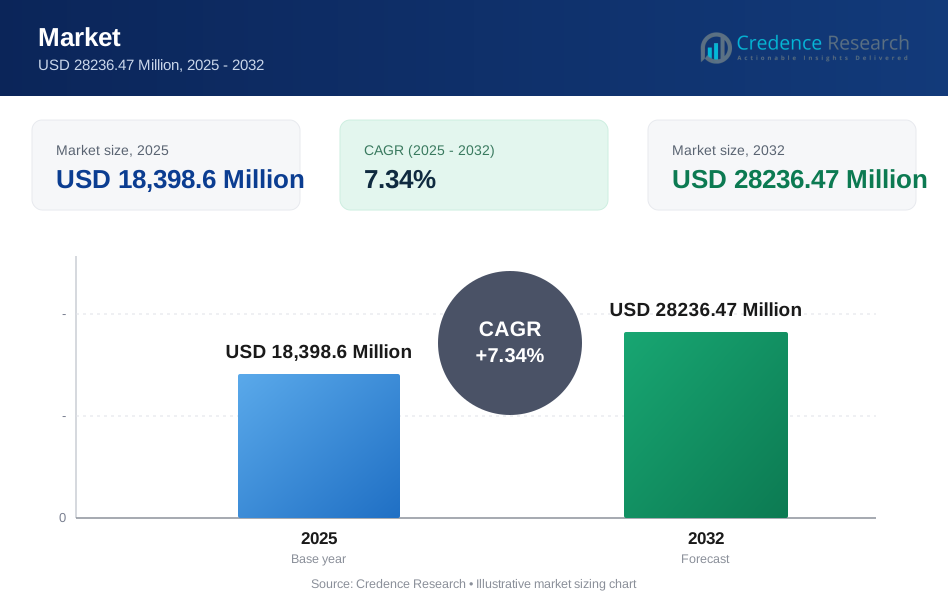
The Urban Street Furniture Market size was valued at USD 18,398.6 million in 2026 and is anticipated to reach USD 28236.47 million by 2032, expanding at a CAGR of 7.34% during the forecast period.
Urban street furniture connects public-space design with everyday needs such as seating, shelter, visibility, waste disposal and wayfinding. The market includes product manufacturers, installation and maintenance providers and advertising-funded infrastructure operators. Procurement opportunities depend on urban redevelopment, transit projects and the replacement of existing assets, while buyers must balance initial cost with durability and long-term upkeep.
Analysis attribute | Coverage |
|---|---|
Market scope | Products and services for urban public spaces |
Product categories | Seating, bollards, lighting, shelters, bicycle racks, bins and information displays |
Material categories | Metal, wood, plastic, concrete and composite |
Geographic coverage | North America, Europe, Asia Pacific, Latin America, Middle East and Africa |
Commercial considerations | Procurement, installation, maintenance, refurbishment and advertising-funded concessions |
Evidence basis | Public company product information and announcements |
This analysis examines product categories, materials, functionality, regional procurement considerations and selected suppliers. Public company sources illustrate how modular construction, refurbishment and connected equipment influence product offerings and contract design.
By Type
The product landscape includes benches, bollards, street lighting, bus shelters, bicycle racks, waste and recycling bins, information displays and other public-space furnishings. Each category addresses a different need: benches provide resting points, shelters protect waiting passengers, lighting supports visibility and bins support waste collection. Integrated products can combine several functions, making compatibility and maintenance access important purchasing considerations.
Landscape Forms lists benches, bike racks, bollards, waste and recycling receptacles, planters and shelters in its furniture portfolio, alongside outdoor lighting. [2]
By Material
Material selection affects structural performance, appearance and maintenance requirements. Metal offers design flexibility and strength, concrete provides mass and stability, and wood contributes visual warmth. Plastic and composite components provide further options for product design. Performance depends on material grade, protective finishes, exposure and construction quality. Mixed-material products allow manufacturers to combine structural and aesthetic characteristics.
JCDecaux identifies recycled aluminum, modular construction, repair and recyclability among its ecodesign priorities. These practices illustrate how material choices connect with product maintenance and end-of-life planning. [7]
By Functionality
Core functions include seating, safety, information display, waste management, illumination, bicycle parking and shelter. Accessibility applies across these functions through product dimensions, placement and ease of use. A bus shelter, for example, can incorporate seating, lighting and passenger information. Suppliers and buyers therefore need to assess complete installations as well as individual components.
Request a Free Sample
Fill in your details and we'll send you a free sample report.
- Sample data tables & charts
- Research methodology
Market Dynamics
Integration of Smart and Digitally Enabled Street Furniture
Connected lighting, information displays and monitoring equipment can add functionality to public-space assets. Commercial viability depends on operating budgets, electricity supply, connectivity and maintenance capability. Advertising-funded concessions can support equipment provision by linking public services with media income. Contract terms determine the responsibilities for installation, upkeep and technology upgrades.
JCDecaux states that its 2024 Nottingham contract includes refurbishment of 800 bus shelters, LED lighting and planned city-center Wi-Fi and air-quality monitoring. The project illustrates how shelter contracts can combine refurbishment with connected services.
Sustainable Materials and Adaptable Design
Durability, repairability and material sourcing affect lifetime cost and procurement decisions. Modular components can simplify replacement, while refurbishment can extend the use of installed structures. Environmental comparisons require product-specific evidence, including service life, material composition and assessment boundaries. Recycled content alone does not prove a lower total environmental impact.
Furnitubes offers modular seating and planters and provides product configuration tools. These are examples of customization capabilities available to architects and public-space buyers.
Installation and Lifecycle Costs
Installed costs include products, foundations, site preparation, transport and labor. Smart equipment may also require power, connectivity and ongoing software support. Weather exposure, vandalism and component replacement affect lifecycle costs. Budget limits can delay purchases or favor simpler designs. Buyers must consider the resources needed to keep installations functional after the initial procurement.
Regulatory Complexity and Urban Planning Constraints
Procurement procedures, heritage considerations, site conditions and applicable safety or accessibility rules can affect product selection and approval. Requirements differ by jurisdiction and project. Standardized designs may need adaptation to local constraints, while narrow sidewalks can limit placement. Coordination among designers, contractors and asset owners is therefore important to installation and ongoing maintenance.
North America
For North American projects, useful procurement considerations include replacement requirements, transit facilities and accessibility within the surrounding public space. Outdoor furnishings and lighting can be specified together where buyers seek a coordinated installation. Landscape Forms’ portfolio illustrates this combination of product categories. [2]
Europe
European contracts provide examples of refurbishment and advertising-funded shelter provision. JCDecaux’s Hamburg announcement and its Nottingham project illustrate approaches that retain or upgrade existing installations while incorporating additional services. These examples highlight the importance of maintenance obligations and asset reuse in contract design. [7, 8]
Asia Pacific
In Asia Pacific, suppliers assessing urban development and transit projects should evaluate local procurement requirements, installation conditions and maintenance capacity. Product suitability depends on the specific site and operating environment. Market entry decisions benefit from project-level assessment of funding, specifications and delivery schedules.
Latin America
For Latin American opportunities, project assessment should consider transit facilities, public-space requirements and the availability of funding for upkeep. Equipment cost is only one part of procurement economics; installation capacity, replacement components and service support also affect the practicality of a proposed solution.
Middle East and Africa
Across Middle Eastern and African projects, product selection should reflect local exposure conditions, site use and service requirements. Suppliers need to assess each project’s funding and delivery arrangements. Designs that work in one operating environment may require changes in materials, finishes or maintenance provisions elsewhere.
On Aug. 11, 2026, JCDecaux announced that Wall GmbH had been awarded Hamburg’s main advertising contract for 15 years. The announcement stated that approval by Hamburg’s Parliament was still required. Plans included retaining existing shelters and adding green-roof shelters. [8]
On Dec. 20, 2024, CROWD announced its acquisition of Armada Mobility BV in the Netherlands. Armada’s portfolio includes travel information systems, multifunctional shelters, bicycle storage and station wayfinding. The transaction expanded CROWD’s offering for public spaces and transport facilities. [9]
Report Coverage
This analysis covers street furniture by product type, material and function, together with regional procurement considerations, selected suppliers, market drivers, operating challenges and company developments. It examines the commercial implications of refurbishment, connected equipment and lifecycle maintenance.
Future Outlook
- Urban development and asset replacement may support demand, subject to municipal funding and procurement schedules.
- Connected equipment may expand where operating budgets support power, connectivity and maintenance.
- Seating and safety products are expected to remain relevant to public-space procurement.
- Buyers may place greater weight on repairability, material sourcing and documented environmental performance.
- Modular designs can support replacement of components and adaptation to site requirements.
- Funded transit projects can create orders for shelters, lighting and wayfinding systems.
- Accessibility considerations will continue to influence project specifications under applicable local rules.
- Advertising-funded concessions can support asset provision where contract economics are viable.
- Regional opportunities will depend on funded projects, local requirements and delivery capacity.
- Suppliers can differentiate through product quality, service support and transparent lifecycle costs.
Need a Custom Version of This Report?
Tailor the scope, geography, or segments to your exact requirements.
- Custom geography or segment scope
- Direct access to our analyst team
The competitive landscape includes manufacturers of outdoor furnishings and operators of advertising-funded public infrastructure. JCDecaux participates through urban street assets and associated services. Landscape Forms and Vestre supply outdoor furnishings, while mmcité lists seating, shelters, bins, bollards and information panels. Furnitubes offers seating, planters, cycle parking and related products. CROWD brings together street furniture and cycling infrastructure businesses. These participants serve different procurement needs, from individual product specifications to broader installation and maintenance contracts. Product range, design adaptability, repairability and service coverage provide useful bases for comparison. Buyers also need to distinguish furniture supply from the continuing obligations associated with operating public assets. The selected companies illustrate the breadth of activity in the sector rather than a ranking by market share.
Frequently Asked Questions
What does the urban street furniture market include?
Which materials are used in street furniture?
How do connected features change street furniture?
What factors can support demand?
Which companies participate in this market?
What should buyers consider when selecting street furniture?
Table of Content
Chapter 1. Report Introduction
- 1.1 Report Description & Purpose
- 1.1.1 Report Title & Market Definition
- 1.1.2 Unique Selling Propositions (USP) & Key Differentiators
- 1.1.3 Value Proposition for Stakeholders
- 1.2 Research Objectives
- 1.2.1 Market Sizing Objectives (Volume & Revenue)
- 1.2.2 Segmentation Objectives
- 1.2.3 Competitive Intelligence Objectives
- 1.2.4 Forecast & Scenario Objectives
- 1.3 Report Scope
- 1.3.1 Urban Street Furniture Market Size, Share, Growth, Trends, 2025-2032 Scope – Types & Subtypes Covered
- 1.3.2 Geographic Scope – Regions & Countries Covered
- 1.3.3 Historical Period, Base Year & Forecast Period (2020-2025; forecast to 2032)
- 1.3.4 Inclusions & Exclusions
- 1.4 HS Code & Classification Framework
- 1.5 Currency, Units & Pricing Basis
- 1.6 Target Stakeholders
- 1.7 Limitations & Assumptions
Chapter 2. Executive Summary
- 2.1 Global Urban Street Furniture Market Size, Share, Growth, Trends, 2025-2032 Market Snapshot
- 2.1.1 Market Size – Historical (2020-2025) & Forecast (2025-2032) (2025: USD 18,398.6 Million → 2032: USD 28236.47 Million)
- 2.1.2 Volume & Revenue – Global Totals
- 2.1.3 Key Market Highlights – Top Five Facts
- 2.2 Urban Street Furniture Market Size, Share, Growth, Trends, 2025-2032 Market Segmentation Snapshot
- 2.2.1 Market Split – By Type – 2025 vs. 2032 (Volume & Revenue)
- 2.2.2 Market Split – By Material – 2025 vs. 2032 (Volume & Revenue)
- 2.2.3 Market Split – By Functionality – 2025 vs. 2032 (Volume & Revenue)
- 2.2.4 Market Split – By Geography – 2025 vs. 2032 (Volume & Revenue)
- 2.2.5 Market Split by Region – 2025 vs. 2032
- 2.3 Competitive Snapshot
- 2.3.1 Top 10 Players by Revenue Share – 2025
- 2.3.2 Top 10 Players by Volume Share – 2025
- 2.3.3 Recent Strategic Developments (18-Month Summary)
- 2.4 Key Investment Highlights & Strategic Conclusions
Chapter 3. Urban Street Furniture Market Size, Share, Growth, Trends, 2025-2032 Market Dynamics & Industry Analysis
- 3.1 Market Overview & Context
- 3.1.1 Urban Street Furniture Market Size, Share, Growth, Trends, 2025-2032 Market Position in the Broader Automotive Value Chain
- 3.1.2 OEM vs. Replacement Market Dynamics
- 3.1.3 Market Maturity & Development Stage by Region
- 3.2 Urban Street Furniture Market Size, Share, Growth, Trends, 2025-2032 Market Drivers
- 3.3 Urban Street Furniture Market Size, Share, Growth, Trends, 2025-2032 Market Restraints & Challenges
- 3.4 Urban Street Furniture Market Size, Share, Growth, Trends, 2025-2032 Market Opportunities
- 3.5 Porter's Five Forces Analysis
- 3.5.1 Threat of New Entrants
- 3.5.2 Bargaining Power of Suppliers
- 3.5.3 Bargaining Power of Buyers
- 3.5.4 Threat of Substitutes
- 3.5.5 Competitive Rivalry – Intensity Assessment
- 3.6 Urban Street Furniture Market Size, Share, Growth, Trends, 2025-2032 Value Chain Analysis
- 3.6.1 Upstream – Raw Material/Input Suppliers
- 3.6.1.1 Raw Material/Input 1
- 3.6.1.2 Raw Material/Input 2
- 3.6.1.3 Raw Material/Input 3
- 3.6.2 Midstream – Production/Manufacturing/Service Delivery
- 3.6.2.1 Production/Process Overview
- 3.6.2.2 Key Facility Locations & Capacity by Manufacturer
- 3.6.3 Downstream – Distribution & End Consumer
- 3.6.3.1 Primary Channel – B2B/OEM
- 3.6.3.2 Secondary Channels – Dealer, Retail, Online, Direct
- 3.6.4 Value Chain Profitability Analysis
- 3.6.1 Upstream – Raw Material/Input Suppliers
- 3.7 PESTEL Analysis
- 3.7.1 Political Factors
- 3.7.2 Economic Factors
- 3.7.3 Social Factors
- 3.7.4 Technological Factors
- 3.7.5 Environmental Factors
- 3.7.6 Legal Factors
- 3.8 Urban Street Furniture Market Size, Share, Growth, Trends, 2025-2032 Supply Chain Analysis
- 3.8.1 Raw Material/Input Supply Risk Assessment
- 3.8.2 Manufacturing Concentration Risk (Geographic Exposure)
- 3.8.3 Trade Disruption Impact Analysis
- 3.9 Regulatory & Policy Landscape
Note: The regulatory and policy landscape section covers regulations based on their applicability to the market, Urban Street Furniture Market Size, Share, Growth, Trends, 2025-2032 category, geography, and scope of the study. Only regulatory frameworks with a material impact on operations, compliance, trade, sustainability, or market access are analyzed in detail.
Chapter 4. Key Investment Pockets & Opportunity Analysis
- 4.1 Urban Street Furniture Market Size, Share, Growth, Trends, 2025-2032 Market Attractiveness Analysis
- 4.1.1 By Region – Investment Attractiveness Matrix (Volume × CAGR)
- 4.1.2 By Type – Investment Attractiveness Matrix
- 4.1.3 By Material – Investment Attractiveness Matrix
- 4.1.4 By Functionality – Investment Attractiveness Matrix
- 4.1.5 By Geography – Investment Attractiveness Matrix
- 4.2 Absolute Revenue Growth Opportunity
- 4.2.1 By Region – Absolute USD Growth Through 2032
- 4.2.2 By Type – Absolute USD Growth
- 4.2.3 By Material – Absolute USD Growth
- 4.2.4 By Functionality – Absolute USD Growth
- 4.2.5 By Geography – Absolute USD Growth
- 4.3 Incremental Volume Opportunity
- 4.3.1 By Region – Incremental Volume Through 2032
- 4.3.2 By Type – Incremental Volume
- 4.4 Emerging Submarket Opportunity Deep Dive (Subject to Applicability)
- 4.5 Emerging Market Opportunity Scorecards
- 4.5.1 United States
- 4.5.2 Europe
- 4.5.3 Asia
- 4.5.4 Middle East & Africa
Note: Emerging Market Opportunity Scorecards will be included based on relevance and strategic importance. Regions listed are indicative and may vary depending on data availability and market dynamics.
Chapter 5. Urban Street Furniture Market Size, Share, Growth, Trends, 2025-2032 Import-Export Analysis & Trade Flows
- 5.1 Global Trade Overview
- 5.1.1 Global Export Value by Country (2020-2025)
- 5.1.2 Global Export Volume by Country (2020-2025)
- 5.1.3 Global Import Value by Country (2020-2025)
- 5.1.4 Global Import Volume by Country (2020-2025)
- 5.1.5 Net Trade Balance by Country (2020-2025)
- 5.2 Export Analysis – By Type
- 5.2.1 Type 1 (HS Code)
- 5.2.2 Type 2 (HS Code)
- 5.2.3 Type 3 (HS Code)
- 5.2.4 Type 4 (HS Code)
- 5.2.5 Type 5 (HS Code)
- 5.3 Import Analysis – By Type
- 5.3.1 Type 1 (HS Code)
- 5.3.2 Type 2 (HS Code)
- 5.3.3 Type 3 (HS Code)
- 5.3.4 Type 4 (HS Code)
- 5.3.5 Type 5 (HS Code)
- 5.4 Average Unit Trade Prices
- 5.4.1 Average Export Price – By Type & Country
- 5.4.2 Average Import Price – By Type & Source Country
- 5.4.3 Price Trends (2020-2025)
- 5.5 Key Trade Route Analysis
- 5.5.1 Trade Route 1
- 5.5.2 Trade Route 2
- 5.5.3 Trade Route 3
- 5.5.4 Trade Route 4
- 5.5.5 Trade Route 5
- 5.6 Trade Policy Impact Assessment
- 5.6.1 US Anti-Dumping & Section 301 Tariffs
- 5.6.2 EU Customs Union Impact
- 5.6.3 Major Free Trade Agreements
- 5.6.4 USMCA Rules of Origin
Note: Trade policy analysis will be included only where relevant to the Urban Street Furniture Market Size, Share, Growth, Trends, 2025-2032 market.
Chapter 6. Competitive Landscape & Company Benchmarking
- 6.1 Urban Street Furniture Market Size, Share, Growth, Trends, 2025-2032 Market Concentration & Structure
- 6.1.1 Herfindahl-Hirschman Index (HHI) – 2020 vs. 2025
- 6.1.2 Tier 1, Tier 2 & Tier 3 Market Structure
- 6.1.3 Global, Regional & Local Player Dynamics
- 6.2 Urban Street Furniture Market Size, Share, Growth, Trends, 2025-2032 Market Share Analysis – 2025
- 6.2.1 Global Revenue Share by Company
- 6.2.2 Global Volume Share by Company
- 6.2.3 Regional Revenue Share
- 6.2.4 Market Share Evolution (2020 vs. 2025)
- 6.2.5 OEM Segment Share by Company
- 6.2.6 Replacement Segment Share by Company
- 6.3 Production/Delivery Capacity & Facility Analysis
- 6.3.1 Global Installed Capacity
- 6.3.2 Capacity Utilization Rates
- 6.3.3 Production/Output Volume
- 6.3.4 Facility Locations & Capacity Map
- 6.3.5 Planned Capacity Additions
- 6.4 Urban Street Furniture Market Size, Share, Growth, Trends, 2025-2032 Competitive Benchmarking Matrix
- 6.4.1 Revenue, Volume, CAGR & Profitability Comparison
- 6.4.2 Channel Revenue Mix
- 6.4.3 Geographic Revenue Exposure
- 6.4.4 R&D Intensity
- 6.4.5 Sustainability Maturity
- 6.5 Strategic Developments in Urban Street Furniture Market Size, Share, Growth, Trends, 2025-2032 (Last 24 Months)
- 6.5.1 Mergers, Acquisitions & Divestments
- 6.5.2 New Urban Street Furniture Market Size, Share, Growth, Trends, 2025-2032 Launches
- 6.5.3 Facility Expansions
- 6.5.4 Strategic Alliances, Joint Ventures & Partnerships
- 6.5.5 Distribution Expansion & Market Entry
- 6.5.6 Sustainability & ESG Initiatives
- 6.6 Competitive Strategy Mapping
- 6.6.1 Leader, Challenger, Follower & Niche Classification
- 6.6.2 Pricing Strategy Comparison
- 6.6.3 Channel Strategy Matrix
Note: Strategic developments are included based on their materiality and the availability of reliable information.
Chapter 7. Global Urban Street Furniture Market Size, Share, Growth, Trends, 2025-2032 Market – By Type
- 7.1 Segment Overview
- 7.1.1 Market Volume Share (2020, 2025 & 2026)
- 7.1.2 Market Revenue Share (2020, 2025 & 2026)
- 7.1.3 Market Forecast Through 2032
- 7.1.4 Key Growth Drivers & Restraints
- 7.1.5 Leading Brands
- 7.2 Types Covered – By Type
- Benches
- Bollards
- Street Lighting
- Bus Shelters
- Bike Racks
- Waste and Recycling Bins
- Information Displays and Wayfinding
- Other Street Furniture
Chapter 8. Global Urban Street Furniture Market Size, Share, Growth, Trends, 2025-2032 Market – By Material
- 8.1 Segment Overview
- 8.1.1 Market Volume Share (2020, 2025 & 2026)
- 8.1.2 Market Revenue Share (2020, 2025 & 2026)
- 8.1.3 Market Forecast Through 2032
- 8.1.4 Key Growth Drivers & Restraints
- 8.1.5 Leading Brands
- 8.2 Types Covered – By Material
- Metal
- Wood
- Plastic
- Concrete
- Composite
Chapter 9. Global Urban Street Furniture Market Size, Share, Growth, Trends, 2025-2032 Market – By Functionality
- 9.1 Segment Overview
- 9.1.1 Market Volume Share (2020, 2025 & 2026)
- 9.1.2 Market Revenue Share (2020, 2025 & 2026)
- 9.1.3 Market Forecast Through 2032
- 9.1.4 Key Growth Drivers & Restraints
- 9.1.5 Leading Brands
- 9.2 Types Covered – By Functionality
- Seating
- Safety
- Information Display
- Waste Management
- Illumination
- Bicycle Parking
- Shelter
- Other Primary Functions
Chapter 10. Global Urban Street Furniture Market Size, Share, Growth, Trends, 2025-2032 Market – By Geography
- 10.1 Segment Overview
- 10.1.1 Market Volume Share (2020, 2025 & 2026)
- 10.1.2 Market Revenue Share (2020, 2025 & 2026)
- 10.1.3 Market Forecast Through 2032
- 10.1.4 Key Growth Drivers & Restraints
- 10.1.5 Leading Brands
- 10.2 Types Covered – By Geography
- North America
- Europe
- Asia Pacific
- Latin America
- Middle East and Africa
Chapter 11. Global Urban Street Furniture Market Size, Share, Growth, Trends, 2025-2032 Market – By Distribution Channel
- 11.1 Segment Overview
- 11.1.1 Volume & Revenue Split by Channel (2025 & 2032)
- 11.1.2 Channel Mix Evolution (2020-2032)
Chapter 12. Regional Market Analysis – Global Overview
- 12.1 Global Regional Overview
- 12.1.1 Regional Volume Share
- 12.1.2 Regional Revenue Share
- 12.1.3 Regional Volume by Region
- 12.1.4 Regional Revenue by Region
- 12.1.5 Regional Forecast Through 2032
- 12.2 Cross-Regional Segment Analysis
- 12.2.1 By Type
- 12.2.2 By Material
- 12.2.3 By Functionality
- 12.2.4 By Geography
- 12.2.5 By Distribution Channel
- 12.2.6 By Brand/Price Tier
Chapter 13. North America Urban Street Furniture Market Size, Share, Growth, Trends, 2025-2032 Market
- 13.1 United States
- 13.2 Canada
- 13.3 Mexico
Chapter 14. Europe Urban Street Furniture Market Size, Share, Growth, Trends, 2025-2032 Market
- 14.1 Germany
- 14.2 France
- 14.3 Italy
- 14.4 United Kingdom
- 14.5 Spain
- 14.6 Poland
- 14.7 Russia
- 14.8 Netherlands
- 14.9 Belgium
- 14.10 Sweden
- 14.11 Denmark
- 14.12 Norway
- 14.13 Rest of Europe
Chapter 15. Asia Pacific Urban Street Furniture Market Size, Share, Growth, Trends, 2025-2032 Market
- 15.1 China
- 15.2 India
- 15.3 Japan
- 15.4 South Korea
- 15.5 Thailand
- 15.6 Indonesia
- 15.7 Vietnam
- 15.8 Malaysia
- 15.9 Australia
- 15.10 Rest of Asia Pacific
Chapter 16. Latin America Urban Street Furniture Market Size, Share, Growth, Trends, 2025-2032 Market
- 16.1 Brazil
- 16.2 Argentina
- 16.3 Colombia
- 16.4 Chile
- 16.5 Rest of Latin America
Chapter 17. Middle East Urban Street Furniture Market Size, Share, Growth, Trends, 2025-2032 Market
- 17.1 Saudi Arabia
- 17.2 United Arab Emirates
- 17.3 Turkey
- 17.4 Israel
- 17.5 Iran
- 17.6 Rest of the Middle East
Chapter 18. Africa Urban Street Furniture Market Size, Share, Growth, Trends, 2025-2032 Market
- 18.1 South Africa
- 18.2 Egypt
- 18.3 Nigeria
- 18.4 Morocco
- 18.5 Rest of Africa
Chapter 19. Urban Street Furniture Market Size, Share, Growth, Trends, 2025-2032 Company Profiles
- 19.1 JCDecaux
- 19.1.1 Company Overview
- 19.1.2 Key Management Personnel
- 19.1.3 Products & Services Portfolio
- 19.1.4 Financial Performance
- 19.1.5 Key Market Focus & Geographic Presence
- 19.1.6 Recent Developments & Strategic Initiatives
- 19.2 Landscape Forms
- 19.3 Vestre
- 19.4 CROWD
- 19.5 mmcité
- 19.6 Furnitubes
Note: The company profile list is preliminary and may change based on research findings, market developments, data availability, and client requirements.
Chapter 20. Appendices
- Appendix A – List of Abbreviations & Acronyms
- Appendix B – Industry Classification Code Reference – Full Series
- Appendix C – Production & Capacity Data Tables
- Appendix D – End-Use & Demand Base Tables
- Appendix E – Consumption & Replacement Rate Assumptions
- Appendix F – ASP Reference Tables
- Appendix G – Manufacturing & Facility Database
- Appendix H – Import-Export Data Tables
- Appendix I – Regulatory Summary Tables
- Appendix J – Primary Research Participant List (Anonymized)
- Appendix K – Primary Research Questionnaire Framework
- Appendix L – Data Sources & Bibliography
- Appendix M – Market Size Divergence & Source Comparison
Chapter 21. Research Methodology
- 21.1 Research Framework & Philosophy
- 21.2 Secondary Research – Sources, Hierarchy & Data Extraction
- 21.3 Data Modeling – Bottom-Up & Top-Down Market Sizing
- 21.4 Primary Research – Stakeholder Framework, LOI & Sample Sizes
- 21.5 Forecast Methodology – Regression, Scenario & Sensitivity Analysis
- 21.6 Quality Control – Four-Layer Validation Framework
- 21.7 Limitations & Standard Assumptions
- 21.8 Disclaimer
