
Older patients and coated coronary devices lift spending
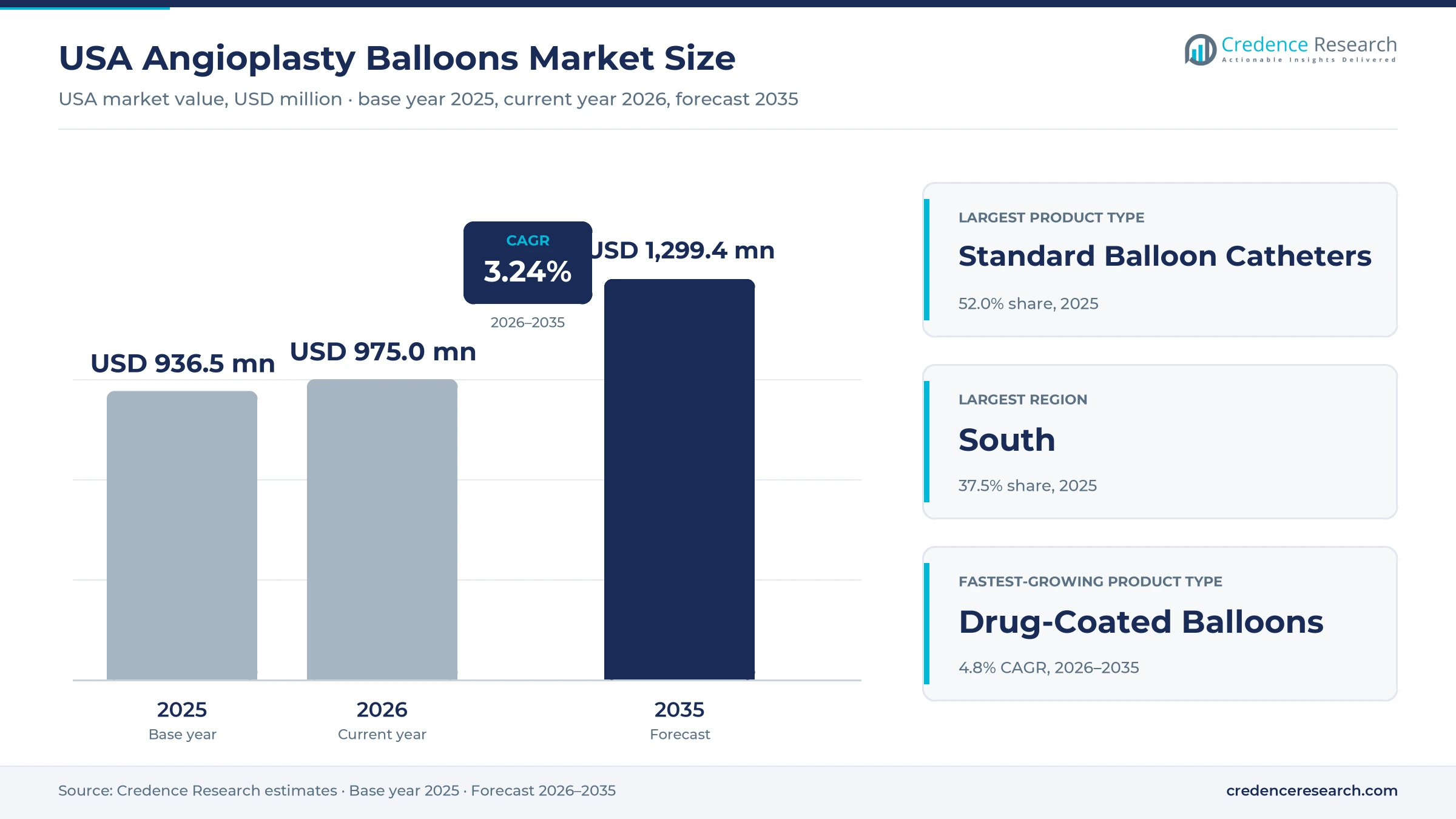
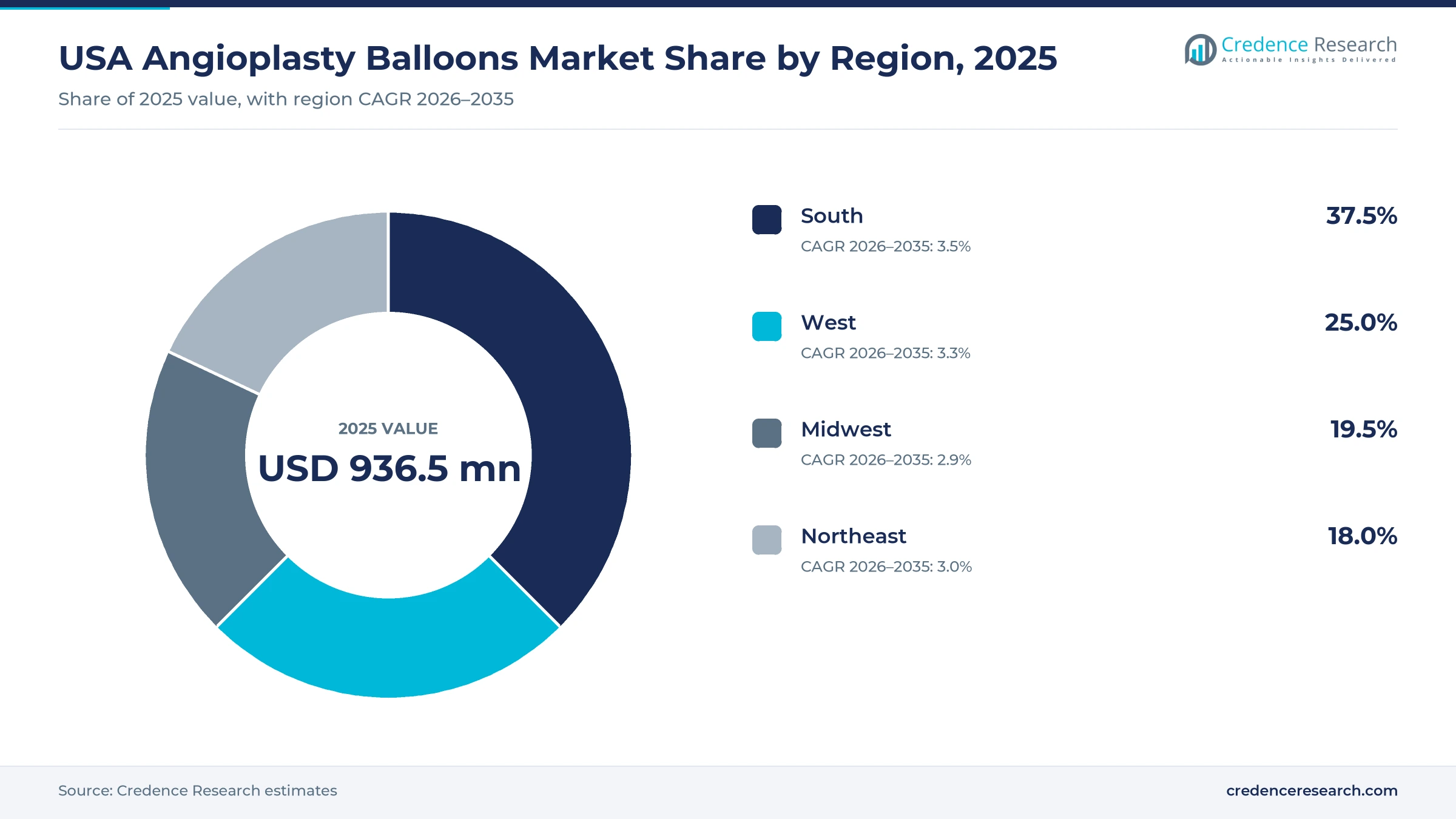
The USA angioplasty balloons market was valued at USD 936.5 million in 2025 and is projected to increase from USD 975.0 million in 2026 to USD 1.30 billion by 2035, registering a CAGR of 3.24% during 2026–2035. Demand rests on a growing number of older patients with coronary and leg artery disease, the arrival of drug-coated coronary devices for in-stent restenosis, and more careful lesion preparation before stenting. The South held the largest regional share, 37.5% in 2025, and it is also the fastest-growing region at 3.5% a year because its population aged 65 and older is growing faster than in the rest of the country. Standard catheters still account for the largest share of value, while drug-coated devices grow fastest as hospitals gain specific Medicare payment for them. Two coronary drug-coated products for restenosis were approved between March 2024 and September 2026, which moved the U.S. from plain dilation toward drug delivery in repeat coronary procedures.
Single-use catheters that open narrowed coronary and peripheral arteries
The market counts manufacturer sales of standard balloon catheters, cutting and scoring balloons, drug-coated balloons and specialty dilation balloons used in coronary, lower-extremity, renal and visceral arteries. Hospitals, ambulatory surgical centers and freestanding catheterization laboratories buy them through national contracts, facility contracts and authorized distributors, usually alongside stents, wires and imaging catheters for the same procedure.
Balloon-expandable stents sold premounted on a delivery balloon, intra-aortic balloon pumps, dialysis access balloons and non-vascular dilation balloons used in the airway or digestive tract are outside the scope. The value chain runs from polymer tubing, coating and drug suppliers through device makers and distributors to catheterization laboratories.
USA Angioplasty Balloons Market Insights
- The USA angioplasty balloons market grows from USD 936.5 million in 2025 to USD 1.30 billion by 2035 at a 3.24% CAGR as coated devices take a larger part of each procedure.
- The South held the largest regional share at 37.5% in 2025 and grows fastest at 3.5% a year, as its 65-and-older population rose 17.5% from 2020 to 2025.
- Standard balloon catheters led with 52.0% of 2025 value, while drug-coated balloons are the fastest-growing product type at 4.8% a year.
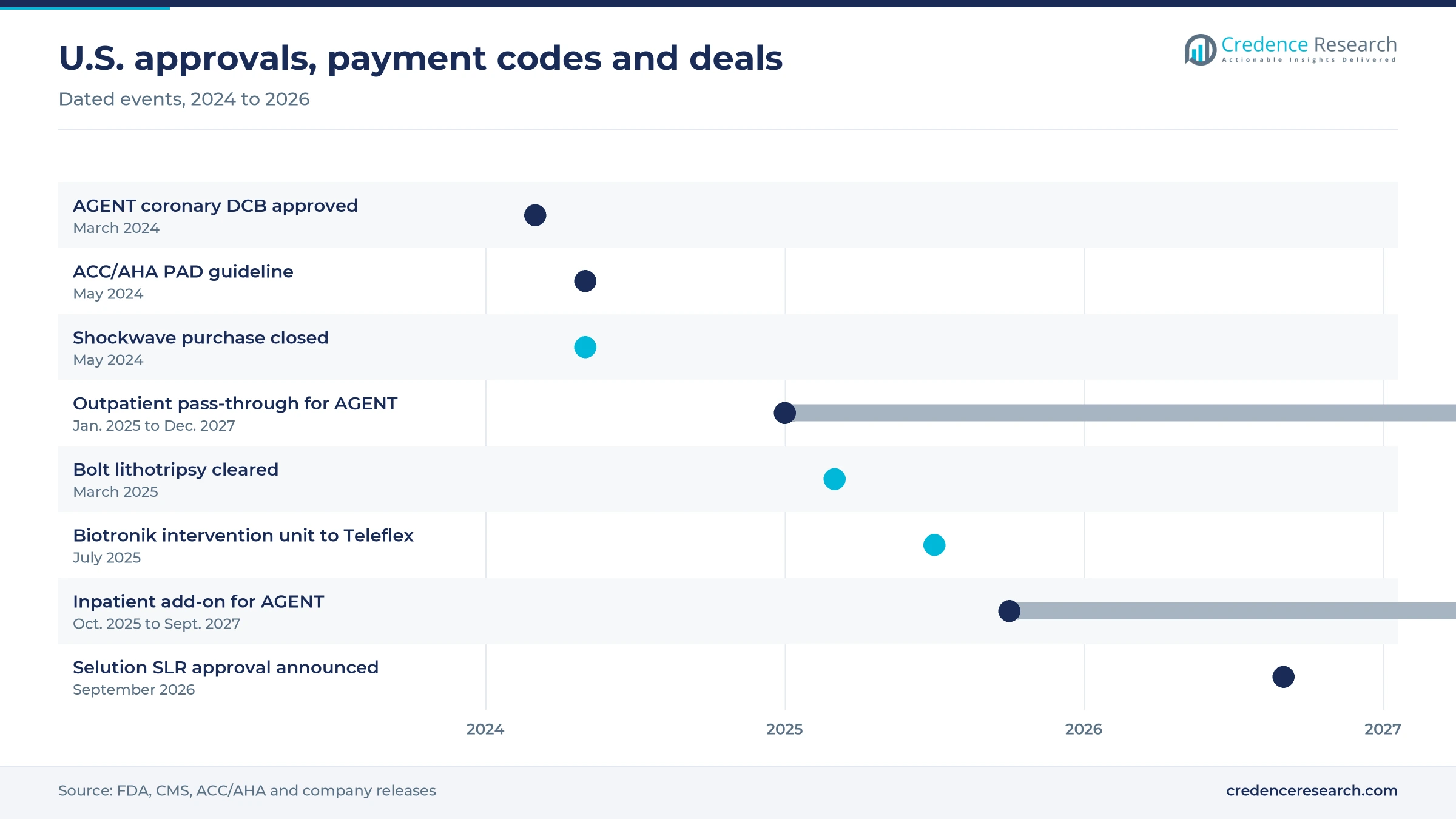
- The FDA approved the first U.S. coronary drug-coated balloon on March 1, 2024, and a second device for in-stent restenosis was announced on Sept. 21, 2026.
- Johnson & Johnson closed its purchase of Shockwave Medical on May 31, 2024, which tied calcium-modifying balloons to one of the largest device portfolios.
Standard catheters lead while coated devices grow fastest
Standard catheters lead as drug-coated devices grow fastest
Based on product type, the market is categorized into standard balloon catheters, cutting and scoring balloons, drug-coated balloons and specialty dilation balloons. Standard balloon catheters led with 52.0% of 2025 value because almost every coronary and leg artery procedure uses at least one for predilation or postdilation, and plain catheters are commodity items, as Endovascular Today put a typical balloon catheter price at about USD 100 in 2015, a small fraction of 1990s levels. Drug-coated balloons grow fastest at 4.8% a year as the coronary choice widens, and Cordis announced FDA approval of its Selution SLR sirolimus-eluting device for in-stent restenosis on Sept. 21, 2026.
Hospitals lead while ambulatory centers grow fastest
Based on care setting, the market is categorized into hospitals, ambulatory surgical centers and freestanding catheterization laboratories. Hospitals led with 71.0% of 2025 value because emergency heart attack care, complex coronary work and inpatient limb salvage stay in hospital laboratories, and the CDC estimates about 805,000 heart attacks a year. Ambulatory surgical centers grow fastest at 5.4% a year as elective cases move out of hospitals, and Medicare has paid ambulatory centers for coronary angioplasty and stent codes since Jan. 1, 2020. Freestanding laboratories hold a large share of leg artery work, where office payment rose for 2026.
Coronary disease leads as leg artery work holds steady
Based on disease area, the market is categorized into coronary artery disease, lower-extremity peripheral artery disease, and renal and visceral arterial disease. Coronary artery disease led with 55.0% of 2025 value because coronary procedures are the most common catheter intervention, and in-stent restenosis alone accounts for about 10% of U.S. coronary interventions, according to Boston Scientific. It also grows fastest at 3.4% a year as coated coronary devices add value to each repeat case. Renal and visceral work is the smallest group because these procedures are far less common than coronary and leg artery cases.
Definitive treatment leads as lesion preparation grows fastest
Based on application, the market is categorized into lesion preparation, definitive balloon treatment and stent optimization. Definitive balloon treatment led with 46.0% of 2025 value because plain or drug-coated dilation is still the final therapy in many leg artery cases and in coronary restenosis. Lesion preparation grows fastest at 4.0% a year as calcified vessels need cracking or scoring before a device is placed, and the FDA cleared the Bolt intravascular lithotripsy system for above-the-knee arteries on March 25, 2025. Stent optimization uses high-pressure catheters after coronary stent placement and grows with imaging-guided procedures.
| Segment Group | Leading Sub-segment | Share, 2025 | Fastest-growing Sub-segment | CAGR, 2026–2035 |
|---|---|---|---|---|
| By Product Type | Standard Balloon Catheters | 52.0% | Drug-Coated Balloons | 4.8% |
| By Care Setting | Hospitals | 71.0% | Ambulatory Surgical Centers | 5.4% |
| By Disease Area | Coronary Artery Disease | 55.0% | Coronary Artery Disease | 3.4% |
| By Application | Definitive Balloon Treatment | 46.0% | Lesion Preparation | 4.0% |
Commodity catheters and paid coatings set two price tiers
Pricing works per catheter under national or facility contracts, while hospitals recover the cost through procedure payments that bundle devices together. A plain catheter is a commodity bought on volume contracts, while coated coronary devices cost many times more, so hospitals rely on separate Medicare add-ons to use them without losing money on each case. The add-ons are temporary, so prices face pressure once a device cost is folded back into the procedure rate. Suppliers with coated or calcium-modifying products earn the widest margins, while standard catheter prices are set mainly by group purchasing contracts and distributor discounts.
| Product or payment item | Typical price or fee | Basis |
|---|---|---|
| Standard peripheral dilation catheter | About USD 100 per catheter | Endovascular Today, August 2015; latest published U.S. benchmark, current contract prices are not public |
| Cutting or scoring catheter, coronary or peripheral | USD 500-1,000 per catheter | Credence Research estimate from contract price spreads, 2025 |
| Coronary drug-coated catheter, illustrative pass-through payment (C9610) | USD 6,299 per case | Boston Scientific payment guide, 2026 |
| Inpatient new technology add-on for the AGENT device | Up to USD 4,014 per case | Cardiovascular Business, 2026 |
| Hospital outpatient coronary angioplasty procedure (92920) | USD 5,815 national rate | Boston Scientific payment guide, 2026 |
| Hospital outpatient stand-alone coated coronary procedure (0913T) | USD 11,794 national rate | Boston Scientific payment guide, 2026 |
Request a Free Sample
Fill in your details and we'll send you a free sample report.
- Sample data tables & charts
- Research methodology
Aging, new coronary approvals and limb care drive demand
Population aging enlarges the cardiovascular patient pool
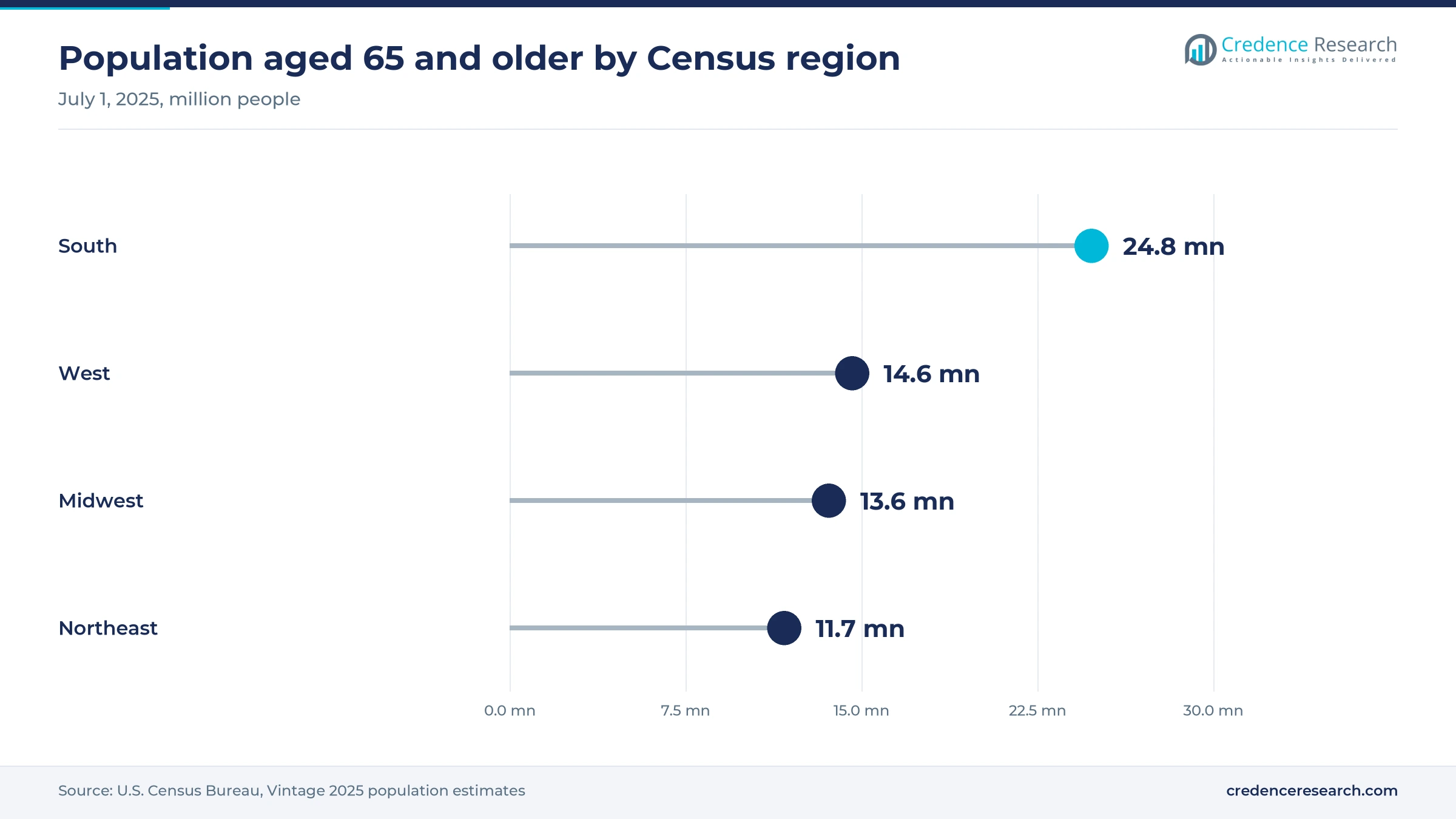
The number of older Americans is rising quickly, and this age group accounts for most coronary and leg artery procedures. The Census Bureau counted 64.6 million people aged 65 and older in July 2025, up 16.2% from April 2020, while the total population grew far more slowly. The CDC estimates that about 1 in 20 adults aged 20 and older has coronary artery disease, and that 919,032 people died from cardiovascular disease in 2023. The South has the largest number of these older patients, which is why it leads regional demand. Hospitals and device suppliers can therefore expect steady procedure demand even in years when payment rates stay flat.
Coronary drug-coated balloon approvals add value per case
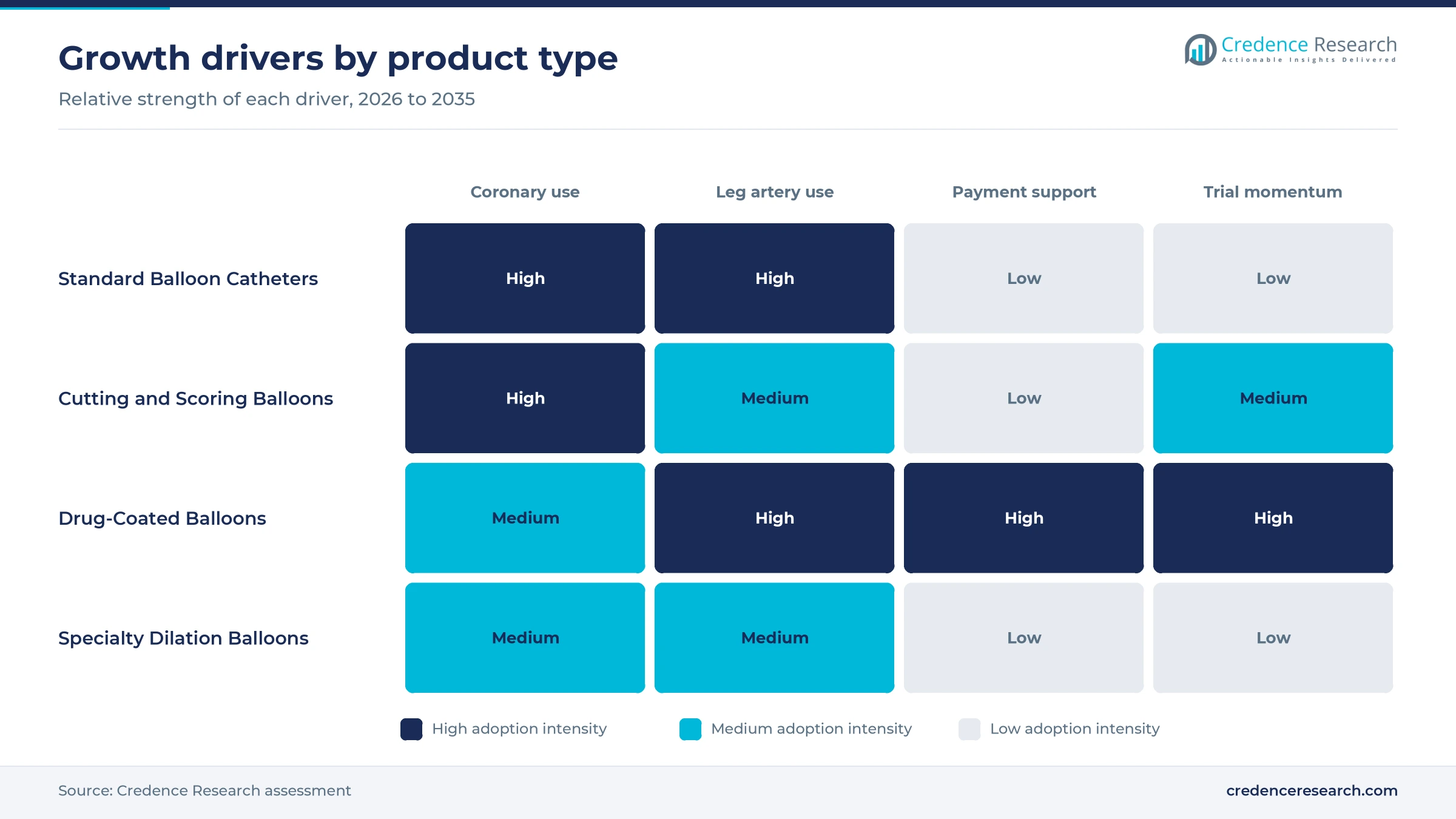
Drug-coated coronary devices give physicians a way to treat restenosis without adding another metal layer, and each one costs many times a plain catheter. Boston Scientific received FDA approval for its AGENT device on March 1, 2024, calling it the first drug-coated coronary balloon in the U.S. Its trial of 600 patients at 40 U.S. sites showed target lesion failure at 12 months of 17.9%, against 28.7% for an uncoated catheter. Medicare then gave hospitals outpatient pass-through payment from Jan. 1, 2025, for three years and an inpatient add-on from Oct. 1, 2025, at the rates shown in the price table. Drug-coated balloons grow fastest among product types, at 4.8% a year.
Complex-lesion preparation and limb preservation guidelines
Calcified and long lesions need careful preparation, and leg artery patients at risk of amputation now have a clear treatment mandate. The NHLBI estimates that nearly 10 million people aged 40 and older in the U.S. have peripheral artery disease. The ACC and AHA guideline published on May 14, 2024, gives a Class 1 recommendation for revascularization in chronic limb-threatening ischemia to heal wounds and preserve a functional limb. Cagent Vascular launched 7 mm and 8 mm Serranator serration catheters in the U.S. on Oct. 8, 2025, for iliac and femoral arteries. Lesion preparation is therefore the fastest-growing application, at 4.0% a year, and it often adds a second, higher-priced catheter to each case.
Site-of-care shift moves elective cases out of hospitals
Medicare payment rules increasingly reward elective procedures performed outside hospital laboratories, which changes who buys catheters and how. Single-specialty cardiology ambulatory centers grew from 55 in 2018 to 221 in 2023, according to a JACC study cited by Becker's ASC. The 2026 Physician Fee Schedule raised office-based cardiology payment by about 5% and cut facility-based services by about 6%, according to the ACC as reported by Cardiovascular Business. Ambulatory surgical centers grow fastest among care settings, at 5.4% a year. Suppliers that offer smaller contract packs and direct service to these centers can win accounts that hospital group contracts do not reach.
De novo trials and lesion-prep deals reshape the field
Shift of coronary drug-coated trials toward de novo lesions
Device makers are now testing coated coronary devices in new, untreated lesions, which would widen use far beyond restenosis. Boston Scientific started the AGENT DCB STANCE trial on Aug. 21, 2025, randomizing more than 1,600 patients against drug-eluting stents or plain dilation, according to MassDevice. Medtronic received FDA approval on Oct. 23, 2024, for a pivotal study of its Prevail device in up to 1,205 patients at about 65 centers. Cordis has also completed enrollment of 960 patients in its SELUTION4DeNovo trial in small coronary vessels. Positive results would let coated devices replace some stents, so stent makers and coating makers are likely to compete for the same cases.
Rise of integrated lesion preparation portfolios
Large device firms are buying calcium-modifying and specialty catheter platforms so they can sell a full procedure set. Johnson & Johnson acquired Shockwave Medical, closing the deal on May 31, 2024, and runs it as a business unit beside its heart recovery and electrophysiology lines. Boston Scientific acquired Bolt Medical in April 2025, shortly after the Bolt system was cleared. Teleflex acquired the Biotronik vascular intervention business for EUR 760 million on July 1, 2025, adding coronary and peripheral catheters. Hospitals that buy these bundles gain simpler contracting, while smaller makers face more pressure to partner or sell.
Below-the-knee therapy opens a new limb salvage niche
Patients with disease below the knee are an underserved group, and better devices for them would lift spending per case. The FDA approved Abbott's Esprit BTK scaffold on April 29, 2024, as the first dedicated device for these arteries, after a 261-patient trial against plain dilation, according to TCTMD. A trial investigator noted that plain balloon angioplasty was the only approved tool before that approval. Lower-extremity disease is the second-largest disease area by value, so even modest gains below the knee matter to suppliers. Makers of coated and scoring catheters for small leg arteries can reach these patients alongside peripheral artery disease therapies such as wound care and drug treatment.
Same-day coronary programs open ambulatory accounts
Same-day discharge after coronary procedures is becoming routine, which opens ambulatory accounts to catheter suppliers. More than one-third of coronary intervention patients now go home the same day, a physician told the Becker's ASC business meeting in 2025. Coronary angiography catheter placement cost USD 382 at an ambulatory center against USD 919 at a hospital outpatient department in 2024, according to Becker's ASC. CMS added 560 codes to the ambulatory center payable list for 2026, including cardiac ablation, in a final rule published on Nov. 21, 2025. Suppliers that bundle catheters, wires and inventory service for these centers can win accounts before hospital contracts follow them.
Payment cuts, audits and long approval paths slow growth
Facility payment cuts squeeze hospital laboratory budgets
Hospital laboratories face tighter budgets because facility-based physician payment fell for 2026. The ACC estimated that many facility procedures, including coronary intervention, lost about 10% in physician payment under the 2026 Physician Fee Schedule, while hospital outpatient rates rose only 2.6%. Hospitals respond by pushing harder on catheter prices in group contracts, which hits standard catheter makers first. Suppliers can protect margins by linking coated devices to outcome data that lower repeat procedure costs.
Federal audits target office-based leg artery procedures
Federal auditors are scrutinizing leg artery procedures in office laboratories, which raises compliance risk for catheter sales there. The HHS Office of Inspector General found USD 105 million in office-based payments that may indicate medically unnecessary procedures, with 26 physicians accounting for 61%, and CMS agreed to monitor billing. Freestanding laboratories that rely on high procedure counts may see closer review. Suppliers will need cleaner documentation and clinical support to keep these accounts.
Long U.S. approval paths keep coated devices offshore
The U.S. requires large domestic trials before approving coated devices, so many products sold abroad cannot be sold here. The coated devices that came with Teleflex's Biotronik purchase, noted above, are not sold in the U.S., Medtronic's Prevail device is not approved in the U.S., and Boston Scientific needed a 600-patient trial at 40 U.S. sites for its first coronary approval. Smaller makers carry this cost hardest, so they often license or partner.
Recalls and product exits narrow hospital choice
Product recalls and withdrawals can leave laboratories short of specific catheter types. The FDA classed Cook Medical's June 2019 recall of its Advance Enforcer focal-force peripheral catheters as Class I, the most serious type, over a risk of unexpected bursting, according to TCTMD. Philips now lists its AngioSculpt RX coronary scoring catheter as no longer available on its U.S. site. Hospitals respond by dual-sourcing each catheter type, which favors suppliers with broad catalogs.
The South leads on its large and fast-aging population
| Region | Value, 2025 (USD million) | Share, 2025 | CAGR, 2026–2035 |
|---|---|---|---|
| South | 351.2 | 37.5% | 3.5% |
| West | 234.1 | 25.0% | 3.3% |
| Midwest | 182.6 | 19.5% | 2.9% |
| Northeast | 168.6 | 18.0% | 3.0% |
The South leads as its older population grows fastest
The South held 37.5% of 2025 value and grows at 3.5% a year, the fastest of the four regions. Census Bureau estimates put its population aged 65 and older at 24.8 million in July 2025, up 17.5% since 2020, the fastest rise in the country. ChristianaCare budgeted USD 9.3 million in April 2026 for a two-laboratory cardiovascular ambulatory center in Newark, Delaware. However, Tennessee regulators denied a proposed one-laboratory center in Cookeville by a 7-1 vote, which shows that certificate-of-need rules still slow new sites in parts of the region.
The West grows on fast aging and outpatient capacity
The West held 25.0% of 2025 value and grows at 3.3% a year. Its 65-and-older population reached 14.6 million in July 2025, up 16.5% since 2020, the second-fastest rise among the four regions according to Census Bureau estimates. Large integrated health systems run much of the region's cardiac care, so national and system-wide contracts decide which catheters are used. Growth in older patients keeps procedure demand ahead of the national average.
The Midwest relies on hospital laboratories and steady demand
The Midwest held 19.5% of 2025 value and grows at 2.9% a year, the slowest of the four regions. Its 65-and-older population of 13.6 million grew 14.7% from 2020 to 2025, below the national 16.2%, according to Census Bureau estimates. Rural areas depend on regional hospital laboratories, which keeps much of the coronary and leg artery work inside hospitals. Standard and non-compliant catheters therefore make up a larger part of regional spending.
The Northeast grows on academic centers and new outpatient sites
The Northeast held 18.0% of 2025 value and grows at 3.0% a year. Its 65-and-older population of 11.7 million grew 14.6% from 2020 to 2025, the slowest rise of any region according to Census Bureau estimates. Dense academic medical centers run many complex coronary cases and clinical trials, which supports early use of coated and scoring devices. New outpatient sites, such as Penn Medicine's cardiology ambulatory center in King of Prussia, add elective capacity.
Approvals, payment codes and acquisitions, 2024 to 2026
| Development | Status and market relevance |
|---|---|
| In March 2024, Boston Scientific received FDA approval for the AGENT drug-coated coronary balloon for in-stent restenosis. | Approved; first U.S. coronary DCB |
| In April 2024, Abbott received FDA approval for the Esprit BTK scaffold for arteries below the knee. | Approved; limb salvage alternative |
| In May 2024, Johnson & Johnson completed its purchase of Shockwave Medical and its lithotripsy catheters. | Completed; lesion preparation platform |
| In July 2025, Teleflex completed its purchase of the Biotronik vascular intervention business. | Completed; coronary and peripheral catheters |
| In September 2026, Cordis announced FDA approval of the Selution SLR sirolimus-eluting device for in-stent restenosis. | Approved; second coronary DCB |
Drug coatings, scoring edges and lithotripsy set price tiers
- Paclitaxel coatings deliver an anti-proliferative drug to the vessel wall during a short inflation, and the FDA said on July 11, 2023, that the data no longer supported an excess mortality risk for these coated peripheral devices.
- Sirolimus-eluting coatings use a different drug with a slower tissue release, and their first U.S. coronary approval in 2026 created a second coated product class.
- Cutting and scoring elements fix blades, wires or serrations to the balloon surface so plaque cracks in a controlled way at lower pressure.
- Intravascular lithotripsy sends acoustic pressure waves through a fluid-filled balloon to fracture calcium, and it is used with specialty guidewires to cross hard lesions.
Need a Custom Version of This Report?
Tailor the scope, geography, or segments to your exact requirements.
- Custom geography or segment scope
- Direct access to our analyst team
Broad-line firms compete with coronary and PAD specialists
Competition turns on clinical evidence, catalog breadth and contract access rather than on the price of standard catheters alone. Boston Scientific holds the first U.S. coronary coated device and added lithotripsy through Bolt, so it can offer a complete coronary set. Medtronic sells its IN.PACT Admiral coated device for leg arteries and is testing Prevail for coronary use. Cordis now competes in restenosis with a sirolimus device, while Johnson & Johnson uses Shockwave to compete in calcium preparation. BD and Philips sell coated peripheral devices, and Cook Medical, Terumo and Teleflex compete with broad standard and specialty catalogs. Abbott competes for arteries below the knee with its Esprit BTK scaffold. Hospitals choose among them through group purchasing contracts, and suppliers that pair catheters with wires, imaging and stents gain an advantage in atherectomy device and lesion preparation tenders.
Broad-line firms, specialists and distributors form the supply side
The U.S. supply side for angioplasty balloons is concentrated at the top, with a few broad-line firms selling full coronary and peripheral catalogs under national contracts with integrated health systems. Specialists such as Cordis, OrbusNeich and Cagent Vascular compete in coated or scoring niches, often through distribution partners, as OrbusNeich did when its Scoreflex NC catheter was announced as FDA-approved in January 2022. Entry barriers are highest for coated devices, which need large U.S. trials, and lowest for standard catheters, where margins are thin. Profits sit with coated and calcium-modifying products, which carry most of the value in cardiovascular device procurement.
Companies profiled and their roles in this market
| Company | Type | Role in the market |
|---|---|---|
| Boston Scientific Corporation | Broad-line manufacturer | AGENT coronary coated device, cutting catheters and Bolt lithotripsy |
| Medtronic plc | Broad-line manufacturer | IN.PACT Admiral peripheral coated device; Prevail coronary device in U.S. trial |
| Abbott Laboratories | Broad-line manufacturer | Esprit BTK scaffold for arteries below the knee |
| Teleflex Incorporated | Specialty manufacturer | Added coronary and peripheral catheters through the Biotronik purchase |
| Cook Medical | Peripheral manufacturer | Advance peripheral dilation catheter range |
| Cordis | Coronary and peripheral specialist | Selution SLR sirolimus-eluting device for restenosis |
| Terumo Corporation | Broad-line manufacturer | TAKERU PTCA dilation catheter in its U.S. interventional catalog |
| Becton, Dickinson and Company | Peripheral manufacturer | Lutonix 035 coated peripheral device |
| Koninklijke Philips N.V. | Peripheral manufacturer | Stellarex coated peripheral device for femoral and popliteal arteries |
| OrbusNeich Medical Group | Coronary specialist | Scoreflex NC coronary scoring catheter |
Drug-coated coronary use, not case counts, drives value
Credence Research's view is that U.S. angioplasty balloons value growth comes mainly from a richer device mix, not from more procedures. Procedure counts grow slowly, but each restenosis case treated with a coated device carries several times the catheter value of a plain dilation. The size of the next step depends on the de novo coronary trials now enrolling, since a positive result would move coated devices into the most common coronary cases. Suppliers should plan for price pressure on standard catheters and invest in evidence, payment support and ambulatory center service for coated and lesion preparation products.
Procedure counts and device prices anchor the estimate
The report uses 2025 as the base year and forecasts to 2035. Market values come from the Credence Research model, which multiplies coronary and peripheral procedure volumes by angioplasty balloons used per case and by typical device prices for each product type. Inputs come from Census Bureau population estimates, CDC and NHLBI disease statistics, FDA approvals, Medicare payment rules, HHS-OIG reports and company announcements. Segment, care setting and regional shares are Credence Research estimates. No interviews or surveys were conducted for this edition of the report.
Value grows by a third as coatings take share to 2035
The market is expected to reach USD 1.30 billion by 2035 as older patients, coated devices and careful lesion preparation lift value per case. Coated devices should take a steadily larger share of coronary restenosis work, and a de novo indication would speed that shift. Leg artery demand rests on limb preservation guidance and on devices for arteries below the knee. Elective work will keep moving to ambulatory centers, so suppliers that serve those sites well and hold strong trial data are best placed to gain share through 2035.
Coronary coated uptake and payment rules set the 2035 range
The range of outcomes depends on how far coated devices move into new coronary lesions and on how Medicare treats device costs after the temporary add-ons end. A downside case assumes the de novo trials disappoint and facility payment cuts continue. The base case assumes steady restenosis use and gradual growth in ambulatory centers. An upside case assumes a broad de novo coronary indication by 2029 and more coated devices for arteries below the knee.
| Scenario | CAGR, 2026–2035 | Value, 2035 | What has to hold |
|---|---|---|---|
| Downside | 2.0% | USD 1.17 billion | De novo coronary trials miss endpoints and facility payment cuts continue each year |
| Base | 3.24% | USD 1.30 billion | Restenosis use grows steadily and elective cases move gradually to ambulatory centers |
| Upside | 4.4% | USD 1.44 billion | A de novo coronary indication arrives by 2029 and below-the-knee coated devices win approval |
Frequently Asked Questions
How big is the USA angioplasty balloons market?
Which product type leads the market?
Which region holds the largest share?
When were coronary drug-coated balloons approved in the U.S.?
How does Medicare pay for coated coronary devices?
Which care setting grows fastest?
What are the main challenges for suppliers?
Which companies compete in the market?
Table of Content
Chapter 1 Market Segmentation
- 1.1 Segmentation Framework
- 1.1.1 Product and Service Classification
- 1.1.2 Application and End-Use Classification
- 1.1.3 Technology and Solution Classification
- 1.1.4 Customer and Distribution Channel Classification
- 1.1.5 Geographic Segmentation
- 1.1.6 Market Segment Definitions and Boundaries
- 1.2 By Product Type
- 1.2.1 Standard Balloon Catheters
- 1.2.2 Cutting and Scoring Balloons
- 1.2.3 Drug-Coated Balloons
- 1.2.4 Specialty Dilation Balloons
- 1.3 By Care Setting
- 1.3.1 Hospitals
- 1.3.2 Ambulatory Surgical Centers
- 1.3.3 Freestanding Catheterization Laboratories
- 1.4 By Disease Area
- 1.4.1 Coronary Artery Disease
- 1.4.2 Lower-Extremity Peripheral Artery Disease
- 1.4.3 Renal and Visceral Arterial Disease
- 1.5 By Application
- 1.5.1 Lesion Preparation
- 1.5.2 Definitive Balloon Treatment
- 1.5.3 Stent Optimization
Chapter 2 Introduction
- 2.1 Report Objectives and Scope
- 2.2 Product Definition and Industry Terminology
- 2.3 Market Inclusions and Exclusions
- 2.4 Research Process
- 2.4.1 Primary Research and Expert Interviews
- 2.4.2 Secondary Research and Source Review
- 2.4.3 Top-Down and Bottom-Up Estimation
- 2.4.4 Data Triangulation and Verification
- 2.5 Market Size Measurement Basis
- 2.5.1 2025: USD 936.5 million → 2035: USD 1.30 billion
- 2.6 Historical and Forecast Reference Periods
- 2.6.1 Historical Period: 2018-2025
- 2.6.2 Base Year: 2025
- 2.6.3 Forecast Period: 2025-2035
- 2.7 Research Assumptions and Limitations
Chapter 3 Executive Summary
- 3.1 Market Snapshot and Key Findings
- 3.2 Base-Year Market Size, 2025
- 3.3 Forecast Market Size, 2035
- 3.4 Revenue and Volume Growth Outlook
- 3.5 Key Demand and Supply Indicators
- 3.6 Leading Market Segments
- 3.7 Fastest-Growing Market Opportunities
- 3.8 Regional Performance Highlights
- 3.9 Technology and Industry Transformation
- 3.10 Competitive Landscape Summary
- 3.11 Analyst View and Strategic Implications
Chapter 4 USA Angioplasty Balloons Market Trends and Developments
- 4.1 Historical Industry Development, 2018-2025
- 4.2 Recent Market Trends and Developments
- 4.3 Demand and Customer Behavior Trends
- 4.4 Technology and Product Innovation
- 4.5 Artificial Intelligence, Automation and Digitalization
- 4.6 Local Manufacturing and Supply Chain Realignment
- 4.7 Industry Partnerships, Mergers and Acquisitions
- 4.8 Sustainability and Circular Economy Developments
- 4.9 Government and Private Sector Investment Trends
- 4.10 Emerging Business Models and Commercialization
- 4.11 Industry Developments and Announcements
Chapter 5 USA Angioplasty Balloons Market Production, Supply and Demand Analysis
- 5.1 Demand Trend and Consumption Analysis, 2018-2025
- 5.2 Demand Forecast, 2025-2035
- 5.3 Production and Output Trend, 2018-2025
- 5.4 Production and Output Forecast, 2025-2035
- 5.5 Installed Capacity and Capacity Utilization
- 5.6 Company-Wise Production Plants and Statistics
- 5.6.1 Installed Production Capacity
- 5.6.2 Actual Production
- 5.6.3 Planned Capacity and Expansion Targets
- 5.7 Supply Chain Structure and Procurement Trends
- 5.8 Supply-Demand Gap and Bottlenecks
- 5.9 Import Dependence and Sourcing Structure
- 5.10 Contract Manufacturing and Outsourcing
- 5.11 Regional Supply and Demand Concentration
Chapter 6 USA Angioplasty Balloons Market Pricing Analysis
- 6.1 Pricing Structure and Measurement
- 6.2 Historical Pricing Trends, 2018-2025
- 6.3 Pricing Outlook, 2025-2035
- 6.4 Average Selling Price and Unit Economics
- 6.5 Pricing by Product and Market Segment
- 6.6 Geographic Pricing Differences
- 6.7 Key Input, Energy, Labor and Logistics Costs
- 6.8 Contract Pricing and Purchasing Models
- 6.9 Pricing Sensitivity and Competitive Positioning
- 6.10 Price, Margin and Profitability Implications
Chapter 7 USA Angioplasty Balloons Market Dynamics
- 7.1 Market Growth Drivers
- 7.1.1 Demand-Side Drivers
- 7.1.2 Technology and Innovation Drivers
- 7.1.3 Infrastructure and Investment Drivers
- 7.1.4 Regulatory and Policy Drivers
- 7.2 Market Restraints
- 7.2.1 Cost and Affordability Constraints
- 7.2.2 Technology and Adoption Barriers
- 7.2.3 Supply Chain and Operational Constraints
- 7.3 Market Challenges
- 7.3.1 Competitive Pressure and Margin Erosion
- 7.3.2 Skills, Infrastructure and Implementation Gaps
- 7.4 Emerging Market Opportunities
- 7.5 Market Dynamics Impact and Time-Horizon Assessment
Chapter 8 USA Angioplasty Balloons Value Chain Analysis
- 8.1 Industry Value Chain Overview
- 8.2 Upstream Suppliers and Critical Inputs
- 8.3 Technology and Component Providers
- 8.4 Manufacturing or Service Delivery
- 8.5 Distribution, Channel Partners and Integrators
- 8.6 Downstream Applications and End Users
- 8.7 Value Addition and Profit Pools
- 8.8 Vertical Integration and Outsourcing
- 8.9 Supplier Concentration and Risk
- 8.10 Supply Chain Localization and Resilience
Chapter 9 USA Angioplasty Balloons Market Regulations and Policies
- 9.1 Relevant Laws, Standards and Compliance Frameworks
- 9.2 Product, Service, Safety and Quality Requirements
- 9.3 Government Policies, Incentives and Subsidies
- 9.4 Imports, Exports and Trade Barriers
- 9.5 Public Procurement and Local Content Requirements
- 9.6 Environmental and Sustainability Compliance
- 9.7 Upcoming Policy Changes and Market Implications
Chapter 10 USA Angioplasty Balloons Market Hotspots and Opportunities
- 10.1 Market Opportunity Mapping and Growth Hotspots
- 10.2 High-Growth Applications and Customer Groups
- 10.3 Underserved Markets and White-Space Opportunities
- 10.4 Emerging Technology and Product Opportunities
- 10.5 New Capacity and Investment Hotspots
- 10.6 Market Entry and Expansion Opportunities
- 10.7 Distribution and Partnership Opportunities
- 10.8 Near-Term and Long-Term Commercial Potential
- 10.9 Opportunity Attractiveness and Execution Risks
Chapter 11 USA Angioplasty Balloons Market Outlook, 2025-2035
- 11.1 Market Size and Analysis
- 11.1.1 Revenue (Market Measurement: 2025: USD 936.5 million → 2035: USD 1.30 billion)
- 11.1.2 Market Volume and Quantity Sold
- 11.1.3 Historical Market Size, 2018-2025
- 11.1.4 Base-Year Market Size, 2025
- 11.2 Market Forecast, 2025-2035
- 11.2.1 Revenue Forecast to 2035
- 11.2.2 Volume Forecast to 2035
- 11.2.3 CAGR and Year-on-Year Growth
- 11.2.4 Incremental Revenue Opportunity
- 11.3 Forecast Assumptions and Scenario Analysis
- 11.3.1 Base-Case Forecast
- 11.3.2 Optimistic and Conservative Scenarios
- 11.3.3 Technology, Pricing and Policy Sensitivities
- 11.4 Market Attractiveness and Growth Outlook
Chapter 12 USA Angioplasty Balloons Market Segmentation and Outlook
- 12.1 Segmentation Summary and Market Shares, 2025
- 12.2 Largest and Fastest-Growing Segments
- 12.3 By Product Type - Market Size and Forecast, 2025-2035
- 12.3.1 Segment Definition and Scope
- 12.3.2 Historical Market Size, 2018-2025
- 12.3.3 Revenue Forecast, 2025-2035
- 12.3.4 Volume Forecast, 2025-2035
- 12.3.5 Base-Year Market Share, 2025
- 12.3.6 Segment CAGR and Growth Drivers
- 12.3.7 Subsegment Market Size and Forecast
- 12.3.7.1 Standard Balloon Catheters
- 12.3.7.2 Cutting and Scoring Balloons
- 12.3.7.3 Drug-Coated Balloons
- 12.3.7.4 Specialty Dilation Balloons
- 12.3.8 Subsegment Pricing and Adoption Trends
- 12.3.9 Leading Suppliers and Competition
- 12.3.10 Regional Demand and Opportunities
- 12.4 By Care Setting - Market Size and Forecast, 2025-2035
- 12.4.1 Segment Definition and Scope
- 12.4.2 Historical Market Size, 2018-2025
- 12.4.3 Revenue Forecast, 2025-2035
- 12.4.4 Volume Forecast, 2025-2035
- 12.4.5 Base-Year Market Share, 2025
- 12.4.6 Segment CAGR and Growth Drivers
- 12.4.7 Subsegment Market Size and Forecast
- 12.4.7.1 Hospitals
- 12.4.7.2 Ambulatory Surgical Centers
- 12.4.7.3 Freestanding Catheterization Laboratories
- 12.4.8 Subsegment Pricing and Adoption Trends
- 12.4.9 Leading Suppliers and Competition
- 12.4.10 Regional Demand and Opportunities
- 12.5 By Disease Area - Market Size and Forecast, 2025-2035
- 12.5.1 Segment Definition and Scope
- 12.5.2 Historical Market Size, 2018-2025
- 12.5.3 Revenue Forecast, 2025-2035
- 12.5.4 Volume Forecast, 2025-2035
- 12.5.5 Base-Year Market Share, 2025
- 12.5.6 Segment CAGR and Growth Drivers
- 12.5.7 Subsegment Market Size and Forecast
- 12.5.7.1 Coronary Artery Disease
- 12.5.7.2 Lower-Extremity Peripheral Artery Disease
- 12.5.7.3 Renal and Visceral Arterial Disease
- 12.5.8 Subsegment Pricing and Adoption Trends
- 12.5.9 Leading Suppliers and Competition
- 12.5.10 Regional Demand and Opportunities
- 12.6 By Application - Market Size and Forecast, 2025-2035
- 12.6.1 Segment Definition and Scope
- 12.6.2 Historical Market Size, 2018-2025
- 12.6.3 Revenue Forecast, 2025-2035
- 12.6.4 Volume Forecast, 2025-2035
- 12.6.5 Base-Year Market Share, 2025
- 12.6.6 Segment CAGR and Growth Drivers
- 12.6.7 Subsegment Market Size and Forecast
- 12.6.7.1 Lesion Preparation
- 12.6.7.2 Definitive Balloon Treatment
- 12.6.7.3 Stent Optimization
- 12.6.8 Subsegment Pricing and Adoption Trends
- 12.6.9 Leading Suppliers and Competition
- 12.6.10 Regional Demand and Opportunities
- 12.7 Segment Growth Comparison
- 12.8 Segment Attractiveness and Priority Matrix
Chapter 13 USA Angioplasty Balloons End-Use and Application Market Outlook
- 13.1 End-Use Industry and Customer Demand Structure
- 13.2 Leading Applications and Customer Groups
- 13.3 End-Use Market Size, Share and Forecast
- 13.4 Major End-Use Industry Deep Dives
- 13.4.1 Customer Requirements and Use Cases
- 13.4.2 Demand and Replacement Cycles
- 13.4.3 Technical and Regulatory Considerations
- 13.4.4 Purchasing and Procurement Models
- 13.4.5 Leading Vendors and Distribution Channels
- 13.4.6 Forecast and Commercial Opportunities
- 13.5 Emerging Applications and Cross-Segment Demand
- 13.6 End-Use Industry Investment Priorities
Chapter 14 USA Angioplasty Balloons Geographic Market Outlook, 2025-2035
- 14.1 Domestic Market Distribution and Demand Clusters
- 14.2 State- or Province-Wise Market Size and Forecast, 2025-2035
- 14.3 City and Metropolitan Market Outlook
- 14.4 Industrial, Manufacturing and Commercial Clusters
- 14.5 Geographic Concentration of Key End Users
- 14.6 Local Pricing and Purchasing Differences
- 14.7 Domestic Production Facilities and Capacity Map
- 14.8 Local Infrastructure and Project Pipeline
- 14.9 State-Level Policy and Incentive Differences
- 14.10 Subnational Investment Hotspots and Opportunities
- 14.11 Distribution and Logistics Networks
- 14.12 Domestic Competitive Footprint
Chapter 15 USA Angioplasty Balloons Technology, Innovation and Sustainability Outlook
- 15.1 Technology Landscape and Maturity
- 15.2 Product, Process and Service Innovation
- 15.3 AI, Automation and Digital Tools in the Industry
- 15.4 Technology Adoption and Performance Benchmarking
- 15.5 Innovation Pipeline and R&D Investment
- 15.6 Patent and Intellectual Property Trends
- 15.7 Energy Efficiency and Resource Management
- 15.8 Sustainability, Recycling and Circularity
- 15.9 Technology Roadmap, 2025-2035
- 15.10 Risks of Obsolescence and Technology Substitution
Chapter 16 USA Angioplasty Balloons Market Key Strategic Imperatives
- 16.1 Growth and Market Entry Priorities
- 16.2 High-Return Products and Segments
- 16.3 Pricing, Profitability and Cost Optimization
- 16.4 Technology Investment and Product Differentiation
- 16.5 Supply Chain Localization and Resilience
- 16.6 Distribution and Customer Acquisition
- 16.7 Partnership, Acquisition and Capacity Strategy
- 16.8 Regional Expansion Priorities
- 16.9 Short-, Medium- and Long-Term Actions
Chapter 17 Competition Outlook
- 17.1 Industry Competition Characteristics
- 17.2 Market Structure and Concentration
- 17.3 Market Share and Competitive Positioning, 2025
- 17.4 Company-Wise Revenue and Product Benchmarking
- 17.5 Production and Service Capacity Benchmarking
- 17.6 Technology, Pricing and Differentiation
- 17.7 Regional Footprint and Distribution Strength
- 17.8 Mergers, Acquisitions and Strategic Alliances
- 17.9 New Entrants and Competitive Threats
- 17.10 Porter's Five Forces and Industry Attractiveness
- 17.11 Competitive Outlook, 2025-2035
Chapter 18 Company Profiles
- 18.1 Company Coverage and Selection Criteria
- 18.2 Boston Scientific Corporation
- 18.2.1 Business Description
- 18.2.2 Company Ownership and Geographic Presence
- 18.2.3 Product and Service Portfolio
- 18.2.4 Manufacturing and Operating Footprint
- 18.2.5 Production Capacity and Expansion Plans
- 18.2.6 Financial Performance and Investment
- 18.2.7 Market Share and Competitive Position
- 18.2.8 Technology and Innovation Capabilities
- 18.2.9 Strategic Alliances or Partnerships
- 18.2.10 Recent Developments
- 18.2.11 Growth Strategy and Outlook
- 18.3 Medtronic plc
- 18.4 Abbott Laboratories
- 18.5 Teleflex Incorporated
- 18.6 Cook Medical
- 18.7 Cordis
- 18.8 Terumo Corporation
- 18.9 Becton, Dickinson and Company
- 18.10 Koninklijke Philips N.V.
- 18.11 OrbusNeich Medical Group
- 18.12 Other Relevant Market Participants
Note: Every listed company is profiled on the structure shown under the first company. The company list is preliminary and may change based on research findings, market developments, data availability and client requirements.
Chapter 19 Disclaimer
- 19.1 Research and Forecast Disclaimer
- 19.2 Data Source and Estimation Limitations
Note: The depth of individual sections depends on data availability for this market. Volume, capacity, trade and other unit-based metrics are included where applicable.

