
Daily insulin refills anchor a supply-led needle market
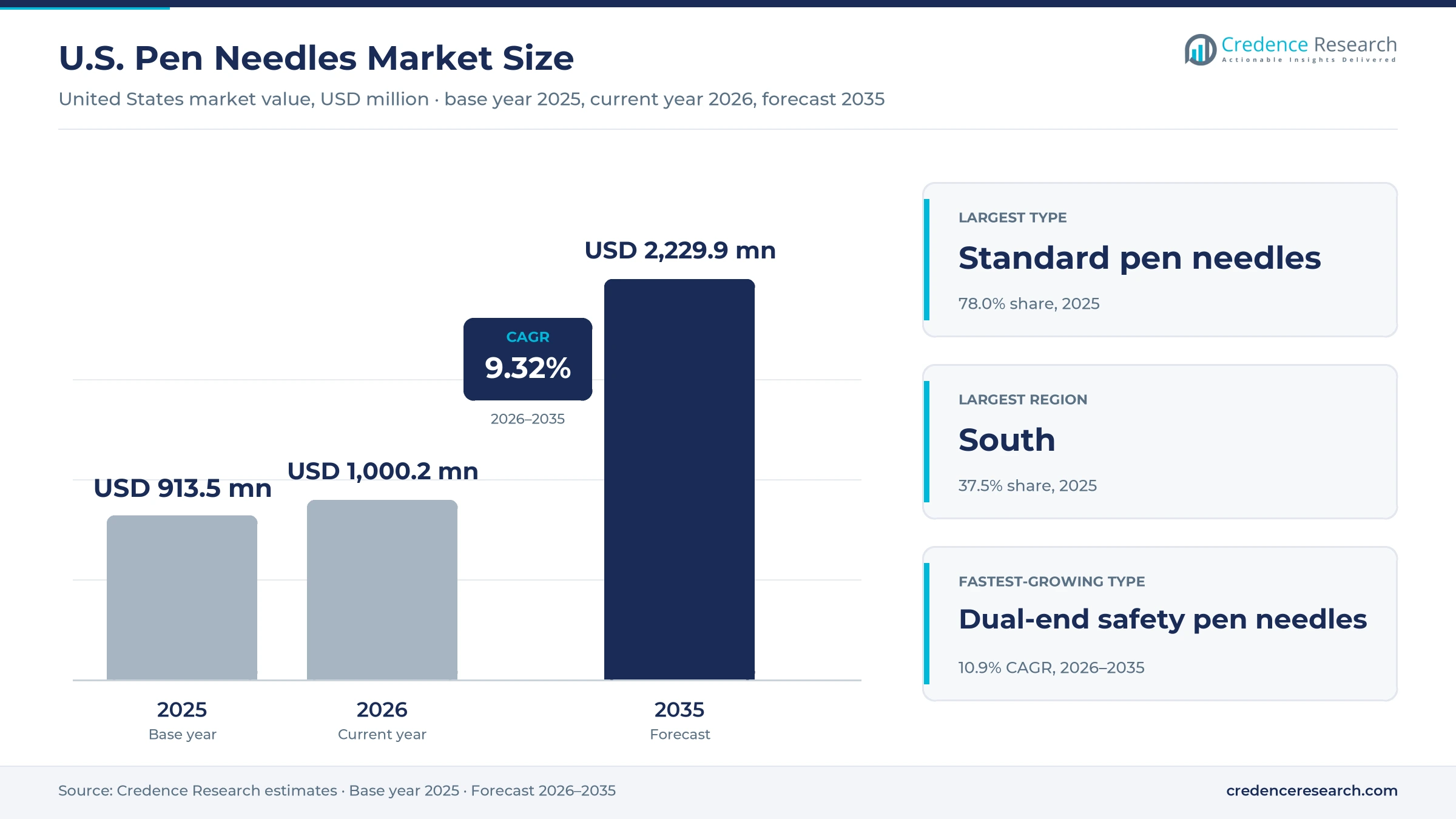
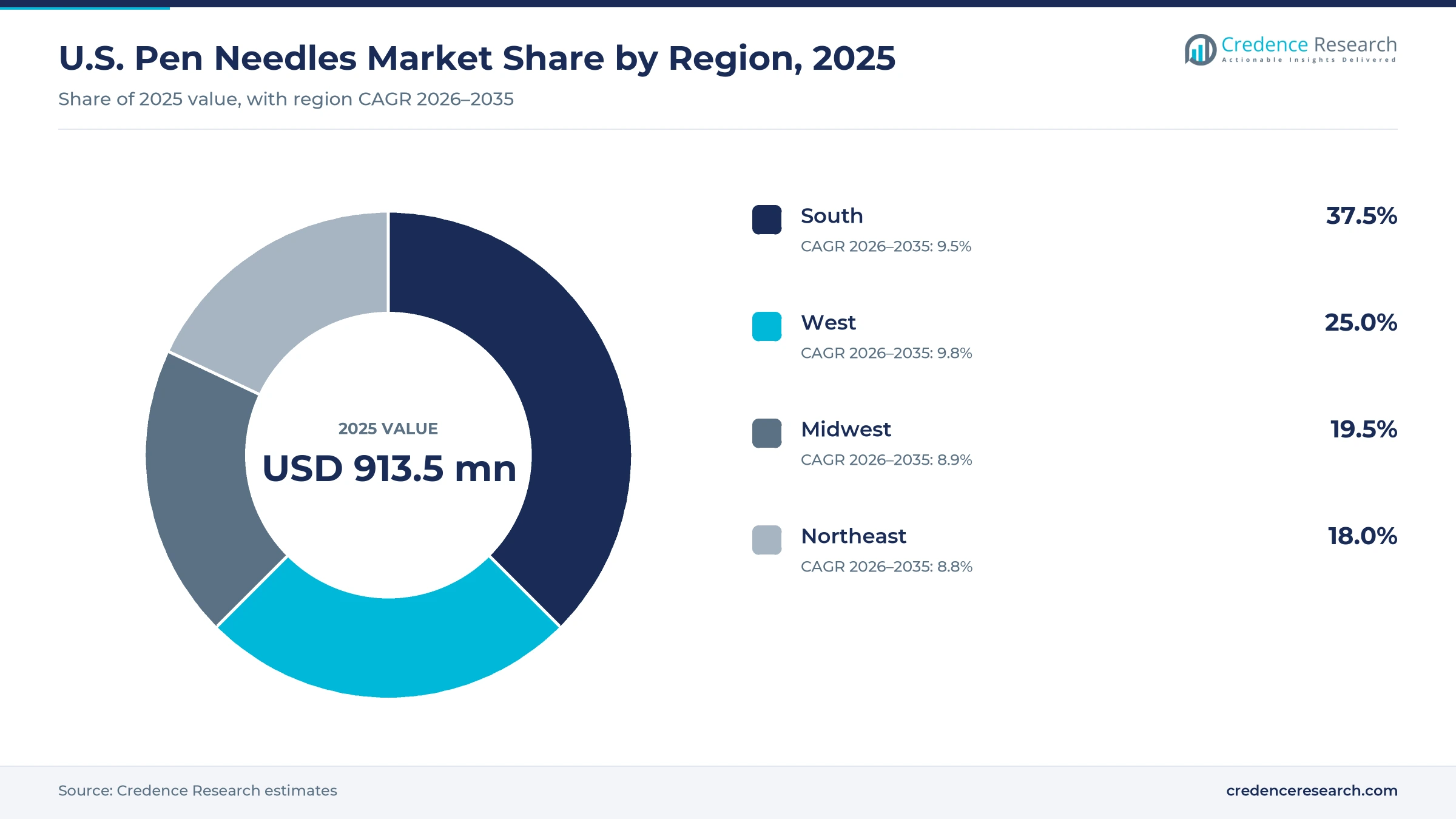
The U.S. pen needles market was valued at USD 913.5 million in 2025 and is projected to increase from USD 1.00 billion in 2026 to USD 2.23 billion by 2035, registering a CAGR of 9.32% during 2026–2035. Demand comes from people who inject insulin several times a day and from patients on multi-dose GLP-1 pens that need a separate needle for each weekly injection. The South held the largest regional share, 37.5% in 2025, because diabetes prevalence is highest in its states, while the West is the fastest-growing region at 9.8% a year. Retail pharmacies dispense most volume, with needles refilled alongside insulin and GLP-1 prescriptions. The most important commercial change is the move of tirzepatide into a four-dose pen that ships without needles, which adds a new stream of pharmacy needle fills outside the insulin base. Supply is concentrated in a few device makers, and private-label and newly cleared Asian products are pushing prices down at the low end.
Pharmacy refills carry most U.S. pen needle volume
The market counts single-use needles that screw or click onto reusable and prefilled injection pens, sold for insulin, GLP-1 drugs, growth hormone and bone-building therapies. Most patients buy them at a pharmacy on a prescription that is refilled with the drug, while hospitals and long-term care sites buy safety versions through distributors and purchasing groups.
The count excludes insulin syringes, needles fixed inside single-dose autoinjectors, needles packed free inside drug cartons and the pens themselves. Value sits with the device makers and the pharmacies and distributors that dispense the boxes.
U.S. Pen Needles Market Insights
- The U.S. pen needles market rises from USD 913.5 million in 2025 to USD 2.23 billion by 2035, growing at 9.32% a year as injection volumes rise.
- The South held 37.5% of 2025 value, the largest share of any region, because its states report the highest adult diabetes prevalence.
- Standard pen needles held 78.0% of 2025 value, while dual-end safety pen needles grow fastest at 10.9% a year.
- The Zepbound KwikPen, launched in February 2026, needs a separate pen needle for every injection, opening a GLP-1 refill stream.
- embecta completed its purchase of Owen Mumford on May 15, 2026, joining two established needle brands under one owner.
Standard 4 mm needles lead as safety formats gain
Standard needles dominate home use while safety formats win sites of care
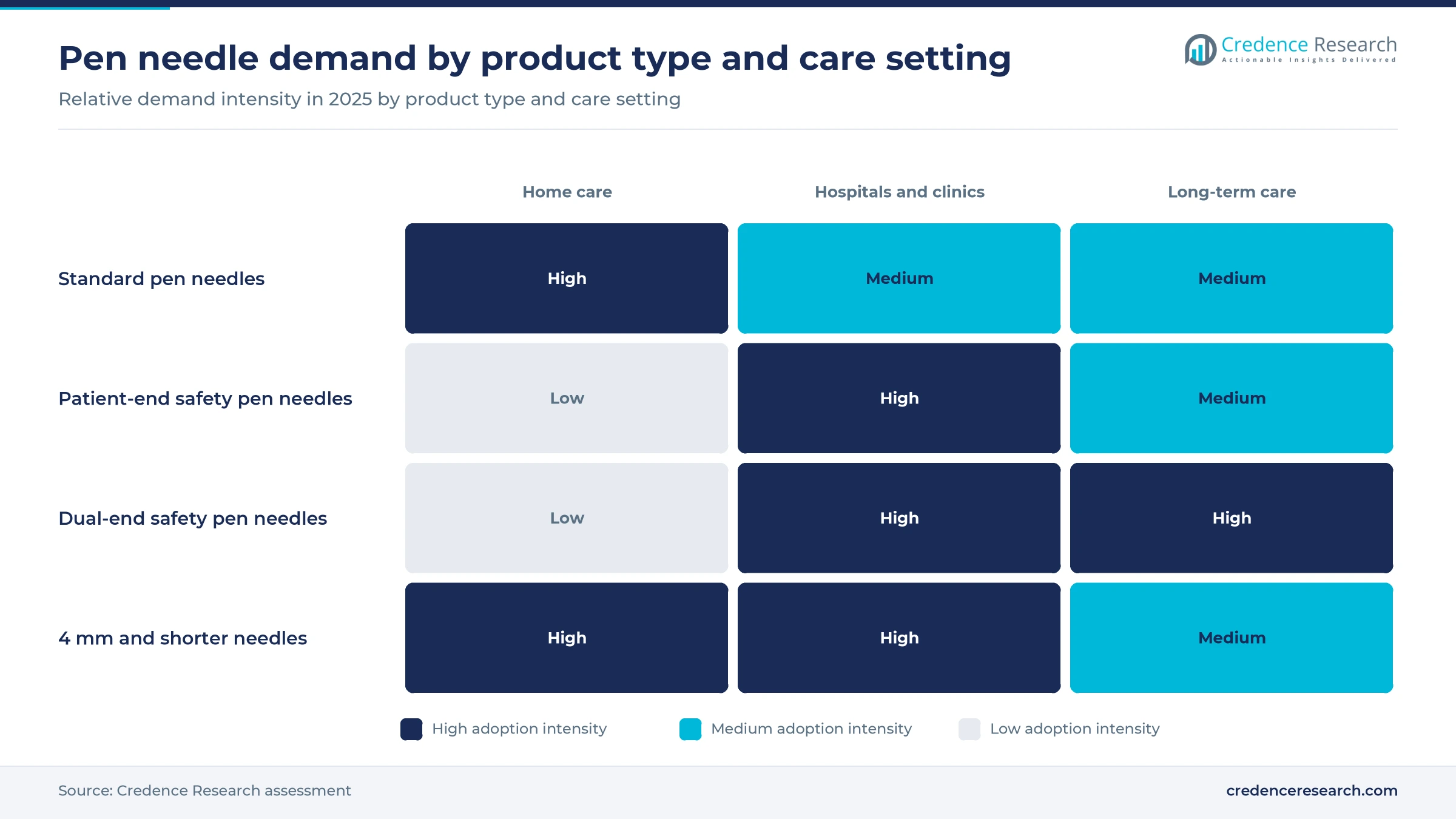
Based on product type, the market is categorized into standard pen needles, patient-end safety pen needles and dual-end safety pen needles. Standard pen needles led with 78.0% of 2025 value because home users buy the lowest-cost boxes, and Walmart sells its ReliOn 4 mm needles for about 14 cents each. Dual-end safety pen needles grow fastest at 10.9% a year as more makers enter the format, including a Ningbo Medsun needle with shields at both ends that the FDA cleared on March 18, 2026. Hospitals and nursing homes pay more for these shielded formats because staff injuries carry legal and treatment costs that outweigh the price difference.
Insulin remains the base while GLP-1 pens add the new volume
Based on disease area, the market is categorized into insulin-treated diabetes, GLP-1-treated metabolic disease and hormonal and bone disorders. Insulin-treated diabetes led with 72.0% of 2025 value because about 3.8 million Medicare beneficiaries use insulin, according to a JAMA study published in March 2026, and many inject several times a day. GLP-1-treated metabolic disease grows fastest at 11.8% a year as multi-dose GLP-1 pens move into wider use. Weekly dosing means each GLP-1 patient uses far fewer needles than an insulin patient, so value growth depends on patient numbers.
Retail pharmacies dispense most boxes as online fills grow
Based on distribution channel, the market is categorized into retail pharmacies, hospital supply channels, online pharmacies and specialty pharmacies. Retail pharmacies led with 58.0% of 2025 value because Part D plans cover needles used to deliver insulin under a CMS memo of Jan. 5, 2018, so most boxes are filled at the counter with the drug. Online pharmacies grow fastest at 11.5% a year as the Zepbound KwikPen launched through LillyDirect Pharmacy. Mail delivery suits patients who pay cash and refill needles with a monthly pen.
Short needles lead as injection guidance settles on 4 mm
Based on needle length, the market is categorized into 4 mm and shorter, 5-6 mm and 8-12 mm needles. Needles of 4 mm and shorter led with 46.0% of 2025 value, and the same group grows fastest at 10.2% a year, because injection guidance summarized by Pharmacy Times in March 2026 recommends a 4 mm needle for all patients. Adult skin averages 2.0 to 2.5 mm thick regardless of body size, so a short needle reaches fat tissue without entering muscle. Long needles persist mainly through older prescriptions that pharmacies refill without change.
| Segment Group | Leading Sub-segment | Share, 2025 | Fastest-growing Sub-segment | CAGR, 2026–2035 |
|---|---|---|---|---|
| By Product Type | Standard pen needles | 78.0% | Dual-end safety pen needles | 10.9% |
| By Disease Area | Insulin-treated diabetes | 72.0% | GLP-1-treated metabolic disease | 11.8% |
| By Distribution Channel | Retail pharmacies | 58.0% | Online pharmacies | 11.5% |
| By Needle Length | 4 mm and shorter | 46.0% | 4 mm and shorter | 10.2% |
Retail needles cost cents, safety formats cost more
Pen needles are priced per box of 50 or 100, and a patient on four insulin injections a day uses about 120 needles a month. Private-label boxes set the floor, as the Walmart listing in the table shows, while safety needles such as AutoShield Duo list at about ten times the private-label price per needle, and branded standard needles sit in between. Pharmacy benefit managers decide which brand is preferred on a formulary, so makers compete on rebates rather than list price. embecta reported unfavorable price changes in its Aug. 7, 2026, results, and cash buyers of GLP-1 pens pay the full shelf price, which favors cheaper brands.
| Offer or benchmark | Typical price or fee | Basis |
|---|---|---|
| ReliOn 4 mm 32G pen needles, 50 count | USD 7.17 a box, about 14 cents a needle | Walmart listing, November 2026 |
| Unifine Pentips 6 mm 31G, 100 count | USD 19.28 to 27.40 a box | State Surgical Supply listing, November 2026 |
| AutoShield Duo 5 mm safety pen needles, 100 count | USD 141.28 a box, about USD 1.41 a needle (list USD 179.85) | Tiger Medical listing, November 2026 |
| Zepbound KwikPen therapy, needles extra | From USD 299 a month for the drug | Healio, January 2026 |
Request a Free Sample
Fill in your details and we'll send you a free sample report.
- Sample data tables & charts
- Research methodology
Insulin refills and multi-dose GLP-1 pens drive volume
Recurring injection demand and pharmacy replenishment
Insulin users replace needles with every injection, so the market behaves like a refill business rather than an equipment sale. The CDC estimates that 40.1 million Americans had diabetes in 2023, and 314,000 people younger than 20 live with type 1 diabetes and inject daily. A JAMA study published March 19, 2026, found that the share of Medicare insulin users paying $35 or less a month rose from 48% in 2019 to 75% in 2023 after the Inflation Reduction Act cap. Cheaper insulin keeps patients filling prescriptions, and pharmacists are advised to refill needles with insulin, which ties needle volume to adherence.
Eligible GLP-1 therapy expansion into multi-dose pens
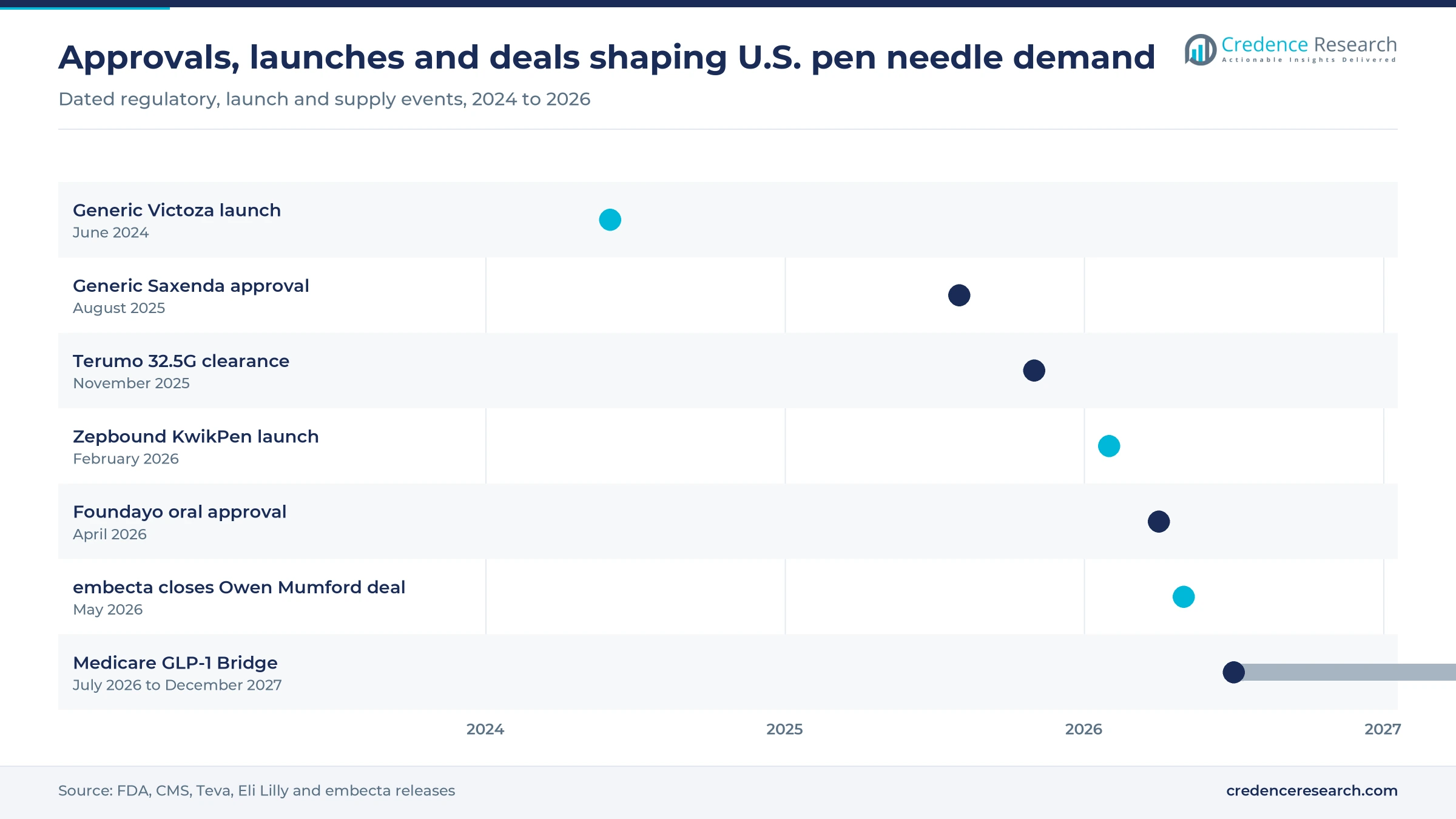
GLP-1 therapy adds needle demand only when the drug comes in a multi-dose pen, and that format is spreading. KFF found in November 2025 that 12% of U.S. adults were taking a GLP-1 receptor agonist or similar drug. HCPLive reported that the Zepbound KwikPen, launched Feb. 23, 2026, does not include pen needles, so each of its four weekly doses needs a separately bought needle. Teva launched an authorized generic of Victoza on June 24, 2024, and won approval for generic Saxenda on Aug. 28, 2025, both daily liraglutide pens. Daily liraglutide use generates about 365 needles a patient a year, against 52 for a weekly pen, which makes generic liraglutide a strong volume source.
Safety procurement and short-needle differentiation
Sites of care buy safety pen needles to protect staff, and makers differentiate home products on length and comfort. The CDC estimates about 385,000 needlesticks and other sharps injuries to hospital-based health care personnel each year, which keeps safety devices and sharps containers on hospital purchasing lists. OSHA's bloodborne pathogens standard requires employers to consider and document safer medical devices, such as sharps with engineered injury protection, every year, which keeps shielded pen needles in hospital and nursing home tenders. Shielded formats are the fastest-growing product type, with dual-end safety pen needles rising 10.9% a year, while short 4 mm needles hold 46.0% of value. Makers that offer both short and shielded options win hospital contracts and pharmacy formulary slots together.
An older population brings GLP-1 coverage into Medicare
Aging enlarges the injecting population because diabetes and obesity treatment rises with age and Medicare pays for more of it. The Census Bureau reported in June 2025 that the U.S. population aged 65 and older rose 3.1% in one year to 61.2 million, or 18.0% of the population. The Medicare GLP-1 Bridge started July 1, 2026, with a $50 monthly copay, and the CMS pharmacy guide covers the Zepbound KwikPen but not single-dose Zepbound pens or vials. That rule steers older tirzepatide patients to the format that needs separate needles, so Medicare growth now feeds needle refills directly, most of all in the South with its large older and diabetic population.
Thinner needles and supplier consolidation reshape supply
A shift to thinner and shorter needles in new clearances
New products push gauge and length down to cut injection pain and the risk of entering muscle. The FDA cleared Terumo's Pen Injector Needle 32.5, a gauge between 32G and 33G, on Nov. 21, 2025. On Jan. 6, 2026, it cleared an HH Global Technology pen needle line that includes a 3.5 mm length, shorter than the predicate devices. Injection guidance summarized in March 2026 recommends 32G needles with a five-bevel tip because they reduce pain without being too fragile. The 4 mm and shorter group grows at 10.2% a year, and buyers should expect premium pricing to shift from length to tip design.
Rising supplier consolidation around the market leader
Ownership is concentrating as the largest maker buys capacity and drops side projects such as its insulin patch pump. embecta completed its acquisition of Owen Mumford Holdings on May 15, 2026, adding the Unifine needle brand and an autoinjector platform. embecta's results of Aug. 7, 2026, confirm the pump exit and a planned U.S. launch of a GLP-1 small pack in the fiscal fourth quarter. Ypsomed, which sells Clickfine needles, plans to supply U.S. customers with self-injection products from its first U.S. site in Holly Springs, North Carolina, from the end of 2027. Fewer independent brands strengthen the leader with pharmacy benefit managers, but they also give hospital buyers a reason to qualify second sources.
GLP-1 small packs give needle makers a new pharmacy format
Needle makers can sell boxes sized to a monthly GLP-1 pen instead of the 90-day insulin box. embecta plans a U.S. GLP-1 small pack launch and already supplies its needles in commercial packs with generic GLP-1 drugs in Canada and Brazil, according to its Aug. 7, 2026, release. A Zepbound KwikPen delivers four weekly doses, so a monthly patient needs only four needles plus spares. GLP-1-treated metabolic disease grows at 11.8% a year, and the supplier that pairs a small pack with each generic liraglutide or multi-dose pen launch can win the fill at the counter. Pharmacies also gain, because a right-sized box reduces waste and makes the needle refill easier to add to each monthly GLP-1 prescription.
Online pharmacies offer an opening for cash-pay needle sales
Cash-paying GLP-1 patients buy their drug online and need a convenient way to add needles to the same order. The Zepbound KwikPen is sold through LillyDirect Pharmacy, and Novo Nordisk opened NovoCare Pharmacy on March 5, 2025, to ship Wegovy directly to cash-paying patients for $499 a month. Walmart sells its ReliOn needles online at the private-label price shown in the pricing table. Online pharmacies grow at 11.5% a year, the fastest channel, because these patients rarely visit a pharmacy counter. Large retail pharmacy chains still hold most refills, but their own home delivery services now compete for the same cash-pay orders. Brands that secure placement on direct-to-patient drug platforms and in subscription refills can win cash buyers without paying for formulary rebates.
Oral GLP-1 pills and bundled needles cap volume
Oral GLP-1 drugs remove needle demand at the start of therapy
Pills take some new GLP-1 patients out of the injection market before they ever buy a needle. The FDA approved the Wegovy pill in December 2025, and it approved Lilly's Foundayo, a once-daily oral GLP-1, on April 1, 2026. Patients who prefer tablets will not generate needle refills, and the GLP-1 segment forecast assumes most higher-dose and Medicare patients stay on pens. Needle makers can mitigate the risk by leaning on insulin and generic liraglutide volumes.
Needles packed inside drug cartons bypass the pharmacy box
Some drug makers pack needles with the pen, which removes the separate purchase. Each Ozempic carton contains NovoFine Plus needles, 4 to 6 per pen depending on strength, according to Drugs.com, so the patient rarely buys another box. Single-dose autoinjectors such as Wegovy and the single-dose Zepbound pen carry a fixed needle and need none at all. Makers of insulin delivery devices that also sell needles lose this volume unless they win supply contracts with the drug makers themselves.
Private-label prices squeeze branded needle margins
Low-cost boxes set a price ceiling that branded makers struggle to exceed in cash and formulary sales. The ReliOn price and the price erosion embecta reported, both noted in the pricing section, anchor cash sales. New 510(k) clearances for Chinese makers such as Ningbo Medsun and HH Global Technology add more low-cost options. Branded makers respond with comfort features and patient education, but pharmacy benefit managers often prefer the cheapest equivalent.
Coverage rules written for insulin leave GLP-1 patients paying
Medicare Part D rules define covered injection supplies around insulin, so GLP-1-only patients can face the full needle price. The CMS memo of Jan. 5, 2018, lists syringes, needles, alcohol swabs and gauze as supplies directly associated with delivering insulin. A patient on the Zepbound KwikPen who does not use insulin may pay cash for needles, which pushes buyers toward cheaper brands. Clear plan guidance or a change in the definition would lift branded needle sales.
The South leads on the highest diabetes prevalence
| Region | Value, 2025 (USD million) | Share, 2025 | CAGR, 2026–2035 |
|---|---|---|---|
| South | 342.6 | 37.5% | 9.5% |
| West | 228.4 | 25.0% | 9.8% |
| Midwest | 178.1 | 19.5% | 8.9% |
| Northeast | 164.4 | 18.0% | 8.8% |
The South leads on the heaviest diabetes burden
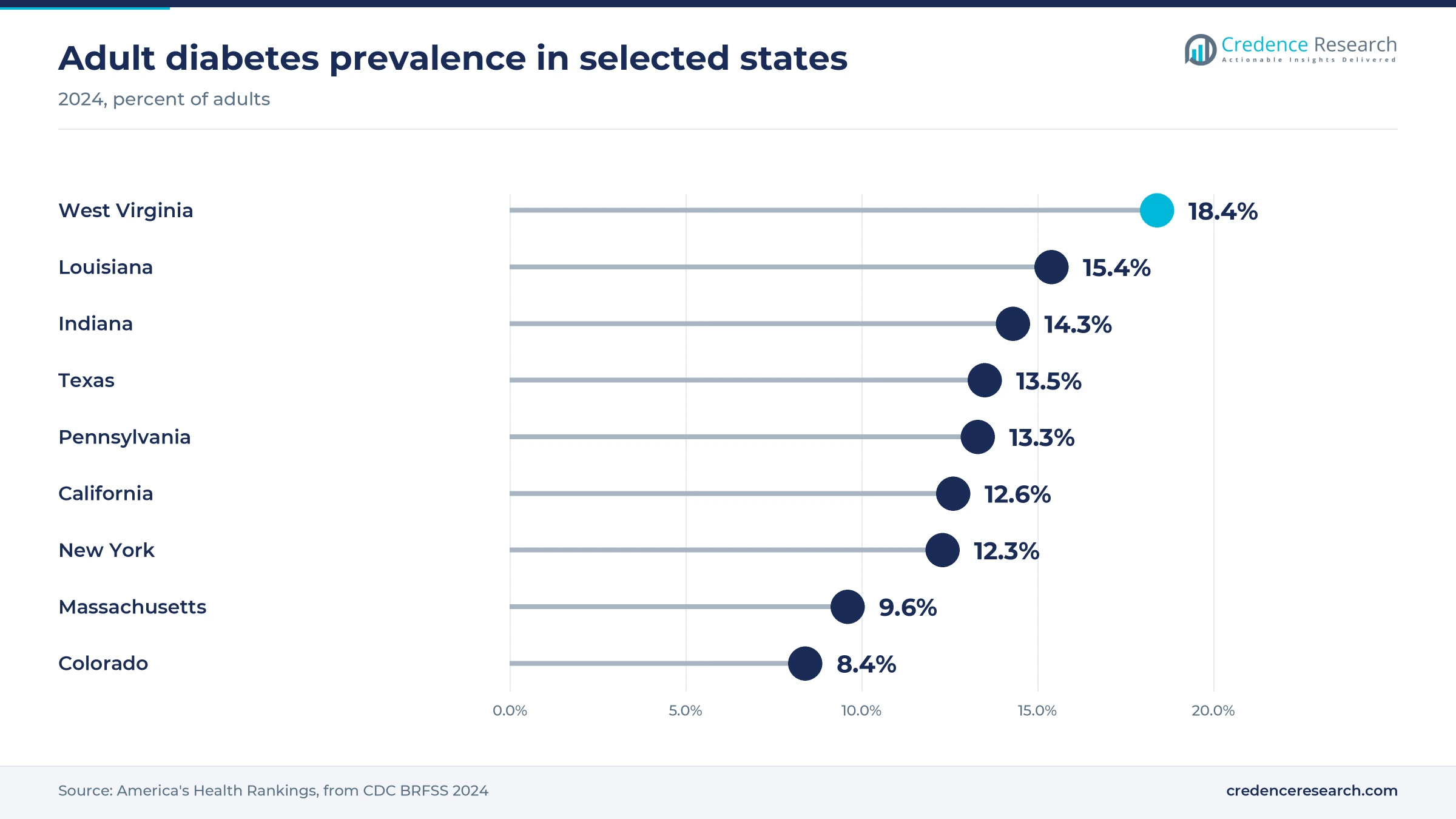
The South held 37.5% of 2025 value and grows at 9.5% a year, the largest regional base. America's Health Rankings, using 2024 CDC survey data, reports adult diabetes prevalence of 18.4% in West Virginia, 15.4% in Louisiana and 13.5% in Texas, all above the national average. High insulin use in these states keeps retail needle fills high, and grocery pharmacy chains such as Publix list branded safety needles through discount-card programs.
The West grows fastest on GLP-1 uptake and population gains
The West held 25.0% of 2025 value and is the fastest-growing region at 9.8% a year. California, the largest state market, reports adult diabetes prevalence of 12.6%, while Colorado records the lowest rate in the country at 8.4%. Growth comes from faster population growth in Mountain states and from higher cash-pay GLP-1 use through online pharmacies, which favors smaller GLP-1 needle packs over the large insulin box.
The Midwest holds steady on insulin refills
The Midwest held 19.5% of 2025 value and grows at 8.9% a year. Indiana reports adult diabetes prevalence of 14.3% and Michigan 13.6%, both above the national rate, while Minnesota sits at 10.1%. Slower population growth limits new patients, so demand depends on refills by existing insulin users and on hospital and long-term care contracts for safety needles in its large health systems.
The Northeast grows slowest from a low prevalence base
The Northeast held 18.0% of 2025 value and grows at 8.8% a year, the slowest pace of the four regions. Massachusetts reports adult diabetes prevalence of 9.6% and New York 12.3%, below several Southern states, while Pennsylvania sits at 13.3%. Dense hospital networks give the region a higher share of safety needle purchases through distributors, which partly offsets slower growth in home use.
Approvals and acquisitions from 2024 to 2026
| Development | Status and market relevance |
|---|---|
| In June 2024, Teva launched an authorized generic of Victoza, the first generic GLP-1 drug in a daily pen in the United States. | Launched; adds daily liraglutide pen needle demand |
| In November 2025, the FDA cleared Terumo's Pen Injector Needle 32.5 through the 510(k) pathway. | Cleared; ultra-thin needle option for U.S. patients |
| In February 2026, Eli Lilly launched the four-dose Zepbound KwikPen, which ships without pen needles. | On market; needles bought separately for each injection |
| In March 2026, the FDA cleared a Ningbo Medsun safety pen needle with patient-end and cartridge-end protection. | Cleared; lower-cost dual-end safety entrant |
| In May 2026, embecta completed its acquisition of Owen Mumford Holdings, owner of the Unifine needle brand. | Completed; consolidates two needle brands |
Gauge, length and shielding decide product choice
- Short 4 mm needles reach fat tissue through skin that averages 2.0 to 2.5 mm thick and lower the risk of injecting into muscle.
- Thin 32G to 34G cannulas reduce injection pain, and new clearances push gauges beyond 32G with thin-wall designs.
- Contoured needle bases spread force on the skin and cut the modeled chance of an intramuscular injection two- to eightfold against standard posted-hub designs.
- Dual-end safety shields cover both the patient end and the cartridge end after use, protecting staff who remove needles from pens.
Need a Custom Version of This Report?
Tailor the scope, geography, or segments to your exact requirements.
- Custom geography or segment scope
- Direct access to our analyst team
One incumbent faces private label and Asian makers
Competition in the U.S. pen needle market turns on formulary status, pharmacy shelf presence and hospital contracts rather than on list price alone. embecta holds the broadest position across retail pharmacies and pharmacy benefit managers, and its acquisition of Owen Mumford adds the Unifine brand and an autoinjector platform. Novo Nordisk supplies NovoFine Plus needles inside its own pen cartons, which keeps that volume outside the open market. Ypsomed and Terumo compete with Clickfine and ultra-thin needles, mostly through distributors and sites of care. Walmart's ReliOn private label sets the retail price floor, and Chinese makers such as Ningbo Medsun and HH Global Technology are entering with newly cleared standard and safety needles. Suppliers that pair low prices with GLP-1 pack sizes and safety options are best placed as volume shifts toward weekly pens.
One incumbent, a few branded rivals and a growing low-cost tier
Supply has three layers. embecta, which now sells the needles once branded BD, is the incumbent with the widest pharmacy and formulary presence, and its purchase of Owen Mumford removed one of its main branded rivals. Novo Nordisk, Ypsomed and Terumo form a second tier tied to their own pens or to hospital contracts. Private-label lines such as Walmart ReliOn and newly cleared Chinese makers form a low-cost tier. Entry barriers are moderate, because a 510(k) clearance is needed, but winning formulary placement and pharmacy shelf space is harder, so margins sit with the brands that hold preferred formulary status.
Pen needle suppliers and their U.S. roles
| Company | Type | Role in the market |
|---|---|---|
| embecta | Device maker | Broadest U.S. range across pharmacy and hospital channels; owner of Owen Mumford since May 2026 |
| Novo Nordisk | Drug and device maker | Packs NovoFine Plus needles inside Ozempic cartons |
| Owen Mumford | Device maker | Unifine Pentips brand sold through U.S. distributors |
| Ypsomed | Device maker | Clickfine pen needles; first U.S. self-injection site planned in North Carolina from late 2027 |
| Terumo Corporation | Device maker | Pen Injector Needle 32.5 cleared by the FDA in November 2025 |
| Ningbo Medsun Medical | Device maker | Dual-end safety pen needle cleared through the FDA 510(k) pathway |
| Walmart (ReliOn) | Retailer, private label | Low-cost 4 mm pen needles sold in stores and online |
Multi-dose GLP-1 pens are the swing factor to 2035
Credence Research's view is that insulin will keep supplying most needle volume to 2035, but the direction of growth will be set by GLP-1 dosage forms. Each multi-dose pen launch, such as the Zepbound KwikPen, adds a refill stream, while each oral approval removes one. Suppliers should treat generic liraglutide and Medicare GLP-1 coverage as near-term volume, build small-pack and online offers for cash buyers, and keep safety ranges ready for hospital and long-term care contracts. Buyers can expect price competition at the low end to continue as new low-cost makers win clearances.
Market values built from patient counts and needle use
The report uses 2025 as the base year and forecasts to 2035. Market values come from the Credence Research model, built from injecting patient counts, needles used per patient and net prices per needle by format. Regional, segment and care-setting splits are Credence Research estimates built from these same public inputs. Inputs include CDC and Census Bureau statistics, CMS program documents, FDA approvals and 510(k) records, a peer-reviewed JAMA study, company filings and announcements, and published retail price listings. No interviews or primary surveys were conducted for this report.
Volume growth holds as price pressure persists
The U.S. pen needles market is set to grow steadily to USD 2.23 billion by 2035, as insulin refills provide a stable base and multi-dose GLP-1 pens add new volume. Growth will be strongest in safety and short needles, in online channels and in the South and West. Price pressure from private label and new Asian makers will persist, so value growth will lag volume growth in standard needles. The key variable is the share of new GLP-1 patients who start on pills rather than pens, followed by any change to Part D supply coverage.
GLP-1 pen formats decide where the 2035 value lands
The range of outcomes depends mostly on the dosage form that GLP-1 makers choose and on how fast insulin users switch to automated delivery. A wider move to oral drugs and insulin pumps would cut needle use, while more multi-dose pens and generic liraglutide would lift it. Insulin volume is steadier, so most of the spread comes from GLP-1 therapy.
| Scenario | CAGR, 2026–2035 | Value, 2035 | What has to hold |
|---|---|---|---|
| Downside | 7.3% | USD 1.89 billion | Oral GLP-1 drugs take most new patients and pump use grows faster among insulin users |
| Base | 9.32% | USD 2.23 billion | Multi-dose GLP-1 pens and generic liraglutide grow while insulin refills stay steady |
| Upside | 10.8% | USD 2.52 billion | More GLP-1 drugs move to multi-dose pens and coverage extends to non-insulin needles |
Frequently Asked Questions
How big is the U.S. pen needles market?
Which product type leads the U.S. pen needles market?
Which region leads U.S. pen needle demand?
How do GLP-1 drugs affect pen needle demand?
Does Medicare cover pen needles?
Which needle length is recommended?
Who are the main pen needle suppliers in the United States?
What could slow the U.S. pen needles market?
Table of Content
Chapter 1 Market Segmentation
- 1.1 Segmentation Framework
- 1.1.1 Product and Service Classification
- 1.1.2 Application and End-Use Classification
- 1.1.3 Technology and Solution Classification
- 1.1.4 Customer and Distribution Channel Classification
- 1.1.5 Geographic Segmentation
- 1.1.6 Market Segment Definitions and Boundaries
- 1.2 By Product Type
- 1.2.1 Standard pen needles
- 1.2.2 Patient-end safety pen needles
- 1.2.3 Dual-end safety pen needles
- 1.3 By Disease Area
- 1.3.1 Insulin-treated diabetes
- 1.3.2 GLP-1-treated metabolic disease
- 1.3.3 Hormonal and bone disorders
- 1.4 By Needle Length
- 1.4.1 4 mm and shorter
- 1.4.2 5-6 mm
- 1.4.3 8-12 mm
Chapter 2 Introduction
- 2.1 Report Objectives and Scope
- 2.2 Product Definition and Industry Terminology
- 2.3 Market Inclusions and Exclusions
- 2.4 Research Process
- 2.4.1 Primary Research and Expert Interviews
- 2.4.2 Secondary Research and Source Review
- 2.4.3 Top-Down and Bottom-Up Estimation
- 2.4.4 Data Triangulation and Verification
- 2.5 Market Size Measurement Basis
- 2.5.1 2025: USD 913.5 million → 2035: USD 2.23 billion
- 2.6 Historical and Forecast Reference Periods
- 2.6.1 Historical Period: 2018-2025
- 2.6.2 Base Year: 2025
- 2.6.3 Forecast Period: 2025-2035
- 2.7 Research Assumptions and Limitations
Chapter 3 Executive Summary
- 3.1 Market Snapshot and Key Findings
- 3.2 Base-Year Market Size, 2025
- 3.3 Forecast Market Size, 2035
- 3.4 Revenue and Volume Growth Outlook
- 3.5 Key Demand and Supply Indicators
- 3.6 Leading Market Segments
- 3.7 Fastest-Growing Market Opportunities
- 3.8 Regional Performance Highlights
- 3.9 Technology and Industry Transformation
- 3.10 Competitive Landscape Summary
- 3.11 Analyst View and Strategic Implications
Chapter 4 U.S. Pen Needles Market Trends and Developments
- 4.1 Historical Industry Development, 2018-2025
- 4.2 Recent Market Trends and Developments
- 4.3 Demand and Customer Behavior Trends
- 4.4 Technology and Product Innovation
- 4.5 Artificial Intelligence, Automation and Digitalization
- 4.6 Local Manufacturing and Supply Chain Realignment
- 4.7 Industry Partnerships, Mergers and Acquisitions
- 4.8 Sustainability and Circular Economy Developments
- 4.9 Government and Private Sector Investment Trends
- 4.10 Emerging Business Models and Commercialization
- 4.11 Industry Developments and Announcements
Chapter 5 U.S. Pen Needles Market Production, Supply and Demand Analysis
- 5.1 Demand Trend and Consumption Analysis, 2018-2025
- 5.2 Demand Forecast, 2025-2035
- 5.3 Production and Output Trend, 2018-2025
- 5.4 Production and Output Forecast, 2025-2035
- 5.5 Installed Capacity and Capacity Utilization
- 5.6 Company-Wise Production Plants and Statistics
- 5.6.1 Installed Production Capacity
- 5.6.2 Actual Production
- 5.6.3 Planned Capacity and Expansion Targets
- 5.7 Supply Chain Structure and Procurement Trends
- 5.8 Supply-Demand Gap and Bottlenecks
- 5.9 Import Dependence and Sourcing Structure
- 5.10 Contract Manufacturing and Outsourcing
- 5.11 Regional Supply and Demand Concentration
Chapter 6 U.S. Pen Needles Market Pricing Analysis
- 6.1 Pricing Structure and Measurement
- 6.2 Historical Pricing Trends, 2018-2025
- 6.3 Pricing Outlook, 2025-2035
- 6.4 Average Selling Price and Unit Economics
- 6.5 Pricing by Product and Market Segment
- 6.6 Geographic Pricing Differences
- 6.7 Key Input, Energy, Labor and Logistics Costs
- 6.8 Contract Pricing and Purchasing Models
- 6.9 Pricing Sensitivity and Competitive Positioning
- 6.10 Price, Margin and Profitability Implications
Chapter 7 U.S. Pen Needles Market Dynamics
- 7.1 Market Growth Drivers
- 7.1.1 Demand-Side Drivers
- 7.1.2 Technology and Innovation Drivers
- 7.1.3 Infrastructure and Investment Drivers
- 7.1.4 Regulatory and Policy Drivers
- 7.2 Market Restraints
- 7.2.1 Cost and Affordability Constraints
- 7.2.2 Technology and Adoption Barriers
- 7.2.3 Supply Chain and Operational Constraints
- 7.3 Market Challenges
- 7.3.1 Competitive Pressure and Margin Erosion
- 7.3.2 Skills, Infrastructure and Implementation Gaps
- 7.4 Emerging Market Opportunities
- 7.5 Market Dynamics Impact and Time-Horizon Assessment
Chapter 8 U.S. Pen Needles Value Chain Analysis
- 8.1 Industry Value Chain Overview
- 8.2 Upstream Suppliers and Critical Inputs
- 8.3 Technology and Component Providers
- 8.4 Manufacturing or Service Delivery
- 8.5 Distribution, Channel Partners and Integrators
- 8.6 Downstream Applications and End Users
- 8.7 Value Addition and Profit Pools
- 8.8 Vertical Integration and Outsourcing
- 8.9 Supplier Concentration and Risk
- 8.10 Supply Chain Localization and Resilience
Chapter 9 U.S. Pen Needles Market Regulations and Policies
- 9.1 Relevant Laws, Standards and Compliance Frameworks
- 9.2 Product, Service, Safety and Quality Requirements
- 9.3 Government Policies, Incentives and Subsidies
- 9.4 Imports, Exports and Trade Barriers
- 9.5 Public Procurement and Local Content Requirements
- 9.6 Environmental and Sustainability Compliance
- 9.7 Upcoming Policy Changes and Market Implications
Chapter 10 U.S. Pen Needles Market Hotspots and Opportunities
- 10.1 Market Opportunity Mapping and Growth Hotspots
- 10.2 High-Growth Applications and Customer Groups
- 10.3 Underserved Markets and White-Space Opportunities
- 10.4 Emerging Technology and Product Opportunities
- 10.5 New Capacity and Investment Hotspots
- 10.6 Market Entry and Expansion Opportunities
- 10.7 Distribution and Partnership Opportunities
- 10.8 Near-Term and Long-Term Commercial Potential
- 10.9 Opportunity Attractiveness and Execution Risks
Chapter 11 U.S. Pen Needles Market Outlook, 2025-2035
- 11.1 Market Size and Analysis
- 11.1.1 Revenue (Market Measurement: 2025: USD 913.5 million → 2035: USD 2.23 billion)
- 11.1.2 Market Volume and Quantity Sold
- 11.1.3 Historical Market Size, 2018-2025
- 11.1.4 Base-Year Market Size, 2025
- 11.2 Market Forecast, 2025-2035
- 11.2.1 Revenue Forecast to 2035
- 11.2.2 Volume Forecast to 2035
- 11.2.3 CAGR and Year-on-Year Growth
- 11.2.4 Incremental Revenue Opportunity
- 11.3 Forecast Assumptions and Scenario Analysis
- 11.3.1 Base-Case Forecast
- 11.3.2 Optimistic and Conservative Scenarios
- 11.3.3 Technology, Pricing and Policy Sensitivities
- 11.4 Market Attractiveness and Growth Outlook
Chapter 12 U.S. Pen Needles Market Segmentation and Outlook
- 12.1 Segmentation Summary and Market Shares, 2025
- 12.2 Largest and Fastest-Growing Segments
- 12.3 By Product Type - Market Size and Forecast, 2025-2035
- 12.3.1 Segment Definition and Scope
- 12.3.2 Historical Market Size, 2018-2025
- 12.3.3 Revenue Forecast, 2025-2035
- 12.3.4 Volume Forecast, 2025-2035
- 12.3.5 Base-Year Market Share, 2025
- 12.3.6 Segment CAGR and Growth Drivers
- 12.3.7 Subsegment Market Size and Forecast
- 12.3.7.1 Standard pen needles
- 12.3.7.2 Patient-end safety pen needles
- 12.3.7.3 Dual-end safety pen needles
- 12.3.8 Subsegment Pricing and Adoption Trends
- 12.3.9 Leading Suppliers and Competition
- 12.3.10 Regional Demand and Opportunities
- 12.4 By Disease Area - Market Size and Forecast, 2025-2035
- 12.4.1 Segment Definition and Scope
- 12.4.2 Historical Market Size, 2018-2025
- 12.4.3 Revenue Forecast, 2025-2035
- 12.4.4 Volume Forecast, 2025-2035
- 12.4.5 Base-Year Market Share, 2025
- 12.4.6 Segment CAGR and Growth Drivers
- 12.4.7 Subsegment Market Size and Forecast
- 12.4.7.1 Insulin-treated diabetes
- 12.4.7.2 GLP-1-treated metabolic disease
- 12.4.7.3 Hormonal and bone disorders
- 12.4.8 Subsegment Pricing and Adoption Trends
- 12.4.9 Leading Suppliers and Competition
- 12.4.10 Regional Demand and Opportunities
- 12.5 By Needle Length - Market Size and Forecast, 2025-2035
- 12.5.1 Segment Definition and Scope
- 12.5.2 Historical Market Size, 2018-2025
- 12.5.3 Revenue Forecast, 2025-2035
- 12.5.4 Volume Forecast, 2025-2035
- 12.5.5 Base-Year Market Share, 2025
- 12.5.6 Segment CAGR and Growth Drivers
- 12.5.7 Subsegment Market Size and Forecast
- 12.5.7.1 4 mm and shorter
- 12.5.7.2 5-6 mm
- 12.5.7.3 8-12 mm
- 12.5.8 Subsegment Pricing and Adoption Trends
- 12.5.9 Leading Suppliers and Competition
- 12.5.10 Regional Demand and Opportunities
- 12.6 Segment Growth Comparison
- 12.7 Segment Attractiveness and Priority Matrix
Chapter 13 U.S. Pen Needles Geographic Market Outlook, 2025-2035
- 13.1 Domestic Market Distribution and Demand Clusters
- 13.2 State- or Province-Wise Market Size and Forecast, 2025-2035
- 13.3 City and Metropolitan Market Outlook
- 13.4 Industrial, Manufacturing and Commercial Clusters
- 13.5 Geographic Concentration of Key End Users
- 13.6 Local Pricing and Purchasing Differences
- 13.7 Domestic Production Facilities and Capacity Map
- 13.8 Local Infrastructure and Project Pipeline
- 13.9 State-Level Policy and Incentive Differences
- 13.10 Subnational Investment Hotspots and Opportunities
- 13.11 Distribution and Logistics Networks
- 13.12 Domestic Competitive Footprint
Chapter 14 U.S. Pen Needles Technology, Innovation and Sustainability Outlook
- 14.1 Technology Landscape and Maturity
- 14.2 Product, Process and Service Innovation
- 14.3 AI, Automation and Digital Tools in the Industry
- 14.4 Technology Adoption and Performance Benchmarking
- 14.5 Innovation Pipeline and R&D Investment
- 14.6 Patent and Intellectual Property Trends
- 14.7 Energy Efficiency and Resource Management
- 14.8 Sustainability, Recycling and Circularity
- 14.9 Technology Roadmap, 2025-2035
- 14.10 Risks of Obsolescence and Technology Substitution
Chapter 15 U.S. Pen Needles Market Key Strategic Imperatives
- 15.1 Growth and Market Entry Priorities
- 15.2 High-Return Products and Segments
- 15.3 Pricing, Profitability and Cost Optimization
- 15.4 Technology Investment and Product Differentiation
- 15.5 Supply Chain Localization and Resilience
- 15.6 Distribution and Customer Acquisition
- 15.7 Partnership, Acquisition and Capacity Strategy
- 15.8 Regional Expansion Priorities
- 15.9 Short-, Medium- and Long-Term Actions
Chapter 16 Competition Outlook
- 16.1 Industry Competition Characteristics
- 16.2 Market Structure and Concentration
- 16.3 Market Share and Competitive Positioning, 2025
- 16.4 Company-Wise Revenue and Product Benchmarking
- 16.5 Production and Service Capacity Benchmarking
- 16.6 Technology, Pricing and Differentiation
- 16.7 Regional Footprint and Distribution Strength
- 16.8 Mergers, Acquisitions and Strategic Alliances
- 16.9 New Entrants and Competitive Threats
- 16.10 Porter's Five Forces and Industry Attractiveness
- 16.11 Competitive Outlook, 2025-2035
Chapter 17 Company Profiles
- 17.1 Company Coverage and Selection Criteria
- 17.2 embecta
- 17.2.1 Business Description
- 17.2.2 Company Ownership and Geographic Presence
- 17.2.3 Product and Service Portfolio
- 17.2.4 Manufacturing and Operating Footprint
- 17.2.5 Production Capacity and Expansion Plans
- 17.2.6 Financial Performance and Investment
- 17.2.7 Market Share and Competitive Position
- 17.2.8 Technology and Innovation Capabilities
- 17.2.9 Strategic Alliances or Partnerships
- 17.2.10 Recent Developments
- 17.2.11 Growth Strategy and Outlook
- 17.3 Novo Nordisk
- 17.4 Owen Mumford
- 17.5 Ypsomed
- 17.6 Terumo Corporation
- 17.7 Ningbo Medsun Medical
- 17.8 HH Global Technology
- 17.9 Walmart (ReliOn)
- 17.10 Other Relevant Market Participants
Note: Every listed company is profiled on the structure shown under the first company. The company list is preliminary and may change based on research findings, market developments, data availability and client requirements.
Chapter 18 Disclaimer
- 18.1 Research and Forecast Disclaimer
- 18.2 Data Source and Estimation Limitations
Note: The depth of individual sections depends on data availability for this market. Volume, capacity, trade and other unit-based metrics are included where applicable.

