
Market Overview
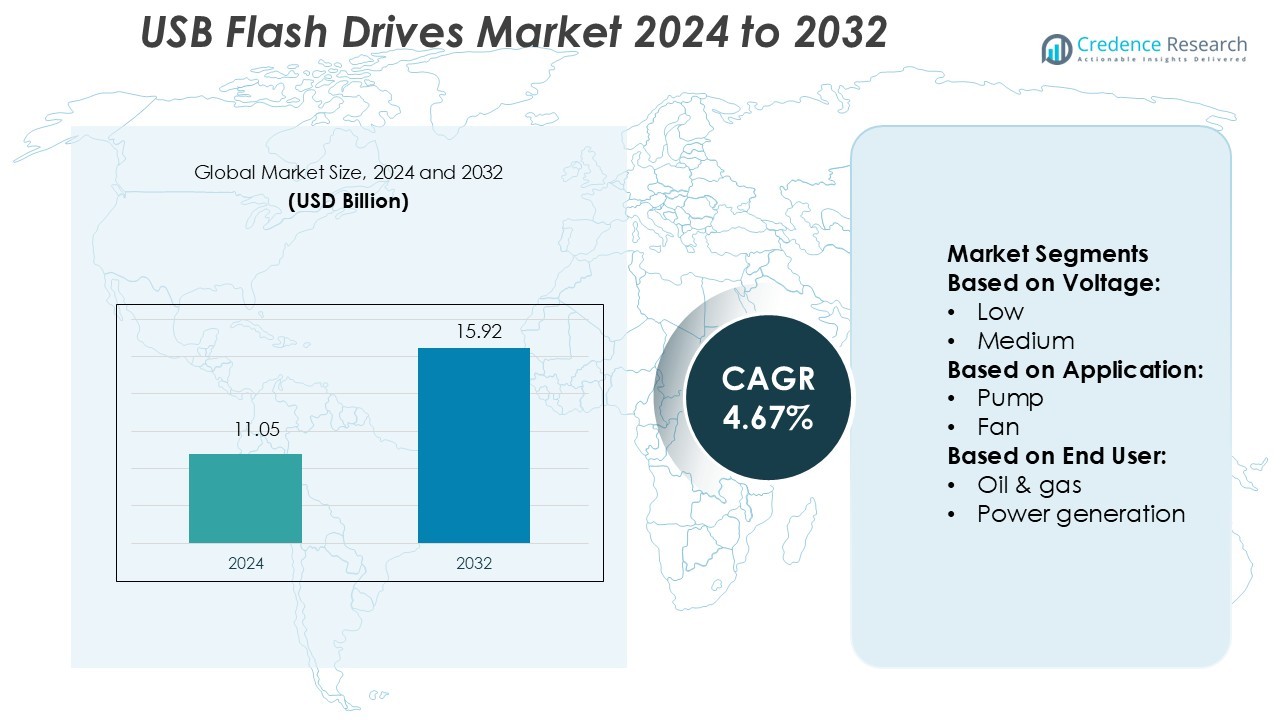
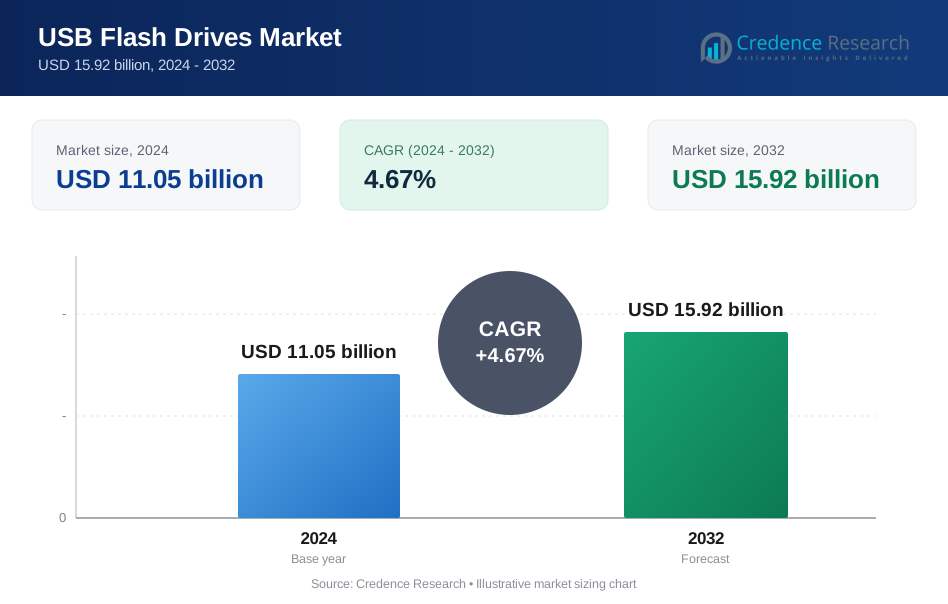
USB Flash Drives Market size was valued USD 11.05 billion in 2024 and is anticipated to reach USD 15.92 billion by 2032, at a CAGR of 4.67% during the forecast period.
| REPORT ATTRIBUTE | DETAILS |
|---|---|
| Historical Period | 2020-2023 |
| Base Year | 2024 |
| Forecast Period | 2025-2032 |
| USB Flash Drives Market Size 2024 | USD 11.05 Billion |
| USB Flash Drives Market , CAGR | 4.67% |
| USB Flash Drives Market Size 2032 | USD 15.92 Billion |
The USB flash drives market is dominated by major players such as Kingston Technology, SanDisk (Western Digital Corporation), Transcend Information Inc., Samsung Electronics Co., Ltd., Toshiba Corporation, Corsair Memory, Inc., HP Inc., Lexar, Verbatim Americas LLC, and PNY Technologies, Inc. These companies focus on developing high-speed, encrypted, and high-capacity flash drives catering to both consumer and industrial applications. Product innovation, durable designs, and USB Type-C compatibility remain key competitive strategies. North America leads the global market with a 35% share, driven by strong IT infrastructure, high enterprise adoption, and growing demand for secure data storage solutions across government and corporate sectors.
Market Insights
- The USB Flash Drives Market was valued at USD 11.05 billion in 2024 and is expected to reach USD 15.92 billion by 2032, growing at a CAGR of 4.67% during the forecast period.
- Increasing data mobility, demand for secure storage, and integration of USB Type-C technology are key drivers boosting market growth across industries.
- The market is witnessing a strong trend toward encrypted, high-capacity, and eco-friendly flash drives designed for consumer and enterprise applications.
- Competition remains intense, with leading players focusing on product innovation, enhanced data transfer speeds, and durable designs to strengthen global presence.
- North America dominates with a 35% market share, followed by Europe and Asia Pacific, while the consumer electronics segment holds the largest share due to rising adoption of portable data storage devices.
Market Segmentation Analysis:
By Voltage
The medium-voltage segment dominates the USB flash drives market, accounting for 57% of total revenue. Its leadership is driven by wide adoption in industrial and commercial automation systems requiring stable and efficient performance. Medium-voltage flash drives are favored for high endurance, better data integrity, and robust resistance to electrical noise, making them ideal for process-critical applications. The segment’s growth is also supported by ongoing upgrades in smart manufacturing and power control systems that depend on reliable embedded storage solutions.
- For instance, Parker Hannifin’s Global Vehicle Motor (GVM) Power Series permanent-magnet AC motors deliver continuous power outputs of up to 351 kW and peak power of up to 850 kW, with peak torque values reaching 2300 Nm.
By Application
The compressor segment holds the largest market share of 32% in the USB flash drives market. Compressors require consistent and durable data storage for system control, parameter monitoring, and performance analysis. USB flash drives are used to store operation logs, configuration files, and firmware updates in automation systems. Demand rises due to their compact size, fast transfer rates, and resilience to mechanical stress. The shift toward predictive maintenance and IoT-enabled compressor monitoring further supports market expansion in this segment.
- For instance, Johnson Controls’ FRICK® High-Pressure Rotary Screw Compressors handle inlet pressures up to 1,100 psi (76 bar) and are rated for drives up to 6,000 hp (4,474 kW).
By End-User
The oil and gas industry leads the market, capturing 38% of the total share. The segment benefits from growing digitalization in field operations, pipeline monitoring, and refinery automation. USB flash drives are widely used for transferring process control data, logging, and configuration backup in hazardous environments where network access is limited. Their rugged design, high read/write endurance, and secure data storage capabilities enhance reliability in critical conditions. The rising integration of data-driven control systems strengthens demand from this sector.
Key Growth Drivers
Rising Demand for Portable Data Storage
The increasing need for convenient and secure data transfer across personal and professional devices drives USB flash drive demand. These devices offer fast read/write speeds, plug-and-play functionality, and compact portability. Their use in education, business, and entertainment sectors continues to grow as cloud storage limitations and data security concerns persist. Additionally, flash drives support offline storage for sensitive information, enhancing data control. Manufacturers are introducing higher-capacity drives exceeding 1 TB, meeting the growing global data storage requirements.
- For instance, GE Vernova announced a strategic alliance with Massachusetts Institute of Technology (MIT) that includes a 50 million funding commitment over five years for research and development in electrification and decarbonisation.
Expansion of IT and Consumer Electronics Sectors
The rapid adoption of digital devices such as laptops, smart TVs, and gaming consoles boosts USB flash drive sales. Flash drives remain vital for file sharing, media transfer, and software updates across devices. The ongoing digital transformation in education, media, and enterprise sectors further enhances usage frequency. For instance, USB Type-C drives compatible with both PCs and smartphones have increased accessibility. Continuous innovation in USB 3.2 and USB 4.0 interfaces improves performance, supporting faster data transfer and seamless user experience.
- For instance, Hitachi Hi-Rel’s grid-tied solar inverter range includes central inverters rated at 2,500 kW at 50 °C and 2,700 kW at 25 °C, using three-level PWM technology achieving up to 99.0 % efficiency.
Growing Demand from Industrial and Automotive Applications
Industrial automation and connected vehicles increasingly use USB flash drives for firmware updates, data logging, and diagnostics. Their ruggedness, compact form, and durability make them ideal for harsh operational environments. The automotive sector integrates flash drives into infotainment and navigation systems to support secure and fast data handling. Similarly, factories use them to record real-time operational data for maintenance and analytics. The rising need for reliable local data backup solutions across non-cloud systems continues to strengthen industrial and automotive adoption.
Key Trends & Opportunities
Emergence of High-Capacity and Secure USB Drives
Technological advancements have enabled the development of USB drives with multi-terabyte storage and enhanced encryption. Demand for encrypted flash drives is increasing in sectors handling sensitive data, including healthcare, defense, and finance. Manufacturers are integrating biometric authentication, fingerprint sensors, and hardware-based AES encryption to improve data protection. The shift toward high-capacity drives, capable of storing 4K and 8K media files, opens new opportunities in creative and enterprise markets that require rapid, high-volume data transfer.
- For instance, Danfoss’ Digital Displacement® pump DDP096 delivers a maximum displacement of 96 cm³/rev, a peak outlet pressure of 450 bar (6,526 psi) and continuous operation at 420 bar (6,091 psi), controlled via the DPC12 controller through CAN J1939.
Adoption of USB Type-C and Dual-Interface Devices
The transition toward USB Type-C interfaces is reshaping the market landscape. Dual-interface flash drives compatible with both USB-A and USB-C ports address the needs of hybrid users operating across laptops, tablets, and smartphones. These devices enhance flexibility, ensuring compatibility with the latest consumer electronics. Their reversible design, faster charging, and improved transfer speeds make them increasingly preferred. As Type-C becomes standard across devices, its widespread integration will accelerate sales growth and foster product innovation.
- For instance, Nidec's E-Axle systems, including the recently mass-produced third-generation models (first unveiled in July 2025), feature the full integration of a motor, inverter, and gearbox in a compact unit. While earlier generations had weights such as 57 kg for a 135 kW second-generation unit (mass-produced from October 2022) and 87 kg for an initial 150 kW system.
Integration with IoT and Edge Computing Systems
USB flash drives are finding growing use in IoT and edge computing environments. They provide localized data caching, firmware updates, and secure boot capabilities in systems that operate without constant cloud connectivity. Industrial IoT devices often rely on flash drives to transfer analytics data for diagnostics and predictive maintenance. The trend supports secure, offline data handling, especially in critical infrastructure. This integration opens opportunities for manufacturers to develop specialized, high-endurance drives optimized for IoT environments.
Key Challenges
Rising Competition from Cloud Storage Solutions
Cloud storage platforms such as Google Drive and Dropbox offer seamless online access and data synchronization, reducing reliance on physical drives. The affordability of cloud subscriptions and increasing internet speeds make them an attractive alternative for consumers and businesses. This trend challenges USB flash drive manufacturers to differentiate through durability, security, and specialized industrial applications. Sustaining relevance in a cloud-dominated ecosystem requires continuous innovation and stronger value propositions around offline data protection and portability.
Data Security and Counterfeit Product Issues
Data breaches, malware risks, and counterfeit USB drives remain key market concerns. Unverified flash drives often lack encryption, exposing users to data loss and corruption. Low-quality counterfeit products entering global markets damage brand reputation and consumer trust. Manufacturers face challenges in maintaining product authenticity and implementing effective encryption without compromising usability. Strengthening supply chain monitoring and integrating advanced security features like hardware encryption and digital authentication remain critical to mitigating these risks.
Regional Analysis
North America North America holds the largest share of 35% in the USB flash drives market, supported by strong IT infrastructure and widespread digital adoption. The U.S. dominates due to high data storage needs across corporate, educational, and government sectors. Demand for encrypted and high-speed USB drives continues to grow, driven by cybersecurity compliance and data mobility requirements. Major manufacturers in the region focus on developing USB 3.2 and USB Type-C drives. The integration of flash drives into business continuity and disaster recovery strategies further strengthens market growth in the region.
Europe
Europe accounts for 27% of the global USB flash drives market, driven by technological innovation and data security regulations under GDPR. Germany, the U.K., and France are leading contributors, with strong demand from enterprise and educational sectors. The market benefits from a rising preference for encrypted and eco-friendly flash drives. Manufacturers emphasize sustainable materials and low-power consumption technologies. The increasing adoption of Type-C compatible devices in Europe also boosts product replacement cycles. Growing use in industrial automation and government data handling contributes to the region’s sustained market expansion.
Asia Pacific
Asia Pacific captures 28% of the USB flash drives market, making it a rapidly expanding region. China, Japan, South Korea, and India drive growth through strong electronics manufacturing and expanding digital economies. The surge in mobile device usage and online learning fuels high flash drive consumption. Competitive pricing and large-scale production enhance accessibility for both individual and enterprise users. Local manufacturers are focusing on USB 3.0 and 3.2 drives to meet speed and capacity demand. The region’s continued industrial and IT development supports consistent market growth.
Latin America
Latin America holds an 8% share in the global USB flash drives market, led by Brazil and Mexico. The increasing adoption of digital storage devices in education, small businesses, and government institutions supports market growth. Affordable USB drives are in high demand due to economic constraints and limited broadband access in remote areas. Regional players emphasize cost-effective and durable flash drives suited for emerging markets. The ongoing expansion of IT services and digital transformation programs in the region continues to create growth opportunities for manufacturers.
Middle East & Africa
The Middle East & Africa account for 7% of the global USB flash drives market. The region’s demand is rising due to increasing investments in education, IT infrastructure, and enterprise digitization. Countries such as the UAE, Saudi Arabia, and South Africa lead adoption, driven by government-led digitalization programs. USB drives are used extensively for data transfer and secure offline storage in sectors with limited cloud access. Growing consumer electronics penetration and expanding retail distribution networks strengthen market presence. The region’s preference for compact, durable, and encrypted drives continues to expand.
Market Segmentations:
By Voltage:
- Low
- Medium
By Application:
- Pump
- Fan
By End User:
- Oil & gas
- Power generation
By Geography
- North America
- U.S.
- Canada
- Mexico
- Europe
- Germany
- France
- U.K.
- Italy
- Spain
- Rest of Europe
- Asia Pacific
- China
- Japan
- India
- South Korea
- South-east Asia
- Rest of Asia Pacific
- Latin America
- Brazil
- Argentina
- Rest of Latin America
- Middle East & Africa
- GCC Countries
- South Africa
- Rest of the Middle East and Africa
Competitive Landscape
The USB flash drives market features strong competition among key players including Parker Hannifin, Johnson Controls, GE Vernova, Hitachi Hi-Rel Power Electronics, Danfoss, Emerson Electric, Nidec, Eaton, Fuji Electric, and ABB. The USB flash drives market is highly competitive, characterized by continuous innovation and product differentiation. Manufacturers focus on developing high-capacity, high-speed drives with enhanced data security and durability. Advancements in USB 3.2 and Type-C interfaces have led to faster transfer rates and broader device compatibility. Companies are investing in hardware encryption, biometric authentication, and rugged designs to meet growing security and industrial needs. The market also emphasizes eco-friendly materials and compact form factors to align with sustainability goals. Strategic partnerships with OEMs and IT providers help expand global distribution and strengthen brand presence.
Key Player Analysis
- Parker Hannifin
- Johnson Controls
- GE Vernova
- Hitachi Hi-Rel Power Electronics
- Danfoss
- Emerson Electric
- Nidec
- Eaton
- Fuji Electric
- ABB
Recent Developments
- In April 2025, ABB showcased the recently launched medium voltage drive, the ACS8080, along with other products, including the existing low voltage cabinet drive, the ACS880. This presentation highlighted the company's focus on innovative engineering and its commitment to energy efficiency and process control.
- In March 2025, Nidec Instruments Corporation, a subsidiary of Nidec Corporation, announced that it will begin accepting orders for the new S-FLAG DYNAMIC MOTION TM MB series motors, expanding the Company’s current lineup of S-FLAG AC servo motors available for purchase.
- In November 2024, Oriental Motor introduced its latest OVR Series of compact industrial robots, including articulated, Cartesian, and SCARA designs. The αSTEP Hybrid AZ Series step-servo motors power the robots.
- In August 2024, Yaskawa announced an expansion to the GA800 variable speed drive product line, which was originally introduced in 2019. The GA800 is a versatile solution for controlling various motor technologies and caters to a broad spectrum of applications, including simple fans and pumps as well as complex test dynamometers that demand precise control.
Report Coverage
The research report offers an in-depth analysis based on Voltage, Application, End-User and Geography. It details leading market players, providing an overview of their business, product offerings, investments, revenue streams, and key applications. Additionally, the report includes insights into the competitive environment, SWOT analysis, current market trends, as well as the primary drivers and constraints. Furthermore, it discusses various factors that have driven market expansion in recent years. The report also explores market dynamics, regulatory scenarios, and technological advancements that are shaping the industry. It assesses the impact of external factors and global economic changes on market growth. Lastly, it provides strategic recommendations for new entrants and established companies to navigate the complexities of the market.
Future Outlook
- The demand for encrypted and secure USB flash drives will continue to increase across industries.
- USB Type-C and dual-interface drives will dominate due to cross-device compatibility.
- High-capacity drives with multi-terabyte storage will gain strong adoption in enterprise use.
- Manufacturers will focus on integrating biometric and hardware-based authentication features.
- The shift toward eco-friendly and recyclable materials will shape product development strategies.
- Growth in IoT and edge computing will create new applications for rugged USB drives.
- Educational
and corporate sectors will sustain strong demand for portable data storage devices.
- Emerging markets in Asia Pacific and Latin America will drive future volume growth.
- Cloud and physical storage integration will enhance hybrid data management solutions.
- Continuous innovation in speed, security, and durability will define the next phase of market evolution.
Request a Free Sample
Fill in your details and we'll send you a free sample report.
- Sample data tables & charts
- Research methodology
Need a Custom Version of This Report?
Tailor the scope, geography, or segments to your exact requirements.
- Custom geography or segment scope
- Direct access to our analyst team
Frequently Asked Questions
What is the current market size for the USB Flash Drives Market, and what is its projected size in 2032?
At what Compound Annual Growth Rate is the USB Flash Drives Market projected to grow between 2025 and 2032?
Which USB Flash Drives Market segment held the largest share in 2024?
What are the primary factors fueling the growth of the USB Flash Drives Market?
Who are the leading companies in the USB Flash Drives Market?
Which region commanded the largest share of the USB Flash Drives Market in 2024?
Table of Content
Chapter 1. Report Introduction
- 1.1 Report Description & Purpose
- 1.1.1 Report Title & Market Definition
- 1.1.2 Unique Selling Propositions (USP) & Key Differentiators
- 1.1.3 Value Proposition for Stakeholders
- 1.2 Research Objectives
- 1.2.1 Market Sizing Objectives (Volume & Revenue)
- 1.2.2 Segmentation Objectives
- 1.2.3 Competitive Intelligence Objectives
- 1.2.4 Forecast & Scenario Objectives
- 1.3 Report Scope
- 1.3.1 USB Flash Drives Scope – Types & Subtypes Covered
- 1.3.2 Geographic Scope – Regions & Countries Covered
- 1.3.3 Historical Period, Base Year & Forecast Period (2024; forecast to 2032)
- 1.3.4 Inclusions & Exclusions
- 1.4 HS Code & Classification Framework
- 1.5 Currency, Units & Pricing Basis
- 1.6 Target Stakeholders
- 1.7 Limitations & Assumptions
Chapter 2. Executive Summary
- 2.1 Global USB Flash Drives Market Snapshot
- 2.1.1 Market Size – Historical (2024) & Forecast (2024-2032) (2024: USD 11.05 billion → 2032: USD 15.92 billion)
- 2.1.2 Volume & Revenue – Global Totals
- 2.1.3 Key Market Highlights – Top Five Facts
- 2.2 USB Flash Drives Market Segmentation Snapshot
- 2.2.1 Market Split by Region – 2024 vs. 2032
- 2.3 Competitive Snapshot
- 2.3.1 Top 10 Players by Revenue Share – 2024
- 2.3.2 Top 10 Players by Volume Share – 2024
- 2.3.3 Recent Strategic Developments (18-Month Summary)
- 2.4 Key Investment Highlights & Strategic Conclusions
Chapter 3. USB Flash Drives Market Dynamics & Industry Analysis
- 3.1 Market Overview & Context
- 3.1.1 USB Flash Drives Market Position in the Broader Automotive Value Chain
- 3.1.2 OEM vs. Replacement Market Dynamics
- 3.1.3 Market Maturity & Development Stage by Region
- 3.2 USB Flash Drives Market Drivers
- 3.3 USB Flash Drives Market Restraints & Challenges
- 3.4 USB Flash Drives Market Opportunities
- 3.5 Porter's Five Forces Analysis
- 3.5.1 Threat of New Entrants
- 3.5.2 Bargaining Power of Suppliers
- 3.5.3 Bargaining Power of Buyers
- 3.5.4 Threat of Substitutes
- 3.5.5 Competitive Rivalry – Intensity Assessment
- 3.6 USB Flash Drives Value Chain Analysis
- 3.6.1 Upstream – Raw Material/Input Suppliers
- 3.6.1.1 Raw Material/Input 1
- 3.6.1.2 Raw Material/Input 2
- 3.6.1.3 Raw Material/Input 3
- 3.6.2 Midstream – Production/Manufacturing/Service Delivery
- 3.6.2.1 Production/Process Overview
- 3.6.2.2 Key Facility Locations & Capacity by Manufacturer
- 3.6.3 Downstream – Distribution & End Consumer
- 3.6.3.1 Primary Channel – B2B/OEM
- 3.6.3.2 Secondary Channels – Dealer, Retail, Online, Direct
- 3.6.4 Value Chain Profitability Analysis
- 3.6.1 Upstream – Raw Material/Input Suppliers
- 3.7 PESTEL Analysis
- 3.7.1 Political Factors
- 3.7.2 Economic Factors
- 3.7.3 Social Factors
- 3.7.4 Technological Factors
- 3.7.5 Environmental Factors
- 3.7.6 Legal Factors
- 3.8 USB Flash Drives Supply Chain Analysis
- 3.8.1 Raw Material/Input Supply Risk Assessment
- 3.8.2 Manufacturing Concentration Risk (Geographic Exposure)
- 3.8.3 Trade Disruption Impact Analysis
- 3.9 Regulatory & Policy Landscape
Note: The regulatory and policy landscape section covers regulations based on their applicability to the market, USB Flash Drives category, geography, and scope of the study. Only regulatory frameworks with a material impact on operations, compliance, trade, sustainability, or market access are analyzed in detail.
Chapter 4. Key Investment Pockets & Opportunity Analysis
- 4.1 USB Flash Drives Market Attractiveness Analysis
- 4.1.1 By Region – Investment Attractiveness Matrix (Volume × CAGR)
- 4.2 Absolute Revenue Growth Opportunity
- 4.2.1 By Region – Absolute USD Growth Through 2032
- 4.3 Incremental Volume Opportunity
- 4.3.1 By Region – Incremental Volume Through 2032
- 4.3.2 Segment – Incremental Volume
- 4.4 Emerging Submarket Opportunity Deep Dive (Subject to Applicability)
- 4.5 Emerging Market Opportunity Scorecards
- 4.5.1 United States
- 4.5.2 Europe
- 4.5.3 Asia
- 4.5.4 Middle East & Africa
Note: Emerging Market Opportunity Scorecards will be included based on relevance and strategic importance. Regions listed are indicative and may vary depending on data availability and market dynamics.
Chapter 5. USB Flash Drives Import-Export Analysis & Trade Flows
- 5.1 Global Trade Overview
- 5.1.1 Global Export Value by Country (2024)
- 5.1.2 Global Export Volume by Country (2024)
- 5.1.3 Global Import Value by Country (2024)
- 5.1.4 Global Import Volume by Country (2024)
- 5.1.5 Net Trade Balance by Country (2024)
- 5.2 Export Analysis – Segment
- 5.2.1 Type 1 (HS Code)
- 5.2.2 Type 2 (HS Code)
- 5.2.3 Type 3 (HS Code)
- 5.2.4 Type 4 (HS Code)
- 5.2.5 Type 5 (HS Code)
- 5.3 Import Analysis – Segment
- 5.3.1 Type 1 (HS Code)
- 5.3.2 Type 2 (HS Code)
- 5.3.3 Type 3 (HS Code)
- 5.3.4 Type 4 (HS Code)
- 5.3.5 Type 5 (HS Code)
- 5.4 Average Unit Trade Prices
- 5.4.1 Average Export Price – Segment & Country
- 5.4.2 Average Import Price – Segment & Source Country
- 5.4.3 Price Trends (2024)
- 5.5 Key Trade Route Analysis
- 5.5.1 Trade Route 1
- 5.5.2 Trade Route 2
- 5.5.3 Trade Route 3
- 5.5.4 Trade Route 4
- 5.5.5 Trade Route 5
- 5.6 Trade Policy Impact Assessment
- 5.6.1 US Anti-Dumping & Section 301 Tariffs
- 5.6.2 EU Customs Union Impact
- 5.6.3 Major Free Trade Agreements
- 5.6.4 USMCA Rules of Origin
Note: Trade policy analysis will be included only where relevant to the USB Flash Drives market.
Chapter 6. Competitive Landscape & Company Benchmarking
- 6.1 USB Flash Drives Market Concentration & Structure
- 6.1.1 Herfindahl-Hirschman Index (HHI) – vs. 2024
- 6.1.2 Tier 1, Tier 2 & Tier 3 Market Structure
- 6.1.3 Global, Regional & Local Player Dynamics
- 6.2 USB Flash Drives Market Share Analysis – 2024
- 6.2.1 Global Revenue Share by Company
- 6.2.2 Global Volume Share by Company
- 6.2.3 Regional Revenue Share
- 6.2.4 Market Share Evolution ( vs. 2024)
- 6.2.5 OEM Segment Share by Company
- 6.2.6 Replacement Segment Share by Company
- 6.3 Production/Delivery Capacity & Facility Analysis
- 6.3.1 Global Installed Capacity
- 6.3.2 Capacity Utilization Rates
- 6.3.3 Production/Output Volume
- 6.3.4 Facility Locations & Capacity Map
- 6.3.5 Planned Capacity Additions
- 6.4 USB Flash Drives Competitive Benchmarking Matrix
- 6.4.1 Revenue, Volume, CAGR & Profitability Comparison
- 6.4.2 Channel Revenue Mix
- 6.4.3 Geographic Revenue Exposure
- 6.4.4 R&D Intensity
- 6.4.5 Sustainability Maturity
- 6.5 Strategic Developments in USB Flash Drives (Last 24 Months)
- 6.5.1 Mergers, Acquisitions & Divestments
- 6.5.2 New USB Flash Drives Launches
- 6.5.3 Facility Expansions
- 6.5.4 Strategic Alliances, Joint Ventures & Partnerships
- 6.5.5 Distribution Expansion & Market Entry
- 6.5.6 Sustainability & ESG Initiatives
- 6.6 Competitive Strategy Mapping
- 6.6.1 Leader, Challenger, Follower & Niche Classification
- 6.6.2 Pricing Strategy Comparison
- 6.6.3 Channel Strategy Matrix
Note: Strategic developments are included based on their materiality and the availability of reliable information.
Chapter 7. Global USB Flash Drives Market – By Distribution Channel
- 7.1 Segment Overview
- 7.1.1 Volume & Revenue Split by Channel (2024 & 2032)
- 7.1.2 Channel Mix Evolution (2024-2032)
Chapter 8. Regional Market Analysis – Global Overview
- 8.1 Global Regional Overview
- 8.1.1 Regional Volume Share
- 8.1.2 Regional Revenue Share
- 8.1.3 Regional Volume by Region
- 8.1.4 Regional Revenue by Region
- 8.1.5 Regional Forecast Through 2032
- 8.2 Cross-Regional Segment Analysis
- 8.2.1 By Distribution Channel
- 8.2.2 By Brand/Price Tier
Chapter 9. North America USB Flash Drives Market
- 9.1 United States
- 9.2 Canada
- 9.3 Mexico
Chapter 10. Europe USB Flash Drives Market
- 10.1 Germany
- 10.2 France
- 10.3 Italy
- 10.4 United Kingdom
- 10.5 Spain
- 10.6 Poland
- 10.7 Russia
- 10.8 Netherlands
- 10.9 Belgium
- 10.10 Sweden
- 10.11 Denmark
- 10.12 Norway
- 10.13 Rest of Europe
Chapter 11. Asia Pacific USB Flash Drives Market
- 11.1 China
- 11.2 India
- 11.3 Japan
- 11.4 South Korea
- 11.5 Thailand
- 11.6 Indonesia
- 11.7 Vietnam
- 11.8 Malaysia
- 11.9 Australia
- 11.10 Rest of Asia Pacific
Chapter 12. Latin America USB Flash Drives Market
- 12.1 Brazil
- 12.2 Argentina
- 12.3 Colombia
- 12.4 Chile
- 12.5 Rest of Latin America
Chapter 13. Middle East USB Flash Drives Market
- 13.1 Saudi Arabia
- 13.2 United Arab Emirates
- 13.3 Turkey
- 13.4 Israel
- 13.5 Iran
- 13.6 Rest of the Middle East
Chapter 14. Africa USB Flash Drives Market
- 14.1 South Africa
- 14.2 Egypt
- 14.3 Nigeria
- 14.4 Morocco
- 14.5 Rest of Africa
Chapter 15. USB Flash Drives Company Profiles
- 15.1 [Company 01]
- 15.1.1 Company Overview
- 15.1.2 Key Management Personnel
- 15.1.3 Products & Services Portfolio
- 15.1.4 Financial Performance
- 15.1.5 Key Market Focus & Geographic Presence
- 15.1.6 Recent Developments & Strategic Initiatives
Note: The company profile list is preliminary and may change based on research findings, market developments, data availability, and client requirements.
Chapter 16. Appendices
- Appendix A – List of Abbreviations & Acronyms
- Appendix B – Industry Classification Code Reference – Full Series
- Appendix C – Production & Capacity Data Tables
- Appendix D – End-Use & Demand Base Tables
- Appendix E – Consumption & Replacement Rate Assumptions
- Appendix F – ASP Reference Tables
- Appendix G – Manufacturing & Facility Database
- Appendix H – Import-Export Data Tables
- Appendix I – Regulatory Summary Tables
- Appendix J – Primary Research Participant List (Anonymized)
- Appendix K – Primary Research Questionnaire Framework
- Appendix L – Data Sources & Bibliography
- Appendix M – Market Size Divergence & Source Comparison
Chapter 17. Research Methodology
- 17.1 Research Framework & Philosophy
- 17.2 Secondary Research – Sources, Hierarchy & Data Extraction
- 17.3 Data Modeling – Bottom-Up & Top-Down Market Sizing
- 17.4 Primary Research – Stakeholder Framework, LOI & Sample Sizes
- 17.5 Forecast Methodology – Regression, Scenario & Sensitivity Analysis
- 17.6 Quality Control – Four-Layer Validation Framework
- 17.7 Limitations & Standard Assumptions
- 17.8 Disclaimer
