
| REPORT ATTRIBUTE | DETAILS |
|---|---|
| Historical Period | 2020-2023 |
| Base Year | 2024 |
| Forecast Period | 2025-2032 |
| USB Type-C Market Size 2024 | USD 13,615.31 Million |
| USB Type-C Market, CAGR | 13.53% |
| USB Type-C Market Size 2032 | USD 37,425.12 Million |
Market Overview
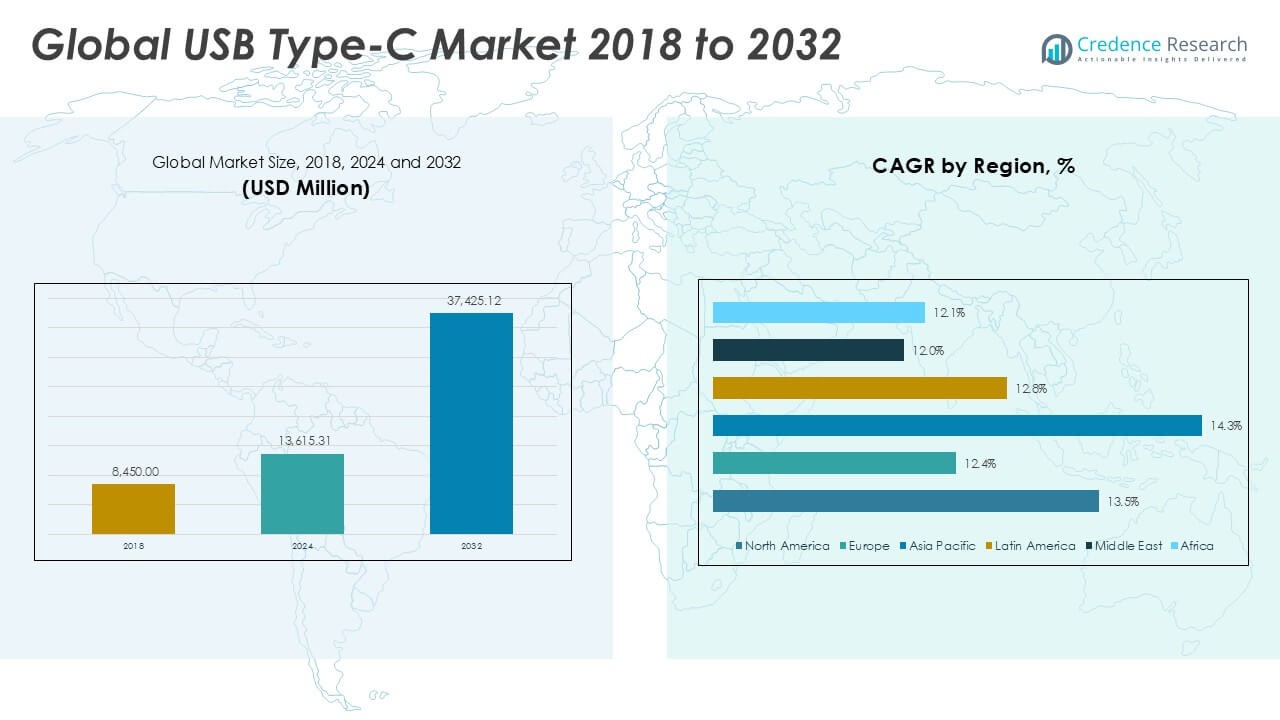
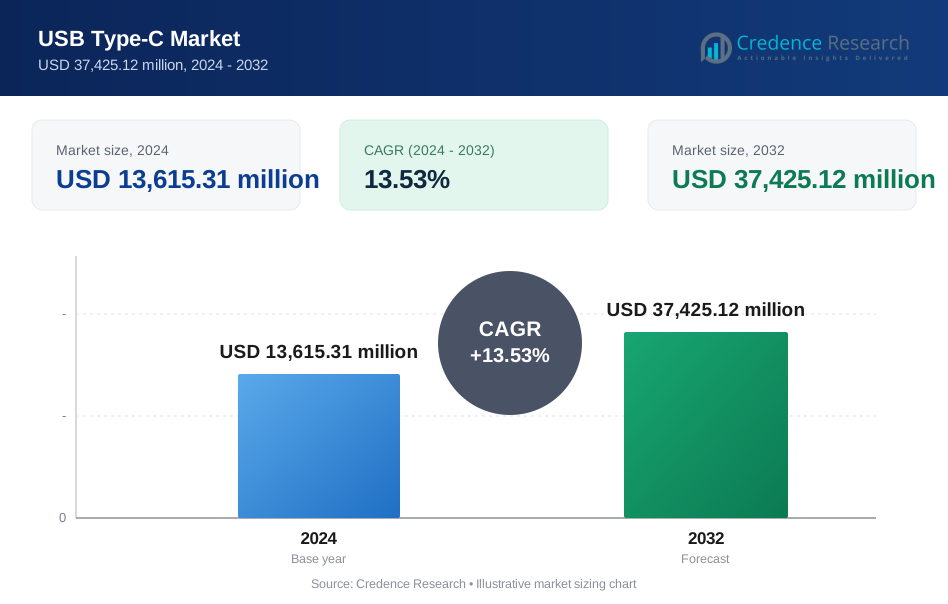
The Global USB Type-C Market is projected to grow from USD 13,615.31 million in 2024 to an estimated USD 37,425.12 million by 2032, with a compound annual growth rate (CAGR) of 13.53% from 2025 to 2032.
The market is witnessing significant growth due to the rising adoption of USB Type-C in smartphones, laptops, and tablets, as manufacturers aim to deliver faster charging and enhanced user convenience. Additionally, the growing trend of device standardization and the push towards a universal charging solution, especially in regions like Europe, are propelling market expansion. USB Type-C’s compatibility with emerging technologies such as 5G devices and its integration in automotive infotainment systems further contribute to its growing popularity. The increasing shift towards slimmer devices also supports the transition to USB Type-C ports.
Geographically, Asia Pacific dominates the USB Type-C market due to the presence of leading electronics manufacturers and large consumer bases in countries like China, Japan, and South Korea. North America and Europe are also significant contributors, driven by technological advancements and regulatory pushes for universal charging standards. Key players operating in the market include TE Connectivity, Texas Instruments, Analog Devices, Molex, Infineon Technologies, ON Semiconductor, STMicroelectronics, and NXP Semiconductors.
Market Insights
- The Global USB Type-C market is projected to grow from USD 13,615.31 million in 2024 to USD 37,425.12 million by 2032, reflecting a strong CAGR of 13.53%.
- Increasing demand for faster data transfer and higher power delivery in smartphones, laptops, and automotive systems drives market expansion.
- The push for universal charging standards, especially in Europe, supports widespread adoption of USB Type-C across devices.
- High production costs and technical complexity present challenges for smaller manufacturers, limiting rapid market penetration.
- Asia Pacific dominates the market with over 45% share in 2024, led by strong electronics manufacturing hubs in China, Japan, and South Korea.
- North America and Europe remain key markets, benefiting from technological innovation and stringent regulations promoting USB Type-C standardization.
- Growth opportunities exist in emerging applications like electric vehicles, industrial automation, and healthcare devices, broadening the market scope.
Market Drivers
Growing Demand for Universal Connectivity Across Devices Boosts Market Growth
The Global USB Type-C market is driven by the rising need for a universal interface across multiple consumer devices. Consumers prefer a single port solution that supports data transfer, charging, and video output. USB Type-C offers all these capabilities with its compact and reversible design. It helps manufacturers streamline device designs while meeting user demands for convenience. Regulatory bodies are also encouraging universal charging standards, which supports the adoption of USB Type-C. It continues to replace older USB types and proprietary charging ports, increasing its global reach.
- For instance, the USB Type-C market size reached USD 5.2 billion, highlighting the scale of its adoption.
Rapid Expansion of Smartphones and Consumer Electronics Fuels Demand
The Global USB Type-C market benefits from the fast-paced growth of smartphones, laptops, tablets, and wearable devices. USB Type-C supports fast charging and high-speed data transfer, which aligns with the performance expectations of modern users. It offers improved power delivery that enhances device functionality. The growing popularity of ultra-thin devices further drives manufacturers to adopt USB Type-C ports. Many leading smartphone brands have already shifted to this standard. It plays a critical role in the competitive consumer electronics landscape.
- For instance, in 2022, USB-C penetration reached 95.8 million notebook PCs and 59.6 million smartphones globally, reflecting widespread adoption among major device categories
Strong Integration in Automotive and Industrial Applications Drives Market Growth
The Global USB Type-C market experiences strong demand from the automotive and industrial sectors. Automakers are increasingly integrating USB Type-C ports into infotainment systems and in-car charging units. It provides faster power delivery, supporting high-performance applications within vehicles. In industrial settings, USB Type-C ports support advanced data exchange and efficient power management. This technology helps streamline connectivity in complex industrial equipment. It continues to find new applications beyond consumer electronics.
Government Policies and Environmental Goals Support USB Type-C Adoption
The Global USB Type-C market gains momentum from regulatory policies promoting device standardization to reduce electronic waste. Governments across Europe and other regions are actively pushing for a common charging standard. USB Type-C aligns well with these goals by offering cross-device compatibility. It helps minimize the need for multiple chargers and cables, which supports sustainability efforts. The push from policymakers accelerates the shift toward USB Type-C interfaces. It strengthens the market’s long-term growth potential.
Market Trends
Transition to USB Type-C Across Consumer Electronics Shapes Market Landscape
The Global USB Type-C market is witnessing a clear trend where manufacturers are rapidly shifting to USB Type-C ports in smartphones, laptops, and tablets. It supports high-speed data transfer and efficient charging, making it a preferred choice for consumers. The trend toward thinner and more compact devices increases the need for smaller yet powerful ports. Manufacturers prefer USB Type-C to simplify designs and offer better user experiences. This transition enhances device interoperability, reducing the dependency on multiple cables. It continues to drive consumer interest in devices with USB Type-C ports.
- For instance, in 2019, more than 68 million phones produced worldwide featured USB Type-C charging ports, reflecting the widespread adoption of this standard in consumer electronics.
Growing Emphasis on Fast Charging and Power Delivery Standards Advances Market Trends
The Global USB Type-C market is influenced by the rising focus on faster charging capabilities and higher power delivery. USB Type-C supports power delivery up to 100W, which meets the growing energy needs of advanced devices. Consumers expect quick charging and seamless data transfer in modern gadgets. It helps manufacturers meet these expectations while maintaining safety standards. The consistent demand for fast and efficient charging technologies strengthens the role of USB Type-C in new product launches. It plays a key part in shaping power delivery trends across devices.
- For instance, the USB Power Delivery Revision 3.1 specification, announced in 2021, enables up to 240 watts of power delivery over a single USB Type-C cable, supporting power-hungry devices like laptops and monitors.
USB Type-C Ports Gain Importance in Automotive and Emerging Applications
The Global USB Type-C market is observing a steady rise in the use of USB Type-C ports within the automotive sector. Automakers are introducing in-car USB Type-C ports to support device charging and data integration. It enhances passenger convenience and meets the demand for high-speed connectivity on the go. USB Type-C ports are also becoming essential in electric vehicles, where power management is critical. It is expanding into other areas like smart home devices and portable medical equipment. This trend broadens the application scope of USB Type-C technology.
Standardization and Regulatory Push Fuel USB Type-C Market Trends
The Global USB Type-C market is shaped by international regulatory movements favoring device standardization. Policymakers in Europe and other regions are pushing for universal charging ports to address environmental concerns. It encourages manufacturers to adopt USB Type-C across all compatible devices. The movement toward a single charging standard aligns with growing consumer awareness about sustainability. It reduces e-waste and simplifies charging for users across various device ecosystems. The regulatory influence will continue to strengthen this market trend in the coming years.
Market Challenges
High Production Costs and Complex Technological Requirements Restrain Market Expansion
The Global USB Type-C market faces challenges due to the high production costs and complex design requirements associated with USB Type-C connectors. It demands advanced manufacturing processes and precision engineering, which increase overall costs for producers. Smaller manufacturers often struggle to meet these technical standards, limiting market participation. The integration of USB Type-C requires strict adherence to power delivery and safety protocols, creating additional development barriers. Compatibility testing across multiple devices further increases design time and expenses. It places pressure on companies to balance cost efficiency with high performance.
- For instance, according to a 2023 survey by the USB Implementers Forum, more than 120 companies reported that the average development cycle for a new USB Type-C connector model required over 14 months and involved at least 25 separate compatibility and safety tests before product launch.
Growing Counterfeit Products and Quality Concerns Impact Market Growth
The Global USB Type-C market encounters significant challenges from counterfeit products that fail to meet established safety and performance standards. It suffers from the circulation of low-quality cables and connectors that can cause device malfunctions and safety hazards. These products erode consumer trust and create negative perceptions about USB Type-C technology. Manufacturers need to invest in brand protection and quality assurance to maintain credibility. The lack of consumer awareness about certified products makes it difficult to control market quality. It continues to pose risks that can slow the adoption rate of USB Type-C.
Market Opportunities
Expansion into Emerging Markets and Untapped Industrial Applications Creates Strong Growth Potential
The Global USB Type-C market holds significant opportunities in emerging economies where smartphone and laptop penetration is increasing rapidly. It can cater to the growing middle-class population that seeks high-performance devices with universal charging solutions. The expanding electronics manufacturing base in countries like India and Vietnam offers new business avenues. Industrial applications in automation and advanced machinery present untapped potential for USB Type-C integration. It supports reliable data transmission and power delivery in complex equipment, creating long-term growth prospects. Manufacturers can explore these sectors to strengthen their market position.
Advancements in USB Type-C Features Enable New Consumer Experiences and Product Innovation
The Global USB Type-C market can capitalize on the continuous development of advanced features such as higher data transfer speeds, enhanced power capabilities, and seamless audio-video support. It creates opportunities to power the next generation of virtual reality, gaming, and high-performance computing devices. Consumer demand for faster, more versatile, and multifunctional ports remains strong. The increasing shift towards smart home devices and portable medical equipment further expands the application range. It allows manufacturers to design innovative solutions that align with evolving consumer lifestyles. The growing importance of unified charging across all personal and professional devices strengthens this opportunity.
Market Segmentation Analysis
By Product Type
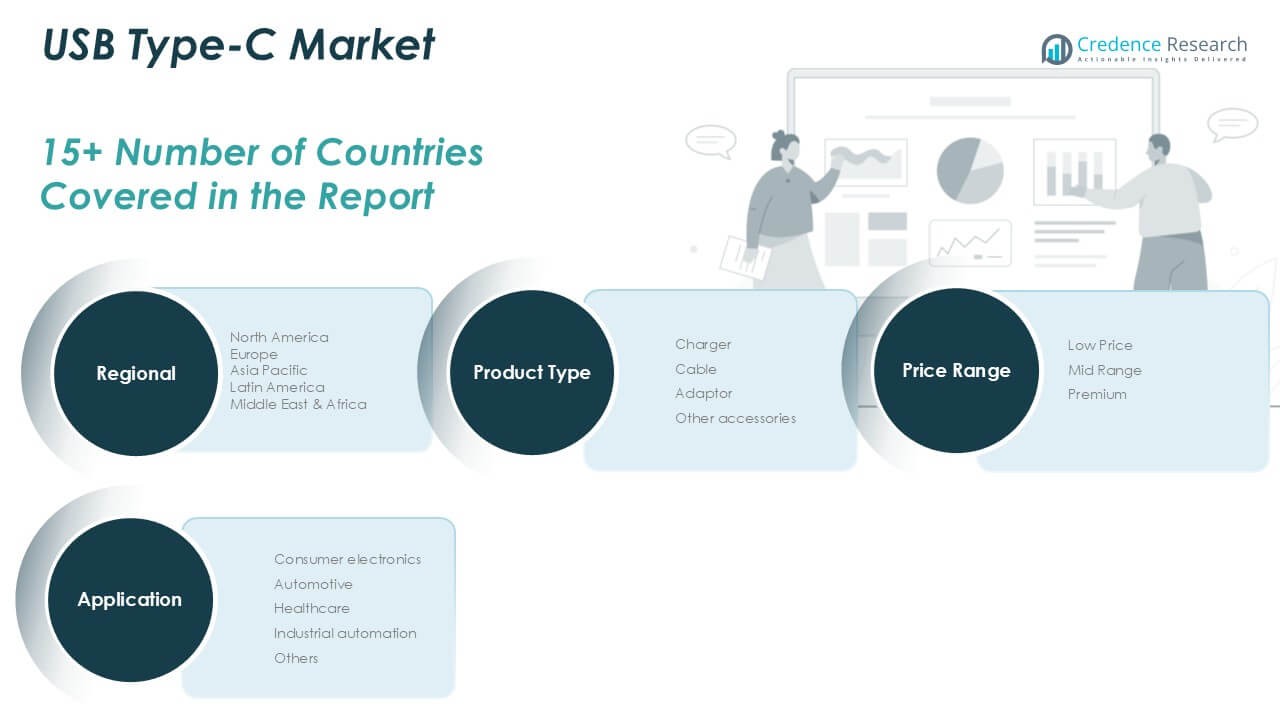
The Global USB Type-C market is segmented into chargers, cables, adapters, and other accessories. Chargers hold a significant revenue share due to the growing demand for fast-charging solutions in smartphones, laptops, and tablets. It gains steady growth from cables, driven by the increasing need for high-speed data transfer and device interoperability. Adapters are in demand for connecting older devices to new USB Type-C ports, which supports a smooth transition across user devices. Other accessories, including docking stations and hubs, continue to expand their presence by enhancing device connectivity and versatility. The market benefits from the rising preference for compact and multifunctional products that meet various consumer needs.
- For instance, a report from the U.S. Department of Energy notes that USB Type-C chargers can achieve energy efficiency levels of up to 94%, compared to traditional chargers that typically reach only 70–80% efficiency
By Application
The Global USB Type-C market is categorized into consumer electronics, automotive, healthcare, industrial automation, and others. Consumer electronics dominate the market due to wide adoption in smartphones, laptops, tablets, and gaming consoles. It finds strong opportunities in the automotive sector where USB Type-C ports support in-car charging and infotainment systems. Healthcare applications are increasing, with USB Type-C used in portable medical devices that require reliable power and data connections. Industrial automation sees growing use of USB Type-C for efficient power delivery and fast communication across equipment. The market continues to expand into new application areas with a strong focus on device standardization.
- For instance, in the automotive sector, USB Type-C ports supporting data transfer speeds up to 40 Gbps (USB4 standard) are being integrated into new vehicles, enabling both high-speed connectivity and rapid charging for multiple devices within cars
By Price Range
The Global USB Type-C market is divided into low price, mid-range, and premium segments. The low-price segment attracts consumers seeking affordable and basic connectivity solutions. It gains momentum in the mid-range segment where consumers expect reliable quality and moderate pricing. The premium segment grows rapidly due to high-performance products with advanced features, fast charging, and superior build quality. Manufacturers focus on this segment to meet rising consumer expectations for speed, durability, and multi-functionality. The price range segmentation allows companies to target distinct consumer groups effectively.
Segments
Based on Product Type
- Charger
- Cable
- Adaptor
- Other accessories
Based on Application
- Consumer electronics
- Automotive
- Healthcare
- Industrial automation
- Others
Based on Price Range
- Low Price
- Mid-Range
- Premium
Based on Region
- North America
- U.S.
- Canada
- Mexico
- Europe
- UK
- France
- Germany
- Italy
- Spain
- Russia
- Belgium
- Netherlands
- Austria
- Sweden
- Poland
- Denmark
- Switzerland
- Rest of Europe
- Asia Pacific
- China
- Japan
- South Korea
- India
- Australia
- Thailand
- Indonesia
- Vietnam
- Malaysia
- Philippines
- Taiwan
- Rest of Asia Pacific
- Latin America
- Brazil
- Argentina
- Peru
- Chile
- Colombia
- Rest of Latin America
- Middle East
- UAE
- KSA
- Israel
- Turkey
- Iran
- Rest of Middle East
- Africa
- Egypt
- Nigeria
- Algeria
- Morocco
- Rest of Africa
Regional Analysis
North America USB Type-C Market
The North America USB Type-C market is projected to grow from USD 3,552.15 million in 2024 to USD 9,701.30 million by 2032, with a CAGR of 13.5% from 2025 to 2032. It holds around 26.1% of the global market share in 2024. Strong consumer demand for fast-charging smartphones, advanced laptops, and gaming consoles drives this regional market. Manufacturers in the United States and Canada focus on offering premium, high-performance USB Type-C products. The increasing integration of USB Type-C ports in electric vehicles and automotive infotainment systems further supports market expansion. It benefits from well-established technology infrastructure and the rapid launch of innovative consumer electronics.
Europe USB Type-C Market
The Europe USB Type-C market is expected to grow from USD 2,372.78 million in 2024 to USD 5,997.48 million by 2032, registering a CAGR of 12.4% during the forecast period. It accounts for 17.4% of the global market share in 2024. Regulatory pushes toward universal charging standards support USB Type-C adoption across the region. Countries like Germany, France, and the United Kingdom lead the transition to USB Type-C in consumer and automotive electronics. It gains traction from growing awareness about reducing electronic waste. The rising use of smart home devices also contributes to regional growth. Europe’s focus on sustainability continues to strengthen this market.
Asia Pacific USB Type-C Market
The Asia Pacific USB Type-C market is forecasted to increase from USD 6,167.00 million in 2024 to USD 17,860.87 million by 2032, with the highest CAGR of 14.3% from 2025 to 2032. It dominates the global market with 45.3% share in 2024. The region benefits from the strong manufacturing base in China, Japan, and South Korea. High smartphone penetration and the rapid rollout of 5G devices support USB Type-C adoption. It attracts demand from both premium and budget consumer electronics. Major regional manufacturers continue to integrate USB Type-C ports across product lines to meet rising consumer expectations. Asia Pacific drives significant growth for the market worldwide.
Latin America USB Type-C Market
The Latin America USB Type-C market is set to grow from USD 686.08 million in 2024 to USD 1,773.95 million by 2032, with a CAGR of 12.8% during the forecast period. It contributes 5.0% to the global market share in 2024. Brazil and Mexico lead regional demand due to rising smartphone adoption and growing interest in fast-charging accessories. It shows steady growth in the automotive and consumer electronics sectors. Manufacturers see potential in affordable USB Type-C products to meet local price sensitivity. Latin America presents opportunities for expansion with increasing connectivity and digital device usage across urban centers. It continues to gain traction in both personal and professional device markets.
Middle East USB Type-C Market
The Middle East USB Type-C market is projected to rise from USD 446.49 million in 2024 to USD 1,096.76 million by 2032, growing at a CAGR of 12.0%. It holds 3.3% of the global market share in 2024. Demand grows in key markets like the United Arab Emirates and Saudi Arabia where consumers adopt advanced smartphones and portable devices. The automotive sector increases USB Type-C port integration in premium vehicle models. It benefits from improving digital infrastructure and growing disposable incomes in the region. USB Type-C’s compatibility with high-performance consumer gadgets fuels local market expansion. Manufacturers target this region to meet the rising preference for fast and reliable charging solutions.
Africa USB Type-C Market
The Africa USB Type-C market is expected to grow from USD 390.81 million in 2024 to USD 994.76 million by 2032, with a CAGR of 12.1%. It represents 2.9% of the global market share in 2024. Demand in countries like South Africa, Nigeria, and Egypt is increasing due to smartphone affordability and rising internet penetration. It supports local consumer needs for universal, cost-effective charging solutions. The market shows steady progress with growing mobile device adoption across rural and urban areas. Manufacturers can tap into this emerging market by offering durable and affordable USB Type-C accessories. Africa’s market continues to expand with improving access to mobile technology.
Key players
- AUK
- Belkin International Inc.
- Bright Industries
- ByteCable
- Cabledo
- Diodes Inc.
- Farreach Electronic Co., Ltd
- HIROSE ELECTRIC Co. Ltd.
- Hon Hai Precision Industry Co. Ltd.
- Infineon Technologies AG
- MediaTek Inc.
- Microchip Technology Inc.
- STMicroelectronics International N.V.
- NXP Semiconductors NV
Competitive Analysis
The Global USB Type-C market is highly competitive with several established and emerging players offering a wide range of products. It features companies like AUK, Belkin International Inc., and HIROSE ELECTRIC Co. Ltd. that provide reliable connectivity solutions across consumer electronics and automotive sectors. Infineon Technologies AG, NXP Semiconductors NV, and STMicroelectronics International N.V. focus on advancing chipsets and power delivery technologies. Companies like Bright Industries, ByteCable, and Cabledo offer competitive pricing in mass markets. Hon Hai Precision Industry Co. Ltd. and Farreach Electronic Co., Ltd strengthen their positions through large-scale production capabilities. The market encourages players to innovate, improve durability, and deliver fast-charging, high-speed products. It maintains a dynamic structure where product quality, pricing, and technology leadership shape competitive advantage.
Recent Developments
- In July 2023, Microchip Technology Incorporated (Nasdaq: MCHP), a leading provider of smart, connected and secure embedded control solutions, today announces the inauguration of its relocated Hyderabad research and development center in the Kokapet business district's One Golden Mile office tower.
- In January 2024, Belkin International introduced its 4‑Port 200 W USB‑C GaN wall charger at CES 2024, supporting fast charging of laptops and gaming devices.
Market Concentration and Characteristics
The Global USB Type-C market demonstrates a moderately concentrated competitive landscape dominated by key industry leaders with extensive technological expertise and manufacturing capabilities. It features a mix of large multinational corporations and specialized manufacturers that focus on innovation, quality, and compliance with evolving standards. The market’s characteristics include rapid technological advancements, frequent product launches, and strong emphasis on power delivery and data transfer efficiency. It faces continuous pressure to reduce costs while enhancing performance and durability. Collaboration between chipset developers, connector manufacturers, and device makers strengthens market dynamics. The presence of stringent regulatory requirements drives companies to maintain high-quality standards and certification processes. It fosters an environment where differentiation through technological superiority and broad product portfolios proves critical to sustaining market share and growth.
Report Coverage
The research report offers an in-depth analysis based on Product Type, Application, Price Range and Region. It details leading market players, providing an overview of their business, product offerings, investments, revenue streams, and key applications. Additionally, the report includes insights into the competitive environment, SWOT analysis, current market trends, as well as the primary drivers and constraints. Furthermore, it discusses various factors that have driven market expansion in recent years. The report also explores market dynamics, regulatory scenarios, and technological advancements that are shaping the industry. It assesses the impact of external factors and global economic changes on market growth. Lastly, it provides strategic recommendations for new entrants and established companies to navigate the complexities of the market.
Future Outlook
- The Global USB Type-C market will continue its rapid expansion, driven by growing demand for universal connectivity across consumer electronics and industrial applications.
- It will benefit from ongoing advancements in power delivery technology, enabling faster charging and support for higher wattage devices.
- Integration of USB Type-C in emerging sectors such as electric vehicles and smart home devices will create new growth avenues.
- The shift toward thinner, lighter, and more compact devices will increase adoption of USB Type-C ports worldwide.
- It will experience strong regional growth in Asia Pacific due to increased manufacturing activity and rising smartphone penetration.
- Regulatory mandates promoting standardized charging solutions, especially in Europe, will accelerate USB Type-C implementation.
- Manufacturers will invest in developing durable, certified, and high-performance cables and accessories to build consumer trust.
- Expanding applications in healthcare and industrial automation will diversify market opportunities and revenue streams.
- It will face competitive pressures to innovate while maintaining cost efficiency to cater to budget-conscious markets.
- The market will witness consolidation and strategic partnerships among key players to strengthen technological capabilities and global reach.
Request a Free Sample
Fill in your details and we'll send you a free sample report.
- Sample data tables & charts
- Research methodology
Need a Custom Version of This Report?
Tailor the scope, geography, or segments to your exact requirements.
- Custom geography or segment scope
- Direct access to our analyst team
Frequently Asked Questions
What is the current and projected market size of the Global USB Type-C market?
What are the main factors driving the growth of the USB Type-C market?
Which industries are adopting USB Type-C technology most rapidly?
How does USB Type-C support emerging technologies?
Which regions dominate the Global USB Type-C market?
Table of Content
Chapter 1. Report Introduction
- 1.1 Report Description & Purpose
- 1.1.1 Report Title & Market Definition
- 1.1.2 Unique Selling Propositions (USP) & Key Differentiators
- 1.1.3 Value Proposition for Stakeholders
- 1.2 Research Objectives
- 1.2.1 Market Sizing Objectives (Volume & Revenue)
- 1.2.2 Segmentation Objectives
- 1.2.3 Competitive Intelligence Objectives
- 1.2.4 Forecast & Scenario Objectives
- 1.3 Report Scope
- 1.3.1 USB Type-C Scope – Types & Subtypes Covered
- 1.3.2 Geographic Scope – Regions & Countries Covered
- 1.3.3 Historical Period, Base Year & Forecast Period (2024; forecast to 2032)
- 1.3.4 Inclusions & Exclusions
- 1.4 HS Code & Classification Framework
- 1.5 Currency, Units & Pricing Basis
- 1.6 Target Stakeholders
- 1.7 Limitations & Assumptions
Chapter 2. Executive Summary
- 2.1 Global USB Type-C Market Snapshot
- 2.1.1 Market Size – Historical (2024) & Forecast (2024-2032) (2024: USD 13,615.31 million → 2032: USD 37,425.12 million)
- 2.1.2 Volume & Revenue – Global Totals
- 2.1.3 Key Market Highlights – Top Five Facts
- 2.2 USB Type-C Market Segmentation Snapshot
- 2.2.1 Market Split by Region – 2024 vs. 2032
- 2.3 Competitive Snapshot
- 2.3.1 Top 10 Players by Revenue Share – 2024
- 2.3.2 Top 10 Players by Volume Share – 2024
- 2.3.3 Recent Strategic Developments (18-Month Summary)
- 2.4 Key Investment Highlights & Strategic Conclusions
Chapter 3. USB Type-C Market Dynamics & Industry Analysis
- 3.1 Market Overview & Context
- 3.1.1 USB Type-C Market Position in the Broader Automotive Value Chain
- 3.1.2 OEM vs. Replacement Market Dynamics
- 3.1.3 Market Maturity & Development Stage by Region
- 3.2 USB Type-C Market Drivers
- 3.3 USB Type-C Market Restraints & Challenges
- 3.4 USB Type-C Market Opportunities
- 3.5 Porter's Five Forces Analysis
- 3.5.1 Threat of New Entrants
- 3.5.2 Bargaining Power of Suppliers
- 3.5.3 Bargaining Power of Buyers
- 3.5.4 Threat of Substitutes
- 3.5.5 Competitive Rivalry – Intensity Assessment
- 3.6 USB Type-C Value Chain Analysis
- 3.6.1 Upstream – Raw Material/Input Suppliers
- 3.6.1.1 Raw Material/Input 1
- 3.6.1.2 Raw Material/Input 2
- 3.6.1.3 Raw Material/Input 3
- 3.6.2 Midstream – Production/Manufacturing/Service Delivery
- 3.6.2.1 Production/Process Overview
- 3.6.2.2 Key Facility Locations & Capacity by Manufacturer
- 3.6.3 Downstream – Distribution & End Consumer
- 3.6.3.1 Primary Channel – B2B/OEM
- 3.6.3.2 Secondary Channels – Dealer, Retail, Online, Direct
- 3.6.4 Value Chain Profitability Analysis
- 3.6.1 Upstream – Raw Material/Input Suppliers
- 3.7 PESTEL Analysis
- 3.7.1 Political Factors
- 3.7.2 Economic Factors
- 3.7.3 Social Factors
- 3.7.4 Technological Factors
- 3.7.5 Environmental Factors
- 3.7.6 Legal Factors
- 3.8 USB Type-C Supply Chain Analysis
- 3.8.1 Raw Material/Input Supply Risk Assessment
- 3.8.2 Manufacturing Concentration Risk (Geographic Exposure)
- 3.8.3 Trade Disruption Impact Analysis
- 3.9 Regulatory & Policy Landscape
Note: The regulatory and policy landscape section covers regulations based on their applicability to the market, USB Type-C category, geography, and scope of the study. Only regulatory frameworks with a material impact on operations, compliance, trade, sustainability, or market access are analyzed in detail.
Chapter 4. Key Investment Pockets & Opportunity Analysis
- 4.1 USB Type-C Market Attractiveness Analysis
- 4.1.1 By Region – Investment Attractiveness Matrix (Volume × CAGR)
- 4.2 Absolute Revenue Growth Opportunity
- 4.2.1 By Region – Absolute USD Growth Through 2032
- 4.3 Incremental Volume Opportunity
- 4.3.1 By Region – Incremental Volume Through 2032
- 4.3.2 Segment – Incremental Volume
- 4.4 Emerging Submarket Opportunity Deep Dive (Subject to Applicability)
- 4.5 Emerging Market Opportunity Scorecards
- 4.5.1 United States
- 4.5.2 Europe
- 4.5.3 Asia
- 4.5.4 Middle East & Africa
Note: Emerging Market Opportunity Scorecards will be included based on relevance and strategic importance. Regions listed are indicative and may vary depending on data availability and market dynamics.
Chapter 5. USB Type-C Import-Export Analysis & Trade Flows
- 5.1 Global Trade Overview
- 5.1.1 Global Export Value by Country (2024)
- 5.1.2 Global Export Volume by Country (2024)
- 5.1.3 Global Import Value by Country (2024)
- 5.1.4 Global Import Volume by Country (2024)
- 5.1.5 Net Trade Balance by Country (2024)
- 5.2 Export Analysis – Segment
- 5.2.1 Type 1 (HS Code)
- 5.2.2 Type 2 (HS Code)
- 5.2.3 Type 3 (HS Code)
- 5.2.4 Type 4 (HS Code)
- 5.2.5 Type 5 (HS Code)
- 5.3 Import Analysis – Segment
- 5.3.1 Type 1 (HS Code)
- 5.3.2 Type 2 (HS Code)
- 5.3.3 Type 3 (HS Code)
- 5.3.4 Type 4 (HS Code)
- 5.3.5 Type 5 (HS Code)
- 5.4 Average Unit Trade Prices
- 5.4.1 Average Export Price – Segment & Country
- 5.4.2 Average Import Price – Segment & Source Country
- 5.4.3 Price Trends (2024)
- 5.5 Key Trade Route Analysis
- 5.5.1 Trade Route 1
- 5.5.2 Trade Route 2
- 5.5.3 Trade Route 3
- 5.5.4 Trade Route 4
- 5.5.5 Trade Route 5
- 5.6 Trade Policy Impact Assessment
- 5.6.1 US Anti-Dumping & Section 301 Tariffs
- 5.6.2 EU Customs Union Impact
- 5.6.3 Major Free Trade Agreements
- 5.6.4 USMCA Rules of Origin
Note: Trade policy analysis will be included only where relevant to the USB Type-C market.
Chapter 6. Competitive Landscape & Company Benchmarking
- 6.1 USB Type-C Market Concentration & Structure
- 6.1.1 Herfindahl-Hirschman Index (HHI) – vs. 2024
- 6.1.2 Tier 1, Tier 2 & Tier 3 Market Structure
- 6.1.3 Global, Regional & Local Player Dynamics
- 6.2 USB Type-C Market Share Analysis – 2024
- 6.2.1 Global Revenue Share by Company
- 6.2.2 Global Volume Share by Company
- 6.2.3 Regional Revenue Share
- 6.2.4 Market Share Evolution ( vs. 2024)
- 6.2.5 OEM Segment Share by Company
- 6.2.6 Replacement Segment Share by Company
- 6.3 Production/Delivery Capacity & Facility Analysis
- 6.3.1 Global Installed Capacity
- 6.3.2 Capacity Utilization Rates
- 6.3.3 Production/Output Volume
- 6.3.4 Facility Locations & Capacity Map
- 6.3.5 Planned Capacity Additions
- 6.4 USB Type-C Competitive Benchmarking Matrix
- 6.4.1 Revenue, Volume, CAGR & Profitability Comparison
- 6.4.2 Channel Revenue Mix
- 6.4.3 Geographic Revenue Exposure
- 6.4.4 R&D Intensity
- 6.4.5 Sustainability Maturity
- 6.5 Strategic Developments in USB Type-C (Last 24 Months)
- 6.5.1 Mergers, Acquisitions & Divestments
- 6.5.2 New USB Type-C Launches
- 6.5.3 Facility Expansions
- 6.5.4 Strategic Alliances, Joint Ventures & Partnerships
- 6.5.5 Distribution Expansion & Market Entry
- 6.5.6 Sustainability & ESG Initiatives
- 6.6 Competitive Strategy Mapping
- 6.6.1 Leader, Challenger, Follower & Niche Classification
- 6.6.2 Pricing Strategy Comparison
- 6.6.3 Channel Strategy Matrix
Note: Strategic developments are included based on their materiality and the availability of reliable information.
Chapter 7. Global USB Type-C Market – By Distribution Channel
- 7.1 Segment Overview
- 7.1.1 Volume & Revenue Split by Channel (2024 & 2032)
- 7.1.2 Channel Mix Evolution (2024-2032)
Chapter 8. Regional Market Analysis – Global Overview
- 8.1 Global Regional Overview
- 8.1.1 Regional Volume Share
- 8.1.2 Regional Revenue Share
- 8.1.3 Regional Volume by Region
- 8.1.4 Regional Revenue by Region
- 8.1.5 Regional Forecast Through 2032
- 8.2 Cross-Regional Segment Analysis
- 8.2.1 By Distribution Channel
- 8.2.2 By Brand/Price Tier
Chapter 9. North America USB Type-C Market
- 9.1 United States
- 9.2 Canada
- 9.3 Mexico
Chapter 10. Europe USB Type-C Market
- 10.1 Germany
- 10.2 France
- 10.3 Italy
- 10.4 United Kingdom
- 10.5 Spain
- 10.6 Poland
- 10.7 Russia
- 10.8 Netherlands
- 10.9 Belgium
- 10.10 Sweden
- 10.11 Denmark
- 10.12 Norway
- 10.13 Rest of Europe
Chapter 11. Asia Pacific USB Type-C Market
- 11.1 China
- 11.2 India
- 11.3 Japan
- 11.4 South Korea
- 11.5 Thailand
- 11.6 Indonesia
- 11.7 Vietnam
- 11.8 Malaysia
- 11.9 Australia
- 11.10 Rest of Asia Pacific
Chapter 12. Latin America USB Type-C Market
- 12.1 Brazil
- 12.2 Argentina
- 12.3 Colombia
- 12.4 Chile
- 12.5 Rest of Latin America
Chapter 13. Middle East USB Type-C Market
- 13.1 Saudi Arabia
- 13.2 United Arab Emirates
- 13.3 Turkey
- 13.4 Israel
- 13.5 Iran
- 13.6 Rest of the Middle East
Chapter 14. Africa USB Type-C Market
- 14.1 South Africa
- 14.2 Egypt
- 14.3 Nigeria
- 14.4 Morocco
- 14.5 Rest of Africa
Chapter 15. USB Type-C Company Profiles
- 15.1 [Company 01]
- 15.1.1 Company Overview
- 15.1.2 Key Management Personnel
- 15.1.3 Products & Services Portfolio
- 15.1.4 Financial Performance
- 15.1.5 Key Market Focus & Geographic Presence
- 15.1.6 Recent Developments & Strategic Initiatives
Note: The company profile list is preliminary and may change based on research findings, market developments, data availability, and client requirements.
Chapter 16. Appendices
- Appendix A – List of Abbreviations & Acronyms
- Appendix B – Industry Classification Code Reference – Full Series
- Appendix C – Production & Capacity Data Tables
- Appendix D – End-Use & Demand Base Tables
- Appendix E – Consumption & Replacement Rate Assumptions
- Appendix F – ASP Reference Tables
- Appendix G – Manufacturing & Facility Database
- Appendix H – Import-Export Data Tables
- Appendix I – Regulatory Summary Tables
- Appendix J – Primary Research Participant List (Anonymized)
- Appendix K – Primary Research Questionnaire Framework
- Appendix L – Data Sources & Bibliography
- Appendix M – Market Size Divergence & Source Comparison
Chapter 17. Research Methodology
- 17.1 Research Framework & Philosophy
- 17.2 Secondary Research – Sources, Hierarchy & Data Extraction
- 17.3 Data Modeling – Bottom-Up & Top-Down Market Sizing
- 17.4 Primary Research – Stakeholder Framework, LOI & Sample Sizes
- 17.5 Forecast Methodology – Regression, Scenario & Sensitivity Analysis
- 17.6 Quality Control – Four-Layer Validation Framework
- 17.7 Limitations & Standard Assumptions
- 17.8 Disclaimer
