Market Overview:
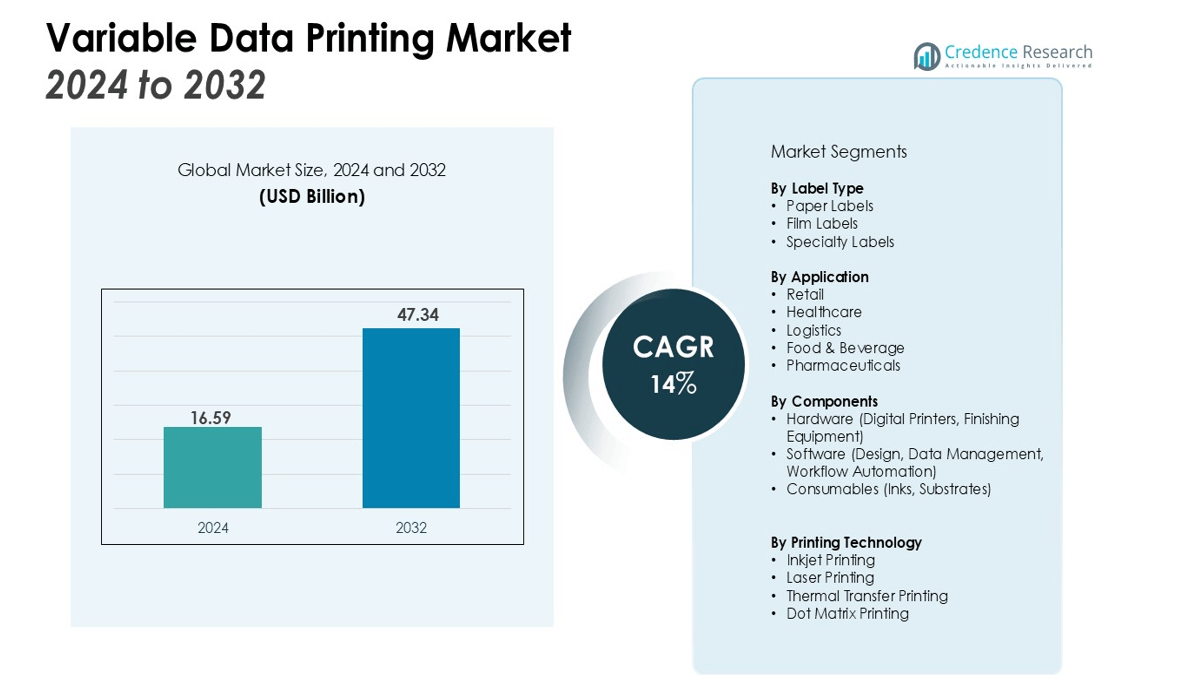
The Variable Data Printing Market size was valued at USD 16.59 billion in 2024 and is anticipated to reach USD 47.34 billion by 2032, at a CAGR of 14% during the forecast period (2024-2032).
| REPORT ATTRIBUTE | DETAILS |
|---|---|
| Historical Period | 2020-2023 |
| Base Year | 2024 |
| Forecast Period | 2025-2032 |
| Variable Data Printing Market Size 2024 | USD 16.59 billion |
| Variable Data Printing Market, CAGR | 14% |
| Variable Data Printing Market Size 2032 | USD 47.34 billion |
Key drivers of the VDP market include the growing need for personalized marketing materials in industries such as retail, healthcare, and finance. The ability to deliver customized content to consumers based on specific preferences and demographics enhances customer engagement and brand loyalty, driving market expansion. Additionally, the increased adoption of digital printing solutions in packaging, labels, and promotional materials is contributing to the market’s growth. The continuous improvements in print quality, speed, and cost-effectiveness further support this trend.
Regionally, North America holds the largest market share, with the United States being a key contributor due to the widespread adoption of digital technologies and a mature consumer goods market. Europe follows closely, driven by growing demand for personalized marketing in the retail and e-commerce sectors. The Asia-Pacific region is expected to witness the highest growth, fueled by rapid industrialization, technological advancements, and increasing demand for customized print solutions in emerging markets like China and India.
Market Insights:
- The VDP market size is valued at USD 16.59 billion in 2024 and is projected to reach USD 47.34 billion by 2032, growing at a CAGR of 14%.
- Growing demand for personalized marketing solutions in retail, healthcare, and finance drives market expansion by enhancing customer engagement and brand loyalty.
- Advancements in digital printing technologies, including improvements in print quality, speed, and efficiency, contribute to cost-effective and sustainable VDP solutions.
- On-demand printing services are gaining traction, offering flexibility, reducing waste, and allowing businesses to print only required materials, supporting sustainability.
- E-commerce growth and demand for customized packaging solutions lead to a higher adoption of VDP for personalized invoices, packing slips, and promotional materials.
- North America holds a 35% market share in 2024, driven by significant demand for personalized content in sectors like retail and healthcare.
- The Asia-Pacific region is the fastest-growing market, with a 25% share, fueled by rapid industrialization, rising disposable income, and expanding e-commerce in countries like China and India.
Market Drivers:
Growing Demand for Personalized Marketing Solutions
The increasing focus on personalized marketing strategies drives the demand for Variable Data Printing (VDP). Companies in sectors like retail, healthcare, and finance seek to engage customers with content tailored to their specific preferences, behaviors, and demographics. VDP allows businesses to create targeted promotional materials, enhancing customer experience and improving response rates. This personalized approach boosts brand loyalty, making VDP an essential tool in customer retention strategies.
- For instance, Printing for Less supports extensive personalized marketing campaigns by offering Variable Data Printing across more than 15 different product types, including business cards, mailers, and catalogs.
Advancements in Digital Printing Technologies
Continuous advancements in digital printing technologies contribute significantly to the growth of the VDP market. The improvements in print quality, speed, and efficiency make digital printing more cost-effective, particularly for small print runs. VDP leverages these advancements to produce high-quality, customized print materials with minimal waste and reduced production time. These innovations expand the range of industries adopting digital printing solutions for personalized marketing campaigns.
- For instance, HP's Indigo 100K Digital Press exemplifies this progress, achieving true digital non-stop print capabilities at a speed of 6,000 sheets per hour.
Rising Adoption of On-Demand Printing Services
The increasing popularity of on-demand printing services fuels market growth for VDP. On-demand printing offers flexibility and cost savings, allowing businesses to produce marketing materials and products in smaller quantities. It eliminates the need for large inventory storage and reduces the risk of outdated or unsold items. VDP enables businesses to print only what is needed, further supporting the trend towards efficiency and sustainability in the printing industry.
Expanding E-commerce and Packaging Markets
The rise of e-commerce and the growing emphasis on customized packaging solutions significantly impact the VDP market. E-commerce companies require personalized invoices, packing slips, and promotional materials to create a more engaging customer experience. VDP enables the production of variable information, such as product details and promotional offers, directly on packaging and shipping labels, enhancing the appeal and uniqueness of online shopping. This trend supports the expansion of VDP applications in the packaging industry.
Market Trends:
Increasing Integration with Automation and AI Technologies
One of the prominent trends in the Variable Data Printing (VDP) market is the growing integration with automation and artificial intelligence (AI) technologies. Companies increasingly leverage AI to analyze customer data and predict the most effective marketing strategies. Automation tools enable businesses to streamline the printing process, reducing human intervention and ensuring faster production times. This integration improves operational efficiency and enables the delivery of highly personalized print materials at scale. The use of AI also enhances the customization of printed products by tailoring content to individual preferences, which boosts customer engagement and enhances return on investment.
- For instance, Fiery has technologically standardized workflow automation by defining a 6-level framework for print shops.
Shift Toward Sustainability and Eco-Friendly Practices
Sustainability is becoming a central focus within the VDP market, as businesses aim to reduce their environmental footprint. The shift toward eco-friendly printing practices is evident, with more companies adopting sustainable materials and environmentally friendly inks in their production processes. VDP enables businesses to print only what is needed, minimizing waste and reducing excess inventory, further contributing to sustainability. In response to growing consumer demand for greener products, companies in the printing industry are adopting these practices to meet environmental standards and appeal to eco-conscious consumers. The trend of sustainability not only aligns with corporate social responsibility efforts but also attracts consumers who prioritize environmentally friendly practices.
- For instance, HP Inc. has achieved a significant technological milestone by sourcing over 1 million pounds of ocean-bound plastics from Haiti for its products.
Market Challenges Analysis:
High Initial Investment and Maintenance Costs
One of the primary challenges facing the Variable Data Printing (VDP) market is the high initial investment and ongoing maintenance costs. The advanced digital printing equipment required for VDP is often expensive, especially for small and medium-sized businesses. In addition to the high capital expenditure, businesses must invest in training staff and maintaining the equipment to ensure optimal performance. These costs can create a barrier to entry for smaller companies, limiting their ability to adopt VDP technologies. Furthermore, as digital printing technology evolves, businesses may face the challenge of upgrading or replacing outdated equipment, further increasing operational expenses.
Data Privacy and Security Concerns
Data privacy and security are significant concerns in the Variable Data Printing market. VDP relies on customer-specific data to create personalized print materials, which raises the risk of data breaches and unauthorized access. Companies must implement robust security measures to protect sensitive consumer information, especially when handling financial or medical data. Regulatory compliance, such as adherence to GDPR in Europe and similar data protection laws in other regions, adds complexity to the VDP process. Ensuring data security not only requires technical solutions but also ongoing monitoring and audits, which can be resource-intensive for businesses.
Market Opportunities:
Expanding Demand for Personalization in Consumer Marketing
A significant opportunity in the Variable Data Printing (VDP) market lies in the increasing demand for personalized marketing across various industries. Businesses in retail, healthcare, and finance recognize the value of offering tailored experiences to their customers, which VDP technology enables by producing customized promotional materials. With more companies seeking to enhance customer engagement through personalized communication, the demand for VDP services is expected to grow. As consumer expectations for personalization rise, companies can capitalize on this trend by adopting VDP to create targeted content, improving customer satisfaction and brand loyalty.
Growth in E-commerce and Direct Mail Campaigns
The continued expansion of e-commerce presents a substantial opportunity for the VDP market. E-commerce companies increasingly rely on personalized communication to enhance customer experiences, particularly through tailored packaging, promotional offers, and product recommendations. VDP allows businesses to print unique content such as personalized invoices and marketing materials, which helps improve customer retention and boost sales. In addition, the resurgence of direct mail marketing, fueled by its effectiveness in delivering personalized messages, offers another opportunity for growth in the VDP market. Businesses seeking to stand out in a competitive digital landscape can use VDP to create engaging, customized mail pieces that capture consumer attention.
Market Segmentation Analysis:
By Label Type
The Variable Data Printing (VDP) market is significantly influenced by the demand for customized labels across industries such as retail, food & beverage, and pharmaceuticals. Labels are crucial for branding, product information, and regulatory compliance. VDP allows for the printing of dynamic content on labels, such as batch numbers, expiration dates, and promotional offers, enabling businesses to meet industry-specific needs. The growing need for personalized labels, particularly in e-commerce and the consumer goods sector, is expected to drive market growth in this segment.
- For instance, Coca-Cola's "Share a Coke" campaign in Europe utilized advanced VDP technology to produce nearly 800 million bottle labels personalized with popular names.
By Application
VDP finds wide application in industries such as retail, healthcare, and logistics. In retail, it is used for personalized packaging, promotional materials, and direct mail campaigns. Healthcare applications involve customized prescriptions, labels, and patient information. The logistics sector uses VDP to produce shipping labels and barcodes. As businesses look for more ways to engage customers with tailored content, the demand for VDP in various applications is expected to expand rapidly.
- For instance, as an application of personalized customer engagement, members of the Walmart+ loyalty program shop an average of 11 more times per year compared to non-members.
By Components
The components segment of the VDP market includes hardware, software, and consumables. Hardware comprises digital printers and finishing equipment that enable high-quality printing. Software includes applications for data management, design, and workflow automation, helping businesses efficiently manage personalized print materials. Consumables, such as inks and substrates, play a vital role in the production of high-quality printed materials. The continued advancements in these components are enhancing the efficiency, quality, and cost-effectiveness of VDP solutions.
Segmentations:
By Label Type:- Paper Labels
- Film Labels
- Specialty Labels
- Retail
- Healthcare
- Logistics
- Food & Beverage
- Pharmaceuticals
- Hardware (Digital Printers, Finishing Equipment)
- Software (Design, Data Management, Workflow Automation)
- Consumables (Inks, Substrates)
- Inkjet Printing
- Laser Printing
- Thermal Transfer Printing
- Dot Matrix Printing
- North America
- U.S.
- Canada
- Mexico
- Europe
- UK
- France
- Germany
- Italy
- Spain
- Russia
- Belgium
- Netherlands
- Austria
- Sweden
- Poland
- Denmark
- Switzerland
- Rest of Europe
- Asia Pacific
- China
- Japan
- South Korea
- India
- Australia
- Thailand
- Indonesia
- Vietnam
- Malaysia
- Philippines
- Taiwan
- Rest of Asia Pacific
- Latin America
- Brazil
- Argentina
- Peru
- Chile
- Colombia
- Rest of Latin America
- Middle East
- UAE
- KSA
- Israel
- Turkey
- Iran
- Rest of Middle East
- Africa
- Egypt
- Nigeria
- Algeria
- Morocco
- Rest of Africa
Regional Analysis:
North America: Market Dominance with High Demand for Personalization
North America leads the Variable Data Printing (VDP) market, accounting for 35% of the global market share in 2024. The United States is the primary driver of this growth, with significant demand for personalized marketing across industries such as retail, healthcare, and finance. Businesses increasingly adopt VDP to improve customer engagement and deliver tailored marketing content. The growing use of e-commerce and direct mail campaigns further contributes to the rising demand for VDP services. As companies focus on enhancing customer experiences, the North American market is expected to maintain its leading position.
Europe: Rapid Growth with Focus on Sustainability
Europe holds a 30% share of the global Variable Data Printing market, driven by the increasing adoption of personalized print materials in retail and consumer goods sectors. The region places significant emphasis on sustainability, with businesses focusing on eco-friendly printing solutions and efficient resource use. Advancements in digital printing technologies have made VDP more accessible, helping companies enhance their customer engagement strategies. The integration of VDP with automation and AI technologies also contributes to the market’s growth. As environmental concerns rise, the demand for sustainable printing solutions is expected to continue fueling market expansion in Europe.
Asia-Pacific: Fastest Growing Market with Expanding E-commerce
The Asia-Pacific region accounts for 25% of the global Variable Data Printing market share, with rapid adoption of VDP driven by emerging economies like China and India. The rise of disposable income and expanding middle class in these countries is creating a demand for personalized products and services. E-commerce growth in the region further boosts the need for tailored print materials. As businesses focus on improving customer engagement, VDP technology is expected to experience the highest growth rate. With the rise of digital technologies and personalization, Asia-Pacific is set to be the fastest-growing market for VDP.
Key Player Analysis:
- Mondi PLC
- 3M
- Xerox Corporation
- Sony Corporation
- HP Inc.
- Avery Dennison Corporation
- Canon, Inc.
- Cenveo Inc.
- Quad/Graphics, Inc.
- WS Packaging Group, Inc.
- FusionPro Creator
- RR Donnelley & Sons Company
Competitive Analysis:
The Variable Data Printing (VDP) market is competitive, with major players such as Xerox Corporation, Canon Inc., HP Inc., and Ricoh Company leading the way through innovations in digital printing technology. These companies focus on improving print quality, speed, and efficiency to meet the growing demand for personalized marketing materials across sectors like retail, healthcare, and logistics. Smaller players often specialize in niche areas such as eco-friendly printing or regional markets. The competition is further heightened as companies integrate VDP with automation, artificial intelligence, and cloud solutions, offering cost-effective and scalable services. Market leaders also emphasize sustainability, focusing on reducing waste and utilizing environmentally friendly materials. This dynamic environment drives continuous technological advancements and positions integrated hardware, software, and consumables solutions as key differentiators in the market.
Recent Developments:
- In September 2025, Avery Dennison Corporation expanded its strategic partnership with Wiliot, an ambient Internet of Things (IoT) pioneer, to scale the manufacturing and market reach of Wiliot's next-generation IoT Bluetooth-enabled sensors.
- In September 2025, Canon, Inc. launched the EOS C50, its smallest and lightest full-frame cinema camera, which features a 7K CMOS sensor capable of 7K/60p internal RAW recording.
Report Coverage:
The research report offers an in-depth analysis based on Label Type, Application, Components, Printing Technology and Region. It details leading market players, providing an overview of their business, product offerings, investments, revenue streams, and key applications. Additionally, the report includes insights into the competitive environment, SWOT analysis, current market trends, as well as the primary drivers and constraints. Furthermore, it discusses various factors that have driven market expansion in recent years. The report also explores market dynamics, regulatory scenarios, and technological advancements that are shaping the industry. It assesses the impact of external factors and global economic changes on market growth. Lastly, it provides strategic recommendations for new entrants and established companies to navigate the complexities of the market.
Future Outlook:
- The demand for personalized marketing materials will continue to drive growth in the Variable Data Printing (VDP) market.
- Advancements in digital printing technologies will enhance print quality, speed, and cost-effectiveness, supporting wider adoption.
- The increasing emphasis on sustainability will push VDP solutions to incorporate eco-friendly materials and reduce waste.
- Automation and AI integration will streamline production processes, improve efficiency, and enhance personalization capabilities.
- The rise of e-commerce and the need for customized packaging solutions will further expand the use of VDP in logistics and retail.
- On-demand printing services will gain traction, offering businesses the flexibility to print only required quantities, reducing inventory costs.
- Emerging markets, especially in Asia-Pacific, will see rapid adoption of VDP driven by industrialization and growing consumer demand for personalized products.
- As data privacy concerns grow, the VDP market will focus on implementing more secure data management and compliance with regulations.
- The demand for high-quality, customized labels and packaging in industries like pharmaceuticals and food & beverage will continue to rise.
- VDP will play an integral role in the digital transformation of marketing and print solutions, enabling businesses to deliver tailored experiences at scale.

Request a Free Sample
Fill in your details and we'll send you a free sample report.
- Sample data tables & charts
- Research methodology
Market Dynamics
Growing Demand for Personalized Marketing Solutions
Businesses in sectors like retail, healthcare, and finance are increasingly leveraging variable data printing to deliver tailored marketing materials, enhancing customer engagement and brand loyalty. The ability to customize content based on consumer preferences and demographics is a key factor driving adoption.
Advancements in Digital Printing Technologies
Continuous improvements in print quality, speed, and efficiency have made digital printing more cost-effective and accessible, especially for short print runs. These technological advancements enable high-quality, customized print materials with minimal waste, expanding VDP adoption across industries.
Rising Adoption of On-Demand Printing Services
On-demand printing allows businesses to produce only the required quantities of marketing materials, reducing inventory costs and waste. This flexibility supports sustainability initiatives and is particularly attractive to companies seeking efficient, just-in-time production.
Expansion of E-commerce and Customized Packaging
The growth of e-commerce has increased the need for personalized invoices, packing slips, and promotional materials, driving the use of VDP in packaging and logistics. Customized packaging enhances the customer experience and differentiates brands in a competitive online marketplace.
Integration with Automation and AI Technologies
The integration of automation and artificial intelligence in VDP workflows streamlines production, reduces human intervention, and enables highly personalized print materials at scale. This enhances operational efficiency and allows businesses to deliver more targeted and effective marketing campaigns.
Need a Custom Version of This Report?
Tailor the scope, geography, or segments to your exact requirements.
- Custom geography or segment scope
- Direct access to our analyst team
Frequently Asked Questions
What is the current market size for Variable Data Printing, and what is its projected size in 2032?
At what Compound Annual Growth Rate is the Variable Data Printing projected to grow between 2024 and 2032?
Which Variable Data Printing segment held the largest share in 2024?
What are the primary factors fueling the growth of the Variable Data Printing?
Who are the leading companies in the Variable Data Printing?
Table of Content
Chapter 1 Market Segmentation
- 1.1 Segmentation Framework
- 1.1.1 Product and Service Classification
- 1.1.2 Application and End-Use Classification
- 1.1.3 Technology and Solution Classification
- 1.1.4 Customer and Distribution Channel Classification
- 1.1.5 Geographic Segmentation
- 1.1.6 Market Segment Definitions and Boundaries
- 1.2 By Components
- 1.2.1 Hardware (Digital Printers, Finishing Equipment)
- 1.2.2 Software (Design, Data Management, Workflow Automation)
- 1.2.3 Consumables (Inks, Substrates)
- 1.3 By Label Type
- 1.3.1 Paper Labels
- 1.3.2 Film Labels
- 1.3.3 Specialty Labels
- 1.4 By Application
- 1.4.1 Retail
- 1.4.2 Healthcare
- 1.4.3 Logistics
- 1.4.4 Food & Beverage
- 1.4.5 Pharmaceuticals
- 1.5 By Printing Technology
- 1.5.1 Inkjet Printing
- 1.5.2 Laser Printing
- 1.5.3 Thermal Transfer Printing
- 1.5.4 Dot Matrix Printing
Chapter 2 Introduction
- 2.1 Report Objectives and Scope
- 2.2 Product Definition and Industry Terminology
- 2.3 Market Inclusions and Exclusions
- 2.4 Research Process
- 2.4.1 Primary Research and Expert Interviews
- 2.4.2 Secondary Research and Source Review
- 2.4.3 Top-Down and Bottom-Up Estimation
- 2.4.4 Data Triangulation and Verification
- 2.5 Market Size Measurement Basis
- 2.5.1 2024: USD 16.59 billion → 2032: USD 47.34 billion
- 2.6 Historical and Forecast Reference Periods
- 2.6.1 Base Year: 2024
- 2.6.2 Forecast Period: 2024-2032
- 2.7 Research Assumptions and Limitations
Chapter 3 Executive Summary
- 3.1 Market Snapshot and Key Findings
- 3.2 Base-Year Market Size, 2024
- 3.3 Forecast Market Size, 2032
- 3.4 Revenue and Volume Growth Outlook
- 3.5 Key Demand and Supply Indicators
- 3.6 Leading Market Segments
- 3.7 Fastest-Growing Market Opportunities
- 3.8 Regional Performance Highlights
- 3.9 Technology and Industry Transformation
- 3.10 Competitive Landscape Summary
- 3.11 Analyst View and Strategic Implications
Chapter 4 Global Variable Data Printing Market Trends and Developments
- 4.1 Historical Industry Development
- 4.2 Recent Market Trends and Developments
- 4.3 Demand and Customer Behavior Trends
- 4.4 Technology and Product Innovation
- 4.5 Artificial Intelligence, Automation and Digitalization
- 4.6 Local Manufacturing and Supply Chain Realignment
- 4.7 Industry Partnerships, Mergers and Acquisitions
- 4.8 Sustainability and Circular Economy Developments
- 4.9 Government and Private Sector Investment Trends
- 4.10 Emerging Business Models and Commercialization
- 4.11 Industry Developments and Announcements
Chapter 5 Global Variable Data Printing Market Production, Supply and Demand Analysis
- 5.1 Demand Trend and Consumption Analysis
- 5.2 Demand Forecast, 2024-2032
- 5.3 Production and Output Trend
- 5.4 Production and Output Forecast, 2024-2032
- 5.5 Installed Capacity and Capacity Utilization
- 5.6 Company-Wise Production Plants and Statistics
- 5.6.1 Installed Production Capacity
- 5.6.2 Actual Production
- 5.6.3 Planned Capacity and Expansion Targets
- 5.7 Supply Chain Structure and Procurement Trends
- 5.8 Supply-Demand Gap and Bottlenecks
- 5.9 Import Dependence and Sourcing Structure
- 5.10 Contract Manufacturing and Outsourcing
- 5.11 Regional Supply and Demand Concentration
Chapter 6 Global Variable Data Printing Market Pricing Analysis
- 6.1 Pricing Structure and Measurement
- 6.2 Historical Pricing Trends
- 6.3 Pricing Outlook, 2024-2032
- 6.4 Average Selling Price and Unit Economics
- 6.5 Pricing by Product and Market Segment
- 6.6 Geographic Pricing Differences
- 6.7 Key Input, Energy, Labor and Logistics Costs
- 6.8 Contract Pricing and Purchasing Models
- 6.9 Pricing Sensitivity and Competitive Positioning
- 6.10 Price, Margin and Profitability Implications
Chapter 7 Global Variable Data Printing Market Dynamics
- 7.1 Market Growth Drivers
- 7.1.1 Demand-Side Drivers
- 7.1.2 Technology and Innovation Drivers
- 7.1.3 Infrastructure and Investment Drivers
- 7.1.4 Regulatory and Policy Drivers
- 7.2 Market Restraints
- 7.2.1 Cost and Affordability Constraints
- 7.2.2 Technology and Adoption Barriers
- 7.2.3 Supply Chain and Operational Constraints
- 7.3 Market Challenges
- 7.3.1 Competitive Pressure and Margin Erosion
- 7.3.2 Skills, Infrastructure and Implementation Gaps
- 7.4 Emerging Market Opportunities
- 7.5 Market Dynamics Impact and Time-Horizon Assessment
Chapter 8 Global Variable Data Printing Value Chain Analysis
- 8.1 Industry Value Chain Overview
- 8.2 Upstream Suppliers and Critical Inputs
- 8.3 Technology and Component Providers
- 8.4 Manufacturing or Service Delivery
- 8.5 Distribution, Channel Partners and Integrators
- 8.6 Downstream Applications and End Users
- 8.7 Value Addition and Profit Pools
- 8.8 Vertical Integration and Outsourcing
- 8.9 Supplier Concentration and Risk
- 8.10 Supply Chain Localization and Resilience
Chapter 9 Global Variable Data Printing Market Regulations and Policies
- 9.1 Relevant Laws, Standards and Compliance Frameworks
- 9.2 Product, Service, Safety and Quality Requirements
- 9.3 Government Policies, Incentives and Subsidies
- 9.4 Imports, Exports and Trade Barriers
- 9.5 Public Procurement and Local Content Requirements
- 9.6 Environmental and Sustainability Compliance
- 9.7 Data Protection, AI and Cybersecurity Compliance
- 9.8 Upcoming Policy Changes and Market Implications
Chapter 10 Global Variable Data Printing Market Hotspots and Opportunities
- 10.1 Market Opportunity Mapping and Growth Hotspots
- 10.2 High-Growth Applications and Customer Groups
- 10.3 Underserved Markets and White-Space Opportunities
- 10.4 Emerging Technology and Product Opportunities
- 10.5 New Capacity and Investment Hotspots
- 10.6 Market Entry and Expansion Opportunities
- 10.7 Distribution and Partnership Opportunities
- 10.8 Near-Term and Long-Term Commercial Potential
- 10.9 Opportunity Attractiveness and Execution Risks
Chapter 11 Global Variable Data Printing Market Outlook, 2024-2032
- 11.1 Market Size and Analysis
- 11.1.1 Revenue (Market Measurement: 2024: USD 16.59 billion → 2032: USD 47.34 billion)
- 11.1.2 Market Volume and Quantity Sold
- 11.1.3 Historical Market Size
- 11.1.4 Base-Year Market Size, 2024
- 11.2 Market Forecast, 2024-2032
- 11.2.1 Revenue Forecast to 2032
- 11.2.2 Volume Forecast to 2032
- 11.2.3 CAGR and Year-on-Year Growth
- 11.2.4 Incremental Revenue Opportunity
- 11.3 Forecast Assumptions and Scenario Analysis
- 11.3.1 Base-Case Forecast
- 11.3.2 Optimistic and Conservative Scenarios
- 11.3.3 Technology, Pricing and Policy Sensitivities
- 11.4 Market Attractiveness and Growth Outlook
Chapter 12 Global Variable Data Printing Market Segmentation and Outlook
- 12.1 Segmentation Summary and Market Shares, 2024
- 12.2 Largest and Fastest-Growing Segments
- 12.3 By Components - Market Size and Forecast, 2024-2032
- 12.3.1 Segment Definition and Scope
- 12.3.2 Historical Market Size
- 12.3.3 Revenue Forecast, 2024-2032
- 12.3.4 Volume Forecast, 2024-2032
- 12.3.5 Base-Year Market Share, 2024
- 12.3.6 Segment CAGR and Growth Drivers
- 12.3.7 Subsegment Market Size and Forecast
- 12.3.7.1 Hardware (Digital Printers, Finishing Equipment)
- 12.3.7.2 Software (Design, Data Management, Workflow Automation)
- 12.3.7.3 Consumables (Inks, Substrates)
- 12.3.8 Subsegment Pricing and Adoption Trends
- 12.3.9 Leading Suppliers and Competition
- 12.3.10 Regional Demand and Opportunities
- 12.4 By Label Type - Market Size and Forecast, 2024-2032
- 12.4.1 Segment Definition and Scope
- 12.4.2 Historical Market Size
- 12.4.3 Revenue Forecast, 2024-2032
- 12.4.4 Volume Forecast, 2024-2032
- 12.4.5 Base-Year Market Share, 2024
- 12.4.6 Segment CAGR and Growth Drivers
- 12.4.7 Subsegment Market Size and Forecast
- 12.4.7.1 Paper Labels
- 12.4.7.2 Film Labels
- 12.4.7.3 Specialty Labels
- 12.4.8 Subsegment Pricing and Adoption Trends
- 12.4.9 Leading Suppliers and Competition
- 12.4.10 Regional Demand and Opportunities
- 12.5 By Application - Market Size and Forecast, 2024-2032
- 12.5.1 Segment Definition and Scope
- 12.5.2 Historical Market Size
- 12.5.3 Revenue Forecast, 2024-2032
- 12.5.4 Volume Forecast, 2024-2032
- 12.5.5 Base-Year Market Share, 2024
- 12.5.6 Segment CAGR and Growth Drivers
- 12.5.7 Subsegment Market Size and Forecast
- 12.5.7.1 Retail
- 12.5.7.2 Healthcare
- 12.5.7.3 Logistics
- 12.5.7.4 Food & Beverage
- 12.5.7.5 Pharmaceuticals
- 12.5.8 Subsegment Pricing and Adoption Trends
- 12.5.9 Leading Suppliers and Competition
- 12.5.10 Regional Demand and Opportunities
- 12.6 By Printing Technology - Market Size and Forecast, 2024-2032
- 12.6.1 Segment Definition and Scope
- 12.6.2 Historical Market Size
- 12.6.3 Revenue Forecast, 2024-2032
- 12.6.4 Volume Forecast, 2024-2032
- 12.6.5 Base-Year Market Share, 2024
- 12.6.6 Segment CAGR and Growth Drivers
- 12.6.7 Subsegment Market Size and Forecast
- 12.6.7.1 Inkjet Printing
- 12.6.7.2 Laser Printing
- 12.6.7.3 Thermal Transfer Printing
- 12.6.7.4 Dot Matrix Printing
- 12.6.8 Subsegment Pricing and Adoption Trends
- 12.6.9 Leading Suppliers and Competition
- 12.6.10 Regional Demand and Opportunities
- 12.7 Segment Growth Comparison
- 12.8 Segment Attractiveness and Priority Matrix
Chapter 13 Global Variable Data Printing End-Use and Application Market Outlook
- 13.1 End-Use Industry and Customer Demand Structure
- 13.2 Leading Applications and Customer Groups
- 13.3 End-Use Market Size, Share and Forecast
- 13.4 Major End-Use Industry Deep Dives
- 13.4.1 Customer Requirements and Use Cases
- 13.4.2 Demand and Replacement Cycles
- 13.4.3 Technical and Regulatory Considerations
- 13.4.4 Purchasing and Procurement Models
- 13.4.5 Leading Vendors and Distribution Channels
- 13.4.6 Forecast and Commercial Opportunities
- 13.5 Emerging Applications and Cross-Segment Demand
- 13.6 End-Use Industry Investment Priorities
Chapter 14 Global Variable Data Printing Geographic Market Outlook, 2024-2032
- 14.1 Regional Market Size and Share, 2024
- 14.2 Regional Market Forecast, 2024-2032
- 14.3 Regional Pricing, Production and Demand Differences
- 14.4 North America
- 14.4.1 United States
- 14.4.2 Canada
- 14.4.3 Mexico
- 14.5 Europe
- 14.5.1 Germany
- 14.5.2 France
- 14.5.3 Italy
- 14.5.4 United Kingdom
- 14.5.5 Spain
- 14.5.6 Poland
- 14.5.7 Russia
- 14.5.8 Netherlands
- 14.5.9 Belgium
- 14.5.10 Sweden
- 14.5.11 Denmark
- 14.5.12 Norway
- 14.5.13 Rest of Europe
- 14.6 Asia Pacific
- 14.6.1 China
- 14.6.2 India
- 14.6.3 Japan
- 14.6.4 South Korea
- 14.6.5 Thailand
- 14.6.6 Indonesia
- 14.6.7 Vietnam
- 14.6.8 Malaysia
- 14.6.9 Australia
- 14.6.10 Rest of Asia Pacific
- 14.7 Latin America
- 14.7.1 Brazil
- 14.7.2 Argentina
- 14.7.3 Colombia
- 14.7.4 Chile
- 14.7.5 Rest of Latin America
- 14.8 Middle East
- 14.8.1 Saudi Arabia
- 14.8.2 United Arab Emirates
- 14.8.3 Turkey
- 14.8.4 Israel
- 14.8.5 Iran
- 14.8.6 Rest of the Middle East
- 14.9 Africa
- 14.9.1 South Africa
- 14.9.2 Egypt
- 14.9.3 Nigeria
- 14.9.4 Morocco
- 14.9.5 Rest of Africa
- 14.10 Regional Investment, Policy and Supply Chain Differences
- 14.11 Regional Competitive Landscape
- 14.12 Geographic Growth Hotspots
Chapter 15 Global Variable Data Printing Technology, Innovation and Sustainability Outlook
- 15.1 Technology Landscape and Maturity
- 15.2 Product, Process and Service Innovation
- 15.3 AI, Automation and Digital Tools in the Industry
- 15.4 Technology Adoption and Performance Benchmarking
- 15.5 Innovation Pipeline and R&D Investment
- 15.6 Patent and Intellectual Property Trends
- 15.7 Energy Efficiency and Resource Management
- 15.8 Sustainability, Recycling and Circularity
- 15.9 Technology Roadmap, 2024-2032
- 15.10 Risks of Obsolescence and Technology Substitution
Chapter 16 Global Variable Data Printing Market Key Strategic Imperatives
- 16.1 Growth and Market Entry Priorities
- 16.2 High-Return Products and Segments
- 16.3 Pricing, Profitability and Cost Optimization
- 16.4 Technology Investment and Product Differentiation
- 16.5 Supply Chain Localization and Resilience
- 16.6 Distribution and Customer Acquisition
- 16.7 Partnership, Acquisition and Capacity Strategy
- 16.8 Regional Expansion Priorities
- 16.9 Short-, Medium- and Long-Term Actions
Chapter 17 Competition Outlook
- 17.1 Industry Competition Characteristics
- 17.2 Market Structure and Concentration
- 17.3 Market Share and Competitive Positioning, 2024
- 17.4 Company-Wise Revenue and Product Benchmarking
- 17.5 Production and Service Capacity Benchmarking
- 17.6 Technology, Pricing and Differentiation
- 17.7 Regional Footprint and Distribution Strength
- 17.8 Mergers, Acquisitions and Strategic Alliances
- 17.9 New Entrants and Competitive Threats
- 17.10 Porter's Five Forces and Industry Attractiveness
- 17.11 Competitive Outlook, 2024-2032
Chapter 18 Company Profiles
- 18.1 Company Coverage and Selection Criteria
- 18.2 HP Inc.
- 18.2.1 Business Description
- 18.2.2 Company Ownership and Geographic Presence
- 18.2.3 Product and Service Portfolio
- 18.2.4 Manufacturing and Operating Footprint
- 18.2.5 Production Capacity and Expansion Plans
- 18.2.6 Financial Performance and Investment
- 18.2.7 Market Share and Competitive Position
- 18.2.8 Technology and Innovation Capabilities
- 18.2.9 Strategic Alliances or Partnerships
- 18.2.10 Recent Developments
- 18.2.11 Growth Strategy and Outlook
- 18.3 Xerox Corporation
- 18.4 Canon Inc.
- 18.5 Avery Dennison Corporation
- 18.6 3M
- 18.7 Mondi PLC
- 18.8 RR Donnelley & Sons Company
- 18.9 Quad/Graphics, Inc.
- 18.10 Cenveo Inc.
- 18.11 WS Packaging Group, Inc.
- 18.12 Other Relevant Market Participants
Note: Every listed company is profiled on the structure shown under the first company. The company list is preliminary and may change based on research findings, market developments, data availability and client requirements.
Chapter 19 Disclaimer
- 19.1 Research and Forecast Disclaimer
- 19.2 Data Source and Estimation Limitations
Note: The depth of individual sections depends on data availability for this market. Volume, capacity, trade and other unit-based metrics are included where applicable.