
| REPORT ATTRIBUTE | DETAILS |
|---|---|
| Historical Period | 2019-2022 |
| Base Year | 2023 |
| Forecast Period | 2024-2032 |
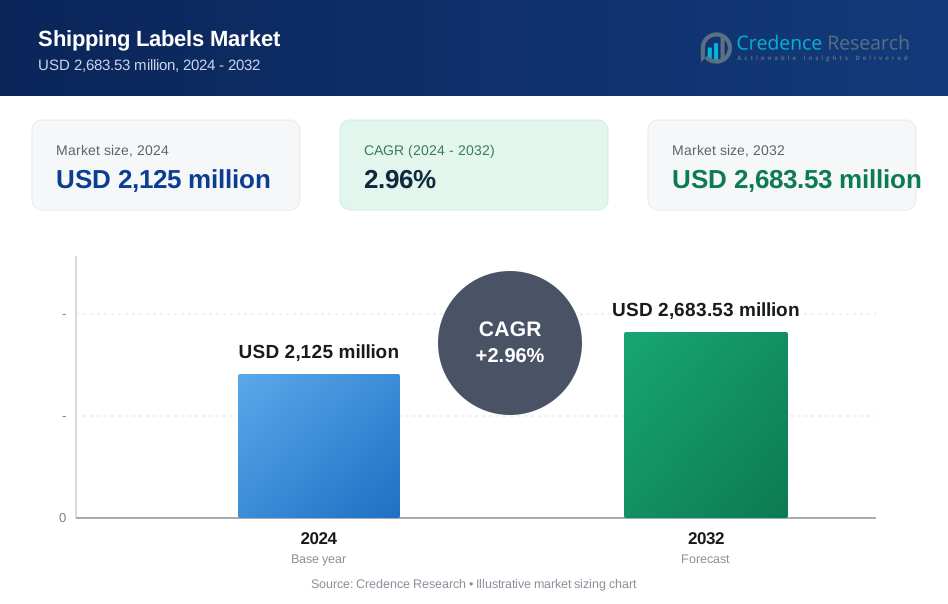
| Shipping Labels Market Size 2024 | USD 2125 Million |
| Shipping Labels Market, CAGR | 2.96% |
| Shipping Labels Market Size 2032 | USD 2683.53 Million |
Market Overview
The Shipping Labels Market is projected to grow from USD 2125 million in 2024 to USD 2683.53 million by 2032, at a compound annual growth rate (CAGR) of 2.96%.
The Shipping Labels Market is driven by the growing e-commerce industry and increasing demand for efficient logistics and supply chain management. Technological advancements in label printing, such as RFID and QR code integration, enhance tracking and inventory management, further propelling market growth. Additionally, the rise of omnichannel retailing and globalization of trade contribute to the increased need for accurate and durable shipping labels. Sustainability trends are also influencing the market, with a growing preference for eco-friendly and recyclable labeling materials. These factors collectively foster the expansion and innovation within the shipping labels market.
The Shipping Labels Market exhibits significant regional diversity, with North America and Europe leading due to advanced logistics infrastructure and high adoption of digital printing technologies. Asia-Pacific is experiencing rapid growth driven by the e-commerce boom and expanding manufacturing sector. Key players in the market include Lintec, Amcor, UPM-Kymmene, 3M, CCL Industries, WS Packaging Group, Herma, Fuji Seal International, PMC Label, and Robos GmbH, who are pivotal in driving innovation and meeting the rising demand for efficient and sustainable labeling solutions across these regions.
Market Drivers
E-commerce Boom The surge in e-commerce has led to a dramatic rise in shipment volumes, necessitating efficient and accurate labeling solutions for tracking and delivery purposes. Efficient and accurate labeling solutions are critical in managing this surge. For instance, a single error in a shipping label can lead to a package being delayed or lost, potentially costing businesses an average of $20 per package in additional handling and reshipping fees. Moreover, with the rise of same-day and next-day delivery options, the pressure on logistics networks to perform flawlessly has never been higher. For instance, during the 2020 holiday season, major carriers in the U.S. experienced a 30% increase in shipment volumes compared to the previous year, pushing the need for reliable labeling solutions to the forefront of e-commerce logistics. As online shopping continues to grow exponentially, businesses face increased pressure to ensure timely and accurate delivery of goods. Shipping labels play a vital role in this process by providing essential information such as destination addresses, tracking numbers, and handling instructions. They help streamline operations within the logistics network, ensuring that packages reach their intended destinations promptly and without error. This demand for precise and reliable labeling solutions is a key driver of growth in the shipping labels market.
Supply Chain Optimization Businesses are constantly seeking ways to streamline their supply chains and reduce inefficiencies. Shipping labels with advanced features like barcodes and QR codes enable automated tracking and real-time visibility throughout the supply chain. For instance, the use of QR codes has been shown to improve the accuracy of package sorting by up to 99.9%. This technological integration allows companies to monitor shipments at every stage, from production to final delivery. The ability to track packages in real-time leads to better inventory management, reducing instances of lost or misplaced items. Additionally, faster delivery times can be achieved through improved logistical coordination. The push for more efficient supply chain operations continues to drive the adoption of sophisticated shipping labels, further boosting market growth.
Technological Advancements
Technological advancements in label printing and design are also propelling the shipping labels market forward. Innovations such as RFID tags and smart labels enhance the functionality of traditional labels, providing additional data storage and retrieval capabilities. For example, RFID technology can increase inventory accuracy to 95% or higher. These advancements facilitate more accurate tracking, inventory management, and overall supply chain transparency. Furthermore, the integration of digital printing technologies allows for high-quality, customizable labels that can be produced quickly and cost-effectively. As businesses strive to stay competitive in a fast-paced market, the adoption of these cutting-edge labeling solutions becomes increasingly important, driving further market expansion.
Regulatory Compliance Various regulations govern the shipment of specific goods, particularly hazardous materials. These regulations mandate the use of specialized shipping labels that clearly communicate potential risks and ensure safe handling during transportation. Compliance with these regulations is crucial for businesses to avoid penalties and ensure the safety of their operations. As regulatory bodies continue to enforce stringent guidelines, the demand for compliant labeling solutions rises. Shipping labels that meet these requirements not only protect public safety but also help businesses maintain their reputations and avoid legal complications. The need for regulatory compliance is a significant factor contributing to the sustained growth of the shipping labels market.
Market Trends
Rise of Digital Printing and Integration with E-commerce Platforms Traditionally, shipping labels were printed in bulk using flexographic or offset printing methods. However, the growing demand for on-demand labels and customization is driving the adoption of digital printing technologies. For instance, in the past year, the digital printing market has seen a 25% increase in demand for on-demand labels, with businesses reporting a 30% reduction in turnaround times compared to traditional methods. Small print runs, which can be as low as 100 labels, are now possible, offering a level of customization that was previously unattainable. Moreover, the integration of shipping label solutions with major e-commerce platforms has led to a 20% decrease in manual data entry errors, streamlining the fulfillment process significantly. Digital printing allows for faster turnaround times, smaller print runs, and variable data printing, such as unique barcodes for each package. This flexibility is crucial for businesses that need to adapt quickly to changing market demands and offer personalized shipping solutions. Furthermore, seamless integration between shipping label solutions and e-commerce platforms is becoming increasingly important. Automated label generation based on order information eliminates manual data entry errors and streamlines the fulfillment process, enhancing efficiency and accuracy. This integration ensures that shipping labels are correctly formatted and contain all necessary information, reducing the risk of delays and errors in the delivery process. As e-commerce continues to expand, the combined impact of digital printing and platform integration is transforming the shipping labels market, making it more responsive and efficient.
Smart and Sustainable Labels, Focus on Security and Anti-Counterfeiting Emerging technologies like RFID tags and near-field communication (NFC) are being incorporated into shipping labels, creating smart labels that offer enhanced tracking capabilities and improve product authentication. Incorporating technologies like RFID tags, which have seen a 40% adoption rate in the shipping industry, smart labels are revolutionizing the way we track shipments. For instance, a shipment with an RFID-enabled label can be tracked with 99% accuracy, providing real-time updates. On the sustainability front, there has been a 35% increase in the use of recyclable materials for shipping labels in the last two years. As for security, the implementation of tamper-evident seals and holographic elements has led to a 50% reduction in counterfeit incidents, ensuring that products maintain their integrity from the warehouse to the consumer. These smart labels can store and transmit data, providing real-time updates on the location and condition of shipments. This technology not only enhances logistics efficiency but also provides consumers with additional product information, improving transparency and trust. Additionally, there is a growing focus on sustainable materials for shipping labels, driven by environmental concerns and the increasing demand for eco-friendly packaging solutions. Companies are exploring recyclable and biodegradable materials for label production, aligning with broader sustainability goals and consumer preferences. Alongside these advancements, the demand for secure shipping labels with anti-counterfeiting features is rising as counterfeit goods become a growing concern.
Market Challenges Analysis
Supply Chain Disruptions and Labeling Errors The shipping labels market, like many other industries, is grappling with ongoing supply chain disruptions. Raw material shortages and rising costs can lead to price fluctuations and impact production timelines for labels. These disruptions can create challenges for manufacturers, who must navigate inconsistent supply chains and fluctuating prices to maintain production schedules and meet demand. Additionally, labeling errors present significant challenges throughout the supply chain. Inaccurate information on shipping labels can cause delays, misdirected shipments, and even product recalls. These errors can have a ripple effect, causing operational inefficiencies and increasing costs for businesses. To mitigate these issues, maintaining data accuracy and ensuring proper integration between labeling systems and other platforms are crucial. Effective integration helps prevent errors, streamline processes, and ensure that shipments reach their intended destinations accurately and on time. Addressing these supply chain and accuracy challenges is essential for maintaining reliability and efficiency in the shipping labels market.
Balancing Cost and Functionality, Environmental Regulations Businesses in the shipping labels market face the challenge of balancing cost and functionality. While basic labels might suffice for some applications, others may require advanced features such as special adhesives for extreme temperatures or tamper-evident seals for high-value goods. Finding the right balance between cost and features can be a challenge, as businesses must ensure that their labeling solutions meet specific requirements without significantly increasing expenses. This balancing act requires careful consideration of the unique needs of each shipment and the value of the goods being transported. Additionally, environmental regulations regarding label materials and disposal add complexity to the manufacturing process. The industry is increasingly adopting more sustainable materials and practices to comply with these regulations and meet growing consumer demand for eco-friendly products. This shift towards sustainability involves exploring recyclable and biodegradable materials for label production and implementing greener manufacturing processes. While these initiatives are essential for reducing environmental impact, they also introduce new challenges related to cost, material availability, and production efficiency.
Market Segmentation Analysis:
By Product:
The shipping labels market is diversified across several product types, each catering to specific industry needs. Non-adhesive based labels are commonly used for applications requiring temporary or repositionable labeling. Glue applied labels, favored for their durability, are prevalent in industries like food and beverage, where they ensure adherence even in moist environments. In-mold labels, integrated during the molding process, offer superior durability and are widely utilized in plastic packaging. Sleeve labels provide 360-degree coverage, making them ideal for branding and promotional purposes. Adhesive based permanent labels are essential for long-term applications where labels must remain intact, such as in logistics and warehousing. Removable labels, on the other hand, are designed for situations where labels need to be removed cleanly without leaving residue, such as retail pricing and promotions. This diverse product segmentation allows businesses to select the most appropriate labeling solutions to meet their operational requirements and regulatory standards, ensuring efficiency and compliance.
By Technology:
The shipping labels market is also segmented based on the technology used in label production, reflecting advancements in printing methods. Digital printed labels have gained popularity due to their flexibility in design and ability to produce high-quality prints with variable data, making them suitable for small to medium-sized batches. Thermal printed labels are preferred for their efficiency in high-speed printing environments, particularly in logistics and retail sectors where quick turnaround is crucial. Lithographic printed labels, known for their high-resolution output, are ideal for large-scale printing with consistent quality, commonly used in packaging and promotional labeling. Flexographic printed labels offer versatility and durability, making them a staple in various industries including food, beverage, and healthcare. These technological advancements in label printing not only enhance the visual appeal and functionality of labels but also contribute to improved operational efficiency and cost-effectiveness for businesses, enabling them to meet diverse labeling requirements across different sectors.
Segments:
Based on Product:
- Non-adhesive based
- Glue applied
- In-mold label
- Sleeve label
- Adhesive based permanent
- Removable
Based on Technology:
- Digital printed labels
- Thermal printed labels
- Lithographic printed labels
- Flexographic printed labels
Based on Material:
- Specialty papers
- Foil
- Plastics
- Polypropylene (PP)
- Polyethylene (PE)
- Polystyrene (PS)
- Polyvinyl Chloride (PVC)
- Polycarbonate (PC)
- Polymethyl Methacrylate (PPMA)
- Others such as PET
Based on the Geography:
- North America
- US
- Canada
- Mexico
- Europe
- Germany
- France
- UK
- Italy
- Spain
- Rest of Europe
- Asia Pacific
- China
- Japan
- India
- South Korea
- South-east Asia
- Rest of Asia Pacific
- Latin America
- Brazil
- Argentina
- Rest of Latin America
- Middle East & Africa
- GCC Countries
- South Africa
- Rest of the Middle East and Africa
Regional Analysis
North America
North America holds a dominant market share of approximately 35%, driven by the region's robust e-commerce sector and highly developed logistics infrastructure. The United States, in particular, contributes substantially to this market dominance, with its extensive network of online retailers and efficient shipping systems. The region's market is characterized by a high adoption rate of advanced labeling technologies, including RFID and smart labels, which enhance tracking capabilities and streamline supply chain operations. Additionally, the increased focus on sustainable packaging solutions has led to growing demand for eco-friendly shipping labels in North America.
Europe
Europe follows closely with a 30% market share, benefiting from its strong manufacturing base and well-established postal services. The European market is marked by stringent regulations regarding packaging and labeling, driving innovation in compliant and efficient labeling solutions.
Key Player Analysis
- Lintec
- Amcor
- UPM-Kymmene
- 3M
- CCL Industries
- WS Packaging Group
- Herma
- Fuji Seal International
- PMC Label
- Robos GmbH
Competitive Analysis
The Shipping Labels Market is highly competitive, with key players like Lintec, Amcor, UPM-Kymmene, 3M, and CCL Industries leading the industry. Lintec and Amcor leverage their extensive R&D capabilities to innovate advanced labeling solutions, focusing on sustainability and smart labels. UPM-Kymmene excels in offering eco-friendly materials, catering to the growing demand for sustainable packaging. 3M stands out with its robust portfolio of adhesive technologies, providing versatile and reliable label solutions. CCL Industries and WS Packaging Group emphasize customization and digital printing technologies to meet diverse customer needs. Herma and Fuji Seal International are noted for their strong market presence in Europe and Asia-Pacific, respectively, while PMC Label and Robos GmbH focus on niche markets and high-quality product offerings. These companies compete by enhancing product features, expanding their geographical reach, and forming strategic partnerships to strengthen their market positions and drive innovation.
Market Concentration & Characteristics
The Shipping Labels Market exhibits a moderate to high level of concentration, dominated by a few key players such as Lintec, Amcor, and 3M, who hold significant market shares due to their extensive technological capabilities and broad product portfolios. These leading companies drive market dynamics through continuous innovation, focusing on advanced printing technologies and sustainable materials to meet evolving customer demands. The market is characterized by its emphasis on customization and efficiency, with trends shifting towards digital and smart label solutions. While major players command substantial market influence, the presence of regional players and new entrants adds competitive pressure, fostering a diverse and dynamic market environment. Companies strategically invest in R&D and form partnerships to enhance their product offerings and market reach, ensuring they address both global and localized needs effectively. This concentration, combined with ongoing technological advancements, shapes the market’s competitive landscape and growth trajectory.
Report Coverage
The research report offers an in-depth analysis based on Product, Technology, Material and Geography. It details leading market players, providing an overview of their business, product offerings, investments, revenue streams, and key applications. Additionally, the report includes insights into the competitive environment, SWOT analysis, current market trends, as well as the primary drivers and constraints. Furthermore, it discusses various factors that have driven market expansion in recent years. The report also explores market dynamics, regulatory scenarios, and technological advancements that are shaping the industry. It assesses the impact of external factors and global economic changes on market growth. Lastly, it provides strategic recommendations for new entrants and established companies to navigate the complexities of the market.
Future Outlook
- The Shipping Labels Market is anticipated to expand as e-commerce growth drives higher demand for efficient labeling solutions.
- Advances in digital printing technologies will facilitate faster, more customized label production.
- Integration of smart technologies, like RFID and NFC, will enhance tracking and authentication capabilities.
- Increasing emphasis on sustainability will lead to a rise in eco-friendly and recyclable label materials.
- The adoption of automated labeling systems will improve accuracy and operational efficiency.
- Regulatory requirements for clear and informative labeling will continue to influence market trends and product developments.
- Growth in global supply chains will drive demand for durable and versatile labeling solutions.
- Innovations in adhesive technologies will address diverse application needs and environmental conditions.
- Collaboration between technology providers and label manufacturers will accelerate advancements in label functionality.
- Expansion in emerging markets will present new opportunities and challenges for industry players.
Request a Free Sample
Fill in your details and we'll send you a free sample report.
- Sample data tables & charts
- Research methodology
Need a Custom Version of This Report?
Tailor the scope, geography, or segments to your exact requirements.
- Custom geography or segment scope
- Direct access to our analyst team
Frequently Asked Questions
What is the current size of the Shipping Labels Market?
What factors are driving the growth of the Shipping Labels Market?
What are the key segments within the Shipping Labels Market?
What are some challenges faced by the Shipping Labels Market?
Who are the major players in the Shipping Labels Market?
Which segment is leading the market share?
Table of Content
Chapter 1. Report Introduction
- 1.1 Report Description & Purpose
- 1.1.1 Report Title & Market Definition
- 1.1.2 Unique Selling Propositions (USP) & Key Differentiators
- 1.1.3 Value Proposition for Stakeholders
- 1.2 Research Objectives
- 1.2.1 Market Sizing Objectives (Volume & Revenue)
- 1.2.2 Segmentation Objectives
- 1.2.3 Competitive Intelligence Objectives
- 1.2.4 Forecast & Scenario Objectives
- 1.3 Report Scope
- 1.3.1 Shipping Labels Scope – Types & Subtypes Covered
- 1.3.2 Geographic Scope – Regions & Countries Covered
- 1.3.3 Historical Period, Base Year & Forecast Period (2024; forecast to 2032)
- 1.3.4 Inclusions & Exclusions
- 1.4 HS Code & Classification Framework
- 1.5 Currency, Units & Pricing Basis
- 1.6 Target Stakeholders
- 1.7 Limitations & Assumptions
Chapter 2. Executive Summary
- 2.1 Global Shipping Labels Market Snapshot
- 2.1.1 Market Size – Historical (2024) & Forecast (2024-2032) (2024: USD 2,125 million → 2032: USD 2,683.53 million)
- 2.1.2 Volume & Revenue – Global Totals
- 2.1.3 Key Market Highlights – Top Five Facts
- 2.2 Shipping Labels Market Segmentation Snapshot
- 2.2.1 Market Split by Region – 2024 vs. 2032
- 2.3 Competitive Snapshot
- 2.3.1 Top 10 Players by Revenue Share – 2024
- 2.3.2 Top 10 Players by Volume Share – 2024
- 2.3.3 Recent Strategic Developments (18-Month Summary)
- 2.4 Key Investment Highlights & Strategic Conclusions
Chapter 3. Shipping Labels Market Dynamics & Industry Analysis
- 3.1 Market Overview & Context
- 3.1.1 Shipping Labels Market Position in the Broader Automotive Value Chain
- 3.1.2 OEM vs. Replacement Market Dynamics
- 3.1.3 Market Maturity & Development Stage by Region
- 3.2 Shipping Labels Market Drivers
- 3.3 Shipping Labels Market Restraints & Challenges
- 3.4 Shipping Labels Market Opportunities
- 3.5 Porter's Five Forces Analysis
- 3.5.1 Threat of New Entrants
- 3.5.2 Bargaining Power of Suppliers
- 3.5.3 Bargaining Power of Buyers
- 3.5.4 Threat of Substitutes
- 3.5.5 Competitive Rivalry – Intensity Assessment
- 3.6 Shipping Labels Value Chain Analysis
- 3.6.1 Upstream – Raw Material/Input Suppliers
- 3.6.1.1 Raw Material/Input 1
- 3.6.1.2 Raw Material/Input 2
- 3.6.1.3 Raw Material/Input 3
- 3.6.2 Midstream – Production/Manufacturing/Service Delivery
- 3.6.2.1 Production/Process Overview
- 3.6.2.2 Key Facility Locations & Capacity by Manufacturer
- 3.6.3 Downstream – Distribution & End Consumer
- 3.6.3.1 Primary Channel – B2B/OEM
- 3.6.3.2 Secondary Channels – Dealer, Retail, Online, Direct
- 3.6.4 Value Chain Profitability Analysis
- 3.6.1 Upstream – Raw Material/Input Suppliers
- 3.7 PESTEL Analysis
- 3.7.1 Political Factors
- 3.7.2 Economic Factors
- 3.7.3 Social Factors
- 3.7.4 Technological Factors
- 3.7.5 Environmental Factors
- 3.7.6 Legal Factors
- 3.8 Shipping Labels Supply Chain Analysis
- 3.8.1 Raw Material/Input Supply Risk Assessment
- 3.8.2 Manufacturing Concentration Risk (Geographic Exposure)
- 3.8.3 Trade Disruption Impact Analysis
- 3.9 Regulatory & Policy Landscape
Note: The regulatory and policy landscape section covers regulations based on their applicability to the market, Shipping Labels category, geography, and scope of the study. Only regulatory frameworks with a material impact on operations, compliance, trade, sustainability, or market access are analyzed in detail.
Chapter 4. Key Investment Pockets & Opportunity Analysis
- 4.1 Shipping Labels Market Attractiveness Analysis
- 4.1.1 By Region – Investment Attractiveness Matrix (Volume × CAGR)
- 4.2 Absolute Revenue Growth Opportunity
- 4.2.1 By Region – Absolute USD Growth Through 2032
- 4.3 Incremental Volume Opportunity
- 4.3.1 By Region – Incremental Volume Through 2032
- 4.3.2 Segment – Incremental Volume
- 4.4 Emerging Submarket Opportunity Deep Dive (Subject to Applicability)
- 4.5 Emerging Market Opportunity Scorecards
- 4.5.1 United States
- 4.5.2 Europe
- 4.5.3 Asia
- 4.5.4 Middle East & Africa
Note: Emerging Market Opportunity Scorecards will be included based on relevance and strategic importance. Regions listed are indicative and may vary depending on data availability and market dynamics.
Chapter 5. Shipping Labels Import-Export Analysis & Trade Flows
- 5.1 Global Trade Overview
- 5.1.1 Global Export Value by Country (2024)
- 5.1.2 Global Export Volume by Country (2024)
- 5.1.3 Global Import Value by Country (2024)
- 5.1.4 Global Import Volume by Country (2024)
- 5.1.5 Net Trade Balance by Country (2024)
- 5.2 Export Analysis – Segment
- 5.2.1 Type 1 (HS Code)
- 5.2.2 Type 2 (HS Code)
- 5.2.3 Type 3 (HS Code)
- 5.2.4 Type 4 (HS Code)
- 5.2.5 Type 5 (HS Code)
- 5.3 Import Analysis – Segment
- 5.3.1 Type 1 (HS Code)
- 5.3.2 Type 2 (HS Code)
- 5.3.3 Type 3 (HS Code)
- 5.3.4 Type 4 (HS Code)
- 5.3.5 Type 5 (HS Code)
- 5.4 Average Unit Trade Prices
- 5.4.1 Average Export Price – Segment & Country
- 5.4.2 Average Import Price – Segment & Source Country
- 5.4.3 Price Trends (2024)
- 5.5 Key Trade Route Analysis
- 5.5.1 Trade Route 1
- 5.5.2 Trade Route 2
- 5.5.3 Trade Route 3
- 5.5.4 Trade Route 4
- 5.5.5 Trade Route 5
- 5.6 Trade Policy Impact Assessment
- 5.6.1 US Anti-Dumping & Section 301 Tariffs
- 5.6.2 EU Customs Union Impact
- 5.6.3 Major Free Trade Agreements
- 5.6.4 USMCA Rules of Origin
Note: Trade policy analysis will be included only where relevant to the Shipping Labels market.
Chapter 6. Competitive Landscape & Company Benchmarking
- 6.1 Shipping Labels Market Concentration & Structure
- 6.1.1 Herfindahl-Hirschman Index (HHI) – vs. 2024
- 6.1.2 Tier 1, Tier 2 & Tier 3 Market Structure
- 6.1.3 Global, Regional & Local Player Dynamics
- 6.2 Shipping Labels Market Share Analysis – 2024
- 6.2.1 Global Revenue Share by Company
- 6.2.2 Global Volume Share by Company
- 6.2.3 Regional Revenue Share
- 6.2.4 Market Share Evolution ( vs. 2024)
- 6.2.5 OEM Segment Share by Company
- 6.2.6 Replacement Segment Share by Company
- 6.3 Production/Delivery Capacity & Facility Analysis
- 6.3.1 Global Installed Capacity
- 6.3.2 Capacity Utilization Rates
- 6.3.3 Production/Output Volume
- 6.3.4 Facility Locations & Capacity Map
- 6.3.5 Planned Capacity Additions
- 6.4 Shipping Labels Competitive Benchmarking Matrix
- 6.4.1 Revenue, Volume, CAGR & Profitability Comparison
- 6.4.2 Channel Revenue Mix
- 6.4.3 Geographic Revenue Exposure
- 6.4.4 R&D Intensity
- 6.4.5 Sustainability Maturity
- 6.5 Strategic Developments in Shipping Labels (Last 24 Months)
- 6.5.1 Mergers, Acquisitions & Divestments
- 6.5.2 New Shipping Labels Launches
- 6.5.3 Facility Expansions
- 6.5.4 Strategic Alliances, Joint Ventures & Partnerships
- 6.5.5 Distribution Expansion & Market Entry
- 6.5.6 Sustainability & ESG Initiatives
- 6.6 Competitive Strategy Mapping
- 6.6.1 Leader, Challenger, Follower & Niche Classification
- 6.6.2 Pricing Strategy Comparison
- 6.6.3 Channel Strategy Matrix
Note: Strategic developments are included based on their materiality and the availability of reliable information.
Chapter 7. Global Shipping Labels Market – By Distribution Channel
- 7.1 Segment Overview
- 7.1.1 Volume & Revenue Split by Channel (2024 & 2032)
- 7.1.2 Channel Mix Evolution (2024-2032)
Chapter 8. Regional Market Analysis – Global Overview
- 8.1 Global Regional Overview
- 8.1.1 Regional Volume Share
- 8.1.2 Regional Revenue Share
- 8.1.3 Regional Volume by Region
- 8.1.4 Regional Revenue by Region
- 8.1.5 Regional Forecast Through 2032
- 8.2 Cross-Regional Segment Analysis
- 8.2.1 By Distribution Channel
- 8.2.2 By Brand/Price Tier
Chapter 9. North America Shipping Labels Market
- 9.1 United States
- 9.2 Canada
- 9.3 Mexico
Chapter 10. Europe Shipping Labels Market
- 10.1 Germany
- 10.2 France
- 10.3 Italy
- 10.4 United Kingdom
- 10.5 Spain
- 10.6 Poland
- 10.7 Russia
- 10.8 Netherlands
- 10.9 Belgium
- 10.10 Sweden
- 10.11 Denmark
- 10.12 Norway
- 10.13 Rest of Europe
Chapter 11. Asia Pacific Shipping Labels Market
- 11.1 China
- 11.2 India
- 11.3 Japan
- 11.4 South Korea
- 11.5 Thailand
- 11.6 Indonesia
- 11.7 Vietnam
- 11.8 Malaysia
- 11.9 Australia
- 11.10 Rest of Asia Pacific
Chapter 12. Latin America Shipping Labels Market
- 12.1 Brazil
- 12.2 Argentina
- 12.3 Colombia
- 12.4 Chile
- 12.5 Rest of Latin America
Chapter 13. Middle East Shipping Labels Market
- 13.1 Saudi Arabia
- 13.2 United Arab Emirates
- 13.3 Turkey
- 13.4 Israel
- 13.5 Iran
- 13.6 Rest of the Middle East
Chapter 14. Africa Shipping Labels Market
- 14.1 South Africa
- 14.2 Egypt
- 14.3 Nigeria
- 14.4 Morocco
- 14.5 Rest of Africa
Chapter 15. Shipping Labels Company Profiles
- 15.1 [Company 01]
- 15.1.1 Company Overview
- 15.1.2 Key Management Personnel
- 15.1.3 Products & Services Portfolio
- 15.1.4 Financial Performance
- 15.1.5 Key Market Focus & Geographic Presence
- 15.1.6 Recent Developments & Strategic Initiatives
Note: The company profile list is preliminary and may change based on research findings, market developments, data availability, and client requirements.
Chapter 16. Appendices
- Appendix A – List of Abbreviations & Acronyms
- Appendix B – Industry Classification Code Reference – Full Series
- Appendix C – Production & Capacity Data Tables
- Appendix D – End-Use & Demand Base Tables
- Appendix E – Consumption & Replacement Rate Assumptions
- Appendix F – ASP Reference Tables
- Appendix G – Manufacturing & Facility Database
- Appendix H – Import-Export Data Tables
- Appendix I – Regulatory Summary Tables
- Appendix J – Primary Research Participant List (Anonymized)
- Appendix K – Primary Research Questionnaire Framework
- Appendix L – Data Sources & Bibliography
- Appendix M – Market Size Divergence & Source Comparison
Chapter 17. Research Methodology
- 17.1 Research Framework & Philosophy
- 17.2 Secondary Research – Sources, Hierarchy & Data Extraction
- 17.3 Data Modeling – Bottom-Up & Top-Down Market Sizing
- 17.4 Primary Research – Stakeholder Framework, LOI & Sample Sizes
- 17.5 Forecast Methodology – Regression, Scenario & Sensitivity Analysis
- 17.6 Quality Control – Four-Layer Validation Framework
- 17.7 Limitations & Standard Assumptions
- 17.8 Disclaimer
