Market Overview
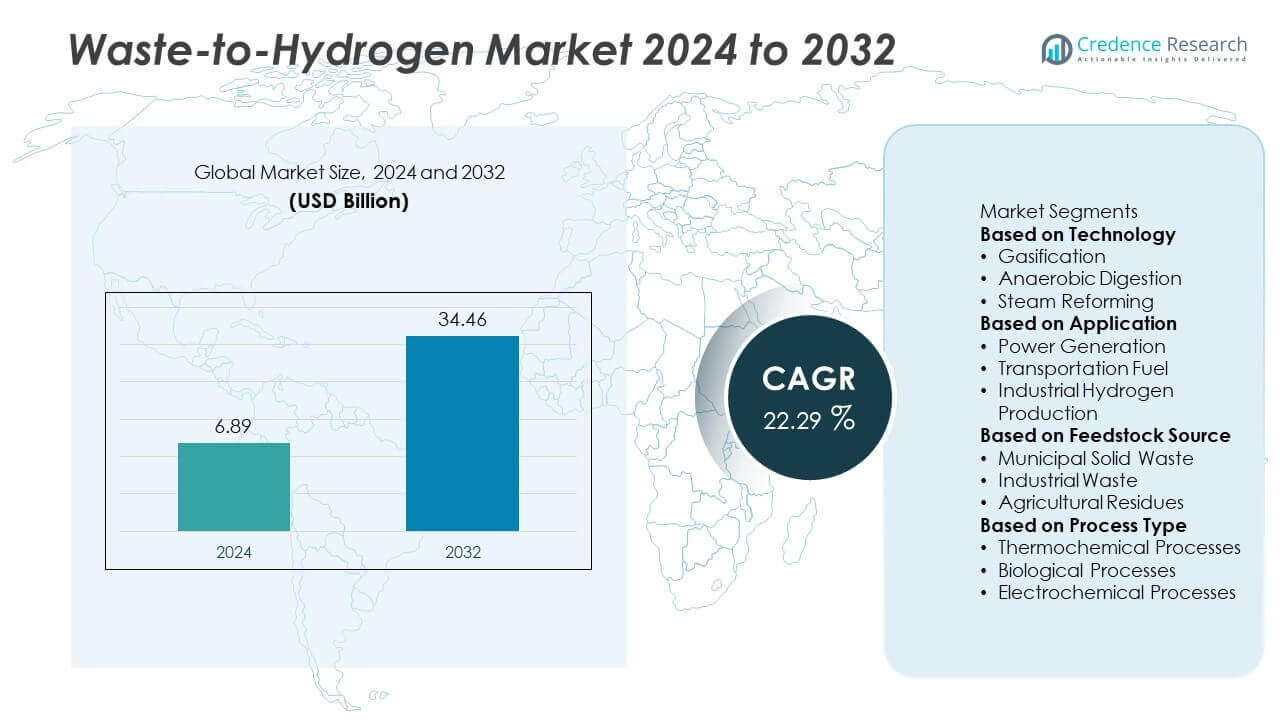
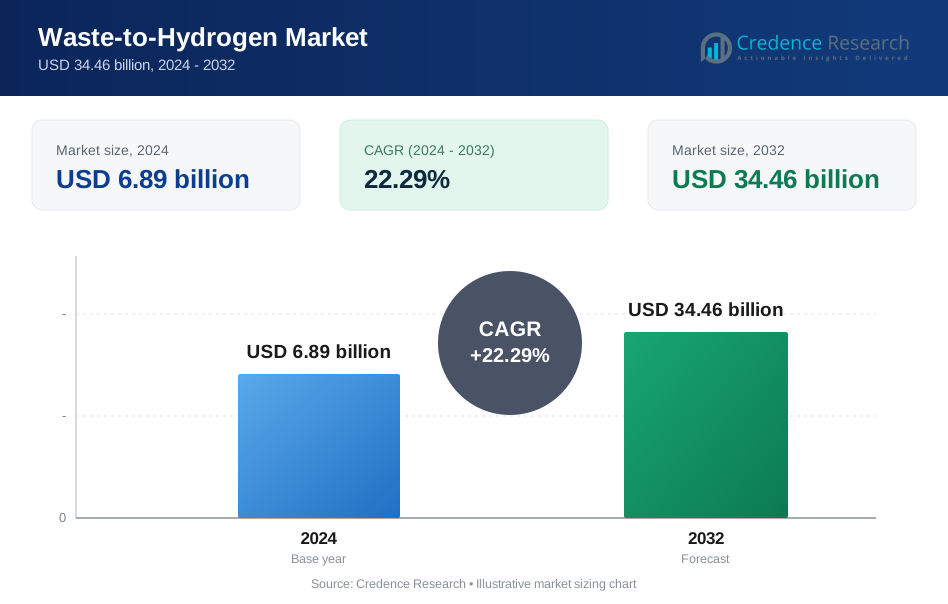
The Waste-to-Hydrogen Market size was valued at USD 6.89 billion in 2024 and is projected to reach USD 34.46 billion by 2032, growing at a CAGR of 22.29% during the forecast period.
| REPORT ATTRIBUTE | DETAILS |
|---|---|
| Historical Period | 2020-2023 |
| Base Year | 2024 |
| Forecast Period | 2025-2032 |
| Waste-to-Hydrogen Market Size 2024 | USD 6.89 Billion |
| Waste-to-Hydrogen Markett, CAGR | 22.29% |
| Waste-to-Hydrogen Market Size 2032 | USD 34.46 Billion |
The Waste-to-Hydrogen Market grows through strong drivers and evolving trends that support its rapid adoption. Rising demand for clean hydrogen as an alternative fuel and government incentives accelerate large-scale investments. It addresses dual challenges of renewable energy needs and sustainable waste management.
The Waste-to-Hydrogen Market demonstrates strong geographical growth across major regions, supported by government initiatives and sustainability goals. North America leads with advanced infrastructure and projects that integrate hydrogen production with municipal waste management. Europe follows with strict environmental regulations and strong policy frameworks that encourage waste valorization and hydrogen adoption in transportation and industry. Asia-Pacific records the fastest momentum, driven by large-scale urbanization, high waste volumes, and national hydrogen roadmaps in China, Japan, and South Korea. Latin America and the Middle East & Africa show emerging potential through pilot projects supported by international investments and circular economy initiatives. Key players driving this market include Siemens, Brightmark, ENGIE, and Waste Management, alongside innovators such as ThyssenKrupp and Ballard Power Systems. Their focus on partnerships, technological advancements, and large-scale project announcements strengthens the global position of waste-to-hydrogen solutions in both energy and environmental strategies.
Market Insights
- The Waste-to-Hydrogen Market was valued at USD 6.89 billion in 2024 and is projected to reach USD 34.46 billion by 2032, growing at a CAGR of 22.29%.
- Rising demand for clean hydrogen as a fuel source drives large-scale adoption across industries and municipalities.
- Governments worldwide introduce incentives, tax credits, and hydrogen roadmaps that strengthen project development and private investments.
- Technological advancements in gasification, pyrolysis, and plasma arc processes improve efficiency, scalability, and emission reduction.
- Leading companies such as Siemens, Brightmark, ENGIE, and Waste Management compete through partnerships, innovation, and regional expansion.
- High capital requirements, long approval cycles, and regulatory inconsistencies act as restraints for smaller developers.
- North America and Europe remain strong markets with established projects, Asia-Pacific emerges as the fastest-growing region, while Latin America and the Middle East & Africa show gradual adoption through pilot initiatives.
Market Drivers
Rising Demand for Clean Hydrogen as an Alternative Fuel Source
The Waste-to-Hydrogen Market benefits from the rising global demand for clean hydrogen as a sustainable fuel. Governments and industries are investing in hydrogen projects to reduce dependence on fossil fuels. It supports decarbonization goals in transportation, power generation, and industrial use. Hydrogen from waste offers a dual benefit of energy production and waste reduction. The growing interest in hydrogen fuel cells in mobility applications enhances market prospects. It aligns with long-term climate strategies set by international agreements.
- For instance, Brightmark announced a new plastics recycling facility in Thomaston, Georgia in April 2024, projected to process over 400,000 tons of plastic annually. This is distinct from its Ashley, Indiana, plant, which had a 100,000-ton capacity and faced operational issues before its subsidiaries filed for bankruptcy in March 2025.
Government Policies and Incentives Encouraging Hydrogen Adoption
Government support plays a critical role in driving the Waste-to-Hydrogen Market. Regulatory frameworks and subsidies are introduced to encourage large-scale hydrogen production from waste streams. It fosters partnerships between public institutions and private companies to accelerate project development. Tax benefits and carbon credits incentivize investments in waste-to-hydrogen infrastructure. Policies focused on reducing greenhouse gas emissions strengthen adoption in heavy industries. It ensures the market receives financial and institutional backing to expand rapidly.
- For instance, in June 2025 Snam secured €24 million in co-financing from the European Commission under the CEF Energy programme to develop the Italian Hydrogen Backbone, integrating hydrogen-including waste-derived hydrogen-into national infrastructure.
Technological Advancements Enhancing Conversion Efficiency and Scalability
Continuous innovation drives growth in the Waste-to-Hydrogen Market by improving efficiency and scalability. Advanced gasification, pyrolysis, and plasma arc technologies are making hydrogen production more cost-effective. It enables better conversion rates from municipal and industrial waste sources. Integration of digital monitoring and automation increases operational reliability. Enhanced technologies reduce carbon footprints compared to traditional hydrogen production. It strengthens industry confidence in deploying large-scale waste-to-hydrogen plants.
Growing Focus on Circular Economy and Sustainable Waste Management
The Waste-to-Hydrogen Market gains momentum from the global push for circular economy models. Converting waste into hydrogen directly supports sustainable waste management practices. It reduces landfill dependency while creating value from discarded materials. Municipalities adopt waste-to-hydrogen solutions to address rising urban waste volumes. The approach aligns with corporate sustainability goals and zero-waste initiatives. It positions waste-to-hydrogen technology as a practical bridge between energy transition and waste reduction.
Market Trends
Integration of Hydrogen into Transportation and Mobility Applications
The Waste-to-Hydrogen Market is witnessing strong momentum through its integration into mobility solutions. Hydrogen-powered buses, trucks, and trains are gaining acceptance as low-emission transport options. It addresses the rising demand for clean energy in urban centers with strict emission norms. Public transport systems in Europe and Asia are investing in hydrogen fleets. The trend creates opportunities for localized waste-to-hydrogen plants near urban hubs. It supports governments in meeting zero-emission targets within the transport sector.
- For instance, Ballard delivered three 100 kW fuel cell modules for a push boat in Berlin, and more recently secured orders for 70 engines for buses in both the UK and Germany.
Expansion of Industrial Applications Beyond Energy Generation
Industrial sectors are emerging as significant adopters of the Waste-to-Hydrogen Market. Heavy industries such as steel, cement, and chemicals are testing hydrogen as a clean substitute for fossil fuels. It reduces carbon intensity in high-emission production processes. Partnerships between industrial players and technology providers expand pilot projects into full-scale plants. Growing industrial demand highlights hydrogen’s role in hard-to-abate sectors. It reinforces the market’s importance beyond transportation and power generation.
- For instance, ThyssenKrupp nucera integrated new electrolysis assets acquired from Green Hydrogen Systems, scaling its alkaline electrolyzer production to support multi-hundred-megawatt industrial hydrogen projects for steel and chemical sectors.
Strategic Collaborations and Large-Scale Project Announcements
The Waste-to-Hydrogen Market is shaped by increasing collaborations among technology firms, governments, and energy companies. Strategic partnerships drive funding and knowledge-sharing to accelerate project deployment. It enables scaling of pilot facilities into commercial production plants. Global energy companies are investing in regional hubs to establish hydrogen corridors. Announcements of multi-million-ton projects highlight the long-term commitment to this technology. It demonstrates confidence in hydrogen’s role within the broader clean energy mix.
Rising Focus on Decentralized and Localized Energy Models
The Waste-to-Hydrogen Market reflects a rising preference for decentralized energy solutions. Smaller waste-to-hydrogen plants are being developed near waste sources and consumption points. It ensures reduced transportation costs and improved efficiency in hydrogen distribution. Urban municipalities see this approach as a way to manage waste sustainably. Decentralized systems also enhance energy security by reducing reliance on centralized grids. It positions waste-to-hydrogen as a flexible solution for both developed and emerging markets.
Market Challenges Analysis
High Capital Requirements and Complex Infrastructure Development
The Waste-to-Hydrogen Market faces significant barriers due to high initial investment needs. Construction of gasification or plasma arc plants requires substantial financial resources and advanced engineering expertise. It limits participation of smaller companies and municipalities with restricted budgets. Long project development cycles and lengthy approval processes further delay implementation. The lack of established hydrogen distribution infrastructure adds to the challenge. It raises concerns about the economic feasibility of projects in developing regions.
Technological, Regulatory, and Feedstock-Related Uncertainties
The Waste-to-Hydrogen Market also struggles with technological and regulatory uncertainties. Variability in waste feedstock quality complicates stable hydrogen production processes. It requires advanced sorting and pre-treatment systems, which increase operational costs. Regulatory inconsistencies across regions hinder cross-border project development. Safety standards for hydrogen handling remain fragmented, delaying widespread adoption. It creates uncertainty for investors and technology providers seeking long-term stability.
Market Opportunities
Expansion of Green Hydrogen Ecosystem and Net-Zero Commitments
The Waste-to-Hydrogen Market presents opportunities through the global shift toward net-zero targets. Countries are scaling up green hydrogen ecosystems to decarbonize transportation, power, and heavy industries. It positions waste-to-hydrogen technology as a vital contributor to national energy roadmaps. Strong government commitments create funding channels for pilot projects and commercial-scale facilities. International energy companies are seeking strategic entry into circular economy solutions. It paves the way for long-term growth and market expansion.
Urban Waste Management Integration and Decentralized Energy Solutions
The Waste-to-Hydrogen Market benefits from rising urbanization and mounting municipal waste volumes. Cities are adopting waste-to-hydrogen systems to transform waste liabilities into clean energy resources. It offers municipalities a dual benefit of sustainable disposal and hydrogen supply for local use. Decentralized plants near waste sources reduce transport costs and enhance efficiency. Growing adoption of microgrids and localized energy hubs further boosts demand. It positions waste-to-hydrogen solutions as scalable models for both developed and emerging economies.
Market Segmentation Analysis:
By Technology
The Waste-to-Hydrogen Market is segmented by technology into gasification, pyrolysis, and plasma arc processes. Gasification leads adoption due to its proven ability to convert municipal solid waste into hydrogen-rich syngas. It offers scalability and cost-efficiency for large plants. Pyrolysis is gaining traction because of its suitability for diverse feedstock, including plastics and industrial residues. Plasma arc technology, though capital-intensive, provides higher conversion efficiency and reduced emissions, making it attractive for advanced projects. It is expected to grow in relevance as industries demand cleaner hydrogen production technologies.
- For instance, in July 2024 Siemens partnered with Boson Energy to scale waste gasification technology capable of processing 40,000 tons of non-recyclable waste annually into hydrogen-rich syngas for mobility and power applications.
By Application
The Waste-to-Hydrogen Market by application includes power generation, transportation, and industrial use. Power generation holds a strong share due to rising demand for renewable energy integration into grids. It enables utilities to reduce reliance on coal and natural gas. Transportation represents a rapidly expanding segment with the rise of hydrogen fuel cell vehicles and urban fleet conversions. Industrial use is expanding as steel, cement, and chemical industries explore hydrogen as a replacement for fossil fuels. It reflects the versatility of waste-to-hydrogen solutions across multiple sectors.
- For instance, in March 2025 EnviTec Biogas commissioned a U.S. facility in South Dakota processing over 300,000 gallons of dairy waste daily to produce 483 scfm of renewable gas, which can be upgraded to hydrogen for industrial and transportation applications.
By Feedstock Source
The Waste-to-Hydrogen Market also divides by feedstock source into municipal solid waste, agricultural waste, and industrial waste. Municipal solid waste dominates as urban centers face growing waste volumes and landfill pressures. It offers municipalities a sustainable method for waste disposal while generating hydrogen. Agricultural waste is becoming important in regions with high crop residue generation, offering additional revenue streams for farmers. Industrial waste contributes through byproducts and residues that are suitable for hydrogen production. It highlights the adaptability of waste-to-hydrogen technologies to local resource availability.
Segments:
Based on Technology
- Gasification
- Anaerobic Digestion
- Steam Reforming
Based on Application
- Power Generation
- Transportation Fuel
- Industrial Hydrogen Production
Based on Feedstock Source
- Municipal Solid Waste
- Industrial Waste
- Agricultural Residues
Based on Process Type
- Thermochemical Processes
- Biological Processes
- Electrochemical Processes
Based on the Geography:
- North America
- U.S.
- Canada
- Mexico
- Europe
- UK
- France
- Germany
- Italy
- Spain
- Russia
- Belgium
- Netherlands
- Austria
- Sweden
- Poland
- Denmark
- Switzerland
- Rest of Europe
- Asia Pacific
- China
- Japan
- South Korea
- India
- Australia
- Thailand
- Indonesia
- Vietnam
- Malaysia
- Philippines
- Taiwan
- Rest of Asia Pacific
- Latin America
- Brazil
- Argentina
- Peru
- Chile
- Colombia
- Rest of Latin America
- Middle East
- UAE
- KSA
- Israel
- Turkey
- Iran
- Rest of Middle East
- Africa
- Egypt
- Nigeria
- Algeria
- Morocco
- Rest of Africa
Regional Analysis
North America
North America accounts for 36% share of the Waste-to-Hydrogen Market, supported by advanced waste management infrastructure and strong government incentives. The United States leads with significant investments in hydrogen production facilities integrated with municipal waste streams. It benefits from supportive policies such as tax credits and state-level funding for clean hydrogen hubs. Canada is also expanding projects to align with national decarbonization commitments and growing interest in hydrogen mobility. Partnerships between technology firms and waste management companies strengthen the regional landscape. It positions North America as a frontrunner in scaling commercial waste-to-hydrogen projects. The region is expected to maintain its leadership with rising demand from both industrial users and the transport sector.
Europe
Europe holds a 30% share of the Waste-to-Hydrogen Market, driven by strict environmental regulations and ambitious net-zero targets. Germany, the UK, and France lead adoption through projects focused on waste valorization and hydrogen fuel production. It benefits from the European Union’s Hydrogen Strategy, which emphasizes sustainable hydrogen from diverse feedstock sources. Strong emphasis on reducing landfill usage encourages municipalities to adopt waste-to-hydrogen systems. The growth of hydrogen fuel cell buses and rail projects further accelerates demand. It ensures Europe remains a key growth region supported by both policy frameworks and corporate commitments to sustainability. The regional market outlook remains strong due to continued integration into industrial and mobility sectors.
Asia-Pacific
Asia-Pacific commands a 24% share of the Waste-to-Hydrogen Market, with China, Japan, and South Korea driving growth. China leverages its large municipal waste volumes and strong policy backing for hydrogen energy. Japan focuses on hydrogen mobility, supported by investments in waste-to-hydrogen plants for fueling stations. It also benefits from South Korea’s hydrogen economy roadmap that integrates waste valorization technologies. Growing urbanization in India and Southeast Asia creates opportunities for localized waste-to-hydrogen projects. Regional governments see this technology as both an energy solution and a waste management tool. It positions Asia-Pacific as the fastest-growing region with strong demand from energy, transport, and municipal sectors.
Latin America
Latin America contributes a 6% share to the Waste-to-Hydrogen Market, reflecting early-stage adoption but rising interest. Brazil leads with initiatives focused on agricultural waste-to-hydrogen projects, given the region’s abundant biomass resources. It benefits from growing collaboration with international investors and technology providers. Mexico is exploring waste-to-hydrogen projects to reduce landfill dependency and meet clean energy targets. Urban waste growth across major cities creates favorable conditions for pilot-scale adoption. It highlights the region’s potential for expanding renewable energy integration through waste valorization. The outlook remains positive with gradual policy support and private sector participation.
Middle East & Africa
The Middle East & Africa account for a 4% share of the Waste-to-Hydrogen Market, supported by rising diversification strategies in the energy sector. Gulf countries such as Saudi Arabia and the UAE are exploring waste-to-hydrogen as part of their clean energy initiatives. It complements large-scale renewable projects in solar and wind to meet green hydrogen export goals. Africa, led by South Africa, shows potential through projects converting municipal and industrial waste into hydrogen. Limited infrastructure and funding challenges slow wider adoption across the region. It remains an emerging market where strategic investments and international partnerships will be crucial. Long-term potential is tied to national decarbonization roadmaps and circular economy ambitions.
Key Player Analysis
- Brightmark
- Siemens
- McKinsey Company
- Ballard Power Systems
- ENGIE
- EnviTec Biogas
- Linde
- ThyssenKrupp
- Waste Management
- Snam
Competitive Analysis
The competitive landscape of the Waste-to-Hydrogen Market features key players such as Siemens, ENGIE, Brightmark, Waste Management, ThyssenKrupp, Ballard Power Systems, Linde, EnviTec Biogas, Snam, and McKinsey Company. These companies focus on scaling waste-to-hydrogen technologies through strategic collaborations, pilot projects, and commercial-scale plants. They leverage strong expertise in energy infrastructure, waste management, and clean hydrogen solutions to expand their global presence. Partnerships with governments and municipalities enable them to align projects with decarbonization roadmaps and circular economy goals. Many invest in advanced processes such as gasification, pyrolysis, and plasma arc systems to improve conversion efficiency and reduce carbon emissions. Competition intensifies as players expand across multiple regions, with Europe and Asia-Pacific witnessing rapid project launches. Companies also engage in joint ventures and technology-sharing agreements to strengthen technical capabilities. This focus on innovation, sustainability, and large-scale deployment positions them to capture growing demand across power generation, transportation, and industrial applications.
Recent Developments
- In June 2025, ThyssenKrupp nucera agreed to acquire key technology assets from Green Hydrogen Systems (GHS). These assets include electrolysis-related intellectual property and testing capabilities, enhancing their green hydrogen development capacity.
- In June 2025, Snam secured a €24 million co-financing agreement with the European Commission under the CEF Energy programme. The funding supports the development of the Italian Hydrogen Backbone, aimed at integrating hydrogen into national energy infrastructure.
- In July 2024, Siemens signed a memorandum of understanding with Boson Energy to support waste-to-hydrogen (Waste‑to‑X) technology.
- In May 2024, Ballard Power Systems entered a collaboration with Element 1 to develop hydrogen power solutions using on-demand hydrogen technologies. The focus spans applications in heavy-duty transport, marine, and off-road sectors.
Report Coverage
The research report offers an in-depth analysis based on Technology, Application, Feedstock Source, Process Type and Geography. It details leading market players, providing an overview of their business, product offerings, investments, revenue streams, and key applications. Additionally, the report includes insights into the competitive environment, SWOT analysis, current market trends, as well as the primary drivers and constraints. Furthermore, it discusses various factors that have driven market expansion in recent years. The report also explores market dynamics, regulatory scenarios, and technological advancements that are shaping the industry. It assesses the impact of external factors and global economic changes on market growth. Lastly, it provides strategic recommendations for new entrants and established companies to navigate the complexities of the market.
Future Outlook
- The market will expand with rising demand for clean hydrogen in multiple industries.
- Governments will continue to support projects with policies and financial incentives.
- Technology innovations will improve efficiency and reduce costs of hydrogen production.
- Transportation will see faster adoption of hydrogen from waste for fuel cell vehicles.
- Industrial users will integrate waste-to-hydrogen into steel, cement, and chemical processes.
- Municipalities will adopt decentralized plants to manage urban waste sustainably.
- Strategic partnerships will accelerate large-scale project development across regions.
- Circular economy goals will strengthen the role of waste-to-hydrogen in sustainability plans.
- Emerging economies will invest in pilot projects to build scalable energy models.
- Global net-zero commitments will position waste-to-hydrogen as a core clean energy solution.
Request a Free Sample
Fill in your details and we'll send you a free sample report.
- Sample data tables & charts
- Research methodology
Market Dynamics
Government Policies and Incentives
Global governments are introducing incentives, tax credits, and hydrogen roadmaps that directly support waste-to-hydrogen project development, making investments more attractive and accelerating market growth.
Technological Advancements in Conversion Processes
Innovations in gasification, pyrolysis, and plasma arc technologies are improving conversion efficiency, scalability, and emission reduction, making waste-to-hydrogen solutions more commercially viable and environmentally attractive.
Integration with Circular Economy and Waste Management
The dual benefit of reducing landfill waste and producing clean hydrogen aligns with circular economy models and municipal sustainability goals, driving adoption by cities and industries seeking to manage waste sustainably.
Expansion of Hydrogen Use in Transportation and Industry
Rising adoption of hydrogen fuel cell vehicles and the use of hydrogen in hard-to-abate industrial sectors such as steel, cement, and chemicals is creating new demand channels for waste-derived hydrogen.
Strategic Collaborations and Large-Scale Project Announcements
Partnerships among technology providers, energy companies, and governments are enabling the scaling of pilot projects into commercial plants, fostering knowledge-sharing and investment that accelerate market expansion.
Need a Custom Version of This Report?
Tailor the scope, geography, or segments to your exact requirements.
- Custom geography or segment scope
- Direct access to our analyst team
Frequently Asked Questions
What is the current market size for Waste-to-Hydrogen, and what is its projected size in 2032?
At what Compound Annual Growth Rate is the Waste-to-Hydrogen market projected to grow between 2025 and 2032?
Which Waste-to-Hydrogen market segment held the largest share in 2024?
What are the primary factors fueling the growth of the Waste-to-Hydrogen market?
Who are the leading companies in the Waste-to-Hydrogen market?
Which region commanded the largest share of the Waste-to-Hydrogen market in 2024?
Table of Content
Chapter 1 Market Segmentation
- 1.1 Segmentation Framework
- 1.1.1 Product and Service Classification
- 1.1.2 Application and End-Use Classification
- 1.1.3 Technology and Solution Classification
- 1.1.4 Customer and Distribution Channel Classification
- 1.1.5 Geographic Segmentation
- 1.1.6 Market Segment Definitions and Boundaries
- 1.2 By Technology
- 1.2.1 Gasification
- 1.2.2 Anaerobic Digestion
- 1.2.3 Steam Reforming
- 1.2.4 Pyrolysis
- 1.2.5 Plasma Arc
- 1.3 By Application
- 1.3.1 Power Generation
- 1.3.2 Transportation Fuel
- 1.3.3 Industrial Hydrogen Production
- 1.4 By Process Type
- 1.4.1 Thermochemical Processes
- 1.4.2 Biological Processes
- 1.4.3 Electrochemical Processes
- 1.5 By Feedstock Source
- 1.5.1 Municipal Solid Waste
- 1.5.2 Industrial Waste
- 1.5.3 Agricultural Residues
Chapter 2 Introduction
- 2.1 Report Objectives and Scope
- 2.2 Product Definition and Industry Terminology
- 2.3 Market Inclusions and Exclusions
- 2.4 Research Process
- 2.4.1 Primary Research and Expert Interviews
- 2.4.2 Secondary Research and Source Review
- 2.4.3 Top-Down and Bottom-Up Estimation
- 2.4.4 Data Triangulation and Verification
- 2.5 Market Size Measurement Basis
- 2.5.1 2024: USD 6.89 billion → 2032: USD 34.46 billion
- 2.6 Historical and Forecast Reference Periods
- 2.6.1 Base Year: 2024
- 2.6.2 Forecast Period: 2024-2032
- 2.7 Research Assumptions and Limitations
Chapter 3 Executive Summary
- 3.1 Market Snapshot and Key Findings
- 3.2 Base-Year Market Size, 2024
- 3.3 Forecast Market Size, 2032
- 3.4 Revenue and Volume Growth Outlook
- 3.5 Key Demand and Supply Indicators
- 3.6 Leading Market Segments
- 3.7 Fastest-Growing Market Opportunities
- 3.8 Regional Performance Highlights
- 3.9 Technology and Industry Transformation
- 3.10 Competitive Landscape Summary
- 3.11 Analyst View and Strategic Implications
Chapter 4 Global Waste-to-Hydrogen Market Trends and Developments
- 4.1 Historical Industry Development
- 4.2 Recent Market Trends and Developments
- 4.3 Demand and Customer Behavior Trends
- 4.4 Technology and Product Innovation
- 4.5 Artificial Intelligence, Automation and Digitalization
- 4.6 Local Manufacturing and Supply Chain Realignment
- 4.7 Industry Partnerships, Mergers and Acquisitions
- 4.8 Sustainability and Circular Economy Developments
- 4.9 Government and Private Sector Investment Trends
- 4.10 Emerging Business Models and Commercialization
- 4.11 Industry Developments and Announcements
Chapter 5 Global Waste-to-Hydrogen Market Production, Supply and Demand Analysis
- 5.1 Demand Trend and Consumption Analysis
- 5.2 Demand Forecast, 2024-2032
- 5.3 Production and Output Trend
- 5.4 Production and Output Forecast, 2024-2032
- 5.5 Installed Capacity and Capacity Utilization
- 5.6 Company-Wise Production Plants and Statistics
- 5.6.1 Installed Production Capacity
- 5.6.2 Actual Production
- 5.6.3 Planned Capacity and Expansion Targets
- 5.7 Supply Chain Structure and Procurement Trends
- 5.8 Supply-Demand Gap and Bottlenecks
- 5.9 Import Dependence and Sourcing Structure
- 5.10 Contract Manufacturing and Outsourcing
- 5.11 Regional Supply and Demand Concentration
Chapter 6 Global Waste-to-Hydrogen Market Pricing Analysis
- 6.1 Pricing Structure and Measurement
- 6.2 Historical Pricing Trends
- 6.3 Pricing Outlook, 2024-2032
- 6.4 Average Selling Price and Unit Economics
- 6.5 Pricing by Product and Market Segment
- 6.6 Geographic Pricing Differences
- 6.7 Key Input, Energy, Labor and Logistics Costs
- 6.8 Contract Pricing and Purchasing Models
- 6.9 Pricing Sensitivity and Competitive Positioning
- 6.10 Price, Margin and Profitability Implications
Chapter 7 Global Waste-to-Hydrogen Market Dynamics
- 7.1 Market Growth Drivers
- 7.1.1 Demand-Side Drivers
- 7.1.2 Technology and Innovation Drivers
- 7.1.3 Infrastructure and Investment Drivers
- 7.1.4 Regulatory and Policy Drivers
- 7.2 Market Restraints
- 7.2.1 Cost and Affordability Constraints
- 7.2.2 Technology and Adoption Barriers
- 7.2.3 Supply Chain and Operational Constraints
- 7.3 Market Challenges
- 7.3.1 Competitive Pressure and Margin Erosion
- 7.3.2 Skills, Infrastructure and Implementation Gaps
- 7.4 Emerging Market Opportunities
- 7.5 Market Dynamics Impact and Time-Horizon Assessment
Chapter 8 Global Waste-to-Hydrogen Value Chain Analysis
- 8.1 Industry Value Chain Overview
- 8.2 Upstream Suppliers and Critical Inputs
- 8.3 Technology and Component Providers
- 8.4 Manufacturing or Service Delivery
- 8.5 Distribution, Channel Partners and Integrators
- 8.6 Downstream Applications and End Users
- 8.7 Value Addition and Profit Pools
- 8.8 Vertical Integration and Outsourcing
- 8.9 Supplier Concentration and Risk
- 8.10 Supply Chain Localization and Resilience
Chapter 9 Global Waste-to-Hydrogen Market Regulations and Policies
- 9.1 Relevant Laws, Standards and Compliance Frameworks
- 9.2 Product, Service, Safety and Quality Requirements
- 9.3 Government Policies, Incentives and Subsidies
- 9.4 Imports, Exports and Trade Barriers
- 9.5 Public Procurement and Local Content Requirements
- 9.6 Environmental and Sustainability Compliance
- 9.7 Upcoming Policy Changes and Market Implications
Chapter 10 Global Waste-to-Hydrogen Market Hotspots and Opportunities
- 10.1 Market Opportunity Mapping and Growth Hotspots
- 10.2 High-Growth Applications and Customer Groups
- 10.3 Underserved Markets and White-Space Opportunities
- 10.4 Emerging Technology and Product Opportunities
- 10.5 New Capacity and Investment Hotspots
- 10.6 Market Entry and Expansion Opportunities
- 10.7 Distribution and Partnership Opportunities
- 10.8 Near-Term and Long-Term Commercial Potential
- 10.9 Opportunity Attractiveness and Execution Risks
Chapter 11 Global Waste-to-Hydrogen Market Outlook, 2024-2032
- 11.1 Market Size and Analysis
- 11.1.1 Revenue (Market Measurement: 2024: USD 6.89 billion → 2032: USD 34.46 billion)
- 11.1.2 Market Volume and Quantity Sold
- 11.1.3 Historical Market Size
- 11.1.4 Base-Year Market Size, 2024
- 11.2 Market Forecast, 2024-2032
- 11.2.1 Revenue Forecast to 2032
- 11.2.2 Volume Forecast to 2032
- 11.2.3 CAGR and Year-on-Year Growth
- 11.2.4 Incremental Revenue Opportunity
- 11.3 Forecast Assumptions and Scenario Analysis
- 11.3.1 Base-Case Forecast
- 11.3.2 Optimistic and Conservative Scenarios
- 11.3.3 Technology, Pricing and Policy Sensitivities
- 11.4 Market Attractiveness and Growth Outlook
Chapter 12 Global Waste-to-Hydrogen Market Segmentation and Outlook
- 12.1 Segmentation Summary and Market Shares, 2024
- 12.2 Largest and Fastest-Growing Segments
- 12.3 By Technology - Market Size and Forecast, 2024-2032
- 12.3.1 Segment Definition and Scope
- 12.3.2 Historical Market Size
- 12.3.3 Revenue Forecast, 2024-2032
- 12.3.4 Volume Forecast, 2024-2032
- 12.3.5 Base-Year Market Share, 2024
- 12.3.6 Segment CAGR and Growth Drivers
- 12.3.7 Subsegment Market Size and Forecast
- 12.3.7.1 Gasification
- 12.3.7.2 Anaerobic Digestion
- 12.3.7.3 Steam Reforming
- 12.3.7.4 Pyrolysis
- 12.3.7.5 Plasma Arc
- 12.3.8 Subsegment Pricing and Adoption Trends
- 12.3.9 Leading Suppliers and Competition
- 12.3.10 Regional Demand and Opportunities
- 12.4 By Application - Market Size and Forecast, 2024-2032
- 12.4.1 Segment Definition and Scope
- 12.4.2 Historical Market Size
- 12.4.3 Revenue Forecast, 2024-2032
- 12.4.4 Volume Forecast, 2024-2032
- 12.4.5 Base-Year Market Share, 2024
- 12.4.6 Segment CAGR and Growth Drivers
- 12.4.7 Subsegment Market Size and Forecast
- 12.4.7.1 Power Generation
- 12.4.7.2 Transportation Fuel
- 12.4.7.3 Industrial Hydrogen Production
- 12.4.8 Subsegment Pricing and Adoption Trends
- 12.4.9 Leading Suppliers and Competition
- 12.4.10 Regional Demand and Opportunities
- 12.5 By Process Type - Market Size and Forecast, 2024-2032
- 12.5.1 Segment Definition and Scope
- 12.5.2 Historical Market Size
- 12.5.3 Revenue Forecast, 2024-2032
- 12.5.4 Volume Forecast, 2024-2032
- 12.5.5 Base-Year Market Share, 2024
- 12.5.6 Segment CAGR and Growth Drivers
- 12.5.7 Subsegment Market Size and Forecast
- 12.5.7.1 Thermochemical Processes
- 12.5.7.2 Biological Processes
- 12.5.7.3 Electrochemical Processes
- 12.5.8 Subsegment Pricing and Adoption Trends
- 12.5.9 Leading Suppliers and Competition
- 12.5.10 Regional Demand and Opportunities
- 12.6 By Feedstock Source - Market Size and Forecast, 2024-2032
- 12.6.1 Segment Definition and Scope
- 12.6.2 Historical Market Size
- 12.6.3 Revenue Forecast, 2024-2032
- 12.6.4 Volume Forecast, 2024-2032
- 12.6.5 Base-Year Market Share, 2024
- 12.6.6 Segment CAGR and Growth Drivers
- 12.6.7 Subsegment Market Size and Forecast
- 12.6.7.1 Municipal Solid Waste
- 12.6.7.2 Industrial Waste
- 12.6.7.3 Agricultural Residues
- 12.6.8 Subsegment Pricing and Adoption Trends
- 12.6.9 Leading Suppliers and Competition
- 12.6.10 Regional Demand and Opportunities
- 12.7 Segment Growth Comparison
- 12.8 Segment Attractiveness and Priority Matrix
Chapter 13 Global Waste-to-Hydrogen End-Use and Application Market Outlook
- 13.1 End-Use Industry and Customer Demand Structure
- 13.2 Leading Applications and Customer Groups
- 13.3 End-Use Market Size, Share and Forecast
- 13.4 Major End-Use Industry Deep Dives
- 13.4.1 Customer Requirements and Use Cases
- 13.4.2 Demand and Replacement Cycles
- 13.4.3 Technical and Regulatory Considerations
- 13.4.4 Purchasing and Procurement Models
- 13.4.5 Leading Vendors and Distribution Channels
- 13.4.6 Forecast and Commercial Opportunities
- 13.5 Emerging Applications and Cross-Segment Demand
- 13.6 End-Use Industry Investment Priorities
Chapter 14 Global Waste-to-Hydrogen Geographic Market Outlook, 2024-2032
- 14.1 Regional Market Size and Share, 2024
- 14.2 Regional Market Forecast, 2024-2032
- 14.3 Regional Pricing, Production and Demand Differences
- 14.4 North America
- 14.4.1 United States
- 14.4.2 Canada
- 14.4.3 Mexico
- 14.5 Europe
- 14.5.1 Germany
- 14.5.2 France
- 14.5.3 Italy
- 14.5.4 United Kingdom
- 14.5.5 Spain
- 14.5.6 Poland
- 14.5.7 Russia
- 14.5.8 Netherlands
- 14.5.9 Belgium
- 14.5.10 Sweden
- 14.5.11 Denmark
- 14.5.12 Norway
- 14.5.13 Rest of Europe
- 14.6 Asia Pacific
- 14.6.1 China
- 14.6.2 India
- 14.6.3 Japan
- 14.6.4 South Korea
- 14.6.5 Thailand
- 14.6.6 Indonesia
- 14.6.7 Vietnam
- 14.6.8 Malaysia
- 14.6.9 Australia
- 14.6.10 Rest of Asia Pacific
- 14.7 Latin America
- 14.7.1 Brazil
- 14.7.2 Argentina
- 14.7.3 Colombia
- 14.7.4 Chile
- 14.7.5 Rest of Latin America
- 14.8 Middle East
- 14.8.1 Saudi Arabia
- 14.8.2 United Arab Emirates
- 14.8.3 Turkey
- 14.8.4 Israel
- 14.8.5 Iran
- 14.8.6 Rest of the Middle East
- 14.9 Africa
- 14.9.1 South Africa
- 14.9.2 Egypt
- 14.9.3 Nigeria
- 14.9.4 Morocco
- 14.9.5 Rest of Africa
- 14.10 Regional Investment, Policy and Supply Chain Differences
- 14.11 Regional Competitive Landscape
- 14.12 Geographic Growth Hotspots
Chapter 15 Global Waste-to-Hydrogen Technology, Innovation and Sustainability Outlook
- 15.1 Technology Landscape and Maturity
- 15.2 Product, Process and Service Innovation
- 15.3 AI, Automation and Digital Tools in the Industry
- 15.4 Technology Adoption and Performance Benchmarking
- 15.5 Innovation Pipeline and R&D Investment
- 15.6 Patent and Intellectual Property Trends
- 15.7 Energy Efficiency and Resource Management
- 15.8 Sustainability, Recycling and Circularity
- 15.9 Technology Roadmap, 2024-2032
- 15.10 Risks of Obsolescence and Technology Substitution
Chapter 16 Global Waste-to-Hydrogen Market Key Strategic Imperatives
- 16.1 Growth and Market Entry Priorities
- 16.2 High-Return Products and Segments
- 16.3 Pricing, Profitability and Cost Optimization
- 16.4 Technology Investment and Product Differentiation
- 16.5 Supply Chain Localization and Resilience
- 16.6 Distribution and Customer Acquisition
- 16.7 Partnership, Acquisition and Capacity Strategy
- 16.8 Regional Expansion Priorities
- 16.9 Short-, Medium- and Long-Term Actions
Chapter 17 Competition Outlook
- 17.1 Industry Competition Characteristics
- 17.2 Market Structure and Concentration
- 17.3 Market Share and Competitive Positioning, 2024
- 17.4 Company-Wise Revenue and Product Benchmarking
- 17.5 Production and Service Capacity Benchmarking
- 17.6 Technology, Pricing and Differentiation
- 17.7 Regional Footprint and Distribution Strength
- 17.8 Mergers, Acquisitions and Strategic Alliances
- 17.9 New Entrants and Competitive Threats
- 17.10 Porter's Five Forces and Industry Attractiveness
- 17.11 Competitive Outlook, 2024-2032
Chapter 18 Company Profiles
- 18.1 Company Coverage and Selection Criteria
- 18.2 Siemens
- 18.2.1 Business Description
- 18.2.2 Company Ownership and Geographic Presence
- 18.2.3 Product and Service Portfolio
- 18.2.4 Manufacturing and Operating Footprint
- 18.2.5 Production Capacity and Expansion Plans
- 18.2.6 Financial Performance and Investment
- 18.2.7 Market Share and Competitive Position
- 18.2.8 Technology and Innovation Capabilities
- 18.2.9 Strategic Alliances or Partnerships
- 18.2.10 Recent Developments
- 18.2.11 Growth Strategy and Outlook
- 18.3 Brightmark
- 18.4 ENGIE
- 18.5 Waste Management
- 18.6 ThyssenKrupp
- 18.7 Ballard Power Systems
- 18.8 Linde
- 18.9 EnviTec Biogas
- 18.10 Snam
- 18.11 McKinsey Company
- 18.12 Other Relevant Market Participants
Note: Every listed company is profiled on the structure shown under the first company. The company list is preliminary and may change based on research findings, market developments, data availability and client requirements.
Chapter 19 Disclaimer
- 19.1 Research and Forecast Disclaimer
- 19.2 Data Source and Estimation Limitations
Note: The depth of individual sections depends on data availability for this market. Volume, capacity, trade and other unit-based metrics are included where applicable.