Hydrogen Fuel Cells Market Overview:
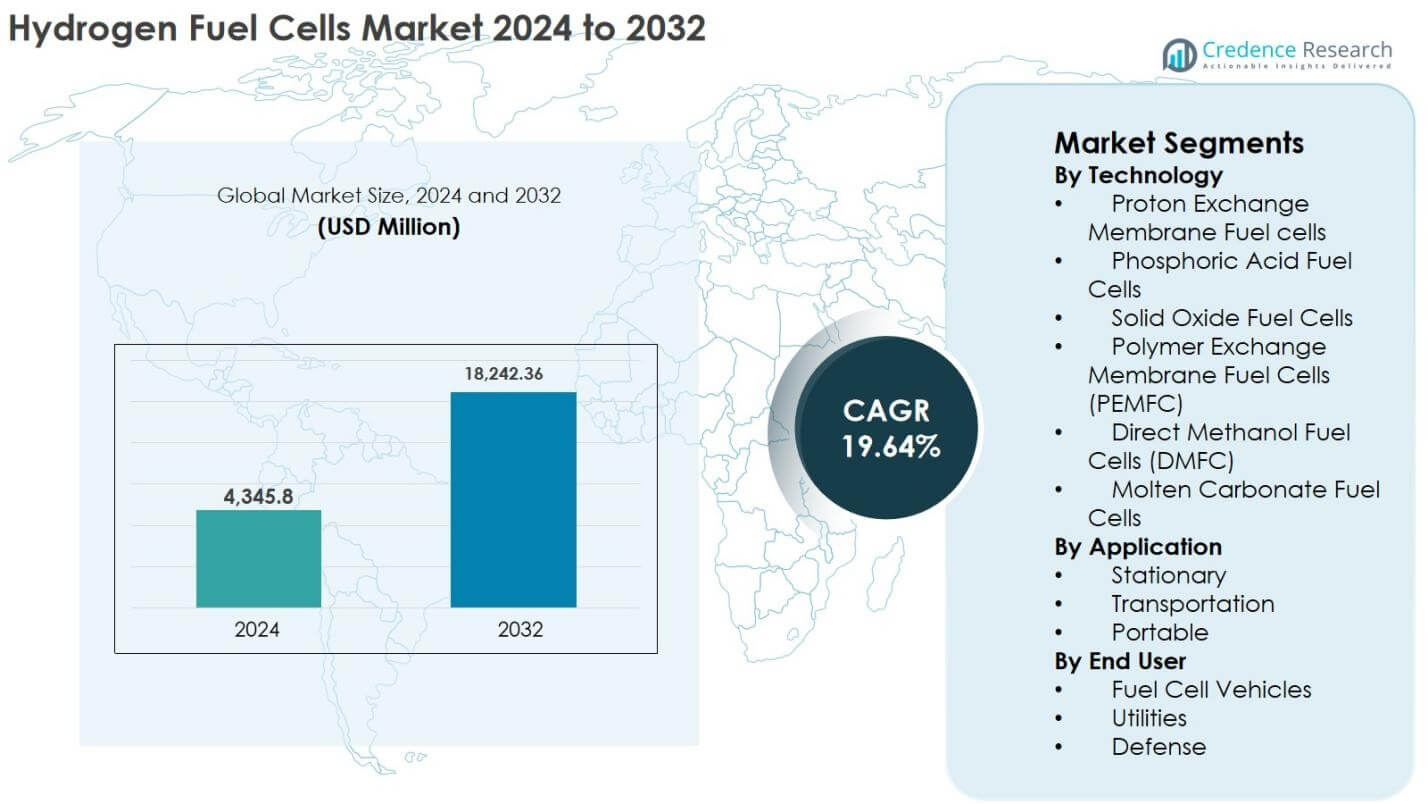
Hydrogen Fuel Cells market size was valued USD 4,345.8 Million in 2024 and is anticipated to reach USD 18,242.36 Million by 2032, at a CAGR of 19.64% during the forecast period.
| REPORT ATTRIBUTE | DETAILS |
|---|---|
| Historical Period | 2020-2023 |
| Base Year | 2024 |
| Forecast Period | 2025-2032 |
| Hydrogen Fuel Cells Market Size 2024 | USD 4,345.8 million |
| Hydrogen Fuel Cells Market, CAGR | 19.64% |
| Hydrogen Fuel Cells Market Size 2032 | USD 18,242.36 million |
Hydrogen Fuel Cells Market Insights
- Market growth is driven by rising investments in zero-emission mobility, increasing adoption of fuel-cell vehicles and stationary backup power systems, and strong government support through hydrogen roadmaps, subsidies, and infrastructure expansion initiatives.
- Key market trends include rapid deployment of fuel-cell buses, trucks, forklifts, and logistics fleets, along with increasing commercialization of heavy-duty and industrial applications; the Transportation segment accounted for 55.2% share in 2024, emerging as the dominant segment.
- Leading players such as Ballard Power Systems, Toyota, Hyundai, Honda, Daimler, BMW, and General Motors are focusing on technology innovation, stack efficiency, modular system design, and strategic partnerships to scale manufacturing and accelerate market penetration.
- Asia-Pacific led the market with a 34.8% regional share in 2024, followed by North America at 32.4% and Europe at 28.7%, supported by national hydrogen strategies, large-scale pilot projects, and growing adoption across mobility and distributed power applications.
Hydrogen Fuel Cells Market Segmentation Analysis:
By Technology
The Hydrogen Fuel Cells market by technology is led by Proton Exchange Membrane Fuel Cells (PEMFC), which accounted for around 48.6% share in 2024. This dominance is driven by their high power density, compact design, rapid start-up capability, and suitability for automotive and portable power applications. Increasing adoption in fuel-cell electric vehicles, forklifts, and backup power systems further strengthens demand. Solid Oxide Fuel Cells and Molten Carbonate Fuel Cells are also gaining traction in industrial and utility-scale applications due to higher efficiency and fuel flexibility; however, their growth remains comparatively slower because of higher operating temperatures and system costs.
- For instance, Toyota’s Mirai fuel-cell sedan uses a PEMFC stack that delivers up to approximately 128 kW of power, enabling refueling in about 3–5 minutes.
By Application
In the Hydrogen Fuel Cells market by application, the Transportation segment held the dominant share of 55.2% in 2024, driven by rising deployment of fuel-cell electric buses, trucks, passenger cars, and logistics fleets. Governments across Europe, North America, and Asia are promoting zero-emission mobility through hydrogen infrastructure investments, tax incentives, and clean-transportation policies, accelerating adoption. Stationary applications are expanding in distributed power generation, telecom towers, and backup power systems, supported by growing demand for reliable and low-carbon energy. Portable applications continue to develop in off-grid and mission-critical environments, though they account for a smaller market share compared to transportation.
- For instance, Hyundai has deployed thousands of XCIENT Fuel Cell trucks in markets such as Switzerland and South Korea to decarbonize heavy-duty freight operations.
By End User
By end user, the Fuel Cell Vehicles segment emerged as the leading category with 49.7% market share in 2024, supported by increasing commercialization of hydrogen-powered passenger cars, buses, and heavy-duty transport fleets. Rising emphasis on decarbonizing logistics and long-haul mobility remains a key growth driver. Utilities represent a rapidly expanding segment as fuel-cell systems are deployed in microgrids, distributed generation, and backup power for critical infrastructure. The Defense segment is also gaining traction as military agencies adopt hydrogen fuel cells for silent tactical power, unmanned systems, and portable field-level energy solutions due to reliability and operational advantages.
Key Growth Drivers
Decarbonization Policies and Zero-Emission Mobility Adoption
Global decarbonization commitments and stringent emission-reduction mandates are driving widespread adoption of hydrogen fuel cells across mobility, energy, and industrial sectors. Governments in Europe, North America, Japan, China, and South Korea are expanding hydrogen roadmaps, carbon-neutrality targets, and financial incentives to accelerate deployment of fuel-cell vehicles, buses, trucks, and material-handling equipment. Public–private partnerships are strengthening hydrogen production, refueling infrastructure, and large-scale demonstration projects, creating a favorable ecosystem for commercialization. Growing pressure to transition from diesel and fossil-fuel-based systems to zero-emission alternatives further reinforces demand. In addition, corporate sustainability commitments and fleet decarbonization initiatives in logistics, public transit, and heavy-duty transportation are increasing investment in fuel-cell platforms, particularly in applications where battery-electric solutions face range, weight, or charging-time limitations.
- For instance, Japan’s Green Growth Strategy targets around 800,000 fuel-cell vehicles and 900 hydrogen refueling stations by 2030, underpinning continued investment in hydrogen mobility and infrastructure.
Advancements in Fuel Cell Efficiency, Cost Reduction, and System Durability
Technological innovation is significantly improving efficiency, durability, and operational reliability of hydrogen fuel-cell systems, supporting market expansion. Progress in proton exchange membrane technology, catalyst optimization, thermal management, and stack design is reducing fuel consumption and extending service life, making fuel-cell solutions more viable for commercial and industrial use. Economies of scale, manufacturing localization, and declining component costs are narrowing the cost gap with conventional and battery-electric systems. Ongoing R&D investments by automakers, utilities, and fuel-cell manufacturers are enabling higher power density, compact architecture, and improved cold-start performance. Standardization initiatives and modular system designs are also simplifying integration into vehicles, stationary power units, and microgrids, advancing deployment across mobility, backup power, telecom, and distributed generation markets.
- For instance, Ballard Power Systems reports durability improvements in its FCmove-HD modules for buses, targeting operating lifetimes of over 30,000 hours to better meet transit fleet requirements.
Growing Demand for Reliable, Clean, and Off-Grid Power Solutions
Rising demand for resilient, low-carbon, and continuous power supply in mission-critical and remote applications is accelerating adoption of hydrogen fuel-cell systems. Utilities, data centers, telecom operators, and industrial facilities are increasingly using fuel cells for backup and primary power due to their high efficiency, low noise, and near-zero emissions. The shift toward decentralized energy networks and microgrids supports greater use of stationary fuel-cell systems for peak-load management and renewable-energy integration. Defense agencies and emergency services are adopting hydrogen fuel cells for silent tactical power and off-grid operations. In regions with weak grid infrastructure or frequent outages, hydrogen-based power solutions offer a dependable alternative to diesel generators, aligning with sustainability mandates and long-term energy-transition objectives.
Key Trends & Opportunities
Expansion of Green Hydrogen Production and Integrated Hydrogen Ecosystems
A major market opportunity is emerging from the rapid scaling of green hydrogen production using renewable energy-powered electrolysis. As countries invest in large-scale hydrogen hubs, export corridors, and cross-border supply chains, the availability of low-carbon hydrogen is expected to significantly reduce lifecycle emissions and operating costs of fuel-cell systems. Integration of fuel cells with renewable-energy assets, power-to-X projects, and energy-storage applications is creating new commercial models for utilities and industrial players. Partnerships between energy companies, electrolyzer manufacturers, and fuel-cell developers are accelerating ecosystem development. This trend supports broader use of fuel cells across transportation, marine, aviation ground systems, and industrial heat applications, strengthening long-term market scalability.
- For instance, the NEOM Green Hydrogen Project in Saudi Arabia, developed by ACWA Power, Air Products, and NEOM, is designed to produce around 600 tons of green hydrogen per day for ammonia export using 4 GW of renewable power.
Commercialization of Heavy-Duty Transport, Marine, and Industrial Applications
Hydrogen fuel-cell technology is transitioning from pilot-scale deployment to large-scale commercialization in hard-to-electrify sectors. Heavy-duty trucks, long-haul buses, rail locomotives, port equipment, and mining vehicles are increasingly adopting fuel-cell propulsion to overcome limitations of battery-electric systems related to range, weight, and charging downtime. The marine sector is exploring hydrogen fuel-cell propulsion for ferries and auxiliary power systems to meet tightening maritime emission standards. Industrial and warehouse operations are expanding the use of fuel-cell forklifts and material-handling fleets, benefiting from high uptime and rapid refueling capability. These emerging applications present significant growth opportunities as technology maturity, infrastructure investment, and operator confidence continue to strengthen.
- For instance, Norled’s MF Hydra in Norway is one of the first ferries powered by liquid-hydrogen fuel cells, demonstrating zero-emission operation on commercial routes.
Key Challenges
High Hydrogen Production, Storage, and Infrastructure Costs
Despite strong growth potential, high costs associated with hydrogen production, storage, transportation, and refueling infrastructure remain key challenges restricting widespread adoption. The cost of green hydrogen is still significantly higher than fossil-fuel alternatives in many regions, limiting economic feasibility for large-scale commercial applications. Infrastructure deployment requires substantial capital investment, long development timelines, and coordinated regulatory support. Limited refueling networks constrain mobility applications, particularly in long-haul and cross-regional transport. Supply-chain fragmentation and lack of standardized safety, handling, and distribution protocols further add to project complexity. These cost and infrastructure barriers continue to slow market penetration compared to more mature electrification and conventional power technologies.
Technical Complexity, Safety Concerns, and Market Readiness Gaps
Hydrogen fuel-cell systems involve technical complexity related to material durability, hydrogen handling, system integration, and operational safety, posing adoption challenges in certain end-use sectors. Concerns around leak prevention, storage pressure management, and public perception of hydrogen safety require rigorous standards and awareness initiatives. Long certification processes, evolving regulatory frameworks, and performance validation requirements can delay commercialization timelines. In some applications, battery-electric alternatives currently offer simpler deployment pathways, creating competition in early-stage markets. Additionally, workforce skill gaps in hydrogen engineering, maintenance, and infrastructure operations hinder rapid scaling. Addressing these technical and readiness challenges is essential for accelerating mainstream market expansion.
Regional Analysis
North America
North America accounted for around 32.4% share of the Hydrogen Fuel Cells market in 2024, driven by strong government support for clean-energy transition, rising deployment of fuel-cell electric buses and trucks, and expanding investments in hydrogen infrastructure. The United States leads regional growth, supported by federal incentives under zero-emission mobility programs, large-scale pilot projects in logistics and public transit, and increasing use of stationary fuel-cell systems in data centers and utilities. Canada is also advancing hydrogen strategies focused on decarbonizing heavy-duty transport and remote power applications. Growing participation from automotive OEMs and energy players continues to reinforce market expansion.
Europe
Europe captured a market share of 28.7% in 2024, supported by ambitious carbon-neutrality targets, hydrogen economy roadmaps, and large-scale adoption of fuel-cell mobility and power-generation projects. Germany, France, the United Kingdom, and the Nordic countries are leading deployment across public transport fleets, maritime applications, and distributed power systems. The region benefits from coordinated policy frameworks, cross-border hydrogen corridors, and strong R&D collaboration between automakers, fuel-cell manufacturers, and infrastructure developers. Increasing investments in green hydrogen production and integration of hydrogen into industrial decarbonization programs further strengthen demand, particularly in heavy-duty transportation, rail, and utility-scale stationary applications.
Asia-Pacific
Asia-Pacific dominated the Hydrogen Fuel Cells market with a 34.8% share in 2024, emerging as the fastest-growing region due to large-scale commercialization efforts in Japan, South Korea, and China. The region is witnessing rapid deployment of fuel-cell passenger cars, buses, and logistics fleets, supported by national hydrogen strategies, subsidies, and infrastructure development programs. China is accelerating industrial and transit applications, while Japan and South Korea remain leaders in residential and stationary fuel-cell systems. Increasing investment in fuel-cell manufacturing capacity, green hydrogen projects, and export-oriented hydrogen value chains continues to drive strong regional growth across mobility and power sectors.
Latin America
Latin America accounted for 2.9% market share in 2024, with growth primarily concentrated in early-stage pilot projects and renewable-energy-linked hydrogen initiatives. Countries such as Brazil, Chile, and Mexico are exploring hydrogen fuel-cell adoption in mining transport, heavy-duty vehicles, and off-grid power applications, supported by emerging clean-energy investment frameworks. Chile’s green hydrogen development roadmap is creating opportunities for fuel-cell integration in industrial and export-led applications. Although infrastructure and technology-readiness gaps remain, increasing collaboration with global energy companies and rising interest in decarbonizing logistics and industrial operations are expected to gradually accelerate regional market expansion.
Middle East & Africa
The Middle East & Africa region held a 1.2% share of the Hydrogen Fuel Cells market in 2024, with growth driven by large-scale green hydrogen mega-projects and early deployment of fuel-cell systems in industrial and utility environments. Gulf countries such as the UAE and Saudi Arabia are investing in hydrogen-based energy transition strategies and pilot applications in mobility and power generation. In Africa, adoption is emerging in telecom power, remote energy supply, and off-grid infrastructure. While market penetration remains limited due to infrastructure and cost challenges, expanding hydrogen production capacity is expected to support future deployment opportunities.
Hydrogen Fuel Cells Market Segmentations:
By Technology
- Proton Exchange Membrane Fuel cells
- Phosphoric Acid Fuel Cells
- Solid Oxide Fuel Cells
- Polymer Exchange Membrane Fuel Cells (PEMFC)
- Direct Methanol Fuel Cells (DMFC)
- Molten Carbonate Fuel Cells
By Application
- Stationary
- Transportation
- Portable
By End User
- Fuel Cell Vehicles
- Utilities
- Defense
By Geography
- North America
- U.S.
- Canada
- Mexico
- Europe
- Germany
- France
- U.K.
- Italy
- Spain
- Rest of Europe
- Asia Pacific
- China
- Japan
- India
- South Korea
- South-east Asia
- Rest of Asia Pacific
- Latin America
- Brazil
- Argentina
- Rest of Latin America
- Middle East & Africa
- GCC Countries
- South Africa
- Rest of the Middle East and Africa
Competitive Landscape
The Hydrogen Fuel Cells market features a diverse and rapidly evolving competitive landscape characterized by technology-focused manufacturers, automotive OEMs, and energy system integrators expanding commercialization across mobility and stationary applications. Leading players such as Ballard Power Systems Inc., Toyota Motor Corporation, Hyundai Motor Group, Honda Motor Co. Ltd, Daimler AG, BMW Group, General Motors Company, MAN SE, Volvo Group, and Audi AG are investing heavily in fuel-cell stack innovation, vehicle integration, and large-scale deployment programs. Companies are strengthening strategic partnerships with utilities, hydrogen producers, and infrastructure developers to accelerate ecosystem development and reduce adoption costs. Many market participants are prioritizing modular designs, higher power density, extended system durability, and localization of manufacturing to scale production and enhance cost competitiveness. Joint ventures, pilot fleet deployments, and government-funded demonstration projects remain central to market expansion, while competition increasingly focuses on heavy-duty transport, logistics fleets, distributed power generation, and emerging industrial and defense applications.
Key Player Analysis
- Ballard Power Systems Inc.
- MAN SE
- Toyota Motor Corporation
- Daimler AG
- Hyundai Motor Group
- Volvo Group
- Honda Motor Co. Ltd
- BMW Group
- General Motors Company
- Audi AG
Recent Developments
- In October 2025, Hyundai Motor Company broke ground on a new hydrogen fuel cell production plant in Ulsan, South Korea, marking a major expansion of its fuel cell manufacturing capabilities.
- In September 2025, Horizon Fuel Cell Technologies signed an exclusive hydrogen train partnership with Indian engineering giant Bharat Heavy Electricals, boosting hydrogen mobility infrastructure and applications
- In February 2025, Toyota Motor Corporation developed and announced its all-new 3rd Generation Fuel Cell System designed for commercial applications with improved performance and cost efficiency
Report Coverage
The research report offers an in-depth analysis based on Technology, Application, End-User and Geography. It details leading market players, providing an overview of their business, product offerings, investments, revenue streams, and key applications. Additionally, the report includes insights into the competitive environment, SWOT analysis, current market trends, as well as the primary drivers and constraints. Furthermore, it discusses various factors that have driven market expansion in recent years. The report also explores market dynamics, regulatory scenarios, and technological advancements that are shaping the industry. It assesses the impact of external factors and global economic changes on market growth. Lastly, it provides strategic recommendations for new entrants and established companies to navigate the complexities of the market.
Future Outlook
- The Hydrogen Fuel Cells market will continue to expand as governments strengthen decarbonization goals and support clean-energy transition programs.
- Adoption in heavy-duty transportation, including trucks, buses, and rail, will increase as fuel-cell systems address range and uptime limitations of battery-electric alternatives.
- Commercialization of stationary fuel-cell systems will accelerate in utilities, telecom, data centers, and microgrid applications to support reliable and low-emission power supply.
- Green hydrogen production growth will enhance long-term cost competitiveness and strengthen deployment across mobility and industrial sectors.
- Technology advancements will improve fuel-cell efficiency, durability, and performance, enabling broader integration across commercial and industrial platforms.
- Strategic partnerships among automakers, energy companies, and infrastructure developers will play a major role in ecosystem development and market scaling.
- Fuel-cell adoption in marine, mining, and port operations will expand as industries shift toward low-carbon operational models.
- Localization of manufacturing and supply-chain development will help reduce system costs and support regional production hubs.
- Policy support, incentives, and hydrogen infrastructure expansion will remain critical in shaping deployment pace and investment trends.
- The market will witness increasing participation from new entrants and technology innovators, intensifying competition and accelerating innovation cycles.

Request a Free Sample
Fill in your details and we'll send you a free sample report.
- Sample data tables & charts
- Research methodology
Need a Custom Version of This Report?
Tailor the scope, geography, or segments to your exact requirements.
- Custom geography or segment scope
- Direct access to our analyst team
Frequently Asked Questions
What is the current market size for the Hydrogen Fuel Cells Market, and what is its projected size in 2032?
At what Compound Annual Growth Rate is the Hydrogen Fuel Cells Market projected to grow between 2024 and 2032?
Which Hydrogen Fuel Cells Market segment held the largest share in 2024?
What are the primary factors fueling the growth of the Hydrogen Fuel Cells Market?
Who are the leading companies in the Hydrogen Fuel Cells Market?
Which region commanded the largest share of the Hydrogen Fuel Cells Market in 2024?
Table of Content
Chapter 1 Market Segmentation
- 1.1 Segmentation Framework
- 1.1.1 Product and Service Classification
- 1.1.2 Application and End-Use Classification
- 1.1.3 Technology and Solution Classification
- 1.1.4 Customer and Distribution Channel Classification
- 1.1.5 Geographic Segmentation
- 1.1.6 Market Segment Definitions and Boundaries
Chapter 2 Introduction
- 2.1 Report Objectives and Scope
- 2.2 Product Definition and Industry Terminology
- 2.3 Market Inclusions and Exclusions
- 2.4 Research Process
- 2.4.1 Primary Research and Expert Interviews
- 2.4.2 Secondary Research and Source Review
- 2.4.3 Top-Down and Bottom-Up Estimation
- 2.4.4 Data Triangulation and Verification
- 2.5 Market Size Measurement Basis
- 2.5.1 2024: USD 4,345.8 Million → 2032: USD 18,242.36 Million
- 2.6 Historical and Forecast Reference Periods
- 2.6.1 Base Year: 2024
- 2.6.2 Forecast Period: 2024-2032
- 2.7 Research Assumptions and Limitations
Chapter 3 Executive Summary
- 3.1 Market Snapshot and Key Findings
- 3.2 Base-Year Market Size, 2024
- 3.3 Forecast Market Size, 2032
- 3.4 Revenue and Volume Growth Outlook
- 3.5 Key Demand and Supply Indicators
- 3.6 Leading Market Segments
- 3.7 Fastest-Growing Market Opportunities
- 3.8 Regional Performance Highlights
- 3.9 Technology and Industry Transformation
- 3.10 Competitive Landscape Summary
- 3.11 Analyst View and Strategic Implications
Chapter 4 Global Hydrogen Fuel Cells Market Trends and Developments
- 4.1 Historical Industry Development
- 4.2 Recent Market Trends and Developments
- 4.3 Demand and Customer Behavior Trends
- 4.4 Technology and Product Innovation
- 4.5 Artificial Intelligence, Automation and Digitalization
- 4.6 Local Manufacturing and Supply Chain Realignment
- 4.7 Industry Partnerships, Mergers and Acquisitions
- 4.8 Sustainability and Circular Economy Developments
- 4.9 Government and Private Sector Investment Trends
- 4.10 Emerging Business Models and Commercialization
- 4.11 Industry Developments and Announcements
Chapter 5 Global Hydrogen Fuel Cells Market Production, Supply and Demand Analysis
- 5.1 Demand Trend and Consumption Analysis
- 5.2 Demand Forecast, 2024-2032
- 5.3 Production and Output Trend
- 5.4 Production and Output Forecast, 2024-2032
- 5.5 Installed Capacity and Capacity Utilization
- 5.6 Company-Wise Production Plants and Statistics
- 5.6.1 Installed Production Capacity
- 5.6.2 Actual Production
- 5.6.3 Planned Capacity and Expansion Targets
- 5.7 Supply Chain Structure and Procurement Trends
- 5.8 Supply-Demand Gap and Bottlenecks
- 5.9 Import Dependence and Sourcing Structure
- 5.10 Contract Manufacturing and Outsourcing
- 5.11 Regional Supply and Demand Concentration
Chapter 6 Global Hydrogen Fuel Cells Market Pricing Analysis
- 6.1 Pricing Structure and Measurement
- 6.2 Historical Pricing Trends
- 6.3 Pricing Outlook, 2024-2032
- 6.4 Average Selling Price and Unit Economics
- 6.5 Pricing by Product and Market Segment
- 6.6 Geographic Pricing Differences
- 6.7 Key Input, Energy, Labor and Logistics Costs
- 6.8 Contract Pricing and Purchasing Models
- 6.9 Pricing Sensitivity and Competitive Positioning
- 6.10 Price, Margin and Profitability Implications
Chapter 7 Global Hydrogen Fuel Cells Market Dynamics
- 7.1 Market Growth Drivers
- 7.1.1 Demand-Side Drivers
- 7.1.2 Technology and Innovation Drivers
- 7.1.3 Infrastructure and Investment Drivers
- 7.1.4 Regulatory and Policy Drivers
- 7.2 Market Restraints
- 7.2.1 Cost and Affordability Constraints
- 7.2.2 Technology and Adoption Barriers
- 7.2.3 Supply Chain and Operational Constraints
- 7.3 Market Challenges
- 7.3.1 Competitive Pressure and Margin Erosion
- 7.3.2 Skills, Infrastructure and Implementation Gaps
- 7.4 Emerging Market Opportunities
- 7.5 Market Dynamics Impact and Time-Horizon Assessment
Chapter 8 Global Hydrogen Fuel Cells Value Chain Analysis
- 8.1 Industry Value Chain Overview
- 8.2 Upstream Suppliers and Critical Inputs
- 8.3 Technology and Component Providers
- 8.4 Manufacturing or Service Delivery
- 8.5 Distribution, Channel Partners and Integrators
- 8.6 Downstream Applications and End Users
- 8.7 Value Addition and Profit Pools
- 8.8 Vertical Integration and Outsourcing
- 8.9 Supplier Concentration and Risk
- 8.10 Supply Chain Localization and Resilience
Chapter 9 Global Hydrogen Fuel Cells Market Regulations and Policies
- 9.1 Relevant Laws, Standards and Compliance Frameworks
- 9.2 Product, Service, Safety and Quality Requirements
- 9.3 Government Policies, Incentives and Subsidies
- 9.4 Imports, Exports and Trade Barriers
- 9.5 Public Procurement and Local Content Requirements
- 9.6 Environmental and Sustainability Compliance
- 9.7 Upcoming Policy Changes and Market Implications
Chapter 10 Global Hydrogen Fuel Cells Market Hotspots and Opportunities
- 10.1 Market Opportunity Mapping and Growth Hotspots
- 10.2 High-Growth Applications and Customer Groups
- 10.3 Underserved Markets and White-Space Opportunities
- 10.4 Emerging Technology and Product Opportunities
- 10.5 New Capacity and Investment Hotspots
- 10.6 Market Entry and Expansion Opportunities
- 10.7 Distribution and Partnership Opportunities
- 10.8 Near-Term and Long-Term Commercial Potential
- 10.9 Opportunity Attractiveness and Execution Risks
Chapter 11 Global Hydrogen Fuel Cells Market Outlook, 2024-2032
- 11.1 Market Size and Analysis
- 11.1.1 Revenue (Market Measurement: 2024: USD 4,345.8 Million → 2032: USD 18,242.36 Million)
- 11.1.2 Market Volume and Quantity Sold
- 11.1.3 Historical Market Size
- 11.1.4 Base-Year Market Size, 2024
- 11.2 Market Forecast, 2024-2032
- 11.2.1 Revenue Forecast to 2032
- 11.2.2 Volume Forecast to 2032
- 11.2.3 CAGR and Year-on-Year Growth
- 11.2.4 Incremental Revenue Opportunity
- 11.3 Forecast Assumptions and Scenario Analysis
- 11.3.1 Base-Case Forecast
- 11.3.2 Optimistic and Conservative Scenarios
- 11.3.3 Technology, Pricing and Policy Sensitivities
- 11.4 Market Attractiveness and Growth Outlook
Chapter 12 Global Hydrogen Fuel Cells Market Segmentation and Outlook
- 12.1 Segmentation Summary and Market Shares, 2024
- 12.2 Largest and Fastest-Growing Segments
- 12.3 Segment Growth Comparison
- 12.4 Segment Attractiveness and Priority Matrix
Chapter 13 Global Hydrogen Fuel Cells Geographic Market Outlook, 2024-2032
- 13.1 Regional Market Size and Share, 2024
- 13.2 Regional Market Forecast, 2024-2032
- 13.3 Regional Pricing, Production and Demand Differences
- 13.4 North America
- 13.4.1 United States
- 13.4.2 Canada
- 13.4.3 Mexico
- 13.5 Europe
- 13.5.1 Germany
- 13.5.2 France
- 13.5.3 Italy
- 13.5.4 United Kingdom
- 13.5.5 Spain
- 13.5.6 Poland
- 13.5.7 Russia
- 13.5.8 Netherlands
- 13.5.9 Belgium
- 13.5.10 Sweden
- 13.5.11 Denmark
- 13.5.12 Norway
- 13.5.13 Rest of Europe
- 13.6 Asia Pacific
- 13.6.1 China
- 13.6.2 India
- 13.6.3 Japan
- 13.6.4 South Korea
- 13.6.5 Thailand
- 13.6.6 Indonesia
- 13.6.7 Vietnam
- 13.6.8 Malaysia
- 13.6.9 Australia
- 13.6.10 Rest of Asia Pacific
- 13.7 Latin America
- 13.7.1 Brazil
- 13.7.2 Argentina
- 13.7.3 Colombia
- 13.7.4 Chile
- 13.7.5 Rest of Latin America
- 13.8 Middle East
- 13.8.1 Saudi Arabia
- 13.8.2 United Arab Emirates
- 13.8.3 Turkey
- 13.8.4 Israel
- 13.8.5 Iran
- 13.8.6 Rest of the Middle East
- 13.9 Africa
- 13.9.1 South Africa
- 13.9.2 Egypt
- 13.9.3 Nigeria
- 13.9.4 Morocco
- 13.9.5 Rest of Africa
- 13.10 Regional Investment, Policy and Supply Chain Differences
- 13.11 Regional Competitive Landscape
- 13.12 Geographic Growth Hotspots
Chapter 14 Global Hydrogen Fuel Cells Technology, Innovation and Sustainability Outlook
- 14.1 Technology Landscape and Maturity
- 14.2 Product, Process and Service Innovation
- 14.3 AI, Automation and Digital Tools in the Industry
- 14.4 Technology Adoption and Performance Benchmarking
- 14.5 Innovation Pipeline and R&D Investment
- 14.6 Patent and Intellectual Property Trends
- 14.7 Energy Efficiency and Resource Management
- 14.8 Sustainability, Recycling and Circularity
- 14.9 Technology Roadmap, 2024-2032
- 14.10 Risks of Obsolescence and Technology Substitution
Chapter 15 Global Hydrogen Fuel Cells Market Key Strategic Imperatives
- 15.1 Growth and Market Entry Priorities
- 15.2 High-Return Products and Segments
- 15.3 Pricing, Profitability and Cost Optimization
- 15.4 Technology Investment and Product Differentiation
- 15.5 Supply Chain Localization and Resilience
- 15.6 Distribution and Customer Acquisition
- 15.7 Partnership, Acquisition and Capacity Strategy
- 15.8 Regional Expansion Priorities
- 15.9 Short-, Medium- and Long-Term Actions
Chapter 16 Competition Outlook
- 16.1 Industry Competition Characteristics
- 16.2 Market Structure and Concentration
- 16.3 Market Share and Competitive Positioning, 2024
- 16.4 Company-Wise Revenue and Product Benchmarking
- 16.5 Production and Service Capacity Benchmarking
- 16.6 Technology, Pricing and Differentiation
- 16.7 Regional Footprint and Distribution Strength
- 16.8 Mergers, Acquisitions and Strategic Alliances
- 16.9 New Entrants and Competitive Threats
- 16.10 Porter's Five Forces and Industry Attractiveness
- 16.11 Competitive Outlook, 2024-2032
Chapter 17 Company Profiles
- 17.1 Company Coverage and Selection Criteria
- 17.2 Leading Market Participants – Standard Profile Structure
- 17.2.1 Business Description
- 17.2.2 Company Ownership and Geographic Presence
- 17.2.3 Product and Service Portfolio
- 17.2.4 Manufacturing and Operating Footprint
- 17.2.5 Production Capacity and Expansion Plans
- 17.2.6 Financial Performance and Investment
- 17.2.7 Market Share and Competitive Position
- 17.2.8 Technology and Innovation Capabilities
- 17.2.9 Strategic Alliances or Partnerships
- 17.2.10 Recent Developments
- 17.2.11 Growth Strategy and Outlook
- 17.3 Other Relevant Market Participants
Note: Every listed company is profiled on the structure shown under the first company. The company list is preliminary and may change based on research findings, market developments, data availability and client requirements.
Chapter 18 Disclaimer
- 18.1 Research and Forecast Disclaimer
- 18.2 Data Source and Estimation Limitations
Note: The depth of individual sections depends on data availability for this market. Volume, capacity, trade and other unit-based metrics are included where applicable.