
Carbon Credit Market Overview:
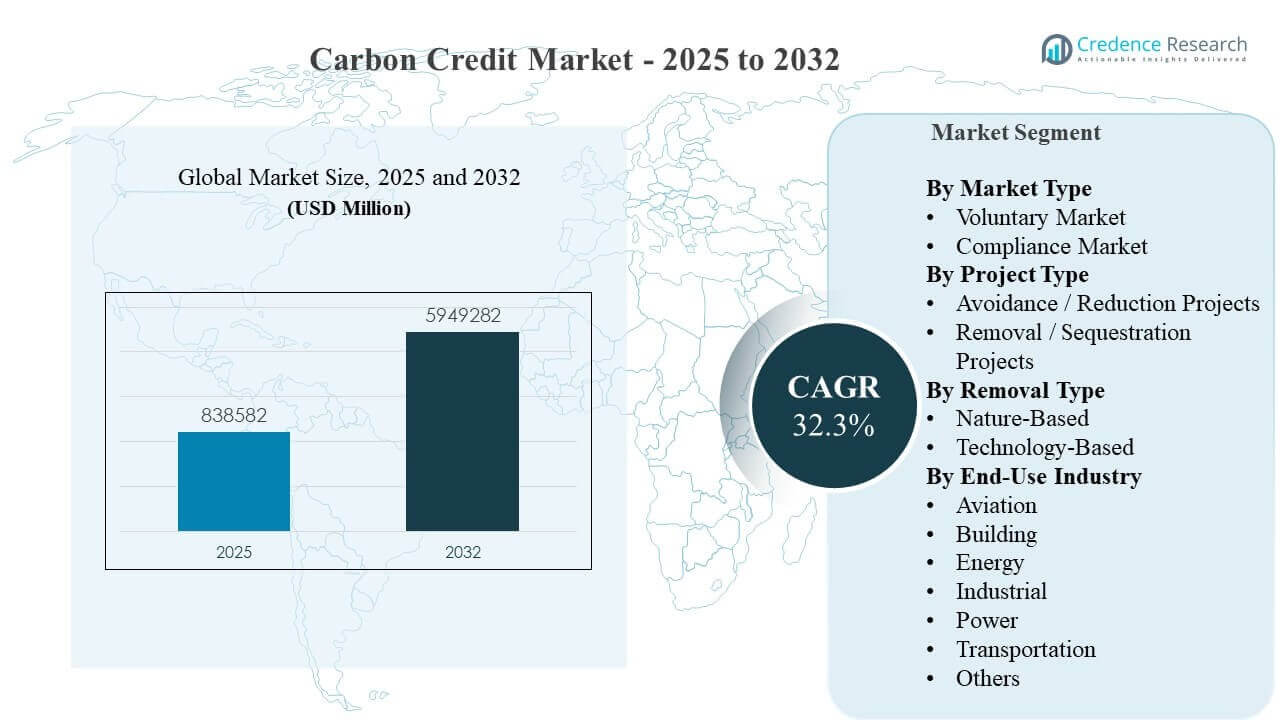
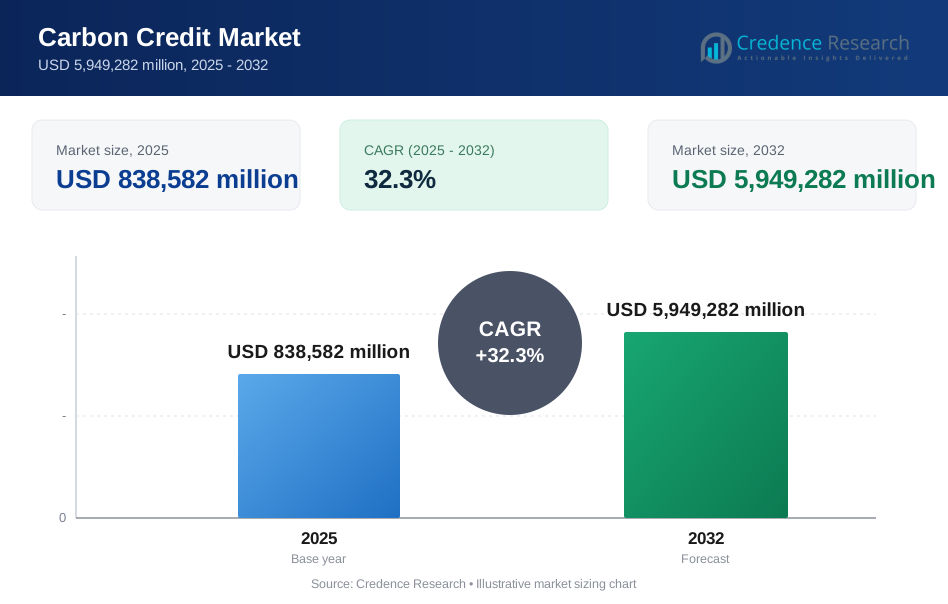
The global Carbon Credit Market size was estimated at USD 838,582 million in 2025 and is expected to reach USD 5,949,282 million by 2032, growing at a CAGR of 32.3% from 2025 to 2032. The strongest growth driver is the widening use of regulated carbon pricing mechanisms and emissions-trading obligations that institutionalize demand for verified credits and allowances across more sectors and larger emitter populations. Carbon Credit Market expansion is also supported by deep market activity in Europe, with increasing market participation and infrastructure development across trading, registries, and verification ecosystems.
| REPORT ATTRIBUTE | DETAILS |
|---|---|
| Historical Period | 2020-2024 |
| Base Year | 2025 |
| Forecast Period | 2026-2032 |
| Carbon Credit Market Size 2025 | USD 838,582 million |
| Carbon Credit Market, CAGR | 32.3% |
| Carbon Credit Market Size 2032 | USD 5,949,282 million |
Key Market Trends & Insights
- The Carbon Credit Market is projected to expand at 32.3% CAGR (2025–2032), reflecting rapid scale-up in credit issuance, trading, and compliance-linked procurement.
- Europe accounted for 83.9% share in 2025, indicating the Carbon Credit Market remains heavily concentrated in mature regulatory trading systems.
- Compliance Market held 96.9% share in 2025, underscoring that regulated demand continues to outweigh voluntary procurement volumes.
- Avoidance / Reduction Projects represented 62.4% share in 2025, supported by larger established project pipelines and faster issuance cycles than removals.
- Power accounted for 28.9% share in 2025, reflecting persistent demand from power-sector compliance exposure and decarbonization-linked trading activity.
Segment Analysis
Carbon Credit Market demand is primarily compliance-led, shaped by policy mandates that require covered entities to surrender credits or allowances and incentivize emissions reductions. The market structure links registries and standards with trading venues and intermediaries, enabling the monetization and transfer of verified reductions and removals. Corporate climate targets also sustain voluntary demand, but purchase activity is more sensitive to integrity concerns, price expectations, and credit quality requirements. Buyer behavior increasingly differentiates between avoidance credits and higher-durability removal credits, especially for residual emissions strategies.
Carbon Credit Market supply dynamics continue to be influenced by project development economics, verification timelines, and methodology requirements that govern issuance and quantification. Avoidance and reduction pathways often scale faster because they can generate higher near-term volumes, while removals face cost, MRV, and permanence complexities. At the same time, procurement strategies increasingly emphasize higher-quality attributes such as additionality, permanence, and co-benefits, shifting demand toward better-rated projects. The Carbon Credit Market therefore reflects both volume-driven demand in compliance systems and quality-driven differentiation in voluntary procurement.
By Market Type Insights
Compliance Market accounted for the largest share of 96.9% in 2025. Compliance Market dominance is supported by mandatory surrender obligations under cap-and-trade and emissions trading schemes that create steady baseline demand. Regulatory caps and tightening sector coverage directly increase the need for compliant instruments, improving liquidity and price discovery. Compliance Market activity also benefits from standardized market infrastructure and established trading participation from utilities, industrial emitters, and financial actors. Voluntary Market growth remains strategically important, but Voluntary Market participation is more dependent on corporate budgets, credibility frameworks, and credit quality preferences.
By Project Type Insights
Avoidance / Reduction Projects accounted for the largest share of 62.4% in 2025. Avoidance / Reduction Projects lead due to mature, scalable pipelines in renewable energy, efficiency improvements, and avoided emissions pathways that deliver high issuance volumes. Project economics often favor avoidance routes through lower cost per tonne and shorter time-to-issuance, improving supplier participation. Avoidance / Reduction Projects also align well with near-term compliance and corporate targets that prioritize measurable reductions. Removal / Sequestration Projects are gaining momentum as procurement strategies increasingly reserve removals for residual emissions, but scaling remains constrained by cost and verification complexity.
By Removal Type Insights
Nature-Based pathways remain central to Carbon Credit Market supply growth due to their scalability in forestry, land-use, and ecosystem restoration programs where land availability and financing structures are developed. Nature-Based credits are often preferred when procurement strategies value co-benefits such as biodiversity and community impact. Technology-Based removals are increasingly discussed in procurement roadmaps, but Technology-Based solutions face higher costs and more complex measurement and permanence requirements that can limit near-term volumes. Carbon Credit Market differentiation by Removal Type is therefore increasingly shaped by buyer willingness to pay for durability and verification rigor.
By End-Use Industry / Application Insights
Power accounted for the largest share of 28.9% in 2025. Power leadership reflects strong compliance exposure and sustained participation in trading systems that price emissions across electricity generation and related industrial energy use. Power-sector decarbonization investments also interact with credit markets through renewables, grid transitions, and compliance-driven optimization of emissions costs. Energy and Industrial applications are supported by expanding decarbonization requirements, reporting standards, and mitigation pathways that increase carbon market participation. Transportation and Aviation demand grows where eligible offset frameworks and compliance systems broaden coverage, but adoption varies by jurisdiction and scheme design.
Carbon Credit Market Drivers
Expansion of regulated carbon pricing and compliance obligations
Carbon Credit Market growth is driven by the spread of regulated carbon pricing instruments and emissions trading obligations that establish recurring compliance demand. Policy frameworks convert emissions reduction targets into enforceable procurement requirements, increasing market liquidity. Sector expansion within trading systems broadens the number of obligated entities and raises transactional activity. Carbon Credit Market participation also increases as compliance planning becomes integrated into corporate financial and operational decision-making. Strong institutional participation supports market depth, trading infrastructure, and standardized procurement practices.
- For instance, A.P. Møller–Maersk became subject to the EU ETS from January 1, 2024, as maritime shipping was formally included in the system requiring the carrier to purchase and surrender EU Allowances (EUAs) for 40% of its verified emissions in 2024, escalating to 70% in 2025, and reaching 100% coverage from 2026 onward.
Corporate net-zero commitments and residual emissions strategies
Carbon Credit Market demand is further supported by corporate decarbonization commitments that require credits for residual emissions after internal reductions. Procurement programs increasingly formalize credit strategies through multi-year plans, internal carbon pricing, and supplier engagement. Carbon Credit Market purchasing decisions now emphasize credit integrity, co-benefits, and alignment with accepted frameworks. As buyer sophistication grows, differentiation between avoidance credits and removals becomes more prominent. This driver sustains a parallel demand layer beyond compliance systems, even when voluntary volumes fluctuate.
Growth in market infrastructure and environmental commodity trading
Carbon Credit Market scale-up is enabled by the expansion of registries, standards, exchanges, and digital trading platforms that improve transparency and accessibility. Better market infrastructure supports faster matching of buyers and sellers, clearer contract terms, and improved price discovery. Carbon Credit Market efficiency improves as delivery mechanisms, verification workflows, and settlement processes mature. Increased standardization lowers friction for institutional participation and cross-border trading. As infrastructure develops, the market becomes more investable and operationally scalable.
Increasing focus on integrity, MRV, and credit quality differentiation
Carbon Credit Market development is strengthened by rising expectations for integrity and measurable outcomes, which drives improvements in MRV and methodology governance. Higher scrutiny increases demand for robust verification and clearer quantification procedures, strengthening confidence in market instruments. Carbon Credit Market suppliers respond by upgrading project documentation, monitoring technologies, and third-party assurance approaches. Quality differentiation also supports premium pricing for durable, well-verified credits. Over time, integrity-driven upgrades can improve market stability and support longer-term procurement commitments.
- For instance, the Integrity Council for the Voluntary Carbon Market (ICVCM) announced the first seven CCP-approved methodologies in June 2024 covering landfill methane capture and ozone-depleting substance destruction under Verra, Gold Standard, ACR, and CAR making an estimated 27 million carbon credits immediately eligible to carry the CCP label.
Carbon Credit Market Challenges
Carbon Credit Market expansion faces challenges related to credit integrity, including concerns about additionality, permanence, leakage, and baseline setting across certain project categories. Variability in methodologies and verification quality can create inconsistent outcomes and reduce buyer confidence. Carbon Credit Market demand can therefore become cyclical when buyers pause procurement to reassess standards and reputational risks. Transparency limitations in some project pipelines and data availability constraints can slow contracting and increase transaction costs.
- For instance, Sylvera’s carbon intelligence platform covers over 20,000 projects across global registries with daily updates, and its rating system scores projects from D to AAA across core dimensions such as carbon, additionality, and permanence, reflecting how technology is being deployed to improve assessment consistency and project transparency.
Carbon Credit Market operations also face regulatory fragmentation across jurisdictions, creating complexity in eligibility rules, accounting practices, and cross-border acceptance. Price volatility and liquidity differences between schemes can raise procurement risk for buyers and revenue uncertainty for project developers. Carbon Credit Market scaling is further constrained by long project development timelines, verification bottlenecks, and financing barriers, particularly for removals. In addition, evolving policy and market rules can create uncertainty for suppliers planning multi-year investments.
Carbon Credit Market Trends and Opportunities
Carbon Credit Market trends increasingly favor higher-integrity credits, stronger MRV, and clearer claims guidance, which is shifting demand toward well-documented projects and durable outcomes. Buyers are adopting more structured procurement approaches, including forward contracts and portfolio strategies that balance price, quality, and delivery risk. Carbon Credit Market participants also show growing interest in removals for residual emissions planning, supporting innovation in both nature-based restoration and engineered sequestration pathways. This trend creates opportunities for differentiated supply and premium segments.
- For instance, Frontier Climate (co-founded by Stripe, Google, Shopify, and Meta) facilitated 667,400 tonnes of verified carbon removal purchases in 2024 alone, including a 116,000-tonne BECCS offtake with Arbor (2028–2030 delivery) and a 122,000-tonne biowaste removal agreement with NULIFE GreenTech (2026–2030), all contractually bound to ISO-compliant MRV protocols.
Carbon Credit Market opportunities are expanding through improvements in market connectivity, digital infrastructure, and standardized trading products that improve access for corporates and institutional participants. Integration with broader environmental commodity markets can strengthen liquidity and accelerate adoption of standardized contracts. Carbon Credit Market growth can also be supported by sector expansion in compliance schemes and clearer alignment between corporate reporting standards and procurement claims. These developments collectively enable higher transaction volumes, improved transparency, and more stable procurement behavior.
Regional Insights
North America
North America accounted for 3.2% share in 2025, supported by active market participation across compliance-linked schemes and voluntary procurement programs. Carbon Credit Market activity is influenced by policy diversity at state and provincial levels, which shapes eligibility and liquidity patterns. Corporate decarbonization initiatives support voluntary demand, particularly among large emitters and consumer-facing brands with net-zero targets. Trading and advisory ecosystems also contribute to market development by improving access to instruments and supporting portfolio strategies.
Europe
Europe accounted for 83.9% share in 2025, reflecting the region’s strong compliance market infrastructure and mature emissions trading systems. Carbon Credit Market scale in Europe is supported by deep liquidity, regulatory clarity, and broad participation across power and industrial sectors. Tightening caps and policy-driven decarbonization targets continue to reinforce market depth and transactional activity. Europe also benefits from established verification, registry, and trading networks that improve operational efficiency and transparency.
Asia Pacific
Asia Pacific accounted for 9.4% share in 2025, supported by expanding policy focus on emissions management and growing corporate procurement interest. Carbon Credit Market development is shaped by emerging compliance frameworks, evolving eligibility rules, and increasing adoption of reporting practices across major economies. Project development potential is substantial due to renewable deployment, industrial transition needs, and land-based mitigation pathways. Growth momentum is supported by increasing market infrastructure and the gradual broadening of carbon pricing coverage.
Latin America
Latin America accounted for 1.8% share in 2025, supported by strong project development potential in nature-based and land-use pathways. Carbon Credit Market supply opportunities are linked to forestry, conservation, and restoration programs that can generate scalable volumes when financing and verification are secured. Buyer interest is supported by co-benefits and biodiversity outcomes, which often align with voluntary procurement preferences. However, market development remains sensitive to policy alignment, verification capacity, and long project development timelines.
Middle East & Africa
Middle East & Africa accounted for 1.7% share in 2025, supported by increasing policy and corporate attention to decarbonization and sustainable finance. Carbon Credit Market participation is growing through project development initiatives and improving market connectivity with global registries and trading platforms. The region’s opportunity set includes renewable energy expansion, industrial efficiency initiatives, and select nature-based pathways where feasible. Growth is influenced by evolving regulatory frameworks, investment capacity, and increasing interest in carbon market-linked solutions.
Competitive Landscape
Carbon Credit Market competition is structured around registries and standards, project developers and advisors, and trading and exchange infrastructure providers. Competitive strategies emphasize methodology credibility, MRV rigor, project pipeline access, and the ability to offer transparent procurement pathways. Market participants also differentiate through platform liquidity, standardized contracts, settlement reliability, and buyer-facing advisory capabilities. Carbon Credit Market consolidation and partnerships are shaping integrated offerings across verification, registry management, trading access, and corporate procurement support.
Verra is positioned as a key standards and registry player, with competitiveness linked to the breadth of methodologies supported and the governance mechanisms used to maintain program credibility. Verra’s approach typically centers on maintaining consistent quantification frameworks, enabling project developers to issue credits under recognized standards, and supporting market acceptance among buyers and intermediaries. Carbon Credit Market credibility is strengthened when registry procedures enable clearer updates, re-quantification, and verification consistency. Strong program governance and transparent procedural updates support confidence in issuance quality and improve buyer willingness to engage in long-term procurement.
The industry research and growth report includes detailed analyses of the competitive landscape of the market and information about key companies, including:
- Verra
- Gold Standard
- American Carbon Registry
- South Pole
- ClimatePartner
- EcoAct
- 3Degrees
- Intercontinental Exchange (ICE)
- Xpansiv
- CME Group
Qualitative and quantitative analysis of companies has been conducted to help clients understand the wider business environment as well as the strengths and weaknesses of key industry players. Data is qualitatively analyzed to categorize companies as pure play, category-focused, industry-focused, and diversified; it is quantitatively analyzed to categorize companies as dominant, leading, strong, tentative, and weak.
Recent Developments
- In March 2026, Carbon Direct acquired Pachama to strengthen its position in the carbon credit market, adding Pachama’s digital platform and forest carbon monitoring capabilities to Carbon Direct’s science-based advisory and credit management services.
- In March 2026, Global Carbon Council and TERI entered a partnership to develop India’s first digital carbon marketplace for household clean energy and livelihood projects, with the platform designed to support carbon credit generation, traceability, and transparent issuance and retirement.
- In January 2025, Carbonmark launched Carbonmark Direct, a blockchain-enabled carbon credit issuance platform aimed at speeding up issuance, lowering transaction costs, and making carbon removal credits easier to buy and sell.
- In July 2025, Davis Commodities launched a carbon credit trading unit as part of its carbon-integrated commodity platform strategy, with plans to source credits from certified projects and develop a digital dashboard for real-time credit monitoring and management.
Report Scope
| Report Attribute | Details |
| Market size value in 2025 | USD 838,582 million |
| Revenue forecast in 2032 | USD 5,949,282 million |
| Growth rate (CAGR) | 32.3% (2025–2032) |
| Base year | 2025 |
| Forecast period | 2026-2032 |
| Quantitative units | USD million |
| Segments covered | By Market Type Outlook: Voluntary Market, Compliance Market; By Project Type Outlook: Avoidance / Reduction Projects, Removal / Sequestration Projects; By Removal Type Outlook: Nature-Based, Technology-Based; By End-Use Industry / Application Outlook: Aviation, Building, Energy, Industrial, Power, Transportation, Others |
| Regional scope | North America, Europe, Asia Pacific, Latin America, Middle East & Africa |
| Key companies profiled | Verra; Gold Standard; American Carbon Registry; South Pole; ClimatePartner; EcoAct; 3Degrees; Intercontinental Exchange (ICE); Xpansiv; CME Group |
| No. of Pages | 338 |
Segmentation
By Market Type
- Voluntary Market
- Compliance Market
By Project Type
- Avoidance / Reduction Projects
- Removal / Sequestration Projects
By Removal Type
- Nature-Based
- Technology-Based
By End-Use Industry / Application
- Aviation
- Building
- Energy
- Industrial
- Power
- Transportation
- Others
By Region
- North America
- U.S.
- Canada
- Mexico
- Europe
- Germany
- France
- U.K.
- Italy
- Spain
- Rest of Europe
- Asia Pacific
- China
- Japan
- India
- South Korea
- South-east Asia
- Rest of Asia Pacific
- Latin America
- Brazil
- Argentina
- Rest of Latin America
- Middle East & Africa
- GCC Countries
- South Africa
- Rest of the Middle East and Africa
Request a Free Sample
Fill in your details and we'll send you a free sample report.
- Sample data tables & charts
- Research methodology
Need a Custom Version of This Report?
Tailor the scope, geography, or segments to your exact requirements.
- Custom geography or segment scope
- Direct access to our analyst team
Frequently Asked Questions
What is the market size of the Carbon Credit Market in 2025 and what is the forecast for 2032?
What is the CAGR of the Carbon Credit Market during the forecast period?
Which segment is the largest in the Carbon Credit Market?
What are the key factors driving Carbon Credit Market growth?
Who are the leading companies in the Carbon Credit Market?
Which region leads the Carbon Credit Market?
Table of Content
Chapter 1. Report Introduction
- 1.1 Report Description & Purpose
- 1.1.1 Report Title & Market Definition
- 1.1.2 Unique Selling Propositions (USP) & Key Differentiators
- 1.1.3 Value Proposition for Stakeholders
- 1.2 Research Objectives
- 1.2.1 Market Sizing Objectives (Volume & Revenue)
- 1.2.2 Segmentation Objectives
- 1.2.3 Competitive Intelligence Objectives
- 1.2.4 Forecast & Scenario Objectives
- 1.3 Report Scope
- 1.3.1 Carbon Credit Scope – Types & Subtypes Covered
- 1.3.2 Geographic Scope – Regions & Countries Covered
- 1.3.3 Historical Period, Base Year & Forecast Period (2025; forecast to 2032)
- 1.3.4 Inclusions & Exclusions
- 1.4 HS Code & Classification Framework
- 1.5 Currency, Units & Pricing Basis
- 1.6 Target Stakeholders
- 1.7 Limitations & Assumptions
Chapter 2. Executive Summary
- 2.1 Global Carbon Credit Market Snapshot
- 2.1.1 Market Size – Historical (2025) & Forecast (2025-2032) (2025: USD 838,582 million → 2032: USD 5,949,282 million)
- 2.1.2 Volume & Revenue – Global Totals
- 2.1.3 Key Market Highlights – Top Five Facts
- 2.2 Carbon Credit Market Segmentation Snapshot
- 2.2.1 Market Split by Region – 2025 vs. 2032
- 2.3 Competitive Snapshot
- 2.3.1 Top 10 Players by Revenue Share – 2025
- 2.3.2 Top 10 Players by Volume Share – 2025
- 2.3.3 Recent Strategic Developments (18-Month Summary)
- 2.4 Key Investment Highlights & Strategic Conclusions
Chapter 3. Carbon Credit Market Dynamics & Industry Analysis
- 3.1 Market Overview & Context
- 3.1.1 Carbon Credit Market Position in the Broader Automotive Value Chain
- 3.1.2 OEM vs. Replacement Market Dynamics
- 3.1.3 Market Maturity & Development Stage by Region
- 3.2 Carbon Credit Market Drivers
- 3.3 Carbon Credit Market Restraints & Challenges
- 3.4 Carbon Credit Market Opportunities
- 3.5 Porter's Five Forces Analysis
- 3.5.1 Threat of New Entrants
- 3.5.2 Bargaining Power of Suppliers
- 3.5.3 Bargaining Power of Buyers
- 3.5.4 Threat of Substitutes
- 3.5.5 Competitive Rivalry – Intensity Assessment
- 3.6 Carbon Credit Value Chain Analysis
- 3.6.1 Upstream – Raw Material/Input Suppliers
- 3.6.1.1 Raw Material/Input 1
- 3.6.1.2 Raw Material/Input 2
- 3.6.1.3 Raw Material/Input 3
- 3.6.2 Midstream – Production/Manufacturing/Service Delivery
- 3.6.2.1 Production/Process Overview
- 3.6.2.2 Key Facility Locations & Capacity by Manufacturer
- 3.6.3 Downstream – Distribution & End Consumer
- 3.6.3.1 Primary Channel – B2B/OEM
- 3.6.3.2 Secondary Channels – Dealer, Retail, Online, Direct
- 3.6.4 Value Chain Profitability Analysis
- 3.6.1 Upstream – Raw Material/Input Suppliers
- 3.7 PESTEL Analysis
- 3.7.1 Political Factors
- 3.7.2 Economic Factors
- 3.7.3 Social Factors
- 3.7.4 Technological Factors
- 3.7.5 Environmental Factors
- 3.7.6 Legal Factors
- 3.8 Carbon Credit Supply Chain Analysis
- 3.8.1 Raw Material/Input Supply Risk Assessment
- 3.8.2 Manufacturing Concentration Risk (Geographic Exposure)
- 3.8.3 Trade Disruption Impact Analysis
- 3.9 Regulatory & Policy Landscape
Note: The regulatory and policy landscape section covers regulations based on their applicability to the market, Carbon Credit category, geography, and scope of the study. Only regulatory frameworks with a material impact on operations, compliance, trade, sustainability, or market access are analyzed in detail.
Chapter 4. Key Investment Pockets & Opportunity Analysis
- 4.1 Carbon Credit Market Attractiveness Analysis
- 4.1.1 By Region – Investment Attractiveness Matrix (Volume × CAGR)
- 4.2 Absolute Revenue Growth Opportunity
- 4.2.1 By Region – Absolute USD Growth Through 2032
- 4.3 Incremental Volume Opportunity
- 4.3.1 By Region – Incremental Volume Through 2032
- 4.3.2 Segment – Incremental Volume
- 4.4 Emerging Submarket Opportunity Deep Dive (Subject to Applicability)
- 4.5 Emerging Market Opportunity Scorecards
- 4.5.1 United States
- 4.5.2 Europe
- 4.5.3 Asia
- 4.5.4 Middle East & Africa
Note: Emerging Market Opportunity Scorecards will be included based on relevance and strategic importance. Regions listed are indicative and may vary depending on data availability and market dynamics.
Chapter 5. Carbon Credit Import-Export Analysis & Trade Flows
- 5.1 Global Trade Overview
- 5.1.1 Global Export Value by Country (2025)
- 5.1.2 Global Export Volume by Country (2025)
- 5.1.3 Global Import Value by Country (2025)
- 5.1.4 Global Import Volume by Country (2025)
- 5.1.5 Net Trade Balance by Country (2025)
- 5.2 Export Analysis – Segment
- 5.2.1 Type 1 (HS Code)
- 5.2.2 Type 2 (HS Code)
- 5.2.3 Type 3 (HS Code)
- 5.2.4 Type 4 (HS Code)
- 5.2.5 Type 5 (HS Code)
- 5.3 Import Analysis – Segment
- 5.3.1 Type 1 (HS Code)
- 5.3.2 Type 2 (HS Code)
- 5.3.3 Type 3 (HS Code)
- 5.3.4 Type 4 (HS Code)
- 5.3.5 Type 5 (HS Code)
- 5.4 Average Unit Trade Prices
- 5.4.1 Average Export Price – Segment & Country
- 5.4.2 Average Import Price – Segment & Source Country
- 5.4.3 Price Trends (2025)
- 5.5 Key Trade Route Analysis
- 5.5.1 Trade Route 1
- 5.5.2 Trade Route 2
- 5.5.3 Trade Route 3
- 5.5.4 Trade Route 4
- 5.5.5 Trade Route 5
- 5.6 Trade Policy Impact Assessment
- 5.6.1 US Anti-Dumping & Section 301 Tariffs
- 5.6.2 EU Customs Union Impact
- 5.6.3 Major Free Trade Agreements
- 5.6.4 USMCA Rules of Origin
Note: Trade policy analysis will be included only where relevant to the Carbon Credit market.
Chapter 6. Competitive Landscape & Company Benchmarking
- 6.1 Carbon Credit Market Concentration & Structure
- 6.1.1 Herfindahl-Hirschman Index (HHI) – vs. 2025
- 6.1.2 Tier 1, Tier 2 & Tier 3 Market Structure
- 6.1.3 Global, Regional & Local Player Dynamics
- 6.2 Carbon Credit Market Share Analysis – 2025
- 6.2.1 Global Revenue Share by Company
- 6.2.2 Global Volume Share by Company
- 6.2.3 Regional Revenue Share
- 6.2.4 Market Share Evolution ( vs. 2025)
- 6.2.5 OEM Segment Share by Company
- 6.2.6 Replacement Segment Share by Company
- 6.3 Production/Delivery Capacity & Facility Analysis
- 6.3.1 Global Installed Capacity
- 6.3.2 Capacity Utilization Rates
- 6.3.3 Production/Output Volume
- 6.3.4 Facility Locations & Capacity Map
- 6.3.5 Planned Capacity Additions
- 6.4 Carbon Credit Competitive Benchmarking Matrix
- 6.4.1 Revenue, Volume, CAGR & Profitability Comparison
- 6.4.2 Channel Revenue Mix
- 6.4.3 Geographic Revenue Exposure
- 6.4.4 R&D Intensity
- 6.4.5 Sustainability Maturity
- 6.5 Strategic Developments in Carbon Credit (Last 24 Months)
- 6.5.1 Mergers, Acquisitions & Divestments
- 6.5.2 New Carbon Credit Launches
- 6.5.3 Facility Expansions
- 6.5.4 Strategic Alliances, Joint Ventures & Partnerships
- 6.5.5 Distribution Expansion & Market Entry
- 6.5.6 Sustainability & ESG Initiatives
- 6.6 Competitive Strategy Mapping
- 6.6.1 Leader, Challenger, Follower & Niche Classification
- 6.6.2 Pricing Strategy Comparison
- 6.6.3 Channel Strategy Matrix
Note: Strategic developments are included based on their materiality and the availability of reliable information.
Chapter 7. Global Carbon Credit Market – By Distribution Channel
- 7.1 Segment Overview
- 7.1.1 Volume & Revenue Split by Channel (2025 & 2032)
- 7.1.2 Channel Mix Evolution (2025-2032)
Chapter 8. Regional Market Analysis – Global Overview
- 8.1 Global Regional Overview
- 8.1.1 Regional Volume Share
- 8.1.2 Regional Revenue Share
- 8.1.3 Regional Volume by Region
- 8.1.4 Regional Revenue by Region
- 8.1.5 Regional Forecast Through 2032
- 8.2 Cross-Regional Segment Analysis
- 8.2.1 By Distribution Channel
- 8.2.2 By Brand/Price Tier
Chapter 9. North America Carbon Credit Market
- 9.1 United States
- 9.2 Canada
- 9.3 Mexico
Chapter 10. Europe Carbon Credit Market
- 10.1 Germany
- 10.2 France
- 10.3 Italy
- 10.4 United Kingdom
- 10.5 Spain
- 10.6 Poland
- 10.7 Russia
- 10.8 Netherlands
- 10.9 Belgium
- 10.10 Sweden
- 10.11 Denmark
- 10.12 Norway
- 10.13 Rest of Europe
Chapter 11. Asia Pacific Carbon Credit Market
- 11.1 China
- 11.2 India
- 11.3 Japan
- 11.4 South Korea
- 11.5 Thailand
- 11.6 Indonesia
- 11.7 Vietnam
- 11.8 Malaysia
- 11.9 Australia
- 11.10 Rest of Asia Pacific
Chapter 12. Latin America Carbon Credit Market
- 12.1 Brazil
- 12.2 Argentina
- 12.3 Colombia
- 12.4 Chile
- 12.5 Rest of Latin America
Chapter 13. Middle East Carbon Credit Market
- 13.1 Saudi Arabia
- 13.2 United Arab Emirates
- 13.3 Turkey
- 13.4 Israel
- 13.5 Iran
- 13.6 Rest of the Middle East
Chapter 14. Africa Carbon Credit Market
- 14.1 South Africa
- 14.2 Egypt
- 14.3 Nigeria
- 14.4 Morocco
- 14.5 Rest of Africa
Chapter 15. Carbon Credit Company Profiles
- 15.1 [Company 01]
- 15.1.1 Company Overview
- 15.1.2 Key Management Personnel
- 15.1.3 Products & Services Portfolio
- 15.1.4 Financial Performance
- 15.1.5 Key Market Focus & Geographic Presence
- 15.1.6 Recent Developments & Strategic Initiatives
Note: The company profile list is preliminary and may change based on research findings, market developments, data availability, and client requirements.
Chapter 16. Appendices
- Appendix A – List of Abbreviations & Acronyms
- Appendix B – Industry Classification Code Reference – Full Series
- Appendix C – Production & Capacity Data Tables
- Appendix D – End-Use & Demand Base Tables
- Appendix E – Consumption & Replacement Rate Assumptions
- Appendix F – ASP Reference Tables
- Appendix G – Manufacturing & Facility Database
- Appendix H – Import-Export Data Tables
- Appendix I – Regulatory Summary Tables
- Appendix J – Primary Research Participant List (Anonymized)
- Appendix K – Primary Research Questionnaire Framework
- Appendix L – Data Sources & Bibliography
- Appendix M – Market Size Divergence & Source Comparison
Chapter 17. Research Methodology
- 17.1 Research Framework & Philosophy
- 17.2 Secondary Research – Sources, Hierarchy & Data Extraction
- 17.3 Data Modeling – Bottom-Up & Top-Down Market Sizing
- 17.4 Primary Research – Stakeholder Framework, LOI & Sample Sizes
- 17.5 Forecast Methodology – Regression, Scenario & Sensitivity Analysis
- 17.6 Quality Control – Four-Layer Validation Framework
- 17.7 Limitations & Standard Assumptions
- 17.8 Disclaimer
