
Executive Summary & Core Metrics
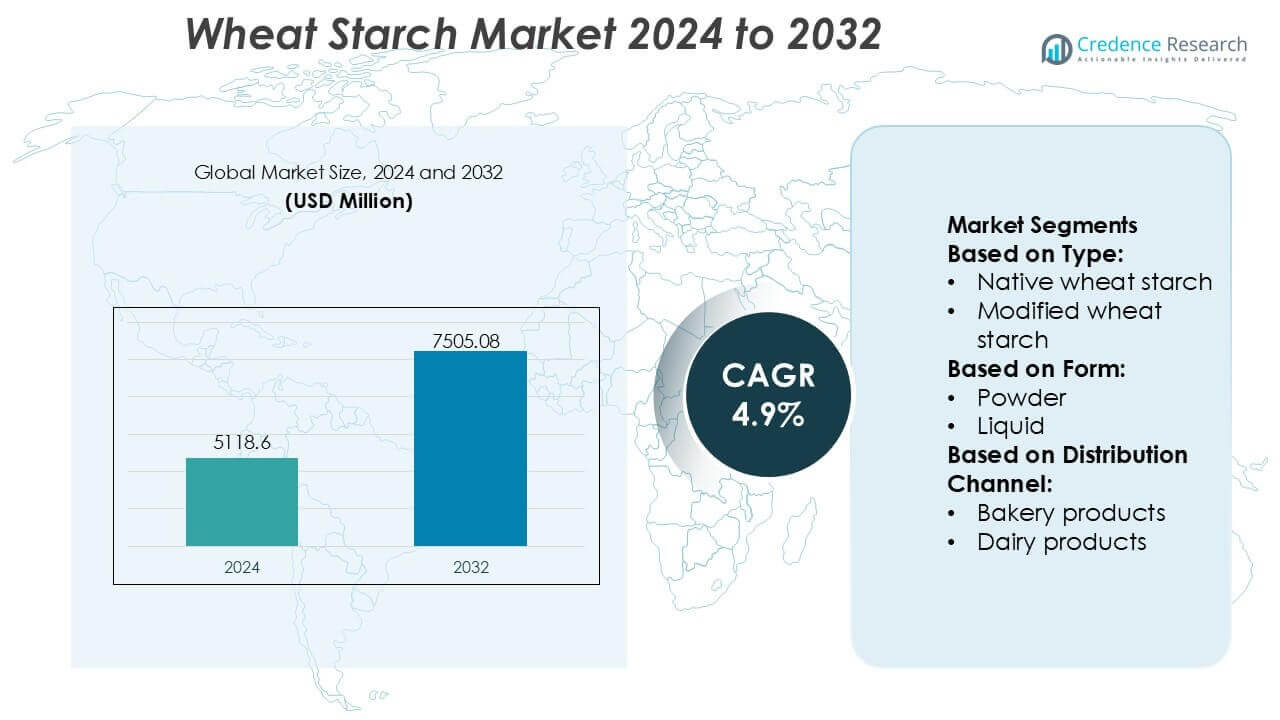
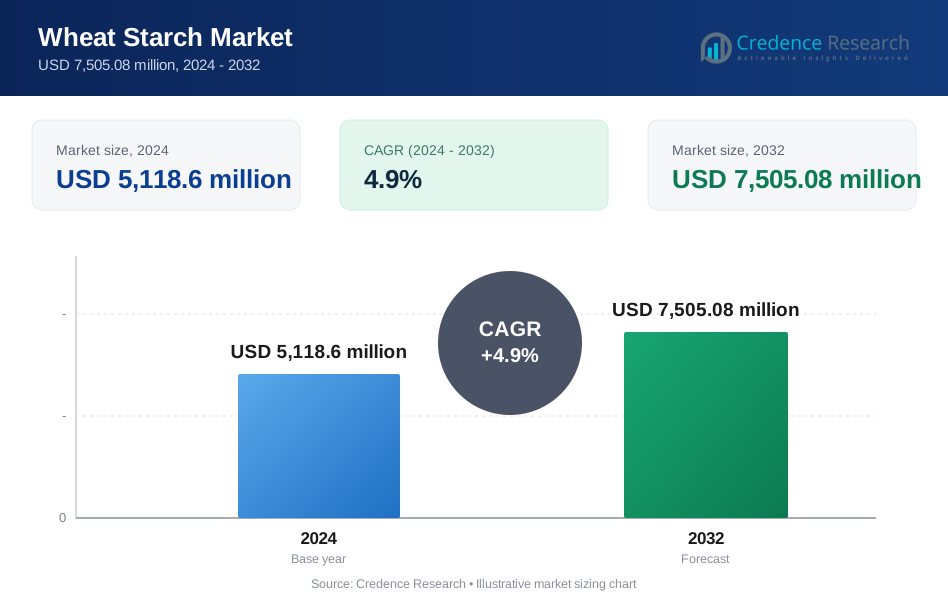
The global wheat starch market was valued at USD 5,118.6 million in 2024 and is projected to reach USD 7,505.08 million by 2032, expanding at a compound annual growth rate (CAGR) of 4.9% during the forecast period, according to Credence Research. This growth reflects sustained demand across food, beverage, pharmaceutical, paper, packaging, textile, adhesive and industrial applications where wheat starch is used for thickening, binding, stabilizing, texturizing and surface-strengthening functions.
The global wheat starch market is characterized by the presence of large, vertically integrated ingredient manufacturers and specialized starch processors competing on milling efficiency, product consistency, application support, raw material access and supply reliability. Leading players focus on native and modified wheat starch solutions supported by advanced wet-milling technologies, drying systems and quality control processes. Strategic priorities across the sector include clean-label product development, functional customization for bakery and processed food applications, non-GMO positioning, process automation and long-term procurement strategies to manage wheat price volatility.
| Market Metric | Dimension |
| 2024 Base Year Valuation | USD 5,118.6 Million |
| 2032 Projected Market Size | USD 7,505.08 Million |
| Compound Annual Growth Rate (CAGR) | 4.9% (2024–2032) |
| Dominant Product Segment | Native Wheat Starch (57% Global Market Share) |
| Leading Form Segment | Powder (68% Global Market Share) |
| Leading End-Use Channel | Food & Beverages (61% Global Market Share) |
| Top Performing Regional Market | North America (34% Global Market Share) |
Strategic Market Insights
- Market growth is primarily driven by the rising use of wheat starch in bakery, processed foods, dairy products, paper manufacturing, pharmaceuticals and industrial applications, where its binding, thickening, stabilizing and texturizing properties support cost-efficient, large-scale formulation.
- Dominant industry trends highlight growing demand for clean-label, plant-based and minimally processed ingredients, with native wheat starch holding the leading position due to its natural origin, broad regulatory acceptance and strong suitability for food and beverage applications.
- The competitive landscape is defined by vertically integrated manufacturers and regional starch specialists focusing on wet-milling efficiency, consistent product quality, application-specific starch solutions and raw material procurement stability.
- According to Credence Research regional mapping, North America represents the largest market, accounting for a definitive 34% global share due to its advanced food processing base, strong bakery and convenience food consumption, mature packaging industry and consistent demand from pharmaceutical and industrial applications.
Wheat Starch Market Segmentation Analysis
By Type
Data compiled by Credence Research confirms that native wheat starch constitutes the dominant product type, holding an estimated 57% market share. Its leadership is supported by widespread demand for clean-label ingredients and minimally processed food additives. Native wheat starch offers reliable thickening, binding, gelling and texturizing performance across bakery, dairy, confectionery, soups, sauces and processed food formulations. Food manufacturers increasingly prefer native starch because it supports simple ingredient declarations while maintaining cost efficiency and functional consistency. Its strong acceptance among regulators and consumers reinforces its position across mainstream food and beverage manufacturing.
Modified wheat starch follows as a key secondary segment, supported by demand for enhanced heat resistance, shear stability, viscosity control, freeze-thaw tolerance and pH performance. These attributes make modified starch suitable for processed foods, dairy desserts, bakery fillings, frozen meals and industrial applications exposed to more demanding processing conditions. However, rising consumer preference for recognizable ingredients continues to favor native wheat starch in many high-volume food categories.
Cargill has advanced starch processing capabilities through automated wet-milling and drying systems that produce food-grade wheat starch with tightly controlled moisture specifications below 14 g per 100 g, while in-process laser diffraction analysis is used to monitor particle size distribution at micron-level resolution.
By Form
Credence Research identifies powdered wheat starch as the leading form segment, accounting for approximately 68% of global market share. Powdered wheat starch dominates due to its long shelf life, ease of storage, lower transportation complexity and compatibility with dry blending operations. The form enables precise dosing, uniform dispersion and predictable functionality in bakery mixes, dairy preparations, processed foods, confectionery products and industrial formulations. Large-scale manufacturers favor powdered starch because it integrates efficiently into automated production systems and supports consistent product output across high-volume operations.
Liquid wheat starch holds a smaller share, serving specialized applications where rapid dispersion, reduced processing steps or immediate incorporation into wet formulations is required. Its adoption remains limited by higher transport costs, shorter shelf stability and greater handling requirements. These constraints reinforce powdered wheat starch as the preferred commercial form for global food, pharmaceutical and industrial buyers.
Emsland-Stärke GmbH demonstrates advanced starch processing expertise through its Emlichheim facility, which processes up to 918,000 tonnes of potatoes annually into starch products, including native and cold-water-swelling variants tailored for functional food systems such as instant noodles and clear coatings.
By Distribution Channel
In terms of end-use channel mapping, food & beverages lead global wheat starch consumption with a confirmed 61% market share. The segment is driven by broad use in bakery products, dairy products, sauces, soups, confectionery, ready meals, frozen foods and convenience products. Wheat starch improves viscosity, mouthfeel, moisture retention, crumb structure, shelf stability and product consistency. Bakery products represent a major demand base because wheat starch supports texture improvement, structure development and controlled moisture migration. Dairy products also use wheat starch to improve viscosity and stability in yogurts, desserts, sauces and fillings.
Processed food manufacturers rely on wheat starch for cost-effective functional performance in high-volume production environments. Its compatibility with automated processing systems, stable availability and versatile functional profile support continuous adoption across food and beverage categories. Beyond food, wheat starch is used in pharmaceuticals as a binder, filler and disintegrant, while paper, corrugated packaging, textiles and adhesives industries use it for surface strengthening, bonding and coating applications.
Key Market Dynamics
Primary Market Drivers
- Rising Demand for Clean-Label and Plant-Based Ingredients
The growing preference for clean-label, plant-based and minimally processed ingredients represents a core commercial driver for the wheat starch market. Wheat starch is widely recognized as a natural thickener, binder and texture enhancer that aligns with consumer demand for simple and familiar ingredient lists. Food and beverage companies increasingly use wheat-derived starch to replace synthetic or chemically modified additives in bakery products, dairy formulations, sauces and convenience foods. This shift supports transparent labeling while maintaining texture, stability and production efficiency. Credence Research identifies clean-label reformulation as one of the strongest long-term growth catalysts for native wheat starch adoption across developed and emerging food markets.
Lodaat’s Potato-Daat resistant starch product contains 78 g of resistant starch per 100 g of ingredient, providing a high level of fermentable fiber that has been studied for its ability to enhance butyrate production in the gut.
- Expanding Use in Processed and Convenience Foods
Rapid growth in processed and convenience food consumption continues to strengthen wheat starch demand. Wheat starch improves viscosity, moisture retention, freeze-thaw stability, texture and shelf life in sauces, ready meals, soups, bakery products and frozen foods. Urbanization, busier lifestyles and rising demand for time-saving food formats are accelerating industrial use of wheat starch across global food manufacturing. Producers prefer wheat starch because it offers functional versatility, broad formulation compatibility and cost efficiency. Its ability to support consistent performance in automated processing environments makes it a core ingredient for high-volume packaged food producers.
Ingredion expanded its portfolio with the launch of NOVATION Indulge 2940, a functional native corn starch designed to provide gelling and mouthfeel enhancement in dairy and plant-based dairy alternatives.
- Increasing Adoption in Non-Food Industrial Applications
Beyond food processing, wheat starch is gaining stronger traction in paper, corrugated packaging, textiles, adhesives, pharmaceuticals and cosmetics. In paper and packaging, wheat starch improves surface strength, printability, bonding performance and coating quality. The shift toward biodegradable, renewable and petroleum-free raw materials is strengthening its role in industrial applications. Pharmaceutical manufacturers use wheat starch as a binder, filler and absorbent excipient, while cosmetics companies use it for texture modification and oil absorption. This diversification reduces dependence on food applications and broadens the market’s revenue base. Credence Research indicates that industrial adoption will remain a stable growth contributor as manufacturers seek bio-based materials that support sustainability and cost-control objectives.
Key Trends & Structural Opportunities
- Growth of Modified Wheat Starch for Functional Performance
A major trend shaping the market is the increasing demand for modified wheat starch grades designed for advanced functional performance. Modified variants provide improved heat resistance, shear tolerance, pH stability, viscosity control and freeze-thaw performance, making them suitable for complex processed food systems. These characteristics are important in bakery fillings, dairy desserts, sauces, frozen meals and convenience products exposed to demanding processing conditions. This trend creates strong opportunities for ingredient suppliers to develop customized starch solutions for specific formulation needs. The CLARIA Functional Clean-Label Starch range includes products engineered for controlled thickening performance across a wide range of temperatures and shear conditions, while planned CLARIA G variants use a production process designed to reduce carbon footprint by 34% and water usage by 35% compared with the legacy line.
- Rising Demand from Sustainable Packaging and Paper Industries
The growing focus on sustainable packaging presents a significant structural opportunity for wheat starch producers. Wheat starch is widely used as a bio-based adhesive, binder and coating material in paperboard, corrugated boxes and molded fiber packaging. Brands and converters are shifting away from synthetic polymers toward compostable, recyclable and bio-based materials. Regulatory pressure to reduce plastic usage and improve recyclability further strengthens demand for starch-based packaging solutions. Wheat starch supports strong bonding performance while improving the renewable content of packaging systems. Credence Research identifies paper and packaging as a stable industrial outlet that will continue to support volume growth, especially as foodservice, e-commerce and consumer goods companies expand sustainable packaging adoption.
- Product Innovation for Gluten-Controlled and Specialty Applications
Although wheat starch is derived from wheat, improved separation and purification technologies are enabling the development of low-protein and gluten-controlled variants for specialized applications. This trend creates opportunities in nutraceuticals, infant nutrition, pharmaceutical formulations and specialty food products where purity, consistency and technical performance are critical. Manufacturers are investing in advanced processing methods to reduce protein residues and improve functional reliability. Specialty wheat starch grades can support controlled viscosity, clean sensory profiles and strong formulation stability. These innovations help producers expand beyond traditional bakery and industrial markets into higher-value applications. Roquette expanded its CLEARAM TR hydroxypropylated botanical tapioca starch portfolio with four grades designed for tailored texturizing performance in sauces, dairy desserts and bakery fillings, reflecting broader industry momentum toward application-specific starch innovation.
Industry Challenges
- Volatility in Wheat Raw Material Prices
Wheat price volatility remains a major challenge for the wheat starch market. Wheat supply is highly sensitive to weather patterns, crop yields, geopolitical disruptions, energy costs, fertilizer prices and agricultural trade policies. These factors create uncertainty in raw material costs and directly affect production margins for starch manufacturers. Large integrated companies can manage procurement risk through long-term contracts and diversified sourcing, but small and mid-sized producers face greater exposure to price swings. Sustained volatility may pressure profitability and limit pricing flexibility in competitive downstream markets.
- Competition from Alternative Starch Sources
Wheat starch faces strong competition from corn, potato, cassava, tapioca and rice starch. These alternatives often provide similar thickening, binding or stabilizing properties and may offer cost advantages depending on regional availability. In gluten-free product categories, non-wheat starches hold a stronger position because they align better with consumer requirements for allergen-sensitive and gluten-free formulations. This competitive pressure requires wheat starch suppliers to emphasize performance, clean-label suitability, supply reliability and sustainability advantages. Continued innovation in specialty grades and functional blends will be critical for maintaining competitiveness.
Detailed Regional Analysis
| Region | Market Share (%) | Strategic Regional Catalysts & Insights |
| North America | 34.0% | Global leader. Driven by advanced food processing infrastructure, strong bakery and convenience food demand, consistent wheat availability and broad use in paper, packaging and pharmaceutical applications. |
| Europe | 29.0% | Mature regional market. Supported by established wheat cultivation, strong starch processing capabilities, strict food quality regulations and growing demand for clean-label and bio-based ingredients. |
| Asia-Pacific | 26.0% | Fastest-growing regional segment. Powered by rapid urbanization, expanding food processing capacity, rising disposable incomes and increasing consumption of noodles, bakery products, sauces and packaged foods. |
| Latin America | 6.0% | Emerging growth market. Anchored by processed food expansion in Brazil, Mexico and Argentina, with steady demand from bakery, sauces, confectionery and adhesive applications. |
| Middle East & Africa | 5.0% | Developing regional market. Driven by food processing growth in Gulf countries and North Africa, rising bakery demand and gradual adoption in pharmaceuticals and paper applications. |
North America commands the largest share of the global wheat starch market at 34%, according to Credence Research. The region benefits from advanced food manufacturing infrastructure, strong consumption of processed and convenience foods and consistent wheat availability across the U.S. and Canada. Wheat starch is widely used in soups, sauces, bakery mixes, ready-to-eat meals and dairy products, where it supports texture, viscosity and shelf-life performance. Industrial demand from paper, corrugated packaging and pharmaceutical excipient applications further reinforces regional market leadership. The presence of large ingredient suppliers and well-developed supply chains supports stable product availability and continued innovation.
Europe accounts for 29% of the global wheat starch market. The region benefits from a well-established wheat cultivation base, mature starch-processing industry and strong regulatory emphasis on traceability, food safety and clean-label ingredients. Germany, France, the Netherlands and other major European food manufacturing hubs drive demand through bakery, confectionery, dairy and processed food applications. Europe also shows strong use of wheat starch in biodegradable packaging, paper sizing and adhesives. Sustainability policies and demand for renewable industrial inputs continue to support long-term regional adoption.
Asia-Pacific represents 26% of the global market and is the fastest-growing regional segment. Growth is driven by rapid urbanization, rising disposable incomes and increasing consumption of processed, packaged and convenience foods in China, India and Southeast Asia. Wheat starch demand is rising in noodles, bakery items, sauces, frozen foods and snacks. Industrial applications in textiles and paper manufacturing also contribute to regional expansion. Improving food processing capacity, broader retail penetration and growing pharmaceutical production are expected to strengthen long-term demand for wheat-based starch ingredients.
Latin America holds 6% market share, supported by gradual expansion of processed food and bakery sectors in Brazil, Mexico and Argentina. Wheat starch is increasingly used in sauces, confectionery, meat processing and bakery products to enhance texture, stability and shelf life. Industrial applications in paper production and adhesives provide an additional demand base. However, regional growth is moderated by wheat import dependence in some countries and strong price sensitivity among manufacturers. Ongoing investments in local food processing infrastructure are expected to support steady market development.
The Middle East & Africa region accounts for 5% of global wheat starch demand. Growth is supported by expanding bakery, sauce, ready-to-cook food and processed food consumption in Gulf countries and parts of North Africa. Rising population, urbanization and food security investments are encouraging the use of standardized ingredients in industrial food production. The region remains heavily dependent on wheat imports, which limits large-scale starch manufacturing expansion. However, gradual growth in pharmaceuticals, paper applications and food processing facilities is expected to support stable long-term demand.
Competitive Landscape & Recent Developments
The wheat starch market is moderately competitive, with a balanced mix of large-scale processors, global ingredient companies and specialized regional starch suppliers. Major players include PURIS, Roquette Frères, MSP Starch Products, Cargill Inc., Emsland Group, Lodaat Pharmaceuticals, Ingredion, The Scoular Co., Tate & Lyle and ADM. These companies compete on functional performance, purity, supply reliability, process efficiency, application expertise and sustainability credentials.
The market is shaped by growing demand for clean-label and non-GMO solutions, particularly across food and beverage applications. Manufacturers differentiate through advanced starch modification capabilities, wet-milling efficiency, application-specific formulations and strong integration across wheat sourcing and processing. High-purity grades for pharmaceutical and industrial applications also support competitive positioning. Cost optimization remains critical because wheat starch producers operate in a price-sensitive environment affected by raw material volatility. Ongoing investments in automation, capacity expansion, energy-efficient production and by-product utilization continue to influence global and regional competition.
Recent Industry Developments (2023–2024)
- In July 2024, KMC launched Gelamyl 625, a potato starch-based gelling agent designed for soft, chewy and non-sticky plant-based gummies. The product supports low-temperature stability at 25 degrees Celsius and helps reduce reliance on gelatin in plant-based confectionery.
- In November 2023, Amber Wave launched production at its wheat protein facility, which is positioned to become one of the largest in North America. The facility supports broader innovation across wheat-based ingredient processing and food industry applications.
- In September 2023, ADM continued offering clean-label wheat starches, including Whetstar, for thickening and stabilization in baked goods, sauces and confectionery applications.
Request a Free Sample
Fill in your details and we'll send you a free sample report.
- Sample data tables & charts
- Research methodology
Need a Custom Version of This Report?
Tailor the scope, geography, or segments to your exact requirements.
- Custom geography or segment scope
- Direct access to our analyst team
Frequently Asked Questions
What is the current and projected size of the global wheat starch market?
What is the projected growth rate of the wheat starch industry over the forecast period?
Which product type holds the maximum market share within the wheat starch industry?
Which form segment dominates the global wheat starch market?
Which end-use channel leads global wheat starch consumption?
Which region commands the highest market share in the global wheat starch space?
Table of Content
Chapter 1. Report Introduction
- 1.1 Report Description & Purpose
- 1.1.1 Report Title & Market Definition
- 1.1.2 Unique Selling Propositions (USP) & Key Differentiators
- 1.1.3 Value Proposition for Stakeholders
- 1.2 Research Objectives
- 1.2.1 Market Sizing Objectives (Volume & Revenue)
- 1.2.2 Segmentation Objectives
- 1.2.3 Competitive Intelligence Objectives
- 1.2.4 Forecast & Scenario Objectives
- 1.3 Report Scope
- 1.3.1 Wheat Starch Scope – Types & Subtypes Covered
- 1.3.2 Geographic Scope – Regions & Countries Covered
- 1.3.3 Historical Period, Base Year & Forecast Period (2024; forecast to 2032)
- 1.3.4 Inclusions & Exclusions
- 1.4 HS Code & Classification Framework
- 1.5 Currency, Units & Pricing Basis
- 1.6 Target Stakeholders
- 1.7 Limitations & Assumptions
Chapter 2. Executive Summary
- 2.1 Global Wheat Starch Market Snapshot
- 2.1.1 Market Size – Historical (2024) & Forecast (2024-2032) (2024: USD 5,118.6 million → 2032: USD 7,505.08 million)
- 2.1.2 Volume & Revenue – Global Totals
- 2.1.3 Key Market Highlights – Top Five Facts
- 2.2 Wheat Starch Market Segmentation Snapshot
- 2.2.1 Market Split by Region – 2024 vs. 2032
- 2.3 Competitive Snapshot
- 2.3.1 Top 10 Players by Revenue Share – 2024
- 2.3.2 Top 10 Players by Volume Share – 2024
- 2.3.3 Recent Strategic Developments (18-Month Summary)
- 2.4 Key Investment Highlights & Strategic Conclusions
Chapter 3. Wheat Starch Market Dynamics & Industry Analysis
- 3.1 Market Overview & Context
- 3.1.1 Wheat Starch Market Position in the Broader Automotive Value Chain
- 3.1.2 OEM vs. Replacement Market Dynamics
- 3.1.3 Market Maturity & Development Stage by Region
- 3.2 Wheat Starch Market Drivers
- 3.3 Wheat Starch Market Restraints & Challenges
- 3.4 Wheat Starch Market Opportunities
- 3.5 Porter's Five Forces Analysis
- 3.5.1 Threat of New Entrants
- 3.5.2 Bargaining Power of Suppliers
- 3.5.3 Bargaining Power of Buyers
- 3.5.4 Threat of Substitutes
- 3.5.5 Competitive Rivalry – Intensity Assessment
- 3.6 Wheat Starch Value Chain Analysis
- 3.6.1 Upstream – Raw Material/Input Suppliers
- 3.6.1.1 Raw Material/Input 1
- 3.6.1.2 Raw Material/Input 2
- 3.6.1.3 Raw Material/Input 3
- 3.6.2 Midstream – Production/Manufacturing/Service Delivery
- 3.6.2.1 Production/Process Overview
- 3.6.2.2 Key Facility Locations & Capacity by Manufacturer
- 3.6.3 Downstream – Distribution & End Consumer
- 3.6.3.1 Primary Channel – B2B/OEM
- 3.6.3.2 Secondary Channels – Dealer, Retail, Online, Direct
- 3.6.4 Value Chain Profitability Analysis
- 3.6.1 Upstream – Raw Material/Input Suppliers
- 3.7 PESTEL Analysis
- 3.7.1 Political Factors
- 3.7.2 Economic Factors
- 3.7.3 Social Factors
- 3.7.4 Technological Factors
- 3.7.5 Environmental Factors
- 3.7.6 Legal Factors
- 3.8 Wheat Starch Supply Chain Analysis
- 3.8.1 Raw Material/Input Supply Risk Assessment
- 3.8.2 Manufacturing Concentration Risk (Geographic Exposure)
- 3.8.3 Trade Disruption Impact Analysis
- 3.9 Regulatory & Policy Landscape
Note: The regulatory and policy landscape section covers regulations based on their applicability to the market, Wheat Starch category, geography, and scope of the study. Only regulatory frameworks with a material impact on operations, compliance, trade, sustainability, or market access are analyzed in detail.
Chapter 4. Key Investment Pockets & Opportunity Analysis
- 4.1 Wheat Starch Market Attractiveness Analysis
- 4.1.1 By Region – Investment Attractiveness Matrix (Volume × CAGR)
- 4.2 Absolute Revenue Growth Opportunity
- 4.2.1 By Region – Absolute USD Growth Through 2032
- 4.3 Incremental Volume Opportunity
- 4.3.1 By Region – Incremental Volume Through 2032
- 4.3.2 Segment – Incremental Volume
- 4.4 Emerging Submarket Opportunity Deep Dive (Subject to Applicability)
- 4.5 Emerging Market Opportunity Scorecards
- 4.5.1 United States
- 4.5.2 Europe
- 4.5.3 Asia
- 4.5.4 Middle East & Africa
Note: Emerging Market Opportunity Scorecards will be included based on relevance and strategic importance. Regions listed are indicative and may vary depending on data availability and market dynamics.
Chapter 5. Wheat Starch Import-Export Analysis & Trade Flows
- 5.1 Global Trade Overview
- 5.1.1 Global Export Value by Country (2024)
- 5.1.2 Global Export Volume by Country (2024)
- 5.1.3 Global Import Value by Country (2024)
- 5.1.4 Global Import Volume by Country (2024)
- 5.1.5 Net Trade Balance by Country (2024)
- 5.2 Export Analysis – Segment
- 5.2.1 Type 1 (HS Code)
- 5.2.2 Type 2 (HS Code)
- 5.2.3 Type 3 (HS Code)
- 5.2.4 Type 4 (HS Code)
- 5.2.5 Type 5 (HS Code)
- 5.3 Import Analysis – Segment
- 5.3.1 Type 1 (HS Code)
- 5.3.2 Type 2 (HS Code)
- 5.3.3 Type 3 (HS Code)
- 5.3.4 Type 4 (HS Code)
- 5.3.5 Type 5 (HS Code)
- 5.4 Average Unit Trade Prices
- 5.4.1 Average Export Price – Segment & Country
- 5.4.2 Average Import Price – Segment & Source Country
- 5.4.3 Price Trends (2024)
- 5.5 Key Trade Route Analysis
- 5.5.1 Trade Route 1
- 5.5.2 Trade Route 2
- 5.5.3 Trade Route 3
- 5.5.4 Trade Route 4
- 5.5.5 Trade Route 5
- 5.6 Trade Policy Impact Assessment
- 5.6.1 US Anti-Dumping & Section 301 Tariffs
- 5.6.2 EU Customs Union Impact
- 5.6.3 Major Free Trade Agreements
- 5.6.4 USMCA Rules of Origin
Note: Trade policy analysis will be included only where relevant to the Wheat Starch market.
Chapter 6. Competitive Landscape & Company Benchmarking
- 6.1 Wheat Starch Market Concentration & Structure
- 6.1.1 Herfindahl-Hirschman Index (HHI) – vs. 2024
- 6.1.2 Tier 1, Tier 2 & Tier 3 Market Structure
- 6.1.3 Global, Regional & Local Player Dynamics
- 6.2 Wheat Starch Market Share Analysis – 2024
- 6.2.1 Global Revenue Share by Company
- 6.2.2 Global Volume Share by Company
- 6.2.3 Regional Revenue Share
- 6.2.4 Market Share Evolution ( vs. 2024)
- 6.2.5 OEM Segment Share by Company
- 6.2.6 Replacement Segment Share by Company
- 6.3 Production/Delivery Capacity & Facility Analysis
- 6.3.1 Global Installed Capacity
- 6.3.2 Capacity Utilization Rates
- 6.3.3 Production/Output Volume
- 6.3.4 Facility Locations & Capacity Map
- 6.3.5 Planned Capacity Additions
- 6.4 Wheat Starch Competitive Benchmarking Matrix
- 6.4.1 Revenue, Volume, CAGR & Profitability Comparison
- 6.4.2 Channel Revenue Mix
- 6.4.3 Geographic Revenue Exposure
- 6.4.4 R&D Intensity
- 6.4.5 Sustainability Maturity
- 6.5 Strategic Developments in Wheat Starch (Last 24 Months)
- 6.5.1 Mergers, Acquisitions & Divestments
- 6.5.2 New Wheat Starch Launches
- 6.5.3 Facility Expansions
- 6.5.4 Strategic Alliances, Joint Ventures & Partnerships
- 6.5.5 Distribution Expansion & Market Entry
- 6.5.6 Sustainability & ESG Initiatives
- 6.6 Competitive Strategy Mapping
- 6.6.1 Leader, Challenger, Follower & Niche Classification
- 6.6.2 Pricing Strategy Comparison
- 6.6.3 Channel Strategy Matrix
Note: Strategic developments are included based on their materiality and the availability of reliable information.
Chapter 7. Global Wheat Starch Market – By Distribution Channel
- 7.1 Segment Overview
- 7.1.1 Volume & Revenue Split by Channel (2024 & 2032)
- 7.1.2 Channel Mix Evolution (2024-2032)
Chapter 8. Regional Market Analysis – Global Overview
- 8.1 Global Regional Overview
- 8.1.1 Regional Volume Share
- 8.1.2 Regional Revenue Share
- 8.1.3 Regional Volume by Region
- 8.1.4 Regional Revenue by Region
- 8.1.5 Regional Forecast Through 2032
- 8.2 Cross-Regional Segment Analysis
- 8.2.1 By Distribution Channel
- 8.2.2 By Brand/Price Tier
Chapter 9. North America Wheat Starch Market
- 9.1 United States
- 9.2 Canada
- 9.3 Mexico
Chapter 10. Europe Wheat Starch Market
- 10.1 Germany
- 10.2 France
- 10.3 Italy
- 10.4 United Kingdom
- 10.5 Spain
- 10.6 Poland
- 10.7 Russia
- 10.8 Netherlands
- 10.9 Belgium
- 10.10 Sweden
- 10.11 Denmark
- 10.12 Norway
- 10.13 Rest of Europe
Chapter 11. Asia Pacific Wheat Starch Market
- 11.1 China
- 11.2 India
- 11.3 Japan
- 11.4 South Korea
- 11.5 Thailand
- 11.6 Indonesia
- 11.7 Vietnam
- 11.8 Malaysia
- 11.9 Australia
- 11.10 Rest of Asia Pacific
Chapter 12. Latin America Wheat Starch Market
- 12.1 Brazil
- 12.2 Argentina
- 12.3 Colombia
- 12.4 Chile
- 12.5 Rest of Latin America
Chapter 13. Middle East Wheat Starch Market
- 13.1 Saudi Arabia
- 13.2 United Arab Emirates
- 13.3 Turkey
- 13.4 Israel
- 13.5 Iran
- 13.6 Rest of the Middle East
Chapter 14. Africa Wheat Starch Market
- 14.1 South Africa
- 14.2 Egypt
- 14.3 Nigeria
- 14.4 Morocco
- 14.5 Rest of Africa
Chapter 15. Wheat Starch Company Profiles
- 15.1 [Company 01]
- 15.1.1 Company Overview
- 15.1.2 Key Management Personnel
- 15.1.3 Products & Services Portfolio
- 15.1.4 Financial Performance
- 15.1.5 Key Market Focus & Geographic Presence
- 15.1.6 Recent Developments & Strategic Initiatives
Note: The company profile list is preliminary and may change based on research findings, market developments, data availability, and client requirements.
Chapter 16. Appendices
- Appendix A – List of Abbreviations & Acronyms
- Appendix B – Industry Classification Code Reference – Full Series
- Appendix C – Production & Capacity Data Tables
- Appendix D – End-Use & Demand Base Tables
- Appendix E – Consumption & Replacement Rate Assumptions
- Appendix F – ASP Reference Tables
- Appendix G – Manufacturing & Facility Database
- Appendix H – Import-Export Data Tables
- Appendix I – Regulatory Summary Tables
- Appendix J – Primary Research Participant List (Anonymized)
- Appendix K – Primary Research Questionnaire Framework
- Appendix L – Data Sources & Bibliography
- Appendix M – Market Size Divergence & Source Comparison
Chapter 17. Research Methodology
- 17.1 Research Framework & Philosophy
- 17.2 Secondary Research – Sources, Hierarchy & Data Extraction
- 17.3 Data Modeling – Bottom-Up & Top-Down Market Sizing
- 17.4 Primary Research – Stakeholder Framework, LOI & Sample Sizes
- 17.5 Forecast Methodology – Regression, Scenario & Sensitivity Analysis
- 17.6 Quality Control – Four-Layer Validation Framework
- 17.7 Limitations & Standard Assumptions
- 17.8 Disclaimer
