Mood Enhancing Supplement Market Overview:
Mood Enhancing Supplement Market size was valued USD 12,329 Million in 2024 and is anticipated to reach USD 21,824.69 Million by 2032, at a CAGR of 7.4% during the forecast period.
| REPORT ATTRIBUTE |
DETAILS |
| Historical Period |
2020-2023 |
| Base Year |
2024 |
| Forecast Period |
2025-2032 |
| Mood Enhancing Supplement Market Size 2024 |
USD 12,329 million |
| Mood Enhancing Supplement Market, CAGR |
7.4% |
| Mood Enhancing Supplement Market Size 2032 |
USD 21,824.69 million |
Mood Enhancing Supplement Market Insights
- Market overview highlights rising consumer focus on emotional wellness and lifestyle-driven supplementation, with Herbal & Botanical Supplements leading the product segment with 42.6% share in 2024, followed by Vitamins & Minerals and Amino Acids & Nootropics as supporting growth categories.
- Markets driver includes increasing adoption of natural adaptogens, clean-label formulations, and expanding online retail penetration, supported by growing awareness of stress management, mood balance, and cognitive wellness among urban and working populations.
- Markets trends and analysis indicate stronger innovation in plant-based mood formulations, science-backed ingredients, and premium wellness positioning, while intense brand differentiation and product quality assurance shape market behavior.
- Regional analysis shows North America holding 36.4 percent share in 2024, Europe accounting for 27.8 percent share, and Asia Pacific securing 22.6 percent share, with Latin America and Middle East & Africa representing emerging growth regions.
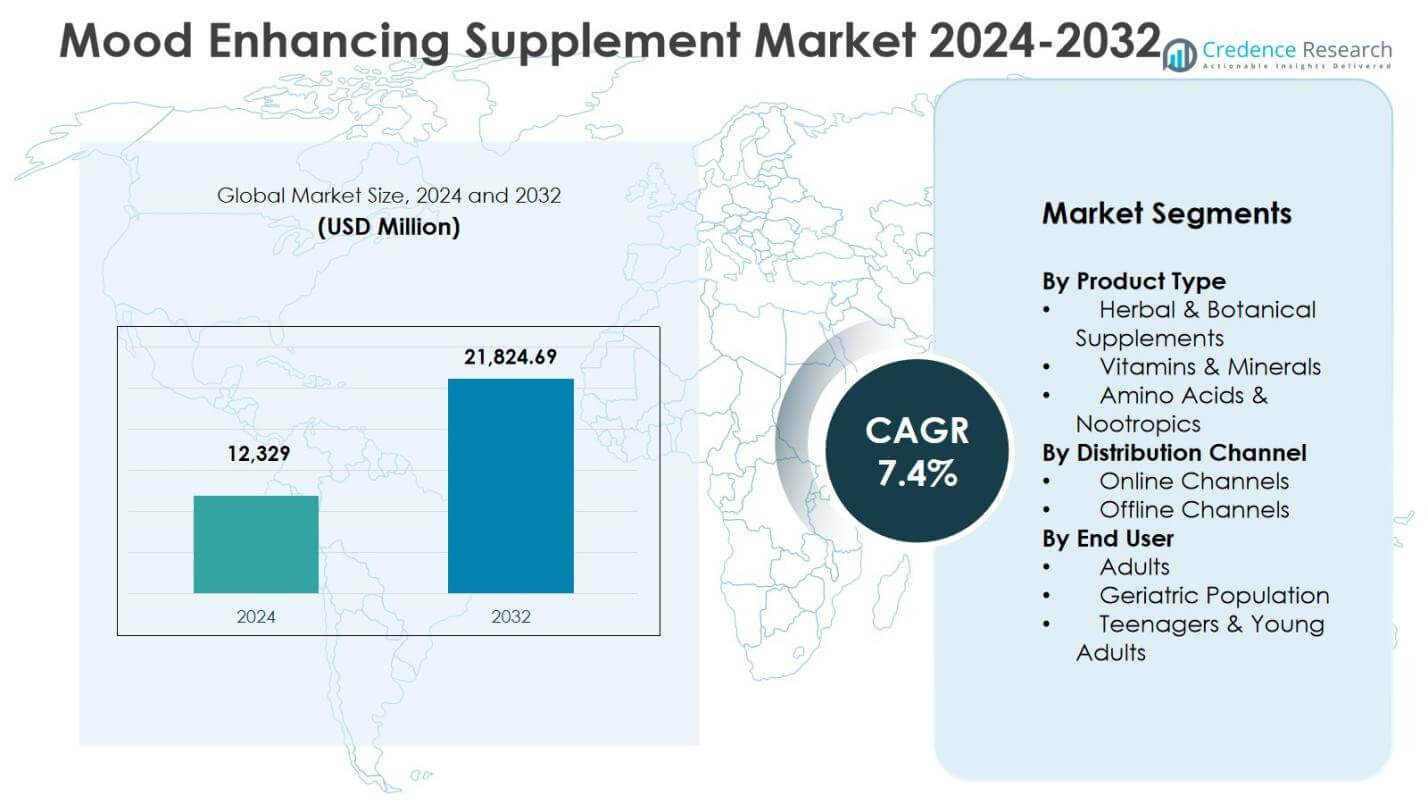
Mood Enhancing Supplement Market Segmentation Analysis:
By Product Type
The Mood Enhancing Supplement Market shows strong traction across product categories, with Herbal & Botanical Supplements emerging as the dominant sub-segment, accounting for 42.6% share in 2024. This leadership is driven by rising consumer preference for natural adaptogens such as Ashwagandha, Rhodiola, and Ginseng, supported by increasing awareness of stress-relief and mood-balancing benefits. Vitamins & Minerals hold 33.8% share, driven by the adoption of Vitamin B-Complex and Magnesium, while Amino Acids & Nootropics capture 23.6% share, supported by growing demand for L-Theanine, 5-HTP, and GABA for cognitive calm and emotional wellness.
- For instance, Metagenics offers a high-strength Vitamin B Complex with active B vitamins, inositol, choline, and PABA to aid energy, cognition, and fatigue reduction. Pure Nutrition provides Magnesium Glycinate tablets with Zinc, formulated specifically for stress relief support.
By Distribution Channel
In the Mood Enhancing Supplement Market, Online Channels represent the leading distribution mode with 55.3% share in 2024, supported by the rapid expansion of e-commerce platforms, brand-owned websites, subscription-based wellness programs, and strong consumer inclination toward convenient home-delivery purchases. Offline Channels account for 44.7% share, driven by the continued relevance of pharmacies, health-nutrition stores, and supermarkets that provide credibility, personalized product consultation, and impulse-driven buying behavior. Growth in online penetration is further accelerated by targeted digital marketing, influencer-led wellness awareness, and improved product accessibility across regions, strengthening direct-to-consumer reach and engagement.
- For instance, OLLY expanded its mood supplements like Goodbye Stress Gummies through e-commerce partnerships with Amazon and brand-owned sites, while also boosting shelf sales at Target and CVS via omnichannel strategies.
By End User
The Mood Enhancing Supplement Market is primarily driven by Adults, who constitute the dominant end-user group with 61.8% share in 2024, reflecting rising work-related stress, lifestyle fatigue, and growing mental-wellness awareness among working professionals and urban consumers. The Geriatric Population accounts for 22.5% share, supported by increasing focus on mood stability, cognitive support, and emotional balance in aging populations. Teenagers & Young Adults hold 15.7% share, driven by demand for mood-support products addressing academic pressure, digital-lifestyle stress, and wellness-oriented consumption patterns, particularly in emerging economies and urban demographics.
Access crucial information at unmatched prices!
Request your sample report today & start making informed decisions powered by Credence Research Inc.!
Download Sample
Key Growth Drivers
Rising Consumer Focus on Mental Wellness and Stress Management
The Mood Enhancing Supplement Market is expanding as consumers increasingly prioritize emotional well-being and stress relief as part of preventive health management. Growing incidences of work-related stress, sleep imbalance, and lifestyle fatigue are accelerating demand for supplements formulated with adaptogens, vitamins, and amino acids that support mood stability and relaxation. The growing integration of mental-wellness routines into daily self-care behaviors, along with rising awareness campaigns by healthcare organizations and wellness brands, further strengthens product adoption. In addition, the increasing acceptance of non-pharmaceutical mood support solutions is encouraging consumers to shift toward natural and holistic supplementation.
- For instance, Ixoreal Biomed’s KSM-66 ashwagandha (300 mg twice daily for 60 days) reduced serum cortisol levels by 27.9% in a study of stressed adults, enhancing relaxation and quality of life.
Expansion of Natural and Plant-Based Supplement Formulations
The market benefits from strong consumer inclination toward herbal, botanical, and clean-label ingredients perceived as safer and more sustainable than synthetic formulations. Demand for products containing Ashwagandha, Rhodiola, Ginseng, and other adaptogenic herbs continues to rise due to their clinically recognized stress-relief and mood-balancing properties. Manufacturers are investing in standardized extracts, transparent sourcing, and scientific validation to enhance efficacy perception and brand trust. The growing popularity of vegan and plant-based supplements, combined with regulatory encouragement for botanical nutraceutical innovation, is further accelerating premium product development and consumer willingness to pay for natural mood support offerings.
- For instance, Sabinsa Corporation offers standardized Rhodiola Rosea Powder with high rosavins and salidroside concentrations, backed by GMP certifications and research for adaptogenic benefits in supplements.
Increasing Online Retail Penetration and Direct-to-Consumer Accessibility
Rapid digitalization and e-commerce expansion are significantly supporting the growth of the Mood Enhancing Supplement Market. Online platforms enable broader product visibility, easier price comparison, subscription-based purchasing, and personalized recommendations that influence consumer buying behavior. Direct-to-consumer brands are leveraging influencer marketing, wellness communities, and evidence-based content to build credibility and awareness around mood health. The availability of global brands across marketplaces, along with faster delivery infrastructure and cross-border distribution, is widening access in both developed and emerging economies. This digital convenience continues to stimulate repeat purchases and strengthens long-term consumer engagement with mood support supplements.
Key Trends & Opportunities
Integration of Mood Support with Holistic Wellness and Functional Nutrition
A key market trend is the integration of mood-enhancing supplements into broader wellness ecosystems that also address sleep quality, cognitive balance, immune health, and energy regulation. Consumers increasingly prefer multifunctional formulations that combine adaptogens, vitamins, probiotics, and nootropics to support emotional resilience and overall mental performance. This convergence is creating opportunities for product innovation in functional beverages, nutritional gummies, fortified foods, and personalized nutrition platforms. Brands are also exploring science-backed blends and lifestyle-positioned offerings targeted at students, working professionals, and aging populations, enabling portfolio diversification and premium segment expansion within mood wellness categories.
- For instance, Stealthy Sereni Calm gummies combine ashwagandha root extract, Rhodiola Rosea, L-Theanine, Holy Basil, Vitamin B6, and magnesium for stress management, relaxation, and mood regulation in a vegan, sugar-free mango-flavored format.
Growing Role of Scientific Validation and Personalized Supplementation
The market is witnessing strong opportunities emerging from clinical research, ingredient standardization, and evidence-based product development that enhance consumer trust and regulatory acceptance. Companies are increasingly investing in clinical trials, bioavailability studies, and transparency labeling to communicate measurable mood-support benefits. At the same time, personalized supplementation powered by digital health tools, mood-tracking apps, and AI-based nutrition assessments is gaining traction, enabling tailored dosing and product recommendations. This shift toward data-driven personalization strengthens consumer loyalty, supports premium pricing models, and positions mood-enhancing supplements as credible, science-aligned wellness solutions within preventive healthcare consumption.
- For instance, OmniActive Health Technologies’ Zenroot ashwagandha extract, standardized to 1.5% withanolides, demonstrated over double the absorption rate of a 600 mg reference product in a randomized crossover study with 20 healthy volunteers, using a low 125 mg dose.
Key Challenges
Regulatory Complexity and Claims Compliance Across Global Markets
The Mood Enhancing Supplement Market faces challenges related to diverse regulatory frameworks, especially restrictions on mental-health-related claims and efficacy messaging across regions. Variations in ingredient approvals, labeling requirements, and safety documentation increase compliance costs and delay market entry for new formulations. Claims around mood improvement, anxiety relief, or emotional balance require strong clinical backing, limiting promotional flexibility for manufacturers. Additionally, stricter oversight of nutraceutical categories in several countries demands higher evidence standards and transparent safety profiling. These regulatory complexities create operational barriers, particularly for emerging brands and cross-border supplement distributors.
Product Safety Concerns and Intense Competitive Differentiation Pressure
Concerns related to product authenticity, ingredient quality, adulteration risks, and inconsistent formulation standards pose challenges to consumer confidence in mood-enhancing supplements. The highly fragmented competitive landscape, with numerous private-label and low-cost brands, intensifies pricing pressure and complicates differentiation. Limited consumer awareness regarding appropriate dosing or interactions with medications can also affect market perception and responsible usage. To remain competitive, companies must invest in quality assurance, third-party certifications, and credible scientific communication while simultaneously innovating in formulation design, delivery formats, and brand positioning to sustain trust and long-term market relevance.
Regional Analysis
North America
North America holds a leading position in the Mood Enhancing Supplement Market, accounting for 36.4% share in 2024, driven by high consumer awareness of mental wellness, strong adoption of dietary supplements, and widespread acceptance of herbal and nootropic formulations. The region benefits from well-established nutraceutical brands, advanced retail infrastructure, and growing demand for stress-relief and mood-balance products among working professionals and aging populations. Expanding e-commerce penetration, clinical research support, and premium product positioning further strengthen market growth, while rising interest in plant-based and clean-label formulations encourages continuous innovation across the United States and Canada.
Europe
Europe represents a significant market, contributing 27.8% share in 2024, supported by increasing emphasis on preventive health, emotional well-being, and lifestyle-driven supplementation trends. Consumer demand is rising for botanical mood enhancers, vitamin-based formulations, and stress-relief supplements influenced by growing public awareness of mental health management. Strong regulatory oversight encourages high-quality manufacturing standards and transparency in labeling, which strengthens consumer trust. Growth is further supported by expanding retail pharmacy networks, the popularity of nutraceuticals in countries such as Germany, France, and the United Kingdom, and increasing adoption of mood-support supplements among health-conscious and aging populations.
Asia Pacific
Asia Pacific is emerging as the fastest-growing regional market, holding 22.6% share in 2024, driven by rapid urbanization, rising mental-wellness awareness, and expanding disposable incomes across developing economies. Increasing stress levels linked to competitive work environments and academic pressure are contributing to higher consumption of herbal and adaptogenic mood-support products. Strong cultural alignment with traditional botanicals such as Ashwagandha and Ginseng strengthens product acceptance, while growing e-commerce accessibility expands regional penetration. Manufacturers are investing in localized formulations, marketing initiatives, and cross-border supplement trade, further accelerating market expansion across China, India, Japan, South Korea, and Southeast Asia.
Latin America
Latin America accounts for 7.4% share in 2024, supported by growing consumer interest in emotional wellness, lifestyle-driven supplementation, and rising acceptance of herbal and vitamin-based mood enhancers. Increasing awareness of stress-management solutions among urban populations and young professionals contributes to market development, while pharmacy-led retail channels remain important for product distribution. The region is witnessing gradual expansion of international nutraceutical brands alongside the emergence of regional wellness companies. Economic recovery trends, digital retail adoption, and rising health-conscious consumption patterns in countries such as Brazil, Mexico, and Argentina continue to strengthen growth opportunities in mood-support supplementation.
Middle East & Africa
The Middle East & Africa region holds 5.8% share in 2024, reflecting a developing but steadily expanding market for mood-enhancing supplements driven by increasing health-awareness initiatives, urban lifestyle transitions, and rising disposable income among middle-class consumers. Demand is strengthening for herbal, vitamin-based, and stress-relief supplements, particularly in Gulf Cooperation Council economies where premium wellness products are gaining traction. Growth is supported by the expansion of pharmacy chains, improving retail infrastructure, and growing digital-commerce access. However, varying regulatory structures and limited product awareness in certain markets present challenges, while ongoing investments in healthcare education continue to encourage gradual market adoption.
Mood Enhancing Supplement Market Segmentations:
By Product Type
- Herbal & Botanical Supplements
- Vitamins & Minerals
- Amino Acids & Nootropics
By Distribution Channel
- Online Channels
- Offline Channels
By End User
- Adults
- Geriatric Population
- Teenagers & Young Adults
By Geography
- North America
- Europe
- Germany
- France
- U.K.
- Italy
- Spain
- Rest of Europe
- Asia Pacific
- China
- Japan
- India
- South Korea
- South-east Asia
- Rest of Asia Pacific
- Latin America
- Brazil
- Argentina
- Rest of Latin America
- Middle East & Africa
- GCC Countries
- South Africa
- Rest of the Middle East and Africa
Competitive Landscape
Competitive landscape in the Mood Enhancing Supplement Market is shaped by key players such as Pharmavite (Nature Made), The Bountiful Company (Nature’s Bounty), NOW Foods, Garden of Life, Solgar, Thorne Research, GNC, Herbalife Nutrition, Life Extension, and Makers Nutrition. The market demonstrates a balanced mix of established nutraceutical brands and emerging wellness-focused companies that actively compete on formulation innovation, ingredient transparency, and clean-label positioning. Companies emphasize herbal adaptogens, vitamin-enriched blends, and nootropic combinations to address stress relief, mood balance, and emotional wellness across diverse consumer groups. Premiumization, science-backed claims, and product differentiation through delivery formats such as capsules, gummies, powders, and functional beverages are strengthening brand competitiveness. Manufacturers increasingly invest in clinical validation, digital marketing, and direct-to-consumer strategies to expand reach and customer loyalty. Strategic initiatives including partnerships with contract manufacturers, portfolio expansion, and entry into high-growth e-commerce channels continue to shape market dynamics, driving innovation intensity and reinforcing value-driven competition across global and regional markets.
Shape Your Report to Specific Countries or Regions & Enjoy 30% Off!
Key Player Analysis
- Pharmavite (Nature Made)
- The Bountiful Company (Nature’s Bounty)
- NOW Foods
- Garden of Life
- Solgar
- Thorne Research
- GNC
- Herbalife Nutrition
- Life Extension
- Makers Nutrition
Recent Developments
- In July 2025, O Positiv launched its URO Vaginal Moisture + Mood supplement designed to support emotional well-being, vaginal moisture, and sexual function with GABA and ashwagandha-based formulation.
- In 2025, Nutrition21 launched EverZen™, a differentiated ingredient for mood and stress support in supplement formulations.
Report Coverage
The research report offers an in-depth analysis based on Product Type, Distribution Channel, End User and Geography. It details leading market players, providing an overview of their business, product offerings, investments, revenue streams, and key applications. Additionally, the report includes insights into the competitive environment, SWOT analysis, current market trends, as well as the primary drivers and constraints. Furthermore, it discusses various factors that have driven market expansion in recent years. The report also explores market dynamics, regulatory scenarios, and technological advancements that are shaping the industry. It assesses the impact of external factors and global economic changes on market growth. Lastly, it provides strategic recommendations for new entrants and established companies to navigate the complexities of the market.
Future Outlook
- The market will expand as consumers increasingly incorporate mood-support supplements into daily wellness and self-care routines.
- Demand will rise for herbal, botanical, and plant-based formulations positioned as natural mood-balancing solutions.
- Companies will focus on science-backed ingredients and clinical validation to strengthen product credibility and consumer trust.
- Digital and direct-to-consumer channels will play a larger role in product discovery, engagement, and repeat purchases.
- Personalized nutrition and tailored mood-support solutions will gain traction through data-driven health platforms and apps.
- Product innovation will accelerate in multifunctional blends that combine mood support with cognitive, sleep, and stress-relief benefits.
- Premium product lines will expand as consumers show strong willingness to pay for high-quality, clean-label formulations.
- Emerging markets will contribute more strongly to growth as awareness of mental wellness and supplement adoption increases.
- Regulatory alignment and transparency initiatives will improve safety standards and labeling practices across regions.
- Partnerships between nutraceutical brands, wellness platforms, and research institutions will support innovation and market expansion.



